OAK RIDGE, Tenn.,—In a new twist to waste-to-fuel technology, scientists at the Department of Energy’s Oak Ridge National Laboratory have developed an electrochemical process that uses tiny spikes of carbon and copper to turn carbon dioxide, a greenhouse gas, into ethanol. Their finding, which involves nanofabrication and catalysis science, was serendipitous. Video follows.
“We discovered somewhat by accident that this material worked,” said ORNL’s Adam Rondinone, lead author of the team’s study published in ChemistrySelect. “We were trying to study the first step of a proposed reaction when we realized that the catalyst was doing the entire reaction on its own.”
The team used a catalyst made of carbon, copper and nitrogen and applied voltage to trigger a complicated chemical reaction that essentially reverses the combustion process. With the help of the nanotechnology-based catalyst which contains multiple reaction sites, the solution of carbon dioxide dissolved in water turned into ethanol with a yield of 63 percent. Typically, this type of electrochemical reaction results in a mix of several different products in small amounts.

“We’re taking carbon dioxide, a waste product of combustion, and we’re pushing that combustion reaction backwards with very high selectivity to a useful fuel,” Rondinone said. “Ethanol was a surprise — it’s extremely difficult to go straight from carbon dioxide to ethanol with a single catalyst.”
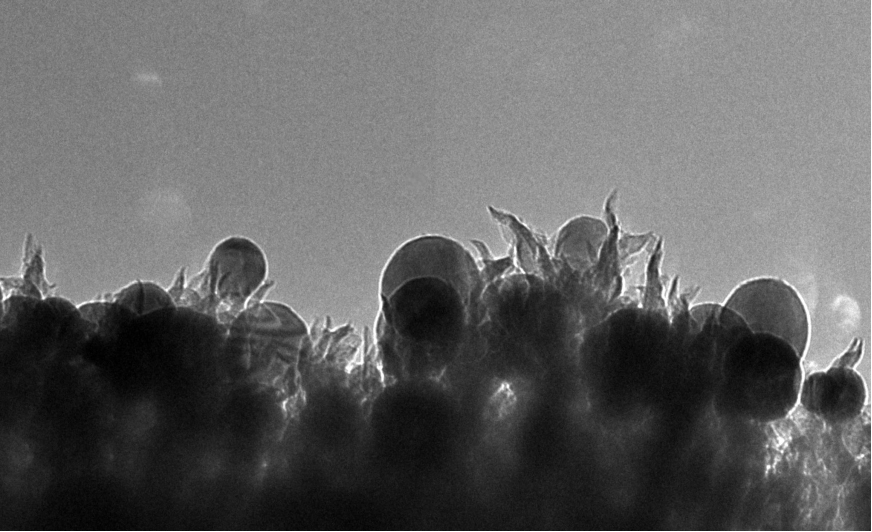
The catalyst’s novelty lies in its nanoscale structure, consisting of copper nanoparticles embedded in carbon spikes. This nano-texturing approach avoids the use of expensive or rare metals such as platinum that limit the economic viability of many catalysts.
“By using common materials, but arranging them with nanotechnology, we figured out how to limit the side reactions and end up with the one thing that we want,” Rondinone said.
The researchers’ initial analysis suggests that the spiky textured surface of the catalysts provides ample reactive sites to facilitate the carbon dioxide-to-ethanol conversion.
“They are like 50-nanometer lightning rods that concentrate electrochemical reactivity at the tip of the spike,” Rondinone said.
Given the technique’s reliance on low-cost materials and an ability to operate at room temperature in water, the researchers believe the approach could be scaled up for industrially relevant applications. For instance, the process could be used to store excess electricity generated from variable power sources such as wind and solar.
“A process like this would allow you to consume extra electricity when it’s available to make and store as ethanol,” Rondinone said. “This could help to balance a grid supplied by intermittent renewable sources.”
The researchers plan to refine their approach to improve the overall production rate and further study the catalyst’s properties and behavior.
ORNL’s Yang Song, Rui Peng, Dale Hensley, Peter Bonnesen, Liangbo Liang, Zili Wu, Harry Meyer III, Miaofang Chi, Cheng Ma, Bobby Sumpter and Adam Rondinone are coauthors on the study, which is published as “High-Selectivity Electrochemical Conversion of CO2 to Ethanol using a Copper Nanoparticle/N-Doped Graphene Electrode.”
The work was supported by DOE’s Office of Science and used resources at the ORNL’s Center for Nanophase Materials Sciences, which is a DOE Office of Science User Facility.
Where do they get the 26.8 megajoules per kilogram from?
HE, that value is the standard energy of combustion of pure ethanol. Many chemical refences give that value. Wiki has a comparison table.
No I meant, to make ethanol from CO2 it takes 28.6 MJ/kg.
Hess’s law.
Why not just let the Co2 green the planet and then use that as fuel? Seems like a self sustaining option to me.
Also he claims, with great confidence, that co2 is an issue. Not sure that has been confirmed. He has his religious straw dog, like they all do, and is sustaining/justifying his career using our money solving a non issue. My opinion of course.
Speaking of the Oak Ridge National Labs in Tennessee, they announced earlier this year that they have developed a process to extract uranium from seawater for nuclear power plants on a small scale:
https://www.ornl.gov/news/advances-extracting-uranium-seawater-announced-special-issue
Unfortunately, Scientific American reports that the process is costly and inefficient and only produces very small amounts of uranium. So it is a VERY long way from producing meaningful amounts of uranium for nuclear power plants:
https://www.scientificamerican.com/article/uranium-extraction-from-seawater-takes-a-major-step-forward/
At the rate that nuclear plants are shutting down these days, we may not be needing uranium anymore anyway….unless 4th generation nuclear plants start coming online someday. This announcement leaves me wondering if it might be possible to develop some similar process to extract thorium from seawater as well. Is there a lot of thorium in seawater? Article linked to above says oceans have 4 billion tons of uranium in them.
I thought that this was an interesting development, so I thought I’d post it here.
Hmmm, 4 billion tons in all the world’s oceans seems pretty dilute. Unless it tends to concentrate locally, best of luck to ’em.
^^^^^^^ What Brian said
If there is any sign this will lead to abundant low cost non polluting fuel for vehicles.
The left will invent a reason to oppose it.
The last thing the environmental left wants is more free people driving their cars at will.
That really pisses them off.
This purpose of developing this process is not to create a new preferred energy source, it is to get rid of CO2. I know, CO2 is good, but the DOE probably believes the doomsday predictions for a world with elevated CO2. If this process takes off its not because it is an economical way to create fuel, its because it is a cheap way to get rid of CO2.
Rather than eliminate gas burning cars because they add CO2, if they add a CO2 to ethanol converter to the system it will drastically reduce the CO2 emitted and increase the fuel efficiency because the ethanol byproduct can be simply fed back into the gas tank, a mixture of gas and ethanol is no problem for most cars.
If they can create such a CO2 converter that can be incorporated into the exhaust system of all carbon fuel burning systems and we can almost eliminate man’s CO2 production. Then Exxon will create a few hundred GIANT CO2-to-ethanol converters that get rid of CO2 that is already in the atmosphere to start lowering atmospheric CO2, remove global warming fear mongering and to get rid of the IPCC since they won’t have any purpose to exist if greenhouse gases aren’t increasing anymore.
Steve,
But when the ethanol is burned the CO 2 is back. It’s just an expensive circle!
Exactly right. Which is why the importance of this is that we can produce an UNLIMITED supply of hydrocarbon fuel–and use it–without altering the CO2 concentration of the atmosphere at all. This would be handy in a world that may have run out of petroleum or coal (not that I shake in my boots at any soon prospect of such dearth). Also, once you have ethanol, you have a feedstock from which you can make nearly any other hydrocarbon.
This is not a get-something-for-nothing scheme; it is simple, straightforward chemistry. You can get the CO2 from burning trash with pure oxygen (no worries about sorting it out from nitrogen). Pure oxygen is easy to distill from liquid air.
But where do we get the electricity for this synthesis? Atomic power, naturally. There’s plenty of it, from both uranium and thorium, especially if the fuel is reprocessed. And one can also burn boron-10, if you are hard up for fissionables (B-10 does not produce neutrons, however).
Mr Dunn- You’ll need reliable electricity to accomplish creation of alcohol from CO2. You will always end up needing more energy than you make.
Oops missed the nuclear part. That would be far superior to so called “renewables”. It certainly does open up avenues once oil and coal become rare and expensive.
I haven’t looked at the published work but I noted that the pictorial representation of the process shown above doesn’t conserve mass and charge — so I am left wondering what happens to the extra oxygen? I don’t know if this is what the author’s put out, but if they did it is sloppy.
Apparently the process is performed in water, why not include this and present proper equations to accurately portray the process?
So can this lead to experiments with beer bubbles – the beer/beer chaser cycle?
“Tekkin’ th’ dug fer a walk, Pet!”
I mean “Beer Chaser Cycle” BCC
Come on guys, we WANT the CO2 out there to green the world. It is the ultimate “green” chemical. So lets skip the conversion to alcohol, and save all those nanofibers from getting liver disease.
Too right! If plants and nanofibers want liver disease they can pay for their own ethanol!
I’ll have a Scotch please 🙂 hic*!
So somebody finally figured out how to convert CO2 into an adult beverage? At what maximum ABW concentration will the process still work?
On a serious note, I hate it when this kind of stuff gets reported with out some sort of energy calculation about the maximum possible efficiency of the process. When it ain’t there I assume it ain’t good.
VODKA!!!
Seems cheaper to just plant trees everywhere the supposedly rising temperature permits and counter the increases that way.
Yes, plant trees – restore the environment while improving the landscape and human amenity. Soaks up excess CO2. Prettier than turbines. The natural and widely beneficial solution.
What does this mean for the solar vs nuclear as prime factor renewables debate. Does this also demonstrate a path to resolving the manmade climate change conundrum?
Not wanting to give the CAGW nutters any help but could this be used in a CCGT plant for smoothing transitions when wind suddenly ramps up?
http://electrical-engineering-portal.com/wp-content/uploads/working-principle-of-ccgt-cycle-gas-turbine-plant.jpg
From a quick look there is a jet engine (top left) used for first alternator. The exhaust then goes through a Heat Recovery Steam Generator (basically a steam engine in the middle) used for the second alternator.
The output of that is a lot of hot CO2 rich air at high pressure and hot water at 140C that needs to be cooled.
If those flue gasses rich in CO2 were passed through several big tanks of water the CO2 would dissolve into it giving the feed for this copper carbon catalyst carpet. The CCGT plant has to shut down due to the priority of wind. The spare electricity is fed to the copper carbon catalyst carpet creating big tanks of water and ethanol. The next time the wind drops the CCGT fires up again and the water and ethanol mix is used as the cooling water drawing off the ethanol first like you do in a still. The ethanol can then be fed back to the first turbine to augment the natural gas to generate electricity.
I am not an engineer and don’t know the temperature that this copper carbon catalyst carpet works at or what plumbing might be needed for cooling but it is an idea how this combined cycle copper carbon catalyst carpet gas turbine (CCCCCCGT for short) might work.
As said above TANSTAAFL but this idea doesn’t seem to have any energy costs? A CCCCCCGT would be a place where you have lots of spare heat and electricity in this crazy world. Then again the CAGW nutters might dismiss the idea of CCCCCCGT for having too many ‘C’s in it 🙂
Of course if you didn’t feed the ethanol back to the gas turbine but pumped it back down into the fracking well you would have a carbon capture combined cycle copper carbon catalyst carpet gas turbine or CCCCCCCCGT for short 🙂
It would even be more carbon neutral 🙂 they couldn’t complain about having too many ‘C’s in it 🙂
EricHa,
“this idea doesn’t seem to have any energy costs?”
Presuming you’re using atmospheric CO2 as the fuel, concentrating it is expensive and it still takes electricity to convert CO2 to ethanol.
I think that the round trip conversion efficiency from electrolytically converting water to H2 and back to electricity in a fuel cell is still better. Perhaps the nanotechnology catalyst technology described in the article can be applied to improve both the efficiency of splitting water and of recombining H2 with O2 in a fuel cell. It takes about the same energy per mole to disassociate water as is produced by burning H2 as a fuel and both fuel cells and water hydrolysis cells can exceed 50% efficiency, for an end to end storage efficiency of > 25% with current technology and > 40% being a future possibility.
I’m not.
There is a jet engine on the front of a CCGT. The exhaust of that very rich in CO2 at high pressure ‘could’ be bubbled through shallow water at the top of a tank. Little energy loss there. It is going straight up the flue anyway. This adds CO2 to the water which is the feedstock to the copper carbon catalyst carpet, carbonic acid. It can sit there until there is too much electricity on the grid and that is used to convert it to ethanol. Think negative electricity price.
You now have ethanol and water which needs to be distilled. The next time the CCGT fires up you use the free spare heat to distil the ethanol off. You now have free ethanol to feed into the first turbine.
As I said, it could be used for smoothing.
I am sure that Stephenson and Trevithick would have chuckled at the idea of a three stage marine steam engine 🙂
It depends on how much wind and solar fluctuate. A lot from what I have seen. As they get priority onto the grid CCCCCCGT could be used to shed all the spare electrons into the carpet and create ethanol.
Nothing is for free, if you bubble the exhaust of the turbine engine into the water, you end up restricting the exhaust flow which makes the engine less efficient, or inoperable. You would have to fill a room and re-compress which takes energy, but at least the room would have a higher level of CO2
I understand that nothing is free but if you look at the diagram the output of the turbine is already restricted as it goes through the HRSG. You get an efficiency of 35% in the turbine and a further 15% in the HRSG ending up with 50% efficiency for the combined cycle. That is a balance.
If you are averse to bubbles then what about passing the exhaust through a large chamber with water raining from the top or even spraying water into the top of the flue. Rainwater goes from neutral to a ph of 5.6 quite readily without compression. In a flue stack with enriched CO2 it might go even lower.
You could even vent the exhaust inside the cooling towers where you already have water sprayed on the condenser. Corrosion might be a problem and you want as lower temp as possible in the cooling tower so hot flue gasses wouldn’t help that at all. But you are already pumping a lot of water around the system so a little bit up the top of the flue might not be a big cost if the returns are high enough.
“I am not an engineer…”
That’s clear…
“…this idea doesn’t seem to have any energy costs?”
…very clear.
Oooooo get you. No need to get shirty!
As an engineer can you think of any way to get CO2 to easily dissolve in water?
The whole idea is to produce a portable fuel. Electric cars will never have the range of an IC driven car, because they carry both the fuel and oxidizer needed to produce electricity. Ethanol is actually an excellent fuel (though not for engines designed to use gasoline – but there is no reason engines can’t be designed specifically for ethanol). Though lower in specific energy content than gasoline, it can actually achieve similar MPG because the higher octane rating of ethanol allows higher compression ratios.
The ideal way to use this would be in a nuclear-electric cycle. It would have the same overall efficiency as electric cars running from nuclear power plants, but without the huge cost of solar and wind, or the slow “fueling” rate of electric car charging.
We already have portable fuels. They are a lot cheaper to boot.
MarkW,
“Electric cars will never have the range of an IC driven car, because they carry both the fuel and oxidizer”
Not true for fuel cells which can use atmospheric O2 as the oxidizer for producing electricity. Ethanol is also a useful fuel as the input to a fuel cell; you could probably even make gasoline work in a fuel cell. Fuel cells are superior to batteries in many ways. They are currently much more expensive, but materials advances should make them more economical in the future.
Maybe they should just apply for a grant to achieve this effect with waste heat. Then we could all get a little bit interested.
and the only thing they can think of to use this is to promote the use of solar and wind….yeah, nah!
But what do you need to do to turn this stuff into single malt scotch? That is the more important question in my way of thinking.
You just need to bubble burning sheep dung through it.
This might make sense if feeding off excess nuclear power
Sounds excellent, exactly what is needed.
Unless they poured a flask of rice vodka in their test device…
8-))))
Hey Willis Eschenbach, another discovery that was ACCIDENTAL!!! You seemed to think there weren’t very many, yet, it keeps happening.
To “reverse the combustion process” one must inject at least as much energy as one got from the combustion.
How science has transformed, that is no longer the case. The laws of thermodynamics have been stood on its head by co2. I think it is a secret book that only climate scientists have and no one else is allowed to look at it because you wouldn’t understand it.
Robert,
Ideal reverse combustion is 100% energy reversible, however; you must get over the activation energy of the reverse combustion reaction which is generally much higher then the energy you get out of combustion. This is where catalysts come in which can reduce the effective activation energy of a reaction. In electrolytic reverse combustion, you also have I^2R heating to deal with as well as other inefficiencies.
The Department of Energy keeps funding this type of research to fool the public into thinking we are on the verge of a discovery that will turn CO2 into something useful. The details are never discussed in the press release. This is just a publicity stunt, nothing more, and nothing commercial will ever come of it.
It is akin to trying to set water on fire, not going to happen…
A vodka-on-demand machine, VodkaStream(TM), for the domestic market, appears to be, in my warped mind, the most obvious application for this technology. They seem to have a working prototype already.
CO2 to ETOH?
Party!!!!!