Guest essay by Rud Istvan
In recent weeks, there have been a number of WUWT guest posts on climate sensitivity related matters. Sensitivity is determined by feedbacks to increased CO2. The delta T to doubled CO2 in the absence of feedbacks is 1.1-1.2C. Monckton calculated 1.166C in his new (and unfinished) ‘Feet of Clay’ series of posts; Lindzen used 1.2 for simplicity (below). The slight difference is of no matter for this mostly conceptual post.
There have been a number of ‘skeptical’ comments and even guest response posts (FUBAR) that have gotten a lot of things ‘not quite right’ on this very important general subject including:
1. Feedback cannot be positive since conservation of energy (COE) would be violated.
2. Feedback cannot be positive since the climate would go unstable.
3. Bode feedback model does not apply to climate at all.
4. Positive feedback cannot be >0.1 as the Bode ‘amplifier’ goes unstable.
These misconceptions are underpinned by mis-definition of the greenhouse effect (GHE), by mis-definition of feedbacks, and by mis-application of the Bode feedback amplifier conceptualization to climate. Bode can ‘translate’ easily between actual climate feedbacks and a simplified conceptual climate system model, when correctly applied within realistic value ranges as Lindzen did in several of his previous papers.
The purpose of this guest post is simply to clarify the general subject matter so that WUWT denizens do not mindlessly repeat apparently erroneous misconceptions. It use only words and logic. No math for the math challenged, and only robust general data for the data challenged. Uses only some simple arithmetic plus some simple Socratic logic. It will therefore be a bit philosophical in nature, as only the big picture is intended. It uses only simple intuitive explanations. Quibbles concerning any of the above are hopefully irrelevant.
And it endeavors to use only previous WUWT guest posts or comments as references (just two footnotes, both relating to one sub-assertion concerning a perhaps little known factoid about observational/model precipitation). Google is your friend if you wish to verify any guest post assertion using only peer reviewed literature, as some warmunists unwisely demand. The Google-Fu clue words are in the text. Truth obviously does not lie only in peer-reviewed literature. Especially not politicized climate ‘truth’. ‘Truth’ is based on verifiable, repeatable scientific method results. And ‘truth’ cannot ever be proven (Gödel’s theorems); only the lack of ‘truth’ via falsification (Popper, Kuhn). As Einstein said, “A single experiment can prove me wrong”. See ebook The Arts of Truth for many confirming ‘Popperian’ examples including in the penultimate climate chapter. And for supporting details with many footnotes, see some essays in ebook Blowing Smoke, foreword by Judith Curry.
GHE
The Earth (both land and sea) is warmed by sunlight energy, aka incoming shortwave radiation (ISR)—and very little else. (Borehole temperature reconstructions show how little heat is coming up from Earth’s core to the surface, another speculative misconception—but that is a digression). Earth is cooled by outgoing longwave radiation (aka infrared, OLR). At any atmospheric CO2 concentration, incoming and outgoing must eventually balance first at the notional effective radiating level (ERL) high in the troposphere somewhere, and then for sure at the definitely measurable (by satellite) top of atmosphere (TOA). Earth then reaches some reasonably stable radiative temperature balance but for its other (for whatever reasons) natural variations (ice ages, MWP, LIA).
For purposes of this mostly conceptual post, lets stipulate surface averages ~287K, or ~14C in 1880, with a 0.8C ‘anomaly’ increase toward ~15C since 1880 as CO2 went from ~280ppm to ~400ppm now. Those are the IPCC norms. See several previous Bob Tisdale guest posts for referenced fact details. The specifics do not matter too much for the conceptual big picture here.
The GHE is not an increase in heat, does not involve CO2 ‘creating’ heat, and does not violate COE. All wrong conceptualizations of AGW basics. Earth’s heat energy input is provided by solar ISR, at about a constant 240wm-2 (Monckton FoC #3 table 1, and Nick Stokes comments to Fubar). GHE is the result of certain gas molecules, most importantly water vapor and CO2, ‘absorbing’ and then ‘scattering’ by omnidirectional re-emission, OLR photons. That is, those atmospheric molecules hinder OLR radiative cooling from Earth’s surface to space. A surface warmed by ISR but not cooled by an equivalent amount of OLR will warm until the increase in resultant surface temperature produces enough additional OLR to restore the net balance. That is the simple essence of the GHE. The precise calculations involve the Stephan-Boltzman law, altitude lapse rates, and other complicated considerations—but those details are not material to this conceptual general post. The net rebalanced temperature equilibrium where net incoming again equals net outgoing radiation energy for a doubling of CO2 is called the equilibrium climate sensitivity (ECS). More practically (concerning observational energy balance model (EBM) calculations of it), the ‘effective climate sensitivity’. (The difference between ‘equilibrium’ and ‘effective’ involves variations over very long time frames to minor stuff like vegetative albedo changes over many centuries. You want the highest ECS, go long like Hansen’s 1000 years paper. We neglect those additional quibbles in this post as a mere sideshow distraction.)
Tyndall first experimentally determined that H2O and CO2 gasses have this OLR retarding property in 1858-9, as reported then to the Royal Society. Lest anyone think this basic physics is wrong (aka Sky Dragons), experimentally deserts are relatively dry so relatively low water vapor. That is why they cool sharply on cloudless nights. Anyone can run this climate experiment for themselves in any desert to verify this for themselves. (But take along a real good sleeping bag water vapor substitute to remain comfortable.) Low atmospheric water vapor does not hinder OLR radiative night cooling from the ISR heated daytime surface. CO2 is the same, except since reasonably well-mixed deserts won’t show the same desert night cooling effect.
The quantum reason both gas molecules have this ‘OLR obstructing’ property relates to their physical molecular shapes. But that is another digression into interesting physics details unnecessary for this conceptual post. Suffice it to say it is also how microwave ovens work (on H2O).
Feedbacks
Properly defined, a feedback is a change in some climate property given a change in some other climate property. Conceptually, it is a first derivative of the property; a change in one with respect to a change in another. This simple calculus idea (first articulated by Newton and Leibnitz, therein lies another wonderful history of science unnecessary digression) has been the source of much unfortunate skeptical WUWT blogosphere confusion nowish.
Consider just three basic properties: CO2 concentration in the atmosphere, water vapor concentration in the atmosphere (specific humidity, NOT relative humidity), and cloud concentration in the atmosphere.
1. CO2 being a GHG will warm ceterus paribus. Stipulated base from a nominal equilibrium at 280ppm in 1880 at +14C. Consensual result 2x= ~+1.2C. Not disputable since just basic SB physics.
2. H2O gas being a GHG will warm ceterus paribus. Since there is much more H2O gas (the global average is about 1.8-2% of the atmosphere) than the ‘trace’ 0.04% CO2, water vapor must be the predominant GHE warmer. In fact, absent the Earth’s specific humidity, the planet would have been about -18C rather than +14C in 1880. This fact could be described by warmunists as a thermal runaway Δ32C catastrophe—except without it and the resulting natural temperature equilibrium given the water vapor positive primary effect, the Earth would have been frozen solid for many epochs supporting no life at all. So the simple water vapor primary warming effect is NOT evidence for modern CAGW feedbacks. It is life’s primary salvation on our watery blue planet.
3. Clouds are a primary negative forcing of about -20wm-2.
Notice that in 1880 (pre AGW), these three primary factors were in ‘equilibrium’ according to warmunist AR4 SPM figure 4. Logically parse that seminal AGW attribution figure. There are two primary warming properties offset by one negative property, but no thermal runaway is evident according to IPCC. How could that be? Because these are all primary factors rather than ‘first derivative’ feedbacks. The primaries obviously equilibrate in a damped (non-runaway) fashion. That is logically simple. The Earth ~T we experience is where water vapor warming roughly balances ISR to OLR under present Earth circumstances at ~287K , since it is the main GHG. The overall system is negatively damped by two simple negative primary cloud mechanisms. If water vapor increases, so will clouds at altitude via the temperature (hence condensation) lapse rate. Such clouds at some altitude have two secondarily primary negative ΔT damping mechanisms. First, on average more cloud means more albedo, which means less ‘heating’ ISR reaching the surface because more is reflected back to space before warming the surface. Second, more cloud eventually means more precipitation, which by definition lowers atmospheric specific humidity (while also releasing the related heat of condensation higher in the atmosphere where it has an easier GHE time radiating away to cool Earth—there is simply less GHE ‘insulation’ to fight through since thin blankets ‘warm’ less than thick blankets). So clouds cool by reflecting ISR and by removing warming water vapor. That is the primary negative Earth damping. No thermal runaway is possible in such a damped system. Nor has any ever been observed. Else we would not be here to guest post and comment. QED.
Properly defined feedbacks are the first derivatives of these primary mechanisms. That is, how do these primary properties change as the underlying fundamentals change? Do they get stronger or weaker? We know that primary delta CO2 changes as a log function of concentration; each doubling has the same effect as the previous doubling. 280=>560ppm is the same as 560=>1120ppm. And we know that the primary effect of each doubling absent other feedbacks is a bit less than 1.2C. We don’t know the first derivative direct feedback (δCO2/ΔCO2) as that involves the planetary carbon cycle. Changes in natural carbon sources and sinks as CO2 changes. It appears unsaturated (unlike the Bern model), which implies a negative feedback (Coccolithophorids have increased 10x in the North Atlantic in the past 30 years). Lets treat this first direct CO2 derivative as unknown, therefore about zero for the sake of general logical argument even though it is probably negative based on planetary land greening and ocean NPP. (Please, the Salby lectures on carbon cycle stuff is just so wrong in several ways including baseline facts and atmospheric saturation that JC and I decided not to even do a joint post on it—Salby does not merit a credible rejoinder at all. A separate post here could be forthcoming if sufficient WUWT denizen skeptics insisted [to further clear the Salby air]. But this digresses yet further.)
The CMIP3 and CMIP5 climate models estimate ECS (not using Bode at all, just mathematical/parameterized climate long term simulations of emergent properties) at about 3.2, implying a Bode feedback f of about 0.65 if f=0 is ~1.2 per Lindzen (below). We also know that several different ways of computing observational ECS give about 1.65 per a comment to CoF #3: “Lewis and Curry 2014 used only IPCC AR5 ‘official’ values to estimate 1.64 (median) using the observational EBM approach. They also provided confidence interval ranges around the central value, and showed the value was not sensitive to choice of EBM time frames. See their table 1 at Climate Etc. Guy Callender estimated 1.67 way back in 1938 in his paper to the Royal Met. Soc. A simple regression of log CO2 ppm versus HadCrut T gives 1.71 with an r^2 of 0.9. Both approaches are discussed in essay Sensitive Uncertainty in ebook Blowing Smoke. Lewis 2013 used Bayesian objective priors to estimate 1.6.”
So we finally reached the core of the true feedback conundrum. There is a ~2x difference between model ECS ~3.2 and observation ECS ~1.65. But note than in neither the GCM model case nor the observational case is there any ‘thermal runaway’ or climate instability ‘tipping point’ implied. There is in either case no C in CAGW (absent the ever feared but non-existant ‘tipping point’ hobgoblins). That imagined instability is another misapplication of climate ‘derivative’ feedbacks based on misunderstanding/misapplying Bode.
A familiar example helps explain why the operational electronic amplifier design example (Bode) is inapt, a mis-definition of ‘tipping point’ instability in the climate context and also in the Bode feedback amplification context. The amplifier design is not the sound system; it is one of four components: the amp, the mic, the loudspeakers, and the ‘room’ environment.
It is self evident from most denizen’s personal experience that auditorium microphone/amplifier/loudspeaker sound systems are usually well behaved despite the existence of substantial feedbacks (the mike obviously ‘hears’ the speaker plus the amplified loudspeaker version of the speaker (with speed of sound delay), and feeds both sounds back to the amplifier for further amplification—a positive feedback by definition). Auditorium sound systems do not misbehavenly screech until the system Bode f present in the venue gets too high (usually f~>0.8, and usually at a fairly high pitched ‘screetch’ frequency since those are more easily reflected from walls back to the mike—which is why Bose sound systems also use a separate single omnidirectional sub woofer). That certainly is not f=0.1 giving a measly ‘stable’ Bode amplification of ~1.1x as Monckton’s FoC series figure 1 ‘max stable’ asserts. Such a sound system would be worthless. No politician would ever be heard at the back of the auditorium—which might be a good thing politically, but unfortunately does NOT happen in the real world. The FoC figure as labeled implies all auditorium sound systems are essentially useless. Obviously that is not true. There are two practical ways to solve this well-known physical feedback problem in actual sound systems. Place the speakers further from the mike so the acoustic feedback energy is sufficiently attenuated by distance to lower system f below ~0.8, or reduce the system amplification to lower f below system ~0.8. The former, not the latter, is usually done so that the crowds can still hear the speaker despite about 6x audio amplification; just put the loudspeakers in the far side corners, or better yet in the room’s back far corners. If a transitory problem, the latter (turn the amp down a bit) is usually done immediately by the mike guy running the sound system.
Reconciling Feedbacks and Observational ECS
The essence of the warmunist ECS 3 difference to observational ECS ~1.65 (e.g. Monckton FoC#3) must lie in correctly defined ‘first derivative’ feedback differences. There are only two significant ones, as all the other minor feedbacks roughly cancel to zero per both AR4 and AR5. These two are water vapor and clouds. Lets consider them in reverse order for simplicity’s sake. Dessler (2010) purported to find (per NASA website) a positive cloud feedback. But his r^2 was only 0.02, meaning no statistical difference from zero feedback despite his and NASA’s subsequent claims. Eschenbach used CERES at WUWT very recently to show the likely value was slightly negative. Zero or slightly negative makes no difference for this general post. Zeroish is just fine conceptually. Both CMIP3 and CMIP5 have a significantly positive cloud feedback.
AR3 made the clear written assertion that water vapor feedback doubles the CO2 no feedback primary result (IPCC TAR WG1 7.2.1.1). So ~1.2C absent feedbacks amplifies to ~2.4C. That translates to a simple WVF Bode f=0.5 assuming 2x CO2 is ~1.2C. Now, AR4 asserted the central ECS was 3.0, so net Bode ~0.65. (Notice this post is simply translating from amplification to feedback using Bode logic, nothing more, per the following Lindzen Bode curve with f0=1.2:

So modeled AR4 clouds must implicitly have a strongly positive Bode feedback of f=(~0.65-0.5)=~0.15, since all other forcings in both AR4 and AR5 roughly cancel to zero. (This is a conceptually qualitative rather than precisely quantitative argument, with which there is perhaps much to quibble about on the data margins—but not concerning the core logic.)
Lets translate all that back to ‘reality’ using simple Bode concepts with observed climate feedbacks in a general physical reconciliation to observational ECS. Clouds, ~f=0 per Eschenbach analysis of CERES. We also know that CMIP3 and CMIP5 understate precipitation by about half, especially in the tropics.[1], [2] So climate models should overstate WVF since they don’t get the precipitation water vapor reduction right. And these faulty precipitation models do not incorporate either the Linden adaptive infrared iris hypothesis (BAMS 2001), nor the closely related Eschenbach tropical Tstorm regulatory hypothesis posted many times previously here (both relate to lowering the net water vapor feedback). So, if WVF is approximately half of the IPCC 0.5 f based just on mis-modeled precipitation, then the total ECS per Bode f ~ 0.25 is ECS about 1.65 per the above curve. That is exactly what Monckton has computed separately, and what several other unrelated observational studies have estimated independently as cited above. A nice conceptual closure.
Summary
Feedbacks are properly understood as ‘first derivatives’ of basic climate properties, not those properties themselves. Since the climate according to warmunists was in proximate ‘property equilibrium’ circa 1880 per their basic CAGW theory, we can infer that the system was reasonably stable then with ISR equaling OLR given WVF, damped by clouds in two logical ways, albedo and precipitation (negative primary system response, a damped system that cannot undergo ‘tipping point excursions’). There is a likely small net positive ‘first derivative’ net feedback on the order of Bode f~0.25, which results in a still stable climate system (absent natural variations) with an ECS of about 1.65. No CAGW, and only a little AGW.
And that little AGW is still not provable since the difference between the warming from ~1920-1945 is not distinguishable from the warming of 1975-2000. Even IPCC AR4 SPM figure 4 could not attribute the earlier warming cycle to AGW, only to natural variation. Natural variation surely has not ceased to exist afterwards, since the world cooled in the interim period 1945-1975 despite rising CO2, and since it has not warmed since 2000 except for a now rapidly cooling 2015 El Nino—despite the fact that about 35% of all additional atmospheric CO2 concentrations measured since 1958 (Keeling Curve) came during the same post ~1999 period that did not meaningfully warm according to 4 different balloon radiosonde and 3 different satellite datasets. The final inconvenient fact:

[1] Stephens, GeWex WCRP 20: 5-7 (2010)
[2] Dai, J. Clim. 19:4605-4630 (2006)
A negative feedback not mentioned is that the atmosphere being a gas could expand outwards rather than re-radiate the infra red radiation it gets from the surface of the Earth ,the surface of the Earth could not then warm as much and the top of the troposphere is higher in summer than it is in winter.
Even if the surface warms , there will always be one atmosphere of pressure at the surface ( almost by definition ). The lapse rate will mean that the altitude at which the temperature gradient is zero ( the tropopause ) will be higher, unless the lapse rate changes due to change in humidity.
So some of the incoming energy get converted into gravitational potential energy of the atmosphere. Maybe that’s where all the “missing heat” went 😉
Check lapse rate changes due to ozone. https://reality348.wordpress.com.
rud- when you start off with
” And ‘truth’ cannot ever be proven (Gödel’s theorems);”
how can the rest not be equally pure balderdash?
any truth can be proven. if you don’t know how- that’s a serious defect in your epistemology. don’t try to fake it when you haven’t got it. so if you don’t think a truth can be proven stop pretending to utter them, right?
godel’s theorem says nothing whatsoever like what you characterize it.
it states that there are things which require you to enlarge the context in order to prove them
you’re pretending to know things you have no freakin clue about
whatever you may have got right- it doesn’t matter – you’re doing macgregor’s goat.
you are fraud. i’m calling you out for fraud. faker.
any truth can be proven
Only in terms of it being a deductive relationship from axiomatic assumptions
Truth is always relative to a metaphysical framework. That framework we simply have to agree on, – we cannot prove it to be true.
i.e. we can make true statements of the order of
if A then B.
Provided we have established (arbitrarily?) what A and B mean, and the rules of our logic etc etc.
But those things must come first, or else that phrase is just squiggles of black on white with no meaning at all.
The whole point about science is that it tests a metaphysical or physical framework against human perception, and denies its truth if it fails to match, but the key point of Popper is that its truth is not established if it fails to be refuted.
In short we can prove falsehood, but we can never prove truth. If all the suspects bar one have alibis, that doesn’t mean the last suspect is guilty.
is what you say true?
are you bewailing the requirement to define your terms? do you have a problem with definitions per se?
people who want to utter undefined noises are not using words – because words have definitions.
you are grunting, then – nobody should wonder how come you can’t define a truth if you won’t use the cognitive tools required.
you want semiotics? dogs do that.
do you wonder where the ‘sapiens’ went?
so you understand that logic is how to prove a statement but you don’t get it that the context must be defined.
you think axioms are the only way to prove something? here’s the news: only definitions are.
do you think what you are saying is true and then expect it to be taken on faith? what kind of lame-ass guru is that?
no, kiddo- truth is that which, in the defined context, can not be contradicted.
that’s the truth about truth. get some.
and notice that you can not disprove my statement but it is self evident – tha’ts not an axiom, it’s just tautology.
there is this thing called ‘the law of identity’ . it’s creeping up behind you right now- don’t turn around.
If climate “is the statistics of weather, usually over a 30-year period” (https://en.wikipedia.org/wiki/Climate) then I would hazard that “feedback” is akin to numerical advection, i.e. the propagation of error where the output becomes the input in a conditional (psychological construct) loop with sloppy code.
Therefore statics (removed from the psychological construct) have no feedback and do not have any “sensitivity” to any physical entity or even any supra natural entity.
Additionally, if climate change is the statistics of weather over a period in excess of 30-years, then climate change is the propagation of error by compound interest over the period in excess of 30-years.
Therefore, no need to worry about feedback, sensitivity or the IPCC as they are all psychological constructs. Of course people like Bon Ki Moon, Barak Obama, John Kerry and Karen Christiana Figueres Olsen and others need victims to live and support their habits. I would hazard there will always be human predators in the powers of national and supra national governments who require the flesh of other humans for day-to-day dietary survival.
Even nightmares end once the human (and plural) wakes up. After all, the surviving peoples of Germany started to wake up after April 30, 1945. And that was a very good thing indeed.
Bold assertion but incorrect.
eg sea ice melts ; lowers albedo; leads to more absorption of solar energy; more melting. Positive f/b , not violation of CoE.
I should add that I don’t think that is an adequate description of what happens when sea ice melts but it is an illustration of a +ve f/b and there is no violation of CoE.
Who made that assertion? Not Rud. He said that was one of the assertions he was going to debunk.
Rud – you said:
” And ‘truth’ cannot ever be proven (Gödel’s theorems)”
this is not true. it is a lie.
if what you say is true, i very much expect you to prove it.
prove it.
or stop with the lies.
NO, its perfectly true to say that truth can never be established! 🙂
In fact it is the only true statement one can make!!!
Everything you experience, is, in terms of conscious thought and logical inferences, all mere supposition.
Cf the Matrix.
ah, the supreme consolence of sublime ignorance… the bliss is strong in you
you don’t even recognize the self contradiction of your utterance.
let me parse that for you, since you can’t”:
‘everything i say is false – except for what i just said’
you don’t get it, do you? that is a self contradiction and therefore a lie.
everything YOU experience may therefore be mere.
i’m an engineer. i know better.
you should never have got out of the house on your own so woefully ill-equipped.
a bird that struggled to rip off its wings – anybody would recognize that as a metaphysical monstroslty.
a tree that strove to mangle its own roots – anybody would understand that its survival is doomed.
a man who struggles to muck up his onw mind – what’s up with that?
Leo,
Do you see this as a true statement?
*Everything you experience, in terms of conscious thought and logical inferences, might be mere supposition.*
“The quantum reason both gas molecules have this ‘OLR obstructing’ property relates to their physical molecular shapes. But that is another digression into interesting physics details unnecessary for this conceptual post. Suffice it to say it is also how microwave ovens work (on H2O).”
Microwave oven do not warm H20 gas, they warm liquid water.
Put dry paper towel and wet paper towel in microwave- wet towel heat and dry one doesn’t heat.
“Microwave oven do not warm H20 gas, they warm liquid water.”
This is not correct. The state of the H2O (liquid, gaseous or solid) does not matter. H2O will vibrate and produce heat when exposed to microwave energy. In your experiment both paper towels will heat, but because there is more H2O on the wet towel it will become hotter. The “dry” towel will heat at the same rate as the air in the microwave, having the same moisture content, and no difference will be discernible.
Try this: Exhale into a sandwich-size ziplock storage bag and inflate it as much as possible before closing. Place in microwave oven and irradiate for one minute. You will be able to feel a slight heating. Irradiate for two more minutes and you will feel a more noticeable heating (I did). The water vapor (gaseous H2O) absorbed energy from the microwaves. If you heat the bag for long enough it would eventually burst, but I did not bother to do this as the point was already proved.
An observation: There is far more water vapor in your breath (and the air) than CO2, and it takes a while to heat that H2O, even exposed to 1000 watts in a microwave oven. By comparison, the relatively tiny amount of atmospheric CO2, exposed to far less energy as LWIR, has a miniscule effect on our heat budget.
The question of whether LWIR affects liquid or solid CO2 (it would) does not arise because neither exists in the environments of earth, afik. Does antarctica get cold enough for CO2 to condense out?
https://lesson-plans.theteacherscorner.net/science/experiments/microwaveice.php
uWave doesn’t affect crystalline water
I do not know the correctness of the comment
But the fact that one can put one’s hand in the microwave oven to retrieve hot food without burning it suggest that it has little heating impact upon whatever water content there may be in the air inside the microwave.
Put your hand in a conventional cooker and the difference is stark.
Just an observation, not put forward as scientific proof.
gnomish
“uWave doesn’t affect crystalline water”
Again, incorrect. The demonstration at the link you provided is a very poor one, a fine example of today’s education which is designed more for rote memorization of approved information instead of critical thinking. If uWaves (thanks for the abbreviation) did not affect crystalline water the defrost function of a uWave oven would not work at all. So, if the H2O molecules are not free to rotate what happens? The “educational” demonstration fails to mention the vibrational motions possible in a molecule of H2O:
A short video:
More detail:
http://www.warwickhughes.com/papers/barrett_ee05.pdf
The vibrational mode of heating of the H2O molecule is far less efficient than the rotational mode, which is the real reason the food can burn (over-cook) on the outside and remain frozen inside.
dude- just try it mmk?
find out for real.
gnomish September 12, 2016 at 9:53 am
“dude- just try it mmk?
find out for real”
SMH
I already did. Reread my first post re water vapor. As for ice crystals read your own link. So much for critical thinking.
you are telling me to read my link when you didn’t?
because you submit as proof of your contentions ” If uWaves (thanks for the abbreviation) did not affect crystalline water the defrost function of a uWave oven would not work at all. ”
do you remember typing that?
and in the link i provided you should find:
“With the ice, the water molecules are locked into position. Since they can’t rotate back and forth, they do not convert the microwaves into heat. Then how can the microwave oven defrost food?…
On the surface of the frozen food, some of the ice will begin to melt at room temperature. The microwaves will cause this tiny bit of water to get hot. Then the oven’s defrost setting turns the power off for a few seconds, giving that heat time to be absorbed into the surrounding food. That heat melts a bit more of the ice, so when the oven cycles back on, there will be more water available to heat.”
do you remember reading that in the link you wanted me to read? i do, because i read it. see the proof of who read what there?
of course the content substatively disputes your notion of uWaves heating crystalline water.
this bit of trivial is so common knowledge, it leads one to wonder how you have avoided finding it out.
scrupulous avoidance of research and experiment, maybe?
gnomish>
As I also said, “so much for critical thinking.” Read it again, but this time after you read Barret and watch the video a few times. After those clues you might figure out that you could put a piece of frozen food in a container, freeze it, then place the frozen food in the container in the uWave so the outside of the food cannot begin to melt before you turn on the oven. You might have been able to figure this out on your own, though I have my doubts, but now we’ll never know. Do tell us what you discover, unless of course you suddenly remember warming frozen leftovers many times in the past.
All these exercises are made on false foundations. Firstly, the global average curve[surface + ocean] is adjusted data set. Even if assume the curve is correct, according to IPCC, the increase in temperature anomaly since 1951 [global warming starting year], more than half is due to greenhouse affect and less than half is due to non-greenhouse effect. This is a qualitative statement. The third most important point is that the energy available to translate in to temperature by greenhouse effect is limited — but not infinity. This has intra-seasonal and intra-annual variability. After taking these in to account, then what will be CO2 change from 280 to 400 ppm and there on wards on temperature? All those papers discussed here rarely looked in to this scenario. Without this, it all will be a futile exercise with assumed constants in the basic equation. My basic perception is: is CO2 increase really raising the temperature to get positive increase at global scale?
Dr. S. Jeevananda Reddy
Has there truly been any real warming post the late 1930s/1940s?
If so, what part of this warming has been brought about by the natural process that took the globe out of the deep throes of the LIA?
I frequently observe that non of the data sets are fit for purpose, and that is why we do not know what is going on, still less why.
If the data sets were fit for purpose, we would almost certainly know the answer to the fundamental questions, and none of us would be engaged on this site arguing about the science and GW, AGW, and CAGW.
So few years ago, you were defending Lindzen ECS of 0.5 K and now, it’s 1.6 K (this is in the Charney range). A factor 3.
And obviously a TCR of 1.3 K is the most likely for wuwt (found in the same paper cited here), even more, if we correct these numbers with updated values, but keeping same (limited) assumptions.
So are you still “skeptics” ?
Is that supposed to be a collective “you” like we all speack with one voice and jointly responsible for what anyone individual writes?
So if a second person posts something different we are all also collectively responsible and therefore self contradictory and no longer skeptics.
Mon cul !
Well, no, it’s not supposed to be a collective “you”.
“So are you still “skeptics” ?”
So you comment is directed at whom? Rud? Yet you use the plural “skeptics” and the plural form of the verb “are you”. Sure sounds like you are adressing more than one person, though we still don’t know whom that may be.
Mon cul !
It’s directed to wuwt editorial board.
https://wattsupwiththat.com/2009/07/23/new-paper-from-lindzen/
“…ERBE data appear to demonstrate a climate sensitivity of about 0.5°C which is easily distinguished from sensitivities given by models.”
That the science is settled is not scientific.
This article doesn’t claim to be scientific, rather it’s philosophical.
And it’s not philosophical in a particularly good way.
+ 100
I think the author took a bit too long to bring up attenuating factors.
As I see it, the main problem with comparing to the Bode feedback model, as Istvan eventually gets around to mentioning, is that it is only a model of the feedback itself. It omits any factors that could attenuate the feedback signal or which might act as negative feedbacks.
That a feedback, given free rein (ceteris paribus as the author puts it) does not model the real world very well is not very surprising.
The real issue is that in the real world, “ceteris paribus” seldom if ever actually exists. And in a coupled chaotic system like the climate one might say it pushes the boundary of “if ever”. It always seems to come back to simultaneous combinations of factors, constantly varying at multiple scales.
It is essentially the partial differential equation problem all over again. They may be necessary for models, given our current understanding and technology, but again that simply means the models do not very well represent the real world.
“ceteris paribus” is latin for partial differential 😉
Greg September 11, 2016 at 5:55 pm
“ceteris paribus” is latin for partial differential 😉
Please cite a 17 century Latin grammar, which would pre-date most modern re-interpretation.
michael ;-(
Pretty sure Greg was joking.
Thanks Anne, at least the humour was not totally lost.
Mike: you use ;-( , notice I used 😉
Although a joke about the latin, ceteris paribus, “all else being equal” is essentially what partial differential means.
Greg,
I don’t know latin (except for isolated words and phrases, like this, that I look up) and I s*cked at calculus, but even I got it.
Formatting error: Should have read:
Ignoring the error in Latin, I have been pointing out for years that this caveat is a meaningless one since we know as fact that the manner in which man adds CO2 to the atmosphere all other matters do not remain equal
As you note, all other matters rarely remain equal in real world conditions (where there is no laboratory control of individual factors) and in the present case we know as fact that all other matters DO NOT remain equal. Accordingly it is absurd to place such a caveat.
We need to address the real world. This is why whether there is such a thing as Climate Sensitivity to CO2 and if so what it is can only be answered by real world observation, not by some theoretical approach based upon mathematics.
I think part of the problem is that feedback comes in multiple flavours. Trying to lump them altogether with a single definition clouds the matter.
To raise the temperature of something at -40 C by 1 degree (assuming equilibrium before and after) takes about 3.3 w/m2. Raising the temperature of something at +40 C by 1 degree takes about 7.0 w/m2. Kinda like blowing up a balloon. The more air you blow into it, the harder it is to blow more air into it.
This is entirely different from water vapour. Warmer air can absorb more water vapour than cold air, so as CO2 warms the air, it absorbs more water vapour, which is a GHG, so warms even more. Not enough to create a runaway effect or we wouldn’t be here to have the discussion.
Two entirely different processes. Clouds, another process. Wind another. Lots and lots of them. Trying to reduce the whole thing to a single definition (or a single equation) is, I think, and over simplification.
My client declines to comment on the grounds that he might incinerate himself.
1. Climate sensitivity is a relationship between the CO2 fraction of the atmosphere and the rate of warming. 2. Climate action is the proposition that warming can be attenuated by reducing fossil fuel emissions.
3. For climate sensitivity to be relevant to climate action it must be shown that the CO2 fraction of the atmosphere is related to fossil fuel emissions.
4. No empirical evidence exists to attribute changes in atmospheric CO2 to the rate of fossil fuel emissions.
5. Without that evidence climate sensitivity can’t be used to support climate action
http://papers.ssrn.com/sol3/papers.cfm?abstract_id=2642639
http://papers.ssrn.com/sol3/papers.cfm?abstract_id=2827927
http://papers.ssrn.com/sol3/papers.cfm?abstract_id=2725743
http://papers.ssrn.com/sol3/papers.cfm?abstract_id=2662870
,b>+1.
Although point 5 should, in my opinion, read
What about reading all the stuff so professionally brought together by Ferdinand Engelbeen?
http://www.ferdinand-engelbeen.be/klimaat/co2_measurements.html
Thanks to Rud Istvan (RI) for Contributing This Post (CTP). It Was Most Enlightening (IWME). In fact (IF), it was probably The Most Enlightening (TME) post in a Very Long Time (VLT). Feel Free to Quote Me (FFQM).
Where does the Urban Heat Island effect fit into all this theory?
It distorts the land based thermometer record, and does not appear to have been properly accounted for in the endless adjustments made to that data set including the impact of station drop outs.
Generally I think the problem with article is assuming Earth would be -18 C without greenhouse gases.
After all this the starting point of the GHE theory.
But in spirit of being philosophical I think there some merit to dwelling upon the idea of -18 C world.
So what does this world look like?
Should we imagine temperature around -10 C at the equator in mid day with cloudless sky at sea level?
Or do we mean a relatively warm equator under the tropical sun, and instead imagine a very cold polar
region. How cold could it be? Or at sea level could be as cold as polar regions of Mars- where CO2 freezes out [and thereby warms]? Or there certainly seems there should be a limit to how cold the polar region gets- if there is atmosphere.
But the polar region are small part of the planet, even if in winter they became colder the -100 C on average, it’s does little to lower the global average temperature.
Now during glacial period the oceans near UK could be frozen at winter, and in this -18 C should we expect that sea ice does not melt in the summer.
If yes of course, then should assume the entire arctic ocean frozen solid?
If so then one could stack a lot ice in the polar region.
So it this -18 C a world with vast mountains of ice in the polar regions, creating shallower ocean in the tropics.
OR are suppose to imagine Earth without oceans. Or water evaporate at below -100 C, or need a world much colder than -18 C to have world without Greenhouse gas of water vapor. Mars is average temperature of -60 C and Mars has water vapor.
Now there is simple way to make a world at earth distance from the Sun be -18 C or colder. And clue to that is our Moon. The rotates every 28 days. The long night should be cold enough to draw a lot of moisture out the atmosphere.
If our sun disappeared, our atmosphere would freeze out in few days, so starting a week into night- far from any sunlight warmed region, this 14 day night would have atmosphere freeze out. Atmosphere drops
and mountains rise up into the space environment, giving very dense and very cold and lacking any moisture. A on daylight side warm and thin and much higher atmosphere than nighside- again atmosphere which can not hold much water vapor. So roughly daylight side average temperature of
say 0 C and nightside of -36 C [or colder- or if colder, increase rotational speed until it’s -36 C].
In my opinion, some very good points upon which to ponder.
I have for years been arguing with Willlis that even absent DWLWIR, the oceans would not freeze, since there is so much solar going into the equatorial and tropical ocean that these would not freeze over.
Perhaps one should consider this the reverse way round, and ask two questions
1. Given that over 70% of all DWLWIR (which is omnidirrectional in nature) is fully absorbed in the top 3 microns of the oceans, and that the only processes said to be mixing this energy to depth and thereby dissipating the energy before it can drive extreme evaporation of the top microns of the oceans, are slow mechanical processes (eg the action of wind, waves,swell, diurnal ocean overturning), why have the oceans not burnt off from the top down these past 4 or so billion years?
2. IF the oceans are absorbing all this solar plus DWLWIR and IF all this energy is being absorbed by the oceans and mixed into them, why are the oceans so very cold after having received all this energy these past 4 or so billion years?
Personally, I consider it wrong to consider the planet as having a temperature of circa 288K. I consider that account should be taken of the average temperature of the oceans, not just the surface. It is only by chance that we see the surface temperature at the level we measure today, and in the future the coldness of the oceans will be important when the planet descends into the deep throes of the ice age it is presently in. At this stage the coldness of the mid/deep ocean will come back to haunt.
If the oceans had throughout a universal temperature the same as that of the surface, the planet might never experience ice ages, or if so, they would be very different. .
Warming only the top 3 microns of the ocean would cause a very steep temperature gradient immediately below the top 3 microns that results in extremely rapid heat conduction to below the top 3 microns. This process would spread downward until the temperature gradient gets spread over enough depth for mechanical mixing to transfer heat downward more than heat conduction.
–Personally, I consider it wrong to consider the planet as having a temperature of circa 288K. I consider that account should be taken of the average temperature of the oceans, not just the surface. It is only by chance that we see the surface temperature at the level we measure today, and in the future the coldness of the oceans will be important when the planet descends into the deep throes of the ice age it is presently in. At this stage the coldness of the mid/deep ocean will come back to haunt.–
Yes, If count entire ocean temperature we are below 5 C average.
In Earth history the entire ocean has been a lot warmer- +10 C or more. And with warm ocean we much higher average air temperature. But it not a hot tropics, rather it’s tropics similar to our tropics, instead it’s warmer pole ward, and earth’s temperature is more uniform. But fear not skiers, one still gets snow on the mountains- though one might need higher elevation for your powder snow, and ski seasons could be on average shorter.
Of course it would take thousands of years to warm the entire ocean but this is not reason to have world government controlling everyone’s CO2 emissions
“why have the oceans not burnt off from the top down these past 4 or so billion years?”
There just isn’t a problem there. The oceans are warmer than the source of DWLWIR. They radiate more than they receive. DWLWIR doesn’t “warm” the oceans. It helps stop them from freezing, by making up the heat balance at the surface. It doesn’t need to penetrate (though it could). What completes the supply of warmth to the surface is the absorbed solar heat coming to the surface. Sunlight takes heat to depth, and thereafter the net flux of sensible and IR heat is upward. Do a flux balance.
“Properly defined, a feedback is a change in some climate property given a change in some other climate property. Conceptually, it is a first derivative of the property; a change in one with respect to a change in another. This simple calculus idea (first articulated by Newton and Leibnitz . . . ”
This is incorrect. A feedback is a structural property of a system where the output is routed back to either add to (positive feedback) or subtract from (negative feedback) the input. A first partial derivative of one property of a system with respect to another property only determines the rate of change of one property with respect to another, whether or not the system has feedback. Even if you have a system where an output is a function of two variables, say T is a function of x multiplied by y, where x is also a function of y and y is a function of x, this simply means that the partial derivative of T with respect to x or y is non-linear. That doesn’t imply feedback.
“Photons DO NOT act as water molecules and “back up” behind a dam across a river.”
Indeed. Interpreting GHE in terms of delay is pointless. There is a much simpler concept – resistance. If you increase resistance in a current, the voltage on the upcurrent side increases. No notion of electrons piling up needed.
Resistance can take the form of back flow, or back radiation. In an electric circuit, you can see this at the input of an amplifier with positive feedback. Without fb, you put in current i, and the voltage rises v. Input impedance v/i. But if the feedback also feeds in current i, then the voltage rises 2v. Input impedance 2v/i. And just because current in sent current back. Same as when IR is emitted up, some comes back.
“GHE is the result of certain gas molecules, most importantly water vapor and CO2, ‘absorbing’ and then ‘scattering’ by omnidirectional re-emission, OLR photons. That is, those atmospheric molecules hinder OLR radiative cooling from Earth’s surface to space.”
With all due respect, there is no such radiative physics effect known as “hindering”. Please buy a copy of Born and Wolf (one of the seminal textbooks that covers most things related to radiation physics) and look for the “hindering” process among the reflection, transmission, scattering, diffraction and interference chapters. You may be surprised to find that there is no such concept in radiation physics as “hindering”.
The OLR photons you are so so convinced have been “hindered” in their normal travels away from the surface of the Earth have only been delayed by some few milliseconds by making a return trip to the surface via “omnidirectional re-emission”. Since they travel at nearly the speed of light this delay is insignificant and has NO EFFECT on the average temperature on the surface of the Earth.
As a degreed and experienced EE (3 decades plus) I can safely state that the climate science community has made a total mockery of “feedback” and Hansen quoting Bode in his work is a JOKE. Hansen has no idea when, how and where electronic feedback theory can be applied successfully. He found some fancy sounding terms from a successful discipline (that brought us radio, TV, radar, GPS, internet,,,,) and decided to borrow some of their fancy words to make his pitiful work seem more impressive.
If the “climate science” community was in charge of designing anything electrical we would still be stuck with knife switches………..
The other experienced EE posting here are totally correct, the “climate science” version of “feedback” is total BS.
Stop trying to be an electronics engineer, it reflects badly on you.
Cheers, KevinK
“Since they travel at nearly the speed of light this delay is insignificant and has NO EFFECT on the average temperature on the surface of the Earth.”
That is not correct. There are 1362 W/m^2 coming in at any given instant. Every millisecond delay would cause 1.3 J/m^2 of that to pool up behind.
It’s the same principal as a dam across a river. There is a constant inflow. Building a dam delays the flow until it can top the dam. Once it tops the dam, the flow in and the flow out are restored to equilibrium, but the quantity of water that flowed in during that delay has pooled behind the dam.
That might have some merit if it were not for the fact that solar is not a 24 hour constant.
In approximate terms, the planet receives solar + DWLWIR for 12 hours, and receives only DWLWIR for 12 hours. The planet does not receive energy as per the K&T energy budget cartoon.
Of course, the planet is radiating 24/7 and the question here is whether on the darkside of the planet there is sufficient time for the photons accumulated during that half’s daylight hours to leave the planet during that half’s nighttime hours.
If the photons are being delayed merely by microns or by seconds, heck even by minutes then all that may be happening is that the coolest period of the night is being put back by micro seconds, or seconds, or heck even by minutes and nothing more than that.
My second paragraph is rather loose. One half of the planet receives solar plus DWLWIR for 12 hours and then only DWLWIR for 12 hours (during this time of course the other half of the planet receives 12 hours of only DWLWIR then 12 hours of solar plus DWLWIR). Of course upwelling LWIR is outgoing 24/7 on both sides of the planet.
K&T do not look at the way energy is packaged. In fact, it is because planet Earth is not as per the K&T energy budget cartoon that we experience climate and weather.
The point being made that there is time during the night for all the energy inputted during the day to escape back to space, if GHGs merely interrupt, redirect and delay the path of outgoing photons as KevinK is suggesting.
The Dam example is not a good example. Consider where a river feeds two dams. The output sluice of both dams is always open 24/7, but the river only feeds 1 dam for 12 hours, and then is diverted and feeds the other dam for 12 hours.
This was from down below. Just re-posting it.
But to KevinK, Radiatively, something happens late at night when air temps near dew points the cooling rate slows, The sky in 8u-14u was -37F at 8am still in the shade.
The point I have made is that a time delay does have consequences when you are looking at a continuous flow. In the end, for balance, the TOA spectrum has to integrate to the same outward energy flux as the inward flux. IR gases, mostly water vapor, take a big divot out of the outgoing spectrum. The rest of the spectrum has to rise in order for balance to be maintained.
And so, the atmosphere with IR gases has to be warmer than it would be without them. But, and it’s a big BUT, that does not mean that a further increase in IR gases from a particular starting point necessarily has to result in a greater divot being taken out. There are confounding feedbacks from convection and evapotranspiration that can limit, or even invert, the sensitivity once the concentration has reached a particular level.
It’s like, adding sugar to your coffee makes it sweeter. But, at some level, you can’t make it any sweeter. The solution becomes saturated, and any additional sugar just settles to the bottom of the cup.
That is the weakness in the cartoon level GHE as commonly presented. The GHE is assumed to be a monotonic function of concentration that never falters. There is no basis for that assumption. It is assuredly wrong.
It has to, but it can’t daily because hemispherical incoming and outgoing energy levels are not equal.
Photons DO NOT act as water molecules and “back up” behind a dam across a river.
Photons do not have mass. Your Dam across a river analogy is wrong in every respect.
Let me ask you, when you turn off the lights in your house do all the photons being reflected off the walls (back radiation) stick around and keep your house illuminated ?
If the “Radiative Greenhouse Effect” can “trap” / “hinder” the flow of photons like a dam across a river why does it get dark inside your house very quickly after you turn out the lights ???
Where are the “pooling” Photons inside your house caused by the “dam” created by the reflective interior walls ???
Cheers, KevinK.
“Photons DO NOT act as water molecules and “back up” behind a dam across a river.”
Sure, they do. You have yourself stated as much when you agree that GHGs delay emission to space. That’s what a dam does – it slows down the flow until it can overtop the dam.
“Let me ask you, when you turn off the lights in your house do all the photons being reflected off the walls (back radiation) stick around and keep your house illuminated ?”
Yes. My house is aglow with IR radiation at all hours. The walls hinder both convection and radiation of heat energy away from my home, so that I do not freeze at night. The convective effect is much greater than the radiative effect, but it is still there.
“If the “Radiative Greenhouse Effect” can “trap” / “hinder” the flow of photons like a dam across a river why does it get dark inside your house very quickly after you turn out the lights ???”
Because my eyes are not attuned to IR radiation.
“Where are the “pooling” Photons inside your house caused by the “dam” created by the reflective interior walls ???”
Everywhere. They’re all over the place. They can be seen with an IR camera.
Seriously, Kevin. The mistakes the CliSci folk are making are much subtler than this. Just because they are wrong about the whole does not mean they are wrong about all the parts. And, you are making yourself a crank that nobody listens to when you go off the deep end like this. Which would be a shame, because I have seen you make cogent points at other times.
Agreed! And that fundamental cluelessness has been entrenched in “climate science” ever since in variety of misconceptions as to what constitutes “feedback.” Sadly, a number of these appear in this post, including feedback as “the first derivative of primary mechanisms.” While arguing this interpretation before a lay audience is a successful polemical enterprise, it’s but a scientific-sounding travesty. What is truly ceterus paribus is that ignorance begets ignorance. Enough said.
1. The initial calculations of the climate sensitivity of CO2 not including feedbacks is too high by a factor of 20 because the calculations ignore the fact that a doubling of CO2 will decrease the dry lapse rate in the troposphere enough so to virtually wipe out any warming effect that adding CO2 might have.
2, The AGW conjecture’s positive feedback comes from the idea that CO2 based warming will cause more H2O to enter the atmosphere which will cause even more warming because H2O is also a greenhouse gas. But this idea neglects the fact that H2O is a major coolant in the atmosphere moving heat energy from the earth;s surface to where clouds form via the heat of vaporization. According to some models, more energy is moved by H2O via the heat of vaporization then by both convection and LWIR absorption band radiation combined. Additional evidence of H2O’s cooling properties is that the wet lapse rate is significantly lower than the dry lapse rate.
3 If H2O did actually amplify the warming effect of adding more CO2 to the atmosphere then it would also amplify the effect of adding more H2O to the atmosphere as well. Such an amplification phenomena would cause a climate instability that has never been observed. The feedback has to be negative for the climate to have been as stable as it has been for at least the past 500 million years, enough for life to evolve.
4. In the troposphere, heat transfer via conduction and convection dominates over radiation so as to wipe our any effect that greenhouse gas LWIR absorption and radiation might have on temperature. The 33 degrees C that the Earth’s surface is warmer because of the atmosphere can all be explained by the convective greenhouse effect as derived from first principals. The insulation effects of the troposphere are all a function of the heat capacity of the atmosphere and the pressure gradient and have nothing what so ever with the LWIR absorption properties of greenhouse gases. The radiative greenhouse effect that the AGW conjecture depends upon has never been observed on Earth nor any where in the solar system.
5. If CO2 did actually affect climate then the increase over the past 30 years should have caused an increase in the natural lapse rate in the troposphere but that has not happened. If CO2 actually operated as an insulator then one would expect there would exist some engineering application where CO2 would be used an an insulator but there is none. For example, a real greenhouse does not stay warm because of the insulation properties of greenhouse gases. A real greenhouse stays warm because the glass inhibits cooling by convection. It is a convective greenhouse effect and not a radiative greenhouse effect.
I’m mostly with you up to #4. But, for a lapse rate to exist, there must be a heat sink, an avenue for energy to radiate away, at the ERL. Without it, there can be no stable gradient.
Bart, lapse rate is primarily about pressure and gravitational potential energy. It is not a result of radiation.
Not so. For conditions for a lapse rate to be sustained, you must satisfy particular boundary conditions. Otherwise, the atmosphere can either collapse into a compact shell, or its constituent particles can attain escape velocity and flow out into space, possibly a bit of both, along with phase changes of some constituents to solid state.
The convective greenhouse effect is observed on all planets in the solar system with thick atmospheres. It has nothing to do with the LWIR absorption properties of greenhouse gases. A radiant greenhouse effect has not been observed, even on Venus.
Regarding point #1: Changing CO2 by a few hundred PPM causes negligible change in the dry adiabatic lapse rate. Changing the atmosphere from 100% diatomic molecules to 100% molecules with more than two atoms would decrease the dry adiabatic lapse rate about 9%.
Regarding point #3: The positive feedback from water vapor falls short of causing the total feedback factor to be close to or exceeding 1, and this is why the climate is stable despite water vapor having a positive feedback on things including itself.
Regarding point #4: Sr. Roy Spencer reports observations in some of his August postings in drroyspencer.com.
“The positive feedback from water vapor falls short of causing the total feedback factor to be close to or exceeding 1…”
This is an assumption that begs the question.
The doubling of CO2 in the atmosphere will change the heat capacity of the atmosphere enough to cause a slight decrease in the lapse rate, enough so to reduce the radiometric change effects by a factor of 20.
H2O in the atmosphere provides a negative feedback to changes in other greenhouse gases as I have explained. For example, the wet lapse rate is considerable less than the dry lapse rate so more H2O in the atmosphere causes a decrease in the insulation properties of the atmosphere and hence cooling, not warming.
Rud Istvan
I stand in awe, you have caused more mayhem & emotional outbursts then I can ever hope for in one of my more melancholy moments. Do you hire these people like medieval mourners? This is basic physics. What is the problem?
michael
That was one of the points of the post. It was to be expected that pointing out incorrect stuff might upset those who said the incorrect stuff.
MM, and secondarily they are all also now on record in writing. Good fun. Worked as planned.
” pointing out incorrect stuff might upset those who said the incorrect stuff.”
Apparently, this holds true for ristvan himself.
When asked to defend his own claim, he responds with inflammatory language from a bruised ego.
Late thread. wonderful, TH. Now please point out any specifics to back up your accusation. You help reinforce my point. Sort of thanks.
The empirical data don’t support strong positive water vapor feedback built into the models; during the satellite/balloon the era the specific humidity throughout the troposphere was steady of falling; no ‘hot spot’ has been identified in the troposphere over the equator, the surface warming faster than the troposphere; there has been no polar amplification, the Antarctic temperature almost in stasis since 1957; but naturally all this indicates to the alarmists is that the data must be wrong.
Chris, do you have any water for water vapour records? The only thing I was ever able to find is something that said the measurements were so inaccurate, it made little point in even publishing the data…
I’m very curious about the link between CO2 and Water Vapour, since such a correlation should be instantaneous. Also, since Water Vapour is the basis for the urgent action camp, one would think it is somehow that is being sought or is being measured and there are countless papers on it?
Go to Climate4You, an excellent site full of data like this …
http://www.climate4you.com/images/NOAA%20ESRL%20AtmospericSpecificHumidity%20GlobalMonthlyTempSince1948%20With37monthRunningAverage.gif
… and brief easily understood commentary by Prof Humlum.
The Arctic and near-Arctic has been warming more than twice as much as the world excluding that and a same-size Antarctic and near-Antarctic region. This means that even with no Antarctic warming, the polar regions combined have warmed more than the world as a whole – we have polar amplification. Now that the AMO has shifted away from its north-warming phase, expect warming in and near the Antarctic. Note that in the past couple years, Antarctic sea ice coverage decreased from record-setting to near normal.
Even without AMO periodically having north-warming and north-cooling phases, I expect more polar amplification in the north than the south, because there is more land with variable snow cover.
There are at least two assumptions that are not scientifically proven to be true. The first one is the sentence “The delta T to doubled CO2 in the absence of feedbacks is 1.1-1.2C.” There are too many papers showing different results.
The second assumption is in the sentence “Since there is much more H2O gas (the global average is about 1.8-2% of the atmosphere) than the ‘trace’ 0.04% CO2, water vapor must be the predominant GHE warmer.” The water is predominant GH gas but it is not solely based on its concentration. If this would be true then the nitrogen would be the predominant GH gas. The molecule structure of a GH gas molecule is as important as its concentration. There is only one way to calculate the real warming effects of GH gases and it is spectral analysis in the real atmospheric conditions. For example ozone is a very strong absorber of SW and LW radiation in the stratosphere, because water concentration there is low.
You are theoretically wrong on the first claim (there are no credible papers showing a different result, only Sky Dragon stuff that is largely not published, or if, thoroughly already discredited), and observationally wrong on the second claim.
Modtran http://climatemodels.uchicago.edu/modtran/modtran.html allows you to calculate the difference in energy reaching the surface due to a change in atmospheric content, say for example a doubling of CO2.
By putting the height above ground as zero and looking up I get 1.66Wm-2 for a change in CO2 from 280ppm to 400 ppm for the standard US atmosphere with no clouds or rain; this equates to a shift in temperature of 0.44C in equilibrium using the Stefan Boltzmann equation.
Now increasing CO2 from 400ppm to 800ppm gives 3.3Wm-2 difference in IR hitting the surface or a 0.88 C temperature shift.
Just checking the above and now shifting from the CO2 concentration from 280 ppm to 800ppm gives 4.96Wm-2 difference or a 1.32 C temperature shift which is the same as adding the 0.44C and 0.88C above.
You need to model what happens as rel humidity goes from 80% to 100%.
And what temp do you see for the sky? Or doesn’t it even consider that?
“Salby does not merit a credible rejoinder at all.”
It never ceases to amaze me how dilettantes think they can gainsay the guy who wrote the book on climate with merely a casual dismissal.
It’s just as spellbinding to see to what lengths people will go to rationalize away a relationship that is right in front of their eyes.
It is absolutely true that internal positive feedback does not violate CoE. The people who claim it does are usually erroneously arguing not about energy, per se, but its rate of change, power. People will say some wattage or other has to balance out some other wattage. But, it doesn’t. Watts is a measure of power, and there is no principal of conservation of power, no CoP. Joules are the measure of energy, and a watt is a joule per second. Eventually, power in has to balance power out, or you get a runaway condition. But, there is no prohibition against temporary power imbalances that can produce a long term change in the thermal state of the system.
However, it is also not true that any positive feedback will necessarily be stabilized by other negative feedbacks, principally that from SB radiation. It is true that SB radiation is enormous, and rapidly increases with the fourth power of temperature. But, that is not enough to stabilize an integral feedback that has arbitrarily high gain at low frequency.
And, CO2 is just such a variable for feedback. The data show clearly that CO2 has an integral relationship with temperature (see 2nd link above). The positive feedback loop created by a positive temperature sensitivity coupled with that integral relationship cannot be stabilized, even with T^4 radiative feedback.
The problem with this entire essay, and the comparison with Bode amplifiers in general, is that it is implicitly assumed that we are dealing with a well-behaved, smooth linear system. It is assumed, moreover, that sensitivities are constant, and globally (in a mathematical sense) valid, across all climatic and atmospheric conditions. It is a confusion of secant lines with tangent lines.
And so, the fact that the GHE warms the planet from what it otherwise would be without IR absorbing gases is extrapolated to an assumption that every incremental addition of GHG produces an incremental increase in temperature. That assumption is unwarranted by the extent of our knowledge.
Equilibrium temperature is established by a complex radiative and convective balance across oceans, atmosphere, and land. There is no justification for assuming a linear relationship that gives a constant sensitivity across all climate states. Because of the potential for instability noted above, we know (well, I know, and maybe some others – the rest of you will learn in time) that in the present climate state, sensitivity of temperature to CO2 is necessarily negligible, effectively zero.
“It never ceases to amaze me how dilettantes think they can gainsay the guy who wrote the book on climate with merely a casual dismissal.”
The guy who wrote A book about climate.
I’d be more impressed if he published the paper we could all look at in detail: which he said was on the point of being published about three or four years ago, rather than trying to flog me a book for a hundred dollars and doing video presentations.
He has a good point about orthogonality but I don’t a means to get where he goes with that argument. If he has something he should publish.
The short term rate of change of CO2 does correlate well with SST:
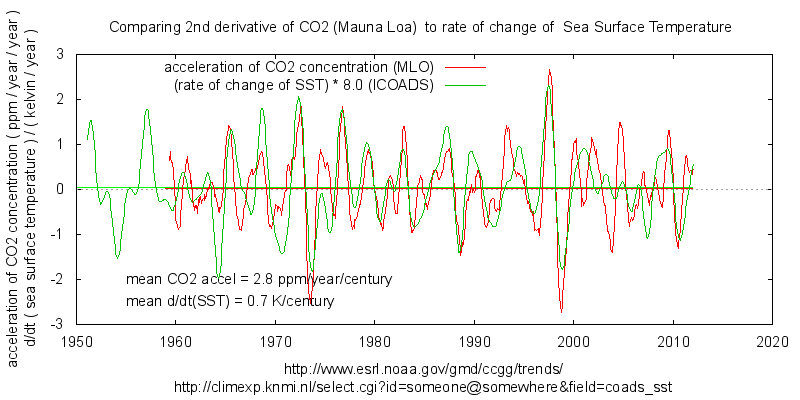
There is still the background rise of about 2ppmv / year.
Is that the same process on a much deeper ocean volume ? Possibly.
https://climategrog.wordpress.com/d2dt2_co2_ddt_sst-2/
Sadly we don’t have accurate CO2 measurements going back far enough to determine the centennial scale changes in the same way.
Is the CO2 a response to changes in SST?
We know that the amount of CO2 that is absorbed and can be entrapped in water is proportionate to the temperature of the water. there is a good physics explanation as to why atmospheric CO2 may appear to increase as SST increases, and drop when SST falls.
The question is which is the driver.
As I understand matters Bartemis claims that CO2 lags temperature changes on every time scale and is a response to temperature changes, not a driver of those changes. that is why he argues that in our present era Climate Sensitivity, if any at all, is zero or close thereto.
“On every time-scale” is Salby’s position but I have not seen a proof of this rigorously presented. While I’m not against the idea, I find that he gets very fuzzy about how he presents this.
It lags on the geologic time-scale and also on the inter-annual time-scale but these are very different situations with what we are currently producing globally. So just joining the two dots and saying “on all time-scales” is not merited.
There is an element of SST producing dCO2 but this may not account for all the change, which is likely to be a combination of out-gassing and emissions. See the article I linked with the graphs.
Greg @ur momisugly September 12, 2016 at 1:51 am
“The guy who wrote A book about climate.”
He has written two books, Fundamentals of Atmospheric Physics (1996), and Physics of the Atmosphere and Climate (2011). The former was one of the most widely used climate texts before he ran afoul of the Inquisition.
“There is still the background rise of about 2ppmv / year.”
And, an acceleration of about 0.1 ppmv/month in about 40 years, reaching a plateau in rate coinciding with the “pause”. This also correlates well with the CO2 data, but not with the emissions data.
http://i1136.photobucket.com/albums/n488/Bartemis/nopause_zpscjndrosf.png
Greg @ur momisugly September 12, 2016 at 3:51 am
“…I have not seen a proof of this rigorously presented.”
It matches very, very well, in a way the emissions data do not, since at least 1958, as the preceding graphs show. In that time, concentration increased from about 315 ppmv to greater than 400 ppmv, which is far and away the lion’s share of the increase that has been observed since the purported pre-industrial level.
It is unnecessary to speculate on other eras as far as addressing the question of anthropogenic attribution. It is very obvious that human activity is not the driving force in the modern era.
Meant to say, “This also correlates well with the temperaturedata, but not with the emissions data.”
“It never ceases to amaze me how dilettantes think they can gainsay the guy who wrote the book on climate with merely a casual dismissal.”
Yes, Salby wrote a text on climate. And what does it say about CO2 in the revised edition? Sec 1.2.4:
That’s what “the book” says.
The proxy evidence is consistent with nearby instrumental measurements of CO2 , which became available in the twentieth century (solid). Jointly, these records describe a modern increase that has brought rCO to values in excess of 380 ppmv, about 35% higher than pre-industrial values in the proxy record… The monotonic increase dates back to around 1850, with interruptions during the 1880’s and 1890’s and, more conspicuously, during the 1940s and 1950s. If anything, rCO2 during those intervals decreased.
…
The decrease of δ 13 C, together with the increase of rCO , reflects the addition of CO2 that is 13 C lean. This feature is consistent with the combustion of fossil fuel,as well as biomass destruction. It is equally consistent, however, with the decomposition of organic matter derived from vegetation. Thus, associating the decrease of δ 13 C to the combustion of fossil fuels requires the exclusion of other sources that are 13 C lean. In particular, it relies on CO2 emissions from the ocean, which overshadows other sources of CO2 (Sec. 17.3), having the same isotopic composition as the atmosphere (which would then be left unchanged). Only then can the decrease of δ 13 C be isolated to continental sources, which are weaker and, in particular, to the combustion of fossil fuel, which is an order of magnitude weaker.
…
The concern over increasing CO2 is supported, in part, by large-scale numerical simulations. Global Climate Models (GCMs) are used to study climate by including a wide array of physical processes. Many can be represented only crudely, with more than a few represented through ad hoc treatment.
_______________
Salby is a professional. He cites evidence both pro and con, and weighs it together to come to a conclusion. Your cherry picking of his words does not incline one to believe that you share such a professional attitude.
Both of Dr. Salby’s textbooks are available to download in pdf format:
Fundamentals of Atmospheric Physics
http://users.df.uba.ar/llamedo/compartido/Salby.pdf
Physics of the Atmosphere and Climate
http://www.atmosfera.unam.mx/jzavala/OceanoAtmosfera/Physics%20of%20the%20Atmosphere%20and%20Climate%20-%20Murry%20Salby.pdf
“weighs it together to come to a conclusion”
So where does the book come to a conclusion contrary to what I quoted?
Bartemis, you inspire a revision of a Salby critique written last year which JC chose not to publish, since was just too much junk science debunked for her rather s rious. We have now three rather than two youtube lectures to dissect. I will get to work on a rather thorough debunk of all three as a possible guest post here. I threatened in this guest post, you asked, it shall be granted. Salby goes down. Many thanks for the request.
Although NS has a good head start. His book isn’t his 3 youtube presentations. Just the opposite.
NS misquoted and cherry picked Salby’s book, as I rather devastatingly showed.
Salby is a serious scientist with serious credentials. I suggest you think very carefully through your critique. You may find it is not he who has leapt to an improper conclusion.
There really is no question that temperatures are the main driver of atmospheric CO2. Or, rather, that a temperature modulated phenomenon is the main driver. This is no accident, and concentration is simply not tracking emissions.
So was Nelson Mandela. I don’t know his current employment situation. But, he definitely has some serious enemies.
For some reason the Jo Nova link didn’t appear in my comment above.
Here is the link:
https://wattsupwiththat.com/2013/08/11/murry-salby-responds-to-critics
” forced out” ??? no, Salby was fired for cause, specifically for not fulfilling his contractual requirements (teaching classes) at Macquarie, not to mention abusing the University’s credit card.
“So was Nelson Mandela. I don’t know his current employment situation.”
He died three years ago, at the age of 95. He finished his term as President of SA at the age of 81, and decided he didn’t want to stand again.
“Regarding Dr. Salby, his response was posted here. Readers can decide for themselves if politics was a factor in his being forced out.”
It may help to listen to the judge who heard his court case against Macquarie (not reported at JoNova or WUWT).
Nick Stokes says:
Yes, Salby wrote a text on climate.
No, he wrote two books. And what Nick cut ‘n’ pasted says what many skeptics have said all along: the rise in CO2 is at least partly caused by the use of fossil fuels. What Nick doesn’t admit to is the evidence that the rise in CO2 is harmless, and beneficial to the biosphere— and that every scary, alarming prediction has failed miserably.
Nick’s problem is that he’s on the side (and no doubt on the payroll) of the purveyors of the repeatedly debunked “dangerous AGW” climate scare.
Nick is doing the equivalent of falsely shouting “Fire!” in a crowded theater. He has no credible or convincing evidence that anything unusual or unprecedented is happening, but he still flogs the “carbon” scare.
To repeat: More CO2 is better for the biosphere. Fossil fuel use simply puts it back into the atmosphere, where it came from originally. Furthermore, the rise in CO2 (from ≈300 ppm to ≈400 ppm) means that CO2 is still very low: about one-fifteenth of past levels.
The rise in CO2 has been by only about one part in ten thousand. No one could tell, without using sensitive instruments—just like we can’t tell when CO2 is 800 ppm. It is still just a tiny trace gas. And the belief that rising CO2 will cause runaway global warming (or any global warming, for that matter) has been falsified by the real world.
The only credible evidence shows that the rise in CO2 has been harmless, and beneficial. All the wild-eyed predictions have been debunked by reality. So where does that leave the debate?
It leaves it here: the climate alarmist crowd is still incapable of admitting that they were wrong, even though Planet Earth demonstrates how wrong they are every day. But as long as the money fuels the scare, alarmists will continue to pretend it’s real.
Isn’t that right, Nick?
As NS has been shown to use selective quoting to further his narrative, I see no reason to respond further. Res ipsa loquitur.
So, How (or why) does the Earth cool faster at the end of a Niño event? Does it have anything to do with CO2 or water feedbacks or is it other phenomena? which one(s)?
It’s warmer out, and warmer cools faster than less warm 🙂
“So, How (or why) does the Earth cool faster at the end of a Niño event? Does it have anything to do with CO2 or water feedbacks or is it other phenomena? which one(s)?”
CO2 levels increase more- so can’t say it has nothing to do with CO2, but otherwise nothing to do with CO2. El Nino is ocean water near equator traveling westward and this draws up deeper, colder and water enriched with CO2- which causes good fishing off South America.
I guess you say it’s like the gulf stream not going pole ward and that stops and starts. When El Nino stops, one could get strong La Niña [or not]. And a stronger La Niña is associated with cooling phase [and other effects- and likewise El Nino does more than just increase average temperature. For instance La Niña has relationship with more Atlantic hurricanes, and El Nino associated with heavier rainfall on west coast of US].
Rud,
Someone a few days ago pointed to the inability to solve for A and B the equation A + B =10.
Make A = IR effect of water vapour and B = IR effect of CO2.
Back in 1880 we do not have estimates of the concentrations of water vapour and CO2 in the air, nor do we have a good global temperature. Therefore, using a rough calculation for primary sensitivity using 1880 values and values now, ‘fixes’ CO2 and H2O concentrations at both times, of necessity. What were the the concentrations of water vapour in the 1880s, known or not?
Further, there is no escape from such physical effects as IR interacting with these molecules. When processes happen it is not an option to say that we cannot measure the effect. When global temperatures fall as CO2 increases, the temperature change must follow. It does not. Maybe you can name some place where the effect is parked until it resumes normal behaviour. Then, there is the matter that there has to be a high enough concentration of CO2 to exert a measurable effect and an effect that sits in place beside water vapour , A B and 10 again?
Lastly, I have not seen a proof of the logarithmic response that you here and others rely on to make it all fit (badly). Does it follow from no more than adoption of a Beer-Lambert relation?
Good comments Geoff. Even though we would know exactly (as we know pretty well) what are the warming effects of H2O and CO2, we do not know the concentration trends since 1880. The logarithmic response for CO2 concentration is confirmed by some research papers (at Myhre et al. and me). The CO2 concentration is so high that Beer-Lambert relation is not valid any more. N2O and CH4 are about on the higher limit of this relationship.
Here is the link to my paper about the strength of CO2: http://www.seipub.org/des/MostDownloaded.aspx
Regards, Dr. Antero Ollila
Thanks for the link.
Hi Antero,
I am a little familiar with some of your past publications. Maybe I can resolve this down to a single question:
Has anyone measured the energy generated by IR and CO2, as opposed to calculated through gas radiation physics, line by line spectral calculations, lines in the wings distorting logarithmic relationships of the central lines and so on? Measured, not calculated?
As an aside, I think I’m correct to state that the power 4 in S-B type relationships might also be unmeasured. It seems to arise from a mathematical integration of an equation carrying a power of 3 related to volume geometry of a sphere. Too many decades since I studied this, but given the importance now attached to this type of work, it does merit going right back to the foundations with a new eye.
GS, short answer is yes. We have satellites above TOA with sophisitcated sensitive EM sensors at all relevant wavelengths. They measure incoming solar, reflected solar, and outgoing infrared based on solar heating. And they do that eventually over almost all the world, over the last 15 plus years. So those data are hardly speculative.
But what is the uncertainty compared the the signal, and remember it’s going to rake a year before you can check the balance across both hemispheres and you have to account for all of that uncertainty.