Guest post by David Middleton

US oil reserves top both Saudi Arabia and Russia
The US holds more oil reserves than Saudi Arabia and Russia, the first time it has surpassed those held by the world’s biggest exporting nations, according to a new study.
Rystad Energy estimates recoverable oil in the US from existing fields, discoveries and yet undiscovered areas amounts to 264bn barrels. The figure surpasses Saudi Arabia’s 212bn and Russia’s 256bn in reserves.
The analysis of 60,000 fields worldwide, conducted over a three-year period by the Oslo-based group, shows total global oil reserves at 2.1tn barrels. This is 70 times the current production rate of about 30bn barrels of crude oil a year, Rystad Energy said on Monday.
[…]
While I have no doubt that the petroleum resource potential in these United States, onshore and offshore, is huge and probably surpasses that of Saudi Arabia and Russia, the word “reserves” has a specific definition:
Reserves
According to the Society of Petroleum Engineers, reserves are “those quantities of petroleum claimed to be commercially recoverable by application of development projects to known accumulations under defined conditions.” Well, that clears things up, right? No? Well, to clarify, the SPE says petroleum quantities must fit four criteria to be classified as reserves. They must be (1) discovered through one or more exploratory wells, (2) recoverable using existing technology, (3) commercially viable, and finally (4) remaining in the ground. Sound okay? Good, because it gets more tricky from there. There are currently three classifications for reserves: proved, probably and possible. Here’s how they break down:
Proved reserves
are those with a “reasonable certainty” (a minimum 90% confidence) of being recoverable under existing economic and political conditions. We can discussed the differences between proved developed, proved undeveloped, etc. with a later post. However, it should be pointed out that proved reserves are the only reserves recognized by the U.S. SEC. This is why energy companies strive to get the latest technology and recovery methods recognized by the government, therefore increasing the chance of “reasonably” recovering oil and gas assets and therefore raising their reserves as well.
Probable reserves
are petroleum and gas quantities with a 50% confidence level of recovery. Basically, you may be able to get some, you may not.
Possible reserves
are quantities with a minimum 10% certainty of being produced. Basically, your long shot discoveries. Only gamble on these types of assets if your Magic 8-Ball tells you to. All right! That takes care of reserves! But what about resources?
Resources
For those of you who have looked at on the market ads, you’ll spot this term a lot in the literature. So what is resources? Again, we turn to the SPE. There are two categories of resources: contingent and prospective. are quantities of petroleum estimated, as of a given date, to be potentially recoverable from known accumulations, but the projects are not yet considered mature enough for commercial development due to one or more contingencies. In other words, there’s a good idea of how much oil and gas is in the reservoir, but issues such as political and social events or even a lack of market prevent production. There can be a major oil discovery in the Congo right now. You want to risk getting shot to get to it? are quantities of petroleum estimated to be potentially recoverable from undiscovered accumulations by application of future development projects. These sorts of resources basically exist in the minds of marketing people. That’s not to say that they don’t exist in the real world as well, it just means that E&Ps are thinking of future oil and gas discoveries in new areas, based on upcoming technology and the discoveries made in similar formations worldwide. Okay! I hope that helps! Until next time, may the resource be with you. Live long and prospect.
The Rystad Energy report is adding its estimate of undiscovered resources to its reserve estimate.
Somehow, they came up with 264 billion barrels of proved, probable, possible and potential reserves (resource potential).

Publicly traded companies are valued according to their proved reserves (1P). Probable reserves (2P) can be used for certain accounting measures; however they are not proved reserves. Possible reserves (3P) cannot be used for any accounting measures. Undiscovered resources aren’t reserves.
Most estimates of undiscovered resource potential in the United States (onshore + offshore) are in the range of 400 billion barrels. If you count oil shales (different from shale oil) you can push the number up to 1.4 trillion barrels. So, Rystad’s 264 billion barrels is actually a conservative estimate of reserves and resource potential. The US has huge potential for future oil and gas discoveries, probably far greater than Saudi Arabia or Russia. However, those future discoveries aren’t reserves.
I applaud Rystad Energy for trying to draw an “apples to apples” comparison of oil reserves in the U.S. and other rule of law nations to those of countries like Russia, Saudi Arabia and Venezuela. However, they are blurring the distinction between reserves and resource potential.
While the distinction between reserves and resources may seem like nitpicking, the misuse of the word “reserves” is frequently used by politicians to give the impression that US petroleum “resources” are scarce…
“The United States holds only 2% of the planet’s proven oil reserves,”
— President Barack Obama
According to President Obama, the United States contains only 2 percent of the planet’s proven oil reserves, Of course, he’s right — to a point. In classic fashion, he’s using a technicality to skirt the facts and keep the myth of energy scarcity alive. The reality is that the U.S. has enough recoverable oil for the next 200 years, despite only having 2 percent of the world’s current proven oil reserves.
Proven oil reserves are not all of our oil resources—not even close. In fact, proved reserves represent a tiny portion of our total oil resources. Proven (or proved) oil reserves are reserves that have already been discovered, typically through actual exploration or drilling, and which can be recovered economically. That estimate does not include oil that we know about, yet are unable to access because of regulatory barriers. For example, the billions of barrels of oil in ANWR are not included in our proved oil reserves. So let’s look at the facts.
Currently, the United States has 1,442 billion barrels of technically recoverable oil, but only about 20 billion barrels are considered proven oil reserves.[ii] That is partly because the federal government is denying access to hundreds of millions of acres oil-rich federal lands: the Alaskan National Wildlife Refuge, the Naval Petroleum Reserve-Alaska, federal waters off the Atlantic and Pacific coasts, at least 45 percent of the Gulf of Mexico, the Chukchi and Beaufort Seas, and oil shale on federal lands in Colorado, Utah, and Wyoming, to name a few. In the case of oil shale (an oil composed of kerogen), technology needs to be perfected to make its production viable, but this will not happen until the land is leased. Regrettably, the Department of Interior has stopped a leasing program Congress directed it to undertake.
[…]
“Proved reserves” are just a tiny fraction of the petroleum resources in these United States. It is primarily an accounting measure used in the valuation of oil companies. Publicly traded US oil companies have to “book” proved reserves according to very strict SEC rules.
Here’s a very simplistic example of proved reserves (1P):

Since the well was drilled up-dip to a dry hole with an oil show, the entire volume can be booked as proved because the down-dip well has an oil-water contact.
Here’s a very simplistic example of proved plus probable reserves(2P)

In this scenario, the down-dip well has no oil show, just a wet sandstone. If there is geological or geophysical evidence (e.g. seismic hydrocarbon indicator) demonstrating that the hydrocarbon column extends down-dip, the volume below the lowest known oil can be booked as probable reserves. Otherwise, it would have to be categorized as possible reserves.
SEC rules & definitions via NSAI
Thank you Dave for bringing all your expertise to this forum. I am particularly pleased that we got this far without a lecture on Russian abiotic yada yada. (all the Russians I have worked with are looking for thermally mature biotic source rocks just like the rest of us.)
My first week in the ol’biz, a geologist told me “don’t ever believe we found all the oil.” Forty years later, I finally understand what he was telling me. Back in the peak oil hysteria, I said over and over that a sustained high price would warp the curves beyond recognition. I could not say exactly where the production would come from, just that is would.
I would be surprised if the US resource exceeds Russia and Saudi. I base that on stories from my wife, who has seen more Saudi core than anyone I know of, and a review I did of Russian source rocks. At any rate, we are a long way from running out. The best models will be those which treat future potential with improved technology as infinite. It is not, of course, but then the stone age didn’t end for lack of stones…
We had a couple of mentions of abiotic oil. Inorganically sourced oil is certainly possible; there’s just no evidence for any significant accumulations of it. Even if oil did form inorganic sources, it wouldn’t really matter. “Oil is where you find it.” We find it mostly in sedimentary rocks where it has accumulated in structural and/or stratigraphic traps.
Peak oil is a real mathematical function. If the Rystad Energy is correct and the sum total of proved, probable, possible reserves (3P) and resource potential is 264 billion bbl, we’ll hit peak oil in about 7 years. If 3P plus resource potential is 1.4 trillion barrels, we won’t hit peak oil until 2194.
I don’t know when we will reach peak oil or if we may have already passed it, because it has no bearing on how I do my job,
Your Stone Age analogy is very appropriate. When I criticize the economics of utility scale solar power, I am often accused of giving up on a technology. The issue is trying to deploy a technology that is not even close to being economically viable. Thomas Edison funded the construction of his Menlo Park research laboratory with the proceeds from the sale of his repeating telegraph invention in 1877. By 1879 he had developed the first commercially practical electric light bulb. In 1882 he opened the first commercial power plant to power electric light bulbs. It was immediately profitable.
Bureaucrats aren’t funding the development of new technology when they mandate and subsidize solar power plants. They are funding the uneconomic build out of utility scale infrastructure because they think they see a future need for solar power.
Imagine if the government had mandated and subsidized the manufacturing of a home version of the UNIVAC I in 1957 because some prescient bureaucrats foresaw a future market for home computers. The misallocation of capital would have been horrendous.
With energy, it’s even worse. Electricity is a cost. When bureaucrats mandate that “x” percentage of electricity be generates by so-called renewable sources, they are mandating higher energy costs – they are destroying wealth. Government subsidies don’t make the electricity cheaper; they just shift the costs from consumers to taxpayers. When government subsidizes the build out of utility scale solar power plants, they are subsidizing more expensive and less available electricity – they are destroying wealth.
When the free market is allowed to work, people like Thomas Edison, Bill Gates and Steve Jobs create wealth.
The problem isn’t teething problems with a new technology. The problem is a mentally challenged government crowbarring the economic equivalent of a 1957 home version of the UNIVAC I into an economy with no real market for a prohibitively expensive home version of the UNIVAC I.
Some day in the future coal, gasoline, natural gas, nuclear fission and just about every other power generation source will be replaced by something that delivers more value to the economy… Real value… Measured in $$$. Not phony value like “social cost of carbon,” EROEI or x case of asthma averted. That day is not here yet.
Man did not leave the Stone Age because of a stone shortage. Man did not advance from the Chalcolithic to the Bronze Age because brilliant government bureaucrats forced copper-smiths to purchase bronze credits. Man left the Stone Age because he figured out ways to derive more value from his work using metals rather than rocks.
David do you place any credence on the view that “with the price of oil below $X there is not the return to justify the investment in exploration and above, the economy can’t afford it”?
I place a lot of credence in that fact. Our capital budget has reflected that fact for the past 2 years.
The industry- wide lack of capital spending will eventually lead to higher prices and increased capital spending.
So effectively we’ve reached peak cheap oil?
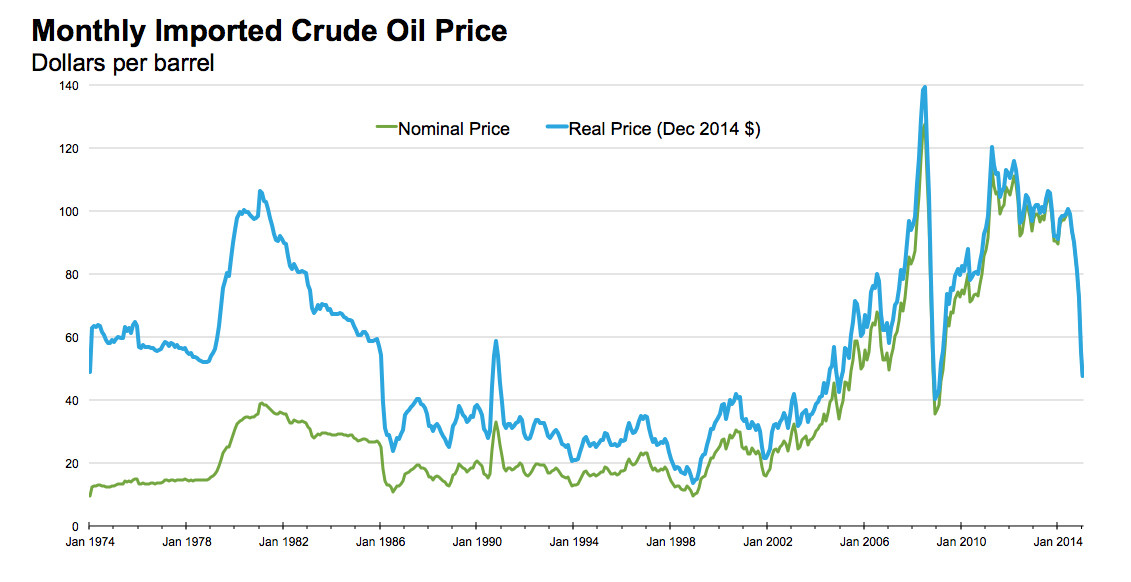
No. On an inflation adjusted basis, oil normally trades in a range of $40-$80/bbl. The fundamental nature of commodity price cycles is that of oscillating booms and busts. Prices drive spending. Spending drives supply. Supply and demand drive prices.
Wall Street’s ‘Hot Air Reserves’ certainly outstrip those of Russia and Saudi Arabia combined……
Peak hot air… You can’t get there from here… 😉
“The analysis of 60,000 fields worldwide,.. shows total global oil reserves at 2.1tn barrels. This is 70 times the current production rate of about 30bn barrels of crude oil a year,”
We’ll run out of oil in 70 years. Then we shift to compressed natural gas to run our vehicles. Then to coal via FT process to get synthetic diesel. In 300 years we’re out of fossil fuels. Then we use cow shit, used cooking oil, pork fat and garbage to run our vehicles.
We won’t run out of oil.