By Andy May
In 2000, Richard Alley released an ice core temperature reconstruction for Central Greenland using Oxygen isotope ratios. He describes the technique used here. I used this ice core proxy data in a previous post “Climate and Civilization for the past 4,000 years.” Since Alley’s data stops at 1855, I spliced the Greenland HadCRUT surface temperature data on the end to show the Modern Warm Period. In the previous post I erroneously thought Alley’s reconstruction stopped at 1905, not at 1855, so the plot in the earlier post is shifted 50 years. This problem is corrected in this post. I spent too little time on the splice, since my focus was on the effect of climate on civilization and several commenters rightly objected to the error. These included David Middleton, who offered up a better Central Greenland reconstruction by Kobashi, et al. as an alternative. A little research and I was able to find a 4,000 year reconstruction to 1993 by Kobashi et al.
Kobashi uses Argon and Nitrogen isotopic ratios from air bubbles in the ice to estimate paleo-temperatures. He claims that that his method is more accurate than the Oxygen isotope ratios Alley used. Details of Kobashi’s methods are in his PhD thesis, which can be seen here. His unsmoothed results from 2,000 BC to 1993 are shown in Figure 1.

Figure 1
It certainly has a higher resolution than Alley’s dataset. It also has major differences at 700AD and 400BC. Figure 2 is the Alley dataset and the HadCRUT 4.4 surface data corrected for the 50 year error in my previous post. The HadCRUT 4.4 central Greenland temperature anomaly record (in red) is adjusted to the Kobashi record average from 1876-1967 after smoothing both reconstructions. This makes the HadCRUT Greenland temperatures 0.43°C lower than in the previous post. In this plot, the Modern Warm Period is slightly lower than Alley’s Medieval Warm Period.

Figure 2
Figure 3 compares all three datasets. The Kobashi data has been smoothed with a 50 year moving average to make the comparison easier. Alley is unsmoothed and the HadCRUT 4.4 data is smoothed with a 20 year moving average. Both the Medieval and the Minoan warm periods are shifted roughly 50 years between the Alley and Kobashi reconstructions. I take this as the time error (roughly +-50 years) in the datasets. The temperature swings in the Kobashi dataset are more dramatic, but allowing for the time error and resolution differences, generally follow temperature swings in the Alley dataset. Visually, Kobashi’s record has roughly 3x the resolution of the Alley dataset. There are two big differences, the major Kobashi temperature high in 700AD and the major Kobashi temperature low about 550 to 350BC. These differences exceed the apparent error bars of +-50 years and the difference in resolution. Remember both of these datasets were created using the same GISP2 ice cores.

Figure 3
What we can do is go to the historical record to see which record corresponds to history better. Figure 4 is the Figure 1 from my previous post, except I’ve added the Kobashi record and corrected the 50 year error. As before you can click on the figure to get a high resolution PDF.

Figure 4 (click on the image to download a high resolution pdf)
Close inspection of these historical events shows that they fit both reconstructions within acceptable limits. The periods where the timelines differ a lot (400BC and 700AD) have no events. There is also a significant gap at 200BC when the Roman Empire and the Han Dynasty were beginning, but that probably does not disqualify either timeline.
700AD
This is the date where the Kobashi reconstruction hits a peak that is as high as the Minoan Warm Period and over 1.5°C higher than the temperatures we see today. It is also over 3°C higher than the Alley reconstruction at this point. The anomaly lasts 100 years and is precisely opposite of what the Alley reconstruction shows. I’m not sure how to interpret this. This was when Charlemagne unified what is now France and Germany into the Frankish Empire. It was also when the Franks (French) finally stopped the Moslem advance into Europe and held them in what is now Spain. Rashid, sultan of the Abbasid Caliphate, caused the caliphate to reach the height of its power at this time. Great empires are usually built during warm affluent times. I score one point to the Kobashi team.
400BC
The Kobashi reconstruction shows this as a very cool time about 200 years long (550 to 350BC). Alley’s reconstruction shows it to be warm. This was the time of Buddha and Confucius. Greece fought off Darius at Marathon and Xerxes fought the “300 Spartans” and sacked Athens. This was also the age of Pericles and when democracy was invented. The Huns begin to invade China, the Romans built their first road. Just at the end of this period Alexander the Great defeated Darius III at Granicus. Pretty important times in history. Generally one would think Alley’s estimate of higher temperatures is correct. Score one for Alley’s team.
Conclusions
Except for these two glaring exceptions, both timelines can be made to fit with major historical events. We do have to assume that the time error is +-50 years and that the temperature error is +-0.2 degrees C or larger and that the Kobashi resolution is roughly 3x the Alley resolution. Visually, the resolution of the Kobashi data (one-half wavelength of the unsmoothed data) is about 50 years. The resolution of the Alley data is no better than 150 years.
After taking these factors into account we are left with two problems, the 700AD difference and the 400BC difference. Both periods are pretty well documented in history and the 700AD difference seems to suggest that Kobashi is correct. But, the 400BC difference suggests the Alley reconstruction is correct. I for one, don’t know what to make of this. I suggest that we remain skeptical of both records and realize that as appealing as they are, they are very rough estimates.
Afterword
Thanks to everyone who commented on my previous post, especially David Middleton who led me to the Kobashi reconstruction. I’m also in debt to Nick Stokes, Ristvan, Andras Gulacsi and David Middleton who caught the 50 year error and suggested I use actual dates on graph axes rather than years before present which are confusing. Anything for clarity. This is how the best science is done. Rapid and insightful debate and discussion. Blogs are great for science, in a way they take us back to the roots of science. Socrates had his gatherings. Mendel and Darwin worked on their own for the love of science and corresponded with like-minded friends. I particularly like the instant feedback of blogs. I’ve published a lot of peer-reviewed papers where I’d nearly forgotten what I wrote before the peer-reviews came back. No fun in that. Plus, the ego factor and bias inherent in the peer-review process is terrible. Blogs are better.
Great Empires are usually built during warm times ?
Do you mean locally warm times ?
The British Empire???
Wtf?
“I really think that trying to overlay historical events onto a reconstructed
climate record is nonsense. “
While I do appreciate this topic and find the connections interesting I too would be hesitant over linking climate change with significant historical events. The connection is tenuous as there are many other variables that need to be taken into account
I would much rather live, work, and farm, in the Mediterranean region during a cool phase than a warm. Conversely, life in the higher latitudes would become much harder, yet not unbearable. A useful comparison would be to study pre-European indigenous population density in the Americas in relation to latitude and mean annual temperature. Many tribes flourished in higher latitudes or elevations where health status is better. Providing climate change was not too abrupt, staple grain crops and the people reliant on them would simply migrate according to the change. We only need consider the potential for this occurrence in the great plains of the US, Russia, China. Rainfall is the limiting factor
What the connection does not include is how trade routes changed along with climate. All empires relied on trade. During these eras and dynasties sea and inland waterways dictated trade flow. How did the
waterways change?
Yes, this is a useful and interesting study but nature and history does not expose itself this lightly. If I were a research supervisor of this study I would say that it needs more work with a greater focus on particular events i,e more robust evidence. Well done so far 🙂
Way I see it is there are two pretty significant incorrect points in both reconstructions and the reasons are not identified which would mean as it stands we cant use either to make any point until the issues are resolved.
Just as with Mikey chopping off bit that disagreed with thermometers in Briffa’s reconstruction, simply deleting or in this case excluding these inconveniences doesn’t change the fact that in all cases the inconveniences bring the entire reconstructions into doubt.
Interesting that the HADCRUT with a 20 year filter makes the 30’s/40’s warmer than the present:
My issue with your approach is this: if you want to compare the 20th century to the past, you have to have consistent data through the period. If you splice a O18+borehole combination with one period with a N-Ar proxy in another period, you don’t know what you have. Better to take an O18 series that reaches through the 20 th century so you can at least determine whether there is anything unusual with the proxy. Attempts to use the Alley reconstruction to compare to the 20th century are a waste of time, since the comparison depends on the splice. That’s one reason why the Vinther data is better.
One reprehensible issue with Greenland ice core scientists is their determined failure to publish/archive updated d18O data. The most recent data when I looked last year came no further forward than 1995 or so. The modern generation is even worse about archiving data than the ones that I’ve criticized.
A big part of the revolution that needs to happen in all regime-funded research but especially “climate science” is the requirement to archive and make public all data collected as a result of public largess.
Maybe President Trump will make this a part of his overhaul of Big “Science”.
Andy,
We both used Richard Alley’s data but did not buy idea that [CO2] is the control knob for global temperature.
Six years ago I made a couple of “Guest Posts” that are in remarkable agreement with yours including the 55 year error in splicing the GISP data to measured data. In spite of our disagreement Richard Alley was approachable and helpful unlike his litigious colleague (Michael Mann) at Penn State.
I would appreciate an opportunity to correspond with you “Off Line”. If you like this idea my public email is info(at)gallopingcamel.info.
https://diggingintheclay.wordpress.com/2010/12/28/dorothy-behind-the-curtain-part-1/
https://diggingintheclay.wordpress.com/2010/12/30/dorothy-behind-the-curtain-part-2/
Steve McIntyre,
Your problem is that you bore everyone to death with minutiae. Once in a while you need to look at the woods rather than the trees.
Please excuse a nit pick, but the Roman Empire per se didn’t begin at 200 BC. The Roman Republic had already long been expanding at that time, but the Empire wasn’t officially established until 27 BC.
The Punic Wars between the Roman Republic and Carthage occurred between 264 and 146 BC.
Mosher says:
“Greenland is not the world. The correlation between Greenland temperature and global temp is rather pathetic. Using historical events from random places to decide which record is “better” is voodoo science at best.”
The GISP site has an altitude of 2,316 meters rising by about 0.05 meters per year. Unfortunately the GISP ice core data only goes back 80,000 years because the site was ice free during the last inter-glacial. Fortunately, Antarctica has maintained its ice sheet for at least 850,000 years so we can look back much further than the DYE and GISP cores allow.
Over the last 850,000 years global temperature has correlated with [CO2] to an R>0.95 thanks to Henry’s Law which governs the solubility of gases. As the oceans warm they release CO2 which explains why temperature leads [Co2] by 500 to 800 years. In my world cause precedes effect……..
https://diggingintheclay.wordpress.com/2013/05/04/the-dog-that-did-not-bark/
You have never been known to admit that you are wrong so don’t waste my time with your sophistry. It is time to present real data and mathematical analysis.
too funny. you understand that the lag is actually a consequence predicted by the science… in fact Hansen predicted the lag before it was discovered.
C02 in the atmosphere is both a cause of warming and a response to warming.
Your problem is that you refuse to be confused by facts. Henry’s law explains the lag whereas you are peddling Hansen/Severinghaus sophistry.
Bill Illis,
I have concentrated on the variation of global temperature at high latitudes because I believe in polar amplification. Averaging temperatures that vary over a range of 100 K to an accuracy of o,1 K is not easy so it makes sense to monitor temperature at high latitudes.
IMHO polar amplification is in the range of 3 to 5.
gallopingcamel , I would have commented on your links provided above but you have comments closed.
Firstly, not only do you make the same BP mistake as Andy but also the same poor choice of filter. You don’t seem to notice that you have troughs in your “smoothed” data when there are massive spikes in the unfiltered data. Typical RM corruption of the data.
You don’t seem to notice that you have high frequency wiggles in data you imagine you have “smoothed” at 10y. You also incorrectly label these lines as “10y average”, not running average. A 10y average would have less dots and would be more defensible.
You also confuse the ten “resolution” of Alley’s data ( which is depth resolution of the slicing ) with resolution of the physical processes: gas diffusion in the firm etc. , so this is not real time resolution of the proxy.
Again you end up with far more excursions in your “10y” filtered data because the proxy is far more heavily damped. 10y is not the true resolution of that record: hence your hockeystick.
You say you ‘believe’ in polar amplification. See whether you can find any at the south pole….
Greg,
As you point out Andy and I made the same mistakes. We are amateurs writing without the benefit of “Peer Review”. Richard Alley was gracious enough to point out my errors in “off line” correspondence five years ago. Even though I disagree with Alley’s conclusions I hold him in the highest regard as he is not afraid to engage in discussions with the general public.
Yes I do believe in polar amplification and there is good evidence for that here:
During the PETM sea sediments show that polar oceans were 12 K warmer than today. Sediments from low latitudes suggest 3 to 4 K so the amplification appears to be in the range 3 to 4.
Yes I did look at the south pole:
https://diggingintheclay.wordpress.com/2013/05/04/the-dog-that-did-not-bark/
Over the last seven glacial cycles the temperature excursion at high southern latitudes was 13 K which is much greater than the 3 K GISP excursion for the last 80,000 years. Thus if you use south polar data an amplification factor of greater than 5 seems plausible.
Look at the spikes in the unfiltered data 1915, 1930, 1946,1982,2003 . All these are inverted by the defective RM “filter”. You also have ripple on the scale of 1-2 years after supposedly filtering with a 10y filter.
Try to find yourself a gaussian at least. See my climategrog links above. I provide scripts for doing filters.
This makes me wonder whether the absense of the 700 AD spike in Alley be filter induced.
Greg,
My math tutor at Cambridge was J.C.P. Miller, a statistician. He seemed quite pleased with my progress but I have not had much occasion to use statistics since graduating in 1961. Given the huge advances in numerical analysis since then I have no doubt that you could do a much better job on the GISP data.
Fortunately, I know someone who is really good at advanced statistical analysis. Nicola Scafetta’s office was directly above mine in the Duke University Free Electron Laser Laboratory. Nicola is a real scientist who will tell it like it is no matter how it will affect his funding:
https://diggingintheclay.wordpress.com/2014/12/16/countering-consensus-calculations/
Andy May
No need to reinvent the wheel. Kobashi already invented it. Just use Kobashi. HadCRUT is crap. It is unreliable and dubious. As I said before, HadCRUT points are in the coasts and on sea, which are warmer than the ice sheet in the middle of Greenland where GISP2 is located. Not to mention the “man-made warming” due to HadCRUT data adjustments. It’s clear from Kobashi that the 1940s is warmer than the 1980s up to 1993. I’m not sure if you got it in your reconstruction using HadCRUT.
Kobashi’s reconstruction showing 1940s warmer than 1980s in Greenland is supported by actual thermometer data from the four harbors in Greenland also showing the warmest years in 1930s and 1940s but more surprising is the coldest years include some 1980s and 1990s. See this presentation where the Nobel laureate physicist showed the Greenland temperature data
This presentation accepts the “Consensus” view that the GHE is ~35 K. That estimate is not even close as it makes unrealistic assumptions about the thermal properties of planetary surfaces..
I can agree that the average global temperature is 288 K. However, global temperature “Sans Atmosphere” cannot be ~255 K as “Consensus Scientists” tell us. A more realistic assumption would be 209 K for a regolith surface or 234 K for an ice surface.
https://tallbloke.wordpress.com/2014/08/27/extending-a-new-lunar-thermal-model-part-ii-modelling-an-airless-earth/
“700AD difference seems to suggest that Kobashi is correct.”
Greenland and European temperatures have varied inversely through the Holocene. The 8th century according to proxies was the warmest part of the MWP for Europe, so would have been very cold in Greenland, as the Alley series shows.
“This is how the best science is done. Rapid and insightful debate and discussion. Blogs are great for science, in a way they take us back to the roots of science. Socrates had his gatherings. Mendel and Darwin worked on their own for the love of science and corresponded with like-minded friends. I particularly like the instant feedback of blogs.”
Yet you gave zero feedback on this:
https://wattsupwiththat.com/2016/06/22/climate-and-human-civilization-for-the-past-4000-years/#comment-2243034
or this:
https://wattsupwiththat.com/2016/06/22/climate-and-human-civilization-for-the-past-4000-years/#comment-2243028
I tried twice to post a new comment but it disappeared both times. Here is a screen shot of it: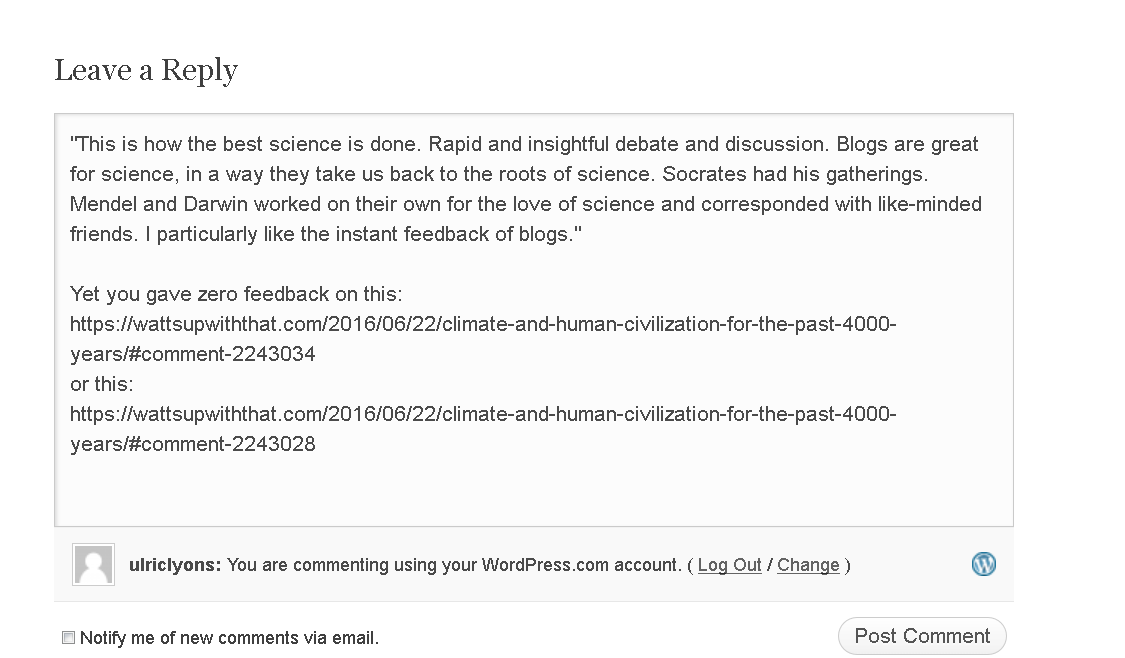
Alan: Interesting post. Your post reminded me that temperature proxies are not temperatures and that consensus climate scientists rarely discuss the dubious reliability of such proxy data when it supports a position they favor.
Kobashi eventually published a non-paywalled on temperatures deduced from Greenland ice cores and various isotopic methods and the figure hopefully shown below is comparable to yours.
http://onlinelibrary.wiley.com/enhanced/figures/doi/10.1029/2011GL049444#figure-viewer-grl28620-fig-0003
http://onlinelibrary.wiley.com/doi/10.1029/2011GL049444/full
This Figure and your work shows that even a 3 degC deviation in a single proxy record (such as the one around 700 AD) may not be real – or at least not be meaningful in terms of global or hemispheric climate. For that reason, I think your attempts to decide which record is “correct” based on events in human history – which may of may not be associated with large scale climate change – are doomed to failure. There is no right or wrong answer just a collection of dubious proxy data that is mostly in agreement about major events (the 8.2 kya event, the Younger Dryas, glacials/interglacials), but isn’t in agreement about the modest swings over that last several millennia – especially quantifying the amount of change that occurred between warm and cool periods. Looking at the warm and cool periods shown at the top of Kobashi’s Figure 3, I’m not convinced that there was a Dark Ages Cold Period, a Roman Warm Period, an Iron Age Cold Period, and a Bronze Age Warm Period – even in Greenland, if not the NH or globally. Perhaps the data from Antarctic Ice Cores or other proxies paint a more consistent picture.
The only exception to this generalization is borehole temperature measurements – which are real measurements of temperature. Unfortunately, they lose resolution in the time domain and don’t provide useful information further back than the MWP.
Thanks for your post.
Frank, thanks for your comment. I had looked at that paper and I notice the Bo Vinther is a co-author, which is helpful. I think Kobashi’s comment that temperatures are lower now than 4000 years ago is a valid conclusion. This is clear in all reconstructions. What else can we tell? Hard to say without more work.
Andy: I’ve decided to ignore any single proxy record and only pay attention to a panel of records. Don’t show me one ice core that says that the Roman Warm period was warmer than today, so me a panel of five or more proxies. If global, some from Greenland, some from Antarctica and some from ocean sediment cores. That makes is difficult for amateurs to be convincing.
FWIW, Kobashi’s N/Ar methodology appears to be more problematic than O18 temperature proxies. O18 is fractionated as it moves from the ocean to air above an ice cap and when it falls as snow. That leaves plenty of room for changes in O18 that aren’t caused by temperature, but once the O18 is in ice, it shouldn’t change much. N/Ar involves two mechanisms of fractionation in the firn and then the possibility of fractionation after coring from air bubble and from within the ice matrix. The nature of the ice changes with depth and – if you go deep enough the ice begins to flow. A 2016 paper demonstrated that the N/A method is biased by accumulation rate.
To Andy May:
Thanks for the comparison between Alley and Kobashi…… It is clear, both studies are
too different, especially the wild Kobashi variations between 1200 BC – 200 BC.
Please go to the Climate Pattern Recognition paper, part 5 on
http://www.knowledgeminer.eu/climate/papers.html . You will see the following:
At each cosmic impact on Earth, the Kobashi graph steeply goes up! This can
even better seen for the time span 1 AD to 800 AD, which will be part 6, out in short time.
For this reason, Kobashi does not show the GISP2 temperatures, but an increase in
Argon components, which are settling peu-a peu in the ice after each cosmic meteor impact.
Therefore, Kobashi provides additional atmospheric prove for cosmic impacts on Earth for
the NH, from the equatorial zone to the North. Impacts in the SH do not show, because
air circulation from the SH is much reduced into the NH. You can therefore retire Kobashi as
Holocenene temperature proxy and stick with Alley.
Check it out. Questions welcome. JS.
FWIW, here’s the power density spectrum estimated directly from the (decimated) 20-yr sampling of del18O isotope data at GISP2:
http://i1188.photobucket.com/albums/z410/skygram/graph1.jpg
Note that there are at least three peaks in the multi-decadal range, which would be adversely affected by a 50-yr moving average. Decimating all data to the sampling rate of GISP2 would make for more meaningful comparisons.
Thanks, I will check that out.
@Greg,
“Well I guess you must be smoking Camel, but instead of insulting Mosh’ why don’t you post up this “stunning correlation”.
I was not insulting Mosher (I’ll take care of that later)………I was pointing out that he is wrong. Stunning correlation between [CO2] and temperature can be found in papers relating to EPICA, Vostok, GISP and DYE. I have linked several of these in my comments above. Please take the time to read them and let me know if you agree or disagree.
Now that you have some of my numerical analysis, how does Mosher’s compare? Does he have anything at all? He seems to be into hand waving and ad hominem. I imagine he is a really crabby old guy without a kind word to say about anyone.
here is the final vostok analysis
http://www.foresight.org/nanodot/wp-content/uploads/2009/12/vostok.png
now
looking at vostok objectively,
and noting that ice ages are not exactly accommodating to any sort of life form, don’t you all have to admit that we are lucky to be in this prolonged period of warmth?
planned creation or planned chaos?
you tell me