From NSIDC:
Antarctic sea ice: an update
Antarctic sea ice extent continues to make headlines because it has grown even as much of the globe, and Antarctica itself, is warming. Arctic sea ice, in contrast, is showing a marked decline. Warmer air and ocean waters are bathing both poles, so why does the Antarctic sea ice trend resist decline?

On September 19, 2014, the five-day average of Antarctic sea ice extent reached a maximum record, exceeding 20 million square kilometers for the first time since 1979. The red line shows the average maximum extent from 1979-2014. Credit: NASA’s Scientific Visualization Studio/Cindy Starr
Despite what some might think, high ice extent in Antarctica does not balance out low ice extent in the Arctic. Antarctica is showing strong warming in other areas, and is experiencing the consequences of this warming, such as the dramatic breakups of ice shelves on the Antarctic Peninsula. Yet Antarctic sea ice extent has increased.
The very different geography of each pole is a large factor. The Arctic is a large body of water surrounded by land, while Antarctica is an icy landmass surrounded by ocean, meaning that the ways in which ocean waters, currents, and winds interact with sea ice are very different as well. But why is the Antarctic story less clear to scientists than the Arctic one?
Less land ice, more sea ice?
While scientists expected Arctic sea ice to respond strongly to warming, and knew that the poles might have different patterns of warming, they are still surprised that Antarctic sea ice has generally expanded. This has been especially perplexing to watch in 2012, 2013, and 2014, during which the Antarctic sea ice winter maximum extent set consecutive records.
For a time, researchers thought melt water might be a factor. Warming ocean waters are causing Antarctica’s ice sheets to flow more quickly and churn more ice into the ocean. This ice then melts into the surface water layer that Antarctic sea ice sits in. But this additional melt water is not large enough to explain the changes.
“The scale of the new freshwater input is small compared with snowfall or even rainfall in the Southern Ocean,” said Ted Scambos, senior research scientist at NSIDC. The Antarctic system has always experienced about 2,000 gigatons of melt annually, and the recent increases have only added about 150 gigatons. On top of that, the Southern Ocean annually receives about 20,000 to 40,000 gigatons of precipitation. “Yes, it is warmer, and more of the land ice is melting . . . but it’s not a big effect compared to the area and mass of the sea ice,” Scambos said.
So if more land ice melting is not a major influence on sea ice, what are scientists looking at now?
Gust in the wind

In October 2015, the ozone hole over Antarctica reached a record extent, expanding to 28.2 million square kilometers (10.9 million square miles). Purple and blue colors indicate the least ozone, and yellows and reds indicate more ozone. The lack of atmospheric ozone over Antarctica can lead to turbulent winds, which affect sea ice extent. Data are from the Ozone Monitoring Instrument aboard the NASA Aura satellite. Credit: NASA Ozone Watch
In a recent study, scientists focused on the Antarctic ozone hole. When ozone is present high in the atmosphere, it absorbs sunlight and warms the atmosphere. A large hole in the ozone layer over Antarctica chills the air high above the continent, and sets up a stronger westward circulation. This can drive stronger westerly winds even near the surface. Scientists Paul Holland and Ron Kwok found that under the right conditions, these winds tend to spread sea ice out, away from Antarctica, creating a larger overall extent.
Satellite evidence of the ozone hole dates to 1976, and this timeline matches changes in sea ice, according to Scambos. “There are several lines of evidence suggesting that sea ice was ‘different’ prior to the mid 1970s, and generally a lot more variable,” he said. Although research and models support the connection between ozone loss and sea ice growth in Antarctica, at least over the short term, scientists would like a longer time series. Older satellite data, from some of the first weather imagers ever launched, are being pressed into service again to investigate sea ice conditions in the early 1970s and even the 1960s.
Regional variability
Scientists are also investigating other climatic influences. “Individual areas of Antarctic sea ice are governed by different climate patterns, and each area has its own degree of variability,” Scambos said. “Looking at the different climate patterns and how they have played out over the past several years will be a key step to explaining what is going on.”

Antarctic sea ice, such as this ice covering the Bellingshausen Sea, has been growing in extent even as air and ocean temperatures rise. This photograph was taken during a NASA Operation IceBridge flight on October 13, 2012. Credit: M. Studinger/NASA
For instance, much of West Antarctica’s climate is influenced by the Amundsen Sea Low, a perennial weather system located over the adjacent Bellingshausen and Amundsen Seas. Researcher Marilyn Raphael and her colleagues published a study showing how the system affects wind and sea ice patterns across West Antarctica’s coasts. When the Amundsen Sea Low is strongest, sea ice extent along much of West Antarctica decreases while extent in the nearby Ross Sea increases; a weak phase results in the opposite effect in each sea. Other scientists are investigating how the ozone hole and El Niño patterns interact with the Amundsen Sea Low to induce changes in sea ice. Similarly complex variations influence sea ice extent in other regions around the continent.
Antarctica’s stubborn paradox has proven puzzling. As scientists learn more, they hope to understand what shapes Southern Ocean sea ice. “Five to ten years from now, I think we’ll still be seeing regional variability dominate any global climate change signal,” Scambos said. “We’ll know more about the drivers of regional trends, and also the history of sea ice in Antarctica,” he said. “But I don’t think we’ll see a climate-driven decline until late in the 21st century.”
References
Holland, P. R., and R. Kwok. 2012. Wind-driven trends in Antarctic sea-ice drift. Nature Geoscience, doi:10.1038/NGEO1627.
Raphael, M. N., G. J. Marshall, J. Turner, R. Fogt, D. Schneider, D. A. Dixon, J. S. Hosking, J. M. Jones, and W. R. Hobbs. 2015. The Amundsen Sea Low: Variability, change and impact on Antarctic climate. Bulletin of the American Meteorological Society, doi:10.1175/BAMS-D-14-00018.1.
“Sea ice.” NASA Earth Observatory. Accessed 11 January 2016.
The cult of CAGW idiots have no idea what caused the cyclic warming and cooling in the paleo record. The same idiots hence have no idea what caused the warming in the last 200 years. The majority of the warming in the last 150 years has caused by solar cycle changes, not the increase in atmospheric CO2.
The sudden increase in Antarctic sea was caused by the abrupt change in the solar cycle. The very recent sudden increase in solar wind bursts from weird super large coronal holes temporary halted the cooling. The solar coronal holes are starting to dissipate and/or move to high latitude regions on sun where they no longer affect the earth’s climate which explains why there is now high latitude cooling
http://www.ospo.noaa.gov/data/sst/anomaly/2016/anomnight.3.24.2016.gif
P.S. Everything in past happened for a physical reason. When all of the observations are examined as a whole the solution pops out.
In the Northern hemisphere there was an electrical charge imbalanced based phenomenon that caused the blocking highs that caused the temporary warm blob in the Northern Pacific ocean. The electrical charge imbalanced base mechanism explains why there is an eleven year delay in the reduction in the solar cycle and the onset of cooling of the Northern hemisphere in the paleo record.
http://arctic.atmos.uiuc.edu/cryosphere/IMAGES/seaice.anomaly.antarctic.png
Analysis of ice core paleo data in this paper “Does the current global warming signal reflect a natural cycle” shows there have been 342 warming events in the high latitude southern hemisphere. The periodicity of the warming period in the Southern hemisphere is the same as the periodicity of the warming events in the Northern hemisphere. The magnitude of the recent warming event is less than the average of past larger warming events.
The average duration of the 342 warming events in the last 250,000 years is 149 years. Based on that the duration of the current warming event is roughly 200 years, based on the fact that there has suddenly been a weird change to the sun, based on the fact there are solar cycle changes at 23 of the last cyclic warming and cooling events, and based on the fact there is suddenly weird high latitude cooling: supports the assertion that global warming is over and the idiot cult of CAGW will need to explain the unexplained in your face cooling.
http://wattsupwiththat.files.wordpress.com/2012/09/davis-and-taylor-wuwt-submission.pdf
and Antarctica itself, is warming
I stopped reading there!
https://notalotofpeopleknowthat.wordpress.com/2016/02/16/the-antarctic-climate-card/
I wonder how much of it is because they have not found a way, not got around to adjusting the sea ice record record yet like they have changed every other dataset.
Antarctic land temp records, for example, are managed by the UK Met Office which has not shown the propensity to adjust records the way the NCDC has. The focus has been on quality control up-front rather than quality control after the fact / making up adjustment algorithms afterward like the NCDC has done.
Even something like the earlier Ocean SST records were managed by the Met. They appear to have been careful about it even in regards to the infamous bucket adjustment. They literally ran scientific tests all over the world to measure the impact. Now NCDC runs the oceans SST data measurement and they adjust accurate bouy measurements to match inaccurate ship engine intakes. Not too many ship engine intake measurements in the southern ocean around Antarctica given all that ice. Whenever the NCDC comes up with something new, it is to move data toward what the theory expects. They just have less influence around Antarctica.
Four comments.
1.dispersed sea ice extent does show a positive trend in the antarctic but if you take concentration into account this trend becomes much less impressive and likely has no meaningful interpretation beyond random natural variability..
2. an ozone “hole” is not an area with no ozone but with total ozone less than an arbitrary value of 200 DU.
usually, not much less than 200 DU. compare that with the seasonal cycle of mean global total ozone that goes from about 250 DU in the northern winter to 300 DU in the northern summer.
3. the ozone hole over artarctica is a seasonal phenomenon. it forms in the southern spring months of october and november and its extent varies greatly from year to year. there is no ozone hole over antarctica in the southern winter months of june, july, august, or september or in the southern summer months of january, february, march, or april.
4. the importance and relevance of the ozone hole in terms of ozone depletion has been greatly exaggerated. mean global ozone does not show any meaningful trend in total ozone.
Here are some links for the details to support these statements
http://papers.ssrn.com/sol3/papers.cfm?abstract_id=2598152
http://papers.ssrn.com/sol3/papers.cfm?abstract_id=2748016
http://papers.ssrn.com/sol3/papers.cfm?abstract_id=2719537
http://papers.ssrn.com/sol3/papers.cfm?abstract_id=2613333
What is the support for your first statement regarding SHSI concentration?
the concentration data are presented in the paper and also included in the online data archive provided with the paper
How do they have the temerity to say that “warmer air and water are bathing both poles”, (note the suggestive language ‘bathing’), when for the Antarctic the opposite is true?
So climate science is waking up to the fact that changes to the weather patterns longer term have a far more important effect on climate then CO2.
Well who would have thought it!.
The science is settled.
Excerpted from above commentary:
DUH, the only thing Holland and Kwok got correct n the above was their last sentence about the down-slope “winds spreading sea ice out”.
I have at least two thoughts on this, probably more. Antarctica has warmed, gone from what, -60 to -58? You expect melt? when you start looking for a correlation between two things, such as the ozone hole, and ice extent change, you tend to see what you are looking for. You are not actually trying to “discover” through research, you are trying to prove your preconceived belief, and since you are trying to make a “superhero” out of yourself, you will overlook or ignore that which would actually give you enlightenment as to the true relationship, if there is one. If you are looking for “red” in everything, you will see that reddish orange as a form of red and ignore that there is yellow there as well.
Today, so called “climate scientists” are not practicing science, they are practicing selective vision, seeing only what they are looking for, and blinding themselves to the processes that affect what they are researching that doesn’t fit with their preconceived belief set. They are not objective about what they are doing since it would require an open mind and a willingness to “suffer” the “art” of pure science, which is discovery for the joy of discovery, and not a pathway to wealth.
if you only offer grants to look for warming, well we cannot expect people to find anything but warming, even when there is cooling.
Hasn’t the claim that Antarctica is warming been debunked?
Data .. UAH.. South Pole is NOT WARMING
http://s19.postimg.org/gr1vmngvn/UAH_South_P.png
There is a crucial difference between “S Pole” and “Antarctica”.
Just as there is a difference between the Globe (as in AGW) and the USA (2% of the globe).
UAH gives the best data there is for the Antarctica.. (and coincides well with RSS)
NSIDC started with TWO BIG FAT LIES in the first sentence or so. ..
“Antarctica itself, is warming. Arctic sea ice, in contrast, is showing a marked decline.”
The Antarctic IS NOT WARMING… and Arctic sea ice has had ZERO TREND for the last 10 years.
.
Not only isn’t it warming, it’s slowly cooling off after it had slowly warmed up, until the 1970s, but cooling down slowly and steadily ever since.

From oz4caster:
Almost forgot, note that after the 1998 El Nino’s cooling down phase, as elevated atmospheric water vapor precipitated out (thus reducing the heating caused by elevated H20 in the atmosphere which causes the greenhouse warming that’s the real cause of the ‘thermal pulses’ associated with El Ninos), Antarctica’s cooling became much more pronounced.
So … what if it did that … again … hmm?
As I posted to David A up-thread …. it is the “waters” around Antarctica that are warming – sub-surface of SST’s.
False claims don’t cut it, data we have says this:
From:
“South Polar Ice Age: Stations Show “Dramatic” Antarctic Peninsula Cooling Since 1998, Sea Ice Surge”
http://notrickszone.com/2015/07/08/south-polar-ice-age-stations-show-dramatic-antarctic-peninsula-cooling-since-1998-sea-ice-surge/
“0 – 100m ocean temperature plummeting:
Sea temp 60 – 70°S
http://notrickszone.com/wp-content/uploads/2015/07/Sea-temp-60-70%C2%B0S-300×119.jpg
Figure 1 is the upper 100 meters of ocean south of 60°S. There’s been a rapid cooling since about 2007. Negative numbers are used to select latitudes in the Southern Hemisphere. The source is KNMI, link.
Sea ice skyrockets…
SH Sea Ice Extent
http://notrickszone.com/wp-content/uploads/2015/07/Sea-Temp-and-Ice-plot-300×173.jpg
Figure 2 is the Southern Hemisphere sea ice area anomaly. The source is KNMI, link.”
Unmentionable:
Could you explain the 0-100m sea temp anomaly graph please ?
You say it’s for 60-70 deg S
But on the graph it says at the top 60-70N ?
Also the link back to it at KNMI is broken.
Also, this is the current state of SH sea-ice anomaly…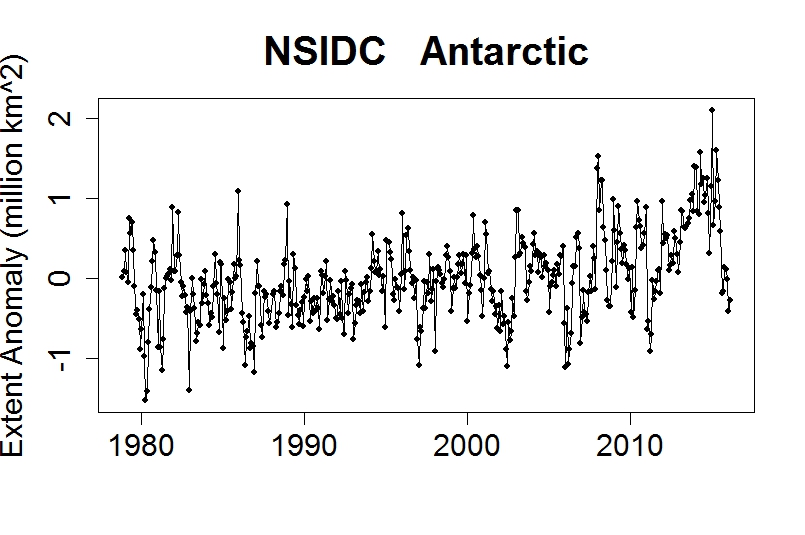
“Also, this is the current state of SH sea-ice anomaly…”
Very obvious upwards trend.. Thanks.
“But on the graph it says at the top 60-70N ?”
Its hard to see, but there is a negative in front of that lot.
Silly way of doing it because its not obvious to less aware person, but graph is correct for 60-70S.
Toneb March 26, 2016 at 12:17 am
As I posted to David A up-thread …. it is the “waters” around Antarctica that are warming – sub-surface of SST’s.
Toneb March 26, 2016 at 10:50 am
Also, this is the current state of SH sea-ice anomaly…
___
‘Toneb’,
Your claim has been refuted, rather than quibble or insinuate the graph is for the northern hemisphere, how about you attempt to substantiate your claim?
“… it is the “waters” around Antarctica that are warming – sub-surface of SST’s. …”,
Are you even going to attempt to substantiate that with data?
{I note you recently (thrice) dodged direct questions and request to substantiate your other unsupported claim about CO2 rise inducing thermal rise in the atmosphere, but that claim is also unsupported by carefully calibrated ground-based IR astronomical instrument’s IR noise delta, over time, from hundreds of professional instruments looking through the atmosphere every night, and don’t measure any noticeable IR change from continuous CO2 rise, even in the 18 year hiatus, where it rose the strongest. One would think you’d be interested in this fact, or rather, disinterested – but apparently not. http://wattsupwiththat.com/2016/03/16/alarmism-cranked-up-to-absurd-level/#comment-2167565 … confirmation bias much?}
I’m afraid you forget to mention that in fact you mention Antarctic’s eastern part… Western Antarctic is warming quite a lot and looses ice since years. Even the totally misunderstood paper of Jay Zwally (and above all the NASA post referring to it) mentions that fact.
http://www.nasa.gov/feature/goddard/nasa-study-mass-gains-of-antarctic-ice-sheet-greater-than-losses
Bindidon March 27, 2016 at 1:34 pm
First, what does that have to do with the topic of actually cooling subsurface waters, from depth of 0 to 100 m, between -60S and -70 South latitude?
Nothing right? Nice deflection. But your own link’s title negates your imputed alarmism about there being a problem with east Antarctic ice ‘melting’, as the title reads:
“NASA Study: Mass Gains of Antarctic Ice Sheet Greater than Losses” Oct. 31, 2015
Gains greater than losses! This is a warming problem, in your view? Maybe the grid data is not given as it’s not a good look?
Antarctica is undergoing a NET rise in ice growth on both land, and sea, at present. Several graphs posted above bear this out, in various ways as measured fact. You understand this means net transfer of water from ocean and atmosphere to ice sheet, on land, right? That Antarctica is NET freezing up and that the steady trend is to slowly conditions since the beginning of the 1980s?
Looks like CO2 does like Antarctica or the southern ocean? Maybe the earth is not so simple as the IPCC aggregated CO2 consensus dross, and its totally useless allegedly ‘climate’ modeling, hmm?
‘ Gains greater than losses! ‘ That’s all?
You remember me french people commenting articles in their newspaper ‘Le Figaro’.
These folks you can separate into two disjunct subsets: those who read articles, and those who comment solely on the base of the articles’ title.
You seem to belong to the latter subset I guess. Have you ever read that NASA page from start to end?
“We’re essentially in agreement with other studies that show an increase in ice discharge in the Antarctic Peninsula and the Thwaites and Pine Island region of West Antarctica,” said Jay Zwally, a glaciologist with NASA Goddard Space Flight Center in Greenbelt, Maryland, and lead author of the study, which was published on Oct. 30 in the Journal of Glaciology. “Our main disagreement is for East Antarctica and the interior of West Antarctica – there, we see an ice gain that exceeds the losses in the other areas.” Zwally added that his team “measured small height changes over large areas, as well as the large changes observed over smaller areas.”
And a few cm below:
But it might only take a few decades for Antarctica’s growth to reverse, according to Zwally. “If the losses of the Antarctic Peninsula and parts of West Antarctica continue to increase at the same rate they’ve been increasing for the last two decades, the losses will catch up with the long-term gain in East Antarctica in 20 or 30 years — I don’t think there will be enough snowfall increase to offset these losses.”
Last not least:
Zwally said that while other scientists have assumed that the gains in elevation seen in East Antarctica are due to recent increases in snow accumulation, his team used meteorological data beginning in 1979 to show that the snowfall in East Antarctica actually decreased by 11 billion tons per year during both the ERS and ICESat periods.
Thus yes: actually everything looks fine for East Antarctic. In 2018 we’ll know more.
P.S.
(1) ‘You understand this means net transfer of water from ocean and atmosphere to ice sheet, on land, right?’
Any paper clearly confirming that?
(2) Who did mention CO2 and IPCC?
Since the “ozone hole” allows more UV radiation to reach the troposphere does the oxygen and nitrogen absorb and thermalize it near the surface? If so Antarctica should receive more Spring heat.
As a psychology major I didn’t realize I would someday wish I remembered what the Physics Prof said.
Radiation, troposphere, polar winter?
John H,
the “ozone hole” DOES NOT allow more UV radiation to reach anything anywhere.
The only reason there is a per se “ozone hole” is the fact that the UV radiation is not entering the atmosphere above Antarctica during the 6 months of wintertime “darkness” because of the tilt of the earth’s axis. The UV creates the ozone, ….. the lack of UV permits the “hole” to form
Not at all, the ozone hole forms in the Antarctic spring when UV returns to the stratosphere above antarctica, during the darkness in the winter the ozone remains approximately constant.
Through August this winter O3 over the pole was about 250 Dobson with a minimum stratospheric temperature of 179K, as the air started to warm the O3 declined to 101 Dobson on Oct 4th.
Clearly the hole forms in sunlight not in darkness!
http://ozonewatch.gsfc.nasa.gov
Sam, thanks, but the hole is in Spring, not Winter. Short days, but days then. What happens to the extra UV that gets through the Stratosphere? Is it absorbed by O2, N2, liquid water or does it just bounce back to space?
Phil, your miseducation of/on the creation and distribution of atmospheric ozone can be “fixed” (re-nurtured) ….. but only if you choose to recognize and accept the factual science as noted below, to wit:
And John H, the per se “ozone hole is in Spring” is also explained in the following.
And pay special attention to the BOLD text because it is of utmost importance.
Ya’ll have a better day tomorrow. Cheers
Samuel C Cogar March 27, 2016 at 5:43 am
Phil, your miseducation of/on the creation and distribution of atmospheric ozone can be “fixed” (re-nurtured) ….. but only if you choose to recognize and accept the factual science as noted below, to wit:
The material you posted has absolutely nothing to do with the formation of the ‘ozone hole’, which is caused by the springtime UV over the pole.
Phil, Solar generated UV is never “over” the pole, ….. either pole, ….. springtime or otherwise.
The closest the Sun’s UV gets to being “over the pole” is the Tropic of Cancer and/or Capricorn.
http://www.solsticebahamas.com/images/Tropic.jpg
Samuel C Cogar March 28, 2016 at 6:09 am
Phil, Solar generated UV is never “over” the pole, ….. either pole, ….. springtime or otherwise.
The closest the Sun’s UV gets to being “over the pole” is the Tropic of Cancer and/or Capricorn.
You have some very strange ideas!
And yet UV is measured on an hourly basis at the S pole.
In fact the Dobsonmeter which is used to measure the total Ozone over the Pole does so by measuring solar UV at two wavelengths there, according to you that is impossible!
When a person uses the word “strange” as an adjective in the context of the above statement …… it highly infers that said person is utterly ignorant about the subject matter that said “ideas” are in reference to.
Samuel C Cogar March 29, 2016 at 5:28 am
You have some very strange ideas!
When a person uses the word “strange” as an adjective in the context of the above statement …… it highly infers that said person is utterly ignorant about the subject matter that said “ideas” are in reference to.
The person who states that the Sun doesn’t shine over the poles is the one who is ‘utterly ignorant’ about the subject. Describing it as a strange idea is a rather mild response.
Phil,
Your “approximately constant,” is actually a slow decline in ozone. While the photo-catalyzed destruction of ozone ramps up with the arrival of sunlight in the early-Spring, it should be noted that it is the presence of the Antarctic polar vortex that blocks ozone from lower latitudes that allows low levels to be reached. Typically, there are regions of high ozone outside the vortex. When the polar vortex breaks up, the air is able to move into the so-called ‘hole’ and restore ‘normal’ conditions. What is going on is creation and destruction simultaneously. It is the polar vortex that unbalances the two processes. One should also note that the early-Spring sunlight has a long slant range and passes through normal ozone concentrations for much of what arrives. Rayleigh scattering also plays a role in the distribution of UV. The ‘hole’ is much less of a danger than is usually claimed.
All that jargon and such, Ice doesn’t melt if it is not warm enough, they are trying to say it’s warm yet ice is not melting.
No matter how convoluted you make it, Ice doesn’t form in a warm environment.
Anyone here want to try creating ice from water from warming the air?
Sometimes the simple answer is the right one. The warming is not where the ice is.
2015 sea ice above 1979 levels, “declining”?
Antarctica is NOT warming. The northern peninsula of Antarctica [4% of total area) is warming. The interior is as cold as ever.
Is it only me or does the actual pole of cold seem to coincide with the magnetic pole? It certainly seems to do so at present in the northern hemisphere? Is this a temporary thing? Or just a temporary coincidence? The magnetic pole moves around pretty quickly…
Almost all ozone (99+%) is caused by Solar EUV. The great climate change is now on; Solar EUV has crashed to 85 sfu [remember, minimum is about 65 sfu; max is about 250 sfu]. It will remain low until the next Solar Cycle peak [Solar Cycle 25] in about 10 years.
Solar EUV measured by the proxy on Earth at Penticton, Canada, is a great indication of Solar Energy reaching the Earth.
SFU:
1) 65 to 100 sfu -> Earth temperature cooling
2) 100 to 120 sfu -> Earth temperature constant
3) 120 up -> Earth temperature warming.
Now we will see what climate change is really about!!
Not true, EUV is below 100nm which is not a major player in ozone production (there’s not much of it anyway). The major production of O3 is in the range 240-160 nm, UV-C.
In any case the Sun produces almost all ozone!
And Lightening “flashes” …. or “flashes” of lightening, …. also create great amounts of ozone.
‘ Why does the Antarctic sea ice trend resist decline? ‘
Wrong question I guess… Better would be to ask:
Why should the Antarctic sea ice trend not resist decline?
Antarctic sea ice gets bigger and bigger around Antarctic’s Eastern part, which is the coldest place on earth with -37 °C average temp.
This repeated discussion about sea ice imho hides the fact that Western Antarctic and the Peninsula really experience warming.
In the UAH6.0betax datasets, we can see that inbetween they fully cover the poles:
http://vortex.nsstc.uah.edu/data/msu/v6.0beta/tlt/uahncdc_lt_6.0beta5.txt
NoPol 60N-90N, SoPol 90S-60S
Isn’t it time for UAH to publish, like Japan’s JMA does for its surface data, a monthly grid of 72×36 cells helping us in better differentiating where it cools and where it warms in the polar regions?
“Antarctica is showing strong warming in other areas, and is experiencing the consequences of this warming, such as the dramatic breakups of ice shelves on the Antarctic Peninsula”… which is on the Pacific Ring of Fire…..
Anomalous hot spots in the ocean, 3 C warmer along this coast indicate one thing to me, and it isn’t CO2.
Why is sea ice increasing? Because increasing ice accumulation on land (which is cooling) is feeding the sea ice or the sea ice isn’t melting as fast (because its cooling).
Either way its cooling.