By Larry Kummer. From the Fabius Maximus website.
Summary: This post looks at an often asked question about climate science — how accurate are its findings, a key factor when we make decisions about trillions of dollars (and affecting billions of people). Specifically, it examines the oceans’ heat content, a vital metric since the oceans absorbing 90%+ of global warming. How accurate are those numbers? The error bars look oddly small, especially compared to those of sea surface temperatures. This also shows how work from the frontiers of climate science can provide problematic evidence for policy action. Different fields have different standards of evidence.
“The spatial pattern of ocean heat content change is the appropriate metric to assess climate system heat changes including global warming.”
— Climate scientists Roger Pielke Sr. (source).
Warming of the World Ocean

NOAA website’s current graph of Yearly Vertically Averaged Temperature Anomaly 0-2000 meters with error bars (±2*S.E.). Very tiny error bars. Reference period is 1955–2006.
.
Posts at the FM website report the findings of the peer-reviewed literature and major climate agencies, and compare them with what we get from journalists and activists (of Left and Right). This post does something different. It looks at some research on the frontiers of climate science, and its error bars. The subject is “World ocean heat content and thermosteric sea level change (0–2000 m), 1955–2010” by Sydney Levitus et al, Geophysical Research Letters, 28 May 2012. Also see his presentation. The bottom line: from 1955-2010 the upper 700 meters of the World Ocean warmed (volume mean warming) by 0.18°C (Abraham 2013 says that it warmed by ~0.2°C during 1970-2012). The upper 2,000m warmed by 0.09°C, which “accounts for approximately 93% of the warming of the earth system that has occurred since 1955.”
Levitus 2012 puts that in perspective by giving two illustrations. First…
“If all the heat stored in the world ocean since 1955 was instantly transferred to the lowest 10 km (5 miles) of the atmosphere, this part of the atmosphere would warm by ~65°F. This of course will not happen {it’s just an illustration}.”

World Ocean of ocean heat content (1022 Joules) for 0–2000 m (red) and 700–2000 m (black) layers based on running pentadal (five-year) analyses. Reference period is 1955–2006. Each estimate is the midpoint of the period. The vertical bars represent ±2.*S.E. Click to enlarge.
Second, they show this graph to put that 93% of total warming in perspective with the other 7%. …

A large question about confidence
These are impressive graphs of compelling data. How accurate are these numbers? Uncertainty is a complex subject because there are many kinds of errors. Descriptions of errors in studies are seldom explicit about the factors included in their calculation.
Levitus says the uncertainty in estimates of warming in the top 2,000 meters of the world ocean during 1955-2010 is 0.09°C ±0.007°C (±2 S.E.). That translates to 24.0 ±1.9 x 10²² Joules (±2 S.E.). That margin of error is reassuring — an order of magnitude smaller than the temperature change. But is that plausible for measurements of such a large area over 55 years?
Abraham 2013 lists the sources of error in detail. It’s a long list, including the range of technology used (the ARGO data became reliable only in 2005), the vast area of the ocean (in three dimensions), and its complex spacial distribution of warming both vertically and horizontally (e.g., the warming in the various oceans ranges from 0.04 to 0.19°C).
We can compare these error bars with those for the sea surface temperature (SST) of the Nino3.4 region of the Pacific — only two dimensions of a smaller area (6.2 million sq km, 2% of the world ocean’s area). The uncertainty is ±0.3°C (see the next section for details). That’s two orders of magnitude greater than the margin of error given for the ocean heat content of the top 2,000 meters of the world ocean — ±0.007°C (±2 S.E.). Hence the tiny error bars in the graph at the top of this post.
If the margin of error is just the same magnitude as that given below for NINO3.4 SST, then it is a magnitude larger than the ocean temperature change of 1955-2010 for the upper 2,000 m. How do climate scientists explain this? I cannot find anything in the literature. It seems unlikely to realistically describe the uncertainty in these estimates.

From Australia’s Bureau of Meteorology.
Compare with the uncertainty of SST in the Niño3.4 region
Here NOAA’s Anthony Barnston explains the measurement uncertainty of the sea surface temperature (SST) of the Pacific’s Nino3.4 region. This is a comment to their “December El Niño update“. Barnston is Chief Forecaster of Climate and ENSO Forecasting at Columbia’s International Research Institute for Climate and Society. He does not say if the ±0.3C accuracy is for current or historic data (NOAA’s record of the Oceanic Niño Index (based on the Niño3.4 region SST) goes back to 1950). Above I conservatively assumed it is for historic data (i.e., current data has smaller errors). Red emphasis added.
“The accuracy for a single SST-measuring thermometer is on the order of 0.1C. … We’re trying to measure the Nino3.4 region, which extends over an enormous area. There are vast portions of that area where no measurements are taken directly (called in-situ). The uncertainty comes about because of these holes in coverage.
“Satellite measurements help tremendously with this problem. But they are not as reliable as in-situ measurements, because they are indirect (remote sensed) measurements. We’ve come a long way with them, but there are still biases that vary in space and from one day to another, and are partially unpredictable. These can cause errors of over a full degree in some cases. We hope that these errors cancel one another out, but it’s not always the case, because they are sometimes non-random, and large areas have the same direction of error (no cancellation).
“Because of this problem of having large portions of the Nino3.4 area not measured directly, and relying on very helpful but far-from-perfect satellite measurements, the SST in the Nino3.4 region has a typical uncertainty of 0.3C or even more sometimes.
“That’s part of why the ERSSv4 and the OISSTv2 SST data sets, the two most commonly used ones in this country, can disagree by several tenths of a degree. So, while the accuracy of a single thermometer may be a tenth or a hundredth of a degree, the accuracy of our estimates of the entire Nino3.4 region is only about plus or minus 0.3C.“
Examples showing careful treatment of uncertainties by scientists
The above does not imply that this is a pervasive problem. Climate scientists often provide clear statements of uncertainty for their conclusions, such as in these four examples.
(1) Explicit statements about their level of confidence
Activists — and their journalist fans — usually report the findings of climate science as certainties. Scientists usually speak in more nuanced terms. NOAA, NASA, and the IPCC routinely qualify their confidence. For example, the IPCC’s confidence statements are quite modest.

NOAA 2014 State of the Climate
(2) Was 2014 as the hottest year on record?
NOAA calculated the margin for error of the 2014 average surface atmosphere temperature: +0.69°C ± 0.09 (+1.24°F ± 0.16). The increase over the previous record (0.04°C) is less than the margin of error (±0.09°C). That gives 2014 a probability of 48% of being the warmest of the 135 years on record, and 90.4% of being among the five warmest years. NOAA came to similar conclusions. This is not a finding from a frontier of climate science, but among the most publicized.

(3) The warmest decades of the past millennium
Scientists use proxies to estimate the weather before the instrument era. Tree rings are a rich source of information: aka dendrochronology (see Wikipedia and this website by Prof Grissino-Mayer at U TN). The latest study is “Last millennium northern hemisphere summer temperatures from tree rings: Part I: The long term context” by Rob Wilson et al in Quaternary Science Reviews, in press.
“1161-1170 is the 3rd warmest decade in the reconstruction followed by 1946-1955 (2nd) and 1994-2003 (1st). It should be noted that these three decades cannot be statistically distinguished when uncertainty estimates are taken into account. Following 2003, 1168 is the 2nd warmest year, although caution is advised regarding the inter-annual fidelity of the reconstruction…”
(4) Finding anthropogenic signals in extreme weather statistics
“Need for Caution in Interpreting Extreme Weather Statistics” by Prashant D. Sardeshmukh et al, Journal of Climate, December 2015 — Abstract…
“Given the reality of anthropogenic global warming, it is tempting to seek an anthropogenic component in any recent change in the statistics of extreme weather. This paper cautions that such efforts may, however, lead to wrong conclusions if the distinctively skewed and heavy-tailed aspects of the probability distributions of daily weather anomalies are ignored or misrepresented. Departures of several standard deviations from the mean, although rare, are far more common in such a distinctively non-Gaussian world than they are in a Gaussian world. This further complicates the problem of detecting changes in tail probabilities from historical records of limited length and accuracy. …”
For More Information
For more information about this vital issue see The keys to understanding climate change and My posts about climate change. Also here are some papers about warming of the oceans…
- “The annual variation in the global heat balance of the Earth“, Ellis et al, Journal of Geophysical Research, 20 April 1978.
- “Heat storage within the Earth system“, R.A. Pielke Sr., BAMS, March 2003.
- “On the accuracy of North Atlantic temperature and heat storage fields from Argo“, R. E. Hadfield et al, Journal of Geophysical Research, January 2007.
- “A broader view of the role of humans in the climate system“, R.A. Pielke Sr., Physics Today, November 2008.
- “World ocean heat content and thermosteric sea level change (0–2000 m), 1955–2010” by Sydney Levitus et al, Geophysical Research Letters, 28 May 2012.
- “A review of global ocean temperature observations: Implications for ocean heat content estimates and climate change“, J.P. Abraham et al, Reviews of Geophysics, September 2013.
- “An apparent hiatus in global warming?“, Kevin E. Trenberth and John T. Fasullo, Earth’s Future, 5 December 2013 — Also see Trenberth’s “Has Global Warming Stalled” at The Conversation, 23 May 2014.
- “Sixteen years into the mysterious ‘global-warming hiatus’, scientists are piecing together an explanation.“, Jeff Tollefson, Nature, 15 January 2014 — Well-written news feature; not research.
The oceans are, on average, 6,400 meters deep.
This begs the question: What’s going on in the 70% of the ocean we didn’t measure?
So… we think we know that the top 30% has gone up 9/100th of a degree.
I have heard, need reference tho, that the temperature of the deep ocean (2,000-6,400m) has remained unchanged.
Therefore, on average, the entire ocean has only heated up by about 3/100th of a degree.
Boiling indeed. Time to increase taxes on the middle class.
A missing slide in this year’s presentation about the warmest year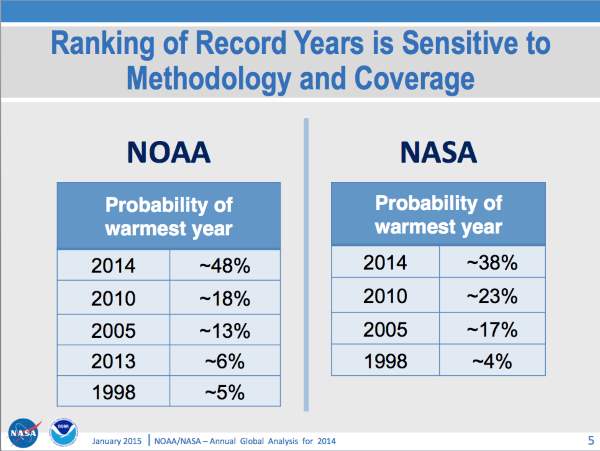
It was in last year’s “NOAA/NASA Annual Global Analysis for 2014”, although (embarrassingly) not mentioned until highlighted by skeptics. It’s not in the Annual Global Analysis for 2015.
I just wrote a post about the careful statements about probability and error estimates by NASA & NOAA, specifically mentioning this slide from last year. Gavin and Karl are making me look bad.
Here it is from last year’s slideshow. It should be in this year’s, even if the numbers were 100% for 2015.
The warming of the oceans may very well be the swan song of a modern warm period. Meaning that heat is not being added to the oceans, what was stored is layering out onto the surface and spreading like an oil slick. A diminution of winds would be teleconnected with this. In fact any wind that counteracts the normal winds set up by the Coriolis affect would serve to let the oceans layer up and its warm surface spread out.
We are losing heat, not gaining it.
Pamela Gray
So. Is the loss of Antarctic sea ice between late August and today (averaging about 0.6 Mkm^2 lower than its slowly increasing yearly average levels) due to the strong El Nino conditions in the east Pacific sub-tropics as it spreads out around the usual antarctic circular winds and southern currents?
Last year’s northwest Pacific “blob” of warm weather can be clearly timed to the singular loss of Southerner arctic sea ice in the Sea of Okhotsk north of Japan.
” _Jim
January 19, 2016 at 2:52 pm
to: ECB
Meanwhile, progress continues on *other* energy fronts, such as detailed here:
https://youtu.be/IQ3S3YMH96s Nota Bena: 1 hr plus video (and ignore the refs to GW)”
I stayed with this video for 29 minutes, and watched the closed captions as well (among the worst I’ve ever seen, BTW), and found the explanation for the unanimous rejection by academics, government, and investors quite inadequate.
Assuming the original experiment was honestly performed and reported, governments and private investors with deep pockets should have been all over it. The fact that they were not leaves me with only two possible explanations:
1. the results were NOT as reported, or
2. there was a global conspiracy among academics, government agencies, and investors to discredit the experiment for social, financial, and military reasons.
Lest anyone dismiss #2 as “conspiracy theory” rearing its ugly head, please consider that this forum provides regular documentation of just such a conspiracy in the realm of “climate change”, and consider your objection noted and answered – far more egregious and much more easily confounded misinformation conspiracies have been successfully perpetrated, including the attribution to the German Army for more than 40 years of the Katyn Wood massacre of the Polish Officer corps, and the reporting of the death toll for the Tang Shan earthquake of 1976 for decades at a mere 10,000.
Historians and journalists re-attributed the Katyn Wood massacre, carried out by soviet troops in plain view of the local villagers (who were NOT transported or imprisoned to keep them quiet) only a few years ago. The Polish President, accompanied by his closest advisers and the chief of the Polish defense staff flew to Russia in part to remonstrate about the massacre shortly after this “revelation”, and his plane crashed on Russian soil, killing everyone aboard.
The Tang Shan death toll was tacitly revised upward to some 250,000 by the Chinese government censors when they allowed a recent mainland movie about the earthquake to display this figure. The more likely figure, given the report of a French delegation visiting the city of 1 million people at that time, that every second building was reduced to rubble in the middle of the night, is half a million dead.
There isn’t much discussion in our mass media about the role of energy distribution systems’ in social control, perhaps because we have become so accustomed to this role as a given.
Providing small communities, families, or individuals with enough locally stored energy to assure a scaleable and uninterruptible supply of electricity for years would reduce the power of central government over the individual dramatically throughout the world. And in many regions, it could well cause or fan conflicts more destructive than the breakup of Yugoslavia.
hmm. posting problem. hit “post comment”, post disappears, nothing showing in comments. Try again… please remove duplicate if any.
Hmmm repost impossible, this time “post comment” button doesn’t respond. try once more…nope
closed the forum link. Closed my email account, logged back in to e-mail, clicked on the Jan. 19 WUWT news and this new item. And find that, for the first time ever, my e-mail address and username are automatically displayed in the Post comment identification form.
Most disturbing. I did NOT choose to log in via any social media links, but my subscription to WUWT is via a gmail account. Not happy about this breach of security.
What do we know about the temperature south of about 45S before 1979. Very little or nothing.
The good news is that to understand this work we can ignore the mental states of the scientists involved — which is always a good idea. Motives don’t matter.
____
Sure. With some obesiety or negligent posture a corset helps.
The mental equivalent for a corset is discipline – and that can be passed on in the form of dogma. So the helpers too remain permanently stable.
Motives are handed over
simultaneously, no understanding needed.
The only prerequisite for the commanding encoder are
charisma and the promise of
success.
But that’s banal – same as it ever was.
Regards – Hans