A runaway JLENS aerostat highlights the uncertainty and risks of pie-in-the-sky green energy schemes.

Guest essay by Tom Scott
One reason that a fragile naked human species has adapted to conditions in every corner of every continent is its ingenuity. Its is simply impossible to know the limits of homo sapiens. That said, one tactic of the green blob, used to rationalized the destruction of existing energy infrastructure, has been to throw out the possibility of one “free energy” scheme after another while ignoring or actively hiding the unknowns, risks, costs, and public dangers associated with each new proposal.
But first a quick review for those who did not see the news reports. On October 28th a 240 foot long (80 meter) aerostat, or tethered blimp, broke loose from its mooring and drug 6,700 foot of cable for some distance, apparently knocking out power for about 20,000 customers. This blimp was one of several in a multi billion dollar Federal system call JLENS. Two aerostats have been in service for less than a year in a Baltimore suburb, but this is at least the second time one of the devices has broken loose.
How could such a thing happen? At least one comment to the Baltimore Sun article referenced below was right on point.
“I worked on the PTDS (very similar) balloons in Afghanistan for a year and what they don’t tell you is that it’s not really the “wind” that makes them break free, it’s the slack and then sudden tension applied to the tether. You are NOT going to stop it. We lost millions of dollars worth of balloons over there.”
The JLENS aerostat operates on a 10,000 foot long cable. Consider for a moment some of the proposed power schemes wherein huge fleets of devices would float 20,000 feet overhead, tethered by 30,000 foot long cables, and collect/generate lots of “free” power.
What could possibly go wrong with that scheme? Not to mention the huge areas of airspace which must be confiscated from public use because of the cables and their swing and unpredictable catenary.

It would be impossible to make a blanket claim that pie-in-the-sky energy schemes could never work. And I applaud anyone who would apply intellect, hard work, and their own investor’s money toward innovative schemes. But a bird in hand is worth 100s of unproven ideas.
Until a concept is tested and proven by experience and a long operating record, and its costs and benefits are truly known, it can never be properly compared to a real production system, much less serve as a rationale for destroying existing infrastructure. If you think otherwise, I suggest you browse the past 90 years or so of “Popular Mechanics”, “Mechanics Illustrated”or “Popular Science” and then ask yourself why so many of those great-sounding ideas never made it past a drawing board and into everyday life.
References:
http://www.defenseone.com/technology/2014/12/drone-hunting-blimp-launch-over-washington-dc/101328/
http://www.foxnews.com/us/2015/10/28/2-fighter-jets-track-jlens-blimp-that-has-broken-free-its-tether-in-maryland/?intcmp=hplnws
http://www.baltimoresun.com/news/maryland/harford/aberdeen-havre-de-grace/bs-md-jlens-blimp-loose-20151028-story.html
Really! Who wants their view to look something like this?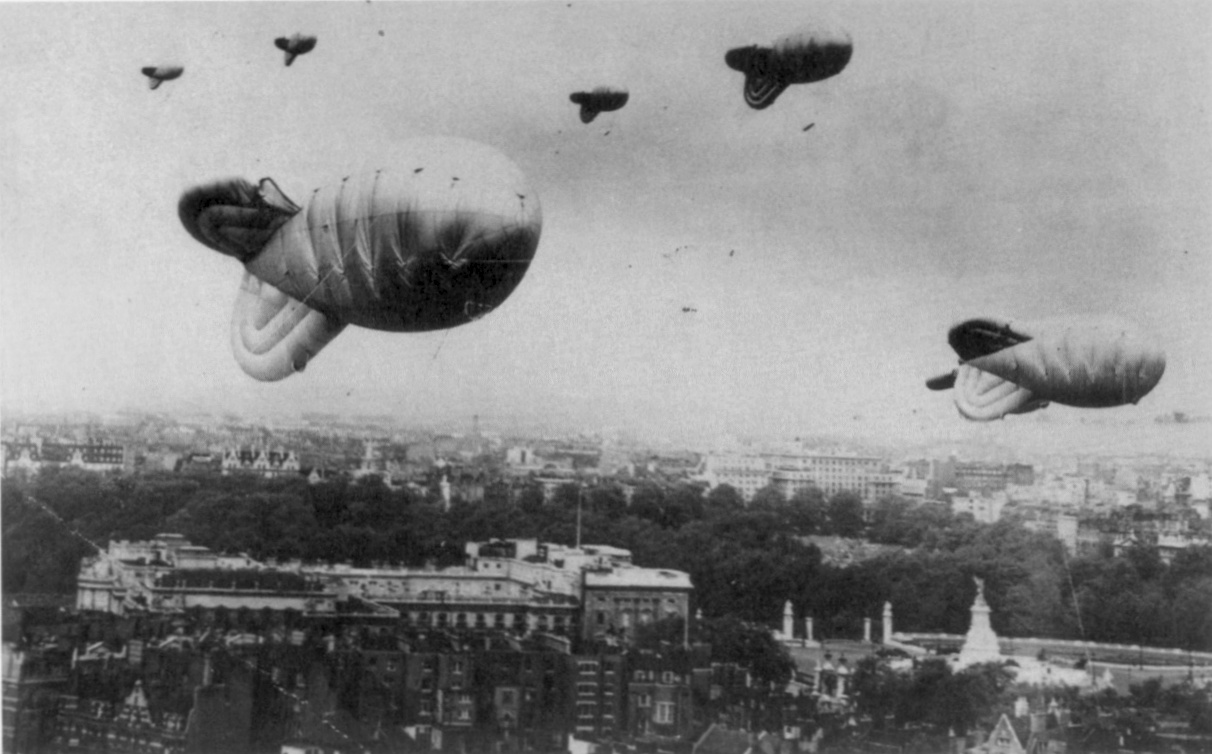
Park the Blimps in a Hanger!
Regards
Climate Heretic
What a waste of Helium, that can be put to better use by scuba divers.
I don’t understand why modern, fire proof materials are not used to form a Hydrogen dirigable with multiple small cells to contain any fire, along with strategically distributed CO2 containers to put out any fire that may start.
Look, if you’ve got so much money (that the taxpayers paid for) that all you can think of is a blimp that levitates your radar systems, while being a sitting duck….I just gotta ask, where did all the money go ?
Seriously, where did all the money go ??
We have, as Anthony knows, been here before in 2012, and Numberwatch back in 2007: http://wattsupwiththat.com/2012/09/10/enough-wind-to-power-global-energy-demand-except-when-the-wind-doesnt-blow/
Do the calculation: “How much does the tether weigh?” for a device high up in a constant wind stream. Then roll over and go back to sleep.
Martin
+++
At sea – water density 1025 – iron/steel anchors work, with iron/steel ships.
In air – density 1 – frankly, my dear, not much does.
Innovation may find a way.
And Nature can trial it . . . . .
At least, if the tie-cables all detach from the blimp, little damage will be done.
If they detach at the ground end – we know they take out a county – or more.
Auto, admiring the innovation!
Flying so high it will be difficult for Don Quichotte to battle with it.
Drag is a regular verb so the past tense is “dragged”. While turning drag into “drug” as if it were an irregular verb might be a common grammatical error in the US, its use in a public paper does not make it right. Otherwise, and interesting read.
Mike
It communicated.
Not perfect – but most [all?] of us understood.
Tomorrow is Friday.
Auto
I think it used to be drug in English too. Any Chaucer experts around? The French complain of the French Canadian accent and grammar and vocabulary, but in the 18th. century, this is how French was … and still is in remoter parts of Normandy and Brittany, where many french Canadians came from.
Amazing the guy in the video must be a standup comedian, I still laugh
In addition to all the comments here about how nutty tethered balloon wind harvesters are (economic, safety), are we not at or past peak helium.
JLENS, Joint Land Attack Cruise Missile Defense Elevated Netted Sensor System. They carry radar that can warn a territory the size of Texas about airborne threats.
I must be missing something, These are balloons. Tethered with thousands of feet of cable. They are fragile to enemies and natural forces or cut the cable and let the balloon do damage across the country side as it did by accident in this case. In a real war I hope this is not what we are banking on for warning of airborne threats.
During the depths of the Cold War, the DEW line of manned radar sites across northern Canada and Alaska would’ve warn of an approaching Soviet bomber attack. (now unmanned sites are used). Of course they are fixed sites with known coordinates, and could be taken out in the first attack wave, but their purpose would have been served, warning. In a pre-emptive attack, the adversary would try to compress and mass the attack to achieve maximum damage and surprise. Satellites now can reliably can detect ballistic missile launches and large bomber aircraft, but small low observable CMs are a real problem. Planners trying to devise defense strategies and warning signs with viable reaction times to protect, preserve your forces need to have reasonable estimates of warning times to plan those precautionary reactions as viable options to military and NCA leadership.
Of course as Mike Tyson once said, “Everyone has a plan until they get punched in the nose.”
I don’t believe that a 2015 instrument package is design for cruise missiles or Soviet aircraft. As you say, airborne threats can be in the form of small domestic planes, balloons, drones etc of the form a small terrorist cell may configure to dispense dirty radioactive material or anthrax or whatever evil genius stuff these a-holes can dream up and I am sure they are dreaming them up hourly.
I would hope that the JLENS is jam packed with seized alien electronics and mind reading antennas ( that was a joke) or the most advanced passive sensors and …jammers in existence.
The balloon platform may well be a scam to use green grants to fund homeland security initiatives. A scam inside a scam.
Something to keep in mind here is that there are “Blimps’ and there are “Balloons”. Both have limits. Within those limits they can be and are often are very useful. (In WW2, no convoy escorted by a (manned) blimp lost a ship.)
The technology is fine. What they want to do with it is questionable.
worth noting:
29 Oct: UK Register: Shaun Nichols: US govt drafts Google, Walmart, Amazon, BestBuy execs for drone registration system
Task force to draw up database for owners of flying gizmos
The US Federal Aviation Administration (FAA) has named the 25 people who will draft the blueprints for a nationwide database of drone owners.
As promised by the FAA and US Department of Transportation (DOT), the task force consists of individuals from companies and organizations that make and sell drones, as well as pilots, crimefighters, and hobbyist organizations…
The FAA said the task force will have until November 20 to decide what recommendations it should make on how to roll out drone registration. The group will gather to meet from November 3-5 to hash out the recommendations.
Chairing the board will be Earl Lawrence of the FAA and Dave Vos of Google X. Vos leads Google’s Project Wing drone delivery experiment…
http://www.theregister.co.uk/2015/10/29/faa_committee_drone_registration/
28 Oct: IEEE Spectrum: Evan Ackerman: Wal-Mart Wants to Use Delivery Drones, Our Skepticism Reaches New High
http://spectrum.ieee.org/automaton/robotics/aerial-robots/walmart-delivery-drones
Google’s Loon project on BBC radio yesterday had plenty of caveats about interference with planes, drifting off or going down cutting internet connections etc.., but it’s all pretty much positive in Kelion’s documented BBC version and the second AP link:
28 Oct: BBC: Leo Kelion: Google’s Project Loon internet balloons to circle Earth
Google believes it is on course to have enough internet-beaming balloons in the stratosphere to form a ring over part of the world next year…
The declaration coincides with the announcement that three of Indonesia’s mobile networks intend to start testing Project Loon’s transmissions next year…
Google suggests that Project Loon would be a cheaper solution than installing fibre optic cables or building mobile phone masts across all of Indonesia’s islands, which contain jungles and mountains…
It is also pursuing a separate effort codenamed Titan, which aims to use solar-panelled drones to provide the internet to unconnected parts of the world.
Facebook is also developing a similar drone-based scheme.
http://www.bbc.com/news/technology-34660205
29 Oct: UK Telegraph: AP: Google’s Internet-beaming balloons to take off in Indonesia
Balloons will begin hovering in the stratosphere above Indonesia in an expansion of ‘Project Loon’
About 250 million people live in the country composed of about 17,000 islands in that part of southeast Asia, although only 42 million have Internet access, according to the CIA’s estimates.
Google’s 2-year-old “Project Loon” programme aims to change that by transmitting high-speed Internet signals from clusters of balloons floating about 60,000 feet above the Earth…
To pull it off, the project’s engineers must choreograph a high-altitude dance, ensuring that as one balloon drifts out of a targeted territory’s Internet-receiving range, another one will float in to fill the void…
http://www.telegraph.co.uk/technology/google/11962052/Googles-Internet-beaming-balloons-to-take-off-in-Indonesia.html
You could approve a billion dollar budget for a military project, and they’d spend 1.1 Billion, have nothing much to show for it, and come back to the senate ask for more.
Works like this…
$50,000 = One military grade monkey wrench ($50.00 via Chinese sub-contractor), Contractor gets $49,950.00 R&D and manufacturing. Donates to the most helpful appropriations committee’s favored party.
$100,000 = One military grade monkey wrench ($50.00 via Chinese sub-contractor), Contractor gets $99,950.00 R&D and manufacturing. Donates to the most helpful appropriations committee’s favored party.
$1,000,000 = One military grade monkey wrench ($50.00 via Chinese sub-contractor), Contractor gets $999,950.00 R&D and manufacturing. Donates to the most helpful appropriations committee’s favored party.
See how that works?
I was curious as to the material used for the tether and found out that it is made from Vectran fibers (specific grade not indicated).
Since any long cable hung from high elevations has a critical length where it will fail near the top because of it’s own weight . So a high strength to weight ratio is important. It appears that Vectran HT has a value of 229 Km versus 7.9 Km for stainless steel, thus its suitability for a long tether. Since the tether apparently did not fail at the top the weight was likely not the primary cause of failure assuming the remaining cable length was still long.
One would need to be suspicious that a potential cause of failure could be a defect in a 10,000 foot long cable, since the probability of a defect increases with the cable length
Material compafisons
Material Density (g/cm3) Tensile Strength (G Pa) Specific Strength (km*) Tensile Modulus (G Pa) Specific Modulus (km**)
*Specific strength = Strength/Density (also divided by force of gravity for SI units). Also known as breaking length, the length of fiber that could be held in a vertical direction without breaking.
** Specific modulus = Modulus/Density (also divided by force of gravity for SI units). This measure increases with increasing stiffness and decreasing density.
(KAI data)
Vectran NT 1.4 1.1 79 52 3700
Vectran HT 1.4 3.2 229 75 5300
Vectran UM 1.4 3 215 103 7400
Titanium 4.5 1.3 29 110 2500
Stainless Steel 7.9 2 26 210 2700
We’ve got two different technologies being discussed here:
1. Blimps/balloons carrying (relatively) lightweight sensor systems for military use, that ‘only’ need tethering to the ground. Yes, the technology for a strong tether (Vectran) is possible for even a blimp up very, very high. It would be (relatively) easy to design an explosive charge pack at the top of the tether that could be fired to release the tether if it broke along its length, or at the ground attachment point, to avoid it causing havoc as it’s dragged along the ground over power cables and buildings.
2. Energy-generating gear-boxed turbines in the sky. We haven’t got a technology for a tether than can carry the current, for a device up in the high-wind stratosphere. Easy to attach a turbine to a blimp – impossible to get the current to the ground over a very long (pair) of cables. Any company attempting this is going to simply lose a lot of money for its investors.
Those things have been in use since at least the 1970s when they were used to provide a radar look-down capability along our southern coast after one or two Cuban aircraft entered the USA at low level. They gave long duration surveillance. Can’t recall them being a problem back then. Maybe everyone just kept quiet about it.
Fat Albert was in service for many years on Cudjoe Key. It was neat to drive by and get a peek whether it was deployed or moored at the moment. This was the ideal topography for such a device, but I suspect they had many thrills dealing with afternoon thunderstorms and the related wind gusts and shear.
@ur momisugly Tom Scott
Consider this for a moment, also.
“A space elevator is a proposed type of space transportation system.[1] Its main component is a ribbon-like cable (also called a tether) anchored to the surface and extending into space (35,800 km altitude). It is designed to permit vehicle transport along the cable from a planetary surface, such as the Earth’s, directly into space or orbit,” https://en.wikipedia.org/wiki/Space_elevator
The difference is that everyone knows the space elevator is a pie in the sky dream and aren’t telling us to rely on it for basic needs. I’ve been repeatedly told that the only reason we don’t have these wind-powered blimps up and running is a big-oil conspiracy.
Balloons are not the answer. The only practical solution is a space tether similar to the space elevator in the science fiction novel “The Fountains of Paradise” by by Arthur C. Clarke.
Side Note: I heard of a really good deal on the Brooklyn Bridge and am seeking investors.
Update 2137 : Terrorists fly commercial space planes into HEGST (Humongous Electricity Generating Space Tether), a billion tons of cable falls to earth in a swath of mass destruction.
Far from me to second guess what our best sneaky bastards are up to.
But, this just looks like an easy target 🙂
If everyone is enjoying lunacy, here are two daft ideas:
1. Make a giant mattress of blimps tethered to each other to vector the stresses horizontally across several neighbours and provide ‘ripple’ shock absorption for the vertical impulses.
2. If you can’t get the power down to the ground, just make everyone live in the air – pave the areas in between the balloons, it’ll look just like those Star Wars scenes..
Alright. I know they are stupid ideas. But it only took me five minutes to imagine they might be interesting.. I just have no faith at all in people who can’t even come up with an exciting (but worthless) fantasy in how many years??? Why don’t the balloons have dolphin-skins, and nano-aerofoils, and honeycomb cross-sections, and, oh, all sorts of things, instead of STILL looking so WWII??
The Altaeros BAT is a joke, right? Surely this can’t be a serious contender for the world’s energy supply.