From the Frack On department, and their previous endorsement of fracking comes this new paper that suggests we should not worry about methane leakage, and just get on with coal to Natural Gas conversion.
Via press release today from Berkeley Earth: Natural gas can help reduce global warming – even if it modestly delays renewables
Can natural gas help us reduce climate change by acting as a bridge fuel away from coal? New research from Berkeley suggests that it can, even if it modestly delays the date at which we switch to renewables.
The U.S. is in the midst of a natural gas boom. The combination of horizontal drilling and hydraulic fracturing has caused gas prices to tumble, resulting in a significant shake-up of the U.S. energy mix. Over the past 7 years U.S. CO2 emissions from electricity generation have fallen an impressive 17%, driven in large part by the replacement of dirty coal-fired generation by cleaner natural gas.
Natural gas has two major benefits over coal: it has less carbon emissions per unit of chemical energy, and can be converted into electricity at a higher efficiency (less energy is lost as waste heat). These two combined mean that the CO2 emissions from new natural gas power plants can be as little as one third of the emissions of existing coal plants.
However, natural gas also has a large potential downside: if it is leaks out before your burn it, the 100-year average climate effect of that leaked methane is about 12 times worse for the climate than the effect of CO2 from the same amount of gas if it were burned.
 Additionally, a large investment in gas could potentially delay the date at which we switch to a near-zero-carbon technology compared to a world where we stuck with coal for longer. On the flip side, gas makes it easier to have a large amount of intermittent renewables on the electric grid without causing disruption.
A new paper from Berkeley Earth looks in depth at how different gas leakage rates, generation efficiencies, and potential delays in zero-carbon alternatives impact the viability of gas as a bridge fuel.
As author Zeke Hausfather explains,
“If we replaced current coal generation with new natural gas power plants today, and leakage rates end up being the EPA’s current best estimate, we could use that natural gas for 2.4 years for every year of coal that it replaces before breaking even on warming over the next 100 years.”
“If you compare a coal plant used for 10 years and replaced by renewables to a gas plant used for 24 years and replaced by renewables, you get the same amount of warming. This means that you could end up delaying renewables by quite a bit before the climate benefit of using gas as a bridge fuel is eliminated.”
The results are somewhat sensitive to natural gas leakage rates, which are currently highly uncertain; while the EPA estimates leakage of slightly below 2% of total production, others have found that leakage rates might be as much as 4% or above. However, the paper finds that it would take a leakage rate of 10% to make new gas worse than existing coal if both are used over the next 100 years and renewables are not delayed.

For a shorter 30-year gas bridge, a leakage rate of over 13% would be required.
 This is because the methane has only an 8.6-year half-life in the atmosphere, and breaks down relatively quickly once gas stops being used. If renewables are delayed, the allowable leakage rate is lower.

“Natural gas is still a fossil fuel, and cannot be a long-term solution if the U.S. is to aggressively reduce greenhouse emissions,” Hausfather warns.
A gas bridge would likely have to last less than 30 years, and strong efforts would have to be made to ensure that natural gas leakage rates are kept low. Cheap natural gas can also compete with renewables, and there is an important role for renewable portfolio standards and other government programs to promote the adoption of near-zero-carbon technologies.
“This research suggests that using natural gas as a bridge fuel away from coal is viable if we cannot immediately transition to near-zero carbon technologies. Coal is responsible for the bulk of U.S. CO2 emissions from electricity generation, and gas provides a practical way to reduce such emissions, even when we include the effects of fugitive methane.”
The Paper is OPEN ACCESS.
Bounding the Climate Viability of Natural Gas as a Bridge Fuel to Displace Coal, by Zeke Hausfather is published in the journal Energy Policy.
Download free here: http://authors.elsevier.com/a/1RQ2~14YGgMDsF
This is my favorite part of the paper:
“Funding
Berkeley Earth has received funding from a number of foundations and private individuals, including an unrestricted educational grant from America’s Natural Gas Alliance; none of these had any involvement the in study design, the collection, analysis and interpretation of data, in the writing of the report, or in the decision to submit the article for publication.”
An unrestricted educational grant. I could use a one of those. Champagne and caviar in the research lab. And if the report pleases the pay-master, more unrestricted grants will follow. Richard Muller is a clever salesman.
Berkeley Earth did receive an unrestricted grant from ANGA. However, if my analysis had found that natural gas was worse than coal (or that small delays in near-zero-carbon alternatives obviated any benefit), I wouldn’t have hesitated to say so. I have a paper nearing completion that find that natural gas vehicles are in many cases worse than conventional diesel or gasoline vehicles from a climate standpoint.
It’s probably better saved for plastics feed in anyway. Structure, me boy, structure.
=================
Zeke has myopia. NG is abundant in the US. We happen to have either the largest or the second largest frackable shale gas TRR. A really good lucky deal. Very nice for Berkely California if they would letnthe stuff be burned in CCGT. But they won’t. (China may or may not be larger, a frequent Berkeley Earth theme from founder physiciat Richard Muller, who obviously does not know much about shale geology [essay Reserve Reservations] illustrates the Sichuan basin point). What about the rest of the world? Russia to EU about double. LNG costs are about triple, ask Japan. Zeke, get real.
Ristvan,
We are lucky, and this paper generally discusses U.S. policy. LNG could certainly be cheaper, and technological developments may unlock reserves elsewhere, but today at least most other countries don’t have the luxury of a rapid transition away from coal via natural gas.
Yah, I know all that. As pointed out in the comment to your post. So, what does BE propose for a longer term solution other than Chinese fracked shales—most unexplored as to folding and faulting. For a reaon.
I’m not sure BE has a formal position. Rich is a big fan of next-gen nuclear; I’m a bit more bullish on solar + storage prices falling far enough to be viable. In parts of the world like India I expect we will see more coal in the near term.
” So, what does BE propose for a longer term solution other than Chinese fracked shales—most unexplored as to folding and faulting. For a reaon.”
solution for who?
As Zeke notes this paper is focused on US policy.
As for China, the problem is a bit more difficult not only for the reasons you suggest.
some thoughts on measures that may help.
http://www.vancouversun.com/opinion/op-ed/Opinion+global+pollution/10950478/story.html
And finally as Zeke notes BE doesn’t really have a single voice on things. You are welcomed to come
to berkeley and propose some things for us to study. Just let me know and I will ask to have you
put on the agenda to come and pitch your ideas.
Bill Clinton once called CO2 ‘plant food’, but only once. I think he couldn’t resist the jibe at Al Gore.
And no thank you; you only get my ideas on line.
=================
Rud
” frequent Berkeley Earth theme from founder physiciat Richard Muller, who obviously does not know much about shale geology ”
That;s why we work with smart people like you Rud.. Rich relies on the expertise of Marlan Downey .
There are some people whose daughter’s papers I will no longer read.
==================
The only thing worse than this retreat by Berkeley Earth on natural gas is the complete capitulation by the NRDC and the Sierra Club, who are now conducting both beyond coal and natural gas campaigns.
To the half of the world living without clean water, reliable electricity, advanced Internet technologies and political freedoms, this is simply unconscionable.
Additionally, none of the above-mentioned environmental organizations are willing to acknowledge that natural gas also provides home heat, cooking gas, back-up power for wind and solar’s intermittency and feedstock for the chemical industry.
Waiting for the BE salesmen to appear !!
It can’t be long until Zeke or Mosh leaves their Dodgy Bros saleyard to try to sell this lemon.
“Natural gas has two major benefits over coal: it has less carbon emissions per unit of chemical energy, and can be converted into electricity at a higher efficiency (less energy is lost as waste heat). These two combined mean that the CO2 emissions from new natural gas power plants can be as little as one third of the emissions of existing coal plants.”
This must be questioned, because in my 20+ years as a utility engineer (11years in large power stations) natural gas NEVER was converted into electricity at a higher efficiency than the carbon-rich fuels. Many hundreds more BTU’S of natural gas had to be consumed in order to generate a MW of electricity. Our boilers could switch between nat gas and No.6 Heavy Oil depending on what was cheaper per BTU, and unit efficiency dropped significantly on nat gas. This is because it doesn’t burn as hot (as high a combustion temp) so more has to be burned in order to get the same heat transfer into the boiler water. This also caused an increase in exit gas temperatures (more waste heat, not less) as more of the available heat is consumed generating water vapor which carries it (excess heat) out the chimney.
While it is true that many new plants built to take advantage of cheap nat gas following the fracking revolution are very efficient combined cycle designs and are more efficient than vintage plants, but even they would be more effective using a more energy-rich, i.e., a carbon-rich fuel, because the carbon-rich fuels are more efficient fuels than the hydrogen-rich ones.
Berkeley Earth got that one wrong.
What else did they get wrong ???
I operated in a power plant in the late 70’s where there were both gas and pulverized coal units. The loading flexibility was more determined by the size of the unit than the fuel, but from my experience you can raise load faster on pulverized coal firing. Coal dust burns like gasoline (and will explode like it also).
Hi GW,
Coal plants are on average around 33% efficient in the U.S. New combined cycle gas turbines are ~50% efficient on average. These days the technology has become cheap enough that most new gas capacity is combined cycle.
See historical EIA data on heat rates for various generation sources: http://www.eia.gov/electricity/annual/html/epa_08_01.html
“Natural gas has two major benefits over coal: it has less carbon emissions per unit of chemical energy,”
===================================================================
Strike one, as CO2 is clearly net beneficial.
Hello Zeke,
I’m sorry, but you’re missing my point ! The difference you stated above is due to mechanical advancements in the heat cycle (machinery) – not in the combustion of the fuel consumed. Burn oil or coal in a similar combined cycle plant (designed for the fuel) and the efficiency will be greater still ! Moreover, you are neglecting the statement in the article that says “natural gas can be converted to electricity more efficiently than coal”.
I am comparing the efficiency of the fuel – nat gas vs. oil or coal (carbon rich). Meanwhile,
You are comparing the efficiency of the machinery.
To be clear, I am stating that if the machinery were designed to use oil or coal the efficiency would be even greater !
And, regarding the Heat Rate in your link, let me tell you, and everyone this : The 185 MW units (around 1960 vintage) of which I spent half of my 11 years as an operating engineer, typically had a heat rate of 10,100 -10,200 Btu / KW while burning No.6 oil, but on nat gas the Heat Rate would climb to 10,600-10,700 Btu / KW – everything else being equal. This is because nat gas is a less efficient fuel than oil (or coal, which these same units burned in the decades prior to my employment), and this fact (oil/coal vs. gas) was well understood in the industry.
AND I KNOW, because for over six years I had to explain any significant deviation from those Heat Rates (100 or more Btu’s) on a monthly basis to both the Plant Manager and the Electric Production Department Manager, which I will attest was often an unpleasant experience !
MOREOVER, the chart you linked to utterly neglects the fact that the petroleum and coal plants are all much older and conventional in design than the nat gas plants they are compared to ! Nat Gas plants built beginning in the mid-late 1990’s were being designed as combined cycle but none of the plants they are being compared against are ! Nevertheless, the 400 MW units(4) plant I was assigned to for a couple of years was capable of achieving Heat Rates approaching 9000 while parked at full load and burning No.6. Meanwhile, those Heat Rates jumped to over 10,000 after the plant was converted to also burn nat gas.
The point is this, Zeke, you’re comparing apples and oranges. To be clear, if the modern, combined cycle plants were being designed and built to consume Heavy Oil (or coal) the efficiency of them would be even greater than when burning nat gas.
And let me be clear, Nat Gas has many favorable attributes when compared to any petroleum or coal, BUT efficiency isn’t among them !
I hope this educated you.
As noted by Gary Pearse, the planet is already rather leaky.
e.g., the San Andreas fracture/fault:
e.g., the 40+ year old “Door To Hell” – now a tourist attraction:
Meanwhile, Africa incinerates on the spot–or “flares”–1.2 trillon cubic feet of natural gas, being the equivalent of half of its power consumption. That’s a bit like collecting dung for cooking while the “Door of Hell” burns in your backyard.
I think Berkley Earth got this one right. Avdore power plant, unit 2, in Denmark is said to be the most efficient coal plant. It’s electric conversion efficiency is 49%. Siemens claims to make the most efficient combined cycle power plant, with an efficiency of 59.7%. Combined Cycle power plants are more expensive but with natural gas prices low they payback faster than coal plants. The cost fuel to run a power plant exceeds the price of the plant in just a few years of operation. We don’t have to shave off mountain tops to get to natural gas, and gas power plants don’t require scrubbers, so gas is probably more environmentally friendly than coal. The specific energy of coal is 24 MJ/kg, while natural gas is 55.5 MJ/kg, so a kilogram of natural gas has about twice as much energy as coal. Natural gas has a flame temperature of 1960°C while bituminous coal is 2172°C so coal does burn hotter but a gas turbine has mechanical advantages as compared to a coal or gas fired boiler so it’s overall efficiency is higher. They are pretty amazing machines.
Thanks Thomas. The paper also presents comparisons of existing (average 42% efficient) gas, new (50% efficient) gas, existing (33% efficient) coal, and new (43% efficient) coal in order to look at all possible outcomes. Its not implausible that with gas prices as low as they are folks might use older peaking gas turbines for baseload generation, for example.
Dunno. The highest one year CCGT efficacy officially reported by Siemens was 61%. Irching 4, built 2011, and which EO.N will close next year unless ‘flexing’ subsidies are renewed thanks to the German Energiewende.
I’ll stick with Hydro, Coal, Gas, Oil and Nuclear, at this point in time and into the foreseeable future they are the best options for humankind!
The emissions comparison is very misleading. Even without scale I can tell it is about 40% less than coal so they are only looking at CO2. How about looking at the real pollutants?
http://naturalgas.org/environment/naturalgas/
Fossil Fuel Emission Levels in Pounds per Billion Btu of Energy Input
Emission Natural Gas Oil Coal
Carbon Dioxide 117,000 164,000 208,000
Carbon Monoxide 40 33 208
Nitrogen Oxides 92 448 457
Sulfur Dioxide 1 1,122 2,591
Particulates 7 84 2,744
Mercury 0.000 0.007 0.016
Yea I’d say natural gas wins hands down in ALL categories.
Now we have about 50+ years of natural gas from land based sources. That should give us enough time to figure out how to get the hydrates from the ocean floor or figure out some nuclear (MSR) source safely & economically.
I’m glad to see Berkley Earth finally starting to ‘get it”. This has been blindingly obvious for more than half a decade now.
Thanks, we agree.
It’s natural, often organic, and has not been genetically modified. So why would Berkeley types not like natural gas?
I’m not understanding Fig 2.
All this fuss over a difference of less than 1/10th of a w/m2 in 100 years?
for 100 Gw of generation.
Ah, so a meaningless metric. Why not use an calculation based on actual coal power produced?
According to a quick google search, stats from 2006 (admittedly out of date) coal produced 227 GW that year. So, if we take your meaningless metric and used it as a constant, multiplying your few 1/100’s of a watt/m2 by 2.21 then we get the forcing difference for taking this action. Depending on how one reads that graph, you wind up with a difference on the rough order of 0.1 w/m2 100 years hence.
Based on SB Law, and an average global temperature of 288K, that’s direct forcing resulting in a change in temperature of 0.02 degrees. 100 years from now. If I have misunderstood your graph by a factor of 10, that’s 0.2 degrees over 100 years. A warming of 0.002 degrees per year.
Please show me where I have gone wrong because it would be silly to produce with much pomp and flair, a paper showing the “major benefits” of a strategy which can barely be measured, let alone be the basis of an informed industrial strategy for a major economic power.
Well, the paper was funded by fossil fuel interests, so there’s that. Paging Willie Soon, there’s a call on the house phone.
=================
One gets such a wholesale return of funding out of such a trifling investment of conjecture, provided the conjecture is founded in fear and guilt.
==================
kim July 28, 2015 at 9:15 am
Well, the paper was funded by fossil fuel interests
Point being that the cost to the economy to force this switch would be enormous. And for what? Nearly nothing.
Reducing CO2 by 2/3 sounds like some kind of major win, but when translated into benefits on the ground, they are so small that they cannot be measured. I don’t see Mosher or Hausfather stepping up to dispute my point, so I assume it stands. They’ve produced with great fanfare a paper which purports to justify natural gas over coal (paid for by money from the natural gas industry) by focusing on benefits that look good out of context, but when translated to facts on the ground produce next to nothing.
Leaving out this part of the analysis is disingenuous.
I’m going to note that neither Steve Mosher nor Zeke Hausfather have deigned to address my objection in this sub thread:
The difference between the two is so vanishingly small as to be meaningless. It provides nothing more than a paid for talking point for the natural gas industry, while being near meaningless in terms of any difference to actual warming.
Their silence speaks loud enough to suggest that my reading of their graphs is correct. The notion that they simply missed my comment is of course possible, but given the detailed manner in which they responded throughout this thread, I doubt that.
It is often more revelatory what people won’t say than what they will say. A big clue in the climate wars is what people don’t want to talk about.
=====================
Now, T. (Bone) Pickens been tellin’ us we gotta save the gas for the trucks. Gotta kinda ‘gree with him as about every fifth vehicle on the interstates is a truck bringin’ us stuff. Pretty soon we can all just stay home and let the trucks bring us stuff.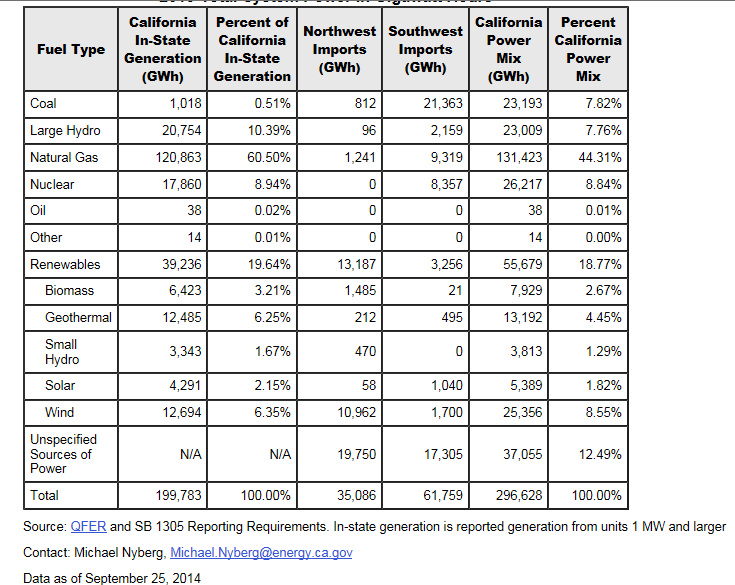 ?w=640

Me, all I know is that when you break Hydrogen bonds you get higher conversion efficiency and less Carbon.
Well, California must have had this idea a while back because over forty per cent of it’s electricity comes from gas.
Getting back to the trucks, the largest single occupation by state in 1978:
The largest single occupation by state in 2014:
About gas, there is a whole lot of it. Maybe more than all the biomass that ever lived could account for. Maybe it’s some incarnation of the 4.54 billion years of Carbon volcanic out gassing we can’t account for either.
Maybe we should save it for the trucks, maybe we should use for electricity, but we should SAVE it every chance we get. We can’t carry on like trust fund teenagers forever.
Looks like self-drive trucks would put a lot of ex-secrataries out of work. : )
You could use a secretary. (Spelling.) But, point taken.
Source of the “occupation” data, please?
PS “Truck Driver” is misleading, as that category in the data is actually “Truck, delivery, and tractor driver”, so big rigs are not really swamping the country, there are many thousands of local USPS, UPS and Fedex vans, plus many farmhands likely accounting for the majority of that category,
Brians, sorry to be so slow, looks like you found the data source. I would guess agricultural “truck drivers” have not increased significantly since 1978. The big rigs feed the urban distribution centers and retreat to truck stops on the periphery where many idle all night. The distribution centers disgorge legions of mid size vans for secondary and final delivery. I second your notion that these vans account for much of the occupational increase, although there are many more big rigs as well.
I don’t see this as misleading. Those vans are trucks and they take a lot of time to drive around and they use a lot of fuel.
gymnosperm,
Wasn’t Pickens referring to the fleet of long-haul trucks in mind when he said that? I could be wrong.
I just wanted to dispel the vision of every other vehicle on the highway being a big rig, and half the jobs being “truck drivers” in the common sense of the term. You know, “Ten four, Bandit! Mercy sakes, we got us a convoy!”
OTOH, anywhere I go it seems like I’m dodging a UPS or Fedex delivery van. And don’t forget USPS, there are huge numbers of mail trucks of all sizes in the cities.
Yeah, I don’t know for sure what Pickens meant either.
“However, natural gas also has a large potential downside: if it is leaks out before your burn it, the 100-year average climate effect of that leaked methane is about 12 times worse for the climate than the effect of CO2 from the same amount of gas if it were burned.”
We rarely read why this is claimed to be so.
Watts Up With That covered this question in April 11, 2014. Here’s what I said then:
http://wattsupwiththat.com/2014/04/11/methane-the-irrelevant-greenhouse-gas/#comment-1611227
Since then I’ve found out that besides requiring only a small amount to double its concentration, its formula weight CH4 at 16 is less than that of CO2 at 44 which is why the usual claim says “CH4 is more powerful greenhouse gas pound for pound than CO2”. And finally Methane is the transport mechanism to get water vapor into the stratosphere as it oxidizes into H20 and CO2.
But the resident time of methane in the atmosphere is very short as it is quickly oxidized. The question is whether or not it can ever become more concentrated than its current value of less than one part per million.
Two observations.
First: Whenever I see the magical zero AFTER the decimal place in a graph of a so-called real world phenomenon then this is what the word “insignificant” really means.
Second: Why the obsession with electricity generation? Even in developed countries it makes up less than 20% of the energy consumed and in some third world countries it represents a big fat zero.
(pedant alert: please don’t start quoting quantum theory BS……we are talking climate and energy consumption.)
Ivor,
Because when you control electricity generation, you can control the population and the industry of a country.
It’s all about social control and taxation.
If you are going to build a bridge don’t there need to be two ends that are real?
“Today’s” end of the natural gas bridge obviously exists, but currently there is no other end. Renewables can’t support a modern industrial economy and there is no way to know if they ever will be able to and if they will there is no telling when that will be.
So we are to start building a bridge while not know where or even if the other side we are trying to connect to even exists. In what world is this a good idea?
The Road to Wigan Pier.
if the other end doesnt exist you keep using NG.
remember this is addressed to an audience who want to end all coal and NG and switch to renewables.
With your pen and paper, and your phone and voice, you address the deluded.
===================
ddpalmer
July 28, 2015 at 3:08 am
It would appear that pointless speculation is the keynote to Academia these days.
And now we see the real reason for the war on coal. The corruption behind the Global Warming hoax is truly staggering.
Some Assumptions:
Assumes methane forcing levels to estimate leakage damages
Ignores Economics and Carbon impact by ignoring manufacturing cost with new machinery and plants to replace old, of which would be significant due to a large infrastructure change.
Total Infrastructure change would involve estimates of:
Machinery production
Retooling
Transportation infrastructure increase
Drilling and capture infrastructure cost
Plant and land cost
Also, CH4 and CO2 climate sensitivity variables are highly suspect, even though more research has been done for CO2 climate sensitivity variables, thus far most models using such estimates seem to be in error. Significantly less has been done to adequately estimate CH4 impact, which leads to a fairly easy conclusion that these numbers are probably even more questionable than CO2, which could lead to a significant change in the findings of the study by using this assumption that unfortunately we have no better data for.
Additionally, in using the IPCC radiative forcing equations (which thus far have not come close to comporting with reality) with their uncertainty as a basis for other equations with additional uncertainty you really end up with exponential uncertainty and the proverbial tripod with a shaky third leg.
For instance forcing numbers by the IPCC on CO2 have been extremely high in most models, which has then led to many recent studies on better ECS TCR estimates that purport to be much lower. If indeed reality is that these forcings for CO2 are radically high, then it brings into question CH4 comparisons with CO2. IF CH4 forcings are equally high (exactly) then the proportion would not change, if, however CH4 is estimated correctly and CO2 is high, then it drastically changes the cost-benefit relationship, making CH4 that much worse than CO2 than estimated in current equations.
Although I have no problem with the idea of replacing coal with natural gas, largely. Due to uncertainty I would be more interested in an economic impact study rather than a climate guesswork study. In the end the only certainty is that after established plants are in use Natural Gas produces less CO2 than Coal, and it’s greater CH4 production perhaps is not enough to offset this, rendering it the better choice in terms of radiative gas addition.
Then of course you have infinite future possibilities that do not account for technology advances in energy capture both from coal and NG, combined with potentially lower ECS estimates, could end up rendering the difference insignificant or greater, at this point it is unknown. Which is another reason why I would consider an economic study on the matter more important personally. That is something tangible to now, and much more certain, and a better use of time. The economic cost would be massive for an instantaneous switch, (perhaps even the climate cost between machinery production and site development would be greater in the end)
Robert Bryce wrote much on what he called N2N = natural gas to nuclear.
Nice to see that Berkeley Earth has taken the first step towards what has been obvious to many engineers and technologists (especially energy delivery specialists) for years now.
http://www.amazon.com/Power-Hungry-Myths-Energy-Future/dp/1586489534/ref=sr_1_2?ie=UTF8&qid=1438091216&sr=8-2&keywords=robert+bryce
I also think that renewables will benefit from increased use of flexible generation technologies such as natural gas power plants. At least until economical bulk energy storage other than pumped hydro becomes available.
The problem with bridges is that they make for challenging business cases.
A generator is at least a 50 year investment, longer if you maintain it well.
How can it make sense to build a huge fleet of new gas plants with the intention of retiring the last of them in 30 years? The vast majority of them will have to be retired before their loans are paid off.
One place “the bridge” was supposed to take us was to a “Hydrogen Economy”, right? Yet, isn’t burning methane actually an iteration of the Hydrogen Economy? With methane, a single carbon atom efficiently delivers four hydrogen atoms, ready for action. Is there a better or safer way to do that?
And, how about that “Recycle, Reduce, Reuse” component? After those carbon atoms successfully deliver their payload of hydrogen, they rush off to feed a green plant! We can burn it in the spring and eat it in the fall. Nice!
Berkley clearly has zero common sense when it comes to sustainability. Burning a less abundant fuel source that is piped into 50% of US homes and businesses for a purpose that can be satisfied with a more abundant fuel source…..well….. is just plain stupid.
Plastic feedstock, whatcha got?
============
So, when we start exporting natural gas the bridge goes poof, unreliables still are, and coal is suddenly a bargain again.
====================
A nickel a ton in the ground, and that’s today’s depraved nickel.
Artisans haul coal out of the ground in gunnysacks. Sure, they’re poor people. That coal is worth more than one of our nickels, and they don’t even get a ton a day.
This stuff is all so precious. You load sixteen tons, and what do you get? Another paper older, bespoke, whaddya bet?
=========================
Zeke, I know this wasn’t contained within your paper, but do you think natural gas replacement as you have described would be more efficient than the kinds of Ultra Super Critical Coal Fired Power plants that Anton Lang discusses here Ultra Super Critical Coal Fired Power gives a 15% CO2 Emissions Reduction? It is my understanding that Germany is replacing its nuclear plants with coal plants like these. That, of course, could be because they have so much domestic lignite and natural gas is so expensive for them.
It’s expensive, and the supplier looks awfully like a bear.
==========
Hi MRW,
In the paper we compare natural gas both to existing (average 33% efficient) and new best available technology (assumed 43% efficient) coal plants; the new coal plants utilize those technologies to achieve a 30% efficiency improvement over existing U.S. pulverized coal plants.
So exactly what date is being modestly delayed? I have not heard when the full conversion to renewables is scheduled to complete. If it is known, they could at least put it in the paper so I can put it on my calendar.