Did SNL’s Tommy Flanagan Oversee the New Surface Temperature Data?
By Bob Tisdale and Anthony Watts, commentary from Dr. Judith Curry follows
There is a new paper published the journal Science about the recent slowdown in global surface warming (released from embargo today at 2PM eastern). It is from Tom Karl and others at NOAA’s newly formed NCEI, National Centers for Environmental Information (a merger of three NOAA data centers: NCDC, NODC and NGDC) and from the government-consulting firm LMI. The lead author is Tom Karl, Director of NCEI and Chair of the Subcommittee on Global Change Research (SGCR) of the U.S. Global Change Research Program (USGCRP). The paper is Karl et al (2015) Possible artifacts of data biases in the recent global surface warming hiatus. “Possible” is obviously the key word in the title.
There is a big push by the American Association for the advancement of Science (AAAS) to promote this paper. Here is what they sent out to press contacts days in advance:
Science Press Package
This information is embargoed until:
2:00 PM U.S. Eastern Time, Thursday, 4 June 2015
Check timezone conversions here.
Please cite the journal Science and the publisher, AAAS, the science society, as the source of this information. Please hyperlink to www.sciencemag.org when publishing online.
Summaries of Articles in the 5 June Science
Evidence Against a Global Warming Hiatus?
An analysis using updated global surface temperature data disputes the existence of a 21st century global warming slowdown described in studies including the latest Intergovernmental Panel on Climate Change (IPCC) assessment. The new analysis suggests no discernable decrease in the rate of warming between the second half of the 20th century, a period marked by manmade warming, and the first fifteen years of the 21st century, a period dubbed a global warming “hiatus.” Numerous studies have been done to explain the possible causes of the apparent hiatus. Here, Karl and colleagues focused on aspects of the hiatus influenced by biases from temperature observation networks, which are always changing. Using updated and corrected temperature observations taken at thousands of weather observing stations over land and as many commercial ships and buoys at sea, the researchers show that temperatures in the 21st century did not plateau, as thought. Instead, the rate of warming during the first fifteen years of the 21st century is at least as great as that in the last half of the 20th century, suggesting warming is continuing apace. According to these and other results, the authors suggest the warming slowdown was an illusion, an artifact of earlier analyses.
Article #16: “Possible artifacts of data biases in the recent global surface warming hiatus,” by T.R. Karl; A. Arguez; B. Huang; J.H. Lawrimore; M.J. Menne; T.C. Peterson; R.S. Vose; H.-M. Zhang at National Oceanographic and Atmospheric Administration (NOAA) in Asheville, NC; J.R. McMahon at LMI in McLean, VA.
The abstract of Karl et al (2015) reads (our boldface):
Much study has been devoted to the possible causes of an apparent decrease in the upward trend of global surface temperatures since 1998, a phenomenon that has been dubbed the global warming “hiatus.” Here we present an updated global surface temperature analysis that reveals that global trends are higher than reported by the IPCC, especially in recent decades, and that the central estimate for the rate of warming during the first 15 years of the 21st century is at least as great as the last half of the 20th century. These results do not support the notion of a “slowdown” in the increase of global surface temperature.
Karl et al expand on that highlighted discussion in the text of the paper (our boldface):
It is also noteworthy that the new global trends are statistically significant and positive at the 0.10 significance level for 1998–2012 (Fig. 1 and table S1) using the approach described in (25) for determining trend uncertainty. In contrast, IPCC (1), which also utilized the approach in (25), re-ported no statistically significant trends for 1998-2012 in any of the three primary global surface temperature datasets. Moreover, for 1998–2014, our new global trend is 0.106± 0.058°C dec−1, and for 2000–2014 it is 0.116± 0.067°C dec−1 (see table S1 for details). This is similar to the warming of the last half of the 20th century (Fig. 1). A more comprehensive approach for determining the 0.10 significance level (see supplement) that also accounts for the impact of annual errors of estimate on the trend, also shows that the 1998–2014 and 2000–2014 trends (but not 1998–2012) were positive at the 0.10 significance level.
THE MISDIRECTION
As shown in their Figure 1 (also our Figure 1), Karl et al. (2015) used the periods of 1951 to 2012 and 1950 to 1999 as references for the recent slowdown in surface warming. The IPCC’s 5th Assessment Report serves as the justification for the early-1950s start point for their reference periods. See Chapter 2 and Chapter 9 of AR5 for the IPCC’s brief mention of the slowdown in global surface warming.

Figure 1
Yet the climate model-based projections of a disaster-filled future global surface warming better align with the warming rate of the recent warming period, which began in the mid-1970s, not 1950. See Figure 2, which uses the GISS Land-Ocean Temperature Index data, because the new NCDC data have not yet been released. Keep in mind there was an earlier hiatus that lasted from the early-to-mid 1940s to the mid-1970s.

Figure 2
If NOAA would like to revise their estimates of future global warming to reflect the more benign warming rate of 0.1 deg C/decade from 1950 to 1999, it would be a big step toward their coming to terms with reality.
We illustrate the ever-growing differences between models and data in the monthly global surface temperature (and lower troposphere temperature) update posts. Figure 3 is the model-data comparison from the April 2015 update.

Figure 3
NEW DATA USED
In many respects, the paper is an introduction to a revised global surface temperature dataset from NOAA. For the oceans, it includes their new ERSST.v4 sea surface temperature data. We discussed that new NOAA sea surface temperature data in the post Has NOAA Once Again Tried to Adjust Data to Match Climate Models? (The WattsUpWithThat cross post is here.)
For the land portion, Karl et al. (2015) state:
Third, there have also been advancements in the calculation of land surface air temperatures (LSTs). The most important is the release of the International Surface Temperature Initiative (ISTI) databank (14, 19), which forms the basis of the LST component of our new analysis. The ISTI databank integrates the Global Historical Climatology Network (GHCN)–Daily dataset (20) with over 40 other historical data sources, more than doubling the number of stations available.
ADJUSTMENTS MAKE MOST OF THE WARMING
NCDC has been in the business of adjusting the surface temperature record for quite some time. The modus operandi so far has been to get a new paper published describing what NCDC considers to be a new and improved dataset, and since NCDC’s articles are often peer reviewed by other government employed scientists at NOAA, they often don’t get a critical peer review. Certainly, based on the reports I’ve received over the years, few if any skeptic scientists have ever been asked to review an NCDC paper on a new global temperature dataset and the techniques involved.
Fortunately, it is very easy to divine such adjustments by comparing the raw data and the final adjusted data, as shown in the graph below. Note how the past gets cooler, centered around 1915 and the present gets warmer.
![NCDC%20MaturityDiagramSince20080517[1]](https://wattsupwiththat.files.wordpress.com/2015/06/ncdc20maturitydiagramsince200805171.gif)
On May 2, 2011, NCDC transitioned to GHCN-M version 3 as the official land component of its global temperature monitoring efforts. In November 2011, the GHCN-M version 3.1.0 replaced the GHCN-M version 3. The overall net effect of the transition from GHCN-M version 2 to version 3 is to increase global temperatures before 1900, to decrease them between 1900 and 1950, and to increase temperatures after 1950.
The diagram below exemplify adjustments made by NCDC since May 2008 for two single months (see arrows in diagram above); January 1915 and January 2000.
![NCDC%20Jan1915%20and%20Jan2000[1]](https://wattsupwiththat.files.wordpress.com/2015/06/ncdc20jan191520and20jan20001.gif)
Clearly, with each revision of data, NCDC is making the past cooler and the near present warmer through their adjustment process of the original data. To revisit something said in regards to a previous news story about NCDC’s tendency to adjust data as time goes on, so much so that they can’t even tell us with certainty anymore which month in the past century was the warmest on record, this is still applicable:
“Is history malleable? Can temperature data of the past be molded to fit a purpose? It certainly seems to be the case here, where the temperature for July 1936 reported … changes with the moment,” Watts told FoxNews.com.
“In the business and trading world, people go to jail for such manipulations of data.”
Hold that thought, because NCDC is at it again.
THE IMPACT OF NOAA’S SHIP-BUOY BIAS ADJUSTMENTS DURING THE SLOWDOWN HAVE MADE THEIR NEW SEA SURFACE TEMPERATURE DATASET AN OUTLIER
You’ll note in Figure 1 that the biggest changes between the new and old NOAA data during the global-warming-slowdown periods are in the sea surface temperature data, not the land surface air temperature data. Those adjustments are supposed to be justified by ship-buoy biases. See the quotes in the post Quick Look at the DATA for the New NOAA Sea Surface Temperature Dataset, under the heading of SHIP-BUOY BIAS CORRECTIONS IN ERSST.v4.
(Note 1: the buoys being discussed are NOT ARGO floats. The buoys used for sea surface temperature measurements are Surface Drifting Buoys and fixed buoys like the TAO Project buoys. Note 2: the latitudes of 60S-60N were used for the following graphs to avoid any differences in how sea ice is accounted for between the datasets and to be consistent with the two papers that introduced the new ERSST.v4 data. Note 3: the trends shown are for sea surface temperatures. They are not directly comparable to the trends discussed by Karl et al. in the second quote, which were for combined land-plus-ocean data.)
THE UKMO HASST3 data have also been adjusted for ship-buoy biases. For the two slowdown periods presented by Karl et al., Figures 6 and 7 compare the HADSST3 and the new NOAA ERSST.v4 data, both of which have been “corrected” for ship-buoys biases, to the older NOAA ERSST.v3b which had not been adjusted for those biases. During both periods, the bias-adjusted HADSST3 data have a much lower trend than the bias-adjusted NOAA ERSST.v4 data. In fact, the bias-corrected HADSST3 data in both cases is more in line with the older NOAA data than the new.

Figure 6

Figure 7
Some might think that NOAA under the direction of Tom Karl designed their ship-buoy bias adjustments with the sole intent of minimizing the impacts of natural slowdown in surface warming. (Those would be some interesting emails and meeting minutes to read.)
And just in case you’re wondering, the new NOAA ERSST.v4 data are compared to the NOAA and UKMO satellite-enhanced sea surface temperature data in Figures 8 and 9.

Figure 8

Figure 9
As noted in the heading, with their new adjustments, NOAA has created an outlier in their new sea surface temperature dataset. Add that to the curious spike in the late-1930s and1940s that can’t be explained by climate models, which were presented in the post here.
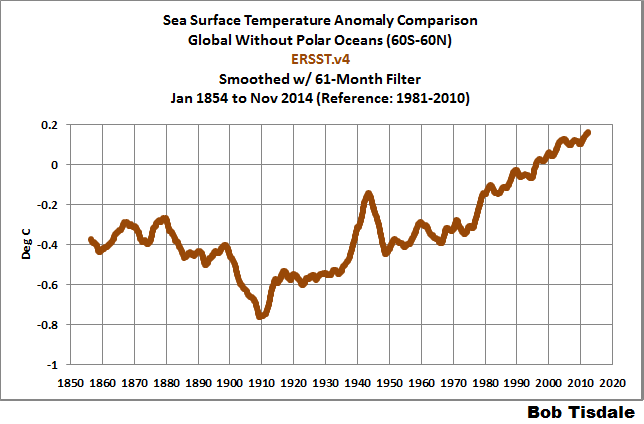

BUT THE WARMING RATES OF NOAA’S OLD AND NEW SEA SURFACE TEMPERATURE DATA ARE THE SAME OVER THE PAST 3+ DECADES
The satellite era of sea surface temperature data started in November 1981. Neither of the NOAA sea surface temperature reconstructions (new or old) utilize the satellite-enhanced data. The original version of the NOAA ERSST.v3 data included satellite data when they were first released in 2008, but the satellite data were removed before the dataset became “official” because they did not meet political agenda of the dataset users, which were only NOAA at that time. The revised dataset was renamed ERSST.v3b. It is ERSST.v3b that Karl et al. are calling the “old” data.
But we can learn something very interesting if we compare NOAA’s ERSST.v4 (new) and ERSST.v3b (old) data during the satellite era. See Figure 10.

Figure 10
The warming rates are the same.
But the new data show a much higher warming rate during the “hiatus” periods, and that means…
TO MANUFACTURE WARMING DURING THE HIATUS, NOAA ADJUSTED THE PRE-HIATUS DATA DOWNWARD
If we subtract the ERSST.v3b (old) data from the new ERSST.v4 data, Figure 11, we can see that that is exactly what NOAA did.

Figure 11
Remember the adjusted data from figures 4 and 5 above? Figure 11 uses the same data subtraction method to determine the difference between the original measured data, and the “new and improved”adjusted data courtesy of government-funded science. It’s the same story all over again; the adjustments go towards cooling the past and thus increasing the slope of temperature rise.
Their intent and methods are so obvious they’re laughable.
It’s like John Lovitz Saturday Night Live character “Pathological liar”, Tommy Flanagan was in charge.
Gee, we need to show more sea surface warming during the hiatus, but we don’t want to increase the trend since about 1982.
 It’s hard to imagine how anyone could take the new NOAA global surface temperature data seriously.
SEA SURFACE TEMPERATURE DATA SOURCE
The sea surface temperature data presented in this post are available from the KNMI Climate Explorer.
Comments from Georgia Tech Climatologist Dr. Judith Curry:
The greatest changes in the new NOAA surface temperature analysis is to the ocean temperatures since 1998. This seems rather ironic, since this is the period where there is the greatest coverage of data with the highest quality of measurements – ARGO buoys and satellites don’t show a warming trend. Nevertheless, the NOAA team finds a substantial increase in the ocean surface temperature anomaly trend since 1998.
In my opinion, the gold standard dataset for global ocean surface temperatures is the UK dataset, HadSST3. A review of the uncertainties is given in this paper by John Kennedy http://www.metoffice.gov.uk/hadobs/hadsst3/uncertainty.html. Note, the UK group has dealt with the same issues raised by the NOAA team. I personally see no reason to the use the NOAA ERSST dataset, I do not see any evidence that the NOAA group has done anywhere near as careful a job as the UK group in processing the ocean temperatures.
I am also unconvinced by NOAA’s gap filling in the Arctic, and in my opinion this introduces substantial error into their analysis. I addressed the issue of gap filling in the Arctic in this recent publication: Curry JA, 2014: Climate science: Uncertain temperature trends. Nature Geoscience, 7, 83-84.
Relevant text:
Gap filling in the Arctic is complicated by the presence of land, open water and temporally varying sea ice extent, because each surface type has a distinctly different amplitude and phasing of the annual cycle of surface temperature. Notably, the surface temperature of sea ice remains flat during the sea ice melt period roughly between June and September, whereas land surface warming peaks around July 1. Hence using land temperatures to infer ocean or sea ice temperatures can incur significant biases.
With regards to uncertainty, in their ‘warmest year’ announcement last January, NOAA cited an error margin in the global average surface temperature anomaly of 0.09oC. The adjustments to the global average surface temperature anomaly is within the error margin, but the large magnitude of the adjustments further support a larger error margin. But they now cite a substantially greater trend for the period 1998-2014, that is now statistically greater than zero at the 90% confidence level.
My bottom line assessment is this. I think that uncertainties in global surface temperature anomalies is substantially understated. The surface temperature data sets that I have confidence in are the UK group and also Berkeley Earth. This short paper in Science is not adequate to explain and explore the very large changes that have been made to the NOAA data set. The global surface temperature datasets are clearly a moving target. So while I’m sure this latest analysis from NOAA will be regarded as politically useful for the Obama administration, I don’t regard it as a particularly useful contribution to our scientific understanding of what is going on.
Someone at Reuters or BussinessInsider.com can’t tell time. They published the expected nonsense about the embargoed paper an hour early:
http://www.businessinsider.com/r-study-dismisses-hiatus-in-global-warming-says-temperatures-up-2015-6
“”””””….. “Possible” is obviously the key word in the title. …..”””””
Translates to “violates not more than one law of Physics. “
BBC radio 4 ‘Today’ just ran a prime-time piece –
“an apparent slowdown…an illusion based on skewed data”
0845
The National Oceanic and Atmospheric Administration in the United States has reported that an apparent slowdown in the pace of global warming in recent years may be an illusion based on skewed data. The ‘hiatus’ in warming has previously been used by some to question the existence of man-made climate change. The report raises questions about the way scientists calculate global warming and the interpretation of their data. Tom Karl is lead author of NOAA report on climate change.
listen again http://www.bbc.co.uk/programmes/b05wz0k7 at 2:45
Thank you! Just to clarify, it is at the 2 hour and 45 minute mark (and goes for about 5 minutes).
Response to “Hiatus” Post
It was my understanding that if global warming were to continue at a high rate, then according to some people, huge damages could result if the temperature were allowed to go 2 C above the 1750 temperature. Then we presumably had a hiatus and suddenly the pressure seemed to be off for a while. (By the way, NOAA defines a “hiatus” as a slowdown in warming and not a complete stop, so we are NOT talking about a pause with a very slight negative slope when talking about whether or not we are in fact experiencing an “hiatus”.)
I am totally perplexed by their whole approach, and I believe their analysis is very misleading.
They give this statement, but never say what the warming was over the last 30 years. Nick Stokes’ site gives numbers that are very close to their “old” values. For 1998 to 2012, Nick had 0.0374/decade, but for January 1985 to December 2014, he had 0.1543/decade. However you may recall the interview with Phil Jones where he was asked about the slope from 1975 to 1998. It turns out that for NOAA, this is 0.1805/decade. Compared to 0.1805 or 0.1543, I would think that a value of 0.0374 would represent a hiatus in the opinion of most people. But it does not end here. In the end, a highly adjusted value for 2000 to 2014 is compared with a somewhat adjusted value for 1950 to 1999 to come to a conclusion that no hiatus occurred. But what slope would you expect from a 50 year period where there was virtually no change for half of the time?
The above statement perplexes me. They appear to be satisfied that they have proven to themselves and hopefully others that no hiatus occurred. But in doing so, they have, in my mind, proven that there is no catastrophic warming occurring either. A warming rate of 1.16 C/century will not reach 2 C by 2100.
significant anthropogenic global warming (1), is 0.113°C dec
==================
so 1.13°C PER CENTURY is what all the big fuss is about? Anything less than 2°C is agreed to be beneficial. So, for the next 100 years at least we would be much, much better off to do nothing about CO2 emission.
in point of fact, by cutting emissions we would be paying money to hurt future generations!!
I believe their analysis is very misleading
Dishonest is the word, not misleading. These fraudsters are playing their political masters’ tune. Yet again, after much adumbration, lo, we find that temperatures were all wrong in the past and we need to adjust them all downwards … again.
Who goes into a career in climate science? Treehuggers. No one else in their right mind finds any value in the field (as opposed to meteorology). Right there is the root cause of the extreme bias in the field. Sound snarky? Perhaps, but I wager it’s the truth!
I’ll bet that Josh will have a good cartoon for this one.
Must be data from the
Wholly
Optimistic
Readjusted
Satellite
Temperature
DATASET
What a crunch of books they are. I’m sure the Guardian will be weeping and wailing about how it’s worse than they thought.
They already are.
Don’t judge a book by its crooked cover!
The scale of deceit is simply breathtaking.
Are they saying the satellite data is simply wrong? RSS shows a cooling trend from 2000-2014:
http://www.woodfortrees.org/plot/rss/from:2000.1/to:2014.12/plot/rss/from:2000.1/to:2014.12/trend
Whereas this paper (as produced in the grauniad) shows a warming.
http://www.woodfortrees.org/graph/rss/from:2000.1/to:2014.12/plot/rss/from:2000.1/to:2014.12/trend
Sorry, fat finger. Grauniad graph here:
http://i57.tinypic.com/2078fg6.png
They report decadal air temperature trends of accuracy ±0.001 C! These people are thoroughly incompetent, at best.
The temperature record is replete with arbitrary accuracy and pretend precision.
Not really 0.001°C, more like ±0.058°C and ±0.067°C. Read the text, not the silly Grauniad bar graph.
When people read an article they look at the graph not the figures, that is why they show graphs.
The graph says 0.116, so that is what Guardian claims. A 0.001 degree precision.
Rick, your numbers are represented as accurate to ±0.001 C. Accuracy is generally read as ±1 in the last reported decimal place.
I think perhaps we need to revisit the discussion of precision vs accuracy.
more like ±0.06°C and ±0.07°C
and the value should only be to the second decimal place. All other figures are irrelevant if the number preceding them are uncertain (exception made for errors where the first sig fig is 1). Putting them in implies that they are significant ie meaningful so Pat’s comment is correct.
I went looking for accuracy and just what they are able to measure after one of Bob posts back in December and had a real awakening. Seems that overall measuring of ‘sea surface’ has problems. Original bucket & thermometer (no depth control), ship intake (well below surface and varied depth due to load +/-20 feet), buoys (seem to rock in the wave with depth resolution of a meter), then IR satellite (cannot get thru the clouds) to microwave (get thru the clouds, but not the rain & surface mist). Oh and did I mention one of the satellites was doing reasonable until they had to boost the altitude, then had problems with pitch, yaw and just had no idea the height it was flying. The number of adjustments to correct is staggering. Includes (but not limited to); wind speed, rain, cloud amount/percent and cloud water vapor, daytime diurnal warming, high latitudes, aerosols, SSTs <10C, columnar water vapor, higher latitudes show a slight warm bias, seasonal cycle wind direction for SST retrieval, fast moving storms and fronts, wind direction error and instrument degradation.
http://images.remss.com/papers/rsspubs/gentemann_jgr_2014.pdf
Still their abstract reads –
Errors were identified in both the MW and IR SST data sets: (1) at low atmospheric water vapor a posthoc correction added to AMSR-E was incorrectly applied and (2) there is significant cloud contamination of nighttime MODIS retrievals at SST <10C. A correction is suggested for AMSR-E SSTs that will remove the vapor dependency. For MODIS, once the cloud contaminated data were excluded, errors were reduced but not eliminated. Biases were found to be 20.05C and 20.13C and standard deviations to be 0.48C and 0.58C for AMSR-E and MODIS, respectively. Using a three-way error analysis, individual standard deviations were determined to be 0.20C (in situ), 0.28C (AMSR-E), and 0.38C (MODIS).
To put that in perspective, the error bars would be the white shaded areas on all the graphed figures above.
And the AGW crooks continue to manufacture their facts and then change them as they see fit. How long will it be before we are getting the same treatment about reality as the chinese give their people concerning Tiananmen square? The public needs to wake up before it is too late.
If climate change continues at this pace, by 2050, 1935 will be completely frozen.
+1
Not only 1935, but every year through and including 2015!
Just emerging from the ice age in 1937
As I have taken to saying: “shortly, our ancestors will have frozen to death”
Well done guys. Frankly the level of desperation shown by NCEI is staggering. I know that they’re worried about inaction on AGW but this really isn’t the way to change things. Why can’t they see that this type of slight of hand damages them? I can only hope that the Met Office are feeling uneasy at their trans Atlantic partners and don’t decide to follow suit.
But it doesn’t. This sleight of hand provides cover for their political masters. They will all get awards for their services to science – given by their political masters.
So, we’ve been wrong over the past 10 years or so about the temperature over the past 20 years or so…. but we nonetheless know how much the temperature has gone up since 1900 or 1800 or 1750? Good grief!
This paper demonstrates how little we actually know.
Indeed. Rather specifically, any that tout this new paper as valid are stating that we have not — in fact — known the temperature at all. Neither absolute, relative, or trending. Which makes the rather stern claim that we need to stop and wait for their results to be replicated/vetted by numerous and independent parties before we accept that we actually know the temperature now.
How convenient, the 1940’s “blip” is also solved with buoys being too warm by 0.12.
http://di2.nu/foia/1254108338.txt
Indeed, this period should never be accepted as accurate. The post says, ” Keep in mind there was an earlier hiatus that lasted from the early-to-mid 1940s to the mid-1970s” Complete acceptance of prior lies, just because they are old, is nonsense. There was no pause then. it was strong global cooling, about .6 degrees in the NH, and .2 in the SH.
As early as 1061 there was a consensus that the world was getting cooler. https://stevengoddard.wordpress.com/2015/06/05/noaa-erasing-the-unanimous-consensus/
by the late 1970s the Ice Age scare was in full form…https://stevengoddard.wordpress.com/1970s-ice-age-scare/
NOAA global and hemispheric temperature graphs all showed this cooling. The removal of the “blip” was criminal. The latest changes are criminal as well. When these current fraudulent changes are a decade or two old, will WUWT posters begin accepting them, as the removal of the blip is now apparently accepted by this line.. ” Keep in mind there was an earlier hiatus that lasted from the early-to-mid 1940s to the mid-1970s”
WUWT, please paint the whole picture, its worse then you think!
typo, “As early as 1961, not 1061.
Given the magnitude of the adjustments in Figure 11, I’d argue if the error bars on the old data are comparable to the range in the graph, that would mean the error bars were way too small.
Here’s one, http://mediamatters.org/static/images/item/globalaverage.jpg – see the +/- 0.1C range in the 95% confidence interval? Figure 11 show adjustments about +/- 0.05C. I guess it will all fit in the envelope, but I’m not very confident about that 95% confidence interval….
The problem is that the mainstream media – journalists that don’t have a clue – will swallow it hook line and sinker. A new warmist ‘meme’ will be born, and it will take years to get rid of it. Website and Newspaper articles don’t get retracted.
Expect a George Monbiot column and a Geoffery Lean article on the subject very soon…
About getting ready for COP 21 in Paris and supporting nonsense like cap-and-trade.
Is new analysis on old data anything like old wine in new bottles?
Wait, what? What happened to catastrophic warming? Are the warmist now arguing against it?
PARIS OR BUST!
Paris will be a spectacle to behold. Where to go after this kind of promotional extravaganza? We are crossing the line between satire and parody…think rock and hard place.
Only comparisons to Orwell will suffice after Paris 2015.
Orwell’s writings will have to be used to see the obfuscation of the New World Order’s “Ministry of Truth”. In no other context will it make sense to any but the sheep following their masters.
We will be hearing jaw dropping lies. The satire, yielding parody will be interpreted as “the new truth” if we do not all keep vigilant in exposing their continued falsehoods……
If you told me in 1979 that 35+ years into having satellite temperature data we would still be arguing over and making adjustments to historical surface measurements, I would have been highly amused. It’s not a laughing matter today.
The intellectual dishonesty of all these supposed scientists who choose to use the surface measured data for medium to long term climate modeling is staggering. Every time we see some supposed expert saying “look! squirrel!” while pointing at the surface data, it erodes all measure of trust in modern “mainstream” climate science.
Well, they can’t use the satellite data, it doesn’t give the right answer.
Anyone who sees no problem with this is showing their colors. It is like the Warmista motorcycle jacket.
So, Winston Smith is alive and well, with a job in the NCDC historical documents department.
Apparent so. And after Paris 2015, he’ll be busy for years.
Whoever controls he past….determines the future.
Scott
And after Paris 2015, Hell will be busy for years.
From Karl et al:
Hey, it’s not as bad as we thought – at this rate it will take nearly two centuries (from the 1950s? 1970s? 2010s?) to see the dreaded +2°C temperature rise. Dang, I’ll miss it.
If it were not because of where this paper came from, it would not be worth a comment at all.
Look at “Figure 1 from Karl et al”. Not all of the desired effect was obtained by simply adjusting the temperatures. By manipulating the temperature record in the way they did, they also opened up the Confidence Interval of the “hiatus” vs. the base period. In this way the two are not significantly different. Also note that the gold standard of 95% confidence (p=0.05) has been tossed overboard in favor of the much looser 90% confidence (p=0.10) test.
It’s clear, the whole GW problem has become a political issue of major importance. Everything is allowed to promote the green agenda of the west. Our MSM produce only widespread green information, fraud about temperature adjestments is legal because the authority tells us.
Sea level rise is caused by global warming, natural rise is already 80 meters and only natural variability is able to lower the sea level. The greenies may think that they can lower sealevel they can forget
Really, NOAA’s slight-of-hand data trick is meaningless v. a v. AGW.
There is still
not one scintilla of evidence
that CO2 emissions CAUSE
significant changes in temperature
in the climate system called “Earth.”
None.
Post hoc, ergo propter hoc is the AGWer’s entire argument.
And as far as science goes, that is JUNK.
+1
although I usually qualify that statement, eg., ‘There is not one scintilla of evidence that withstands ordinary and expected levels of scientific rigour and scrutiny that CO2 emissions CAUSE SIGNIFICANT changes in temperature in Earth’s climate system.’
We cannot yet even with our best measuring equipment/devices detect the signal (if any) to CO2. If there is such a signal it is lost within natural variability and/or within the error bounds of our best measuring equipment/devices.
If the error bands are large (and I suspect that if one is honest they are), then there is still scope for CO2 to be a driver of temperature, but if the error bands are small (as the warmists claim), then CO2 is not s ignificant driver and at best it is merely a bit player swamped by natural variability.
Thanks, Mr. Verney #(:)). And thank you for the more careful statement of my gist of the matter.
(and thank you to Robert (of Ottawa) above for the correct spelling of “sleight of hand” (I just plain misspelled it!)
If the temperature change following the CO2 concentration change is a “signal” it travels at superluminal speed violating relativity theory. Thus, it is best to characterize the temperature change from the CO2 concentration change as a “message.”
lol, Terry Oldberg (good one).
Oh, yes, yes, indeed. A very important message….
deep from within the imagination of a greedy little Leprechaun who needed a way to sell his windmills.
#(:))
http://wattsupwiththat.com/2015/02/25/almost-30-years-after-hansens-1988-alarm-on-global-warming-a-claim-of-confirmation-on-co2-forcing/
If NOAA would like to revise their estimates of future global warming to reflect the more benign warming rate of 0.1 deg C/decade from 1950 to 1999, it would be a big step toward their coming to terms with reality.
Your first mistake is comparing a 50 year trend to a 25 yr trend to a 30 yr trend. Do you think its wise to evaluate the CMIP5 mean future trend only, ignoring any hindcasting, omitting model spread, comparing it to a 50 yr trend, and calling it unrealistic? You think maybe you simplified that comparison a bit too much? Not to mention my eyes are now bleeding after looking at Bob Tisdale’s graphs.
Fitting that this post has absolutely no mention of the actual methods used in these adjustments, no discussion of whether there is a need for adjustments (there most certainly is), and not a single alternative proposed for accounting for bias! Also missing from this post is the fact that these new adjustments show an overall DECREASE in the trend for the dataset.
“The greatest changes in the new NOAA surface temperature analysis is to the ocean temperatures since 1998.”
I don’t get it. I thought the science was settled. /s
Sat dat=wrong
Sondes=wrong
Scores of papers ‘splainin’ away the stoppage=wrong
Sceptics=wrong
There we go.
Good dog. Sit.