Guest essay by Buel Henry
In 2007, the Nobel Prize for Peace was awarded to Albert Gore and the IPCC for their work in promoting the theory that global warming was caused by green-house gasses, and that, based upon computer simulations, increasing amounts of these gasses in the atmosphere would cause runaway warming, with disastrous consequences for the planet.
At the time, this appeared to be a plausible explanation for the warming, since CO2 levels in the atmosphere were clearly rising. However, for the past 15 years or so, there has been a “Pause” (no statistically significant warming) in the warming trend, leaving scientists around the world scratching their heads for an explanation, since this was not predicted by any of their models.
However, it can be proven, from published data, that the observed warming was actually a “side effect” of the American Clean Air Acts (1963, 1979, 1990 ) and similar efforts abroad, and had nothing to do with greenhouse gasses..
Just as the global cooling caused by a large volcanic eruption ends after its stratospheric Sulfur Dioxide (SO2) aerosols have settled out of the atmosphere, warming will naturally occur when anthropogenic SO2 aerosols are likewise removed from the troposphere.
As the Clean Air Act efforts were implemented, warming naturally occurred, as it was expected to, but the warming was wrongly attributed to greenhouse gas emissions rather than simply to the cleaner, more transparent air (fewer dimming SO2 aerosols to weaken the sun’s rays). The eruptions of Mt. Pinatubo and Mount Hudson (1991) injected 23 million tonnes of SO2 into the stratosphere, according to TOMS satellite measurements (plus other fine particulates which settled out within a few weeks), leaving a cloud of sulfate aerosols that circled the globe and persisted for about 2 years before finally settling out. Examination of the Goddard Institute for Space Studies (GISS) monthly temperature maps shows that global cooling, from the pre-eruption level, reached 0.45 deg. C. in November of 1992.
As the pollution settled out, temperatures rose to pre-eruption levels, because of decreased dimming, an increase of 0.45 deg. C. from the nadir.This represents a temperature rise of approx. .020 deg. C. for each Megatonne of SO2 removed.
Anthropogenic emissions of SO2 into the troposphere peaked during year 1972 at about 131 Megatonnes. By year 2000, due to worldwide Clean Air Act efforts, SO2 emissions in the West had decreased by approximately 48 Megatonnes. However, during the same time period, emissions elsewhere rose by 23 Megatonnes, for a net worldwide decrease of 25 Megatonnes.
According to the NASA fact sheet on atmospheric aerosols, both stratospheric (volcanic) and tropospheric aerosols have the same climatic effect:
“Strato-spheric SO2 aerosols reflect sunlight, reducing the amount of energy reaching the lower atmosphere and the Earth’s surface, cooling them”. Human-made sulfate aerosols “absorb no sunlight but they reflect it, thereby reducing the amount of sunlight reaching the Earth’s surface”.
The changing levels of SO2 emissions around the world are nicely shown in the graph “Global Anthropogenic SO2 Emissions” in the paper “Anthropogenic Sulfur Dioxide Emissions:1850-2005” by S. J. Smith, et al. The graph was compiled from published data by Robert A. Rhode. The 1972-1985 SO2 emission levels cited herein were extracted from that graph, and emissions from 1990-2011 were taken from “The last decade of global anthropogenic sulfur dioxide: 2000-2011 emissions”, Table S-1, by Z. Klimont, et al.

Applying the “.020 deg. C. per Megatonne of SO2 removed” relationship to the net 25 Megatons of SO2 removed, 1972-2000, due to global Clean Air efforts, an average global temperature rise of 0.50 deg. C. would be expected. The NASA Global Land-Ocean Temperature Index GHCN-v3, shows a rise of 0.38 deg. C., (0.12 Deg. C. lower). However, this lower temperature rise was due to the effects of the strong 1998-2001 La Nina which depressed average global temperatures.
Otherwise, both temperatures would have been nearly identical.
In contrast, the models incorporating CO2 in the IPCC fourth assessment report (Figure SPM 5) projected an increase of 0.8-1.2 deg. C. for the same time period, much too high.

With respect to anthropogenic SO2 emissions from intermittent sources, they will generally settle out of the atmosphere within a few days. The conversion of SO2 to Sulfuric Acid (the SO2 aerosol) happens very quickly, so it acts as a dimming aerosol even in that short time.
However, the bulk of anthropogenic SO2 emissions come from relatively constant sources such as power plants, factories, foundries, vehicle exhausts, home heating units, maritime shipping, and the like. The atmosphere is never free of their dimming aerosols since they are constantly being renewed. As such,.they have a much longer effective lifetime than aerosols injected into the stratosphere, ending only when the emitting sources are either modified to reduce emissions, or are shut down.
The fact that an empirically-derived factor from the Mount Pinatubo eruption can be used to accurately predict the amount of temperature rise resulting from the removal of 25 Megatons of dimming anthropogenic SO2 aerosols due to Clean Air Act efforts is further proof that the climatic behavior of stratospheric and tropospheric SO2 aerosols is identical.
It also proves that the IPCC “Graph of Radiative Forcings” is completely incorrect, since it does not include any warming due to the removal of dimming-aerosols from the atmosphere. To be correct, this forcing needs to be included (which will have the effect of completely eliminating any forcing due to CO2). As noted above, all of the warming can be accounted for by the reduction in SO2 emissions.
The ultimate test of any hypothesis lies in its predictive ability. Above, it accurately predicted the amount of warming that would occur when a net of 25 Megatonnes of SO2 emissions were removed from the atmosphere.
Another example (using data from the Table S-1 cited above): Between 2000 and 2005, anthropogenic SO2 emissions increased by 5.58 Megatonnes, thus decreasing the 25 Megatonnes of reduction by that amount, lowering it to 19.4 Megatonnes. This was followed by a reduction in anthropogenic SO2 emissions between 2005 and 2010 of 9.28 Megatonnes, giving a final net reduction of 28.7 Megatonnes at 2010, for an expected anomalous temperature rise, 1972-2010, of .020 x 28.7 = .0.57 deg. C., versus a NASA’s 2010 value of 0.66 deg. C. (GISS value of 0.61 deg. C) (It should be noted that NASA and
GISS values were essentially identical until about 2005, but NASA values have trended higher since then).
The slightly higher-than-predicted temperature rise was due to the moderate 2009-2010 El Nino, which, in this case, temporarily raised global temperatures Without the El Nino warming, the actual and predicted temperatures would would have been essentially identical.
This can be seen on the accompanying annotated graph of global temps. 1972-2011. The graph shows the “background” warming due to the removal of SO2 aerosols, and deviations above and below that line due to natural causes, such as El Niños, La Niñas, volcanic eruptions and (probably) non-eruptive SO2 ventings, such as currently coming from Baroarbunga, in Iceland.

The graph also shows that the “pause” is caused by the near balance in the amounts of global increases and decreases of SO2 emissions since 2001.
This balance, however, cannot be expected to continue, because of planned EPA actions, and efforts to reduce pollution in the Far East.
During the 1930’s depression era, global anthropogenic SO2 levels decreased, largely due to reduced industrial activity Between 1930 and 1938, for example, they fell by approx. 29 Megatonnes (see the graph of Global Anthropogenic SO2 emissions cited above) Again, using the “.020 deg. C.” factor, an average global temperature rise of 0.58 deg. C. would be expected, NASA and GISS temp. values show a rise of only 0.30 deg. C, for that period, but, again, a strong La Nina (8th strongest in 115 years) in 1938 lowered the average global temperature. Without it, both values would have been much closer.
The accuracy of the above three examples proves that the “.020 deg.C.temp. rise for each Megatonne of SO2 removed” relationship is basically correct (although some minor adjustment may need to be made as it is more closely examined). Conversely, an increase in the amount of SO2 in the atmosphere should cause a decrease in global temperatures.
This happened, for example, in the 1960 -1972 period, when global levels of SO2 emissions rose from 93 Megatons to 131 Megatons, an increase of 38 Megatons. This was the period when there were concerns that a new Ice Age might be dawning, because of the lower temperatures being experienced.
The phenomenon of global brightening, as detected by satellites, also mirrors the reduction in SO2 levels in the atmosphere, as would be expected. According to the Wikipedia article on Global Dimming the switch from a “global dimming” trend to a “global brightening” trend began around 1985, just as global SO2 emissions started to significently decline, and basically ended when the “pause” began, in 2000.
Twenty-one of the 25 Megatonnes (84%) of net SO2 emission decreases, 1972-2000.were removed in the 1985-2000 period of global brightening, as well as 84% of the resultant temperature rise, 1972-2000. The “brightening” in the absence of any increased solar output, could only have been caused by ewer dimming aerosols, resulting in increased warming of the earth’s surface.
Of the 131 Megatonnes of SO2 emissions present in the troposphere in 1972, a net global reduction of only about 29 Megatonnes occurred by 2010. This was sufficient to raise average global temperatures by about 0.60 deg. C, and is the primary cause of the California drought.
It is unfortunate, but further actions to reduce SO2 emissions, especially by the EPA, and in Eastern Asia, can be expected to cause ever-increasing temperatures.
Since CO2 has been shown to have no climatic effect, all efforts to reduce CO2 emissions in hopes of controlling global warming will be a waste of resources.
As the climatologist Beate Liepert remarked in 2005:
“We thought we lived in a global warming world, but this is actually not right. We live in a global warming plus a global dimming world, and now we are taking out the global dimming. So we end up with a global warming world, which will be much worse than we thought, much hotter”.
References:
Clean Air Acts: http://www2.epa.gov/laws-regulations/summary-clean-air-act
NASA fact sheet on atmospheric aerosols: http://www.nasa.gov/centers/langley/news/factsheets/Aerosols.html
“Anthropogenic Sulfur Dioxide Emissions:1850-2005″ by S. J. Smith http://www.atmos-chem-phys.net/11/1101/2011/acp-11-1101-2011.pdf
The last decade of global anthropogenic sulfur dioxide: 2000-2011 emissions”, Table S-1, by Z. Klimont, et al. http://iopscience.iop.org/1748-9326/8/1/014003
IPCC fourth assessment report (Figure SPM 5) https://www.ipcc.ch/publications_and_data/ar4/syr/en/figure-spm-5.html
NASA GISS global surface temperature: http://data.giss.nasa.gov/gistemp/
First, Buel, thank you for all of the interesting work. However, I would caution you in the strongest terms from making any facile assumptions about the relationship between SO2 and temperature. See e.g.
and also
Finally, per your references (which I thank you for providing) we are currently adding ~ 100 megatonnes of SO2 to the atmosphere annually, versus only a couple of MT in 1850. Since the SO2 stays in the atmosphere for something on the order of a year, we’d currently be running an excess airborne burden of on the order of 100 MTonnes of airborne SO2.
Your rule of thumb is “.020 deg. C. [of warming] per Megatonne of SO2 removed”. However, that means that it’s also .020 deg. C of cooling per MT of SO2 added … and we’ve added on the order of 100 tonnes since 1850. So according to your SO2 thermometer, 2015 should be about 2°C COOLER than 1850 …
w.
PS: Using three decimals of significance, as in “.020 deg. C.”, is much more than the accuracy of the calculations will sustain.
As I had stated, anthropogenic SO2 emissions in the troposphere peaked around 1972 at approx. 131 Megatonnes.
Excellent agreement, when El Ninos, La Ninas and volcanic eruptions are factored in, is obtained using the .020 deg. C/Megatonne removed “rule of thumb”, as you say.
Regardless of what happened in the 1850’s to now, currently the lowering of SO2 emissions is causing higher temperatures, and that must be our greatest concern.
I leave it to others to explore earlier intervals (effects of eruptions, changes in solar output, etc.)
Higher temperatures are not a cause for concern, but to be welcomed and embraced.
Why should higher temperatures be a concern? We should welcome them.
Hummm… if the SO2 emissions peaked near 130 megatons in 1975, then applying your 0.02C per megaton suggests that in 1975 the Earth’s temperature was being depressed by 2.6C relative to what it would have been absent SO2 emissions. I don’t think that is plausible, unless sensitivity to aerosol forcing (and so climate sensitivity in general) is extremely high. Is that what you are suggesting? There are lots of reasons to think (see recent paper by Bjorn Stevens) the aerosol forcing is even lower than the IPCC suggests in AR5. 2.6C of cooling in 1975 from SO2 is just not very plausible.
We know from the Mt. Pinatubo eruption that the aerosol forcing is approx. 0.2 deg. C/Megatonne of SO2 removed
I would maintain that, if all of the SO2 were removed, a temp.. rise of a disastrous 2.6 deg. C. is quite plausible
That result is preposterously implausible.
There are so many things wrong with your assumptions that I scarcely know where to start.
But how about the fact that human SO2 emissions are in the troposphere and major volcanic eruptions inject sulfur compounds into the stratosphere?
clive best did a recent comparison of CMIP and Hadcrut, volcanic aerosol cooling is structurally overcooled
http://clivebest.com/blog/wp-content/uploads/2014/12/CMIPH4.png
http://clivebest.com/blog/?p=6636
“However, it can be proven, from published data, that the observed warming was actually a “side effect” of the American Clean Air Acts (1963, 1979, 1990 ) and similar efforts abroad, and had nothing to do with greenhouse gasses..”
It might be possible to prove such a case if it was true that there is no natural climate variability, but since there would appear to be such variability if the historical record is any guide, then I’m afraid this theory has the same insurmountable problem as that of AGW . . . as we don’t know what the climate would have been doing throughout the relevant period or what it will do in future . .
http://data.giss.nasa.gov/modelforce/strataer/
Specifically:
http://data.giss.nasa.gov/modelforce/strataer/tau_line.txt
Nice theory but it doesn’t seem to fit the data. SO2 started dropping after 1970 but temperatures fell then rose again.
http://www.skepticalscience.com/pics/SO2-emissions.png
Actually fits well. S emissions dropped from the late 1970s, not 1970. That’s when allegedly the late 20th century warming began.
Tony:
You need to study the graph that I provided. What you say is not true.
Sorry, what’s not true? The graph I posted?
As Sturgi says, it looks like falling SO2 from late 1970’s.
Temps rose from 1910, then fell from about 1945 to 1970, then 30 years increase, then steady.
– and the warming in the thirties actually lasted from around 1910 to after 1945, the correlation to the SO2 emission drop in the thirties is very weak.
– and the warming in the thirties actually lasted from around 1910 to after 1945, the correlation to the SO2 emission drop in the thirties is very weak.
This is not true. SO2 emissions dropped by approx. 29 Megatonnes in the 1930’s, and temps. in North America/Europe flared as a result, even though the whole decade experiencd La Nina’s, which acted to lower average global temperatures.
Examine the GISS temp. maps for the 1930’s (especially 1938)
The higher temps. in the 1940’s were due to El Nino’s..
Skeptical of the numbers here. China has been increasing SO2 probably much faster than the rest of the world has been reducing it.
The theory itself is based on a more logical premise (that of surface albedo), than the greenhouse theory, but I would need much more evidence to convince me that the 0.02C per megaton of SO2 is accurate.
The numbers used were from Table 1 in ” A decade of global anthropogenic sulfur dioxide 2000-2011″ which shows worldwide emissions of SO2 by area. Between 2005-2010 global emissions actually decreased by 9.281 Megatonnes
As I said, skeptical of the numbers. More likely to trust the SO2 measurements than the calculations of its affect on temperature, but that “trust” is still flakey. There are just too many sources of emission and measurements of the entire atmosphere, just too unreliable.
As I said, skeptical of the numbers. More likely to trust the SO2 measurements than the calculations of its affect on temperature, but that “trust” is still flakey. There are just too many sources of emission and measurements of the entire atmosphere, just too unreliable.
Don’t know why that posted twice. Anyway, it’s the assertion that SO2 is 100% responsible for the exact change in observed global mean temperatures that the main cause for my skepticism.
I also was reminded of the “Super Freakenomics” chapter that suggested future warming could quickly and economically be eliminated with “smokestacks to the sky”, deliverring SO2 from ‘dirty coal’ plant emissions high into the atmosphere. The above paper, which oozes of hubris in statements of “proving” SO2 forcing Temp and “proving” that CO2 forcing Temp is a Myth, at least shows that our climate is chaotic and complex, even though both statements are surely wrong. The “proof” that only one model can be right is surely correct, and that averaging models that vary by several degrees of magnitude to predict a quantifiable change is not scientific in any sense is also correct IMO. With the proven effects of Pinotubo and other eruptions of SO2 forcing Temp down, the thesis of EPA sanctioned “brightening” of Earth (causing warming) does pass the sniff test for me. No wonder Obama is sabre rattling with the Chinese over some atolls. If China and India are allowed to build out their coal fired plants the recent warming will be permanent history,
and the Freakeconomists will be proven right in yet another debate.
“Save the planet, ban the EPA.” Do I have that about right?
Minor pendantic f@rt
https://www.google.ca/webhp?complete=0#complete=0&q=gasses
Unravelling the secrets of the climate system will forever remain a never ending story. How the IPCC ever thought it could get away with declaring that CO2 emitted by human activity causes catastrophic global warming and is the key driver of climate change, will go down in history as the greatest ever scientific failure.
Is this new findings? We can add 10% of sunshine since 1980 in Nordic countries thanks to solar brightening. I got this when I asked why:
http://journals.ametsoc.org/doi/pdf/10.1175/BAMS-D-11-00074.1
It confirms your findings I guess.
Nice informative article Burl,
There is certainly some correlation with SO2 output from coal burning and temperature fluctuations over the past 4o years or so. Whether “it can be proven, from published data, that the observed warming was actually a ‘side effect’ of the American Clean Air Acts” is something else again. Was that a global event?
I had noticed that the introduction of clean air directives in various countries and the scrubbing of Coal Power Station emissions coincided with change from cooling (1940-1970) to warming at the end of the 20th century.
Then the Chinese started building coal-fired power stations every week putting unscrubbed emissions into the atmosphere and the temperatures stopped rising. Indeeed, this is one of the many reasons given for the ‘pause’.
We do know that aerosols have a significant effect on global temperatures, but not exactly by how much. In fact, different models use different ‘fudge factors’ for aerosol cooling in order to get their ‘hindcasts’ correct.
One of the main drivers in sourcing thermal coal from Wyoming rather than the Virginian areas was the lower sulphur coals from the Thunder and Powder Basins.
The rail freight cost more than offset the astronomical costs of retrofitting sulphur scrubbers.
Mike:
You missed the last of the quoted statement “and similar efforts abroad”
The “.02 deg. C. temp. change /Megaton of SO2 removed/added” factor seems to nicely quantify the effect of SO2 aerosols.
A fourth example:
In the time period 2000-2005 global anthropogenic aerosol emissions rose by 5.58 Megatonnes, causing a dip in the calculated “background” temperature level (see my graph) This caused a reported decrease in average global temperatures of .09 deg. C. Using .02 x 5.58 gives an expected 0.11 deg. C, temp. decrease–within .02 deg. C. of actuality..
Fair enough, I did read too quickly, but my main objection was to the word ‘proven’.
Tropospheric SO2 has a short lifetime in the atmosphere (unlike SO2 in the stratosphere); the half life is on the order of a week or less. This time is far too short to allow mixing across the equator, so any cooling influence from tropospheric SO2 has to be confined mostly to the hemisphere where it is emitted. Nearly all SO2 current emissions (and more so in the past) take place in the northern hemisphere, so based on your global average effect of 0.02C per megaton, we would expect cooling of the northern hemisphere, where the effect of SO2 emissions would be strongest, and to be much LARGER than the 2.6C global average you suggest for 1970-1975. But that is not what we see. Measured warming has always been at least as great in the Northern hemisphere as in the southern, even when SO2 emissions were rising in the period of 1910 to 1940. Your suggested strong SO2 cooling should have dominated the vert weak GHG forcing in that period and caused marked cooling, especially in the northern hemisphere, but it didn’t.
Several people have provided you with clear arguments why your tropospheric SO2 theory of cooling fails. You should listen to them. Your theory is contrary to clear observational evidence.
As I had pointed out, tropospheric SO2 has a very long effective lifetime because it is constantly being removed, ending only when the emitting source is either modified or shut down.
Your comments regarding lifetimes are only valid for intermittent sources.
You need to examine the GISS surface temperature maps. They do show cooling in the northern hemisphere, as you pointed out. And its warming as SO2 is removed
Removal of SO2 aerosols will naturally cause warming.
My theory is not one of “tropospheric SO2 cooling” as you state. It is one of warming due to the removal of cooling SO2 aerosols, and IS based upon observational evidence.
Sorry, but your arguments are, frankly, nuts. You are ignoring a wealth of long published work, and suggesting a level of climate sensitivity that even wild-eyed CAGW advocates don’t suggest. You should reconsider this silly argument.
Mankind is causing cooling!
No, he’s causing warming!
Wait! You’re both right.
The quest for human importance continues.
Neanwhile, nature scoffs.
I had not thought of that one.
My own observations are that Mexico City, Beijing and Shanghai on a bad day are not as bad as the horrible brown smog that used to occasionally settle on London, Los Angeles and New York in the 1970’s – the stuff that used to mildly “burn” your nostrils and throat.
Burned the eyes too. It is one way that you actually see an improvement driven in part by environmental regulation. Of course rising gas prices also helped by pushing engineer to improve engine efficiency.
I remember the group of engineers working on the acid rain project telling the climate people that there would be a step function in the temperatures as a result of the removal of SO2 and being told to go back and fix your washing machines or whatever it is that engineers do now. This was over half a century ago.
I think it is time this arrogant and inept profession should be held to account for the unnecessary suffering and even deaths it has caused and also be reminded that human influence is tiny so the change will be sub degree level as should be the academic status of climate science.
MIke (May27, 4:03
1. Figure 1 is of total global emissions and does include China
2. The general cooling in 1989 was due to a strong La Nina (May 1988-May 1989) It was completely unrelated to the cooling from the Pinatubo/Hudson eruptions.
These eruptions occcurred during a strong El Nino (Mar. 1991-June 1992) which initially masked the cooling effect of the eruptions, until it waned
3. Note my annotated graph: Net SO2 emissions increased by 5.58 Megatonnes between 2000 and 2005, causing a dip in the calcuated “background” warming and a consequent dip of about 0.1 deg. C.in average global temperatures. This was between the temporary warming caused by the 2002-2003 and 2004-2005 El Ninos, and further exhibits the sensitivity of global temperatures to SO2 increases/decreases.
Did anyone study the eruption of the volcano Tambora on the island of Sumbawa, Indonesia in April 1815 (the worst Vulcan eruption in human history) which led to the lost summer of 1816, a worldwide cooling of the climate, failed crops in many parts of the world,.
The OTHER dioxide. The actually evil and poisonous one. Useful in sterilization. Measured ratios of H20,, CO2, and SO2 from volcanoes shows considerable variation, not only from different regions, but also from successive eruptions of the same volcano.
Interesting work. Unfortunately it appears the third world seems to be picking up where we left off in emissions. This will complicate the interpretation going forward.
This discussion was fascinating to read. THank you.
Missing from all of this is any discussion of the southern hemisphere. CO2 is a well mixed gas. SO2, by contrast, falls out of the atmosphere quickly.
So, most global dimming/brightness hypotheses can be easily tested by comparing reactions of northern and southern hemispheres. SO2 is mainly emitted in the north. Very little SO2 ever gets across the equator due to the Coriolis force inhibiting cross-equatorial flow. The southern hemis is mostly ocean with low SO2 emissions and minimal regulatory changes.
I’m certainly not an expert in this, but I know enough to realize that you can’t do the math on this or come to conclusions without comparing the differential hemispheric responses.
I would appreciate if people could add to this line of thinking.
So the shady, high SO2 NH should be cooler than the sunnier, low SO2 SH. Yet Antarctic sea ice is growing.
Examination of GISS temperature maps, especially for the 1930’s, shows what you are suggesting. Also for years without El Ninos.
The GISS maps also include a graph showing the differential
hemisphere responses.
Burl Henry,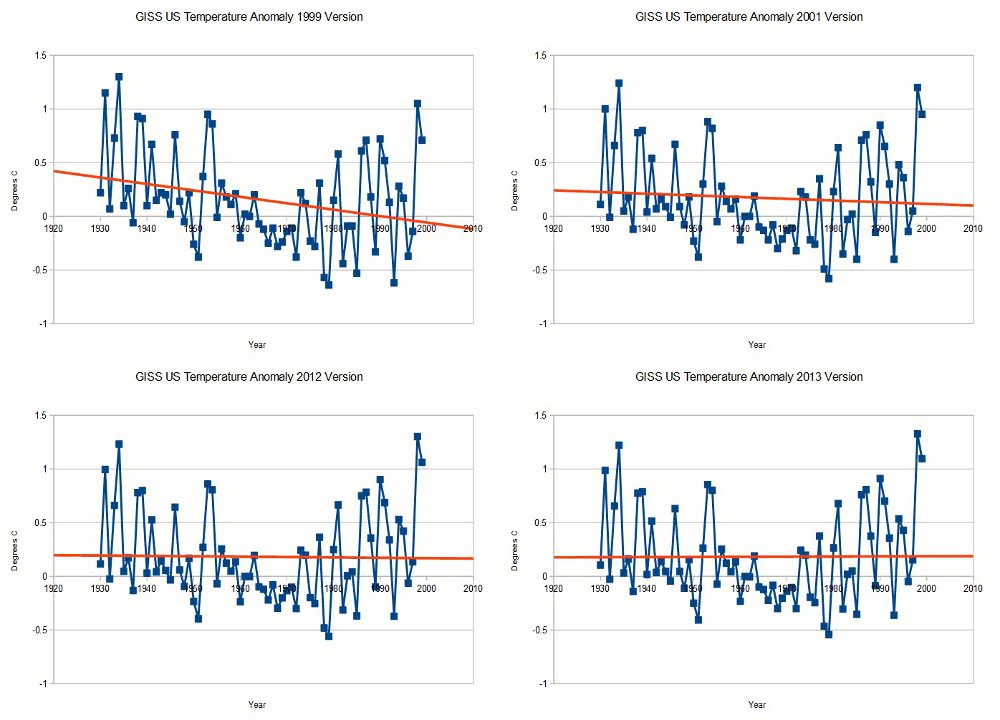
Are you aware that GISS constantly “adjusts” temperatures from the 1930’s to show non-existent warming?
dbstealey
Nice GIF, hope you don’t mind that I’ve pinched it for later use.
MikeB,
Feel free to expropriate that .gif image. I stole it from Steve Goddard!☺
well if Buel Henry is correct, shouldn’t he be publishing this is a respected journal, rather than here? Who is Buel Henry anyway, no sign of him on google and what’s his/her qualifications?
As Michal Mann said “We will keep them out – even if we have to redefine what the peer-reviewed literature is” – as he was inputting raw data instead of mean-centered data into a PCA program.
Qualifications don’t matter. Only what he can support with evidence and analysis.
Faraday had no qualifications.
sturgishooper,
Thanks. Perfect answer.☺
Who cares who he is?
His ideas are crazy.
The lady doth protest too much, methinks
hint: Hamlet
stevefitzpatrick.
You say my ideas are crazy, but you are ignoring all of the evidence that I had provided that supported my conclusions, primarily the accuracy in predicting what later temperatures
would be, based solely upon how much SO2 was removed in the interim.
I had given 3 examples in my post. Here is a fourth example, from an earlier reply, which you may have missed
From 1972 -2000, SO2 levels were continually decreasing because of Clean Air Efforts. But in the period 2000-2005, they increased by a reported 5.58 Megatonnes because of rising pollution in China.
What would you predict would happen to average global temperatures?
What actually happened was that average global temperatures dropped by 0.9 deg. C, the first drop in more than 25 years.
Applying my .02 deg. C. temp. change/Megatonne of SO2 removed factor, a temperature decrease of 0.2 x 5.58 = 0.11 deg. C.would be expected. This is within .02 deg. C of actuality!
No, Steve, my ideas are dead on. It is you, and other deniers, who have the problem.
The latest data on global SO2 emissions that I had was only to 2011. Later data should be available in the near future. At that time, further confirmation (or rebuttal) of my thesis should be possible.
[Reply: You’re new here, so this is just a notice that labeling others as ‘deniers’ is against site Policy. ~mod.]
.
Actually, my name is Burl Henry.
The problem with publishig in a “respected” journal is that there are probably hundreds of peer reviewed climate-related articles relating to C02 and greenhouse gasses that are, based upon my analysis, completely wrong.
Too few here have noticed the huge elephant in the tiny room!
Using three decimals in any value regarding measurements in the atmosphere is pure fabrication! There is no such precision! Non scientific, just the way IPCC et al prefer … It’s just a plain simple delusional trick to make some work look better then it actually is. Even two decimals are too much, regarding how measurements are conducted.
CO2, brightening and warming are all beneficial. Don’t sweat the small stuff.
The problem is that projections predict the small stuff becoming much larger, and therefore worrisome.
With no non-digital evidence, and equal plausibility! History, OTOH, is clear. Warming blooms the biosphere.