Holocene century-on-century changes have a standard deviation close to 1deg C, so if there is a signal due to carbon dioxide, it still has not emerged from the background noise
 Guest essay by Philip Lloyd
A paper of mine has just appeared in Energy and Environment:
(Lloyd, Philip J. An estimate of the centennial variability of global temperatures. Energy & Environment, 26(3), pp. 417–424 2015. DOI: 10.1260/0958-305X.26.3.417
with an abstract:
“There has been widespread investigation of the drivers of changes in global temperatures. However, there has been remarkably little consideration of the magnitude of the changes to be expected over a period of a few decades or even a century. To address this question, the Holocene records from several ice cores up to 8000 years before present were examined. The differences in temperatures between all records which are approximately a century apart were determined, after any trends in the data had been removed. The differences were close to normally distributed. The average standard deviation of temperature over a century was 0.98 ± 0.27 oC.
This suggests that while some portion of the temperature change observed in the 20th century was probably caused by greenhouse gases, there is a strong likelihood that the major portion was due to natural variations. “
I was led to this by a statement from Trenberth et al in AR4 “The standard deviation of the HadCRUT3 annual average temperatures for the globe for 1850 to 2005 shown in Figure 3.6 is 0.24°C. The greatest difference between two consecutive years in the global average since 1901 is 0.29°C between 1976 and 1977, demonstrating the importance of the 0.75°C and 0.74°C temperature increases (the HadCRUT3 linear trend estimates for 1901 to 2005 and 1906 to 2005, respectively) in a centennial time-scale context.”
This can only be regarded as naïve – the standard deviation of annual temperatures cannot indicate much about the standard deviation
over a century.
What global temperature change?
I second that motion! The Global temperature of the Earth (if that is at all possible to determine,) has remained closer to the average than the state of the art computer controlled thermostat in the average office building (as they contain auto heat/cooling functions) has over the last year (ignoring any power losses or automatic setbacks.)
There appears to be no correlation between CO2 emissions and climate change. Many warmists believe it is linear ie y=mx+c and it most certainly is not. Extreme warmists (Mann, Gore etc) insist that it is exponential ie y=e^x. Experience over the last 18 years indicates that a flatlining correlation is appropriate ie y=C where c=0
Zero plus or minus 0.2
I have always wondered why climatologists argue about the mean temperature rather than the median temperature. Just curious.
Markstoval, agreed. Good question. The average daily climate-relevant number would be the time-weighted temperature factored with the absolute humidity. That would report the energy content average during the period.
Humidity has a strong effect on temperature. Ultimately the claim about temperature is a claim about energy and the temperature doesn’t tell us the energy content of a system with variable humidity.
“Why not use the median?” This is an interesting question.
In my field of underwater acoustics, the mean is generally higher than the median for many data distributions. Take for example long-tailed distributions of shipping noise vs. azimuth… the mean is at about the 85th %-ile!
So using the mean may well bias the answer high, and in a somewhat unstable way.
The median depends on the number of samples (readings) you take. The average does not.
So if you average a data set, you always get a value which could actually be equal to one of the data set items.
With the median value, it can NEVER be equal to one of the members of the data set unless there is always an odd number of set members, and it ALWAYS is equal to one of the set values if there is an odd number of items in the set.
With the average, it can equal one of the set values but it also might NEVER be equal to any member of the set.
But both of them are simply algorithms defined in statistical mathematics; they are what they are defined to be.
There is no scientific proof that any changes in Earth’s climate have been caused by humans.
.
Since climate change for the past 4.5 billion years has been “natural”, including several ice ages that came and went, there would have to be unusual climate changes in the past century to suggest any meaningful climate effect from humans.
.
There have been no meaningful climate changes in the past 100 years of very rough measurements — slight warming or cooling over 100 years is not unusual, proves nothing, and predicts nothing.
.
We do know that humans have built many cities, and cities are warmer than the surrounding countryside.
.
Since some thermometers used for the global average are located in cities (too many), one could say the increased area of Earth covered by cities is probably responsible for some warming that has been measured by surface thermometers … but that climate change must be one that people like, since so many of them choose to live in cities.
.
Climate change today is not science — it is a political tool used by leftists to scare people into wanting more government control of corporations, and their own lives.
.
It has been more effective than past boogeymen, such as DDT, acid rain, and the hole in the ozone layer, only because of the huge amount of government funding available for any scientists willing to “cry wolf” in return for grants.
.
The average temperature of Earth is a meaningless, inaccurate, statistic used for political purposes by presenting truncated charts that make meaningless 0.1 degree changes in the average temperature look important.
.
Sadly, skeptics tend to use the same misleading style of temperature charts, even on this website, when they should know better.
.
Climate change for non-scientists here:
http://www.elOnionBloggle.blogspot.com
Be careful you don’t fall into the same trap you are criticizing. Your opening statement:
conflicts with your later point:
Your first statement is implicitly based upon a global average since, as you subsequently point out, local and possibly regional climate impacts by human have been demonstrated by valid observations. Yet your opening declaration appears to reject the possibility of local, long-term weather pattern changes as a result of human activity.
For forecasts of the timing and extent of the coming cooling based on the natural solar activity cycles – most importantly the millennial cycle – and using the neutron count and 10Be record as the most useful proxy for solar activity check my blog-post at
http://climatesense-norpag.blogspot.com/2014/07/climate-forecasting-methods-and-cooling.html
We are past the 1991 millennial peak in solar “activity” (figs 14 and 13) and 12 years past the corresponding temperature peak in the RSS data in 2003. See
http://www.woodfortrees.org/plot/rss/from:1980.1/plot/rss/from:1980.1/to:2003.6/trend/plot/rss/from:2003.6/trend
The general cooling trend will likely continue to the depths of the next LIA at about 2650. This trend will be modulated on the way down by the shorter term temperature periodicities ( De Vries , Gleissberg and 60 year cycles.
Dr. Page, while I don’t go as far as 2650, my solar model, which is based on F10.7cm solar flux and SSTs, indicates that we started cooling overall post-2003, as you have determined, and that sometime between this year and 2017, we are going to experience noticeable cooling from lower solar activity (less energy in). My model is NOT based on cycles, but rather actual measured solar activity levels.
The recent end of 2014/start of 2015 warmth records were driven by higher solar activity since Sept 2014, that has since dropped off.
The Sun is currently oscillating around ~133 sfu/day (over one rotation). For instance, for the past two weeks, half a solar rotation, F10.7 averaged 144 sfu/day, and for the next two weeks, according to the USAF 45 day forecast, http://services.swpc.noaa.gov/text/45-day-ap-forecast.txt, they say the average will be 106 sfu/day over the next two weeks.
When F10.7cm goes below ~120 sfu/day, and stays there, it’s all over – until SC25 or #26 max, if there’s high enough flux, that is….
More details this summer.
! agree with your short term analysis. By the way SFI today is 120.
My 2650 number ( probably more like 2635 – I just rounded it off a bit) comes from the general trend of the 50 year moving average in Fig 9 in the linked blog. The general trend of the next 1000 years is conservatively forecast to be likely to be similar to the last 1000.Possibly slightly cooler as we go down the precession cycle towards the next ice age.
This is the one that gets me because it’s a suburb of my town-
http://www.sa.gsa.org.au/Brochures/HallettCoveBrochure.pdf
In particular from that Point 6-
Shore platform
The level shore platform has been eroded by wave
action across the rocky coastline during the past
7000 years. The big fold was formed during the
mountain building about 500 million years ago.
During the Recent ice age about 20 000 years ago,
sea level was about 130 metres lower than today
and South Australia’s coastline was about 150
kilometres south of where Victor Harbor now is.
The ice cap started to melt about 15 000 years ago.
Sea level began to rise and reached its present level
about 6000–7000 years ago.
Well 130 metres in a 9000 year period is an average rise of 14.4mm/yr but let’s say those rock gurus got it a bit wrong and it was 130M over 13000 yrs that’s still 10mm/yr average.
The First Fleet full of carboniferous whitefellas only rolled up in sailing ships in 1788 so where’s the CO2 signal in all that sea level rise warmy folks? Does the truth about Gaia lie in the rocks on the ground or the rocks in your heads?
Of course we need to compare that with the whitefella warming of 0.85mm/yr average-
“One of the oldest tide gauge benchmarks in the world is at Port Arthur in south-east Tasmania. When combined with historical tide gauge data (found in the London and Australian archives) and recent sea level observations, it shows that relative sea level has risen by 13.5 cm from 1841 to 2000.”
scroll down to see the Port Arthur tide gauge-
http://www.cmar.csiro.au/sealevel/sl_hist_few_hundred.html
Why is the burning of fossil fuels considered anthropogenic? Clearly any competent geologist will inform a climate “scientist” that eventually all “fossil” materials will be sucked into the mantel subduction zone and “recycled” i.e. regurgitated in a nearby volcano in a decomposed (burnt, oxidized, etc. ) state. If with the minimal geological training that I received while earning my engineering degree can envision this why can’t the climate “scientists?” Further, it just seem illogical that a gas that is release naturally by every volcano and vent on the surface of the Earth, and Ocean can cause significant changes to the natural balance of nature. The anthropogenic amount produced is an amount that is LESS than 1SD of the amount released naturally. In other words, it is in the NOISE level. it has no significance! It is just not logical it is also not probable or possible and can not be supported by math or any form of science. All charts showing thousand or millions of years of the temperature and CO2 concentrations of Earth show this and support this.
http://www.geocraft.com/WVFossils/CO2_Temp_O2.html
The only reason there is a correlation today is that there just happens to be a correlation today.
A lot of the carbon sequestered during the Carboniferous and Permian Periods lies on continental cratons not likely to be subducted for a long time, if ever.
The evolution of seed-bearing land plants in the Devonian Period before the evolution of fungi able rapidly to break them down left later periods a legacy of buried carbon, pulled out of the air.
Thanks, Philip Lloyd. Good article.
After paying attention to this matter for years, and compiling a lot of diverse climate data.
I have come to the conclusion that almost all of the global temperature rise in the twentieth century is natural and not caused by the small man-made increase of atmospheric CO2. Also, that CO2 cannot be the controlling factor for global temperature; Sea surface temperatures and ocean circulations powered by the Sun are.
Interesting to note how the ‘global’ average sea level rise nearly doubles the rate measured at Port Arthur which is obviously statistically significant for some-
“We have used a combination of historical tide-gauge data and satellite-altimeter data to estimate global averaged sea level change from 1880 to 2009. During this period, global-averaged sea level rose about 21 cm, with an average rate of rise of about 1.6 mm/yr over the 20th Century. The sea level record indicates a statistically significant increase in the rate of rise between 1880 to 2009.”
Either that or you lot are on sinking ground compared to Gondwanaland 😉
Philip Lloyd,
I think it is great to see attempts to use observational data to estimate natural variability, The mainstream climate community seems to have extremely remiss in that regard.
I have not managed to access your paper, so perhaps you can answer some questions for me. Which ice cores did you use? How did you estimate the contribution of measurement uncertainty to the total variance?
The cores were GISP, GISP 2, Vostock and EPICA Dome C, with data downloaded from National Climatic Data Center. Isotope measurements have a precision of the order of 1 per thousand, which would suggest a temperature precision of the order of 0.3oC at temperatures of ~300K. However, all the samples analysed in this study had well over 200 values, so the precision of measurement should have had little influence on the results.
Philip Lloyd,
Thanks. I have EPICA and Vostok data that I downloaded a few months ago and the files do not have century scale resolution. Perhaps I have the wrong files. Is there a chance that you could provide the raw data file names?
GISP was ftp://ftp.ncdc.noaa.gov/pub/data/paleo/icecore/greenland/summit/gisp2/isotopes/gisp2_temp_accum_alley2000.txt
GISP 2 was GISP2 Ice Core 4000 Year Ar-N Isotope Temperature Reconstruction
LAST UPDATE: 3/2012 (Original receipt by WDC Paleo)
EPICA % File name Vinther_etal_2009_data_29sep2009.xls
I did not unfortunately record the Vostok file name, but I think there is only one
Correction! EPICA was EPICA Dome C Ice Core 800KYr Deuterium Data and Temperature Estimates; LAST UPDATE: 11/26/2007 (Replaced age model. This file now includes EDC3
age model. Previous version of this file dated 10/16/2007 erroneously
included the older EDC1-EDC2 age model)
CONTRIBUTOR: Valérie Masson-Delmotte, LSCE/IPSL
IGBP PAGES/WDCA CONTRIBUTION SERIES NUMBER: 2007-091
Thanks. I may not have exactly the same files, but they should give me a feel for the data. I am very much interested in the question raised by Frank (May 18, 2015 at 9:26 am) which I think is very important to address.
Interesting how a likelihood can be “strong”, and so I presume it can also be weak, medium, super strong and super jumbo strong. “Probably” I assume refers to probability but without a defined numerator and denominator to calculate actual probability, it becomes meaningless as a determinate. It is instead conjecture.
I am not against conjecture in science, it is part of the process. Evolution is a known, Abiogenesis is reasonable conjecture based on available evidence. A competent evolutionary biologist would not claim to know how Abiogenesis works. They know how it might work but if asked how life first began they would have to answer, “We don’t know, we got some ideas”.
It seems the expression “I don’t know” has been banned from climate science creating shoddy differentiation between what is known and not known. This then becomes fodder, inferior but readily available material for heads of state to engage in all manner of idiocy.
‘settled science’ has no room for ‘we don’t know ‘ for they understand that by admitting that their already not great case becomes weaker still . Its the same reason they ‘need ‘ the unprecedented idea therefore there is time to waste, they are trying to rush things through before any ‘hard questions ‘ get asked .
What fits the global temperature trend data the best since the Holocene Optimum- Present is what I suggest below.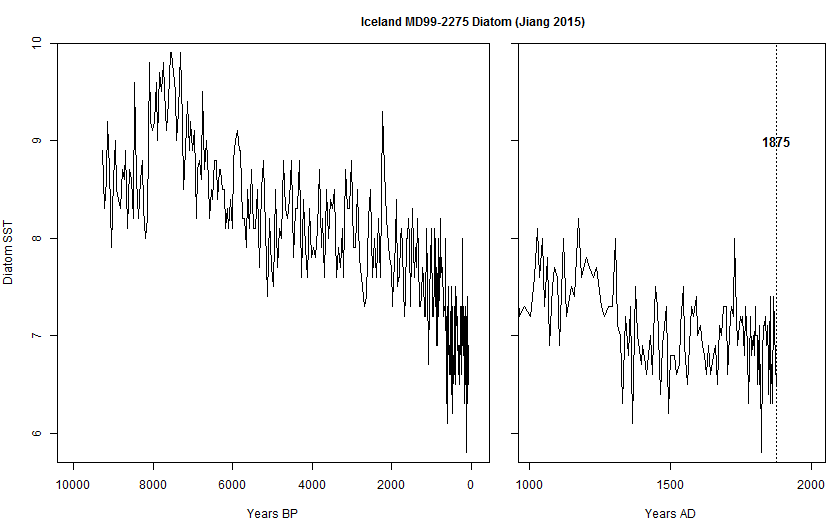
My thoughts on what drives the climate conform to what the data shows(present/past), unlike AGW theory which totally ignores the data both present and past.
AGW theory wants the data to conform to what it suggest, not the other way around.
More data which shows since the Holocene Optimum from around 8000BC , through the present day Modern Warm Period( which ended in 1998) the temperature trend throughout this time in the Holocene, has been in a slow gradual down trend(despite an overall increase in CO2, my first chart ), punctuated with periods of warmth. Each successive warm period being a little less warm then the one proceeding it.
My reasoning for the data showing this gradual cooling trend during the Holocene ,is Milankovitch Cycles were highly favorable for warming 10000 years ago or 8000 BC, and have since been in a cooling cycle. Superimposed on this gradual cooling cycle has been solar variability which has worked sometimes in concert and sometimes in opposition to the overall gradual cooling trend , Milankovitch Cycles have been promoting.
Then again this is only data which AGW enthusiast ignore if it does not fit into their scheme of things. I am going to send just one more item of data and rest my case.
http://www.murdoconline.net/wordpress/wp-content/uploads/2011/01/gisp2-ice-core-temperatures.jpg
Lloyd: It is meaningless to compare the amount of variation in temperature at one location – the site of an ice core in Greenland – with variation in global temperature – the AVERAGE of many different locations. You don’t have to wait a century to observe a 1 degC change in mean annual temperature at one location – it happens EVERY year at any one location. The standard deviation in mean ANNUAL temperature at any one location on the planet is about 1 degC.
This happens because heat is chaotically distributed around the planet by wind and ocean currents. Unusual warmth is observed in one locations is often (but not always) associated with unusual cold in another. A static Rossby wave brought unusual warmth to Alaska last winter and cold to the East Coast of the US (and the low pressure systems which tend to follow such waves brought little precipitation to California and the western US). ENSO shifts heat between the Eastern and Western Equatorial Pacific. The Arctic Oscillation shifts heat between the Arctic and temperate zones of the NH. The AMO shifts heat between the North Atlantic (near your ice core data) and the ocean further south. So mean annual temperature in Greenland is far more variable than mean global temperature.
Redistribution of heat within the planet changes the mean annual temperature of any one location, but redistribution can’t change mean annual temperature of the whole planet! In the long run, mean GLOBAL temperature varies only* by changing: 1) the amount of incoming radiation (solar TSI times albedo) and 2) radiation to space (emitted and absorbed by GHGs).
*There are some possible exceptions to this generalization: 1) Since the deep ocean is far colder than the surface, changes in the slow rate of exchange (upwelling and downwelling) between the surface and the deep ocean can change global climate for a long time without changing the flux of heat into and from the whole planet. However, except for some polar regions, the ocean is stably stratified – with less dense warm water on the surface and colder water below. 2) Since radiation is emitted following a T^4 law, more evenly distributing heat within the planet will decrease OLR and decrease mean global temperature. The slow movement of continents certainly changes the heat flux to the polar regions by ocean currents.
The Greenland ice sheets are regional, since the water that ends up there comes from most of the N. Atlantic.
I chose not one, but four points, and they all agree on the timing and magnitude of the major events, so perhaps, while you have a point, you may need to reconsider it in this light.
Frank good points you make. While oceans are redistributing heat stored from solar radiation, the circulations are sometimes centennial or longer in their effects, and thus create what humans see as “climate change”. I think the AMOC deserves more respect for making changes in our world’s climate.
https://rclutz.wordpress.com/2015/04/13/climate-pacemaker-the-amoc/
One of the many zany aspects of the CACCA ho*x is the idea that the atmosphere warms the oceans measurably through back radiation or convection from the allegedly warmer air. That’s the tail wagging the dog on a planetary scale.
The oceans give up their stored solar heat through circulations and oscillations such as the AMO and ENSO. The GHE from CO2 is mainly an effect, not a cause.
I agree.
Now with the decline in solar cycle 24 and with solar activity perhaps staying at very low levels for several years the nonsense of AGW theory will finally come to an end.
I expect sea surface temperatures to eventually fall in response to very low solar activity.
Okay, let me get this straight.
Temperature is an average — the average kinetic energy of a collection of objects with some distribution of momenta.
Average global temperature is then an average of averages, right?
Does not the Yule-Simpson Paradox (or Effect) — a paradox in probability and statistics in which a trend that appears in different groups of data disappears or reverses when these groups are combined — apply here?
And if the Yule-Simpson Paradox is at play, and the means are meaningless, what information do standard deviations contain?
(Don’t even get me started on ‘average standard deviations.’)
Max Photon,
I don’t think the Simpson Paradox applies here as long as the data from the different groups are properly weighted, but I have not tried to prove it. Do you have some reason to think it is an issue?
Anyone with the modicum of come sense can see the c02 signal is between 4 and 6th s of a degree of warming for a doubling of c02.This makes it impossible to be concerned about the climate scare meme.
Well the world’s just seen again that Anthony Watt’s and his followers don’t understand anything about statistics. This is beyond stupid. Can’t wait for this little gem to be destroyed on the other blogs.
Why don’t you use your understanding of statistics and destroy it yourself here ?
He’s just a dog. He can’t even spell correctly, and you expect him to understand statistics??
Fine. Do you honestly think that it is valid to compare estimates of variability derived ice cores against estimates of variability derived from satellite records/temperature station measurements? [snip . . irrelevant invective is not useful . . mod]
Siberian Husky,
We have no estimates of natural variability “derived from satellite records/temperature station measurements”. Unless, that is, you assume that man has had absolutely no impact on the climate.
No, no, no, you’re completely missing the point. It’s totally inappropriate to compare apples and oranges, as it is completely pointless wasting one’s time trying to educate anyone on this blog. Using ice cores as a proxy for global temperature average involves massive uncertainties in measurement. These will also contaminate any estimate of variability of variation over a century using these samples. Therefore it’s totally inappropriate to compare them to measurements of variability over a time frame using satellite data or temperature records without some sort of adjustment for this.
Mr. “No, no, no”
If you don’t like ice cores, and you don’t like satellite data, then what system do you use?
Witch doctor juju?
You’re the one making the ridiculous claim honey.
Siberian_Husky,
“Anthony Watt’s and his followers”? Anthony has followers? What do you think he is, some sort of prophet? I am pretty sure he has no such delusions and would not want any “followers”.
From what I have seen, the commenters here resemble a herd of cats. Blind, drunken cats in some cases. But pretty much all not following anyone’s lead but their own. Unlike what you will find at a site like, say, ATTP.
Yes, there is a lot of nonsense to be found here. Beats an echo chamber, in my book. It would be better if people would try to make constructive comments, rather than just mouthing off.
One constant with the puppy, he can’t be bothered with actually demonstrating the claims he makes.
Growling about how others are wrong seems to be the limit of his mental capacities.
Fitting since all his posts are huge growlers.
Philip Llloyd,
It seems you paper is in some pre-publication state behind a double paywall, so I can not access it. So I am reduced to trying to reproduce it blind. So far, I have managed to take a quick look at the last 8000 years of EPICA and GISP2 data. Just on the raw numbers, standard deviations about the mean in each data set are about 0.8 K, smaller than the 100 year values you report. I can not see why that would be. I took 100 year averages and find standard deviations between successive points of 0.45 K (GISP2) and 0.48 K (EPICA); much smaller than what you report. As Frank points out, global average values will be smaller due to averaging out local effects. Also, global averages will be smaller since high latitudes have higher temperature variability. And some of that is measurement uncertainty. So it is starting to look to me like the last 100 years may well be unprecedented.
In all the records there are records which differ by 100 +/- 10 years. I looked at the differences between each of those records – and there were several hundred such pairs for each core. . They were normally distributed and the mean was close to 100 years. I also de-trended the data before taking the differences because there is some Milankovich cooling going on over the past 8000 years – detrending had a minimal effect on the result. It is quite a simple experiment – sorry about the paywall!
Greenland ice cores may not be a good proxy for global temperature changes. RSS data show Arctic temperature trend is 2.5 times greater than global temperature trend
http://notrickszone.com/wp-content/uploads/2013/11/Caryl_1_22Nov1.png
http://notrickszone.com/wp-content/uploads/2013/11/Caryl_22.png
Since 2012 the temperature in the Arctic decreases.
http://www.climate4you.com/images/70-90N%20MonthlyAnomaly%20Since2000.gif
You can see to what extent the temperature in the Arctic depends on the circulation and the importance of the strength of the polar vortex in the stratosphere in the winter.
http://www.climate4you.com/images/ARCTIC%20Temp%20201501%20versus%20last%2010yr%201200km.gif
It is worth to compare it with Earth’s magnetic field.
http://www.geomag.nrcan.gc.ca/images/field/fnor.gif
The CRII leads to the production of odd nitrogen. For example, fast secondary
electrons (e∗) can dissociate the nitrogen molecule, N2+e∗→2N(2D)+e, and almost
all of the N atoms in the excited 2D state react with O2, producing nitric oxide,
N(2D)+O2 →NO+O. Vitt and Jackman (1996) estimated CRII to produce 3.0 to
3.7×1033 molecules of odd nitrogen per year in the global stratosphere, which amounts
to about 10% of the NOx production following N2O oxidation. They also mention that
the northern polar/subpolar stratosphere (>50◦ N) is believed to be supplied with NOx
in equal amounts by GCRs (7.1 to 9.6×1032 molecules/yr) and by N2O oxidation (9.4
to 10.7×1032 molecules/yr). In the deep polar winter stratosphere, when air masses
experience sunlit periods only infrequently and photolysis of HNO3 becomes negligible,
CRII become the only source of NOx, revealing the importance of GCRs in high latitudes.
http://www.researchgate.net/profile/I_Usoskin/publication/49611898_Influence_of_galactic_cosmic_rays_on_atmospheric_composition_and_temperature/links/0deec518021e5b06ef000000.pdf
ABSTRACT The odd nitrogen source strengths associated with solar proton events (SPEs), galactic cosmic rays (GCRs), and the oxidation of nitrous oxide in the Earth’s middle atmosphere from 1974 through 1993 have been compared globally, at middle and lower latitudes (50 ø) with a two-dimensional photochemical transport model. As discovered previously, the oxidation of nitrous oxide dominates the global odd nitrogen source, while GCRs and SPEs are significant at polar latitudes. The horizontal transport of odd nitrogen, produced by the oxidation of nitrous oxide at latitudes
A comparison of sources of odd nitrogen production from 1974 through 193 in the Earth’s middle atmosphere as calculated using a two-dimensional – ResearchGate. Available from: http://www.researchgate.net/publication/242267498_A_comparison_of_sources_of_odd_nitrogen_production_from_1974_through_193_in_the_Earth%27s_middle_atmosphere_as_calculated_using_a_two-dimensional [accessed May 21, 2015].
In short, the null hypothesis that long-term temperature changes are natural cannot be rejected. Why is this hard?
A few problems with Dr Lloyd’s logic:
1) No smoking gun: Yes, climate change has happened in the past, for other reasons (e.g.: solar and volcanic activity) but none of these triggers have occurred recently. Dr Lloyd basically saying temperature has changed before (for other reasons) so it could be changing now for the same reasons, without showing those same drivers have occurred.
2) Coupled system: We know for a fact CO2 increases temp. We know for a fact we are putting CO2 into the atmosphere, and levels have risen significantly. To deny the CO2 we are putting into the atmosphere is having an effect on temperature, you have a burden of proof, i.e.: prove that CO2 can have no effect. Also not shown. Worse, you have to disprove the empirical finding that our CO2 – based on C12/13 isotopes – residing in the lower atmosphere, is causing current warming. You can’t just pretend those proofs don’t exist to suit yourself.
3) Selective variables: Natural variability could be worsening warming… It could also be slowing down human-induced warming. There’s basically a 50:50 chance. To choose the favoured outcome is plain wrong, especially when the same data may actually prove real warming is twice as bad (rather than not as bad). This worse-case is actually more probably, since a negative Pacific Decadal Oscillation (which we’ve been in for the past several years) normally causes cooling, but this time has been more than offset by other warming factors (i.e.: real warming is potentially much worse than current perceived warming.)
4) CO2 vs Temp: We also know there is a delayed effect on temp from rising CO2, which accumulates in the atmosphere meaning the full temperature effect of current emissions hasn’t occurred yet. (Just as there is a delayed effect on CO2 from rising temp – it is a feedback loop.) Dismissing temperature variability is therefore inconclusive without also explaining CO2 variability, which cannot be explained by the same logic. Not only are current CO2 levels outside the range of natural variability for 8000 years, they are outside the natural variability for millions of years.