From Scripps Institution of Oceanography
![sioLogo-scale[1]](https://wattsupwiththat.files.wordpress.com/2015/04/siologo-scale1.png?quality=75)
Research Highlight: Arctic Sea Ice Loss Likely To Be Reversible
Scenarios of a sea ice tipping point leading to a permanently ice-free Arctic Ocean were based on oversimplified arguments
New research by Till Wagner and Ian Eisenman, scientists at Scripps Institution of Oceanography, UC San Diego, resolves a long-running debate over irreversible Arctic sea ice loss.
Ever since the striking record minimum Arctic sea ice extent in 2007, the ominous scenario of a sea ice tipping point has been a fixture in the public debate surrounding man-made climate change and a contingency for which Arctic-bordering countries have prepared.
For decades, scientists have been concerned about such a point of no return, beyond which sea ice loss is irreversible. This concern was supported by mathematical models of the key physical processes (known as process models) that were believed to drive sea ice changes. The process models forecasted that increased global warming would push the Arctic into an unstoppable cascade of melting that ceases only when the ocean becomes ice-free.

Implications of a permanently ice-free Arctic for the environment and for national and economic security are significant, driving deep interest in predictive capabilities in the region.
Wagner and Eisenman’s research was co-funded by the Office of Naval Research (ONR) and by the National Science Foundation. It supports the goals of the Navy’s U.S. Arctic Roadmap, which calls for an assessment of changes in the Arctic Ocean to clarify the national security challenges for future naval operations as this strategic region becomes increasingly accessible.
“The Navy has broad interest in the evolution of the Arctic,” said the ONR’s Frank Herr. “Sea ice dynamics are a critical component of the changing environmental picture. Our physical models lack important details on the processes controlling ice formation and melting, thus ONR is conducting a series of experimental efforts on sea ice, open water processes, acoustics, and circulation.”
During the past several years, scientists using global climate models (GCMs) that are more complex than process models found sea ice loss in response to rising greenhouse gases in their computer simulations is actually reversible when greenhouse levels are reduced.
“It wasn’t clear whether the simpler process models were missing an essential element, or whether GCMs were getting something wrong,” said Wagner, the lead author of the study. “And as a result, it wasn’t clear whether or not a tipping point was a real threat.”
Wagner and Eisenman resolve this discrepancy in the study in an upcoming Journal of Climate article, “How Climate Model Complexity Influences Sea Ice Stability.”
They created a model that bridged the gap between the process models and the GCMs, and they used it to determine what caused sea ice tipping points to occur in some models but not in others.
“We found that two key physical processes, which were often overlooked in previous process models, were actually essential for accurately describing whether sea ice loss is reversible,” said Eisenman, a professor of climate dynamics at Scripps Oceanography. “One relates to how heat moves from the tropics to the poles and the other is associated with the seasonal cycle. None of the relevant previous process modeling studies had included both of these factors, which led them to spuriously identify a tipping point that did not correspond to the real world.”
“Our results show that the basis for a sea ice tipping point doesn’t hold up when these additional processes are considered,” said Wagner. “In other words, no tipping point is likely to devour what’s left of the Arctic summer sea ice. So if global warming does soon melt all the Arctic sea ice, at least we can expect to get it back if we somehow manage to cool the planet back down again.”
Source: Scripps Press Release
Process models? Somehow I doubt that they are talking about the same sort of tools that are used to analyse industrial or engineering processes. They moved on to GCMs, which have bogus CO2 sensitivity hard-wired into them, so they are still going round in circles.
Maybe the hope is that the “process models” will be confused for something like HYSIS.
Wow – cheered me up seeing that stuff. Real modelling 🙂
The title of their article says it all. “How Climate Model Complexity influences Sea Ice Stability”
How far from reality can one go? These “scientists’ have given us a new high mark to strive for.
And I’m sure many more will try.
Hooray for GCMs!
But this is no bombshell. The IPCC was not projecting an irreversibly ice-free Arctic. The AR4 says:
“An important characteristic of the projected change is for summer ice area to decline far more rapidly than winter ice area (Gordon and O’Farrell, 1997), and hence sea ice rapidly approaches a seasonal ice cover in both hemispheres (Figures 10.13b and 10.14). Seasonal ice cover is, however, rather robust and persists to some extent throughout the 21st century in most (if not all) models.”
Incidentally, they also say, in 2007:
“In 20th- and 21st-century simulations, antarctic sea ice cover is projected to decrease more slowly than in the Arctic (Figures 10.13c,d and 10.14), particularly in the vicinity of the Ross Sea where most models predict a local minimum in surface warming. This is commensurate with the region with the greatest reduction in ocean heat loss, which results from reduced vertical mixing in the ocean (Gregory, 2000). The ocean stores much of its increased heat below 1 km depth in the Southern Ocean.”
what? the IPCC are all about ‘tipping points’.
http://climate.dot.gov/about/overview/climate_tipping_points.html#_ftn11
“IPCC Perspectives on Tipping Points
In the IPCC Fourth Assessment Report, the IPCC addresses the issue of tipping points in the discussion of “major or abrupt climate changes” and highlights three large systems: the meridional overturning circulation (MOC) system that drives Atlantic Ocean circulation, the collapse of the West Antarctic Ice Sheet, and the loss of the Greenland Ice Sheet (Meehl et al. p. 818). The IPCC also mentions additional systems, as noted below, that may have tipping points but does not include estimates for these additional systems.
Various climate and climate-affected systems that might undergo abrupt change, contribute to climate surprises, or experience irreversible impacts are described in the IPCC Working Group I report (see Chapter 10, Box 10-1). The systems that the IPCC described include:
Atlantic MOC (AMOC) and other ocean circulation changes;
Arctic sea ice;
Glaciers and ice caps;
Greenland and West Antarctic Ice Sheets;
Vegetation cover; and
Atmospheric and ocean-atmosphere regimes.”
this is what the USA government are telling their tax payers..
Yes, they listed it in FAQ 10.1 of the AR4. But don’t you ever stop to read what they said about it? Here it is:
“Arctic sea ice is responding sensitively to global warming. While changes in winter sea ice cover are moderate, late summer sea ice is projected to disappear almost completely towards the end of the 21st century. A number of positive feedbacks in the climate system accelerate the melt back of sea ice. The ice-albedo feedback allows open water to receive more heat from the Sun during summer, and the increase in ocean heat transport to the Arctic through the advection of warmer waters and stronger circulation further reduces ice cover. Minimum arctic sea ice cover is observed in September. Model simulations indicate that the September sea ice cover decreases substantially in response to global warming, generally evolving on the time scale of the warming. With sustained warming, the late summer disappearance of a major fraction of arctic sea ice is permanent. “
Same as above. “With sustained warming, the late summer disappearance of a major fraction of arctic sea ice is permanent.” No total disappearance, and dependent on sustained warming.
Nick, it is not me that wrote that trash the American government put on their website. your problem is with them it seems. I never believed that the arctic melt was unprecedented in human times, so i dont really care about the crap that the IPCC formulate from their already proven wrong models.
my specific issue is the ‘no bombshell’ statement you make. considering the government website makes it rather clear that there are indeed tipping points for the arctic sea ice, this is what they expect the public to digest. kids go do their homework and find.. tipping points. green trash statements which are just as bad as the word sustainability. who decides what is sustainable when the figures are nonsense? who decided tipping points when the figures (models) were nonsense? etc.
Nick,
There are so many authorities to choose from as the voice of AGW Consensus Inc.
You favour a jejune utterance from the IPCC.
Why not Mark Serreze?
“We could very well be in that quick slide downward in terms of passing a tipping point,” said Mark Serreze, a senior scientist at the data center, in Boulder, Colo. “It’s tipping now. We’re seeing it happen now.”
That was 2008 before his damascene moment.
We recently read that skeptics are actually closet believers but I’m sensing that, along with “death spiral” Serreze, you and Brandon and the other couple of warm-hearted visitors are covert contrarians, who knew the tipping point thing was nonsense all along but neglected to mention it.
Serreze? Sure, there are scientists who think there may be a tipping point. But this article says the discovery of one group that thinks there may not is a BOMBSHELL. The IPCC summarises the general trend of the literature, and says (2007) that Arctic ice disappearance is not expected this century. That one more paper says that is not a bombshell.
In fact, it’s a rather technical paper on the bifurcation of a differential equation. I don’t think there has been discussion of this, pro or con, in popular discourse.
“There are so many authorities to choose from as the voice of AGW Consensus Inc.”
That is so you can quote many different shades of grey when you need an excuse for the fear-mongering going poorly.
Nick,
I know the IPCC is a convenient cover to duck into and out of; Pachauri, himself, did it.
Interview:
“SIMON LAUDER: You’ve said before that carbon dioxide needs to be no higher than 350 parts per million to avoid the climate tipping point. Do you think action is happening fast enough to avoid that still?
RAJENDRA PACHAURI: Well, I did preface that remark by saying this is a personal view and I’m not saying that as chairman of the IPCC because the IPCC is not supposed to be politically prescriptive. I mean it is for the world to decide whether they want 350 parts per million or 450 or whatever but as a human being, as an individual I would say that I would feel comfortable with that level and of course, we know that is going to be quite a challenge.”
Opining that 351ppm is a tipping point is not “politically prescriptive” if it’s based on science, as he claims it is. What he’s saying is that people must decide whether they care about it being a tipping point, not whether it is one.
The reason he was being interviewed was precisely because he was the boss of the IPCC, just as Hansen got his soap-box as a perk of working at NASA.
It’s also clear that every blow struck on the AGW body is merely a Monty Python flesh wound, so we have to ask; if it’s not a bombshell, then what is it?
Is it noteworthy that Serreze, whom you dismissed as merely one of several, reversed his position on the tipping point?
Will it be another damp squib when Peter Wadhams postpones permanently the plunge off the polar precipice?
mebbe,
Sorry, but I’m on record in this forum as saying that I’m dubious of claims that the WAIS has reached tipping point. Not “sceptical” — dubious. I’m not convinced. That does not mean that I categorically reject the concept, nor saying that such claims must be false, and it certainly doesn’t make me a covert climate contrarian. It does, however, make me honest about my doubts.
An aside: on a subject as complex as climate, it’s very easy to say to someone, “you’ve never said X about Y” and “conclude” that they must have been trying to hide something. This is a nonsense argument because there’s always something that I will not have written about given the mammoth scope of the topic. As well, I seriously doubt that you read ever word I’ve ever written everywhere I post on this topic, so you’re essentially making insinuations on the basis of incomplete information. Which I do NOT consider honest.
Cheers.
Brandon,
Even you should savour the irony of your invoking the WAIS in a thread about Arctic sea ice, since your side always accuses us of saying “What about the Antarctic?”
Skeptical, even when you spell it with a c is the same as dubious; you doubt the validity, veracity or truthiness and that casts a shadow over your full-fledged, non-contrarian credentials.
In addition, on the strength of your doubts as to my having perused the entire corpus of your on-line contributions, you have the temerity to “insinuate” that I am not “honest”. You didn’t have the complete information necessary to impugn my integrity but I can now asseverate that your doubts about my familiarity with your world-wide commentary are well-founded.
This admission does not exonerate you with regard to the calumny you previously perpetrated and which was equivalent to the slander that you claim I slung your way.
You might even be accused of the horrible crime of hypocrisy!
“antarctic sea ice cover is projected to decrease more slowly …….particularly in the vicinity of the Ross Sea”
Unfortunately exactly the opposite has happened since AR4 was writtten. The Ross sea and adjoining areas are about the only place in the Southern Ocean where sea-ice hasn’t increased much.
Well, I suppose a slow increase is closer to a slow decrease than is a fast increase….
I suppose if one thinks that somewhere around 1850 or so was Earth’s optimum climate, then even the normal “snowball-to-hothouse” Earth climates we know about would seem catastrophic. Anyone schooled in geology takes a rather phlegmatic, long-term view of things such as climate; however, perhaps those not so blase would be rather alarmed at Chicago going back under a kilometer of ice, or sea levels rising another 100 feet. Even natural variability is a bitch if you’re the one at the far end of it.
Was an interview with a Polar Bear involved?
Yes, but it ate the reporter. No film at 11, damn thing got the camera guy too.
“It wasn’t clear whether the simpler process models were missing an essential element, or whether GCMs were getting something wrong,”
uhhh…yes and yes
You beat me to it!
They’re both models so they’re both crap.
How can these numbskulls continue to use models as ‘evidence’. Models aren’t data, they’re just guesses (and bad guesses at that)
Well they got it half right, what they missed is the melt is a cooling mechanism in itself.
Did they miss it, or is it just not mentioned in the press release?
Since they say this
“During the past several years, scientists using global climate models (GCMs) that are more complex than process models found sea ice loss in response to rising greenhouse gases in their computer simulations is actually reversible when greenhouse levels are reduced.”
I’m guessing they missed it.
micro6500,
Turns out there’s a preprint of the entire paper here: http://eisenman.ucsd.edu/papers/Wagner-Eisenman-accepted-2015.pdf
Lf is the latent heat of fusion of sea ice, and cw is the heat capacity of the ocean mixed layer, which is equal to the product of the ocean mixed layer specific heat capacity, density, and depth.
So no, they didn’t miss it, it’s just not mentioned in the press release.
Brandon Gates April 28, 2015 at 7:50 pm
////
Brandon, that is not a complete answer. It only deals with latent heat, but there is potentially another inter -related feedback.
The other aspect is whether the low extent of ice coverage enables more heat to be lost from the ocean (on an annual basis) than heat is gained by the ocean during such periods as there is sufficient solar irradiance impacting upon the ice free ocean.
richard verney
And that conclusion is what the Arctic calculations do show. Down south, not so: Over the 2014-2015 twelve month year, the rising Antarctic sea ice does reflect 168% more energy over the entire year than the slightly-smaller (7% low) Arctic absorbs into its darker waters. Only 4 months of the year, (April, May, June, July) does the Arctic Ocean get exposed to enough sun to even have a heat gain.
The other 8 months? Greater Arctic ice loss from today’s extents = More heat loss from the planet.
Richard Verney,
It completely answers the posed question that latent heat of fusion had been “forgotten”. The balance of your response moves the goalposts. Nice try, but no dice.
Brandon Gates commented
So, since it was my comment, I should be the one to say if you answered it, and I’ll give you a B, you made a reasonable attempt at answering what I wrote but I was not talking about heat of fusion, I was really referring to the massive radiative heat loss from open water, and that I don’t believe there is even a possibility of a tipping point, that was what I was pointing out they missed..
micro6500,
Yes quite true, I was out of order.
A mistake on my part for which I feel a bit silly about upon review. Ice melt is not a cooling mechanism per se, it’s an endothermic process which involves no temperature change … only a phase change. IOW, absobed energy which does not increase temperature.
I don’t think they missed radiative heat loss from open ocean either. They discuss it in various places, here they show the maths for it: http://eisenman.ucsd.edu/papers/Wagner-Eisenman-accepted-2015.pdf
b. EBM formulation with seasonal variations
The time evolution of E(t;x) is determined at each latitude by the net energy flux into the atmospheric column and surface below:
∂E/∂t = aS – L + D∇²T + Fb + F (2)
which includes fluxes due to top-of-the-atmosphere net solar radiation, aS; outgoing longwave radiation (OLR), L; meridional heat transport in the atmosphere, D∇²T; and heat flux into the model domain from the ocean below, Fb (Figure 1).
However, they do go on to explicitly “ignore” something:
Note that most EBMs compute only the equilibrium climate state, ∂E/∂t = 0 in (2), whereas here we consider the time-evolution of the system. Since we are considering an aquaplanet, and the ocean mixed layer has an effective heat capacity that is more than an order of magnitude higher than the atmosphere (North and Coakley 1979), we neglect the heat capacity of the atmospheric column. This implies that the vertical temperature profile in the atmosphere at a given time and latitude is fully determined by T.
They “forget” the LAND and “neglect” heat capacity of the atmospheric column!
I suggest you could come up with better critiques by reading the paper instead of just guessing, same as I could have come up with a better rebuttal by not making an assumption about what cooling mechanism you were invoking.
Well there you go being all reasonable and stuff…..
richard verney,
As micro6500 has informed me that he was indeed thinking about cooling due to radiative heat loss in open ocean, I stand corrected and retract my previous comment to you with apologies.
Well, Scripps’ false premise was there was a significant net loss lover a significant period. But now allow a modified premise it is probably reversible. Their original premise was tainted but i’ll now take very graciously the more reasonable position that it is probably reversible. : )
This may be the end of the alarmist’s world as they knew it, or at least another facet in the beginning of the start of the end of the alarmist’s world as they knew it.
John
Do you accept Scripp’s conclusion that the disappearance of Arctic sea ice due to AGW can be reversed if AGW is reversed?
“Do you accept Scripp’s conclusion that the disappearance of Arctic sea ice due to AGW can be reversed if AGW is reversed?”
No, the amount of ice has nothing to do with AGW, so doing anything about AGW will do nothing to the ice.
NO!
Doggone Scripps Institute. Another example of fraudulent Science at work…
@warrenlb- as you can see, the crowd here is focused now on the fact that sea ice melt CAN be reversed, as opposed to the fact that it is already melted, and could melt a lot more. It’s a generally consistent “trick” that is played out here. Bait the crowd with XYZ alarmist admits worst case projections were not realized, and then they pile on as if that is proof that no scenario exists at all except the one that they want. No probabilities, no possibilities, simply purity of a future than no one can predict, unless your name is sunsettommy…
If the premise is faulty, then by definition the conclusion must also be faulty.
“Do you accept Scripp’s conclusion that the disappearance of Arctic sea ice due to AGW can be reversed if AGW is reversed?”
NEWSFLASH: ARTIC SEA ICE RECOVERING RAPIDLY!
Credited with the recovery? Doing nothing.
Leland Neraho,
Not really. The fact is that none of the alarmist predictions re: arctic ice disappearing have come to pass. In fact, no alarming prediction has ever happened. They have all been flat wrong.
Arctic ice cover is now recovering and has hit a decade high. So much for the scare stories. When one side of a debate is 100.0% wrong in every prediction they make, rational folks will stop listening to their self-serving climate alarmism.
dbstealey April 29, 2015 at 3:24 am
Arctic ice cover is now recovering and has hit a decade high.
Hardly stealey, according to NSIDC march was the lowest extent on there record.
http://nsidc.org/arcticseaicenews/files/2015/04/monthly_ice_NH_03.png
But they’re cherry picking Phil!
Why stop at 1979? other than it’s the peak ice of the last 50 years, but let’s ignore the first 50 years of the 20th century. A little inconvenient truth too much for you, or did they just forget to add it to your talking points?
Since there isn’t a documented value of “AGW”, the answer necessarily has to be, “Have you stopped beating your wife?”
micro6500 April 29, 2015 at 6:20 am
But they’re cherry picking Phil!
Try to read micro! Stealey claimed that:
“dbstealey April 29, 2015 at 3:24 am
Arctic ice cover is now recovering and has hit a decade high.
Now that’s ‘cherry picking’ and what’s more it’s untrue as I showed, ~0.5 million sq km loss over the last decade, some recovery! Rather than a ‘decade high’ it’s a ‘decade low’, if you want to argue ‘cherry picking’ take it up with stealey, he chose the time frame for comparison.
You picked the current March ice extent, and I think db was talking about min extent in Sept. ?attachauth=ANoY7cqXWhnwSv-xjXGHvAuk-vgGPwGMKUzsBmAgYjJVMB8FDKqHdAZQPAmeLRIkg0LMCJViQTaDbUwGSlLXiVEmBne5QtkOziSFJLPIzj8OX7Fiww5XVYF-AHR0y5bRzICD_KgbAc8sx9Ht0y8gCHZPPPesNlpFj_OhJ73YLl-NrjKNQ4s30nwYSZGtH94LeSOvtTpOKex25YP0t_mpteGQmQ9laR-pZ10UlsScvibgP_ZHlF4rLfByfhuzxMgDTbgoJ9bOHIqD&attredirects=0
But if you look at the data (below), you see 2015 ice is right with the last bunch of years.
http://ocean.dmi.dk/arctic/icecover.uk.php
All hype Phil.
Maybe this link will work better than the long one. ?attredirects=0
One more time
http://arctic.atmos.uiuc.edu/cryosphere/iphone/images/iphone.anomaly.global.png
Phil.,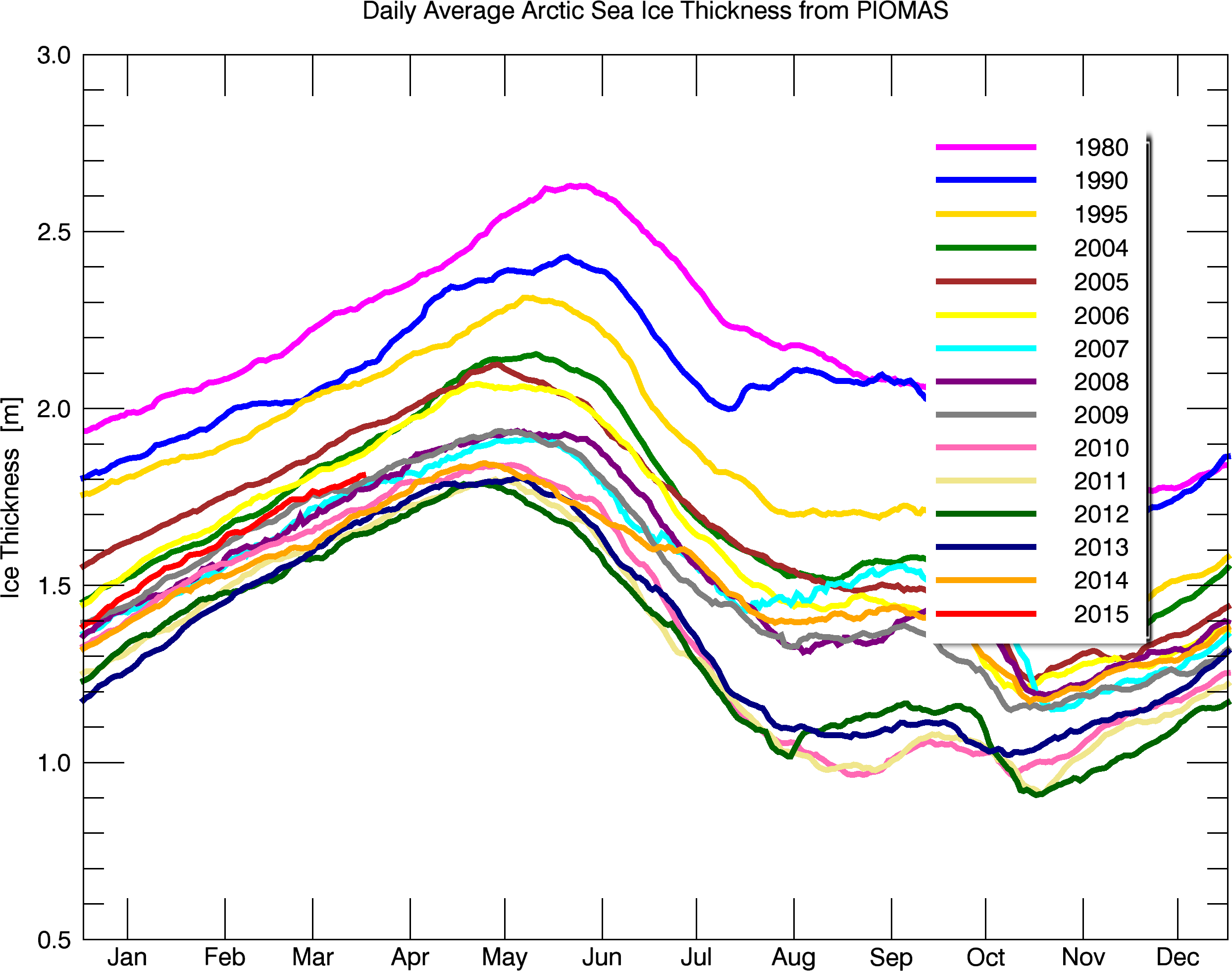
Arctic sea ice is recovering very strongly, whether you are willing to admit it or not:
It is now at its highest since the early winter of 2006 — the highest in a decade.
micro6500 April 29, 2015 at 7:50 am
You picked the current March ice extent, and I think db was talking about min extent in Sept.
Really, I guess ‘Now’ means something different in your language? I guess we have to be psychic to understand stealey’s posts. That the lowest maximum extent on the record is over-ruled by a previous minimum is rather strange usage. Also by decade he apparently means the calendar decade (since 01/01/2011) not the last 10 years.
Also for your posts too apparently since you posted an unlabeled graph in a discussion of Arctic sea ice which purports to be of Arctic sea ice anomaly but is not!
Further disingenuousness by stealey follows:
dbstealey April 29, 2015 at 8:57 pm
Phil.,
Arctic sea ice is recovering very strongly, whether you are willing to admit it or not:
Now he switches from recovering sea ice coverage, which he first tried to deceive us about, to sea ice thickness (without saying so of course).
It is now at its highest since the early winter of 2006 — the highest in a decade.
He can’t even read his own graphs since it was higher in 2009, also note the flexible meaning of ‘decade’.
Of course you might expect the average ice thickness to increase as sea ice coverage decreases since the thinnest ice melts first.
You have to be very careful with stealey’s posts, they’re very deceptive!
“It’s a generally consistent “trick” that is played out here. Bait the crowd with XYZ alarmist admits worst case projections were not realized, and then they pile on as if that is proof that no scenario exists at all except the one that they want …”.
================================
Nonsense, I think most posters are laughing at the fact that a computer model is used to validate the bleeding’ obvious.
completely agree that models fail, or at least are fallible. One only need to point to Alan Greenspan and the many credit models that failed. All you had to do was pay attention to price vs income to know that whole house of cards would collapse.
So Leland, you admit the models can be (and often are) wrong.
So why do you and the other warmistas believe we should change the whole economic world model because of some fallible results? (Your expensively subsidised solar panels being a case in point.)
warrenlb on April 28, 2015 at 7:02 pm
– – – – – – – – –
warrenlb,
I would consider responding, if you want to clarify what you are saying in the form of some basic kind of Aristotelian logic. Premises and logic matter and can be one’s friend or enemy. Are they your friend or enemy?
John
Warren wants to know if you stopped beating your wife up in the arctic.
@John Whitman.
Here’s what I posted April 28, at 7:02pm:
‘Do you accept Scripp’s conclusion that the disappearance of Arctic sea ice due to AGW can be reversed if AGW is reversed?’
Seems like the question asks for a simple YES or NO. No Aristotle, Mills or Bertrand Russell needed.
@Warrenlb ‘Do you accept Scripp’s conclusion that the disappearance of Arctic sea ice due to AGW can be reversed if AGW is reversed?’
I think I figured out why you seem to be having such a hard time understanding the replies you are receiving. The question being asked isn’t exactly like asking ‘So how long ago did you stop beating your wife?’ It is, however, like asking ‘Do you accept the conclusion that the loss of prairie grass due to unicorn grazing can be reversed if unicorns are stopped from grazing?’
“all models are wrong, some models are useful”. Doesn’t sound like anyone has a useful model on arctic sea ice.
But, but, CO2 has gone up 10% in 20 years and we have 2006 ice?
Seems all those links saved on the 2007 arctic cyclone don’t work any longer. WUWT?
It turns out that CO2 doesn’t melt sea ice after all.
“Till Wagner and Ian Eisenman, scientists at Scripps Institution of Oceanography, UC San Diego.”
Well, if they carry on with this line of inquiry then that’s surely the last time that they’ll hear themselves called scientists.
If they continue to doubt the validity of the most scary modeled predictions then surely they will soon be known as “deniers”, or if they are lucky, “contrarians”.
Of course they still have time to pull back from the irreversible tipping point. The tipping point at which their mainstream credibility is wrecked by the alarmists.
Someone needs to warn them – it’s not too late for them to get back on the alarmist bus, to start agreeing with absolutely all the most scary predictions and occasionally manipulate an old prediction in such a way that it looks even more scary than the last.
That’s what real scientists do. Isn’t it?
Being Scripps, they can transfer to the “Ocean Acidification” bus that leaves out of Alarmist Gate 2.
Arctic Death Spiral canceled? YAY!
Oh, wait. I’m all for an extra couple of degrees of global warming. Nevermind…
Me too. I’m also for a Northwest Passage.
Let’s clarify that headline:
“Once Again, Climate Skeptics Proven Correct: Arctic Ice Not In Death Spiral”
The Warming ‘Elite’ may be wising up. If they continue with the”irreversible ” banter, their Taxpayer-provided, research $Billions could be yanked. ‘Why throw more money at something that we can do nothing about?’. Pretty shrewd…..eh?
“They created a model that bridged the gap between the process models and the GCMs, and they used it to determine what caused sea ice tipping points to occur in some models but not in others.”
So is there now a Model Science developing; the science of the study of models? Will there be PHD’s awarded in this new field?
Now some may think this is just cleaning up faulty programming but it looks more like a whole new area of specialization worthy of significant government grants and requiring special meetings at exotic locations.
So just like the U.S. President can slow the increase in sea level rise, at least Obama can, PHDs in this field are able to use models to make sea ice more stable.
“Wagner and Eisenman resolve this discrepancy in the study in an upcoming Journal of Climate article, “How Climate Model Complexity Influences Sea Ice Stability.”
In a sane world it would be “How Sea Ice Stability Influences Climate Model Complexity” and not the other way around. But, such are the effects of CO2 on gubbmint funded thinking…
It’s neither horse nor ass it’s a ….mule
The blob is going to sneak into the Arctic Ocean and finish off all the Arctic sea ice. No one received the memo, obviously.
“Oversimplified” is being very kind. “Idiotic” would be a better description off the alarmist arctic ice predictions. A brief study of actual past ice cycles, by anyone of average intelligence, would lead to a different conclusion. Of course a brief review of history doesn’t pay as well as developing a “complex” model.
Not much talk of that, even here. Why is this do you think?
The Blob prefers attacking Hollywood.
Seth Borenstein may well be getting drunk, drawing a warm bath and digging through his tool box looking for a razor. Better call on him.
28 April: CarbonBrief: Roz Pidcock: Prof Richard Muller: Not adjusting global temperature records would be “poor science”
The Global Warming Policy Foundation (GWPF), Lord Lawson’s UK-based climate skeptic lobby group, has announced it is launching an inquiry into the integrity of global surface temperature records…
Carbon Brief has spoken to Prof Richard Muller, physicist and self-professed skeptical scientist, who carried out a very similar inquiry a few years ago as part of the Berkeley Earth surface temperature ( BEST) project, based in California. Muller tells Carbon Brief:
“From a scientific point of view, it would be irresponsible not to adjust … it would be considered poor science to avoid such corrections … [and] ***they do not affect the substantial results.”…
http://www.carbonbrief.org/blog/2015/04/prof-richard-muller-not-adjusting-global-temperature-records-would-be-poor-science/
***”they do not affect the substantial results.”… or should it be “they do not SUBSTANTIALLY affect the results.”?
paywalled, but add this to the few MSM covering the story:
27 April: Australian: Panel to probe homogenisation
The GWPF is a controversial voice in the climate change debate but Professor Kealey said his review team “approaches the subject as open-minded scientists — we intend to let the science do the talking”. “Our goal is to help the public understand the challenges in assembling climate data sets, the influence of adjustments and modifications to the the data, and whether … In Australia, the Bureau of Meteorology has faced similar …
http://www.theaustralian.com.au/news/health-science/panel-to-probe-homogenisations-role-in-warming-trend/story-e6frg8y6-1227323733213
”they do not affect the substantial results.”
Nonsense, the results are presented in a way to hide the fact that the increase in Co2 doesn’t appear to be doing anything.
More models? Geesh. The Ludic Fallacy continues apace….
none of the previous models didn’t account for seaonal changes? really? And they wonder why climate models are mocked.
Only mocked by those who are ignorant that models are not weather forecasting tools.
That too.
Wrong, Warren, they use forecasting models everyday, to predict rain,wind and so on.
“Tomorrow there is a 60% chance of so on.”
@sunsettommy.
We’re talking about models (e.g., AOGCMs) used by the IPCC, you know. If you think they’re using weather forecasting models just so you’d have something to criticize, you might imagine they have more important issues to deal with.
“Only mocked by those who are ignorant that models are not weather forecasting tools.”
Models are forecasting tools.
@RH.
You say “Models ARE forecasting tools”
I say: But the IPCC’s models are NOT weather forecasting tools, nor did the IPCC intend them to be. Nor do their scientists claim them to be so. Only you seem to.
What we expect is that they get climate correct at the regional level, being 10 or 20 degrees warm one place and cold in another and because the average is close doesn’t make them accurate.
logos_wrench,
No, some models did and some models didn’t. Not all models do the same thing, and even between similar kinds of models there are differences. As well, let’s be clear; this study is limited to Arctic sea ice. The authors do not say that seasonal variations were not considered across the board in all models. Here’s the abstract:
Abstract
Record lows in Arctic sea ice extent are making frequent headlines in recent years. The change in albedo when sea ice is replaced by open water introduces a nonlinearity that has sparked an ongoing debate about the stability of the Arctic sea ice cover and the possibility of Arctic “tipping points”. Previous studies identified instabilities for a shrinking ice cover in two types of idealized climate models: (i) annual-mean latitudinally-varying diffusive energy balance models (EBMs) and (ii) seasonally-varying single-column models (SCMs). The instabilities in these low-order models stand in contrast with results from comprehensive global climate models (GCMs), which typically do not simulate any such instability. To help bridge the gap between low-order models and GCMs, we develop an idealized model that includes both latitudinal and seasonal variations. The model reduces to a standard EBM or SCM as limiting cases in the parameter space, thus reconciling the two previous lines of research. We find that the stability of the ice cover vastly increases with the inclusion of spatial communication via meridional heat transport or a seasonal cycle in solar forcing, being most stable when both are included. If the associated parameters are set to values that correspond to the current climate, the ice retreat is reversible and there is no instability when the climate is warmed. The two parameters have to be reduced by at least a factor of 3 for instability to occur. This implies that the sea ice cover may be substantially more stable than has been suggested in previous idealized modeling studies.
This would have been much more persuasive if you’d attached a graph of some sort. Three graphs would be super serial!
Only if the graphs had nothing to do with the point he was making.
The substantive nature of the comments above is astounding. I must concede, I’m completely outclassed by the erudition on display here.
If models influence the weather, my wife is correct and my concept of the language is
outdated.
“If models influence the weather, my wife is correct and my concept of the language is
outdated.”
Doesn’t rising hemlines on models, mean an excess of warming?
Rising hemlines mean improving economic conditions.
Hemlines going down means worsening economic conditions and increasing unemployment [probably get that if North America is overwhelmed by ice again].
GregK commented on
I was just thinking about how hot Models warm me up 😉
Well that’s potentially good news. But somewhat like ELCore (@OneLaneHwy) just above me points out, interesting that we apparently trust models today.
Are you being paid to make yourself look dumb, or do you just get a kick out of it.
We are ridiculing the fact that the early models have been shown to be faulty, despite the claims of warrenlb and the other warmistas. We are also having fun with the fact that the models are now agreeing with what we knew all along.
“We are also having fun with the fact that the models are now agreeing with what we knew all along.”
Are you referring to the point that the authors made that the ice, once gone, will not come back until we cool the Earth?
MarkW,
When I am amused by all this, it’s generally for comments like that one.
Since all models are always wrong, I’d hardly call that prescient.
There you go, making yourself look dumb again.
Nobody said that all models are wrong. Just the GCMs.
MarkW,
I said that all models are always wrong. If they were always right, they’d be reality. Not a difficult terribly concept in my view, YMMV.
Brandon, the peer reviewed research already gave them the answers they had before ignored. They are not discovering any new process or influence.
David A,
Peer reviewed literature tells you that human CO2 emissions are warming the planet. Do you ignore it, reject it, or simply have not had the time to fully understand it? What you have written in the past certainly suggests that you do not believe it. I do not know precisely why — I cannot tell, because I am not a mind reader.
Now, please tell me which particular peer reviewed papers gave which modelers the information you already knew, and demonstrate how it is that you KNOW that it had been deliberately ignored. Thanks.
This deals with the seasonal variation in the AO. http://dx.doi.org/10.1175/1520-0442%282002%29015%3C2648:ROSITT%3E2.0.CO;2
“Rigor et al. showed that year-to-year variations in the wintertime AO imprint a distinctive signature on surface air temperature (SAT) anomalies over the Arctic, which is reflected in the spatial pattern of temperature change from the 1980s to the 1990s. Here it is shown that the memory of the wintertime AO persists through most of the subsequent year: spring and autumn SAT and summertime sea ice concentration are all strongly correlated with the AO index for the previous winter.”
This study deal more with the multi decadal variation of that seasonal flux….
Abstract
Atmospheric and oceanic variability in the Arctic shows the existence of several oscillatory modes. The decadal-scale mode associated with the Arctic Oscillation (AO) and a low-frequency oscillation (LFO) with an approximate time scale of 60–80 years, dominate. Both modes were positive in the 1990s, signifying a prolonged phase of anomalously low atmospheric sea level pressure and above normal surface air temperature in the central Arctic. Consistent with an enhanced cyclonic component, the arctic anticyclone was weakened and vorticity of winds became positive. The rapid reduction of arctic ice thickness in the 1990s may be one manifestation of the intense atmosphere and ice cyclonic circulation regime due to the synchronous actions of the AO and LFO. Our results suggest that the decadal AO and multidecadal LFO drive large amplitude natural variability in the Arctic making detection of possible long-term trends induced by greenhouse gas warming most difficult.
This is similar but dealing with the Atlantic ocean influence specifically http://dx.doi.org/10.1175/JCLI-3224.1
Recent observations show dramatic changes of the Arctic atmosphere–ice–ocean system, including a rapid warming in the intermediate Atlantic water of the Arctic Ocean. Here it is demonstrated through the analysis of a vast collection of previously unsynthesized observational data, that over the twentieth century Atlantic water variability was dominated by low-frequency oscillations (LFO) on time scales of 50–80 yr. Associated with this variability, the Atlantic water temperature record shows two warm periods in the 1930s–40s and in recent decades and two cold periods earlier in the century and in the 1960s–70s. Over recent decades, the data show a warming and salinification of the Atlantic layer accompanied by its shoaling and, probably, thinning. The estimate of the Atlantic water temperature variability shows a general warming trend; however, over the 100-yr record there are periods (including the recent decades) with short-term trends strongly amplified by multidecadal variations.
Brandon, this is a SMALL sample of the past literature on the subject describing seasonal and multi decadal influences on arctic ice having to do with wind currents and ocean flows. No GHG required. The Scripps paper is a backpedal to the CAGW arctic pattern starting to change, but this release from Scripps is nothing new, and nothing the climate science models should not have ALREADY fully incorporated.
I have lead you to this and much more, but you and Warren fail to read beyond the IPCC.
Brandn says, “Peer reviewed literature tells you that human CO2 emissions are warming the planet. Do you ignore it, reject it, or simply have not had the time to fully understand it? What you have written in the past certainly suggests that you do not believe it. I do not know precisely why — I cannot tell, because I am not a mind reader. ”
===================================
Now you degenerate into silliness. I understand that CO2 is a GHG. You know that, so stop playing games. I have, in detail and in general, lead you to peer reviewed research that simply explains to you the failure of the models to match the observations. I have explained the consistency of the models running to warm. I have led you through the failures of the projected harms to manifest, and shown you how the benefits of CO2 are in fact known and manifesting. You know that as well. I have shown you specifics, and whole bodies of hundreds of peer reviewed reports supporting all of this. Your incapacity to either acknowledge this, or study yourself, is strong evidence of a closed mind.
David A,
AOGCMs don’t predict the timing of internal variability. The study which is the subject of this post does not take it into account either. So far as I can tell, it only models straight up seasonal variations in a very simple ocean-only world.
By the way, why do you apparently trust the models in this study?
Only now?
Either that wasn’t clear to me before, or I forgot. There are many different attitudes here about that topic and I cannot keep track of everyone’s particular attitudes about it. Apologies.
Sounds like it would be a good idea to not need them.
As an ensemble, yes. So has the IPCC. This is not Earth-shattering news. IIRC the last time we had this discussion you tried to tell me that ALL models run hot …
http://1.bp.blogspot.com/-ZY_oL2cq4r4/VQiX3rRH2aI/AAAAAAAAAYo/0VNOKoRIQJw/s1600/CMIP5%2Bvs%2BHADCRUT4%2Btrend%2B1860-2014%2B01.png
… which is false. I don’t believe you commented on that plot the first time I posted it for you.
And you know these trends will continue …. how? What models are you using to predict the future?
Do you feel better now? Now that you’re done reading my mind, may I have my brain back so that I can read, study and think for myself again? Thanks.
Brandon, we trust models that have been tested. I’m assuming you’re referring to engineering models, and you’d be correct. The climate models have proven not to be reliable. “We” don’t trust them. But it’s good to see you’re starting to understand our position.
Greg, I think he is referring to the warm reception (pun fully intended) this paper received on WUWT, even though its conclusions are based on models. Model-based scientific papers that support the AGW position are vilified here, whereas those that support the skeptic position, or do not provide implicit support for AGW, are touted as being proof that the AGW premise is false.
On a separate note, this paper in no way refutes the AGW position, it simply says that unlike Antarctica, the Arctic ice “genie in a bottle” can be put back. However, only if we can cool the Earth again: “So if global warming does soon melt all the Arctic sea ice, at least we can expect to get it back if we somehow manage to cool the planet back down again.”
Chris– that makes too much sense. Please restate.
Leland,
OK, I’ll down 4 shots of tequila and take another crack at it. 😉 However, it’s noon here, and that might cost me my job – perhaps I should re-think this idea…..
Chris,
You have properly interpreted my comment. Have 5 tequilas, first one on me. Cheers.
Chris,
How perspicacious of you! AGW-promoting studies get a frostier reception here than AGW-refuting ones.
It’s a typical exaggeration to say that the latter are “touted as being proof that the AGW premise is false.” It is fair to say that they are held up as evidence that it’s false or weak or whatever.
An analogy for your consideration would be a discussion with proselytizing JW’s at the garden gate. If you elect to do anything more than tell them to go away, you have to try to relate to them on their terms, since they are not capable of discussion on yours.
Certainly, that is condescension, but I feel I owe you that much since you have taken the trouble to come and try to convert me to your faith.
where is the ‘warm reception’? all i see is people making fun of the backpedaling by the alarmists.
sceptics have already stated their position clearly about the models. ie they are trash. this new batch of models will be thought of no differently. the subject matter the models purport to explain is neither here nor there. it is the theatre of the backpedal that is of interest here. ie how one goes from co2 causes actric ice to melt to a point of no return, to co2 causes arctic ice to possibly recover (even while increasing exponentially) without the possibility of a tipping point.. bravo for co2!
@mebbe said “AGW-promoting studies get a frostier reception here than AGW-refuting ones.”
A frostier reception is fine, but to call science junk when it supports AGW, and good science when it does not, is a lot more than frostiness. And this happens even for paywalled papers where most commenters have not even read the papers.
I did not come here to convert you to my “faith” as you call it, I came here to have a discussion about a scientific paper.
@mohici,
There is no backpedaling by alarmists here, you have misunderstood the conclusions of the paper. It in no way says that the decline in Arctic ice is not happening, and it does not say that Arctic ice is increasing. It says that should Arctic temperatures decline at some future date, it would be possible for Arctic ice to recover. That it would not get to a tipping point beyond which the ice could never recover, no matter what happened to surface temperatures.
Chris,
When you characterize the response of commenters here you apply a subjective filter that casts them as stubborn and lazy.
My view of the general WUWT reaction to all studies that are based on models is that they are scorned, even when they ostensibly depart from the AGW orthodoxy.
In fact, it’s very rare that studies that utterly fly in the face of AGW see the light of day, so it’s not hard to be consistently anti-model.
As regards this paper, its significance is that it refutes the strongly expressed view of an AGW faction that has energetically promoted the idea of a tipping point for just about everything. The media have certainly given lots of exposure to that viewpoint.
Small wonder then, that there is delight here at the prospect of an internecine squabble on the other side.