![cosmic_rays_hit_earth[1]](https://wattsupwiththat.files.wordpress.com/2010/12/cosmic_rays_hit_earth1.jpg?quality=83) From the paper in PNAS:(h/t to Dr. Leif Svalgaard)
From the paper in PNAS:(h/t to Dr. Leif Svalgaard)Our results suggest weak to moderate coupling between CR and year-to-year changes of GT,” they write. “However, we find that the realized effect is modest at best, and only recoverable when the secular trend in GT is removed.” This “secular trend” is the warming widely believed to be caused by excess carbon in the atmosphere, an effect the researchers accounted for by first-differencing. “We show specifically that CR cannot explain secular warming, a trend that the consensus attributes to anthropogenic forcing. Nonetheless, the results verify the presence of a nontraditional forcing in the climate system, an effect that represents another interesting piece of the puzzle in our understanding of factors influencing climate variability,
While they might simply be trading one effect for another with that sort of language, or they might simply be latching on the to Forbush decrease signal, it seems to me that they set out to prove that CR’s aren’t affecting trend. The fact that they show a link at suggests there’s at least some merit to Svenmark’s cosmic ray theory.
Significance
Here we use newly available methods to examine the dynamical association between cosmic rays (CR) and global temperature (GT) in the 20th-century observational record. We find no measurable evidence of a causal effect linking CR to the overall 20th-century warming trend; however, on short interannual timescales, we find a significant, although modest, causal effect of CR on short-term, year-to-year variability in GT. Thus, although CR clearly do not contribute measurably to the 20th-century global warming trend, they do appear as a nontraditional forcing in the climate system on short interannual timescales, providing another interesting piece of the puzzle in our understanding of factors influencing climate variability.
Dynamical evidence for causality between galactic cosmic rays and interannual variation in global temperature
- Anastasios A. Tsonis
- Ethan R. Deyle
- Robert M. May
- George Sugihara
- Kyle Swanson
- Joshua D. Verbeten
- Geli Wangd
Abstract
As early as 1959, it was hypothesized that an indirect link between solar activity and climate could be mediated by mechanisms controlling the flux of galactic cosmic rays (CR) [Ney ER (1959) Nature 183:451–452]. Although the connection between CR and climate remains controversial, a significant body of laboratory evidence has emerged at the European Organization for Nuclear Research [Duplissy J, et al. (2010) Atmos Chem Phys 10:1635–1647; Kirkby J, et al. (2011) Nature 476(7361):429–433] and elsewhere [Svensmark H, Pedersen JOP, Marsh ND, Enghoff MB, Uggerhøj UI (2007) Proc R Soc A 463:385–396; Enghoff MB, Pedersen JOP, Uggerhoj UI, Paling SM, Svensmark H (2011) Geophys Res Lett 38:L09805], demonstrating the theoretical mechanism of this link. In this article, we present an analysis based on convergent cross mapping, which uses observational time series data to directly examine the causal link between CR and year-to-year changes in global temperature. Despite a gross correlation, we find no measurable evidence of a causal effect linking CR to the overall 20th-century warming trend. However, on short interannual timescales, we find a significant, although modest, causal effect between CR and short-term, year-to-year variability in global temperature that is consistent with the presence of nonlinearities internal to the system. Thus, although CR do not contribute measurably to the 20th-century global warming trend, they do appear as a nontraditional forcing in the climate system on short interannual timescales.
The full paper is available here (PDF)
Theoretical analysis is very limited (can never converge on the truth, goes in circles) if there are multiple fundamental errors in the models/mechanisms/theory.
For example if the sun is fundamental different than assumed (there are more than 100 cosmological observations to support the assertion that the sun and stars are ‘different’ than assumed), it would be quite difficult (impossible) to solve the theoretical/mechanisms puzzle: How does the sun modulate planetary temperature and what will happen next to both the sun and to planetary temperature.
We know that planetary temperature has cyclically warmed and cooled in the past at a 1400 year period cycle with beats of plus or minus 400 years. We know solar ‘changes’ correlate with the period of time of the cyclic warming and cooling of the planet.
We know atmospheric CO2 did not change during or after the 1400 year with beats of plus or minus 400 years cyclic warming and cooling of the planet and hence cannot be the cause of what is observed. We know that the same cyclic warming and cooling occurs in both the northern and southern hemisphere. We know the pattern/regions that warm and then cool (mechanism reverses) are the same as the regions that have warmed in the last 150 years.
We know that roughly every 8000 to 10,000 years there is an abrupt cooling change to planetary climate which it appears is the reason why the interglacial periods end abruptly.
All of the above comments, are believed to be observational facts from the analysis of multiple proxies in hundreds and hundreds of peer reviewed papers published over the last two decades, not a theory. We also know there must be a physical explanation for what happened in the past. There are no magic wands.
We know the sun is almost spotless which is anomalous as it appears there will be a very sharp drop in sunspot number (The sharp drop in sunspot number has started and was predicted by Livingston and Penn to occur in 2015 based on a simple extrapolation of the fact that the magnetic field strength of newly formed sunspots was decaying linearly and there are no sunspots on the surface of the sun that have a magnetic field strength less than around 1500 gauss), Due to weaken of the solar magnetic cycle, GCR is currently the highest ever recorded at a solar maximum, and we know the solar heliosphere density has declined 40% which is reducing the effect of solar wind bursts on the modulation of planetary clouds in high latitude regions and in the tropics.
The solar large scale magnetic field is the lowest ever recorded for this period of a solar cycle. The intensity of the solar large scale magnetic field is one of the best predictors of the strength of the next solar magnetic cycle. Based on current observations of solar cycle 24 it is almost certain that cycle 25 will be a very, very weak cycle, if it occurs at all.
http://www.solen.info/solar/polarfields/polar.html
http://www.solen.info/solar/
We know in the past when there was a sudden increase in solar cycle length there was a delay in cooling in high latitude Arctic regions of roughly one solar cycle, 11 years.
Observational evidence that climate forcing changes are underway, is patterns of planetary temperature change that have never occurred in the recorded past. The new patterns developing appear to support the assertion that there will be global cooling rather than global warming. As atmospheric CO2 has not as yet declined, we know changes in atmospheric CO2 cannot be the cause of the observed start of what appears to be planetary cooling.
Significant unabashed global cooling would be both a climate war and theoretical game changer. It appears we will be able to resolve the question how much of the warming in the last 150 years was due to increases in atmospheric CO2 and how much was due to solar changes (more complicate than just solar magnetic cycle changes if I understand the mechanisms.), by observations.
http://arctic.atmos.uiuc.edu/cryosphere/IMAGES/seaice.anomaly.antarctic.png
Ocean surface temperature January 1, 2015
http://www.ospo.noaa.gov/data/sst/anomaly/2015/anomnight.1.1.2015.gif
Current Ocean surface temperature March 9, 2015
http://www.ospo.noaa.gov/data/sst/anomaly/2015/anomnight.3.9.2015.gif
I find it interesting that the sun accounts for the demontrable variation but not the rise that is most likely adjustments anyway… just saying…
What about the rise in the UAH record?
The UAH trend is quite flat. 2014 and 2010 are both significantly (about .3 degrees) below the 1998 high.
The UAH trend since 1979 is 0.14 deg per decade; The GISS trend since 1998 is 0.077 deg per decade
The UAH trend since 1990 is 0.165 deg per decade; The GISS trend since 1990 is 0.15 deg per decade
The UAH trend since 1998 is 0.070 deg per decade; The GISS trend since 1998 is 0.077 deg per decade
1998 is an outlier – a 3+ sigma event – for the UAH record. Even so it only makes a small difference to trends.
The mean temperature for 2010 was about 0.02 degrees below the mean for 1998. The mean for 2014 was about 0.14 degrees below 1998.
However, as I have already shown if the 1981-2010 baseline is used, the 2014 anomalies for GISS and UAH are almost exactly the same. UAH anomalies for 1998 and 2010 are MUCH higher than the GISS anomalies. Like I said, LT temperatures are very sensitive to ENSO.
Sorry (re:previous post) this
“The UAH trend since 1979 is 0.14 deg per decade; The GISS trend since 1998 is 0.077 deg per decade”
should be
The UAH trend since 1979 is 0.14 deg per decade; The GISS trend since 1998 is 0.156 deg per decade
i.e. Less than 2 hundredths of a degree difference in the trends since 1979.
“On 24 August 2011, preliminary research published in the journal Nature showed there was a connection between Cosmic Rays and aerosol nucleation. Kirkby went on to say in the definitive CERN press Release “Ion‐enhancement is particularly pronounced in the cool temperatures of the mid‐troposphere and above, where CLOUD has found that sulphuric acid and water vapour can nucleate without the need for additional vapours. This result leaves open the possibility that cosmic rays could also influence climate. However, it is premature to conclude that cosmic rays have a significant influence on climate until the additional nucleating vapours have been identified, their ion enhancement measured, and the ultimate effects on clouds have been confirmed”
http://www.nature.com/nature/journal/v476/n7361/full/nature10343.html
The speed of the solar wind is a very good indicator of the GCR.
“But the flux of cosmic rays interacting with the atmosphere is affected by the solar wind and Earth’s own magnetic field. The solar wind, particularly at the region between the sun’s termination shock and the heliopause, acts as a barrier to cosmic rays and decreases the flux of low-energy cosmic radiation. Earth’s magnetic field deflects cosmic rays toward the poles, which produces the aurorae observed at certain latitudes. Therefore, researchers have theorized that the extent to which cosmic rays affect the Earth’s climate depends on this combination of factors.”
http://phys.org/news/2015-03-cosmic-fluctuations-global-temperatures-doesnt.html
Next solar maximum may be safest time for manned missions to Mars.
The two main sources of radiation are the galactic cosmic rays (GCRs) from supernova explosions in the far-off corners of the galaxy that send galactic cosmic rays rocketing towards our solar system at nearly the speed of light, and the Solar Energetic Particles (SEPs) emitted from our own Sun. Cosmic rays are the most energetic particles in the universe, and remain a significant and worsening factor that limits mission durations.
“The high energy of GCRs allows these particles to penetrate nearly every material known to man, including shielding on space craft; when the cosmic rays penetrate that shielding, secondary particles are produced that can damage organs and lead to cancer,” said Schwadron.
http://www.pnas.org/content/early/2015/02/23/1420291112
I wondered if the changes in the position of the magnetic poles somehow changed the disposition of GCRs which in turn influenced global temperatures was the cause of the remarkable correlation between the drift of the magnetic poles and temperatures. My published paper can be seen here.
http://www.akk.me.uk/Climate_Change.htm
Evidence for large century time-scale changes in solar activity in the past 32 Kyr, based on in-situ cosmogenic 14C in ice at Summit, Greenland
Abstract
We present results of estimates of cosmic ray flux in Greenland at the Summit (3200 m.a.s.l, 72.6°N, 38.5°W), during the past 32 Kyr. We derive these estimates based on concentrations of in-situ cosmogenic 14C produced in ice crystals. Based on the secular equilibrium concentration of in-situ produced 14C in quartz in terrestrial rocks, we find that on century time-scales, the cosmic ray production rate of 14C at the Summit was close to its estimated long-term average production rate, except during 3 periods: (i) during 8500–9500 yr B.P. and 27,000–32,000 yr B.P, when the production rate was higher by about a factor of 2, and (ii) during 12,000–16,000 yr B.P, when the production rate was lower by a factor of ∼ 1.5. The observed variation in cosmic ray flux at the polar site is best attributed to changes in solar activity resulting in variable modulation of terrestrial cosmic ray flux. Changes in the geomagnetic field in the past do not affect the cosmic ray flux at polar latitudes. Likewise, climate changes do not affect the in-situ 14C record in ice.
During the first two epochs, the solar activity must have been very low, as during Maunder Minimum (virtually no sunspots), resulting in essentially no modulation of the cosmic ray flux by the solar plasma. During the low cosmic ray flux epoch, 12,000–16,000 yr B.P., the observed decrease in cosmic ray flux corresponds to high solar activity as seen in 1958 (sun-spot number ∼ 190).
We discuss the proxy evidence from tree ring and sediment based records of atmospheric 14C/12C ratios during the three epochs. These records have been used as a measure of changes in cosmic ray flux, and solar activity in the past. However, since they are also appreciably affected by climatic changes, a comparison of the two records is potentially valuable for delineating the nature of past changes in solar activity, and large-scale ocean circulation and air–sea exchange.
[Note: the polar ice is assumed to be free of solar activity interference.]
http://www.sciencedirect.com/science/article/pii/S0012821X05001135
Any increase in GCR in Oulu (winter) above 6200 contributes to slowdown of the polar vortex.
http://cosmicrays.oulu.fi/webform/query.cgi?startday=13&startmonth=12&startyear=2014&starttime=00%3A00&endday=23&endmonth=12&endyear=2014&endtime=00%3A00&resolution=Automatic+choice&picture=on
“Specific features of the vortex location and a possible mechanism of solar-climate links:
The data presented above suggest that the polar vortex plays an important part in the mechanism of solaratmospheric links. Indeed, its location seems to be rather favourable for different mechanisms of solar
activity influence on the lower atmosphere circulation. In particular, the data in Fig.3a shows that the area of
the vortex formation is characterized by low values of geomagnetic cutoff rigidity. So GCR particles with a
broad energy range may precipitate in this area including the low energy component strongly modulated by
solar activity and ion production rate is higher than at middle and low latitudes.”
http://geo.phys.spbu.ru/materials_of_a_conference_2012/STP2012/Veretenenko_%20et_all_Geocosmos2012proceedings.pdf
No change, then, from the current mainstream climate science understanding:
“There is still no evidence suggesting that the GCR influence our climate in significant ways.”
“….while we cannot rule out cosmic-ray/cloud mechanisms being relevant for historical climate changes, they certainly have not been an important factor in recent climate change.”
Yep! The voice of reason. Question everything. Including the plays from your own team.
New research suggests that the sun’s magnetic field controls the large-scale shape of the heliosphere “much more than had been previously thought,” says Merav Opher, associate professor of astronomy and director of the Center for Space Physics at Boston University (BU). In the new model, the magnetic field squeezes the solar wind along the sun’s North and South axes, producing two jets that are then dragged downstream by the flow of the interstellar medium through which the heliosphere moves.
The model indicates that the heliospheric tail doesn’t extend to large distances but is split into two by the two jets, and that the format of the jets is similar to that of astrophysical jets observed in many other stars and around black holes.
“Most researchers don’t believe in the importance of the solar magnetic field, because the magnetic pressure on the solar wind’s particles is far lower than the thermal pressure of the particles,” says Opher, lead author on a paper appearing today in Astrophysical Journal Letters. However, the model shows that tension of the magnetic field controls what happens to the solar wind in the tail.
Picture a tube of toothpaste with rubber bands wrapped around it, suggests co-author James Drake, professor of physics and director of the Joint Space-Science Institute at the University of Maryland. In this case, the toothpaste is the jet’s plasma, and the rubber bands are the rings of the solar magnetic field. “Magnetic fields have tension just like rubber bands, and these rings squeeze in,” he says. “So imagine you wrap your toothpaste tube very tightly with a lot of rubber bands, and they will squeeze the toothpaste out the end of your tube.”
“Jets are really important in astrophysics,” Drake adds. “And from what we can tell, the mechanism that’s driving these heliospheric jets is basically the same as it is in, for example, the Crab Nebula. Yet this is really close by. If we’re right about all of this, it gives us a local test bed for exploring some very important physics.”
“It’s also exciting that these jets are very turbulent, and will be very good particle accelerators,” says Opher. The jets might, for example, play a role in the acceleration of so-called anomalous cosmic rays “We don’t know where these particles are accelerated; it’s a bit of a puzzle,” she says.
Solving such puzzles will be important for space travel. The heliosphere acts as “a cocoon to protect us, by filtering galactic cosmic rays,” she says. “Understanding the physical phenomena that govern the shape of the heliosphere will help us understand the filter.”
http://phys.org/news/2015-02-view-solar-astrophysical-jets-driven.html
Some useful links from the past 8 years.
http://wattsupwiththat.com/2013/02/20/its-the-sun-stupid-the-minor-significance-of-co2/
Dr Norman Page.
http://www.forbes.com/sites/larrybell/2011/09/20/sorry-but-with-global-warming-its-the-sun-stupid/
Larry Bell
http://news.nationalpost.com/2010/05/21/its-the-sun-stupid/
Lawrence Soloman
http://blog.heartland.org/2014/03/its-the-sun-stupid/
Edmund Contoski
http://wattsupwiththat.com/2007/04/06/its-the-sun-stupid/
Anthony Watts
http://www.foxnews.com/story/2007/11/29/it-sun-stupid/
Steve Milloy
Good articles. Its frustrating that the “other side” in this debate will not even consider a single word written in them, though, because of the source (Fox News, this “funded misinformation” site, Heartland, Forbes, etc).
For the latest update of my forecasts of the future amplitude and timing of the cooling trend which began in 2003 and the role of the sun see
http://climatesense-norpag.blogspot.com/2014/07/climate-forecasting-methods-and-cooling.html
also see
http://www.woodfortrees.org/plot/rss/from:1980.1/plot/rss/from:1980.1/to:2003.6/trend/plot/rss/from:2003.6/trend
Interesting articles. Its too bad that anyone from the “alarmist” side will not even consider a single word written in any of them, b/c of the sources (Fox News, Heartland, this “paid misinformation site”, forbes, etc).
Re: WUWT CR flux & GAST 150309
Cole Pritchard provides a link that doesn’t work, and the moderator suggests it might be a paper behind the paywall. 3/9/15 @ur momisugly 4:38 pm. Readers are supposed to pay $35.95 just to see if Biktash correlates with what Pritchard asked. Science for sale.
lsvalgaard rags on the Pritchard (4:54 pm) then has to walk it back, stepping on the third rail of civility (crummy link, 4:59 pm, et seq.), which, undeterred, he defends tooth and nail.
At the same time, Leif shows he has access to the paper (confirmed later at 10:19 pm), quoting one word from it. But Leif doesn’t bother to fix the citation. And no one bothers to quote from it.
Leif and the moderator say,
When you post a link, you should try out first that it works. There is a need to re-enforce that, don’t you agree? [We usually check the links, but we can’t get to all of them. .mod] 7:53 pm.
Too bad the only way to proof a comment is after it is indelibly committed to a post.
Now comes Bevan with an anonymous screenshot. 4:36 pm. It turns out to be from The Soon fallacy, by Gavin Schmidt (!), realclimate.org (!), 2/24/15.
To which lsvalgaard says,
Yes, as is well-documented Soon was wrong too.
What and where exactly is the documentation that Soon was wrong? What does it mean to be well-documented?
Besides, has it not been shown that the Sun is indeed the cause of the measured GAST? (Click on my name to see SGW.) That validates Soon’s results, if not his model.
Now comes Eric Worrall with a link to Kopp’s 2014 TSI construction, again with neither a link nor a substantive comment. In fact, Kopp’s model was the topic of Historical and present Total Solar Irradiance has been tinkered with again on WUWT, 2/10/2014. Be sure to see Tony’s comparison of three TSI estimates, labeled LEIF2007 (the weakest), WANG2005 (slightly stronger), and LEAN2000 (extremely strong) along with Kopp’s pair. In fact, the Wang estimate may be the one preferred by IPCC in AR4, identified as Wang, et al. 2005. AR4 ¶2.7.1.2.1.1 Reconstructions of past variations in solar irradiance, p. 190, Figure 2.17. Wang, et al. 2005 is the model that predicts HadCRUT3 with a realizable transfer function to almost the same accuracy as IPCC’s unrealizable smoothed estimator, and that transfer function fits the physics of ocean circulation.
Leif ambiguously criticized “the model used” (the paper discusses 5) suggesting four citations at leif.org, apparently his own work. To be sure, he adds, My own assessment is that there [is] no evidence for a secular upward trending background. WUWT on tinkering, 2/10/2014, 6:57 pm. Is this what Leif means by well-documented? Is Leif’s nullification of the rising background the reason he thinks Soon’s work is wrong, notwithstanding that it has been validated? Is Leif rising to defend realclimate.org (The Soon fallacy, the house organ for IPCC climatologists and their failed model?
Unfortunately tweeting cannot produce a meaningful dialog on a scientific question.
So, with all this crummy stuff out of the way, let me turn to the substantive matter, the Link between Cosmic Ray Flux and Global Temperature found. The post, down through the first 121 comments available to this writing, never mentions the mechanism in Svensmark’s failing hypothesis. Nobody mentions the link between GCRs and cloud cover through new CCNs created from atmospheric aerosols by GCR radiation. That mechanism is of singular importance, because it is part of the explanation for the failure of Svensmark’s hypothesis.
The problem is that the atmosphere almost always and especially in the most important places (where Earth mostly absorbs solar radiation), has a superabundance of CCNs. After all, there must be a superabundance of either water vapor or CCNs because the probability of an exact balance must be zero. And if there were a superabundance of humidity, the atmosphere would act like a cloud chamber to incoming particles that turn aerosols into CCNs. Instead, clouds are reliably created every night and burned-off every morning. Evaporation from the ocean provides a continuous source for both water vapor and CCNs. Additional CCNs hypothetically created by GCRs are a small signal variation on top of the perpetual superabundance of CCNs.
So even if Svensmark’s model, seems, like the Callendar Effect (now the greenhouse effect), to have a basis in physics, neither actually works, and both for the same problem. Cloud cover, the strongest feedback in climate, positive WRT to the Sun and negative WRT to ocean warming from any cause, depends primarily on surface temperature (the Clausius-Clapeyron effect), and not on either Galactic Cosmic Rays or man’s CO2 emissions. The GCR effects on clouds is lost in the perpetual abundance of CCNs from other sources. Man’s CO2 emissions are lost in the natural CO2 flux and the effects, instantaneous on much less than climate scales, of the temperature-dependent solubility of CO2 in water.
The greenhouse effect and Svensmark’s GCR hypothesis are not wrong, they’re just too small to be measured. In the state-of-the-art of measurements, neither rises to the level of a scientific fact.
The reason Soon is wrong is GIGO. Garbage-in = Garbage-out. Soon uses the obsolete Hoyt & Schatten TSI reconstruction.
Very civil. Speaking for everyone, thank you.
You’ve added a sixth TSI reconstruction into the mix. I’m a little curious how it compares the others, but it’s not worth the research. If the climate model doesn’t allow for cloud cover feedback, and here the more important aspect is its amplification of TSI, then refining the TSI model is, to use the trite analogy, like arranging the deck chairs on the Titanic. (That needs updating, too.)
Before one discusses what influence TSI has on the climate one should have a plausible series of TSI values, so getting TSI right is well worth doing.
A conventional wisdom in one particularly school of exercise physiology in the pay of sports drinks is that thirst is a poor indicator of dehydration. The question put to these physiologists that they couldn’t answer is how do they know whether thirst is a good signal? How do they measure dehydration anyway?
This seems quite analogous to getting TSI right. How would you ever know? TSI can’t predict itself, for if it could it would account for Cycle 24 falling off the bottom of the charts. If the TSI estimate doesn’t yield a climate model with predictive power, all evidence of its value is missing. The estimator might be useful in some political sense, like getting more funds or banning more technology, but scientifically it doesn’t matter whether it is right or wrong, relevant or irrelevant, unless it yields a valid model.
Since variations in TSI are tied to the magnetic field of the Sun, we can know that we have TSI right by seeing how well the measurements and proxies we have for the magnetic field [extending back almost 200 years] account for TSI. I don’t think the value of TSI should be determined by the mediocre climate models we have now.
Calling the models mediocre is being very generous.
Why is this such a difficult concept to accept given all the documented evidence (SSN reconstruction errors and miss-calculations)? It reminds me of the time when men resolutely said that sperm had a little baby in the head and women were just the oven. It is long past the day when that has been proven wrong. The old reconstructions are like the sperm filled with a little baby in the body of the organism. Word to the wise: Let it go!
There. Maybe that will wake up the commentators. Or, on the other hand, I will be burned at the stake as a leprechaun witch.
What is wrong is the claim that either The greenhouse effect and Svensmark’s GCR hypothesis are major driver of climate. If their effects are trivially small and cannot be measured there is nothing to discuss.
Re: Lsvalgaard 3/10/15 @ur momisugly 8:41 pm
What is wrong is the claim that either The greenhouse effect and Svensmark’s GCR hypothesis are major driver of climate. If their effects are trivially small and cannot be measured there is nothing to discuss.
Perhaps we might profitably discuss what went wrong (i.e., can’t predict) with climatology and the GCMs. We might discuss how to scrap IPCC’s goal of scaring Policymakers, and how to insert the scientific goal of finding the causes of climate. We might discuss the epistemological problem of how to bring objectivity back into the physical sciences of academia. We might discuss how to restore science to the professional journals, which by and large have turned into gatekeepers for the dogma of the day; replace publish or perish — the spirit Of academia, By academia, and For academia — with models of the real world with predictive power.
Our plate is full.
I can dance to that tune!!!!!
From the paper:
“..the reduction in flux in CR in times of high solar activity is hypothesized to result in less cloud nucleation and fewer cloud condensation nuclei, and consequently, reduced low-level cloud amounts. This, in turn, leads to a higher solar radiation flux at the Earth’s surface, and warmer temperatures.”
I suggest that faster solar wind will increase positive NAO/AO states giving a more northerly atmospheric circulation pattern, but will also increase La Nina conditions and cool the AMO, e.g. as in the mid 1970’s. Both the inter-annual and even the inter-decadal divergence between the aa index and the global mean surface T can be accounted for by better understanding of oceanic negative feedbacks. Of course this would imply a direct forcing from the solar wind and not from the GCR’s, which don’t follow the aa index well anyway.
After reading the paper, one of the weaknesses is that the paper discusses the century warming trend but the new CCM method used for finding causality does not seem appropriate for finding non-linear dynamics that operate on long time scales. On the other hand, based on my short research on the method, I think it is appropriate for finding the shorter correlations. The paper does in part discuss this weakness with the comment that on page 3, column 1. “The results presented in Fig. 2 show that although CR and ΔGT both exhibit evidence for nonlinear dynamics, the raw GT time series does not. It is likely that evidence for nonlinearity is masked by the strong linear trend dominating the raw GT record over the course of the 20th century.”
For temperature changes that occur fairly rapidly, the temperature record will represent those changes well. Therefore, CCM can be used. For longer term temperature changes, that are smaller in overall magnitude, the temperature record won’t necessarily reflect those changes very well if at all at the time that they occurred. And second, longer term changes in temperature have more potential variables that impact the change increasing the complexity.
One way of deducing how poor the temperature record is is to look at the changes made over the last 10 years to that record by NOAA and the changes that they continue to make year over year. Some of the changes seem politically motivated and some are simply due to the low quality of the measurements.
“Remember a few weeks ago when the weather on Mars was making the news? At the time, parts of the Red Planet was experiencing temperatures that were actually warmer than parts of the US. Naturally, there were quite a few skeptics. How could a planet with barely any atmosphere which is farther from the Sun actually be warmer than Earth?
Well, according to recent data obtained by the Curiosity rover, temperatures in the Gale Crater reached a daytime high of -8 °C (17.6 °F) while cities like Chicago and Buffalo were experiencing lows of -16 to -20 °C (2 to -4 °F). As it turns out, this is due to a number of interesting quirks that allow for significant temperature variability on Mars, which at times allow some regions to get warmer than places here on Earth.
It’s no secret that this past winter, we here in North America have been experiencing a bit of a record-breaking cold front. This was due to surges of cold air pushing in from Siberia and the North Pole into Canada, the Northern Plains and the Midwest. This resulted in many cities experiencing January-like weather conditions in November, and several cities hitting record-lows not seen in decades or longer.
For instance, the morning of November 18th, 2014, was the coldest since 1976, with a national average temperature of -7 °C (19.4 °F). That same day, Detroit tied a record it had set in 1880, with a record low of -12 °C (11 °F).”
http://phys.org/news/2015-02-mars-warmer-earth.html
http://cosmicrays.oulu.fi/webform/query.cgi?startday=11&startmonth=10&startyear=2014&starttime=00%3A00&endday=27&endmonth=10&endyear=2014&endtime=00%3A00&resolution=Automatic+choice&picture=on
“Sun’s activity in 18th century was similar to that now.”
http://cdn.phys.org/newman/gfx/news/2015/1-thesunsactiv.jpg
http://phys.org/news/2015-02-sun-18th-century-similar.html
The data presented by the historical climatic record shows if one superimposes all of the items that I mention below they will fit in with the historical climatic temperature record.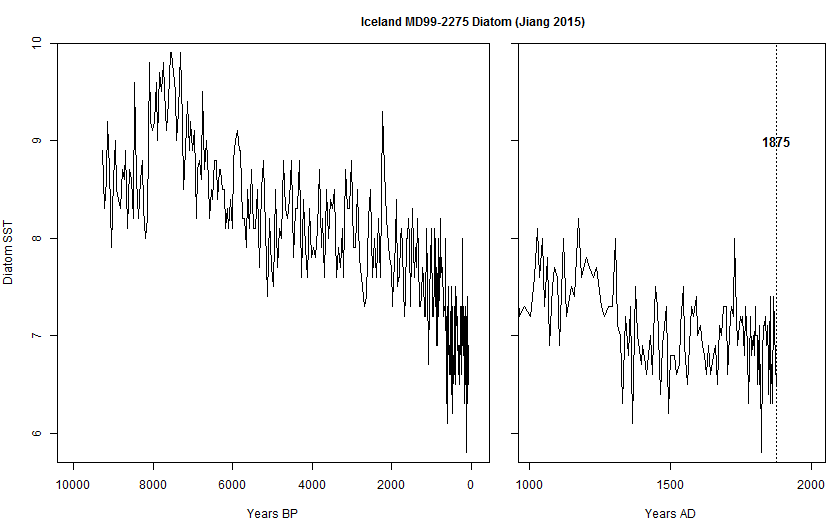
All arguments that try to claim otherwise (and we know who you all are) are in denial of the historical climatic temperature record and how the data applies or conforms to it.
The problem is if you try to take one item that impacts the climate at a given time and do not evaluate it against the whole spectrum of items that impact the climate at that given time in conjunction with that item, the correlation which does exist could be obscured. This is the down fall of so many and is very OBVIOUS with many of the posters. They have the mentality on item cause and effect ,and it does not work that way.
What fits the global temperature trend data the best since the Holocene Optimum- Present is what I suggest below.
My thoughts on what drives the climate conform to what the data shows(present/past), unlike AGW theory which totally ignores the data both present and past.
AGW theory wants the data to conform to what it suggest, not the other way around.
More data which shows since the Holocene Optimum from around 8000BC , through the present day Modern Warm Period( which ended in 1998) the temperature trend throughout this time in the Holocene, has been in a slow gradual down trend(despite an overall increase in CO2, my first chart ), punctuated with periods of warmth. Each successive warm period being a little less warm then the one proceeding it.
My reasoning for the data showing this gradual cooling trend during the Holocene ,is Milankovitch Cycles, (in addition to Land /Ocean Arrangements ,Land Mean Elevation, Mean Temperature Gradient (pole to equator),Initial State of The Climate(how far from glacial /inter-glacial threshold the climate is and or ice Dynamic) were highly favorable for warming 10000 years ago or 8000 BC, and have since been in a cooling cycle. Superimposed on this gradual cooling cycle has been solar variability which has worked sometimes in concert and sometimes in opposition to the overall gradual cooling trend , Milankovitch Cycles have been promoting.
To further refine and account for the historical climatic trend the phase of the PDO,AMO and ENSO, along with Volcanic Activity has to be superimposed upon the above.
Then again this is only data which AGW enthusiast ignore if it does not fit into their scheme of things. I am going to send just one more item of data and rest my case.
http://www.murdoconline.net/wordpress/wp-content/uploads/2011/01/gisp2-ice-core-temperatures.jpg
Again, Greenland temperatures through the Holocene move inversely to the mid latitudes so the global trend would tend to be the reverse, as can be seen on the Vostok core proxy. And also the very warm period from around 2750 BC, from when the Minoan culture flourished, their final demise was around 1200 BC, along with many others:
http://mclean.ch/climate/figures_2/Vostok_to_10Kybp.gif
Interesting that the Antarctic was apparently out of phase with the 8.2 Ka cold event.
The Vostok proxy does though indicate an increase in intensity of cold events through the last ~3000 years. It’s possible that the general slow rise previous to that could have been long term ocean heat accumulation.
I am convinced that around 1200 BC was a very cold period for the mid latitudes, so I am highly sceptical of the 8.2kyr event being a global cold event.
Looks as if it were unusually cold at Vostok around 800 BC.
The spike at 8.2 Ka indicates something out of the ordinary happened then, when at least the North Atlantic region and probably much else of the NH and world cooled rapidly.
Take the example of the 8th century in Europe then, it was as warm or even warmer than the present, but a decidedly cold period in Greenland. The cold Dark Ages period was largely in the 4-6th centuries when it was warmer in Greenland.
http://www.nature.com/ngeo/journal/v6/n5/images_article/ngeo1797-f2.jpg
I am going to send just one more item of data and rest my case.
Resting your case with data which is wrongly dated and which you’ve been told before is wrongly dated, doesn’t help your case.
The relationship between galactic cosmic ray flux and prolonged solar activity has shown up time and time again in the data.
This move to fabricate and or change the data by some I simply ignore because that is garbage in and garbage out as some have said.
There is a correlation, but no evidence of causation. How is that determined except to rule out every other correlation?
REN I think it needs to be 6500 in order for GCR values to have a big impact.
That is enough.
http://cosmicrays.oulu.fi/webform/query.cgi?startday=01&startmonth=10&startyear=2014&starttime=00%3A00&endday=10&endmonth=03&endyear=2015&endtime=00%3A00&resolution=Automatic+choice&picture=on
http://www.cpc.ncep.noaa.gov/products/stratosphere/strat-trop/gif_files/time_pres_TEMP_ANOM_JFM_NH_2015.gif
Total Solar Irradiance (TSI)
34 years – Instrument offsets are unresolved calibration differences, much of which are due to internal instrument scatter (see Kopp & Lean 2011).
http://spot.colorado.edu/~koppg/TSI/TSI.jpg
Not unresolved. We know why. Explained in Kopp’s paper.
More climate heresy (We KNOW it is ALL caused by the demon-gas CO2)
Thanks to Albert Jacobs.
No opinion – will read later.
Best, Allan
This is the title of two papers by David Douglas and Robert Knox in Physics Letters A
The Sun is the climate pacemaker II. Global ocean temperatures
Physics Letters A
Volume 379, Issue 9, 17 April 2015, Pages 830–834
http://www.sciencedirect.com/science/article/pii/S0375960114012213
Abstract
In part I, equatorial Pacific Ocean temperature index SST3.4 was found to have segments during 1990–2014 showing a phase-locked annual signal and phase-locked signals of 2- or 3-year periods. Phase locking is to an inferred solar forcing of 1.0 cycle/yr. Here the study extends to the global ocean, from surface to 700 and 2000 m. The same phase-locking phenomena are found. The El Niño/La Niña effect diffuses into the world oceans with a delay of about two months.
Physics Letters A
Volume 379, Issue 9, 17 April 2015, Pages 823–829
http://www.sciencedirect.com/science/article/pii/S0375960114012201
The Sun is the climate pacemaker I. Equatorial Pacific Ocean temperatures
Abstract
Equatorial Pacific Ocean temperature time series data contain segments showing both a phase-locked annual signal and a phase-locked signal of period two years or three years, both locked to the annual solar cycle. Three such segments are observed between 1990 and 2014. It is asserted that these are caused by a solar forcing at a frequency of 1.0 cycle/yr. These periodic features are also found in global climate data (following paper). The analysis makes use of a twelve-month filter that cleanly separates seasonal effects from data. This is found to be significant for understanding the El Niño/La Niña phenomenon.
It is hardly surprising that there is an annual variation.
Hello again Leif,
I hope you and yours are all well.
Even though we are not yet in 2016, do you have any new prediction on the magnitude of SC25?
Best, Allan
http://wattsupwiththat.com/2013/10/28/bbc-real-risk-of-a-maunder-minimum-little-ice-age/#comment-1461494
Allan MacRae says: October 30, 2013 at 11:38 am
Have you made any prediction for SC25?
lsvalgaard says: October 30, 2013 at 11:43 am
A highly speculative one is here: http://www.leif.org/research/apjl2012-Liv-Penn-Svalg.pdf
Come 2016 we should see the new polar field build and from then on I think we can predict with some confidence, not before.
The polar fields have now reversed and are building up again. A wild guess would be to 2/3 of what they were in 2008, so SC25 would be 2/3 of SC24. But it is WAY too early to attach any confidence to this.
http://www.leif.org/research/WSO-Polar-Fields-since-2003.png
[Thank you. .mod]
Thank you Leif.
Best regards, Allan
Ulric says,
The Vostok proxy does though indicate an increase in intensity of cold events through the last ~3000 years
My reply
This conforms to the GISP2 record. They both show an overall down trend in global temperature.
Or it could call into question the validity of the GISP proxy, especially the last 800yrs, it looks rather unrealistic that the temperature range is only 0.5°C through the whole period. From my frame of reference there should be warm spikes in GISP through the LIA in Europe.
The coldest part of Maunder does show warmer on GISP, as does the coldest years of Dalton (1807-1817), and the equally cold 1836-1845 on CET. Warmer years in Maunder show colder on GISP (around 1666 & 1686), and the very sharp rise on CET from 1690 to the 1720’s, is a strong cooling on GISP. Previous cold years on GISP around the 1610’s and 1540 were very warm in Europe, and the known cooling from the 1560’s in Europe turns much warmer on GISP. Around 1740 also stands out as warm on GISP:
http://www.21stcentech.com/wp-content/uploads/2012/07/Greenland-ice-core-data.png
http://climexp.knmi.nl/data/tcet.dat