Guest essay By Paul C. “Chip” Knappenberger and Patrick J. Michaels
Despite what you may think if you reside in the eastern United States, the world as a whole in 2014 has been fairly warm. For the past few months, several temperature-tracking agencies have been hinting that this year may turn out to be the “warmest ever recorded”—for whatever that is worth (keep reading for our evaluation). The hints have been turned up a notch with the latest United Nations climate confab taking place in Lima, Peru through December 12. The mainstream media is happy to popularize these claims (as are government-money-seeking science lobbying groups).
But a closer look shows two things: first, whether or not 2014 will prove to be the record warmest year depends on whom you ask; and second, no matter where the final number for the year ranks in the observations, it will rank among the greatest “busts” of climate model predictions (which collectively expected it to be a lot warmer). The implication of the first is just nothing more than a jostling for press coverage. The implication of the latter is that future climate change appears to be less of a menace than assumed by the president and his pen and phone.
Let’s examine at the various temperature records.
First, a little background. Several different groups compile the global average temperature in near-real time. Each uses slightly different data-handling techniques (such as how to account for missing data) and so each gets a slightly different (but nevertheless very similar) values. Several groups compute the surface temperature, while others calculate the global average temperature in the lower atmosphere (a bit freer from confounding factors like urbanization). All, thus far, only have data for 2014 compiled through October, so the final ranking for 2014, at this point in time, is only a speculation (although a pretty well-founded one).
The three major groups calculating the average surface temperature of the earth (land and ocean combined) all are currently indicating that 2014 will likely nudge out 2010 (by a couple hundredths of a degree Celsius) to become the warmest year in each dataset (which begin in mid-to-late 1800s). This is almost certainly true in the datasets maintained by the U.S. National Oceanographic and Atmospheric Administration (NOAA) and the UK Met Office Hadley Centre. In the record compiled by NASA’s Goddard Institute for Space Studies (GISS), the 2014 year-to-date value is in a virtual dead heat with the annual value for 2010, so the final ranking will depend heavily on the how the data come in for November and December. (The other major data compilation, the one developed by the Berkeley Earth group is not updated in real time).
There is one other compilation of the earth’s surface temperature history that has recently been developed by researchers Kevin Cowtan and Robert Way of the University of York. This dataset rose to prominence a year ago, when it showed that if improved (?) methods were used to fill in data-sparse regions of the earth (primarily in the Arctic), the global warming “hiatus” was more of a global warming “slowdown.” In other words, a more informed guess indicated that the Arctic had been warming at a greater rate than was being expressed by the other datasets. This instantly made the Cowtan and Way dataset the darling of folks who wanted to show that global warming was alive and well and not, in fact, in a coma (a careful analysis of the implications of Cowtan and Way’s findings however proved the data not up to that task). So what are the prospects of 2014 being a record warm year in the Cowtan and Way dataset? Slim. 2014 currently trails 2010 by a couple hundredths of a degree Celsius—an amount that will be difficult to make up without an exceptionally warm November and December. Consquently, the briefly favored dataset is now being largely ignored.
It is worth pointing out, that as a result of data and computational uncertainty, none of the surface compilations will 2014 be statistically different from 2010—in other words, it is impossible to say with statistical certainty, that 2014 was (or was not) the all-time warmest year ever recorded.
It is a different story in the lower atmosphere.
There, the two groups compiling the average temperature show that 2014 is nowhere near the warmest (in data which starts in 1979), trailing 1998 by several tenths of a degree Celsius. This difference is so great that it statistically clear that 2014 will not be a record year (it’ll probably fall in the lower half of the top five warmest years in both the Remote Sensing Systems (RSS) and the University of Alabama-Huntsville (UAH) datasets). The variability of temperatures in the lower atmosphere is more sensitive to the occurrence of El Niño conditions and thus the super El Niño of 1998 set a high temperature mark that will likely stand for many years to come, or at least until another huge El Niño occurs.
Basically, what all this means, is that if you want 2014 to be the “warmest year ever recorded” you can find data to back you up, and if you prefer it not be, well, you can find data to back up that position as well.
In all cases, the former will make headlines.
But these headlines will be misplaced. The real news is that climate models continue to perform incredibly poorly by grossly overestimating the degree to which the earth is warming.
Let’s examine climate model projections for 2014 against the observations from the dataset which has the greatest chance of 2014 as the warmest year—the NOAA dataset.
Figure 1 shows the average of 108 different climate model projections of the annual surface temperature of the earth from 1980 through 2014 along with the annual temperature as compiled by NOAA.
![cw_12_10_14_fig1[1]](https://wattsupwiththat.files.wordpress.com/2014/12/cw_12_10_14_fig11.jpg?quality=83) Figure 1. Global annual surface temperature anomalies from 1980 to 2014. The average of 108 climate models (red) and observations from NOAA (blue) are anomalies from the 20th century average. In the case of the NOAA observations, the 2014 value is the average of January-October.
Figure 1. Global annual surface temperature anomalies from 1980 to 2014. The average of 108 climate models (red) and observations from NOAA (blue) are anomalies from the 20th century average. In the case of the NOAA observations, the 2014 value is the average of January-October.
For the past 16 straight years, climate models have collectively projected more warming than has been observed.
Over the period 1980-2014, climate models projected the global temperature to rise at a rate of 0.24°C/decade while NOAA observations pegged the rise at 0.14°C/decade, about 40 percent less. Over the last 16 years, the observed rise is nearly 66 percent less than climate model projections. The situation is getting worse, not better. This is the real news, because it means that prospects for overly disruptive climate change are growing slimmer, as are justifications for drastic intervention.
We don’t expect many stories to look any further than their “2014 is the warmest year ever” headlines.
As to the rest of the picture, and the part which holds the deeper and more important implications, well, you’ll have to keep checking back with us here—we’re happy to fill you in!
The Current Wisdom is a series of monthly articles in which Patrick J. Michaels and Paul C. “Chip” Knappenberger, from Cato’s Center for the Study of Science, review interesting items on global warming in the scientific literature or of a more technical nature that may not have received the media attention that they deserved, or have been misinterpreted in the popular press.
If a buyer’s market, then Ban Ki Moon will indulge, and demand that all meteorological and weather agencies fabricate their near-surface temperatures to coincide with the “Tastes” of Ban Ki Moon, or else face extermination by nuclear detonations ordered by Ban Ki Moon.
You have to remember that Korea was occupied, brutally, the the Japanese from about 1899 through 1945. Old-Boy-Ban himself is half Japanese and this fact is of the greatest distaste to him.
In Korea, growing up Half Breed, he had to survive on the streets. His “Brothers and Sisters” kidnapped to Japan grew up as slaves to the Japan Industrial Complex, Fujii, Mitsubishi and Sony and the like.
Old-Boy-Ban’s hatred of the Japanese is unbounded. If pushed, he will call you a Japanese Nigger, even though you were born in Germany.
D. Socrates,
Feel free to keep calling me a “stupid fuck” [December 10, 2014 at 7:23 pm], it’s water off a duck’s back to me. I have a thick skin. Now, if you want a chart I will be happy to post more charts than you can handle. But first you need to start answering questions from other readers, and responding to the dozens of charts I’ve already posted that debunk your climate alarmism. Until you do, don’t expect me to jump every time you demand something. It’s a two way street.
It would be nice to see what the models at the time actually predicted, rather than models that hindcast to 1980. With the hindcast, there is a deceptively close correlation from 1980 to about 2004-2005.
What are the reference dates of the 108 models that were averaged to get the red bars in the first figure?
A hindcast is necessarily accurate because the parameters for the model were developed using the data in those past years.
The only hindcast that could be considered a reasonable test is one that goes far back before the time of start of data used for the model.
Thus suppose a model is developed using data from 1850 to present, it cannot be considered relevant that the hindcast gives, say, a 97% correlation back as far as 1850.
However, having developed that model, it would be considered great if the model then gave 97% accuracy when used to hindcast temperatures back from 1850 to 1066.
Socrates
Ok, the Arctic chart is interesting. A consolidated chart of Arctic + Antarctic (showing total sea ice exceeding average) is more interesting.
Well, assuming we’re being intellectually honest about discussing the thing called GLOBAL warming.
From the Washington Post recently,
……… marvel at the the perversity of cheering on a strategy that would, through inaction, bet human welfare on the notion that elite scientists with their elite models and elite consensus are so spectacularly and systematically wrong on the risks of greenhouse emissions that the rational strategy is to rapidly ramp up fossil fuel burning.
Is the rest of the world really that deluded ?
Is it just me, or does it seem like there’s a bunch of trolls all rather focused on dbstealey?
I think they come from HotWhopper. He is subject to particular vitriol there and he is seen as being easy to anger. Making someone angry will win the argument – practically.
Neutral lurkers are always swayed away from the angry one’s position.
They used to bait my father quite well too.
M Courtney,
I have no knowledge of what goes on at that thinly-trafficked blog since I never give them clicks. But if the best they can do is what we see here, they are über lame.
Given the fall-off in traffic volume on some warmest sites (Hot Whopper comes to mind), flaming trolls may indeed be looking for new homes. I don’t mind reading contrary opinions if they’re civil and well defend, but the continued snarky, childish name calling and refusal to engage in civil debate does get tiresome. Especially the stuff seen here today from Brandon.
Example: Brandon’s 9:09a comment to dbstealey:
“To make that silly point by selecting only the portion of the data which support your argument is dishonest”
…and then refusing to admit he accused him of lying is a classic troll rat-hole technique – argue about anything other than the data and it’s interpretation.
Dave Hoffer,
Not a bunch. Only two.
“Record
Global TemperatureMeaningless Metric—Conflicting Reports, Contrasting Implications”There, fixed.
Brandon Gates;
Isn’t it funny that except for 1998 every year in the top 10 is in the 21st century?
>>>>>>>>>>>>>>>>>>>>
This has got to be one of the silliest arguments there is in support of CAGW, but it keeps on appearing. The earth has been warming for 400 years. So given that the dominant temperature trend for close to 1/2 a millennium is warming, what else would you expect? The question is not if the present is the warmest in some given time period, but how much warmer than it would be without anthropogenic effects.
If I put $100 in a jar every week for 10 years, and then for the next ten years I put in just 1 penny per week, I could rightfully say that I now had the most savings ever the last 10 weeks out of 20 years. It would be technically true, but it would still be only an extra ten cents on over $50,000.00. Trivially true, but insignificant.
davidmhoffer,
Some people say similar things about men evolving from monkeys. Funny that they don’t take the time to learn that we descended most directly from apes.
I agree, but I’m curious … from whence you get the information to support your conclusion?
The Earth being a physical system, I would expect it to behave according to measurable phenomena. IOW, I would expect that someone who was capable of telling me that the planet had warmed for 400 years might just know some of the reasons for that. If I chose to reject their explanation for the change, I’d find it tough to explain why I believe any of their observations.
IIRC, about 50% of the trend since the 19th century is attributable to human influence. Tough one to validate since we can’t rewind time and run the experiment forward absent our influence.
Why pull random numbers out of a hat that have absolutely no connection whatsoever to the actual figures?
Global temps at the LGM 22,000 years ago were -3.5 °C from the Holocene average. 12,000 years was the time it took to rise that amount, for a rate of 0.3 °C/1,000 years.
From 1850 until now, temps have risen 0.9 °C. That’s just over one-quarter the entire rise from the last glacial to the top of the interglacial. If 25% doesn’t sound non-trivial to you, that temperature rise occurred at a rate of 5.5 °C/1,000 years. What is that … 18 times a faster rate.
Extra ten cents on $50,000 … holy Toledo, I’m too tired to calculate how many orders of magnitude your “estimate” is off.
Brandon says:
Why pull random numbers out of a hat that have absolutely no connection whatsoever to the actual figures?IIRC, about 50% of the trend since the 19th century is attributable to human influence.
“About 50%” is what’s called an “assertion”. It has no verifiable connection to the real world. It could just as well be 5%, or 95%, or 0.5%. No one knows.
You also say:
I’m curious … from whence you get the information to support your conclusion?
I would ask the same thing. Post a verifiable, testable measurement of AGW. But instead, you’re just projecting. You ask:
Why pull random numbers out of a hat that have absolutely no connection whatsoever to the actual figures?
Yes indeedy. So let’s stop pulling numbers out of a hat, and post testable, empirical measurements quantifying AGW in a way that they show the true fraction of human-caused global warming, out of the total.
That is the central question, which would settle the debate once and for all. But there are no verifiable measurements of AGW, which means that AGW is an unproven conjecture. It is an opinion, nothing more.
The alarmist crowd is engaging in a giant head fake. They tell everyone that human emissions are gonna fry us. But that is nothing but speculation. And direct observations do not support it.
The lack of credibility on this issue is astonishing. There is not a single verifiable measurement of something that we are told we must take immediate action upon, drastically altering Western civilization in the process; something that millions of people have been discussing non-stop for more than thirty years. It’s like discussing what kind of green cheese the moon is made of, without going to the moon. Is that crazy, or what?
dbstealey,
It’s called an estimate.
Rational people understand that the planet is complex and accept the uncertainties that go along with attempting to figure out what it’s doing, and what if any effect we’re having on it.
I asked someone else first. I’ve shown you plenty of observations on the past two days. Your main complaint is that those data cannot be found in the WFT database. “Why should I trust it” you ask. Well, why do you trust what’s in WFT?
ROFL!!!
Brandon Gates December 11, 2014 at 12:47 am
>>>>>>>>>>>>>>>>>>>>
LOL. Just intent on dragging the discussion into rat holes and ignoring the main point, huh?
1. Since the LIA which was 400 years ago. Don’t give me any crap about it not being global, we’ve just crushed that stupidity on another thread.
2. I don’t need to propose a mechanism, I’m just making an observation, which is that the trend for the last 400 years is positive, so the last few years being the warmest is no surprise.
3. The “50% attributed to humans” meme comes from the models, which have since turned out to be a total bust, even the IPCC agrees they are too sensitive to CO2, and hence since their estimates of sensitivity are high, so are estimates of human contribution based on them.
4. The example was meant to illustrate a point about misuse of minute amounts to make a technically accurate but misleading statement. There was no intent to present same as a model of temperature change, your attempt to characterize it as such is disingenuous.
Brandon says:
It’s called an estimate.
No, it’s called a guesstimate. Emphasis on “guess”.
Face it, you can’t find any comparable chart from the WFT databases, showing that CO2 is the control knob of the climate. Instead, you’re all over the map as usual. Hoffer is right, you’re simply trying to mislead.
davidmhoffer,
Wasted effort on me, I’ve been looking at Moberg et al. (2005) data, a NH temperature proxy reconstruction from 1-1979 CE for the past few days: http://climexp.knmi.nl/data/imoberg2005.dat
Clear MWP and LIA. I see no reason to distrust those data. Try arguing the points I make, not the ones you want me to be making.
I’m so sorry, I thought this was a discussion of science, which is concerned with proposing mechanisms and matching them against observation.
You’ve read every paper out there, and not one of them has anything remotely resembling an observation? Amazing.
[cough, cough] $0.10 / $50,000 ≈ 0.25 is not misleading? That one doesn’t even have the benefit of being technically accurate.
That’s some furious backpedaling you’re doing there, I must say. If you weren’t talking about temperature change, what WERE you talking about? The price of tea in China?
dbstealey,
Face it, there’s something in the data I’ve presented you don’t wish to look at. Why your choice should be my problem is a complete mystery to me.
Far be it for me to confuse anyone with the facts.
Wow Brandon Gates is brilliant, he questions the global origin of the LIA and whether it has warmed or not since and then categorically states that it was “-3.5 °C from the Holocene average” 22,000 years ago when there was not a single thermometer in the world.
One has anecdotal evidence and the other has “guesses”, which would you put your money on?
A C Osborn,
Please point to the exact text where I alleged the LIA was not global.
I trust thermometers and satellites over proxy reconstructions any day of the week. You?
Brandon,
This chart shows clearly how much effect CO2 has on temperature geologically: none. CO2 is not a measurable long term [or short term] cause of rising T.
I’ve already posted a dozen or so charts showing clearly that changes in CO2 are caused by changes in temperature, and although your link claims that T “lags behind” CO2, that is not clear at all in their simple overlay. If anything, their chart shows that ∆T causes ∆CO2.
Once again, I await an empirical measurement quantifying AGW. So far, no one has been able to produce one.
Brandon
Your comment “Why pull random numbers out of a hat that have absolutely no connection whatsoever to the actual figures?” is the very definition of my reaction to climate models.
Brandon,
Yes, face it: you cannot produce a chart using the same databses, showing that CO2 is the magic cntrol knob of the climate. I would be more impressed if you just admitted that any effect from CO2 is simply too small to measure, since there are no such measurements. [As usual: if there are measurements of AGW, please post them.]
The entire ‘carbon’ scare is based on the belief that CO2 is a problem. But the promoters of the scare cannot support their conjecture with testable evidence. Doesn’t that bother you, even a little?
I guess I just don’t see what the ‘warmest’ year even matters to the warmists? Shouldn’t every year from 2000 or so on be roughly close or breaking the record for the warmest year on record? Fact is, it was basically just as warm in the 30’s as it is now when there was a ‘hill’ of warmth. So now it’s taken 80 years of AGW global warming to warm us back up be rivaling those years for the warmest ever, before there was ever any effect from humans? And what is all the fuss about? Is this real life?
Doesn’t this basically demean their product by trying to sell it in this way?
If you remember photos of Cape Town, you will remember seeing Table Mountain. When you climb to the top, you have been rising, and rising and rising. You can walk about, roughly at the same height, but if you keep going in a straight line (a “time-line”?) you will eventually come to the edge and start going down.
Temperatures have been climbing. We have got to a plateau. The future is blindfolded. We don’t know whether they will stay the same, resume rising or start falling. If temperatures resume rising, we can assume that the present plateau is due to “natural variation” effectively cancelling warming due to CO2 over the last 18 years. But the corollary from that is that natural variation must have been contributing to the temperature rise over the previous 20 years.
As we don’t know what it will do, before spending pots of money to alleviate effects of something that might not happen, we should follow the advice given by the great Liberal Prime Minister Herbert Asquith:- “We had better wait and see.”
Does anyone know how many posts I have to make to get rid of the ‘Your comment is awaiting moderation.’ message and wait? It seems I should not be a bot.
No I don’t. But it happens a lot to me too – and they definitely know I’m not a bot.
My language and subject matter of interest keeps hitting the filters. Perversely, the problem is the mods rely on bots.
[Reply: We don’t, at least not willingly. WordPress shunts numerous comments into the Spam folder for reasons known only to them. Our job is to fish out the legit ones. Often there is a delay. ~mod.]
“statistical certainty” That’s a new one to me.
He means a confidence level of 95%.
The French could be revolting:
http://www.telegraph.co.uk/finance/economics/11285291/How-a-volcanic-explosion-could-trigger-the-next-French-Revolution.html
Aren’t the French always revolting?☺
The current high solar activity has caused move return north polar vortex. Now it will be quickly was incremental ice in the Arctic from the Svalbard.
http://cosmicrays.oulu.fi/webform/query.cgi?startday=01&startmonth=09&startyear=2014&starttime=00%3A00&endday=11&endmonth=12&endyear=2014&endtime=00%3A00&resolution=Automatic+choice&picture=on
http://www.ijis.iarc.uaf.edu/seaice/extent/Sea_Ice_Extent_v2.png
http://www.spaceweatherlive.com/images/grafieken/Kp_cyclus.png
KNMI reported the hottest year ever for The Netherlands, last 300 years. And the MSM as propaganda machine for the greenies let us know how bad the situation is. Indoctrination to fulfill their agenda.
1998 was a ‘super El Nino’ year, 2010 was a ‘strong El Nino’ year, and 2014 is a ‘quite mediocre El Nino’ year. If these three are tied in lead then we really need to be careful about what we claim.
Much more important than ‘pause’ or ‘hiatus’ is the continuing divergence between real world temperatures and climate models on which we are building our policies for the future.
Who is to be blamed for the record year 2014? Was it Pope Gregory XII in 1582? No, he introduced the leap days at every 4 years. Was it Julius Caesar in 46 BC? No. The Julian calendar has a regular year of 365 days divided into 12 months. New Year’s celebrations are founded before. Some have suggested this occurred in 153 BC in Rome. Other nations used or use different New Year’s celebrations. I think it is better to use running annual means : The records including data until Oct 2014 are: NOOA 14,53 °C, Oct 2009-Sep 2010, HadCrut4 14.55 °C , Sep 2009-Aug 2010, GISS 14,58 °C, Aug 2009 –Jul 2010 with an estimated uncertainty +- 0.05 °C.
“Was it Julius Caesar in 46 BC? No.”
Take out July and August and it would be a lot cooler.
Not in the SH
Take out July and August…
But he didn’t take out July and August.
Gras Albert has posted a graph over at Judith Curry’s blog which I think is pretty good.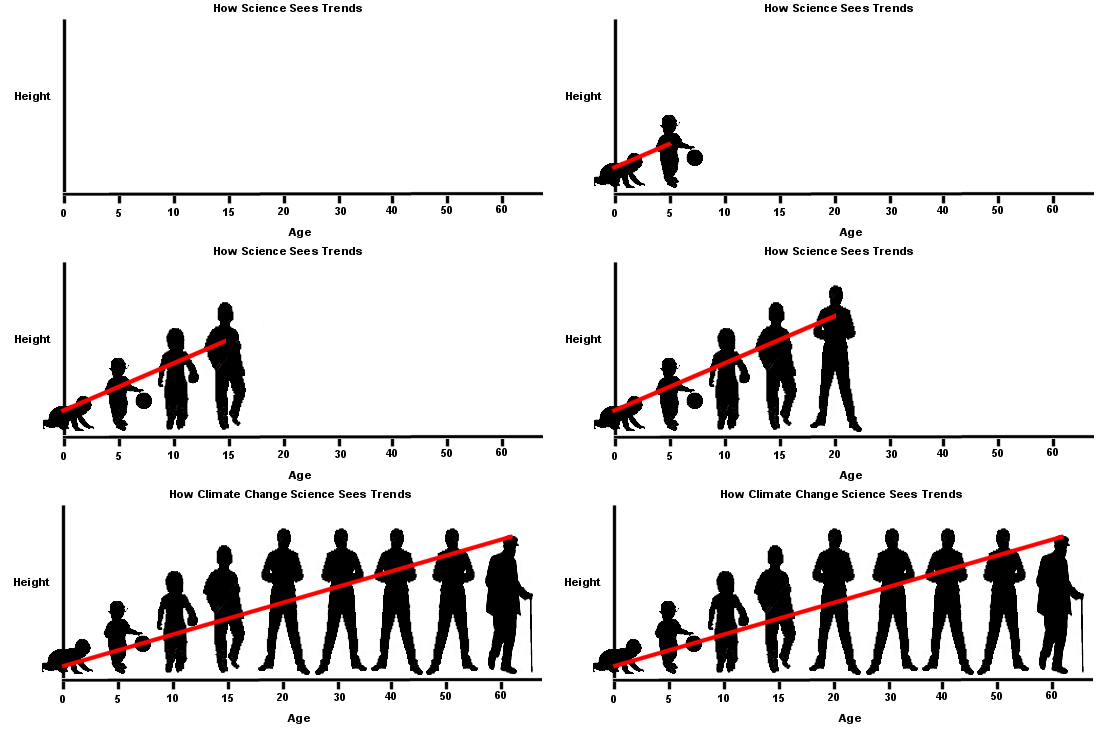
+1
A very good demonstration of how to properly interpret data, and the folly of putting a straight fit linear trend line on data that is not responding on a linear time basis, and why the claim of the ‘warmest’ year on record, and/or the claim that 10 of the past dozen or so years are the warmest on record, carries no scientific significance.
Thanks Richard, absolutely true. When even defining the surface temperature is hard, presenting it as a dot in one dimension and expecting a straight line as function of time is somewhat depressing.
+1
Here is what I find interesting…
The Cowtan and Way dataset is considered an improvement in that it adjusts “better” for areas where no direct temperature data is available. Its impact is enough to change the calculated average of the Earth’s temperature and reorder the hierarchy of the years with the highest calculated temperature.
If you think about the last 150 years as a continuum then every decade you go back, the more sparse the temperature record and the larger effect this kind of interpolation will have on the calculated average temp. I would imagine that by the time you got back to say, 1900, the accuracy of the calculated average is pretty poor.
And yet, somehow we seem to believe that we have a good temperature record to work with…good enough to calculate within a hundredth of a degree what the so called average temperature of the Earth is.
Sounds a bit farfetched to me. It falls into the same category of people believing they can measure the ocean levels to within a few millimeters. Doesn’t pass the smell test.
I am also skeptical that tree rings or ice cores can be measured with that level of accuracy either.
“The Cowtan and Way dataset is considered an improvement in that it adjusts “better” for areas where no direct temperature data is available.”
Wrong.
There are no LAND stations on the ICE.
To calculate a global average you have THREE and only THREE choices.
A) Do not infill.
B) Infill with the closest data
C) Estimate the values using other data sources.
Option A. This is what CRU does. Refusing to infil is the mathematical equivalent of INFILLING with the global average. That is demonstrably wrong.
OptionB. This is GISS, they extrapolate from the nearest land stations
Option C. Use other data sources. C & W use satellite data. There approach is similar to one used by
McIntyre and Odonnell ( yes that steve McIntyre) in estimating antarctica. To do this you establish
a relationship between the satellite data and the land data. You then use the satillite data over the arctic
to estimate what wasnt measured directly.
All of these options can be tested for their accuracy of estimating the arctic.
How?
Simple.
1. Reanalysis data. Reanalysis data exist for the arctic. In fact it is used on WUWT arctic page.
2. Bouy data. Cowtan and Way used bouy data collected in the arctic. These bouys sit on the ice and
collect daily data.
In short. C&W has been shown to be a better estimate than CRU or GISS.
So where is what you quoted wrong?
Interesting info. Thanks. Not sure you completely understood what I was saying.
Actually, there is a fourth option…Build a time machine and go back a million years with enough sensors to cover the Earth in a reasonable grid. Make sure the black boxes have enough battery life to last until you retrieve them in 2014. Then you will have a reliable and accurate record of temperatures and you won’t have to measure tree rings or ice cores or whatever and try to convince people you can calculate the temperature on March 23rd, 853,924 BC to three decimal places.
I favor option four.
http://cosy.com/Science/CO2vTkelvin.jpg
What’s the gray ball doing?
This whole discussion is another illustration of the principle of science that says, the more you know, the less you understand. Or more eloquently, the old Chinese proverb:
Man with one watch knows the time
Man with two, not sure
One thing is clear: regardless of the truth of whether 2014 turns out to be the warmest EVAH, and even if it’s by a millionth of a degree, and despite the fact that it is scientifically meaningless anyway, the Climate Ignorati need to be able to trumpet it to their brain-dead followers (those who remain, anyway).
“Despite what you may think if you reside in the eastern United States, the world as a whole in 2014 has been fairly warm.”
= = = = = = = = = = = =
Here’s what our “fairly warm” planet did in 2014:
* * * * * * * * * * * * * * * * * * * *
‘Polar vortex’ grips the US in coldest temperatures in decades
Telegraph UK, Jan 04
The United States is spending the first days of 2014 in the grips of record-breaking cold and snow as freezing Arctic winds sweep across the country
Niagara Falls frozen: tourists flock to see icy spectacle
Guardian UK, January 13
Historical Great Lakes Ice Cover
NCDC-NOAA, March 02
During the winter of 2013/14, very cold temperatures covered the Great Lakes and surrounding states. Minnesota, Wisconsin, Michigan, Illinois, and Indiana each had winter temperatures that ranked among the ten coldest on record. The persistent cold caused 91 percent of the Great Lakes to be frozen by early March. This was the second largest ice coverage for the lakes, with data dating to 1973, and the largest on record for the date.
Niagara Falls comes to a halt AGAIN: Millions of gallons of cascading water is frozen in bitter temperatures
DailyMail UK, March 04
Great Lakes covered in record-shattering amount of ice this late in spring
Washington Post, April 23
“There is roughly 16 times more ice than normal right now!”
Great Lakes are FINALLY ice free after record breaking seven months frozen
DailyMail UK, June 10
Stunning satellite images show [Arctic] summer ice cap is thicker and covers 1.7 million square kilometres more than 2 years ago
…despite Al Gore’s prediction it would be ice-free by now
DailyMail UK, August 31
With Ice Growing at Both Poles, Global Warming Theories Implode
TheNewAmerican, September 15
Antarctic Sea Ice Reaches New Record Maximum
NASA, October 7
Cold winters have been caused by global warming: new research
Telegraph UK, Oct 27
Climate sceptics often claim that recent icy winters show that global warming is not happening. New research suggests the opposite is true
Earliest ice on record appears on Great Lakes
NOAA, Nov 24
Fall snow cover in Northern Hemisphere was most extensive on record, even with temperatures at high mark
Washington Post, December 4
http://img.washingtonpost.com/blogs/capital-weather-gang/files/2014/12/rutgers-snow.png
In 46 years of records, more snow covered the Northern Hemisphere this fall than any other time. It is a very surprising result, especially when you consider temperatures have tracked warmest on record over the same period.
Data from Rutgers University Global Snow Lab show the fall Northern Hemisphere snow cover extent exceeded 22 million square kilometers, exceeding the previous greatest fall extent recorded in 1976.
* * * * * * * * * * * * * * * * * * * *
When they’re saying that 2014 will be the highest ever recorded, are they speaking in total average temps for the year, or in terms of anomolies?