Rebuttal to Chen and Tung (2014) highlighted in “Cause for ‘The Pause’ #38 – Cause of global warming hiatus found deep in the Atlantic Ocean”
Numerous scientific papers have reported the hiatus in global surface warming will end with the next El Niño event. But according to a new paper by Chen and Tung published today online in ScienceMag (link to paper follows), that’s not going to happen because the multidecadal variations in ocean heat sequestration at depth in the Atlantic and Southern Oceans will suppress surface warming for a decade or two more. Additionally, unlike many other papers of its kind, Chen and Tung (2014) indicate a lessening in ocean heat sequestration to depth (the reverse of what we’re seeing now) was responsible for the accelerated warming during the latter part of the 20th Century.
Looking at Chen and Tung (2014) in a different light, they went looking for Trenberth’s missing heat, and, not surprisingly, they found it in the same ocean heat content reanalysis (ECMWF ORAS-4) used in Balmaseda et al. (2013), which Trenberth co-authored.
The paper is Chen and Tung (2014) Varying planetary heat sink led to global-warming slowdown and acceleration. The abstract reads (my boldface):
A vacillating global heat sink at intermediate ocean depths is associated with different climate regimes of surface warming under anthropogenic forcing: The latter part of the 20th century saw rapid global warming as more heat stayed near the surface. In the 21st century, surface warming slowed as more heat moved into deeper oceans. In situ and reanalyzed data are used to trace the pathways of ocean heat uptake. In addition to the shallow La Niña–like patterns in the Pacific that were the previous focus, we found that the slowdown is mainly caused by heat transported to deeper layers in the Atlantic and the Southern oceans, initiated by a recurrent salinity anomaly in the subpolar North Atlantic. Cooling periods associated with the latter deeper heat-sequestration mechanism historically lasted 20 to 35 years.
Basically, Chen and Tung (2014) are saying that the vast majority of the human-induced global warming signal can be found in the ocean temperature and salinity data (and reanalysis) for the oceans to depths of 1500 meters. (There’s nothing new about that.) They are also clarifying that naturally occurring variations (that last for multiple decades) in where that ocean heat is sequestered (shallow or deeper layers of the oceans) impacts the rate of global warming at the surface. (There’s nothing new there, either.) During the “latter part of the 20th century” there was “rapid global warming as more heat stayed near the surface” and “[i]n the 21st century, surface warming slowed as more heat moved into deeper oceans.” While this proposal is not new, Chen and Tung (2014) are arguing against El Niño and La Niña as the primary cause and saying the variations in sequestration are occurring in the Atlantic and Southern Oceans…the result, primarily, of Atlantic meridional overturning circulation, with which the Atlantic Multidecadal Oscillation (AMO) is associated. The last little tidbit of value is the time periods of similar past cooling periods, 20 to 35 years, and that’s important because the current hiatus has not lasted that long yet.
Unfortunately, the Southern Ocean is one of the key regions in Chen and Tung (2014). There is so little long-term subsurface temperature and salinity data that far south that any reanalysis of the Southern Ocean before the ARGO floats were deployed (around 2003) has to be viewed as fantasy.
DATA AND REANALYSIS
Chen and Tung (2014) relied on the JMA ocean heat content data (Ishii and Kimoto) along with the COBE sea surface temperature data and on the ORAS-4 Reanalysis from ECMWF. As you’ll recall, a reanalysis is the output of a computer model that uses data as one of its inputs, so it’s not data. We discussed the curious behavior of the ECMWF reanalysis in the post Trenberth Still Searching for Missing Heat. The ECMWF ORAS-4 is forced by volcanic aerosols and ENSO to give it features that do not exist in data. Also see Willis Eschenbach’s post Why Reanalysis Data Isn’t…
Would the results of Chen and Tung (2014) be different if they had used another reanalysis of subsurface temperatures and salinity?
CHEN AND TUNG COMMENT ON OTHER PROPOSED REASONS FOR HIATUS
Chen and Tung (2014) discussed a number of the proposed explanations for the slowdown in surface warming. To these, they stated (my boldface):
Response to solar cycle changes was found to be small (40, 41). The aerosol cooling should have a signature in subsurface ocean (42), and yet it is not seen, perhaps suggesting that the proposed radiative effects may be too small. The second involves ocean heat sequestration: The present work follows the original proposal of Meehl et al. (5, 24) regarding global deep-ocean heat sequestration. However, our observational result does not support their Pacific-centric view. The duration of the cooling periods in the CCSM4 model they used is typically 10 years, with one rare 15-year hiatus in 375 years and none over 15 years. The current hiatus already lasted over 15 years using their definition of hiatus as periods with zero trend. Comparing that model with observation, we found that model’s Atlantic has too little variability with too high frequency (fig.S7 versus Fig. 6). This artifact appears to be attributable to a new overflow parameterization scheme in CCSM4 in the Denmark Strait and Faroe Bank Channel (31).
CHEN AND TUNG CONCLUSIONS
They write:
The fact that the global-mean temperature, along with that of every major ocean basin, has not increased for the past 15 years, as they should in the presence of continuing radiative forcing, requires a planetary sink for the excess heat. Although the tropical Pacific is the source of large interannual fluctuations caused by the exchange of heat in its shallow tropical layer (3), the current slowdown is in addition associated with larger decadal changes in the deeper layers of the Atlantic and the Southern oceans. The next El Niño, when it occurs in a year or so, may temporarily interrupt the hiatus, but, because the planetary heat sinks in the Atlantic and the Southern Oceans remain intact, the hiatus should continue on a decadal time scale. When the internal variability that is responsible for the current hiatus switches sign, as it inevitably will, another episode of accelerated global warming should ensue.
So according to Chen and Tung (2014), an El Niño will only cause a temporary surge in global warming but not impact the multidecadal hiatus. But data contradict them. We know that strong El Niño events are a primary cause of global surface warming. Sunlight-produced warm waters released from below the surface of the western tropical Pacific during strong El Niño events (like ones in 1986/87/88, and 1997/98 and 2009/10) are then distributed to adjoining ocean basins in the wakes of those El Niños, and those El Niño residuals cause blatantly obvious upward steps in the sea surface temperatures of the South Atlantic, Indian and West Pacific Oceans. For more information on how strong El Niños cause those upward shifts, see the illustrated essay The Manmade Global Warming Challenge (42mb pdf).

However, in some respects, the sea surface temperature data for the North Atlantic do agree with Chen and Tung (2014). That is, the surface of the North Atlantic had been warming at a much higher rate than the rest of the global oceans during the satellite era (about 3 times faster)…until about 11 years ago. Since January 2003, the surface of the North Atlantic has been cooling, while the warming has slowed drastically for rest of the global ocean surfaces. (See the graph here.) So the North Atlantic has suppressed global warming for the past 11 years.

And, of course, the sea surfaces of the Southern Ocean show cooling for the entire satellite era, with a big step down in 2006-08.
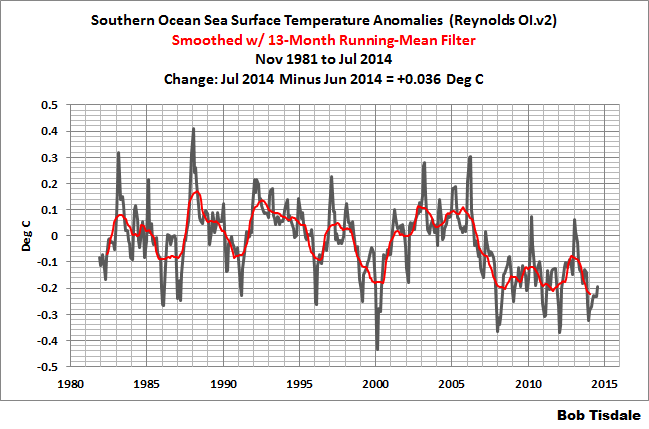
Last, according to Chen and Tung (2014), hiatus periods due to the sequestration of ocean heat to depth in the Atlantic and Southern Oceans can last 20 to 35 years. And they note the current hiatus period has already lasted 15 years. That indicates we’ve got another 5 to 20 years more to go with the current hiatus.
CLOSING
Over the past few years, we’ve seen more and more papers that admit natural variability contributed to the warming from the mid-1970s to the turn of the century and suppressed the warming in the 21st Century. When will the climate science community admit they’d tuned their models to a naturally occurring upswing in the warming of global surfaces from the mid-1970s to the turn of the Century, and as a result their projections of future global warming are way too high? (Answer: Probably not in my lifetime.)
Matt Skaggs:
At August 22, 2014 at 7:32 am you say
Anthropogenic (i.e. man-made) global warming (AGW) is at best a hypothesis.
It has not risen to the level of a theory and – in light of the failure to determine any supporting evidence for it – AGW seems unlikely to ever become a theory.
Richard
Thanks Bob for the great explanation.
I’m trying to understand how this all works: GHGs send heat to the deep ocean, which is 1) undetectable at those depths and 2) can’t be detected on it’s way to the deep and 3) doesn’t warm the atmosphere. 4) Somehow instead of radiating upward and outward into the atmosphere, something on the ocean surface gobble up the heat and secrets it away to the depths and 5) the heat comes up and warms the ocean surface as an el nino.
Did I miss something?
If the oceans are getting warmer shouldn’t we be seeing more hurricanes?
mothcatcher on August 22, 2014 at 1:33 am
From mothcatcher
Phlogiston – I find your perspective compelling. The heat storage capacity of the oceans must be huge. Can we have some figures, relative to the heat content of the atmosphere and land surface? Of course, the many factors that will regulate the interchange will be complex and obscure, and, reading the range of current papers, quite possibly beyond the ability of present understandings to disentangle, but we might get an idea of the likely inertia that the oceans may impart to any real or imagined forcings..
One way to express the relative amount of heat in atmosphere and ocean is to calculate the depth of water at the ocean surface that contains the same amount of heat as the whole atmosphere. Estimates of this thickness are in the range 2-10m. This gives a good idea of where all the heat is.
It is extraordinary how two-faced the climate community is about natural climate variability. I well remember during the warmists glory days of the 90’s how the idea of natural climate change was dismissed with derision. “Natural” was a dirty work for these folks. The party line then was that computer modelling was the only legitimate climate science and that nothing but co2 can change climate because they “could not see how it could”.
Now that climate has stopped warming they have finally realised that they need natural variability to explain the “pause”. Naturally of course they do not admit any previous error.
Tung and Chen have in fact identified correctly ocean vertical heat redistribution as a mechanism of climate change at the land surface. If they were honedt they would state the glaringly obvious corollary of this research, that is, that the warming of the 80s and 90s could have been a natural ocean driven process unrelated to human activity. However instead they assert on the basis of pure religious dogma that co2 has been continually adding heat to the earth’s climate. The “pause” simply means that vertical ocean redistribution has cancelled out the warming in the last couple of decades.
This is not science with integrity. They should grow some cojones and admit the logical possibility that most or all recorded climate variability is from natural changes and cycles in ocean vertical mixing.
Bob:
In order of inceasing scientific sophistication, here are 3 links to Wunsch’s views on ocean circulation:
http://climateaudit.org/2008/07/22/the-carl-wunsch-complaint/
http://ocean.mit.edu/~cwunsch/papersonline/thermohaline.pdf
http://books.google.com/books?id=ugHsLF1RNacC&pg=PA324&lpg=PA324&dq=Fairy+tale+for+adults,+Wunsch&source=bl&ots=b6-LosM-Lq&sig=N60BuwmkS47b6Fvs1ry2dNWwTZ0&hl=en&sa=X&ei=N8X3U9yoMsK3iwKJ9IDACg&ved=0CDEQ6AEwBTgK#v=onepage&q=Fairy%20tale%20for%20adults%2C%20Wunsch&f=false
Plenty there to digest.
Matt Skaggs says: “So Bob’s work is really important, but it does not impinge upon basic AGW theory.”
It actually does. Because ENSO can and does cause long-term changes in surface temperature and ocean heat content, it is also responsible, in part, for the radiative imbalance…where the assumption now is that the imbalance is all manmade.
Cheers
Thanks for the links, 1sky1.
Cheers.
Climate science is a sick joke. These ocean mixing processes have been well known and well studied for decades – just Google-scholar terms like “bipolar seesaw” or “meridional overturning” or “Antarctic reversal” or “heat piracy” etc. and you can very quickly assemble a coherent literature on how decadal to millennial timescale shifts in thermohaline circulation (THC) can cause shifts in earth surface temperatures. So a perfectly plausible mechanism for continual climate variation, dare one say “climate change”, as a natural and normal process, is well known.
Thus this paradigm of continual climate change driven by ocean circulation complex dynamics is a major underpinning of the null hypothesis of climate that it is in fact always changing naturally.
Thus for that reason it has until now been diligently swept under the carpet (not contradicted – just consigned to silence and obscurity by scientists’ laziness, narrow-mindedness, low intelligence, ignorance, un-curiosity and submissive herd mentality) since the party line for CAGW needed the narrative of “climate was always an unchanging idyllic garden of Eden until sinful white males ate the apple of technology, industry and capitalism and this sin cursed the earth by warming its climate”. Its so pathetically absurd it would be laughable if it were not such a balefully dominant reality in science-politics worldwide.
It is only now with the pause challenging the credibility of the global warming story that they allow oceanography out of the closet and two spiv-s1opes claim as their “new discovery” what has been textbook oceanography for decades.
Plagiarism, corruption, propaganda, concealment, manipulation – you name it its all there. With every twist of reality there is a twist in carefully choreographed propaganda strategy and established bodies of scientific knowledge alternate between mentionable and unmentionable like the flashing of a DJ’s strobe lights.
Since OLR rises linearly with surface temps, it must be assumed that negative feedback is removing any “added” heat as fast as it accumulates. It’s not missing — it’s gone.