Sun said to be “bi-modal”
While many, including the IPCC, suggest the modern Grand Maximum of solar activity from 1950-2009 has nothing to do with the 0.4C global warming measured over that time frame, it does seem to be unique in the last three millennia.
from CO2 Science: A 3,000-Year Record of Solar Activity
What was done
According to Usoskin et al. (2014), the Sun “shows strong variability in its magnetic activity, from Grand minima to Grand maxima, but the nature of the variability is not fully understood, mostly because of the insufficient length of the directly observed solar activity records and of uncertainties related to long-term reconstructions.” Now, however, in an attempt to overcome such uncertainties, in a Letter to the Editor published in the journal Astronomy and Astrophysics, Usoskin et al. “present the first fully adjustment-free physical reconstruction of solar activity” covering the past 3,000 years, which record allowed them “to study different modes of solar activity at an unprecedented level of detail.”
What was learned
As illustrated in the figure below, the authors report there is “remarkable agreement” among the overlapping years of their reconstruction (solid black line) and the number of sunspots recorded from direct observations since 1610 (red line). Their reconstruction of solar activity also displays several “distinct features,” including several “well-defined Grand minima of solar activity, ca. 770 BC, 350 BC, 680 AD, 1050 AD, 1310 AD, 1470 AD, and 1680 AD,” as well as “the modern Grand maximum (which occurred during solar cycles 19-23, i.e., 1950-2009),” which they describe as “a rare or even unique event, in both magnitude and duration, in the past three millennia.”
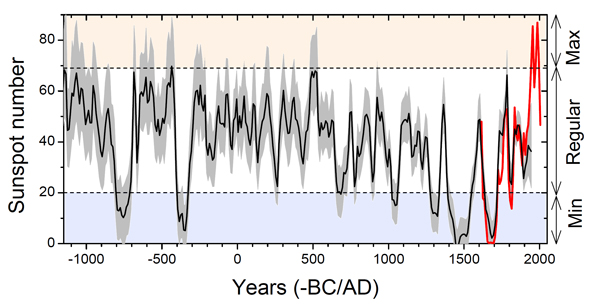
Further statistical analysis of their reconstruction revealed the Sun operates in three distinct modes of activity – (1) a regular mode that “corresponds to moderate activity that varies in a relatively narrow band between sunspot numbers 20 and 67,” (2) a Grand minimum mode of reduced solar activity that “cannot be explained by random fluctuations of the regular mode” and which “is confirmed at a high confidence level,” and (3), a possible Grand maximum mode, but they say that “the low statistic does not allow us to firmly conclude on this, yet.”
What it means
Usoskin et al. (2014) write their results “provide important constraints for both dynamo models of Sun-like stars and investigations of possible solar influence on Earth’s climate.” They also illustrate the importance of improving the quality of such reconstructions, in light of the fact that previous reconstructions of this nature “did not reveal any clear signature of distinct modes” in solar activity.
Unfortunately, it was beyond the scope of this paper to address the potential impact of solar activity on climate. Yet the reconstruction leaves a very big question unanswered — What effect did the Grand maximum of solar activity that occurred between 1950 and 2009 have on Earth’s climate? As a “unique” and “rare” event in terms of both magnitude and duration, one would think a lot more time and effort would be spent by the IPCC and others in answering that question. Instead, IPCC scientists have conducted relatively few studies of the Sun’s influence on modern warming, assuming that the temperature influence of this rare and unique Grand maximum of solar activity, which has occurred only once in the past 3,000 years, is far inferior to the radiative power provided by the rising CO2 concentration of the Earth’s atmosphere.
Reference
Usoskin, I.G., Hulot, G., Gallet, Y., Roth, R., Licht, A., Joos, F., Kovaltsov, G.A., Thebault, E. and Khokhlov, A. 2014. Evidence for distinct modes of solar activity. Astronomy and Astrophysics 562: L10, doi: 10.1051/0004-6361/201423391.
Abstract
Aims. The Sun shows strong variability in its magnetic activity, from Grand minima to Grand maxima, but the nature of the variability is not fully understood, mostly because of the insufficient length of the directly observed solar activity records and of uncertainties related to long-term reconstructions. Here we present a new adjustment-free reconstruction of solar activity over three millennia and study its different modes.
Methods. We present a new adjustment-free, physical reconstruction of solar activity over the past three millennia, using the latest verified carbon cycle, 14C production, and archeomagnetic field models. This great improvement allowed us to study different modes of solar activity at an unprecedented level of details.
Results. The distribution of solar activity is clearly bi-modal, implying the existence of distinct modes of activity. The main regular activity mode corresponds to moderate activity that varies in a relatively narrow band between sunspot numbers 20 and 67. The existence of a separate Grand minimum mode with reduced solar activity, which cannot be explained by random fluctuations of the regular mode, is confirmed at a high confidence level. The possible existence of a separate Grand maximum mode is also suggested, but the statistics is too low to reach a confident conclusion.
Conclusions. The Sun is shown to operate in distinct modes – a main general mode, a Grand minimum mode corresponding to an inactive Sun, and a possible Grand maximum mode corresponding to an unusually active Sun. These results provide important constraints for both dynamo models of Sun-like stars and investigations of possible solar influence on Earth’s climate.
Steven Mosher: I think I am justified in accepting his work as the best. Could it be wrong? sure.
But as it stands its the best work on the problem I have seen.
I agree, and that was a good post.
After reading his comments, criticisms of his comments, links by Leif Svalgaard and his critics and supporters, I think he is the best informed and most reliable of the commenters on this topic.
vukcevic says:
August 7, 2014 at 3:34 pm
There is a problem in trying to ascertain solar activity from the geomagnetic signal.
Since we can extract solar activity with success, there is no such problem. And external variations cannot penetrate to the core anyway.
rgbatduke says:
August 7, 2014 at 4:24 pm
I would suggest softening it to the more reasonable:
If our climate depends on solar activity [be it TSI, magnetic field, UV, cosmic rays, what-have-you] in a linear response model with no other dynamical influences with longer (or just different) timescales, then our climate the last 30-40 years would be very similar to that a century before [even allowing lags of several solar cycles], and it is not.
People who claim solar influences rarely [if ever] make that qualification [with any precision] when they present correlations so I’ll go with them to the extent that such correlations simply cannot be made as we lack both the data and the theory for making them. A conclusion must be that no correlation presented so far is evidence for any causal connection.
rgbatduke: “Personally, I think we could do much better if we really used the fluctuation-dissipation theorem to analyze the data.”
Oh, man, yet another buzzword (or buzzphrase, if there be such a thing) about whose relevance to the task we’re left to speculate:-)
Seriously, I appreciate references to techniques with which not all of us are familiar; it’s always nice to learn something new. But maybe you could give us non-scientists a little more of a hint about how what Wikipedia says about it might be applied in this context?
Matthew R Marler says:
August 7, 2014 at 4:48 pm
“Compare the low OSF during the Maunder LIA versus the late 20th Century.”
and it is not at all a given that OSF was all that low during the Maunder Minimum: http://www.leif.org/research/Confronting-Models-with-Reconstructions-and-Data.ppt or a pdf-version with no movie http://www.leif.org/research/Confronting-Models-with-Reconstructions-and-Data.pdf
Leif Svalgaard says:
August 7, 2014 at 5:05 pm
rgbatduke says:
August 7, 2014 at 4:24 pm
The climate wouldn’t need to be identical to that of a century ago or 150 or 300 years ago, since climatic conditions existing for hundreds of years previously had been colder. However, you might expect to see similar rates of change from the initially lower temperatures and associated phenomena.
That is what indeed has been observed. The early 18th century warming up from the depths of the LIA was warmer and more sustained than during the late 20th century. Similarly, the warming spells in the mid-19th and early 20th centuries. Don’t know how well these temperature rises correspond to solar cycles as now reconstructed, but I hope you see my point.
It appears to me that an important, if not the most important, parameter in climate change on at least a lot of time scales is tropical insolation, which is a function not only of changes in TSI and solar magnetism, but in terrestrial and other extraterrestrial modulators of solar irradiance (and spectral variance therein) and magnetism. The modulators which seem most important in glacial and interglacial transitions are the orbital and rotational mechanics in the Milankovitch Cycle. For millennial and centennial scale fluctuations, an important factor could be geomagnetism, as discussed recently in comments on this blog.
Here’s a recent paper on the geodynamo bearing on that suggestion, with climatic implications since a ~1350 year cycle coincides will with some observations, such as Bond Cycles:
http://www.lunduniversity.lu.se/o.o.i.s?id=12683&postid=2345020
Where would earth science be without its Nordic contingent? But also hard to beat the aptly named Ian Snowball.
sturgishooper says:
August 7, 2014 at 5:35 pm
Here’s a recent paper on the geodynamo bearing on that suggestion, with climatic implications since a ~1350 year cycle coincides will with some observations, such as Bond Cycles
There is no evidence of the geodynamo having any influence on climate. The Bond cycles may have a quite natural explanation http://www.leif.org/EOS/palo20005-D-O-Explanation.pdf
Leif Svalgaard says:
August 7, 2014 at 5:49 pm
There are correlations between the position of the north magnetic and geomagnetic poles, and both Northern Hemisphere and global temperatures, some say strong, others not statistically significant. Usual disclaimer about correlation and causation.
The ice shelf mechanism suggestion has been around for quite a while and probably actually happens during glacial phases. This sort of amplification is just one reason why D/O Cycles are much more pronounced than Bond Cycles, which nevertheless are globally detectable in the Holocene and previous interglacials. In both glacial and interglacial cycles, the same part of the world may be critical, the North Atlantic.
The fluctuation-dissipation theorem basically says that a non-equilibrium/open system responds in the same way to a (small) applied force as it does to a spontaneous fluctuation. In context, it means that when the Earth, as an open climate system with an irregular but reasonably predictable external driver (the sun, plus a smattering of energy from e.g. tides and geothermal sources) experiences a “sudden” fluctuation in its forcing, we should be able to learn a lot about the internal dynamics of its energy dissipation mechanisms — minimally the most important timescales of dissipation, quite probably a lot more about the actual mechanisms. This works both ways — observing the relaxation mechanisms and timescales of spontaneous fluctuations in e.g. temperature, humidity, etc. can provide information on how the system should respond to related variations in forcing.
That’s why I was asking about some of what Lief had slides on and the connections between the phenomena, when I couldn’t see the mechanisms in questions from what was there. One of the slides, for example, displays a very regular pattern of variations around a mean value of the magnetic field — except when a solar event occurs, when the fluctuation gets bigger. I didn’t know if the fluctuation itself was a solar thing or how the larger fluctuation was coupled back to solar behavior, so I asked basically if the mechanism was known via fluctuation-dissipation from looking at the regular fluctuations and hence available to infer the associated behavior of the Sun in the larger bumps. I should probably have been clearer, sorry.
rgb
rgbatduke says:
August 7, 2014 at 7:07 pm
One of the slides, for example, displays a very regular pattern of variations around a mean value of the magnetic field — except when a solar event occurs, when the fluctuation gets bigger. I didn’t know if the fluctuation itself was a solar thing or how the larger fluctuation was coupled back to solar behavior
The answer is that the two fluctuations have very different causes, the regular one is due to rotation of the Earth into sunlight [which contains the UV giving rise to the electric currents causing the variation]. The larger, irregular ones are due to plasma blobs from the sun hitting the Earth’s magnetic field. Two utterly different beasts having nothing to due with ‘fluctuation-dissipation’. Nature is often much more ‘innovative’ than our feeble attempts of pigeon-holing effects into tidy classes under the pretext that we understand what is going on. [it took us a hundred years to figure this out]
Who the hell uses BC/AD in a scientific paper?
@Juice – Anyone older than 40.
rgb at duke, I found this for the fluctuation-dissipation theorem at wikipedia. It explicitly refers to a slight purturbaation from equilibriium, not a relevant concept for a non-equilibrium system like the Earth. Do you have more information.
Matthew R Marler says:
August 7, 2014 at 8:59 pm
rgb at duke, I found this for the fluctuation-dissipation theorem at wikipedia. It explicitly refers to a slight perturbation from equilibrium
And not applicable to the solar phenomena I discussed in my talk. These are directly driven, like hammer blows.
Leif
Do you believe the Maunder Minimum was just like any solar minima of 20th century? Cassini, Picard et al didn’t know how to count sunspots? Or lowest sunspot count ever had no effect on solar magnetic field and TSI?
“McCracken (2007) proposes that the concept of floors in B may indeed be valid, but notes that since 1428 there must have been at least 4 upward steps in such a floor to reach present day values, the floor value for 1428-1528 being less than a tenth of today’s value.”
You don’t believe this too?
Dr. Strangelove says:
August 7, 2014 at 11:16 pm
>i>Do you believe the Maunder Minimum was just like any solar minima of 20th century? Cassini, Picard et al didn’t know how to count sunspots? Or lowest sunspot count ever had no effect on solar magnetic field and TSI?
The solar magnetic field and TSI were more or less as today. The puzzle is why the magnetic field did not assemble into sunspots: http://www.leif.org/research/SSN/Svalgaard12.pdf
http://www.leif.org/research/Confronting-Models-with-Reconstructions-and-Data.pdf
“McCracken (2007) proposes that the concept of floors in B may indeed be valid, but notes that since 1428 there must have been at least 4 upward steps in such a floor to reach present day values, the floor value for 1428-1528 being less than a tenth of today’s value.”
Not even McCracken believes that today. http://www.leif.org/research/Svalgaard_ISSI_Proposal_Base.pdf
You don’t believe this too?
Why do you believe this? McCracken doesn’t anymore.
The paper does not cite McCraken agreeing with you. It seems to be still an open question. In Figure 2, McCraken (2007) put minimum B at 1 nT while you put it at 6 nT. Between curve fitting of proxy data and eyewitness accounts of astronomers, I trust the latter more. (Remember von Neumann and the elephant)
“The Maunder Minimum was not a serious deficit of magnetic flux, but a lessening of the efficiency of the process that compacts magnetic fields into visible spots. This may now be happening again soon. If so, there is new solar physics to be learned”
To quote Carl Sagan, “extraordinary claims require extraordinary evidence.”
rgbatduke: “That’s why I was asking about some of what Lief had slides on and the connections between the phenomena”
Thanks for connecting that up.
Dr. Strangelove says:
August 8, 2014 at 12:32 am
The paper does not cite McCraken agreeing with you.
…………
Anyone who doesn’t agree with Dr.S and co is a crank.
Dr. McCracken has gone ‘crackers’ and for the good measure joined cyclomaniacs:
Evidence for Planetary Forcing of the Cosmic Ray Intensity and Solar Activity Throughout the Past 9400 Years K.G. McCracken et al
http://link.springer.com/article/10.1007%2Fs11207-014-0510-1#page-2
And that’s why I asked, to learn precisely things like this (which were not clear, of course, from the slides themselves:-).
But I agree totally and absolutely with this:
I think that we (scientists in general) are still figuring this out in far too many cases. It’s partly because of our educational process, that starts by focussing on linearizable causes if only because they can be understood by rules. It leaves one with the implicit belief that we can always find rules. But in chaotic nonlinear multivariate systems of high dimensionality (like nature) even if basic physics is nice and linear, “more is different” as my friend Richard Palmer used to say, and complex systems have different rules if they have “rules” at all.
rgb
Leif Svalgaard says:
17) This means that the decrease of solar activity from the 1870s to the 1910s is very much similar to the decrease from 1980 to now. In particular, TSI now is very likely the same as it was 100 years ago.
1980 ?
http://www.solen.info/solar/images/comparison_similar_cycles.png
http://www.solen.info/solar/images/comparison_recent_cycles.png
http://solarscience.msfc.nasa.gov/images/Zurich_Color_Small.jpg
Dr. Strangelove says:
August 8, 2014 at 12:32 am
The paper does not cite McCraken agreeing with you. It seems to be still an open question. In Figure 2, McCraken (2007) put minimum B at 1 nT while you put it at 6 nT. Between curve fitting of proxy data and eyewitness accounts of astronomers, I trust the latter more. (Remember von Neumann and the elephant)
The whole issue is an active research area and things change rapidly. In McCracken 2007 most of the decrease in B [about 2 nT] takes place in modern times [~1950]. McCracken’s latest [preliminary] assessment is that that decrease did not happen. You can see the latest here: http://www.leif.org/research/HMF-B-since-1815.png
The pink curve labeled ’10Be Ice Cores’ is his latest values, while the purple dashed curve shows his 2007 values that he does not believe anymore. The blue curve is my [and Lockwood’s – as we agree on this] assessment from the geomagnetic record. BTW, my minimum is not 6 nT, but 4 nT.
To quote Carl Sagan, “extraordinary claims require extraordinary evidence.”
To my mind, the extraordinary claim is that the solar magnetic field during the Maunder Minimum almost vanished…There is some evidence that it didn’t, e.g. http://www.leif.org/EOS/Eddy/2007SP_prairie.pdf
“The historical eclipse observations described here seem to require the presence of even the bright network structures, and thus of substantial solar photospheric magnetism during at least the last decade of the Maunder Minimum.”
More of the same and solar is not any where near my criteria for cooling effect, although overall solar activity has been quite low post 2005 despite this recent maximum of solar cycle 24 which is now in the process of ending. Once it ends solar conditions should approach my criteria over a long duration of time which should start global temperatures on the decline.
What has taken place in year 2005 is a complete change from active to inactive solar activity.
This change in my opinion will be more then enough to have another climatic impact just as is the case when one reviews historical climatic data.
My challenge remains- Which is to show me the data which shows a prolonged solar minimum period being associated with a rising temperature trend or a prolonged maximum solar period being associated with a falling temperature trend.
I find no such data and the same result is going to happen as this decade proceeds.
Already solar activity is falling off and we are no where near the bottom of the solar cycle 24-solar cycle 25 minimum.
I think the data (especially post 2005/prior to 2005 ) supports the view that the sun can be quite variable and this variability can happen over a short period of time as is the case in the first decade of this current century.
Expect climate implications if this prolonged solar minimum keeps advancing going forward.
The problem with so many postings is there is a lack of understanding of noise in the climate system, thresholds in the climate system ,lag times in the climate system and that the climate system is non linear and never in the same state.
Therefore my point (which I have made many time previously) is DO NOT EXPECT an x change in the climate from given x changes in items that control the climate. This I have preached but with little fanfare.
Why- look read below.
The initial state of the global climate.
a. how close or far away is the global climate to glacial conditions if in inter- glacial, or how close is the earth to inter- glacial conditions if in a glacial condition.
b. climate was closer to the threshold level between glacial and inter- glacial 20,000 -10,000 years ago. This is why the climate was more unstable then. Example solar variability and all items would be able to pull the climate EASIER from one regime to another when the state of the climate was closer to the inter glacial/glacial dividing line, or threshold.
The upshot being GIVEN solar variability IS NOT going to have the same given climatic impact.
Solar variability and the associated primary and secondary effects. Lag times, degree of magnitude change and duration of those changes must be taken into account.
Upshot being a given grand solar minimum period is not always going to have the same climatic impact.
This is why solar/climate correlations are hard to come by UNLESS the state of solar activity goes from a very active state to a very prolonged quiet state which is what has happened during year 2005.
So the nonsense that post Dalton no definitive solar /climate correlations exist just supports my notions of what I just expressed.
Meanwhile, a quiet sun is correlated with a stronger more meridional jet stream pattern which should cause a greater persistence in Wx. patterns which I think is evident post 2005 for the most part.
This is what those who deny a solar /climate connection fail to understand. They do not know how the climate system of the earth responds to stimuli.
http://www.met.reading.ac.uk/~vy902033/Papers_PDFs/2014%20Lockwood%20and%20Owens,%20ApJL%202041-8205_781_1_L7.pdf
I along with countless others subscribe to this point of view.
Another great source for good solar information/climate connections is the recent climate summit that took place in Las Vegas during July of this year.
Salvatore Del Prete says:
August 8, 2014 at 7:57 am
http://www.met.reading.ac.uk/~vy902033/Papers_PDFs/2014%20Lockwood%20and%20Owens,%20ApJL%202041-8205_781_1_L7.pdf
I along with countless others subscribe to this point of view.
Unfortunately, that view is not quite correct
http://www.leif.org/research/Confronting-Models-with-Reconstructions-and-Data.pdf
but who cares about that when looking for confirmation of a belief subscribed to.
As they say to each his own. Many like myself subscribe to that point of view. Some don’t .
Neither side is going to convince the other.