 El Niño has not yet shortened the Great Pause
By Christopher Monckton of Brenchley
Remarkably, the El Niño warming of this year has not yet shortened the Great Pause, which, like last month, stands at 17 years 10 months with no global warming at all.
Taking the least-squares linear-regression trend on Remote Sensing Systems’ satellite-based monthly global mean lower-troposphere temperature dataset, there has been no global warming – none at all – for 214 months. This is the longest continuous period without any warming in the global instrumental temperature record since the satellites first watched in 1979. It has endured for about half the satellite temperature record. Yet the Great Pause coincides with a continuing, rapid increase in atmospheric CO2 concentration.

Figure 1. RSS monthly global mean lower-troposphere temperature anomalies (dark blue) and trend (thick bright blue line), October 1996 to July 2014, showing no trend for 17 years 10 months.
The hiatus period of 17 years 10 months, or 214 months, is the farthest back one can go in the RSS satellite temperature record and still show a zero trend.
Yet the length of the Great Pause in global warming, significant though it now is, is of less importance than the ever-growing discrepancy between the temperature trends predicted by models and the far less exciting real-world temperature change that has been observed.
The First Assessment Report predicted that global temperature would rise by 1.0 [0.7, 1.5] Cº to 2025, equivalent to 2.8 [1.9, 4.2] Cº per century. The executive summary asked, “How much confidence do we have in our predictions?” IPCC pointed out some uncertainties (clouds, oceans, etc.), but concluded:
“Nevertheless, … we have substantial confidence that models can predict at least the broad-scale features of climate change. … There are similarities between results from the coupled models using simple representations of the ocean and those using more sophisticated descriptions, and our understanding of such differences as do occur gives us some confidence in the results.”
That “substantial confidence” was substantial over-confidence. A quarter-century after 1990, the outturn to date – expressed as the least-squares linear-regression trend on the mean of the RSS and UAH monthly global mean surface temperature anomalies – is 0.34 Cº, equivalent to just 1.4 Cº/century, or exactly half of the central estimate in IPCC (1990) and well below even the least estimate (Fig. 2).

Figure 2. Near-term projections of warming at a rate equivalent to 2.8 [1.9, 4.2] K/century , made with “substantial confidence” in IPCC (1990), January 1990 to June 2014 (orange region and red trend line), vs. observed anomalies (dark blue) and trend (bright blue) at 1.4 K/century equivalent. Mean of the three terrestrial surface-temperature anomalies (GISS, HadCRUT4, and NCDC).
The Great Pause is a growing embarrassment to those who had told us with “substantial confidence” that the science was settled and the debate over. Nature had other ideas. Though more than two dozen more or less implausible excuses for the Pause are appearing in nervous reviewed journals, the possibility that the Pause is occurring because the computer models are simply wrong about the sensitivity of temperature to manmade greenhouse gases can no longer be dismissed.
Remarkably, even the IPCC’s latest and much reduced near-term global-warming projections are also excessive (Fig. 3).

Figure 3. Predicted temperature change, January 2005 to June 2014, at a rate equivalent to 1.7 [1.0, 2.3] Cº/century (orange zone with thick red best-estimate trend line), compared with the observed anomalies (dark blue) and –0.1 Cº/century real-world trend (bright blue), taken as the average of the three terrestrial surface temperature anomaly datasets (GISS, HadCRUT4, and NCDC) and the two satellite lower-troposphere temperature anomaly datasets (RSS and UAH).
In 1990, the IPCC’s central estimate of near-term warming was higher by two-thirds than it is today. Then it was 2.8 C/century equivalent. Now it is just 1.7 Cº equivalent – and, as Fig. 3 shows, even that is proving to be a substantial exaggeration.
On the RSS satellite data, there has been no global warming statistically distinguishable from zero for more than 26 years. None of the models predicted that, in effect, there would be no global warming for a quarter of a century.
The Great Pause may well come to an end by this winter. An el Niño event is underway and would normally peak during the northern-hemisphere winter. There is too little information to say how much temporary warming it will cause, but a new wave of warm water has emerged in recent days, so one should not yet write off this el Niño as a non-event. The temperature spikes caused by the el Niños of 1998, 2007, and 2010 are clearly visible in Figs. 1-3.
Why RSS? Well, it’s the first of the five datasets to report each month, so it’s topical. Also, it correctly shows how much bigger the el Niño of 1998 was than any of its successors. It was the only event of its kind in 150 years that caused widespread coral bleaching. Other temperature records do not distinguish so clearly between the 1998 el Niño and the rest. It is carefully calibrated to correct for orbital degradation in the old NOAA satellite on which it relies. The other satellite record, UAH, which has been running rather hotter than the rest, is about to be revised in the direction of showing less warming. As for the terrestrial records, read the Climategate emails and weep.
Updated key facts about global temperature
Ø The RSS satellite dataset shows no global warming at all for 214 months from October 1996 to July 2014. That is more than half the 427-month satellite record.
Ø The fastest measured centennial warming rate was in Central England from 1663-1762, at 0.9 Cº/century – before the industrial revolution. It was not our fault.
Ø The global warming trend since 1900 is equivalent to 0.8 Cº per century. This is well within natural variability and may not have much to do with us.
Ø The fastest warming trend lasting ten years or more occurred over the 40 years from 1694-1733 in Central England. It was equivalent to 4.3 Cº per century.
Ø Since 1950, when a human influence on global temperature first became theoretically possible, the global warming trend has been equivalent to below 1.2 Cº per century.
Ø The fastest warming rate lasting ten years or more since 1950 occurred over the 33 years from 1974 to 2006. It was equivalent to 2.0 Cº per century.
Ø In 1990, the IPCC’s mid-range prediction of near-term warming was equivalent to 2.8 Cº per century, higher by two-thirds than its current prediction of 1.7 Cº/century.
Ø The global warming trend since 1990, when the IPCC wrote its first report, is equivalent to 1.4 Cº per century – half of what the IPCC had then predicted.
Ø Though the IPCC has cut its near-term warming prediction, it has not cut its high-end business as usual centennial warming prediction of 4.8 Cº warming to 2100.
Ø The IPCC’s predicted 4.8 Cº warming by 2100 is well over twice the greatest rate of warming lasting more than ten years that has been measured since 1950.
Ø The IPCC’s 4.8 Cº-by-2100 prediction is almost four times the observed real-world warming trend since we might in theory have begun influencing it in 1950.
Ø Since 1 March 2001, the warming trend on the mean of the 5 global-temperature datasets is nil. No warming for 13 years 4 months.
Ø Recent extreme weather cannot be blamed on global warming, because there has not been any global warming. It is as simple as that.
Technical note
Our latest topical graph shows the RSS dataset for the 214 months October 1996 to July 2014 – more than half the 427-month satellite record.
Terrestrial temperatures are measured by thermometers. Thermometers correctly sited in rural areas away from manmade heat sources show warming rates appreciably below those that are published. The satellite datasets are based on measurements made by the most accurate thermometers available – platinum resistance thermometers, which not only measure temperature at various altitudes above the Earth’s surface via microwave sounding units but also constantly calibrate themselves by measuring via spaceward mirrors the known temperature of the cosmic background radiation, which is 1% of the freezing point of water, or just 2.73 degrees above absolute zero. It was by measuring minuscule variations in the cosmic background radiation that the NASA anisotropy probe determined the age of the Universe: 13.82 billion years.
The graph is accurate. The data are lifted monthly straight from the RSS website. A computer algorithm reads them down from the text file, takes their mean and plots them automatically using an advanced routine that automatically adjusts the aspect ratio of the data window at both axes so as to show the data at maximum scale, for clarity.
The latest monthly data point is visually inspected to ensure that it has been correctly positioned. The light blue trend line plotted across the dark blue spline-curve that shows the actual data is determined by the method of least-squares linear regression, which calculates the y-intercept and slope of the line via two well-established and functionally identical equations that are compared with one another to ensure no discrepancy between them. The IPCC and most other agencies use linear regression to determine global temperature trends. Professor Phil Jones of the University of East Anglia recommends it in one of the Climategate emails. The method is appropriate because global temperature records exhibit little auto-regression.
Dr Stephen Farish, Professor of Epidemiological Statistics at the University of Melbourne, kindly verified the reliability of the algorithm that determines the trend on the graph and the correlation coefficient, which is very low because, though the data are highly variable, the trend is flat.
You’re still waffling. Here’s graph of CET from 1772
http://www.metoffice.gov.uk/hadobs/hadcet/
There’s a dip in ~1780 another one in ~1820 another one in ~1840 and one in ~1890. None of these dips is significantly different to the other. All the peaks reach a virtually identical point (i.e. roughly the 1961-90 average)
I see no turning point in the 19th century. Show me the point on the graph where the LIA ends?
sturgishooper says:
August 5, 2014 at 4:24 pm
Re middle of 1800s LIA end, please read the abstract from the above-cited 2012 paper
Please read the previous 300 odd comments so you understand what this discussion is about. I’ll give you a clue it specifically relates to the CET and the end of the LIA.
I’m assuming you can’t find the end of the LIA in the CET record either – at least not one that occurs in ~1850.
John Finn says:
Show me the point on the graph where the LIA ends?
On a graph made from a single thermometer, in a single region of one smallish country? You extrapolate the entire planet from one site, and draw your wide-ranging conclusions?
What if skeptics cherry picked like that? Would that be A-OK with you?
John Finn says:
August 5, 2014 at 4:30 pm
What you lie as “waffling” I call telling the same thing over & over with no result in your brain. That means I’m nuts to keep trying.
But one more time. Look at this graph from the first IPCC review in this link:
http://climateaudit.org/2008/05/09/where-did-ipcc-1990-figure-7c-come-from-httpwwwclimateauditorgp3072previewtrue/
Do you see where the line turns up in the mid-19th century, to regain fairly rapidly (by 1900) the long term (multi-century) average? That’s when Lamb identified the end of the LIA. I’m not going to teach you any more, since you refuse to learn. Do your homework & read the solid climate classics, studying hard.
John Finn says:
August 5, 2014 at 4:36 pm
I’ve read enough of your drivel to know what’s going on.
Yes, I can see the end of the Little Ice Age in the 1800s. Why can’t you?
John Finn,
You’re beginning to sound as whacked-out as ‘H Grouse’. Not quite as much. But getting closer…
Why? Because you argue with everything. A sure sign of a closed mind.
John Finn says:
August 5, 2014 at 4:30 pm
In the “adjusted” Hadley CET “data” set you posted, why can’t you see the end of the LIA at either c. 1840, 1880 or in between? Those were the last lows of the LIA or last of it and first of the current Warm Period, since which time no new low has been made. I can see putting the mild gain in between those two lows either as the last of the MWP or first of the Modern Warm Period.
dbstealey says:
August 5, 2014 at 4:37 pm
John Finn says:
“Show me the point on the graph where the LIA ends?”
On a graph made from a single thermometer, in a single region of one smallish country? You extrapolate the entire planet from one site, and draw your wide-ranging conclusions?
What if skeptics cherry picked like that? Would that be A-OK with you?
That’s exactly what they do, in the head post here Monckton says:
Updated key facts about global temperature
Ø The fastest measured centennial warming rate was in Central England from 1663-1762, at 0.9 Cº/century – before the industrial revolution. It was not our fault.
Ø The fastest warming trend lasting ten years or more occurred over the 40 years from 1694-1733 in Central England. It was equivalent to 4.3 Cº per century.
Mason I. Bilderberg (MIB) says:
August 5, 2014 at 1:01 pm
Made a funny graphic
_______________________
Credit where credit is due.
That image is a Gary Larson original,
to which you have photoshopped in a
different chart in the background, and
slightly changed the words around.
It’s not really something that you made.
At least you might have stated that it
was “after Gary Larson (The Far Side)”,
or apologies to Gary Larson & etc.
This is the original “postcard”
http://moblog.net/view/897525/another-far-side-card
Still we appreciate the effort, but copyright may be
an issue. The Far Side is actually quite an internet
sensation, and I recognised Gary Larson signature
scrawl straight away, though it can’t easily be read
in the picture you showed at your link.
Gary Larson is still alive, at the time of writing this
comment, and ” The Far Side” cartoon series ran
from January 1, 1980 until January 1, 1995, when
Larson retired. He has published numerous books.
see mostly originals with a few retouched examples
https://www.google.com/search?q=gary+larson+far+side&tbm=isch
My acknowledgement to Gary Larson.
You made me laugh when depressed,
and brightened many a cloudy day
😀
Phil. says:
August 5, 2014 at 5:34 pm
Monckton uses satellite data for the whole planet, not the CET.
CET has been shown a good proxy, with high correlation to planetary reconstructions and actual observations, however rigged by the US and UK regimes, in particular for the Northern Hemisphere. Moreover, it’s not from a single thermometer, but from many over centuries.
If you imagine that you can show the MWP and LIA not to have existed and the “pause” to be false, please by all means let’s see your demonstration.
No Global Warming for 17 years and 10 months ……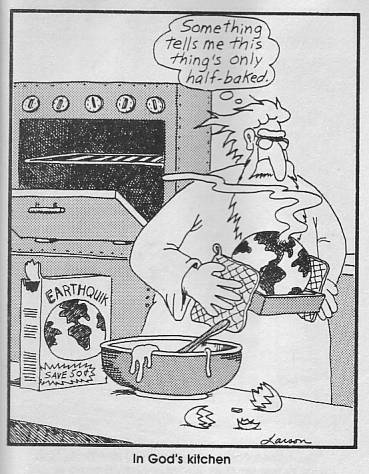
The real Reason ?
This is quite apropos
A Gary Larson Original (unchanged)
😉
Phil. misses the point again:
Ø The fastest measured centennial warming rate…
Ø The fastest warming trend…
Acknowledging records is not cherry picking.
dbstealey says:
August 5, 2014 at 7:47 pm
Phil. misses the point again:
Ø The fastest measured centennial warming rate…
Ø The fastest warming trend…
Acknowledging records is not cherry picking.
As usual stealy when caught out in a mistake you squirm and try to change the subject.
What you said was: “On a graph made from a single thermometer, in a single region of one smallish country? You extrapolate the entire planet from one site, and draw your wide-ranging conclusions?
What if skeptics cherry picked like that? Would that be A-OK with you?”, which of course is exactly what Monckton does in the head post
Kristian says:
Yes I think this is a communication problem. “Determination” is a fact-finding exercise. Just as a detective can determine, from the bullet holes in a wall, where the gun was fired from, so we can determine, by looking at the radiation escaping to space, what the temperature must be to cause that radiation. then we can determine within limits, the temperature at the surface, just as the detective then determines the height of the person firing the gun etc. But the detective never mistakes his “working backwards” from the bullet hole as somehow causing the shooter to have grown up to be a certain height. The shooter’s height caused the gun position, firing it caused the bullet hole. But we determine all that working in the reverse direction. Likewise here, the causation is from the surface upwards, but our observed data is at the end, so we work backwards.
sturgishooper challenges Phil.:
If you imagine that you can show the MWP and LIA not to have existed and the “pause” to be false, please by all means let’s see your demonstration.
Phil. can’t demonstrate anything. He can’t tell the difference between reporting on a record and cherry picking.
No wonder he’s wrong about the ‘carbon’ scare. Phil. has never yet been on the right side of the debate. The MWP and the LIA are historical facts. And global warming stopped a long time ago.
Where is it?
From Lamb’s own figures
1800-1850 mean temps 9.12 degrees
1850-1900 mean temps 9.12 degrees
!800-1900 trend is 0,003 degrees per decade (total warming 0.03 degrees per century)
Other “interesting” bits
1801-1810 mean temps 9.11 degrees
1910-1910 mean temps 9.07 degrees
So the second decade of the Dalton Minimium (1790-1820) was slightly warmer than the first decade of the 20th century. In fact, the decade immediately preceding the Dalton Minimum (i.e. 1781-90) with a mean temperature of 8.9 degrees was colder than most of the Dalton Minimum.
What exactly is this graph? Is it a cartoon drawing or what? What smoothing is used?
If it is a genuine graph then I suspect the smoothing is such that the point in the late 19th century where temperatures show a rise is because that it is the midpoint of a moving average which includes readings from the 20th century.
Tell you what, if i get a bit of time, I’ll take a look at it, and see if I can reproduce the graph.
UPDATE No need Steve Mc has already done it – and I’m right. The upturn is an artefact of the 50 year smoothing. What you are seeing is an increase temperatures from about 1875 to 1925.,i.e. the increase in mean temps from 1850-1900 to 1900-1950.
Further to my previous post
I’ve produced a graph of ALL data points between 1825 and 1950 as per the Lamb ‘graph’ and, as I suspected, the Lamb graph is a bit misleading (not deliberate). Because he appears to only use a few points (see CA link) to produce his drawing the upturn is seen from 1875. If all points are used the upturn doesn’t take place until about 1904.
Ron House says, August 6, 2014 at 12:02 am:
“Yes I think this is a communication problem. “Determination” is a fact-finding exercise. Just as a detective can determine, from the bullet holes in a wall, where the gun was fired from, so we can determine, by looking at the radiation escaping to space, what the temperature must be to cause that radiation. then we can determine within limits, the temperature at the surface, just as the detective then determines the height of the person firing the gun etc. But the detective never mistakes his “working backwards” from the bullet hole as somehow causing the shooter to have grown up to be a certain height. The shooter’s height caused the gun position, firing it caused the bullet hole. But we determine all that working in the reverse direction. Likewise here, the causation is from the surface upwards, but our observed data is at the end, so we work backwards.”
OK. Good.
But then I will have to ask you: What caused (yes, “caused”), in your mind, the surface to end up at 288K in the first place, making it able to, via the lapse rate, surface solar heating and the convective response, to establish that atmospheric layer midway up in the troposphere cool enough (255K) to give off Earth’s balanced radiation flux to space (239 W/m^2)? (Yes, there isn’t ONE such layer, we’ve clarified that; it’s an average.)
In other words: Is it the fact that the atmosphere possesses a certain opacity to outgoing IR (because of the so-called ‘GHGs’) and that the IR will therefore have to be radiated away to space from somewhere up the atmosphere rather than from the surface? (The ‘elevated effective emission height’ explanation of the rGHE.)
Or is there some other reason?
You have got it wrong (what’s new). See this post by Monckton
CM doesn’t say he is just reporting trends. He states that CET is “a reasonable indication of global trends” . He is clearly tying to make a direct comparison between CET and global trends. Your earlier point, therefore, about the “single location” contradicts the Monckton position.
I expressed no opinion on the use of CET as a proxy for global temperatures but did suggest that a 19th century recovery from a LIA was not readily evident in the CET record. I also questioned the relative cooling in the Dalton Minimum based on the CET data.
You should, perhaps, be aware that the well known ‘graph’ depicting both the MWP and LIA was almost entirely based (directly and indirectly) on the CET record.
John Finn (August 6, 2014 at 3:20 am) “I’ve produced a graph of ALL data points between 1825 and 1950 as per the Lamb ‘graph’ and, as I suspected, the Lamb graph is a bit misleading (not deliberate). Because he appears to only use a few points (see CA link) to produce his drawing the upturn is seen from 1875. If all points are used the upturn doesn’t take place until about 1904.”
I realize you are a troll, but I would like to thank you for pointing out that the Little Ice Age ended, according to CET, around 1904. I would argue 1890 given the graph you posted earlier: http://www.metoffice.gov.uk/hadobs/hadcet/ Some commenters may say I am wrong and it really ended in 1850. They may be crypto-trolls, or I may be a crypto-troll. My definition of a troll in this context is commenter simply attempting to stoke discord and cause arguments over complete trivialities. On my part I promise not to argue about the date the LIA ended any further except for the following point which will hopefully put some of the (false) controversy to rest.
The CET may or may not be a suitable proxy for global temperature. But over the course of many decades and especially centuries, ANY local temperature record is a suitable proxy for global temperature. The reason is quite simple: there are no local effects that last for more than a few decades. I realize there are arguments to the contrary, the SkepSci people will tell you that the Atlantic currents changed for centuries at a time, cooling off Europe, blah blah blah. But they are wrong. Currents do not change for centuries at a time because there is no physical mechanism for them to do so.
So this: http://wattsupwiththat.files.wordpress.com/2010/12/easterbrook_fig5.png is as good a worldwide proxy for temperature as the CET chart you posted. But we must also realize there can be local effects that last for a few decades. I appears that the LIA ended in 1900 plus or minus a few decades.
To set this discussion in context here are some quotes from the latest post at
http://climatesense-norpag.blogspot.com
“2. The Past is the Key to the Present and Future . Finding then Forecasting the Natural Quasi-Periodicities Governing Earths Climate – the Geological Approach.
2.1 General Principles.
The core competency in the Geological Sciences is the ability to recognize and correlate the changing patterns of events in time and space. This requires a mindset and set of skills very different from the reductionist approach to nature, but one which is appropriate and necessary for investigating past climates and forecasting future climate trends. Scientists and modelers with backgrounds in physics and maths usually have little experience in correlating multiple, often fragmentary, data sets of multiple variables to build an understanding and narrative of general trends and patterns from the actual individual local and regional time series of particular variables. The value of the geologists’ approach to understanding the past is proven by the trillions of dollars spent by the oil companies to find and produce the millions of barrels of oil and billions of cubic feet of gas needed daily to fuel the world economy. It works!
“Earth’s climate is the result of resonances and beats between various quasi-cyclic processes of varying wavelengths combined with endogenous secular earth processes such as, for example, plate tectonics. It is not possible to forecast the future unless we have a good understanding of the relation of the climate of the present time to the current phases of these different interacting natural quasi-periodicities which fall into two main categories.
a) The orbital long wave Milankovitch eccentricity,obliquity and precessional cycles which are modulated by
b) Solar “activity” cycles with possibly multi-millennial, millennial, centennial and decadal time scales.
The convolution of the a and b drivers is mediated through the great oceanic current and atmospheric pressure systems to produce the earth’s climate and weather.
After establishing where we are relative to the long wave periodicities to help forecast decadal and annual changes, we can then look at where earth is in time relative to the periodicities of the PDO, AMO and NAO and ENSO indices and based on past patterns make reasonable forecasts for future decadal periods.
In addition to these quasi-periodic processes we must also be aware of endogenous earth changes in geomagnetic field strength, volcanic activity and at really long time scales the plate tectonic movements and disposition of the land………… .
The object of forecasting is to provide practical guidance for policy makers. The rate, amplitude and timing of climate change varies substantially from region to region so that, after accounting for the long term quasi-millennial periodicity, I suggest estimating the modulation of this trend by providing multi-decadal climate forecasts for specific regions. This would be accomplished with particular reference to the phase relationships of the major oceanic and atmospheric systems PDO AMO, NAO, ENSO etc, a la Aleo and Easterbrook linked to in section 2.4 above. The earth has been subdivided into tectonic plates. It would be useful to have, as a guide to adaptation to climate change, multi-decadal regional forecasts for the following suggested climate plates, which are in reality closely linked to global geography.
1 North America and Western Europe.
2 Russia
3 China
4 India and SE Asia
5 Australasia and Indonesia
6 South America
7 N Africa
8 Sub Saharan Africa
9 The Arctic
10 The Antarctic
11 The intra tropical Pacific Ocean. Detailed analysis of the energy exchanges and processes at the ocean /atmosphere interface in this area is especially vital because its energy budget provides the key to the earth’s thermostat.”
Now John Finn is defending “Phil.”?? heh
Let me ask John Finn a very pertinent question: John, do you still believe the predictions of runaway global warming and climate catastrophe? It certainly appears that you do. Why else would you argue incessantly with everyone?
Runaway global warming is bunkum. If you don’t see that, John, you should. The planet itself has falsified that nonsense. So, what are we left with?
We are left with minor nitpicks that would not affect humans or the biosphere one way or another. The rise in harmless, beneficial CO2 has been only from 0.03%, to 0.04% of the atmosphere over the past 150 years. So what? CO2 has been up to twenty times higher in the past, with no ill effects. The recent rise is minuscule by comparison. It is well within the parameters of natural variability, and there is no measurable, testable evidence showing that CO2 is the cause [it might be — or not. But skeptics would like more than an evidence-free conjecture].
So, why are you arguing incessantly, John? When skeptics are wrong, we acknowledge it and move on. But alarmists are different.
Alarmists like you and ‘Phil.’ never admit that exactly none of your wild-eyed global warming predictions have happened, from Polar bears disappearing, to accelerating sea level rise, to vanishing Arctic ice, to ocean “acidification”, to frogs going extinct, to irreversible coral bleaching, to runaway global warming itself. Every crazy alarmist prediction has failed. None of them have happened.
But you still argue incessantly. You move the goal posts, you engage in psychological projection, you falsely cry “Wolf!”, you promote alarmist blogs, and you never will admit you’ve been wrong about anything — when everyone here can see that you are routinely wrong.
So, why do you persist in flogging the dead runaway global warming horse? Why do you not admit that Planet Earth herself is falsifying your “carbon” scare. In short, what is wrong with you?
No I don’t. I think warming from CO2 will be modest but that doesn’t mean I support every argument made by “sceptics”.