 Guest essay by David Archibald
A couple of years ago the question was asked “When will it start cooling?” Of course solar denialists misconstrued this innocent enquiry. There is no doubt – we all know that lower solar irradiance will result in lower temperatures on this planet. It is a question of when. Solar activity is much lower than it was at a similar stage of the last solar cycle but Earthly temperatures have remained stubbornly flat. Nobody is happy with this situation. All 50 of the IPCC climate models have now been invalidated and my own model is looking iffy.
Friss-Christenson and Lassen theory, as per Solheim et al’s prediction, has the planet having a temperature decrease of 0.9°C on average over Solar Cycle 24 relative to Solar Cycle 23. The more years that pass without the temperature falling, the greater the fall required over the remaining years of the cycle for this prediction to be validated.
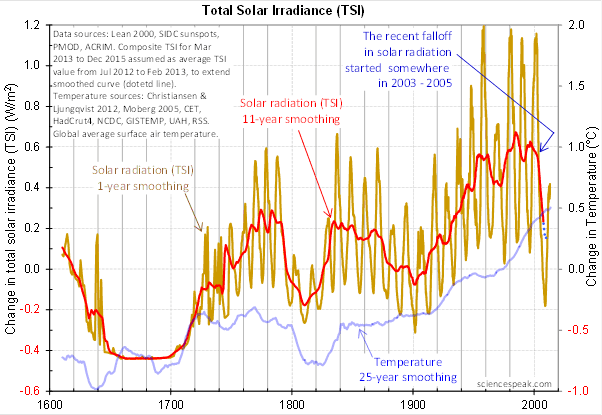
The question may very well have been answered. David Evans has developed a climate model based on a number of inputs including total solar irradiance (TSI), carbon dioxide, nuclear testing and other factors. His notch-filter model is optimised on an eleven year lag between Earthly temperature and climate. The hindcast match is as good as you could expect from a climate model given the vagaries of ENSO, lunar effects and the rest of it, which gives us a lot of confidence in what it is predicting. What it is predicting is that temperature should be falling from just about now given that TSI fell from 2003. From the latest of a series of posts on Jo Nova’s blog:

The model has temperature falling out of bed to about 2020 and then going sideways in response to the peak in Solar Cycle 24. What happens after that? David Evans will release his model of 20 megs in Excel in the near future. I have been using a beta version. The only forecast of Solar Cycle 25 activity is Livingstone and Penn’s estimate of a peak amplitude of seven in sunspot number. The last time that sort of activity level happened was in the Maunder Minimum. So if we plug in TSI levels from the Maunder Minimum, as per the Lean reconstuction, this is what we get:

This graph shows the CET record in blue with the hindcast of the notch-filter model using modern TSI data in red with a projection to 2040. The projected temperature decline of about 2.0°C is within the historic range of the CET record. Climate variability will see spikes up and down from that level. The spikes down will be killers. The biggest spike you see on that record, in 1740, killed 20% of the population of Ireland, 100 years before the more famous potato famine.
I consider that David Evans’ notch-filter model is a big advance in climate science. Validation is coming very soon. Then stock up on tinned lard with 9,020 calories per kg. A pallet load could be a life-saver.
David Archibald, a Visiting Fellow at the Institute of World Politics in Washington, D.C., is the author of Twilight of Abundance: Why Life in the 21st Century Will Be Nasty, Brutish, and Short (Regnery, 2014).
UPDATE:
For fairness and to promote a fuller understating, here are some replies from Joanne Nova
David Archibald asserts: “We are well into the 21st century and, as far as I know, there are only two models with predictive ability that are still in the game – mine and David Evans’”
Yet if you just turn down the water vapor positive feedback then the climate models should do fine. It’s not that they are falsified in spirit, only in overenthusiastic and alarming sensitivity. Their need to parametrize a bit doesn’t suddenly throw good light on mere wiggle matching models.
hmm –
http://solarscience.msfc.nasa.gov/images/bfly.gif
http://solarscience.msfc.nasa.gov/images/ssn_predict_l.gif
from mid 1997 to mid 2000 (3 year period) the ssn went from 10 to 170
from mid 2010 to mid 2013 the ssn went from 10 to 70 though there was a larger peak (about 100) later, but it is clear to see there has been a dramatic drop in the suns activity.
looks to me that the tsi follows the ssn pretty well-
http://spot.colorado.edu/~koppg/TSI/TSI.jpg
ultimately it does not matter that much because it seems we will be able to play with the model ourselves. congrats and thanks to evans and jo for taking the time to create the model. i am looking forward to playing with some of the variables and maybe plug in some other info as well.
the response from this series of posts from nova seems to be a bit out of proportion even before the series is over. whats the story? some toes being stood on or something? is this model going to cost us billions of dollars or something? who knows. but this last couple of months has had me revising the people i trust for an unbiased opinion, thats for sure.
RossP says:
June 28, 2014 at 9:18 pm
Certainly he can decide how to publish it. I’m saying that publishing it as he has done gives him a huge and unfair advantage over those with whom he’s spent seven posts discussing his theory. Christopher Monckton described his position accurately as being “sure in the knowledge that no one will be able to falsify what he refuses to make available.”
And that, my friend, is about as far from science as you can get. Sure, as you point out they can publish like that, and give David an unfair advantage over anyone who might not agree with him … but while they are free to do it, it is an underhanded tactic.
Absolutely not, I have no interest in that at all. The problem is not that I can’t access the data or read the results of the out-of-sample tests. It’s that no one can read or access them.
You have missed the point completely. There is no way that I can make up my mind about anything until I see the data and the code. Nobody can say whether it’s genius or garbage, and all the while David is prating about its advantages and “defeating” his naysayers … sorry, but to me that’s unacceptable.
Sure, I think his model wrong, just based on the improbable complexity and the lack of any other system that works in the way I think his model works … but at this point none of us know how his model works except the inner circle. Without the data and the code it’s not science, it’s just an advertisement.
Best regards,
w.
Mr Svalgaard is wrong and Monckton of Brenchley is right, Dr Evans is owed an apology. I’d like to make a verry important point here, just because data is slightly wrong doesn’t make the model invalid. The MODEL is correct as far as it goes, there is nothing scientifically wrong with it as a mathematical description of a system. The data that is fed into it, is another matter, it is NOT part of the model. The model is not defined by the data, just the parameters of it. I agree an apology is in order.
For those that dispute that radiant energy can exhibit notches at different time delays, please review the two slit experiment from high school, two radiant energy beams from the same source destructively interfere at certain time delays to create a null, same effect causes speckling in lasers.
Willis, needs to have patience, David is working with many people to see if his model can withstand criticism, he, I expect, will fix issues as they are pointed out to him prior to releasing his code. Willis, Doubtless he has already taken your criticisms into account. Let’s give him time to lay out his story and take feedback before we move to convict.
From Salvatore Del Prete on June 28, 2014 at 9:00 am (bold added):
ETC. You pulled the same stupid stunt at Maunder and Dalton Sunspot Minima.
If you’re gonna spew Wikipedia and pretend it’s relevant, then PLEASE provide the entry link.
https://en.wikipedia.org/wiki/Solar_variation
And clean it up.
Actually, next time can you PLEASE just provide the dang link, and stop cluttering the blog with nigh-endless nonsense requiring not-quite-nigh-endless scrolling to get past? Like you did here in this very thread.
Oh wait, I see what you did by what you have in that comment. My apologies. It wasn’t that you spewed Wikipedia. You spewed a Wikia entry which is using an uncredited copy of the Wikipedia entry.
So you presented the same info as evidence twice, except the first time was annoying.
Needless to say, such actions do not help your presentation.
Monckton of Brenchley says:
June 28, 2014 at 6:16 pm
Dr Evans for having used TSI data virtually indistinguishable from the historical record on the SORCE/TIM website
The plot on the SORCE/TIM website is not a ‘historical record’, but a flawed reconstruction by Lean dating back to 2000. Even Lean now acknowledges that this old reconstruction is not correct [she published another one with Wang in 2005], and recent work [Hagenaar 2008] shows that the underlying assumption of both reconstructions [that the emergence rate of ephemeral regions follows the solar cycle] is false, so the reconstructions are not valid. Mr Evans should have done due diligence before using flawed data. He clearly did not [to be generous].
Tom Harley says:
June 28, 2014 at 7:10 pm
Just shut up Dr Svalgaard, and wait until it’s all out there, then you can be free to criticize all you want.
No need to wait as it is already clear that the TSI data that goes into the model is garbage. And garbage in, garbage out.
Monckton of Brenchley says:
June 28, 2014 at 7:25 pm
Mr Svalgaard made an issue of it, saying that Dr Evans had deliberately used wrong total-solar-irradiance data, saying he had an “agenda” and, for good measure, accusing him of coming close to fraud.
I don’t think he did it nilly-willy, so shall assume that what he does is deliberate, but it is still the case that garbage in gives you garbage out. His and yours agendae are obvious.
And Mr Svalgaard has unbecomingly ducked and dived and wriggled instead of apologizing promptly
One should not apologize for stating the truth. One the contrary, one must be steadfast and not be bullied by threats [see below].
Mr Svalgaard is very lucky that it was not I who was his victim.
But you have now made yourself a victim now because of your accusations.
the laws of libel apply to blog comments, is to take one of them to court.
Ah, the Mannian method. If you can’t beat their science take them to court. Good luck with that.
Wouldn’t the suns orbit have some measure of temperature fluxes, including sun spot activity. And cloud cover generated by nutrinos (cosmic rays).
Monckton of Brenchley says:
June 28, 2014 at 6:16 pm
Dr Evans for having used TSI data virtually indistinguishable from the historical record on the SORCE/TIM website
The plot on the SORCE/TIM website is not a ‘historical record’, but a flawed reconstruction by Lean dating back to 2000. Even Lean now acknowledges that this old reconstruction is not correct [she published another one with Wang in 2005], and recent work [Hagenaar 2008] shows that the underlying assumption of both reconstructions [that the emergence rate of ephemeral regions follows the solar cycle] is false, so the reconstructions are not valid. Mr Evans should have done due diligence before using flawed data. He clearly did not [to be generous].
bobl says:
June 28, 2014 at 9:36 pm
I’d like to make a verry important point here, just because data is slightly wrong doesn’t make the model invalid.
The data is not slightly wrong, but verry wrong, and hence the prediction [which was the topic of the post until the hound of the PR-machine began to spew nonsense] is wrong, which was my point.
In response to my:
“As I read this work it starts with an assumption TSI => GST without recourse to GHGs, and looks at the consequences. It steps its way through making a number of further assumptions about cause and effect that are chosen not to violate empirical evidence”
lsvalgaard says at June 28, 2014 at 4:42 pm:
“Except that it does. The TSI reconstruction they use is not empirical evidence and we know today that it is wrong.”
Strangely, from a methodological view the primary assumption doesn’t have to be empirical, only not related to GHG concentrations. For practical purposes it is more useful if one can forecast it, and it is less credible without an empirical explanation, but if we found we could stick white noise into a model that didn’t rely on internal processes and it reliably and predictably reproduce the temperature series the same point would be made.
Willis, what farmerbraun is saying is you are accusing DA of behaviour that might not break the letter of the law, but isn’t (shall we say) “cricket”. Facing Lillie without a box is leaving oneself unprotected in the face of an extremely fast bowler. We Kiwis understand this stuff well as the former is typical behaviour from those from the West Island.
More broadly on your contribution to the debate, I get your point about lack of data and your desire for testable results (I got it before you said it the first time), but it surprises me the methodological issues aren’t of interest in the meantime.
Well I am sure David will be resilient enough to answer queries, just tune onto JoNova blog, he’s her husband.
mobihci says:
June 28, 2014 at 9:25 pm
looks to me that the tsi follows the ssn pretty well-
http://spot.colorado.edu/~koppg/TSI/TSI.jpg
And on the plot you can see that there is not a dramatic drop in either tSI or the SSN from 2003-2005 until today. On the contrary, TSI [and SSN] is now higher than in 2003-2005. This was my objection to the prediction of a sharp drop in temperature based on a [non-existing] drop in TSI. simple as that.
So where’s the improved TSI plot then, Leif?
Hagenaar 2008 doesn’t have one: http://iopscience.iop.org/0004-637X/678/1/541/pdf/0004-637X_678_1_541.pdf
Vast changes in the TSI plot have been noted here:
http://wattsupwiththat.com/2014/02/10/historical-and-present-total-solar-irradiance-has-been-tinkered-with-again/
The SORCE page claims their plot is not an ancient algorithm:
“The historical reconstruction provided here was computed using TIM V.15 data in February 2014. It is updated annually as new TIM data are available or as improved historical reconstructions are created.”
You have your own plot that doesn’t show much drama, but just as a web page;
http://www.leif.org/research/TSI-Reconstruction-2014.png
Again though, with a wiggle matching algorithm, any plot may do but future predictions might change.
farmerbraun says:
June 28, 2014 at 8:23 pm (Edit)
Willis , you’ve made it clear where you’re coming from. But it looks like a storm in a teacup.
In ‘Strine terms (Down Under Speak) you could be seen to be accusing DA of “under-arm bowling”.
But it looks to me like he’s gone out to face Denis Lillee , without even a box. Pretty damn gutsy for mine.
HAS says:
June 28, 2014 at 10:04 pm
Thanks, HAS. So farmerbraun saying that David’s actions aren’t “cricket”, but he deserves credit for putting his theory out there in the face of strong opposition …
Mmmm … what is the strong opposition that he’s facing that take so much guts?
And in any case, near as I can tell, withholding the code and data has given him a huge advantage over myself or anyone disagreeing with him. Lord Monckton accurately describes his position as being “sure in the knowledge that no one will be able to falsify what he refuses to make available.” I’ll have to ask the farmer, how on earth is that “gutsy”?
Until he releases the details of the method, there is no way to decide if such issues even exist. Seriously, he hasn’t released the equations that make up the method … so how can anyone discuss the method?
w.
NikFromNYC says:
June 28, 2014 at 11:17 pm
So where’s the improved TSI plot then, Leif?
http://www.leif.org/research/TSI-LEIF.png is close enough although there are recent [small] upgrades.
The SORCE page claims their plot is not an ancient algorithm:
“The historical reconstruction provided here was computed using TIM V.15 data in February 2014. It is updated annually as new TIM data are available or as improved historical reconstructions are created.”
SORCE/TIM began observing in February 2003. The “historical reconstruction provided here was computed using TIM V.15 data in February 2014” simply means that the old Lean 2000 reconstruction was spliced to TIM matching in 2003. Of course, if new ‘improved historical reconstructions’ are created TIM can be spliced to the end of those as well. There are, of course, no historical data before 1978, only guesses based on models and assumptions [some of which were wrong]
Well then Willis you will have to wait like the rest of hs won’t you?
Leif, if the data is so wrong then how about you furnish Dr Evans with better data?
While I am making this point Leif, are you claiming the reconstruction David used is wrong for every solar cycle it is trained on as David’s methods involves extracting the transfer function from the TSI data. To arrive at a grossly incorrect parameterisation of his model either time, or magnitude, the training data would have to be systematically wrong in both time and magnitude across a significant span. If you are worried about the last few years as in a recent post, then that will affect the prediction but not the MODEL, which is based on all 150 years or so of data.
It makes a difference whether you dispute the model, or the prediction.
I also wonder if you really understand what David has done here? It’s hard to know?, you are a very smart person, but everyone has gaps.
Willis, I should have added I take no view on what farmerbraun said, just a helpful sideline interpretation. You need to understand that part of the joke is the Aussie cricket team had one last ball to bowl in a limited over match and the Kiwis need a 6 to tie. The under arm bowl deprived the Kiwis of that opportunity. Since then under-arm bowling has been band in one day cricket.
Turning to more substantial issues than trans-Tasman grudges, each to their own but I’m surprised you aren’t more interested in top-down and mult-scale modelling as techniques in climate science, or in the application of signal processing to it. I found enough of interest in that alone without needing to see the definitive data and results, although they will be equally interesting when they arrive (although I don’t think they will prove to be the main game).
As to the PR effort surrounding this, I’d have to say we’re all guilty of that, all said and done.
… and that should of course been “banned”. Too busy keeping an eye on the dinner.
The notch filter idea isn’t that complex. Personally I wish he had avoided the term as it makes people think of it far too concretely. He is using the terminology of signals processing and all he is saying here is that the 11 year frequency in TSI isn’t showing up in the output (temperature). I like this idea of looking at frequencies. It has its limitations but it gets past so many issues with adjustment and reliabillity of data.
The notch defines the filter. Even if you simply disconnect the input from the output, you can model that disconnection as a filter. As to linearity – it isn’t a vital part of his analysis. He only mentions it because certain aspects of the fourier analysis he is using are only guaranteed to work properly (in the mathematical sense) if the system is linear. However all realistic systems are at least approximately linear so Fourier analysis continues to be useful even when the assumption of strict linearity does not hold.
I don’t think what you and David are doing needs to conflict. I found the early parts of David’s analysis very interesting and thought provoking. I don’t buy his model though as I seriously doubt you can build an accurate model with TSI as the only input.
I agree with your active thermostat approach (and your analysis of cloud formation and thunderstorms is spot on) but unfortunately there is much that this does not explain. To damp out the 11 year TSI signal completely that thermostat would need to react very quickly and strongly to the extent that the thermostat completely dominates over all other factors. It is an attractive idea, but if climate were that tightly regulated then how could the climate vary at all? Your hypothesis explains very nicely why climate does not change, but it is less satisfactory as an explanation for why it does.
My choice is that I think you both are right. I think David’s notch filter is indirect solar effects tweaking with the control knob of your thermostat. And the tweaking is happening in an approximately 11 year cycle in opposition to TSI further helping to damp out the 11 year signal.
Proving this numerically would be difficult though. It would be hard to separate out the active response of the thermostat from the effect of tweaking the knob.
Cheers
Cynic
I’ve advised folks in the past not to bet again Leif Svalgaard regarding the sun. I mean, the dude has a solar-related effect named after him. Mark Twain once commented, “Never argue with a man who buys ink by the barrel.”
Me, I’d say “Never bet against a man in a field where he has a scientific effect named after him” … this post is a good reason why.
Leif said that the input data for the Evans model is incorrect, because it shows a large recent drop in TSI. Here’s that data, from JoNova’s web site:
Note that the claim is made in the graph that from 2003-5 to the present, the TSI has been dropping almost vertically. Over that period, it’s supposed to have dropped almost half a watt per square metre … and regarding that graph, Leif said:
Since Leif made his statement, there’s been lots of noise about it. Lord Monckton and others have wasted lots of electrons claiming that Leif was incorrect, but so far nobody’s shown that he’s wrong about the claimed drop in TSI.

Now, some of you know my style—go straight to the data. I’d love to use the Evans data … but they haven’t published it yet, so I can’t …
However, upon re-reading this thread just now, I realized that in addition to the ACRIM etc. TSI data and the Lean TSI data, we also have 13 years of very good solar data from the CERES dataset. This would give me the chance to use an entirely different dataset to see if Leif is right, or whether the TSI actually has dropped from 2003-5 to the present … so went and calculated the TSI from the CERES dataset. Here’s the result.
As you can see, the CERES data says that Leif is totally correct. Not only is there no precipitous drop in TSI since 2002/3 as Evans claims. In fact, by 2013 the TSI was HIGHER than it was in 2003-5.
And as a result, what’s going into David Evan’s magic notch filter model is garbage, because TSI isn’t falling at all since 2003-5 as they claim … and there’s an old saying about what happens when you put garbage into a computer model …
w.
What is the average temperature? Does predicts in October half a meter of snow on the prairie? Does foresee in May snowfall on the field? Consider what people remember from the Dalton Minimum?
Perhaps Napoleon’s expedition to Russia? Durable changes in circulation will change our views.
Don’t worry about when the cooling will begin, it already has, and it’s right in plain sight.
The Antarctic Sea Ice extent is at a record 2m sqkm above ‘normal’, and the Arctic is busy rebuilding it’s 5 meter ice wall from Greenland to the northern tip of Banks Island, is back within the 1979 – 2000 (or 2010) mean, and readying for more of those balmy Polar Vortex droppings.
Just because it doesn’t arrive in the generally expected manner doesn’t mean that it isn’t happening.
It surely is starting. Besides, predicting with the ‘correct’ formula isn’t going to to stop it or make it any less devastating.
HAS says:
June 28, 2014 at 11:49 pm
Good question, HAS. I’m interested in both top-down modeling and the application of signal processing. However, I am also very aware that neither top-down nor bottom-up methods spontaneously generate emergent phenomena, which are generally far below grid scale. And without emergent phenomena the model is useless.
I am also aware that there are many things that work in the lab that have no counterpart in nature. For example, we commonly take a signal on a carrier wave, heterodyne it with an intermediate frequency, rectify the result, and extract the signal … but I know of no part of the climate that does anything like that.
So when David Evans claims that we can model the climate using just the TSI as input by feeding it into a delayed multiplier feeding a notch filter filter whose output goes to a delay filter, and the result is then added to a direct multiplier of the original signal and fed into a low-pass filter, whose output goes into a RATS multiplier … sure, that’s a 100% possible design for something we might build in the lab.
But as a model of a natural climate system? Sorry, not interested in the slightest. Evans is postulating a thermally based notch filter. I’ve never even heard of such an animal, and I have no idea how it would work. A notch filter works on resonance … and although I can conceive of the possibility of a thermal resonator, I’ve no idea what it would look like in a climate system.
Finally, HAS, because David has refused to share the method, to date we have no idea how many tunable parameters are used in the model. With enough tunable parameters and a free choice of mathematical transforms (notch filters, multipliers, low-pass filters, adders, delay filters, etc), I can match the global temperature data using nothing except for the price of US stamps as the input … but so what? Does that mean that stamps rule the climate? Hardly.
Regards,
w.
Agreed. You can’t use TSI to explain temperature regardless of what kind of filter you use. Nor should you try. Unfortunately I think this broken model and bad choice of data is going to overshadow the more useful ideas in the earlier parts of his work. In particular I think looking at the transfer function is a very useful approach.
To me the sad thing is that he has missed the point of his earlier observations. He observed possible evidence for a direct solar effect out of phase with TSI (magnetic field strength being a good candidate). But instead of switching his attention to magnetic field strength he persisted with modelling this indirectly from TSI via an 11 year delay when he KNOWS that this is unphysical. The problem is that by doing this he misses precisely all the interesting stuff that happens when the sun goes quiet and magnetic field strength drops across the entire solar cycle. He didn’t need to use old data with an erroneous drop in TSI. If he’d used actual magentic field strength he would probably have obtained a similar result without bending any data.