From the Massachusetts Institute of Technology
Plugging an ozone hole
MIT researchers find that the extremes in Antarctic ozone holes have not been matched in the Arctic

CAMBRIDGE, Mass– Since the discovery of the Antarctic ozone hole, scientists, policymakers, and the public have wondered whether we might someday see a similarly extreme depletion of ozone over the Arctic.
But a new MIT study finds some cause for optimism: Ozone levels in the Arctic haven’t yet sunk to the extreme lows seen in Antarctica, in part because international efforts to limit ozone-depleting chemicals have been successful.
“While there is certainly some depletion of Arctic ozone, the extremes of Antarctica so far are very different from what we find in the Arctic, even in the coldest years,” says Susan Solomon, the Ellen Swallow Richards Professor of Atmospheric Chemistry and Climate Science at MIT, and lead author of a paper published this week in the Proceedings of the National Academy of Sciences.
Frigid temperatures can spur ozone loss because they create prime conditions for the formation of polar stratospheric clouds. When sunlight hits these clouds, it sparks a reaction between chlorine from chlorofluorocarbons (CFCs), human-made chemicals once used for refrigerants, foam blowing, and other applications — ultimately destroying ozone.
“A success story of science and policy”
After the ozone-attacking properties of CFCs were discovered in the 1980s, countries across the world agreed to phase out their use as part of the 1987 Montreal Protocol treaty. While CFCs are no longer in use, those emitted years ago remain in the atmosphere. As a result, atmospheric concentrations have peaked and are now slowly declining, but it will be several decades before CFCs are totally eliminated from the environment — meaning there is still some risk of ozone depletion caused by CFCs.
“It’s really a success story of science and policy, where the right things were done just in time to avoid broader environmental damage,” says Solomon, who made some of the first measurements in Antarctica that pointed toward CFCs as the primary cause of the ozone hole.
To obtain their findings, the researchers used balloon and satellite data from the heart of the ozone layer over both polar regions. They found that Arctic ozone levels did drop significantly during an extended period of unusual cold in the spring of 2011. While this dip did depress ozone levels, the decrease was nowhere near as drastic as the nearly complete loss of ozone in the heart of the layer seen in many years in Antarctica.
The MIT team’s work also helps to show chemical reasons for the differences, demonstrating that ozone loss in Antarctica is closely associated with reduced levels of nitric acid in air that is colder than that in the Arctic.
“We’ll continue to have cold years with extreme Antarctic ozone holes for a long time to come,” Solomon says. “We can’t be sure that there will never be extreme Arctic ozone losses in an unusually cold future year, but so far, so good — and that’s good news.”
memoryvault1 says:
April 15, 2014 at 6:05 pm
Chris,
Nice link to David’s work at knowledgedrift. Pretty graphics too.
Pity it’s incorrect.
Just one of many variants on a theme created by NASA and others in the early 90′s to try and smudge over the fact that they had been caught out lying their pants off about “ozone holes”.
I repeat: There IS NO OZONE LAYER.
>>>>>>>>>>>>>>
I spend so little time on my own blog I completely forgot I wrote that, thanks Chris.
As for it being incorrect, the article is clear that it is meant to be illustrative, and ACTUALLY SAYS that there really isn’t a hole, just a depression in concentration.
http://knowledgedrift.files.wordpress.com/2010/05/antarctic-ozone-hole.png
The ozone “hole” appears and disappears every year, completely based on the earth’s axial tilt and orbit. Some fluctuation in size on an annual basis should be just as much expected as fluctuations in sea ice. We don’t have enough years of data to determine a trend for either.
Bill Illis says: April 15, 2014 at 5:16 pm NOAA – National Weather Service – Climate Prediction Center [/caption]
 NOAA – National Weather Service – Climate Prediction Center [/caption]
The Ozone just gets pushed out of the polar vortex during the peak of the Antarctic cold.
Yes, that’s the simplest explanation, i.e. the dynamical forces of the Polar Vortex displace the ozone, resulting in an Ozone “Surplus” around the Polar Vortex and associated Ozone “Hole”:
[caption id="" align="alignnone" width="449"]
It is primarily centrifugal force, i.e. “The walls of the polar vortex act as the boundaries for the extraordinary changes in chemical concentrations. Now the polar vortex can be considered a sealed chemical reactor bowl, containing a water vapor hole, a nitrogen oxide hole and an ozone hole, all occurring simultaneously (Labitzke and Kunze 2005)”
http://books.google.com/books?id=B93SSQrcAh4C&lpg=PA283&ots=d0-uBRjmyI&dq=%22water%20vapor%20hole%22%20polar%20vortex&pg=PA283#v=onepage&q=%22water%20vapor%20hole%22%20polar%20vortex&f=false
“The transport circulation is modified to simulate the vortex by preventing the exchange of air across the vortex boundary. The 03 distributions calculated using standard gasphase chemistry with and without this modification are shown in Figures 2a and 2b, respectively. Comparison of Figures 2a and 2b shows that modification of the circulation to eliminate transport of 03 into the vortex has the effect of increasing 03 (up to 10%) immediately outside the vortex wall and decreasing 03 (up to 20%) inside the vortex. In the following discussion the change in 03 due to the imposed 03 hole will be calculated relative to the 03 amount given in Figure 2b.”
http://onlinelibrary.wiley.com/doi/10.1029/JD094iD09p11521/abstract
By way of example:
“Structure of a Hurricane
In center: centrifugal force is very strong
Divergence and sinking air
Mostly clear skies in the eye of the hurricane”
http://www.indiana.edu/~geog109/topics/13_severe/13-Hurricanes_nf.pdf
“The hurricane’s center is a relatively calm, generally clear area of sinking air and light winds that usually do not exceed 15 mph (24 km/h) and is typically 20-40 miles (32-64 km) across. An eye will usually develop when the maximum sustained wind speeds go above 74 mph (119 km/h) and is the calmest part of the storm.
But why does an eye form? The cause of eye formation is still not fully understood. It probably has to do with the combination of “the conservation of angular momentum” and centrifugal force. The conservation of angular momentum means is objects will spin faster as they move toward the center of circulation. So air increases it speed as it heads toward the center of the tropical cyclone. One way of looking at this is watching figure skaters spin. The closer they hold their hands to the body, the faster they spin. Conversely, the farther the hands are from the body the slower they spin. In tropical cyclone, as the air moves toward the center, the speed must increase.
However, as the speed increases, an outward-directed force, called the centrifugal force, occurs because the wind’s momentum wants to carry the wind in a straight line. Since the wind is turning about the center of the tropical cyclone, there is a pull outward. The sharper the curvature, and/or the faster the rotation, the stronger is the centrifugal force.
Around 74 mph (119 km/h) the strong rotation of air around the cyclone balances inflow to the center, causing air to ascend about 10-20 miles (16-32 km) from the center forming the eyewall. This strong rotation also creates a vacuum of air at the center, causing some of the air flowing out the top of the eyewall to turn inward and sink to replace the loss of air mass near the center.
Radar image of hurricane Andrew showing eye, eyewall, and spiral bands. This sinking air suppresses cloud formation, creating a pocket of generally clear air in the center. ”
http://www.srh.noaa.gov/jetstream/tropics/tc_structure.htm
This explains why the Ozone “Hole” has it’s lowest concentrations at its center:
[caption id="" align="alignnone" width="449"]
The MIT team’s work also helps to show chemical reasons for the differences, demonstrating that ozone loss in Antarctica is closely associated with reduced levels of nitric acid in air that is colder than that in the Arctic.
In other words, they haven’t ruled out the possibility Antarctica has always had an ozone “hole” during winter due to the extreme cold. The fear-mongering troughers.
And there are other dynamical influences that needs to be taken into account, i.e. “in the center of the Antarctic vortex. Air from very high altitudes descends vertically through the center of the vortex, moving air to lower altitudes over several months.”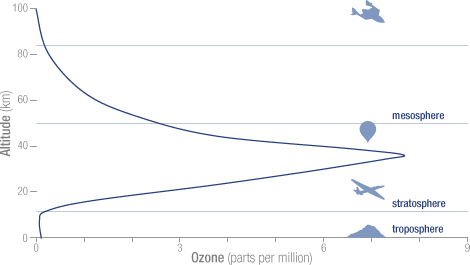 NOAA – National Aeronautics and Space Administration (NASA) Goddard Space Flight Center (GSFC) – Click the pic to view at source[/caption]
 Figure 2.14: Ozone Concentration vs. Height (Ajavon, et al., 2007)- Click the pic to view at source[/caption]
 Figure 2.14: Ozone Concentration vs. Height (Ajavon, et al., 2007)- Click the pic to view at source[/caption]
http://www.nasa.gov/centers/langley/news/factsheets/HALOE-Ozone.html
“In the NH vortex, air parcels which were initialized at 18 km on November 1, descended about 6 km by March 21, while air initially at 25 km descended 9 km in the same time period. This represents an average descent rate in the lower stratosphere of 1.3 to 2 km per month. Air initialized at 50 km descended 27 km between November 1 and March 21.
In the SH vortex, parcels initialized at 18 km on March 1, descended 3 km, while air at 25 km descended 5–7 km by the end of October. This is equivalent to an average descent in the lower stratosphere of 0.4 to 0.9 km per month during this 8-month period. Air initialized at 52 km descended 26–29 km between March 1 and October 31. In both the NH and the SH, computed descent rates increased markedly with height. The descent for the NH winter of 1992–1993 and the SH winter of 1992 computed with a three-dimensional trajectory model using the same radiation code was within 1 to 2 km of that calculated by the one-dimensional model, thus validating the vortex averaging procedure. The computed descent rates generally agree well with observations of long-lived tracers, thus validating the radiative transfer model.”
https://earthref.org/ERR/59278/
Air towards the top of the stratosphere and bottom of the mesosphere has lower concentrations of ozone;
[caption id="" align="alignnone" width="578"]
As such, when this “air from very high altitudes descends vertically through the center of the vortex” it displaces the air below it, decreasing the concentration of ozone within the Polar Vortex.
Additionally, “Throughout the winter, air from the upper stratosphere moves poleward and descends into the middle stratosphere. In the SH lower to middle stratosphere, strongest descent occurs near the edge of the polar vortex. The NH shows a similar pattern in late winter, but in early winter strongest descent is near the center of the vortex. Strong barriers to latitudinal mixing exist above =420 K throughout the winter. Below this, the polar night jet is weak in early winter, so air that descends below that level mixes between polar and middle latitudes. In late winter, parcels descend less, and the polar night jet moves downward, so there is less latitudinal mixing. The degree of mixing in the lower stratosphere thus depends strongly on the position and evolution of the polar night jet.”
“Diagnostics of mixing show a strong barrier to mixing at the edge of the polar vortex in the lower stratosphere, even into December in the SH, In the middle stratosphere, stratospheric warmings cause mixing to increase, and the vortex edge, as identified by a minimum in mixing, to move to higher PV values. This is consistent with previous studies showing the shrinking of the vortex and weakening of PV gradients during stratospheric warmings. As expected, considerably more mixing is seen in the NH than in the SH, In the lower stratosphere, in early winter the ,po]ar night jet usually does not extend significantly below =400 K, and parcels that descend below this level experience little barrier to mixing into mid-latitudes. As the winter progresses, the polar night jet moves downwards, and the parcels descend more slowly. Consistent with this, our simulations show considerably less mixing of polar air into mid-latitudes in late winter than in early winter in both hemispheres. In the presence of this polar night jet structure in the lower stratosphere and the sub-tropical jet in the upper troposphere, the degree of mixing of between polar and mid-latitude air in the lower stratosphere is strongly dependent on the amount of descent.”
http://trs-new.jpl.nasa.gov/dspace/bitstream/2014/33809/1/94-0540.pdf
Here is a simple view of the Ozone Layer;
[caption id="" align="alignnone" width="451"]
here is what happens to Column Ozone when the Polar Vortex descends into and through the Ozone Layer:
[caption id="" align="alignnone" width="451"]
and here is an animation of it occurring in 2013:
http://www.esrl.noaa.gov/gmd/dv/spo_oz/movies/index.html
Simple dynamical effects appear to explain the existence of Ozone “Holes”.
Since a reduction in ozone in the polar night at the poles (north or south) could cause an increase in UV and burn fair skin I will certainly limit my sun bathing in these regions in their respective winters.
Think about it for a moment. You would get more sunburn if only the sun were to shine there. Is someone’s head where the sun doesn’t shine?
Gary Pearse says: April 15, 2014 at 4:12 pm Interhemispheric Differences in Polar Stratospheric HNO3, H20, C10, and 03 – Santee, et al.[/caption]
 NOAA – National Weather Service – Climate Prediction Center[/caption]
 NOAA – National Weather Service – Climate Prediction Center[/caption]
 NOAA – National Weather Service – Climate Prediction Center[/caption]
 NOAA – National Weather Service – Climate Prediction Center [/caption]
 NOAA – National Weather Service – Climate Prediction Center [/caption]
 NOAA – National Weather Service – Climate Prediction Center [/caption]
I won’t go into it all again in detail, but expect there to be a CO2 hole, N2 hole, noble gases hole and methane hole coincident with the ozone hole.
Yes, “the polar vortex can be considered a sealed chemical reactor bowl, containing a water vapor hole, a nitrogen oxide hole and an ozone hole, all occurring simultaneously (Labitzke and Kunze 2005)”
http://books.google.com/books?id=B93SSQrcAh4C&lpg=PA283&ots=d0-uBRjmyI&dq=%22water%20vapor%20hole%22%20polar%20vortex&pg=PA283#v=onepage&q=%22water%20vapor%20hole%22%20polar%20vortex&f=false
“measurements of low methane concentrations in the vortex made by the HALOE instrument on board the Upper Atmosphere Research Satellite.” Rapid descent of mesospheric air into the stratospheric polar vortex, AGU 1993
http://onlinelibrary.wiley.com/doi/10.1029/93GL01104/abstract
“The ozone hole is in the center of a spiraling mass of air over the Antarctic that is called the polar vortex. The vortex is not stationary and sometimes moves as far north as the southern half of South America, taking the ozone hole with it.”
http://www.nasa.gov/centers/langley/news/factsheets/HALOE-Ozone.html
“Simultaneous global measurements of nitric acid (HNO3), water (H2O), chlorine monoxide (CIO), and ozone (O3) in the stratosphere have been obtained over complete annual cycles in both hemispheres by the Microwave Limb Sounder on the Upper Atmosphere Research Satellite. A sizeable decrease in gas-phase HNO3 was evident in the lower stratospheric vortex over Antarctica by early June 1992, followed by a significant reduction in gas-phase H2O after mid-July. By mid-August, near the time of peak CIO, abundances of gas-phase HNO3 and H2O were extremely low. The concentrations of HNO3 and H2O over Antarctica remained depressed into November, well after temperatures in the lower stratosphere had risen above the evaporation threshold for polar stratospheric clouds, implying that denitrification and dehydration had occurred.”
“There are no MLS measurements over Antarctica from mid-September through the end of October (20). By the time southviewing resumes on 1 November, chlorine over Antarctica has been largely deactivated. However, the 03 deficit that developed in September (4, 11, 12) persists. The deficits in gas-phase HNO3 and H20 also persist, with mixing ratio values less than 6 ppbv and less than 3 ppmv, respectively, throughout most of the vortex. Similar H20 values were measured by the UARS Halogen Occultation Experiment (HALOE) in mid-October 1992 (29). The strong PV gradient indicates that the vortex is still intact, inhibiting mixing between polar and midlatitude air. Lower stratospheric temperatures rose above the NAT PSC formation threshold the last week in September (30). The fact that gas-phase HNO3 and H20 values remain depressed long after the last PSCs would have been expected to evaporate strongly implies that irreversible removal (denitrification and dehydration) occurred at this level.”
http://www.sciencemag.org/content/267/5199/849.short
Here are the associated images of the Ozone, Nitric Acid and Water Vapor Holes:
[caption id="" align="alignnone" width="500"]
If these differential concentrations of the other gases is correct, then the case for solely a chemical reaction reason for the ozone hole is very tenuous.
Yes, and the chemical explanation doesn’t explain the Ozone “Holes” that exist higher in the atmosphere, i.e. “Antarctic ozone depletion occurs primarily between the altitudes of 12 and 20 kilometers, a region where polar stratospheric clouds, necessary for the chlorine-catalyzed chemical ozone destruction process, readily form.”
http://www.esrl.noaa.gov/gmd/dv/spo_oz/1220plot.html
However, on October 15, 2013, in the Southern Hemisphere, the Ozone “Hole” started at .5 hPa/mb – ~55 km;
[caption id="" align="alignnone" width="450"]
grows at 1 hPa/mb – ~50 km;
[caption id="" align="alignnone" width="450"]
is quite pronounced at 2 hPa/mb – ~42 km;
[caption id="" align="alignnone" width="450"]
weakened at 5 hPa/mb ~ 35 km;
[caption id="" align="alignnone" width="450"]
split into two lobes at 10 hPa/mb ~ 31 km;
[caption id="" align="alignnone" width="450"]
and reinvigorated, with a large Ozone “Surplus” at 30 hPa/mb ~ 23 km;:
[caption id="" align="alignnone" width="449"]
Since no one is taking me up on the invitation to examine this, I’m planning to collaborate with a physicist specializing in magnetics on a paper of this subject.
Why do we need magnetism if simply observable dynamical effects can explain the existence of Ozone “Holes”? Not to say that magnetic and chemical are not necessarily factors, but what portion of the Ozone “Hole” can’t be explained by dynamical effects within polar vortices?
Atmospheric ozone is almost completely the result of incoming solar radiation reacting with O2 oxygen, and creating the higher-energy O3 oxygen allotrope. As such, no O2 = no ozone, and no sunlight = no ozone.
Since there is little or no sunlight at the poles for some months of the year, it was postulated that there would be a corresponding lack (or “depletion”) of ozone. This was the accepted wisdom in the late ’30’s, the ’40’s and the early ’50’s.
Professor Gordon Dobson (and others) believed there were high-speed, high-level air currents called “jet streams”, which had a major effect on weather and climate. However, demonstrating their existence had proved problematic. It is difficult to “tag” a parcel of air and track its movement in the upper atmosphere.
Professor Dobson postulated that, if these currents existed, then at certain times of the year they would move ozone-rich air from the lower latitudes, into the ozone depleted areas at the poles, where accepted wisdom said there should be little if any. By mapping the pattern of encroachment of ozone-laden air into the ozone-deficient polar region, Professor Dobson hoped to demonstrate the existence of the jet streams, as well as lay the foundations for mapping their paths and calculating their intensity.
To this end Dobson invented the Dobson Spectrophotometer, and the Dobson Unit, He then spent some years traveling the world, measuring ozone concentrations. In 1957 (The International Geophysical Year), he spent the spring at Antarctica, measuring the pathways of incoming air-streams, by measuring variations in ozone.
In this way Dobson proved the existence of the jet streams, and did much of the foundation work in plotting their pathways. In recognition of this ground-breaking work, Dobson was named “International Geophysical man of the Year”. He co-wrote a book about it in 1962 (revised edition 1964), “Exploring the Atmosphere”, which was one of my science textbooks in high school.
In the 1980’s, when NASA decided to jump on the “holes in the ozone layer” band-wagon, Dobson and his work proved something of a stumbling block. So, like Tesla and others, he, and his work, were quietly “disappeared” out of the history and science books.
It always struck me as an amazingly fortuitous coincidence that the Ozone Hole was discovered just as Dupont’s patent on freon was expiring, and the only answer was to ban freon and substitute a whole batch of new refrigerants with new, exclusive long term patents attached to them.
yep, an amazingly fortuitous and…. highly profitable…. coincidence.
Ok, perhaps someone upstream has mentioned this—sorry, gotta rant or I’d be patient and read to find out—but as many have pointed out today, and every time this subject arises, the “Ozone hole” in the Southern Hemisphere has been there since we first looked with Satellites at the South Pole. We don’t know what caused it, and I’m not sure if it’s hubris, idiocy, or both to assume it’s man-made or even man influenced. There have been studies which have shown how very difficult it is to get gasses to diffuse from the Northern Hemisphere to the Southern Hemisphere in any quantity, and nearly all the industrial activity is in the North. The US is frequently criticized by the do-gooders who want to redistribute the wealth of the West to themselves, that less than a quarter of the world’s population uses more than three quarters of it’s fuel, etc. Oh, and created most of those nasty CFCs, because the evil rich people there used so many CFCs for their air conditioning, which is evil (until every despot of every banana republic has it and people of North America do not anymore).
But, ok, so if there’s no Ozone hole in the north, just who, exactly, is the bad-guy responsible for the one in the South? Kiwis? Aussies? Pacific Islanders? Wait! Easter Islanders! Yeah! That’s the ticket!
The entire argument is foolish. No one has yet proven a thing regarding the hole in the South: what caused it, was man responsible at all, etc., and it is equally foolish to claim credit that there isn’t one in the North because of any policies.
There isn’t a shred of evidence to support either hypothesis.
p@ur momisugly Dolan
It is both arrogant and pointless to ask people to explain something to you, when it has already been explained in the comments, and you complete your request by stating that you are too lazy to read the comments.
Might I suggest you instal some text-to speech software, then you can have the comments read to you while you lie down and veg out.
Huh?! We need less CFCs too!
” in part because international efforts to limit ozone-depleting chemicals have been successful.”
Or maybe because CFCs had nothing to do with it in the first place?
“The fear-mongering troughers.” (Katherine at 7:10pm)
You GO, girl! #(:))
***************************************
@ur momisugly A. D. Everard — How is the writing going? Hang in there. Sometimes, things just take much longer than we expected. Hold onto hope with both hands!!
Robert Parson’s old Ozone FAQ should be required reading before anyone comments here, however, it must be said that the press release was misleading. Justthe has explained a great deal of what happens, but the principle difference between the Arctic and Antarctic wrt ozone depletion is that the south is a lot colder.
To form an ozone hole in the spring (note the ozone concentrations are roughly constant over the dark winter, because, while ozone does not form in the dark, neither is it destroyed by absorption of UV light) requires a temperature in the mid-lower stratosphere of about 195 K, at which NAT or nitric acid trihydrate freezes forming the polar stratospheric clouds (PSCs) (water vapor freezes maybe 20 K lower under stratospheric conditions and does not play the leading role)
The PSCs sweep up NO2 converting it to nitric acid and depleting NO2ClO, which is a large reservoir for Cl atoms in the stratosphere. At first light the ClO is released and starts a rapid surge of ozone destruction. It is this that forms the ozone hole in the Spring.
Details can be found all over the net and in the literature but the fact is that no one has ever expected a serious ozone hole in the Arctic, if for no other reason than the Arctic is warming at a very fast rate, and never was nearly as cold as the Antarctic, so PSCs there are much much rarer.
Clearly, the CFC’s are migrating creatures, and have a preference for terra firma in Antarctica over mere ice at the Arctic. This prompts them to make their annual journey from the northern hemisphere where they are born two thirds of the way around the planet to their roost in Antarctica, where they gorge themselves on ozone before they die.
A poignant miracle of nature.
@ur momisugly Gymnosperm (9:33pm) — LOL.
On the other hand, the 11-year modulation of GCR fluxes is strongest at the heights 20-25 km [Bazilevskaya et al., 2008] where the vortex is most pronounced. Hence, the vortex location seems to be favorable for the mechanisms of solar activity influence on the atmosphere
circulation involving GCR variations. It is also favorable for the mechanisms involving solar UV variations, as at these heights (15-25 km) in the polar stratosphere the maximum ozone content is observed.
However, Earth’s poles are where the radiation problem can be most severe. Our planet’s magnetic field funnels cosmic rays and solar energetic particles over the very same latitudes where airlines want to fly. On a typical day when the sun is quiet, dose rates for international flights over the poles are 3 to 5 times higher than domestic flights closer to the equator.
http://geo.phys.spbu.ru/materials_of_a_conference_2012/STP2012/Veretenenko_%20et_all_Geocosmos2012proceedings.pdf
http://science.nasa.gov/science-news/science-at-nasa/2013/25oct_aviationswx/
Please see the changes in ozone in the southern polar vortex.
http://www.cpc.ncep.noaa.gov/products/intraseasonal/temp50anim.gif
http://www.cpc.ncep.noaa.gov/products/precip/CWlink/blocking/real_time_sh/500gz_anomalies_sh.gif
“(note the ozone concentrations are roughly constant over the dark winter, because, while ozone does not form in the dark, neither is it destroyed by absorption of UV light)”
‘Fess up, Eli, this is straight out of the Wizard of Oz Thunder and Lightning Machine Operations Manual, right?
Ditto for Ren’s remarks about the polar vortex effect on ozone depletion.
My remarks are based on the latest research and scientific observations.
http://cc.oulu.fi/~usoskin/
“My remarks are based on the latest research and scientific observations.”
Then I suggest you give young Ilya a call and gently explain to him that the allotrope of oxygen known as ozone (O3), is in a higher energy state than its plebeian cousin O2, and quickly loses that energy and returns to its original form, ALL BY ITSELF.
It doesn’t need UV light – or anything else – to “destroy” it.
It’s a high-energy molecule, godammit, not a dragon.
Cosmic rays do not get far into the atmosphere before they collide with nitrogen or oxygen molecules in the air. The collision destroys the cosmic ray particle and the air molecule, and then several new particles emerge. Cosmic rays from space are termed “primary,” and any particles created in the atmosphere from collisions are termed “secondary.” A bit of energy is transferred to each new secondary particle. Secondary cosmic rays spread out and continue to hit other particles and air molecules, creating a cascade of particles showering towards the ground. Figure 2 shows how the particles shower to the ground. The number of secondary cosmic rays in the atmosphere increases to a maximum, and then diminishes as the energy fades closer to the ground. Because of atmospheric absorption, low energy particles are plentiful and high energy particles are rare. Scientists studying the neutron monitor data are more interested in the energy of primary cosmic rays, before they are affected by the atmosphere. A typical energy level for a galactic cosmic ray detected by the neutron monitor is 17 billion electron volts. Solar cosmic rays are more concentrated towards lower energies. The ones reaching ground level started out with an average energy of about 3 billion electron volts before meeting the atmosphere.
http://neutronm.bartol.udel.edu/listen/main.html#lives
Cosmic rays influence both the reduction of ozone (in summer) and its increase (in winter). The more that in front of us low solar cycles.
I remember well when the BBC announced, all those years ago, that “scientists had discovered” the ozone hole. The newsreader went on, in true, smooth BBC style, to tell us (remember, this was the first time they’d mentioned it at all) that it had been attributed to mankind’s evil CFCs. This resulted in an immediate shout of laughter from my then partner, and the comment, “It didn’t take them long to work that out, did it?” My, how we laughed!
My partner was not a climate scientist, but I guess you’d worked that out from her obvious good sense.
Boondoogle stated above;
‘Can anyone tell me what the ozone levels were in the Antarctic in 1950? 1900? 1800? 1700? If no,t how can we tell if the ozone hole has changed or been affected by man or is it a natural phenomenon? Could it be that there are natural reasons that the ozone hole is behaving differently in the Arctic as compared to the Antarctic?’
I asked the world experts at the Max Plank institute and Cambridge University a similar question some 4 or 5 years ago. In essence, as we did not have instruments capable of recording the ozone hole prior to the 1950’s how do we know whether or not the hole hasn’t always been there?
They said they didn’t know and at that time there was no means to hindcast the likely hole size in earlier centuries.
So the appearance of the hole in modern times due to man is complete speculation based on physics theory
tonyb