
Image Credit NASA – Polar Vortex on Venus
WUWT Regular “Just The Facts”
Currently there is a lot of media hype about the Polar Vortex over North America, but little in the way of coherent explanation as to what a Polar Vortex is and how it affects Earth’s temperature. As such, a Polar Vortex is “caused when an area of low pressure sits at the rotation pole of a planet. This causes air to spiral down from higher in the atmosphere, like water going down a drain.” Universe Today “A polar vortex is a persistent, large-scale cyclone located near one or both of a planet’s geographical poles.” “The vortex is most powerful in the hemisphere’s winter, when the temperature gradient is steepest, and diminishes or can disappear in the summer.” Wikipedia In addition to those on Earth, Polar Vortices also have been sighted on Venus, Mars, Jupiter , Saturn and Saturn’s Moon Titan.
“Long-term vortices are a frequent phenomenon in the atmospheres of fast rotating planets, like Jupiter and Saturn, for example. Venus rotates slowly, yet it has permanent vortices in its atmosphere at both poles. What is more, the rotation speed of the atmosphere is much greater than that of the planet. “We’ve known for a long time that the atmosphere of Venus rotates 60 times faster than the planet itself, but we didn’t know why. The difference is huge; that is why it’s called super-rotation. And we’ve no idea how it started or how it keeps going.
The permanence of the Venus vortices contrasts with the case of the Earth. “On the Earth there are seasonal effects and temperature differences between the continental zones and the oceans that create suitable conditions for the formation and dispersal of polar vortices. On Venus there are no oceans or seasons, and so the polar atmosphere behaves very differently,” says Garate-Lopez.” Phys.org
So with that background, let’s take a look at the Polar Vortex currently over North America. Starting at 10 hPa/mb – Approximately 31,000 meters (101,700 feet) here we have a Height Analysis showing the low pressure area;

a Temperature Analysis showing the cold area;

Zonal Mean Temperatures showing the cold area from a global perspective;

a wide perspective Wind Animation and more focused Wind Animation showing the motion of the Vortex,
and Ozone Mixing Ratio map showing the “Ozone Hole” within it:

Now we are going to travel down the Polar Vortex in several steps, so here’s another Height Analysis showing the low pressure area at 30 hPa/mb – Approximately 23,700 meters (77,800 feet);

a Temperature Analysis showing the cold area;

Zonal Mean Temperatures showing the cold area from a global perspective;

and Ozone Mixing Ratio map showing the “Ozone Hole” within the Vortex:

Here’s a Height Analysis showing the low pressure area at 70 hPa/mb – Approximately 18,000 meters (59,000 feet);

a Temperature Analysis showing the cold area;

Zonal Mean Temperatures showing the cold area from a global perspective;

a wide perspective Wind Animation and more focused Wind Animation showing the motion of the Vortex,;
and Ozone Mixing Ratio map showing a slight “Ozone Hole” within it:

And here’s here we have a Height Analysis showing the low pressure area at 100 hPa/mb – Approximately 15,000 meters (49,000 feet);

a Temperature Analysis showing the cold area;

Zonal Mean Temperatures showing the cold area from a global perspective;

and Ozone Mixing Ratio map showing a slight “Ozone Hole” within the Vortex:

Per this Northern Hemisphere – Vertical Cross Section of Geopotential Height Anomalies you can see that the Polar Vortex currently extends to approximately 100 hPa/mb:

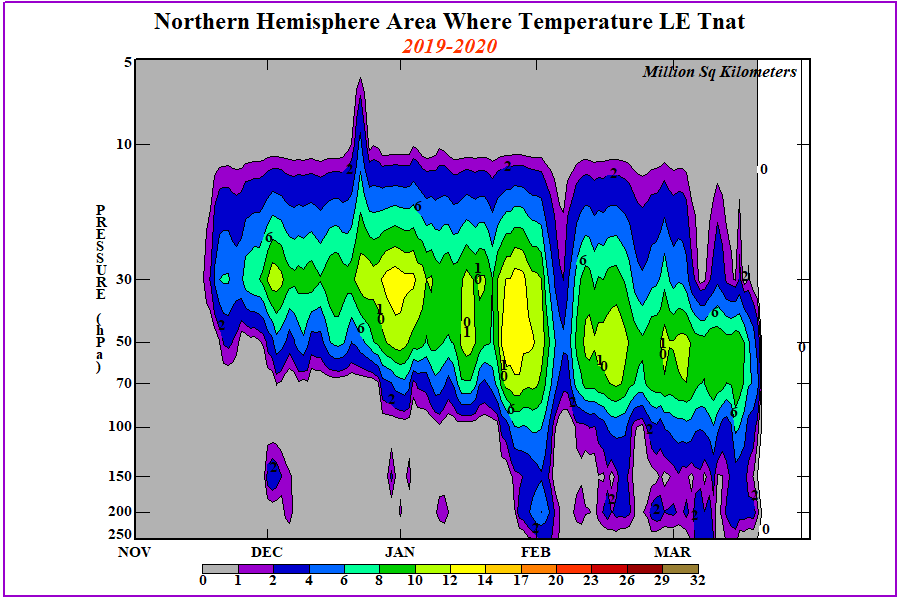
also reflected in this Northern Hemisphere – Area Where Temperature is Below 195K or -78C:

So why is it so cold in North America right now? Per Global – 10-hPa/mb Height Temperature Anomalies – Atmospheric Temperature Anomalies At Approximately 31,000 meters (101,700 feet);

it appears that that we are having an [Upper Stratosphere Lower Mesosphere (USLM) Disturbance] that could lead to a Sudden Stratospheric Warming growing over East Asia, i.e. “the breakdown of the polar vortex is an extreme event known as a sudden stratospheric warming, here the vortex completely breaks down and an associated warming of 30-50 degrees Celsius over a few days can occur. The Arctic vortex is elongated in shape, with two centres, one roughly over Baffin Island in Canada and the other over northeast Siberia. In rare events, the vortex can push further south as a result of axis interruption, see January 1985 Arctic outbreak.” Wikipedia ”The January 1985 Arctic outbreak was a meteorological event, the result of the shifting of the polar vortex further south than is normally seen. Blocked from its normal movement, polar air from the north pushed into nearly every section of the eastern half of the United States, shattering record lows in a number of states.” Wikipedia This BBC Article and Video are helpful in understanding Sudden Stratospheric Warmings. (Note that the text within the [brackets] above has been added and the struck-through removed to correct the article based upon learnings from this comment and this comment below.)
In terms of claims that “US polar vortex may be example of global warming” Guardian and “Polar Vortex: Climate Change Could Be the Cause of Record Cold Weather” Time, these appear to be unsupported conjecture as:
“Many atmospheric general circulation models (GCMs) and chemistry–climate models (CCMs) are not able to reproduce the observed polar stratospheric winds in simulations of the late 20th century. Specifically, the polar vortices break down too late and peak wind speeds are higher than in the ERA-40 reanalysis. Insufficient planetary wave driving during the October–November period delays the breakup of the southern hemisphere (SH) polar vortex in versions 1 (V1) and 2 (V2) of the Goddard Earth Observing System (GEOS) chemistry–climate model, and is likely the cause of the delayed breakup in other CCMs with similarly weak October-November wave driving.”
“In the V1 model, the delayed breakup of the Antarctic vortex biases temperature, circulation and trace gas concentrations in the polar stratosphere in spring. The V2 model behaves similarly (despite major model upgrades from V1), though the magnitudes of the anomalous effects on springtime dynamics are smaller.”
“Clearly, if CCMs cannot duplicate the observed response of the polar stratosphere to late 20th century climate forcings, their ability to simulate the polar vortices in future may be poor.”
“It is unclear how much confidence can be put into the model projections of the vortices given that the models typically only have moderate resolution and that the climatological structure of the vortices in the models depends on the tuning of gravity wave parameterizations.
Given the above outstanding issues, there is need for continued research in the dynamics of the vortices and their representation in global models.”
To learn more about Polar Vortices please visit the WUWT Polar Vortex Reference Page.
Discover more from Watts Up With That?
Subscribe to get the latest posts sent to your email.
Carla says: January 11, 2014 at 7:21 am R. Holme & O. de Viron – Characterisation and implications of intradecadal varia-
You may want to have a look at the graph on page 19 figure S1.
Characterisation and implications of intradecadal variations
in length-of-day
R. Holme1 & O. de Viron2
http://www.liv.ac.uk/~holme/nature_sub.pdf
Figure S1: LOD observations, atmospheric and oceanic signals, and predictions.
[caption id="" align="alignnone" width="578"]
tions in length-of-day – Click the pic to view at source[/caption]
The figure is pretty telling. Wish we had a longer reliable reference though…
Also, IERS says no adding leap second again this year.
“The length-of-day (LOD) fluctuations from 1962 until 2012 are corrected for atmospheric and oceanic effects using assimilating general circulation models (see supplementary material, Figure S1). This correction accounts for most of the variation at yearly and shorter periods.”
That tells me that on short timescales atmospheric and oceanic cycles effect LOD, not the other way around.
Carla says: January 11, 2014 at 12:51 pm
…which is showing a consistent ‘trend towards a slower rotation since early 1990,’
Korean scientists are seeing the same trend in rotation. See page 2 of the sneek preview for figures 1 +2. Note figure 1(b) the time period from 1999 to 2006 is also a period with 4 geomagnetic jerks/LOD jumps. Starting in around 2006- 2009 is also when the N. Magnetic pole slowed its latitudinal ascent and began moving more longitudinal.
Spectral analysis on earth’s spin rotation for the recent 30 years
http://link.springer.com/article/10.3938/jkps.61.152
Sung-Ho Na, et al. refer to the change in LOD as “tiny indeed”. There is no doubt that LOD is changing and there are correlations with Ocean and Atmospheric cycles, however I am not aware of any mechanism, other then butterflies, whereby a few millisecond change in Earth’s rotation could have significant short-term influence on the Ocean, Atmosphere or Polar Vorticity. Do you?
Bill H. Thank you for mentioning the REAL culprit, THE SUN.
Bill H. As much as the Warmists would like to say that Sudden Stratospheric Warmings are driven purely by ocean/land/orography temperature differentials causing Rossby waves that disrupt the wind circulation and particularly in conjunction with the QBO can be focused directly at the Polar Vortex, the truth is far more likely to be Solar activity that happens to correspond with SSWs.
I know acknowledging this would mean that Anthony would have to agree with Piers Corbyn, the arch-nemesis of Meteorologists everywhere 😉
Gunga Din says: January 11, 2014 at 7:27 am NOAA – National Weather Service – Climate Prediction Center – Click the pic to view at source[/caption]
 NOAA – National Weather Service – Climate Prediction Center – Click the pic to view at source[/caption]
 NOAA – National Weather Service – Climate Prediction Center – Click the pic to view at source[/caption]
 NOAA – National Weather Service – Climate Prediction Center – Click the pic to view at source[/caption]
 NOAA – National Weather Service – Climate Prediction Center – Click the pic to view at source[/caption]
 NOAA – National Weather Service – Climate Prediction Center – Click the pic to view at source[/caption]
 NOAA – National Weather Service – Climate Prediction Center – Click the pic to view at source[/caption]
 NOAA – National Weather Service – Climate Prediction Center – Click the pic to view at source[/caption]
 NOAA – National Weather Service – Climate Prediction Center – Click the pic to view at source[/caption]
 NOAA – National Weather Service – Climate Prediction Center – Click the pic to view at source[/caption]
Did you strike “East Asia” because you meant “East Anglia”? 😎
Funny. I had thought that it might only be an Upper Stratosphere Lower Mesosphere (USLM) Disturbance, versus a full-fledged Sudden Stratospheric Warming. However, as things unfold, I am wondering if the first version was right, i.e.:
The Vertical Cross Section of Geopotential Height Anomalies shows that the Polar Vortex has weakened significantly and the AO has swung negative;
[caption id="" align="alignnone" width="578"]
Northern Hemisphere Temperature Analysis at 10 hPa/mb – Approximately 31,000 meters (101,700 feet) shows a high level split within the Polar Vortex:
[caption id="" align="alignnone" width="578"]
Height Analyses show that the Polar Vortex has split in two below 50 hPa/mb – Approximately 20,100 meters (66,000 feet);
[caption id="" align="alignnone" width="578"]
70 hPa/mb Height Analysis – Approximately 18,000 meters (59,000 feet);
[caption id="" align="alignnone" width="578"]
and 100 hPa/mb Height Analysis – Approximately 15,000 meters (49,000 feet):
[caption id="" align="alignnone" width="578"]
The split is also visible in Ozone Mixing Ratio 30 hPa/mb – Approximately 23,700 meters (77,800 feet);
[caption id="" align="alignnone" width="578"]
50-hPa/mb Ozone Mixing Ratio – Approximately 20,100 meters (66,000 feet);
[caption id="" align="alignnone" width="578"]
and 70-hPa/mb Ozone Mixing Ratio – Approximately 18,000 meters (59,000 feet):
[caption id="" align="alignnone" width="578"]
Northern Hemisphere Area Where Temperature is Below 195K or -78C shows significant warming in the last few days;
[caption id="" align="alignnone" width="578"]
and Global – 10-hPa/mb Height Temperature Anomalies – Atmospheric Temperature Anomalies At Approximately 31,000 meters (101,700 feet) continues to increase over East Asia:
[caption id="" align="alignnone" width="578"]
justthefactswuwt says:
January 11, 2014 at 2:11 pm
Sung-Ho Na, et al. refer to the change in LOD as “tiny indeed”. There is no doubt that LOD is changing and there are correlations with Ocean and Atmospheric cycles, however I am not aware of any mechanism, other then butterflies, whereby a few millisecond change in Earth’s rotation could have significant short-term influence on the Ocean, Atmosphere or Polar Vorticity. Do you?
———————-
We’ve added 25 leap seconds between 1972 and 2012.
In the period 1999 to 2012 only 3 leap seconds.
page11 figure 9
Earth Rotation – Basic Theory and Features
Sung-Ho Na
http://cdn.intechopen.com/pdfs/44925/InTech-Earth_rotation_basic_theory_and_features.pdf
Phase change in the Chandler Wobble 2005
Chandler wobble: two more large phase jumps revealed
Zinovy Malkin and Natalia Miller
Central Astronomical Observatory at Pulkovo of RAS,
Pulkovskoe Ch. 65, St. Petersburg Russia
23 August 2009
Abstract
Investigations of the anomalies in the Earth rotation, in particular, the polar mo-
tion components, play an important role in our understanding of the processes that
drive changes in the Earth’s surface, interior, atmosphere, and ocean. This paper is
primarily aimed at investigation of the Chandler wobble (CW) at the whole available
163-year interval to search for the major CWamplitude and phase variations. First, the
CW signal was extracted from the IERS (International Earth Rotation and Reference
Systems Service)…
Among other interesting CW peculiarities, a phase jump of about 180◦ occurred in the
1920s. Perhaps, it was for the first time detected by Orlov (1944). Detailed consideration
of this CW phase jump is given e.g. in Guinot (1972) and Vondr´ak (1988). Also, less
significant CW phase jumps can be observed, which may be in temporary coincidence with
geomagnetic jerks and Free Core Nutation (FCN) phase perturbations (Gibert & Le Mou¨el
2008, cf. Shirai et al. 2005).
…All the methods used gave very similar results, with some differences at the ends of the
interval. These discrepancies can be explained by different edge effects of the methods used,
but they can hardly discredit the final conclusion that can be made from this study about
existence of two epochs of deep CW amplitude decrease around 1850 and 2005, which are
also accompanied by a large phase jump, like the well-known event in the 1920s. Thus, the
latter seems to be not unique anymore.
page 5 Figure 2: The CW amplitude computed for SSA-filtered and FT-filtered CW time series.
Unit: mas. One can see similar behavior of the CW amplitude obtained for both series, with
some differences near the ends of the interval. However, three deep minima below 0.05 mas
around 1850, 1925 and 2005 coincide in both cases.
Motion of North and South magnetic poles in 2001-2009
http://adsabs.harvard.edu/abs/2012EGUGA..1411236Z
Zvereva, T.
EGU General Assembly 2012, held 22-27 April, 2012 in Vienna, Austria.,
We created the daily average spherical harmonic models of the main geomagnetic field (n = m = 10) with an interval of 4 days using vector data CHAMP satellite during May 2001 – December 2009 (2001.5-2009). Using obtained set of the models coordinates of the North and South magnetic poles (i.e. the point on the Earth’s surface where the magnetic filed lines are vertical) were calculated. Both poles continue to move northward and westward. North pole shifted 400 km, South pole moved 10 times slower. Accelerated motion of the North magnetic pole stopped around year 2003, when rate of motion increased to ~ 62.5 km/yr. Then the motion of North pole started to decelerate to ~45 km/yr in 2009. At the same time it should be noticed that North pole began to retrace in the direction of Canada, moving northwestward as before. This follows from the fact that during this period the rate of the pole latitude movement decreased from 58 to 35 km/yr, while the longitude speed increased from 23 to 32 km/yr. Thus, we can hope that North magnetic pole just “wanders” and will not leave Canadian anomaly and will not reach Siberia in approximately 50 years, as predicted earlier.
4 geomagnetic jerks/LOD jumps 1999-2007
See page 21 figure S3 vertical dashed lines.
Characterisation and implications of intradecadal variations
in length-of-day
R. Holme1 & O. de Viron2
…Here, by working in the time domain, rather than
the frequency domain, we demonstrate a clear partition of the non-atmospheric component
into only three components: a decadally varying trend, a 5.9-year period oscillation, and
jumps at times contemporaneous with geomagnetic jerks. The nature of the jumps in LOD
changes fundamentally what class of phenomena may give rise to the jerks, and provides a
strong constraint on electrical conductivity of the lower mantle, which can in turn constrain
its structure and composition.
page 21 figure S3
Wish just one of these articles would have at least tried to couple the Earth system with Solar electro and magnetic system.
Note in 2003.5 geomagnetic jerk/LOD jump same year as, “Accelerated motion of the North magnetic pole stopped around year 2003, when rate of motion increased to ~ 62.5 km/yr. Then the motion of North pole started to decelerate to ~45 km/yr in 2009. “”
sabretruthtiger says: January 11, 2014 at 4:37 pm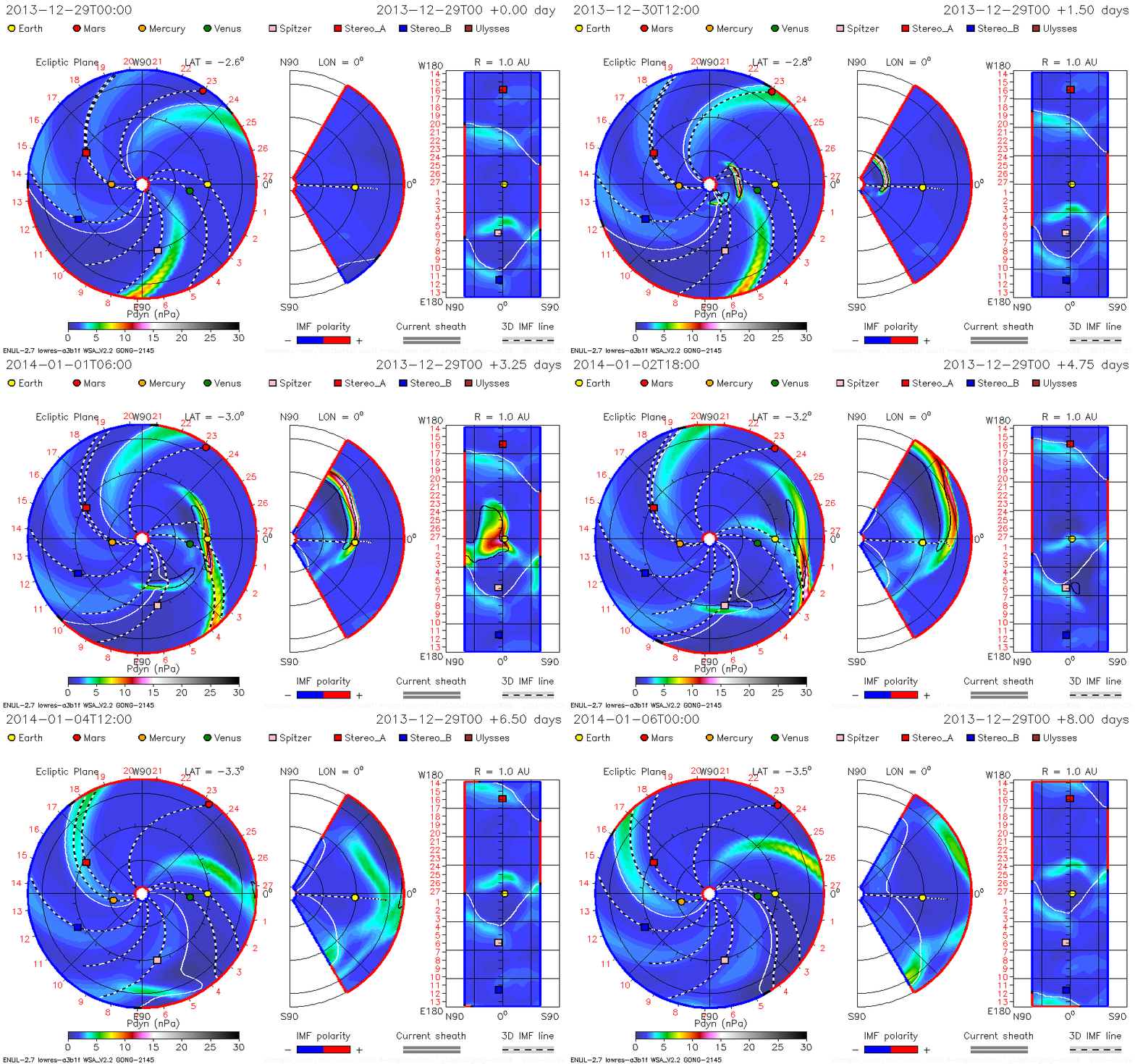 NOAA – Integrated Space Weather Analysis – Click the pic to view at source[/caption]
 NOAA – Integrated Space Weather Analysis – Click the pic to view at source[/caption]
 NOAA – National Weather Service – Climate Prediction Center – Click the pic to view at source[/caption]
As much as the Warmists would like to say that Sudden Stratospheric Warmings are driven purely by ocean/land/orography temperature differentials causing Rossby waves that disrupt the wind circulation and particularly in conjunction with the QBO can be focused directly at the Polar Vortex, the truth is far more likely to be Solar activity that happens to correspond with SSWs.
A Coronal Mass Ejection (CME);
http://en.wikipedia.org/wiki/Coronal_mass_ejection
hit Earth around January 1st:
Ensemble WSA-ENLIL+Cone Model Evolution Movie for Median CME Input Parameters – Dynamic Pressure
[caption id="" align="alignnone" width="632"]
and the Magnetosphere was rocking and rolling:
[caption id="" align="alignnone" width="632"]
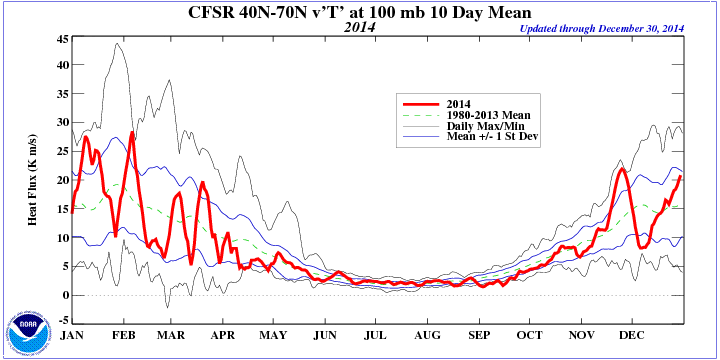
“Strong negative fluxes indicate poleward flux of heat via eddies. Multiple strong poleward episodes will result in a smaller polar vortex, Sudden Stratospheric Warmings and an earlier transition from winter to summer circulations. Relatively small flux amplitudes will result in a more stable polar vortex and will extend the winter circulation well into the Spring”
Also, the 10 day Averaged Eddy Heat Flux Towards The North Pole At 100mb is near its record high daily maximum for this day of the year:
[caption id="" align="alignnone" width="578"]
“Strong negative fluxes indicate poleward flux of heat via eddies. Multiple strong poleward episodes will result in a smaller polar vortex, Sudden Stratospheric Warmings and an earlier transition from winter to summer circulations. Relatively small flux amplitudes will result in a more stable polar vortex and will extend the winter circulation well into the Spring”
There are numerous papers that argue connections between Space Weather and Earth’s Weather, e.g.: “The Influence of the Solar Cycle and QBO on the Late-Winter Stratospheric Polar Vortex” by Charles D. Camp and Ka-Kit Tung:”
This non-peer-reviewed 2009 article by Václav Bucha: “Geomagnetic Activity and the Global Temperature” states that;
This 2010 paper, “Geomagnetic activity related NOx enhancements and polar surface air temperature variability in a chemistry climate model: modulation of the NAM index” by A. J. G. Baumgaertner1, A. Seppälä, P. Jöckel and M. A. Clilverd states that;
This paper, “The Influence of the Solar Cycle and QBO on the Late-Winter Stratospheric Polar Vortex” this paper finds “SIGNALS OF SOLAR WIND DYNAMIC PRESSURE IN THE NORTHERN ANNULAR MODE AND THE EQUATORIAL STRATOSPHERIC QUASI-BIENNIAL OSCILLATION” By Hua Lua and Martin J. Jarvis. They ;
eeek…Atmospheric Temperature Anomalies At Approximately 31,000 meters (101,700 feet) continues to increase over East Asia:
Carla says: January 11, 2014 at 8:14 pm
We’ve added 25 leap seconds between 1972 and 2012.
In the period 1999 to 2012 only 3 leap seconds.
page11 figure 9
Earth Rotation – Basic Theory and Features
Sung-Ho Na
http://cdn.intechopen.com/pdfs/44925/InTech-Earth_rotation_basic_theory_and_features.pdf
According to Wikipedia;
http://en.wikipedia.org/wiki/Leap_second
Thus Leap Seconds are primarily to address the fact that “the duration of one mean solar day is slightly longer than 24 hours (86400 SI seconds).” “Seasonal perturbation in star transit time; being behind in spring and ahead in late summer by 20-30 millisecond, which should be accumulation of LOD variation of the same periodicity. Along with the seasonal perturbation, fortnightly and monthly variations in LOD exist. Amplitudes of LOD variations of these different periodic components are in the order of one millisecond. Some amounts of these periodic perturbations are associated with body/ocean tides in the Earth. However, there is strong atmospheric effect on LOD variation. There also exist large quasiperiodic variations of much longer period range, called decadal fluctuation.”
Even if we granted a full second per year of variations in LOD, beyond butterflies, I don’t see how one second variations in Length of Day can have a signifacant impact on short-term Polar Vortex strength and persistance. There are numerous other variables involved in Polar Vortex development, persistance and breakdown, including Atmospheric and Oceanic Occillations, Heat Eddys, Rossby Waves, Tidal Forces, Potentially Solar e.g. CME or Cosmic Ray/Cloud, etc. I still don’t see a mechanism whereby LOD could be a signifacant varaible in short term changes to Polar Vorticity.
Carla says: January 11, 2014 at 8:30 pm
eeek…Atmospheric Temperature Anomalies At Approximately 31,000 meters (101,700 feet) continues to increase over East Asia:
Yes, per the paper “The Influence of Stratospheric Vortex Displacements and Splits on Surface Climate”, Daniel M. Mitchell, et al.;
justthefactswuwt says:
January 11, 2014 at 8:23 pm
———————————————
Thanks for the additional information given in that post.
Will be back later ..
Computer crash and bang, bang down go the over 60 browser windows I had open.
justthefactswuwt says:
January 11, 2014 at 11:31 pm
Even if we granted a full second per year of variations in LOD, beyond butterflies, I don’t see how one second variations in Length of Day can have a signifacant impact on short-term Polar Vortex strength and persistance. There are numerous other variables involved in Polar Vortex development, persistance and breakdown, including Atmospheric and Oceanic Occillations, Heat Eddys, Rossby Waves, Tidal Forces, Potentially Solar e.g. CME or Cosmic Ray/Cloud, etc. I still don’t see a mechanism whereby LOD could be a signifacant varaible in short term changes to Polar Vorticity.
———-
Yes, I understand what you are saying.
I was only trying to show that while these short term changes to Polar vorticity exist, at the same time some changes are occurring in the long term trend of the polar region. Movement of the N. Magnetic pole change magnetic field orientation. Field lines are most vertical at the polar regions around the magnetic pole. Maybe its jerk, wobble and jump that contributes to the polar vortex irregularity? lol.
But found a precipitating electron flux dump at the south pole. Apparently the POES satellite is missing these electron flux enhancements.. just how often does POES miss this? And then we must ask, is this also happening at the N. Pole?
Energetic electron precipitation characteristics observed from Antarctica during a flux dropout event
Mark A. Clilverd1,*, Neil Cobbett1, Craig J. Rodger2,
James B. Brundell2, Michael H. Denton3, David P. Hartley3,
Juan V. Rodriguez4,5, Donald Danskin6,
Tero Raita7, Emma L. Spanswick8
5 NOV 2013
..””Combining the ground-based data with low and geosynchronous orbiting satellite observations on 27 February 2012, different driving mechanisms were observed for three precipitation events with clear signatures in phase space density and electron anisotropy. Comparison between flux measurements made by Polar-orbiting Operational Environmental Satellites (POES) in low Earth orbit and by the Antarctic instrumentation provides evidence of different cases of weak and strong diffusion into the bounce loss cone, helping to understand the physical mechanisms controlling the precipitation of energetic electrons into the atmosphere. Strong diffusion events occurred as the 30 keV flux than was reported by POES, more consistent with strong diffusion conditions.””..
Seems that more and more electron fluxes are being found to penetrate into regions that will and do affect atmospheric composition and climate.
Gee the part of the abstract I wanted to post is not there. Let’s try again.
Do we see 10 to 100 times greater flux values in the following text? Yes there we go now..
Energetic electron precipitation characteristics observed from Antarctica during a flux dropout event
http://onlinelibrary.wiley.com/doi/10.1002/2013JA019067/abstract;jsessionid=82D30A53CA4AA047776345D2B8F415A2.f01t01?deniedAccessCustomisedMessage=&userIsAuthenticated=false
“”Comparison between flux measurements made by Polar-orbiting Operational Environmental Satellites (POES) in low Earth orbit and by the Antarctic instrumentation provides evidence of different cases of weak and strong diffusion into the bounce loss cone, helping to understand the physical mechanisms controlling the precipitation of energetic electrons into the atmosphere. Strong diffusion events occurred as the 30 keV flux than was reported by POES, more consistent with strong diffusion conditions.””
This getting weird on me now. Let’s try from a different source for the same article..
Never had a copy paste do that before.
“”Strong diffusion events occurred as the 30 keV flux than was reported by POES, more
consistent with strong diffusion conditions.””
http://www.physics.otago.ac.nz/space/Auto_AARDDVARK_MS_2013.pdf
Carla says: January 12, 2014 at 4:08 pm
Computer crash and bang, bang down go the over 60 browser windows I had open.
Been there, done that… 🙂
Yes, I understand what you are saying.
I was only trying to show that while these short term changes to Polar vorticity exist, at the same time some changes are occurring in the long term trend of the polar region. Movement of the N. Magnetic pole change magnetic field orientation. Field lines are most vertical at the polar regions around the magnetic pole. Maybe its jerk, wobble and jump that contributes to the polar vortex irregularity? lol.
I poked at this with Leif a few years ago and he was dismissive, i.e.:
http://wattsupwiththat.com/2011/02/16/watch-sunspot-group-1158-form-from-nothing/#comment-614640
Excerpted:
Here is a more recent paper on the same:
I covered an array of potential influences with Leif on this thread;
http://wattsupwiththat.com/2011/02/16/watch-sunspot-group-1158-form-from-nothing/
but can’t say that I made too much headway. There are so many variables in play, the system is ridiculously complex, our data record is woefully brief and our understanding is rudimentary. It is fun to poke around with, but realistically it will take us generations to understand Polar Vorticity and even longer to accurately predict its behavior.
Look up and install the “Session Manager” add-on. Saves tabs every few minutes, recovers from crashes, etc. I wouldn’t surf without it.
Other essentials:
“Lazarus” add-on, saves posts as they are being typed.
ClipMate package, saves all copied items and text.