NASA Reveals New Results From Inside the Ozone Hole – Dec. 11, 2013

NASA scientists have revealed the inner workings of the ozone hole that forms annually over Antarctica and found that declining chlorine in the stratosphere has not yet caused a recovery of the ozone hole.
More than 20 years after the Montreal Protocol agreement limited human emissions of ozone-depleting substances, satellites have monitored the area of the annual ozone hole and watched it essentially stabilize, ceasing to grow substantially larger. However, two new studies show that signs of recovery are not yet present, and that temperature and winds are still driving any annual changes in ozone hole size.
“Ozone holes with smaller areas and a larger total amount of ozone are not necessarily evidence of recovery attributable to the expected chlorine decline,” said Susan Strahan of NASA’s Goddard Space Flight Center in Greenbelt, Md. “That assumption is like trying to understand what’s wrong with your car’s engine without lifting the hood.”
To find out what’s been happening under the ozone hole’s hood, Strahan and Natalya Kramarova, also of NASA Goddard, used satellite data to peer inside the hole. The research was presented Wednesday at the annual meeting of the American Geophysical Union in San Francisco.
Kramarova tackled the 2012 ozone hole, the second-smallest hole since the mid 1980s. To find out what caused the hole’s diminutive area, she turned to data from the NASA-NOAA Suomi National Polar-orbiting Partnership satellite, and gained the first look inside the hole with the satellite’s Ozone Mapper and Profiler Suite’s Limb Profiler. Next, data were converted into a map that shows how the amount of ozone differed with altitude throughout the stratosphere in the center of the hole during the 2012 season, from September through November.
The map revealed that the 2012 ozone hole was more complex than previously thought. Increases of ozone at upper altitudes in early October, carried there by winds, occurred above the ozone destruction in the lower stratosphere.
“Our work shows that the classic metrics based on the total ozone values have limitations – they don’t tell us the whole story,” Kramarova said.

The classic metrics create the impression that the ozone hole has improved as a result of the Montreal protocol. In reality, meteorology was responsible for the increased ozone and resulting smaller hole, as ozone-depleting substances that year were still elevated. The study has been submitted to the journal of Atmospheric Chemistry and Physics.
Separate research led by Strahan tackled the holes of 2006 and 2011 – two of the largest and deepest holes in the past decade. Despite their similar area, however, Strahan shows that they became that way for very different reasons.
Strahan used data from the NASA Aura satellite’s Microwave Limb Sounder to track the amount of nitrous oxide, a tracer gas inversely related to the amount of ozone depleting chlorine. The researchers were surprised to find that the holes of 2006 and 2011 contained different amounts of ozone-depleting chlorine. Given that fact, how could the two holes be equally severe?
The researchers next used a model to simulate the chemistry and winds of the atmosphere. Then they re-ran the simulation with the ozone-destroying reactions turned off to understand the role that the winds played in bringing ozone to the Antarctic. Results showed that in 2011, there was less ozone destruction than in 2006 because the winds transported less ozone to the Antarctic – so there was less ozone to lose. This was a meteorological, not chemical effect. In contrast, wind blew more ozone to the Antarctic in 2006 and thus there was more ozone destruction. The research has been submitted to the journal Geophysical Research Letters.
This work shows that the severity of the ozone hole as measured by the classic total column measurements does not reveal the significant year-to-year variations in the two factors that control ozone: the winds that bring ozone to the Antarctic and the chemical loss due to chlorine.
Until chlorine levels in the lower stratosphere decline below the early 1990s level – expected sometime after 2015 but likely by 2030 – temperature and winds will continue to dictate the variable area of the hole in any given year. Not until after the mid 2030s will the decline stratospheric chlorine be the primary factor in the decline of ozone hole area.
“We are still in the period where small changes in chlorine do not affect the area of the ozone hole, which is why it’s too soon to say the ozone hole is recovering,” Strahan said. “We’re going into a period of large variability and there will be bumps in the road before we can identify a clear recovery.”
Related Links
› NASA Goddard’s Ozone Hole Watch website
Here is Jeffrey Masters, Ph.D. — Director of Meteorology, Weather Underground, Inc. arguing against himself. He fails to ask AND answer one question: Has the hole always been there?
Sorry, here is the link.
http://www.wunderground.com/resources/climate/ozone_skeptics.asp
As I understand it the Antarctic ozone hole grows in the winter and shrinks in the summer – lending one to suspect that the hole has more to do with the extremely cold temperatures, and the total lack of sunlight – sunlight which is needed to generate ozone in the first place. However I’m no expert, just an interested bystander who tries to think about issues.
Questions I’d like to ask include – what is the wind pattern in the upper atmosphere over the South Pole in the winter? Does this pattern change in the summer? Are there any older scientific records from Antarctica which could possibly give us a history of the ozone hole prior to the satellites?
CFCs have nothing to do with the Ozone above the Antarctic.
Maybe thats why it’t not healing.
Next!
I think the Ozone just gets moved out of the polar vortex at the end of the winter, to the sides of the polar vortex.
Some of the highest readings of Ozone in the atmosphere anywhere are at the edges of the polar vortex when the hole has formed.
For example, Ozone on October 20, 2013 from the new OMI instrument. Yes, there is a big hole but there are also areas on the edge of the (misshapen at this time) vortex which are the highest numbers in the atmosphere. Polar view first, global second.
ftp://toms.gsfc.nasa.gov/pub/omi/images/spole/Y2013/IM_ozspl_omi_20131020.png
ftp://toms.gsfc.nasa.gov/pub/omi/images/global/Y2013/IM_ozgbl_omi_20131020.png
Perhaps it’s becuase CFCs don’t have anything to do with ozone depletion?
In fact, I clearly remember the very first measurement of the ozone hole- and based on that single data point global catastrophe and human causation was projected.
Gerry Parker
DocattheAutopsy says:
December 11, 2013 at 3:53 pm
—————————————–
Doc,
I will have to search for the reference as it is in 1950’s hardcopy book on space science. I recall that early results from Russian sub-orbital sound rockets led them to conclude that ozone would be naturally thin if not non existent over the poles. This was well before Sputnik.
Quote↘
“Not until after the mid 2030s will the decline stratospheric chlorine be the primary factor in the decline of ozone hole area.”
OK, so WT* did he say?
This study is almost complete speculation based on a science that we obviously don’t even understand yet.
Reminds me of something I heard in a song once!
“Money for nothin and your checks for free”
Video redacted ▶
20 years ago Dixy Lee Ray in “Environmental Overkill: Whatever Happened to Common Sense?” pointed out that the ozone layer is in fact created by UV dissociating O2 and that , having a finite half life , it’s not surprising that it is depleted during the course of the sunless polar winters . Additional chlorine may speed that depletion , but it always has and always will occur . Further , it has no consequence for surface life because it happens literally where the sun don’t shine .
The extremism of the eco-statists on this topic is displayed by their undoubtedly killing at least some asthma sufferers by criminalizing the most effective affordable inhaler , Primatine Mist , for the gram or so of propellant each contains .They even have refused to permit the sales of already created inventory despite their being no simple way to dispose of them without releasing their CFCs . ( I laid in a supply before the ban , which given my infrequent need , should last a number of years . )
I consider these people criminal misanthropes .
Another funding please Scare winding up??? Notice the pic from AP.
http://www.scmp.com/news/world/article/1378485/scientists-discover-earths-most-powerful-greenhouse-gas-date
Regards
For the back story look at Dow Corning’s patent on Freon that when it was about to expire and south american factories were ready to start producing it much cheaper “research” came out about how CFCs were destroying ozone and with some well coordinated manoeuverings the Montreal protocol was set in motion. The damning research… well that just happened to come from Dow Corning who was ready to save the day with a much less effective but delightfully more expensive replacement that they had the patent on. Follow the money. You will also find some of the names behind the Montreal Protocol hanging around Kyoto. Best show in town.
Bill Illis says: December 11, 2013 at 5:13 pm
I think the Ozone just gets moved out of the polar vortex at the end of the winter, to the sides of the polar vortex.
Yes, the “ozone hole” is likely a result of the dynamical effect of the stratospheric polar vortex, i.e.:
And there are other “holes” along with the ozone one, i.e.
For those not familiar, Polar Vortices:
Polar Vortices and their “holes” also exist on Mars;
http://www.lpi.usra.edu/meetings/sixthmars2003/pdf/3248.pdf
Venus;
http://www.wired.com/wiredscience/2010/09/venus-polar-vortex/
Saturn;
http://www.windows2universe.org/saturn/atmosphere/south_polar_vortex.html
and Saturn’s Moon Titan;
http://www.space.com/16520-saturn-s-moon-titan-sports-polar-vortex-video.html
However, it is not really “at the end of the winter”, but the second half. The Southern Hemisphere Polar Vortex usually occurs from May to December; NOAA – National Weather Service – Climate Prediction Center – Click the pic to view at source[/caption]
 NOAA – National Weather Service – Climate Prediction Center – Click the pic to view at source[/caption]
[caption id="" align="alignnone" width="578"]
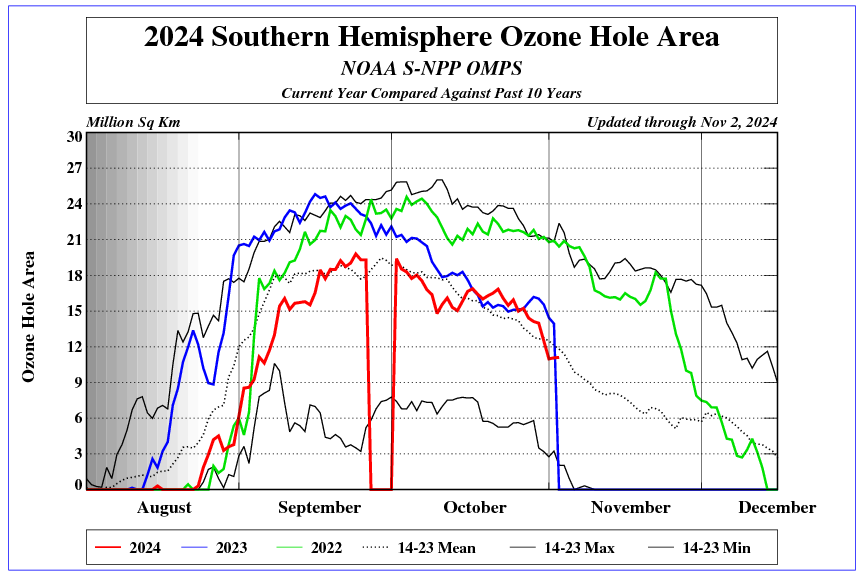
and the Southern Hemisphere Ozone “Hole” from August to December:
[caption id="" align="alignnone" width="578"]
There never was an ozone hole, the area of thinning is on average one third the average level of ozone measured in Dobson units. The term is, like the greenhouse effect, another PR term that underscores the political nature of the claims.
I pointed out to the Canadian Parliamentary Hearing on the matter that ozone is created by a photodisdassociation of oxygen by a portion of the ultraviolet section of sunlight. The assumption was, like with the greenhouse effect, that sunlight was constant. This meant you had no choice but to blame another agent for measured variations. They wanted a human agent and they had one already prepared from the lab experiments of Rowland and Molina. Like the IPCC they got a Nobel prize even though, as I understand, they did did not duplicate the temperature and pressure conditions high over Antarctica. Indeed, at that time they did not even know of the existence of Polar Stratospheric Clouds (PSC).
One human link between the ozone scam and the CO2 scam because of deep involvement with both was Susan Solomon.
http://en.wikipedia.org/wiki/Susan_Solomon
As Wikipedia notes; “Solomon was the first to propose the chlorofluorocarbon free radical reaction mechanism that is the cause of the Antarctic ozone hole.”
It also notes; “Solomon served as a contributing author for the Third Assessment Report[6] and Co-Chair of Working Group 1 for the Fourth Assessment Report[7] of the Intergovernmental Panel on Climate Change.[2]”
The Montreal Protocol was touted as proof the Kyoto Protocol could work, but as I pointed out to the Parliamentary committee neither China nor India were willing or required to participate.
Yes, the Ozone issue was a template for the greenhouse issue and just as falsely based and manipulated.
James Ard says: December 11, 2013 at 3:20 pm
The ozone hole hoax was good practice for becoming a climate skeptic. All of the same ingredients; media hype, end of the world predictions and a boogieman that actually benefited mankind.
Yep, a strong sense of Déjà vu, i.e.:
Time – Feb 17, 1992
I may be wrong about this, but it seems like I read that Freon (R-22) was too heavy to make it to the ozone hole and therefore unable to destroy the ozone hole. I do know this cheap refrigerant was banned and replaced by Puron (R-410a) which, by the way, is not pure because it is a very potent greenhouse gas.
I do know this, soon after Freon was banned I read about studies which showed how the ozone hole was affected by the angle of the sun. Then I believe I read something here on WUWT that how the ozone hole was only discovered when satellites started monitoring it and the assumption was the hole was man-made.
An attempt by somebody to ‘debunk’ this aspect; it would appear that the patents for such actually ran out in the 1950’s:
“R-12 Retrofitting: Are we really doing it because DuPont’s patent for Freon® ran out?”
http://www.imcool.com/articles/aircondition/refrigerant_history.htm
.
This might explain the rather strange statement the IPCC team members made, that they have a problem communicating “the science”.
They do sound bewildered and frustrated, as their methods worked so well in the ozone scare, perhaps they do not understand why the CO2 scare is failing so miserably.
The longer the ozone hole persists the more it looks to me that we the public were stampeded into the Montreal Protocol on emotion not science.
For the personal gain of a few agitators.
Same methods with CO2, no baseline measurements, imaginary effects and extending verification timelines into the future, every time nothing changes.
Yup, beginning in Part One “The Air above us”, in Chapter 3 tilted “Stratospheric Ozone and The “Hole”” on page 28 where the subtitle reads: “Now You See it; Now You Don’t” …
.
Kind of like trying to compare land survey measurement where the measurements, old and new, have no benchmarks nor any common, i.e. joint benchmark system by which to make a comparison. Therefore the old and the new are equally rubbish.
Not to worry.
CFC’s like CO2 have nothing to do with the physics of the problem.
btw: Luuza from luuzaville Hansen showed his face today for the Fart-iers of UgoFysics but behind massive security and quarantine. I did not attend. Heard from others he was slurring and miss-pronouncing words and otherwise showing his majesty navy ship a garbage scow of ill repute. Serves ’em right. Costing the AGU the entire top floor of the Marriott, tickets to the Seahawks-49ers game, [trimmed uncalled for] and demanding Exec-level Fed pay scale per hour and health benefits and 401(k) and 403(l) retirement entitlements.
Likely our dues will increase to $100 in 2014 to cover the scandal.
One day the membership will wake up and realize that the AGU President can’t blame Vietnam and agent orange for her “disabilities” any more.
[Yes, you’re angry. Watch your language nevertheless. Mod]
Occam’s Razor at work:
We have two competing hypotheses:
1) Most of the “ozone-depleting” chemicals are produced in the Northern Hemisphere. They would have to travel almost half-way around the Earth to get to the stratosphere above Antarctica, where they do their dastardly deed (but not until they arrive in the vicinity of the South Pole).
2) In his epic work on natural climate and natural climate change, the late Marcel Leroux wondered about Mt. Erebus. It would seem that this volcano has been in almost continuous eruption, for at least several hundred years (spanning the time humans have known about the existence of Antarctica). Now, Mt. Erebus is almost directly under the center of the south polar ozone “hole”.
Last time I checked, various compounds of Chlorine were constituents of volcanic gasses.
So, which is the simpler hypothesis?
Forget CO2, CFCs and whatever as this is worse than any catastrophists have thought of-
http://www.adelaidenow.com.au/travel/world/scientists-have-revealed-the-supervolcano-lurking-beneath-yellowstone-national-park-is-twice-as-big-as-previously-thought/story-fni0bxo5-1226781381769
We need all the resources we can lay our hands on to concrete over this lot and fast.
It’s very hard to make policy when changes and outcomes can be decades away. of course, that leads to panic and that’s what the climate change debate is mainly comprised of – panic on the one hand and ‘wait and see’ on the other. Either way – we’re doomed!
It begins (Fair use excerpt for discussion purposes):
So, worst case, take the 1935 date and add 20 years (patent lifetime) and the result is 1955. The patent, if valid in 1935, would have expired
in 1955 (if not before because of an earlier patent filing/grant date).
.
ALLRIGHT ! Let’s bring back R-22 ( . .or do I have that wrong, is it R-12) instead of R-134, for our automobiles, and get the price back donw to $1 per can or so . . .
. .geeez, I remembering looking into this, having to go to the Library to pull articles on the ozone over Antarctica, research by Dr. Dobson, who if I recall correctly, the ‘Dobson Units’ of ozone were named after, realizing this CFC scare was total BS.
Then with the Global warming, thinking that the ozone scare was a ‘warm-up’ to the CAGW garbage ( . .and an article by W. Happer of Princeton seemed to confirm that ( . .I KNOW i saved it as a link somewhere – just can’t find it now . . ).
WE’ve got to put an end to all this alarmism real soon . . .