We discussed the ISON ISOFF again nature of comet ISON in this WUWT thread, now it looks like ISOFF again.
From NASA’s Spaceweather.com (h/t Fernando): Comet ISON is fading fast as it recedes from the sun. Whatever piece of the comet survived the Thanksgiving flyby of the sun is now dissipating in a cloud of dust. (animation follows)
(Note: The animation may take a minute or more to load, based on your Internet connection speed.) Click to view a 3-day movie centered on perihelion (closest approach to the sun):
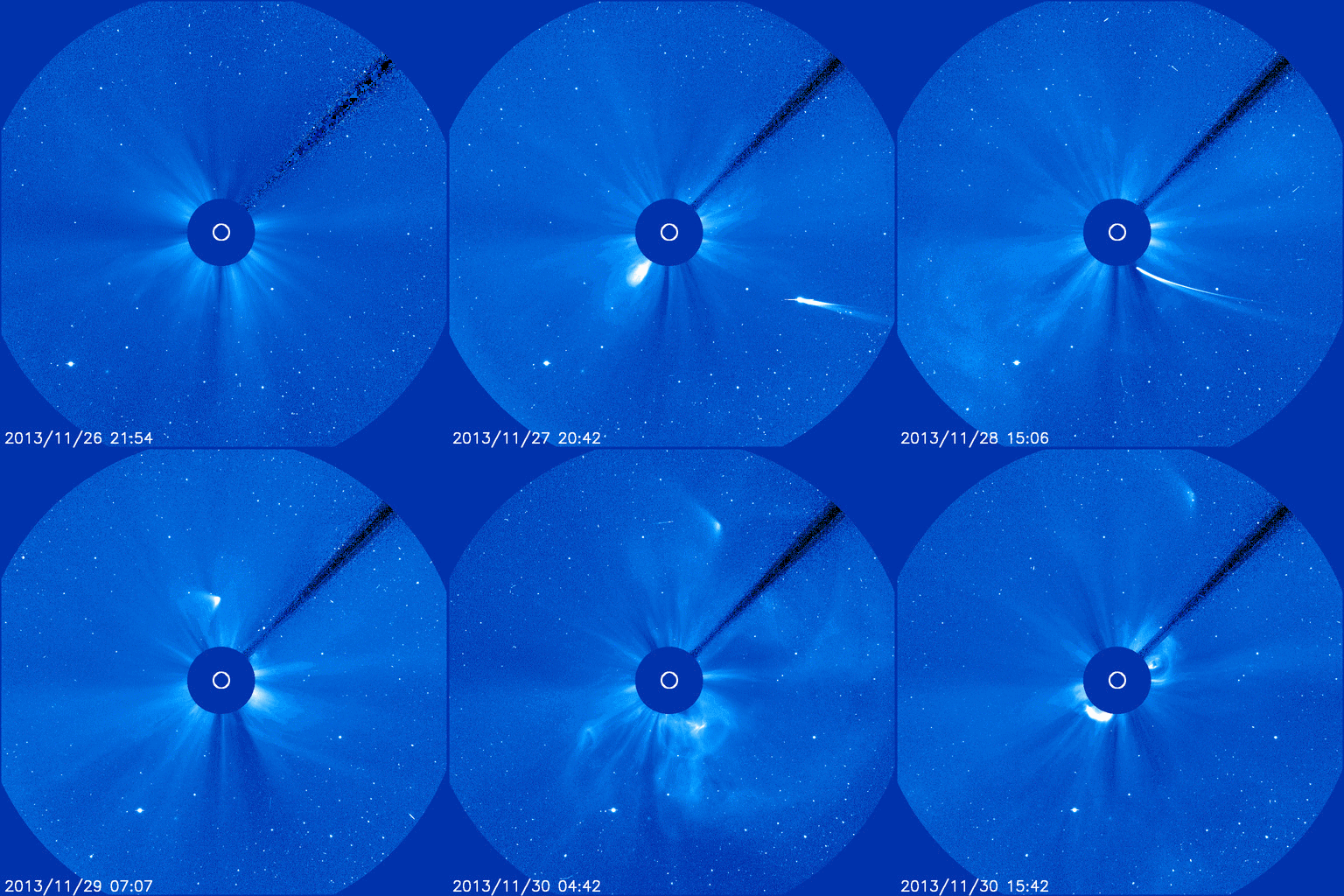
This development makes it unlikely that Comet ISON will put on a good show after it exits the glare of the sun in early December. Experienced astro-photographers might be able to capture the comet’s fading “ghost” in the pre-dawn sky, but a naked-eye spectacle can be ruled out.
On Nov. 29th, pilot Brian Whittaker tried to catch a first glimpse of Comet ISON from Earth, post-perihelion, from a plane flying 36,000 feet over the Arctic Circle in northern Canada. No luck:

“Ideal viewing conditions from the Arctic revealed no Comet ISON,” reports Whittaker. “This negative report is to quench the thirst of other fellow dreamers under cloudy skies or further south. Later I could see that SOHO showed the comet dimming further.”
Despite Whittaker’s negative result, it is too soon to rule out observations from Earth as the twice-dead comet moves away from the glare of the sun. Meanwhile, NASA’s fleet of solar observatory will be tracking the remains.
thankyou Leif. Thats a good contrast with my prediction – still in one piece and will brighten once the ion jets reorganise on a new side, happening before Earth pass.
The primarily volatile content of the ion tail suggested to me Ison is now healthy, just resting after the excitement.
That’s ook, there will soon be anoother sent froom the imaginary Obutt cloud. Oops, Oort.
hehe, yeah. Leif oort to know EU people think the oort cloud is a myth.
meemoe_uk says:
December 2, 2013 at 9:12 am
EU people think the oort cloud is a myth.
Ah, another false claim. Well, ISON disposes of that.
I asked if there was anywhere a published paper on EU comets. Still asking.
ison’s hyperbolic trajectory suggests it was from interstellar space, not from a high orbit.
I asked if there was anywhere a published paper on EU comets. Still asking..
Yes there is. But whats your point? A paper isn’t a magic wand. You are just going to say EU paper is rubbish.
I think there is a problem with the explanation of why comet ISON was the color green, it is being parroted about the web that “this is probably due to Cyanogen”, but I’ve been reading up on the Physical Properties of Cyanogen and I’ve noticed some flaws, the two that stuck out are “When cooled below -35° C liquid cyanogen freezes to a crystalline mass which melts at -34.4° C.” that would mean a percentage of Comet ISON was in a liquified state, the other flaw is with its spectrum, the ‘Detection and Estimation’ of Cyanogen contains prominent bands in the blue and violet. There is also Its critical temperature (when it becomes a gas) which is 124° C.
meemoe_uk says:
December 2, 2013 at 10:57 am
ison’s hyperbolic trajectory suggests it was from interstellar space, not from a high orbit.
Perturbations to the Oort cloud now and then sends a comet from there in a orbit [which is close to a parabola and can be either elliptic or hyperbolic, depending on the details of the particular perturbation] towards the inner solar system. http://en.wikipedia.org/wiki/Oort_cloud
“Analysis of the carbon and nitrogen isotope ratios in both the long-period and Jupiter-family comets shows little difference between the two, despite their presumably vastly separate regions of origin. This suggests that both originated from the original protosolar cloud, a conclusion also supported by studies of granular size in Oort-cloud comets and by the recent impact study of Jupiter-family comet Tempel 1.
Yes there is. But whats your point? A paper isn’t a magic wand. You are just going to say EU paper is rubbish.
If a paper is good it is a magic wand. You are correct in that if the paper is rubbish it will not be a magic wand. A published paper can be discussed, your hand waving cannot. So, show us the BEST EU published paper on comets.
meemoe_uk says:
December 1, 2013 at 2:15 pm
@sparks
Try starting…
TAKE 5
A comet is a charged body…
i don’t know anything about the Electric Universe theory, but, Einsteins theory E=MC2 means that that energy and mass are interchangeable, are you interpreting mass as a charge?
[snip – no more electric universe stuff – Anthony]
I’m with Leif, this electric universe stuff is all bad science
It’s also not something we embrace by our policy here at WUWT. Its in the same category as UFO’s/bigfoot as far as I’m concerned. Further comments on it will be snipped.
meemoe_uk says:
December 2, 2013 at 12:00 pm
“So, show us the BEST EU published paper on comets.”
http://www.thunderbolts.info/pdf/ElectricComet.pdf
Is not a published paper. Next one.
🙁
He tricked me into linking to it
I forgot WUWT policy for a moment
wow. this went downhill fast. mostly I just ignore people who talk a lot but don’t say much. far better than getting into a battle of wits against someone who is unarmed. best that can happen is they drag you down to their level. just makin’ an observation…
I shall say nothing about any particular theory, but only to notice that certain proponents have made predictions, though the degree of specificity and therefore falsifiability is somewhat doubtful. Still, I am happy to sit here and wait for any such predictions to come true, or not, and then apply the appropriate Bayes factor to my current subjective probabilities of validity of said hypotheses.
I’m sorry, I can’t help being a Bayesian. Except of course when I get into a frequentist mood 🙂
Rich.
See – owe to Rich says:
December 2, 2013 at 1:27 pm
I am happy to sit here and wait for any such predictions to come true, or not
Predictions are only useful if they are decisive, i.e. makes it possible to decide which theory fits best. The problem is that the predictions made are not of that caliber, as standard comet theory predicts the same outcome:
http://www.scientificamerican.com/article.cfm?id=comet-ison-sun-approach
“Just how bright it will get largely depends on whether ISON withstands its encounter with the sun or breaks up under the intense solar heat and tidal forces. If it survives, ISON is likely to flare much brighter than it is now as it curves back around the sun”.
As ISON now looks dead, it is doubtful it will revive. If it does, we still don’t know which theory to go with. If it does not, the same thing.
Leif, if the standard theory is correct it would, I think, be very unusual for ISON to brighten from now on at this late stage. So if it does brighten again, I’m going to add a brightness-dependent number of quatloos to the log Bayes pot belonging to the people who predicted that it will brighten. And if it doesn’t brighten I’m going to take some quatloos away from them and put some in the pot for the standard theories.
Of course, as you say, we all love a decisive “falsification” test, but in the absence of such we have to argue by the accumulation of evidence.
I do wish, though, that we had a spacecraft near enough to measure the size of the largest remaining lump of ISON.
Rich.
See – owe to Rich says:
December 2, 2013 at 2:10 pm
So if it does brighten again, I’m going to add a brightness-dependent number of quatloos to the log Bayes pot belonging to the people who predicted that it will brighten.
but that prediction was predicated on ISON surviving. If there is only a dust cloud left, neither theory would predict brightening, so you would have to have a third pot for your quatloos in and nobody would be the wiser. It is hard to tell if only dust is left. The best evidence would be if there was no brightening. If brightening occurs it may simply mean [in both theories] that more than just dust is left. Either way, you can’t tell. The prediction is not decisive.
but then, if one theory is indecisive while another is decisive and the evidence agrees with the decisive theory, science should discard the former and prefer the latter.
I agree with Leif, conventional theory is indecisive on the matter of Ison’s current integrity as a comet. There were aspects of the perihelion that I think weren’t given proper recognition which signalled the state of the comet.
meemoe_uk says:
December 2, 2013 at 2:18 pm
conventional theory is indecisive on the matter of Ison’s current integrity as a comet.
both theories are indecisive, so you can’t tell. Unless you make the claim [falsified by the observations] that ISON did not disintegrate and is intact as a significant rocky body.
I haven’t seen any evidence indicating Ison has disintegrated. Where is it?
meemoe_uk says:
December 2, 2013 at 2:33 pm
I haven’t seen any evidence indicating Ison has disintegrated. Where is it?
You mean where is ISON? It is gone, obviously. From empirical observations one must conclude that ISON is nowhere to be seen.
Did you see the way it behaved after perihelion?
Here: http://www.nasa.gov/sites/default/files/soho_c3_timelapse.jpg
That is an ex-comet, this comet is no more, it is pining for the fjords.
You mean where is ISON?
No I mean Where is evidence indicating Ison has disintegrated
meemoe_uk says:
December 2, 2013 at 2:59 pm
No I mean Where is evidence indicating Ison has disintegrated
ISON is nowhere to be seen. Where is evidence that it is still there, just invisible?
lsvalgaard says:
December 1, 2013 at 8:15 pm
dr svalgaard:
pearls before swine, and whatnot.
I may nitpick over grammar; I know better than to attempt to teach you anything about the sun. i read and learn. others might try that as well.
I suppose we return to normal science [I was trying to control the “Gavin ” that exists in all(/sarc) …. thank Rev]
Leif, please. [you know how much I respect you]
The math is simple.
SB ….sigma T ^ 4 …..
One million kilometers distance from the Sun
3 km diameter object [exaggeration]
Without greenhouse.
I have limitations in doing inquiry in English [sorry]
I suppose anything is volatile.
?? very wrong???
Gracias
fernando says:
December 2, 2013 at 3:44 pm
Leif, please. [you know how much I respect you]
The math is simple.
1000000 km from surface is 88 times closer to the center than the earth, so the radiation is 88^2 = 7744 times stronger. The fourth root of that is 9.4, so the temperature will be 9.4 times higher than the Earth’s. Say the Earth’s ‘bare’ temperature is 255K, then the comet’s would be 2400K or 2100C. Hot enough for you? You can play a bit with albedos etc, but the order of magnitude stays.