We discussed the ISON ISOFF again nature of comet ISON in this WUWT thread, now it looks like ISOFF again.
From NASA’s Spaceweather.com (h/t Fernando): Comet ISON is fading fast as it recedes from the sun. Whatever piece of the comet survived the Thanksgiving flyby of the sun is now dissipating in a cloud of dust. (animation follows)
(Note: The animation may take a minute or more to load, based on your Internet connection speed.) Click to view a 3-day movie centered on perihelion (closest approach to the sun):
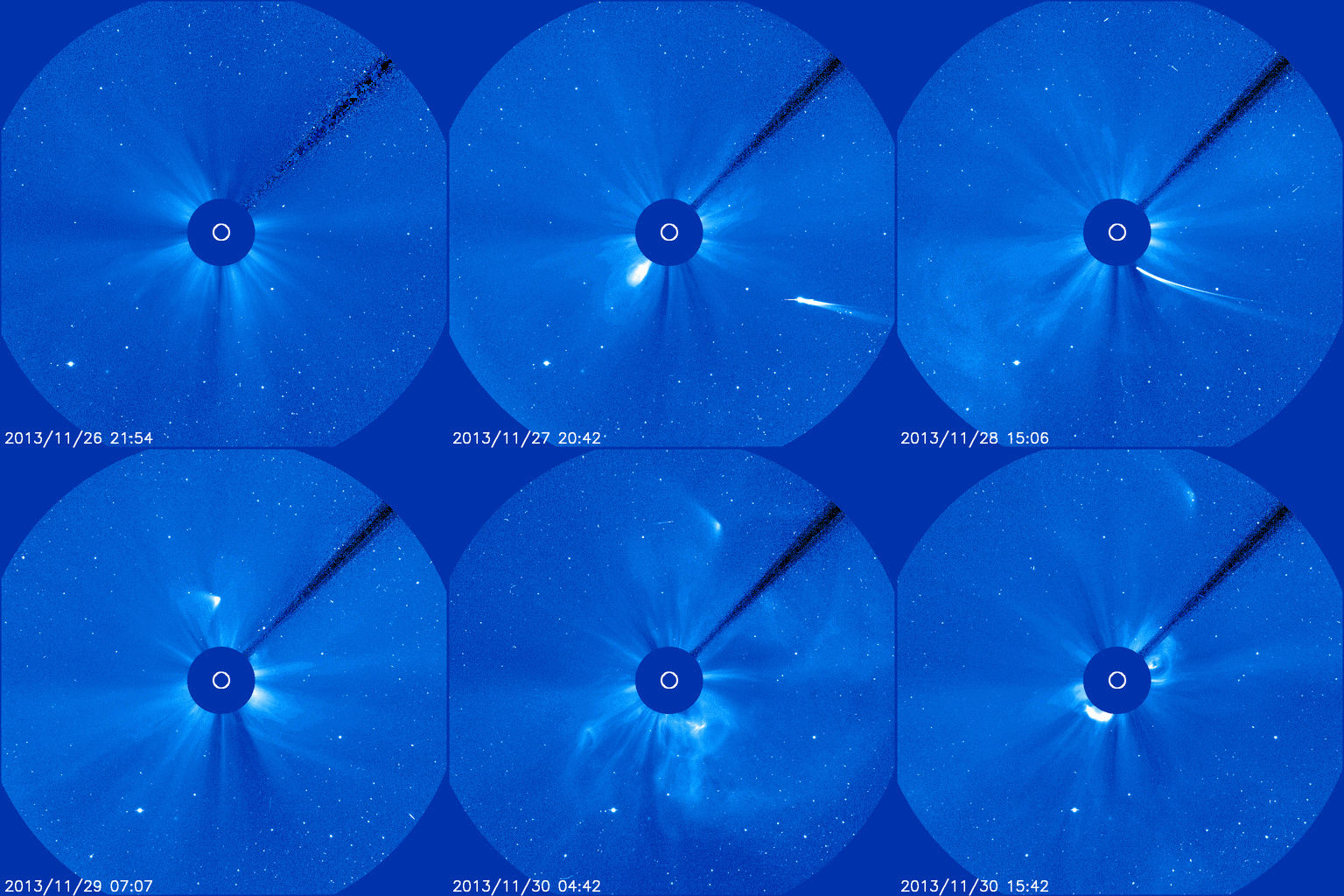
This development makes it unlikely that Comet ISON will put on a good show after it exits the glare of the sun in early December. Experienced astro-photographers might be able to capture the comet’s fading “ghost” in the pre-dawn sky, but a naked-eye spectacle can be ruled out.
On Nov. 29th, pilot Brian Whittaker tried to catch a first glimpse of Comet ISON from Earth, post-perihelion, from a plane flying 36,000 feet over the Arctic Circle in northern Canada. No luck:

“Ideal viewing conditions from the Arctic revealed no Comet ISON,” reports Whittaker. “This negative report is to quench the thirst of other fellow dreamers under cloudy skies or further south. Later I could see that SOHO showed the comet dimming further.”
Despite Whittaker’s negative result, it is too soon to rule out observations from Earth as the twice-dead comet moves away from the glare of the sun. Meanwhile, NASA’s fleet of solar observatory will be tracking the remains.
It looks like Comet Ison was a very small comet anyway. It wouldn’t have produced much for us on Earth.
Compare the out-gassing on SOHO Lasco C3 from other relatively unknown comets “Neat” and “Bradfield”. As Ison exited Lasco C3, it was nothing to compared to these comets and they turned out to be nothing when visible from Earth.
http://www.thunderbolts.info/tpod/2005/images05/050526neatcme.jpg
http://soho.esac.esa.int/comet1000/bradfield.jpg
mddwave says:
November 30, 2013 at 9:05 pm
A beginners comet observer question: Why was ISON’s fragmented tail not in line with the solar wind? Most comets I thought the tail was always away from the sun.
You’d think that this would be instantly noticed 1st thing by everyone who looks at the vids. But you’re only the 2nd person alive I’ve seen independently point it out .
The tail spins to 10deg off the tangential and then maintains this angle. This is 80deg off where theory predicts it should be, so can’t be ignored. When I commented on this, Leif evaded by talking about the trailing tail. when I asked again he said it was because of our perspective ( point of view ), our projection ( magnification of view ), and aberration effects. I thought this was obviously wrong.
perspective : If a line points to or away from an object, it does so from ALL perspectives, so this doesn’t explain a 80 degree anomaly
projection : no effect on angle at all
aberration : would curve the tail ( not observed ), would also have similar effect on trailing tale ( knock it out of expected angle by large angle ) , but this is not observed.
When I pointed this out Leif evaded not providing an explanation but instead saying trailing tail dynamics have been studied for over 50 year – i.e. ( who was I to dare question astronomers! )
At that point I didn’t bother debating with him any more, I was convinced he was wrong, so I had no more to gain. And I wanted to see if anyone else here would raise a red flag at Leif to say perspective, projection and aberration can’t cause angles to be off by 80deg. There was a few comments of support, but no one pointed out his 1+1=3 style error. A mixed bag of they weren’t reading, they are too scared to question him, they are blind faith supporting him, or they don’t know that a line pointing to or away from an object does so from all perspectives.
I’ve asked around in dedicated comet forums, and no one can explain with conventional theory why the angle was off by 80degrees. The word from NASA is that the comet has defied a lot of theory and left them baffled. The only supposed authority in the whole world who seems to think the comet hasn’t done anything unusual by conventional astronomy is …. Leif.
links to COR2 satellite views of ison perihelion
http://www.isoncampaign.org/karl/a-trail-of-questions
http://www.isoncampaign.org/files/images/blogpics/ison_stereo.gif
@meemoe
>The tail spins to 10deg off the tangential and then maintains this angle.
>This is 80deg off where theory predicts it should be, so can’t be ignored.
But how do you know that it’s not aligned with solar wind? This close to the Sun there is more turbulence from filaments, CMEs etc. Do you have an actual (i.e. not theoretical) map of the solar wind vectors in the vicinity of the comet?
😐
Because the solar wind is not moving directly away from the sun. There is some lateral motion caused by the Sun’s rotation and turbulence due to flares and CME’s.
http://www.solarham.net/cmewatch2.htm
Good point, but the lateral motion of the solar wind is small and insufficient compared to the 80degree difference in expect angle. So the conventional theory : the solar wind is knocking atoms off the comets surface and off and the collision takes them off in the similar direction as the wind. Seems wrong.
You should consider what is forcing the solar wind to rotate.
I really like the solar wind model in your link. I hope it’s a model in the sense its a conversion of raw data from dedicated solar wind measuring instrument, i.e. its a model in the same way a camera ‘models’ views into images.
It offers a beautiful and clear illustration of that CME coinciding with Ison.
Just one of the most perfect pieces of evidence we’ve got.
Wonder if Leif fancies trying to assert it was just sheer co-incidence.
Or will he cave in and admit that Ison interacted the the sun and provoked the CME via massive electromagnetic influence.
Chapman derailed astronomy in the 1950s with his insane zero electricity is space obsession.
But how do you know that it’s not aligned with solar wind?
Because you can see the solar wind coming off the sun in the vids. At that close range the angle of rotation is too small to be noticeable. Compare this with the 80degree anomalous angle of the comets tail.
edit : doof, i should have more faith in my theory. That explosion in the solar wind observed on
http://www.solarham.net/cmewatch2.htm
wasn’t a CME. It was Ison.
I just reflex assumed anything that powerful was a CME. I think others have made the same mistake and asserted it was a CME.
So a good question is how the heck did Ison cause such a massive CME style shock wave to the solar wind?
Leif?
@meemoe
> So a good question is how the heck did Ison cause such a massive
> CME style shock wave to the solar wind?
Because it didn’t happen. You’re looking at a 4-day forecast/prediction based on a theoretical magneto-hydrodynamic model. There were no reported CMEs at that timeframe and it certainly doesn’t appear on Soho Lasco (which is orbiting a million miles from earth at the L1 Lagrangian point) imagery of Ison (which i_s_ real).
http://www.swpc.noaa.gov/wmo/solar-wind.php (WSA-Enlil Solar Wind Prediction)
I think that “sideways” tail of Ison is pointing in the direction which was “outward” when the outgassing began. So it has some momentum which will try to keep it streaming in the same direction. But if you look closely, you can see that the solar wind is trying to rotate it. It has a noticeable clockwise vorticity.
When drawing conclusions of such grand scale, you must look before you leap!
😐
Because it didn’t happen. You’re looking at a 4-day forecast/prediction based on a theoretical magneto-hydrodynamic model.
You sure? Why would a model predict a massive violent shockwave days in advance without any forseeable cause?
two things
a-loss “volatile” material.
Knowing that the region has low density, sudden decompression of ‘volatile’ material. Consequently an extra [not related to any CME] shine
b-non “volatile” material was fragmented. These heated debris emitted light causing the illusion of a tail.
Although not correct my interpretation. I do not see the need for a “new astronomy”
Re: the comet’s tail not being straight out from the solar wind. I noticed this too, and wondered. But then I thought that maybe the comet’s angular speed across the disc of the sun had something to do with it.
Consider a garden hose. The water comes straight out of the nozzle, like the wind from the Sun. In normal conditions, a comet is so far from the sun that it has nearly zero change in angular velocity (if I’m using the term correctly) across its disk. It’s like you pointing the garden hose in one direction and leaving it there. However, if you move the nozzle rapidly from left to right, the stream of water describes a curve due to the fact that the water that came out of the nozzle 0.1s ago is not moving on the same trajectory as the water coming out of the nozzle now. Could the rapid motion of ISON across the face of the Sun cause the same effect with a comet tail?
The Tails of a Comet:
The gas which is blown away from the coma is ionized by the Solar radiation and becomes electrically charged. It is then affected strongly by the magnetic fields associated with the Solar wind (a stream of charged particles expelled by the Sun).
The gas tail is made visible by line-emissions from the excitation of the gas by the Sun’s radiation. This gives the gas tail its characteristic blue colour. The geometric shape of the tail is governed by the magnetic structures in the Solar wind, but predominantly, the gas tail points directly away from the direction from the comet to the Sun.
The dust which is blown away from the coma, is blown by the Sun’s radiation and it moves in a direction which is governed by the motion of the comet, by the size of the dust particles, and by the speed of ejection from the coma. The dust tail can be complex, multiple and even curved but, in general, will point away from the Sun.
Sometimes, due to projection effects, part of the dust tail can be seen pointing in a sunward direction. This is just due to the fact that the comet and the Earth are moving, and that part of the tail has been ‘left behind’ in such a place as to appear to point towards the Sun.
From http://www.oarval.org/section3_15.htm (Comets, Science and Engineering Research Council, Royal Greenwich Observatory)
@meemoe
>You sure? Why would a model predict a massive violent
> shockwave days in advance without any forseeable cause?
I was surprised by this too. So I checked Solen (http://www.solen.info/solar/) for the CME data for that timeframe. He reported no Earthward CME activity. Then I watched the LASCO video again, several times, to see if there was any hint of an explosion around 28-Nov@1900Z. Couldn’t see anything. Something that big should have shown up clearly in the video.
I always assumed the WSA-Enlil was tracking and forecasting at the same time, given some real CME event data. So I’m not sure what “seeded” this forecasted “event”, but note that they’re forecasting it to hit Earth on 3-Dec with a big storm bump. (Eventtually a report will be written on these CME events, but they’re six months behind in publishing these).
I just can’t see how Ison could have caused something that big, with no effect on its own presentation and orbit, which shows nothing unusual, IMO.
In the future I will be much more skeptical about the predictions of this NASA product.
😐
re: direction of the tail.
You are all assuming (it appears to me) that you are viewing the images in a flat plane from above. If ISON is behind and above the sun, the tail will appear to have a different angle relative to the CME’s etc that you also see in the frame moving directly away from the sun.
The tail is pointing away from you (and the sun). The CME’s are moving in a different direction. Because of the different vectors the angles appear different from our flat perspective. Gotta think in three dimensions.
“His pattern indicates two-dimensional thinking.” — Spock. The Wrath of Kahn
In the future I will be much more skeptical about the predictions of this NASA product.
Doh. Well if your right ( i think you are ), I don’t feel to foolish getting hyped by that model. I don’t expect NASA to just cook stuff up for no reason, and the model is set 3 days ago, so I too assumed its a measurement-prediction mix.
You are all assuming (it appears to me) that you are viewing the images in a flat plane from above.
I’m not.
I know the positions of the satellites. SOHO is at the infront of the Earth Lagrange point and the COR2 satellites are marked on this map
http://www.isoncampaign.org/files/images/blogpics/ison_stereo.gif
But the key assertion is unaffected by perspectives. A line that is radially aligned is radially aligned from ALL perspectives. So since it wasn’t radially aligned from the LASCO perspective it wasn’t radially aligned.
Seems to be a trickier concept than I thought. Point a pen or a stick at a ball. then move around, No matter what perspective you have the pen will always point at the ball.
meemoe_uk says:
December 1, 2013 at 7:10 am
So a good question is how the heck did Ison cause such a massive CME style shock wave to the solar wind? Leif?
It did not. The solar wind magnetic field if reversing directions [does that two to four times per month] it can steal the comet’s tail. We have observed thousands of comets and the tail behavior is well-studied and well-understood. ISON is not special as far as I can see.
And, BTW, nobody is ‘baffled’ about the direction of the tails, except perhaps you.
Several commenters have attempted to explain to you that you think in 3D. Study what they said and learn.
meemoe_uk says:
December 1, 2013 at 10:02 am
A line that is radially aligned is radially aligned from ALL perspectives.
The flaw in this argument is your assumption that the tail is a stiff, rigid rod. It is not, a piece of the tail is moving away with the solar wind while the comet’s head is also moving [and in a different direction], so the line connecting the head and a tail piece changes direction constantly and will never be aligned with the radial.
Comet Ison destroyed by Global warming…..
On Thursday, Comet ISON was approaching the perihelion, the closest point to the Sun on its trajectory. Centuries ago, before the climate began to change, such a moment in the life of a comet would be an important event for the religious societies. However Comet ISON was largely destroyed. The experts are not quite sure about the cause but most of the researchers mention the global warming. The Solar System is being catastrophically heated up by the man-made emissions of CO2, especially by those produced by the corporations in countries with GDP per capita exceeding $20,000, particularly those countries which tolerate a larger number of the climate change deniers, heretics, and other contrarians.
H/T Lubos Motl
Print this in the “Guardian” and it will be repeated as Gospel by the brain-dead numpties in the BBC and Parliament.
All comets are electrically neutral until they interact with the suns magnetic field, when a comet is traveling towards the sun it begins to experience ionization, the rate of which, increases the closer to the sun it gets, this ionization process on a comet is actually all the atoms or a molecules trying to magnetically align them selves with the suns magnetic field, this results in an ion tail as atoms or a molecules near the surface of the comets nucleus become lose and begin to free them selves from the parent comet, this also produces turbulence which causes larger dust particles and ice (which have a greater number of atoms or a molecules) to become lose from the parent body where they separate and eventually become neutral or balanced with the suns magnetic field.
Hello all,
to who is interested in science here without access to CBET telegrams,
here is a latest CBET 3731 about comet ISON.
Best regards,
Jakub Cerny
Electronic Telegram No. 3731
Central Bureau for Astronomical Telegrams
INTERNATIONAL ASTRONOMICAL UNION
CBAT Director: Daniel W. E. Green; Hoffman Lab 209; Harvard University;
20 Oxford St.; Cambridge, MA 02138; U.S.A.
e-mail:cbatiau@… (alternatecbat@…)
URLhttp://www.cbat.eps.harvard.edu/index.html
Prepared using the Tamkin Foundation Computer Network
The comet’s nucleus apparently disrupted near perihelion, with the
comet’s head fading from perhaps a peak brightness of visual mag -2 some
hours before perihelion to well below mag +1 before perihelion. M.
Knight, Lowell Observatory, finds that the comet peaked around visual
mag -2.0 around Nov. 28.1 UT, adding that the brightest feature in the
coma of the comet faded steadily after perihelion from about mag 3.1 in
a 95″-radius aperture when the comet first appeared from behind the SOHO
coronagraph occulting disk on Nov. 28.92 to about mag 6.5 on Nov.
29.98. K. Battams, Naval Research Laboratory, writes that, based on the
most recent LASCO C3 images (Nov. 30.912 UT), there is no visible
nucleus or central condensation; what remains is very diffuse, largely
transparent to background stars, and fading; it appears that basically a
cloud of dust remains from the nucleus. S. Nakano, Sumoto, Japan,
writes that he measured the comet’s total magnitude in a 27′ photometric
aperture from the SOHO C3 camera images to be as follows: Nov. 29.383,
0.5; 29.755, 1.4; 30.013, 2.0; 30.496, 3.0; 30.883, 5.4.
Z. Sekanina, Jet Propulsion Laboratory, reports that, from the
position of the northeastern boundary of the comet’s fan-shaped tail in
three images taken with the C3 coronagraph onboard the SOHO spacecraft
between 0.7 and 1.9 days after perihelion (Nov. 29.46 to 30.66 UT), he
finds that the comet’s production of dust terminated about 3 hours
before perihelion. Although this result is preliminary, it is unlikely
to be significantly in error, because the position angles of a
perihelion emission are off in the three images by 14-22 deg, and those
of post-perihelion emissions still more. The peak radiation-pressure
accelerations derived from the tail boundary’s angular lengths
(estimated at 1.8-2.5 deg) are about 0.1-0.2 the solar gravitational
acceleration, implying the presence of micron-sized particles. The
estimated time of terminated activity is consistent with the absence of
any feature that could be interpreted as a condensation around an active
nucleus in the 20 or so images taken with the C2 coronagraph on Nov.
28.8-29.0 UT (0.8 to 5.4 hr after perihelion) and with the appearance of
a very sharp tip (replacing a rounded head) at the comet’s sunward end
in the C2 images starting about 4 hr before perihelion and continuing
until its disappearance behind the occulting disc around Nov. 28.74 UT
(or some 50 minutes before perihelion). The time of terminated activity
is here interpreted as the end of nuclear fragmentation, a process that
is likely to have begun shortly before a sudden surge of brightness that
peaked nearly 12 hr prior to perihelion. Fine dust particles released
before perihelion moved in hyperbolic orbits with perihelion distances
greater than is the comet’s, thus helping some of them survive. The
post-perihelion tail’s southern, sunward-pointing boundary consists of
dust ejected during the pre-perihelion brightening. However, the
streamer of massive grains ejected at extremely large heliocentric
distances, so prominently seen trailing the nucleus along the orbit
before perihelion (cf.CBET 3722), completely disappeared. The dust
located inside the fan, between both boundaries, was released in
intervening times, mostly during the last two days before perihelion.
The strong forward-scattering effect (phase angles near 120-130 deg) has
tempered the rate of post-perihelion fading of the comet, but the
merciless inverse-square power law of increasing heliocentric distance
is necessarily the dominant factor in the comet’s forthcoming gradual
disappearance.
H. Boehnhardt, J. B. Vincent, C. Chifu, B. Inhester, N. Oklay, B.
Podlipnik, C. Snodgrass, and C. Tubiana, Max Planck Institute for Solar
System Research, Katlenburg-Lindau, reports that two diffuse tail
structures were analyzed in post-perihelion images obtained by the
LASCO-C3 corongraph onboard the SOHO spacecraft between Nov. 29.60 and
29.81 UT. The southward tail extended toward p.a. about 167 deg to
about 0.4 deg distance from the central brightness peak. The eastward
tail had an approximate position angle of 68 deg and extended to at
least 1.2 deg distance. By Finson-Probstein simulations, the eastward
tail can best be interpretated as being caused by a dust release about 1
hr around perihelion. The maximum beta value in the eastward tail
reaches values up to 1.5, typical for graphite or metallic grains of
about 0.1 micron radius. No indications are found for a continuation of
the release of similar dust after 2 hr post-perihelion. The shorter
southward tail may be a relict of heavier grains released about 1-2 days
before perihelion passage. Diffuse cometary material is noticeable in
the p.a. range covered by the two dust tails. The match of the
synchrone pattern for the eastward tail is not optimal, which may
indicate secondary effects to the dust grains involved.
NOTE: These ‘Central Bureau Electronic Telegrams’ are sometimes
superseded by text appearing later in the printed IAU Circulars.
(C) Copyright 2013 CBAT
2013 December 1 (CBET 3731) Daniel W. E. Green
http://groups.yahoo.com/neo/groups/comets-ml/conversations/messages/22839
Sparks says:
December 1, 2013 at 10:53 am
All comets are electrically neutral until they interact with the suns magnetic field,
They stay neutral. That something is ionized does not mean it is charged, just that free charges [of both signs] exist.
lsvalgaard says:
December 1, 2013 at 11:05 am
They stay neutral. That something is ionized does not mean it is charged, just that free charges [of both signs] exist.
That’s an interesting point Leif, though, my comment doesn’t refer to a charge.
Sparks says:
December 1, 2013 at 11:40 am
That’s an interesting point Leif, though, my comment doesn’t refer to a charge.
Then you need to get your terminology right. ‘Electrically neutral’ means ‘without net charge’. ‘Stay neutral until…’ means ‘stay without net charge until…’, thus when no longer neutral there is net charge.
Fernando, something is in the air tonight, the stars are bright, Fernando. Unfortunately it is the stars and not the comet. I was just beginning to think that all the speculation here about the formation of the “fan-tail” could do with some real scientific analysis, so thank you ever so much for sharing that with us.
Rich.
Leif,
I did mention ‘molecules’ three times in my comment, which are set-apart from ions by their lack of electrical charge in context.