We discussed the ISON ISOFF again nature of comet ISON in this WUWT thread, now it looks like ISOFF again.
From NASA’s Spaceweather.com (h/t Fernando): Comet ISON is fading fast as it recedes from the sun. Whatever piece of the comet survived the Thanksgiving flyby of the sun is now dissipating in a cloud of dust. (animation follows)
(Note: The animation may take a minute or more to load, based on your Internet connection speed.) Click to view a 3-day movie centered on perihelion (closest approach to the sun):
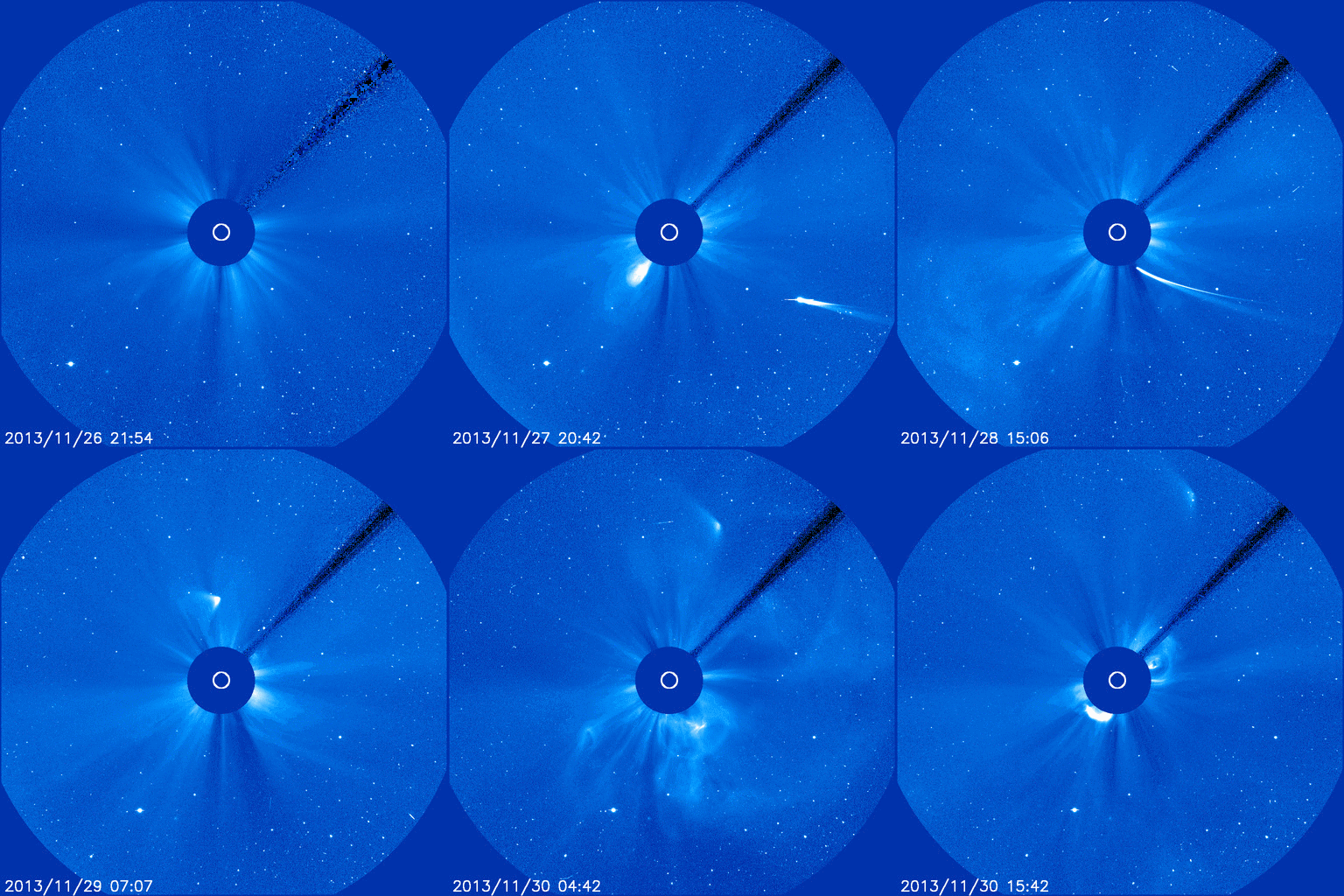
This development makes it unlikely that Comet ISON will put on a good show after it exits the glare of the sun in early December. Experienced astro-photographers might be able to capture the comet’s fading “ghost” in the pre-dawn sky, but a naked-eye spectacle can be ruled out.
On Nov. 29th, pilot Brian Whittaker tried to catch a first glimpse of Comet ISON from Earth, post-perihelion, from a plane flying 36,000 feet over the Arctic Circle in northern Canada. No luck:

“Ideal viewing conditions from the Arctic revealed no Comet ISON,” reports Whittaker. “This negative report is to quench the thirst of other fellow dreamers under cloudy skies or further south. Later I could see that SOHO showed the comet dimming further.”
Despite Whittaker’s negative result, it is too soon to rule out observations from Earth as the twice-dead comet moves away from the glare of the sun. Meanwhile, NASA’s fleet of solar observatory will be tracking the remains.
Hans Erren says:
November 30, 2013 at 2:34 pm
That’s a nice mockup!
*Produce NOT “producing”… lol
Dead, undead, disundead…reminds me of antidisestablishmentarianism.
That was my assessement too, especially after looking at Bryan A’s projected vs actual trajectory overlay:
http://wattsupwiththat.com/2013/11/30/zombie-comet-ison-dies-again/#comment-1488303
So it looks like the comet has been in free fall for the last three days. Yes it passed near the sun inside the corona, But the corona is very thin, virtually a vacuum, and exerted no significant braking forces on the comet. (Otherwise the trajectory would have changed.)
No disintegration has been observed, other than some outgassing. The outgasssing must have been caused by heating and was mostly uniform, otherwise a directed outgassing would have changed momentum into a different trajectory. But otherwise the rocky part of the comet is probably intact.
So why did the brightness fade, causing great concern here that the comet was “dead”?
I don’t know, but I don’t think the comet has vanished. Too much mass to account for.
Not knowing the spectral response of C3, I’m guessing that part of the brightness was caused by solar light reflected from the gassy part of the comet, which is now gone. Another part may have been radiation from comet, glowing from absorbed solar light, which is now cooling and dimming.
My two cents. So I’m applying Conan-Dolye logic here: “What else could it be?”
😐
ISON is a vastly diminished young comet, with volatiles nearly exhausted, with dormancy and extinction in its future. It will not likely, certainly soon, get this hot again so its remaining volatiles are are frozen under a relatively inert layer.
Assuming it has remaining volatiles sealed inside a shell formed by a frozen layer, could continued thermal contraction of the shell with cooling, lead to enough tension to tear a fissure in the shell?
To expose relatively warm volatiles to freezing? Look at the ripples on Enceladus
So can we get some of the EU folks to explain how their prediction utterly failed?
I recall “as the comet moves further from the sun, the magicthingamajig will hooziewhatsit and it will get brighter, something arc plasma nonsense padiddle” or something roughly along those lines.
Comets are subversive. Church-goers of the yore were right to fear them. They kill ideas.
Are you refering to this, from “CO2-Rich” yesterday?
http://wattsupwiththat.com/2013/11/28/comet-ison-appears-to-be-toast/#comment-1487086
“A further question would be whether, if part of it was pulled slightly apart, as it moves further away from the Sun and the inverse cube effect decreases more rapidly than its own internal inverse square effect, could it come back together again? Someone, somewhere, may already have calculated this sort of thing.”
That’s not a prediction. More of a speculative question, and irrelevant because (I think) he was assuming that tidal forces had ripped the comet apart, which was not the case.
Also nothing to do with EU. [Disclaimer: I’m not an “EU folk”]
But can we at least say that your recollection of this has “utterly failed”? :-]
:
John Day, there are a few statements you made in your post of November 30, 2013 at 4:49 pm that I would like you to clarify or expand upon. I do admit that I am a complete and total layman concerning anything scientific about comets, however some of your statements beg explanation.
In you post you say:
…That was my assessement too, especially after looking at Bryan A’s projected vs actual trajectory overlay:
http://wattsupwiththat.com/2013/11/30/zombie-comet-ison-dies-again/#comment-1488303
Well, I looked at that image you quoted and looked at that image and looked at that image and I can not see a projected trajectory versus and actual trajectory. Was this the image you meant to link to? Mind you I am older, accused of being daft and prone to posting curmudgeon post here, but I honestly don’t see what you seem to be claiming to see. What am I missing?
This part of your post really makes me wonder:
… So it looks like the comet has been in free fall for the last three days. …..
Huh, yeah. It’s a comet. It has been in “free fall” for a great number of years and even though it is now outbound from Sol, isn’t it still it technically in “free fall”. What did you actually mean by that?
….Yes it passed near the sun inside the corona, But the corona is very thin, virtually a vacuum, and exerted no significant braking forces on the comet. (Otherwise the trajectory would have changed.) ….
It would have changed? You sure about that? At these distances are you so sure and based on what math?
Now this next part really makes me wonder about what the heck you are thinking or smoking:
No disintegration has been observed, other than some outgassing. The outgasssing must have been caused by heating and was mostly uniform, otherwise a directed outgassing would have changed momentum into a different trajectory. But otherwise the rocky part of the comet is probably intact.
Ok, outgassing is a loss of mass and therefore disintegration. “The outgassing must have been caused by heating…” Duh. “…..and was mostly uniform, otherwise a directed outgassing would have changed momentum into a different trajectory.” By what model, standard of observation or is this just your theory? And with just a few days of looking for what does remains of ISON, is it enough trajectory to accurately say that the trajectory has not changed? Does Shoemaker-Levy 9 bring anything to mind?
Just some questions. I admit that I am under informed and I am willing to be educated. Just don’t try to bullshhitte me.
@Randall_G
>I looked at that image you quoted and looked at that image and looked at that image
>and I can not see a projected trajectory versus and actual trajectory.
“Bryan A” said it was “projected trajectory overlaying the actual path”. If so, then it looks perfect, at this large scale. If you zoom in you can see what looks like ‘o’ overlayed on ‘x’ (just the four corners of the ‘x’ sticking out.
BryanA, can you confirm that it is correct?
>and even though it is now outbound from Sol, isn’t it still it
> technically in “free fall”. What did you actually mean by that?
Yes, you got it right, the comet is in orbit around the Sun, so is in ‘free fall’. That wouldn’t be the case if it was being subjected to braking forces, which will steal kinetic energy and even cause it to disintegrate. But such forces, if they were significant, would cause the trajectory to change, which would have shown up as a ‘divergence’ on Byan_A’s diagram. But we didn’t see any divergence, so I claim there is no significant braking. (Assuming of course that Bryan’s diagram is correctly showing almost perfect alignment of projected vs actual trajectory)
> It would have changed? You sure about that?… Based on what math?
Based on the knowledge that the density of the corona is exceedingly thin, almost a vacuum. Not enough matter there to cause any _significant_ braking. Again, if there were any braking large enough to cause the comet to break apart and disintegrate, a large amount of its kinetic energy would be lost as heat (friction etc), and would be readily observable as a divergence in the trajectory. Again, we see no such divergence (assuming Byran’s diagram is correct)
>outgassing …and was mostly uniform, otherwise a directed outgassing would have changed
>momentum into a different trajectory.”
>By what model, standard of observation or is this just your theory?
The outgassing is visible in the imagery, probably accounting for its brightness (I said I was guessing there). Again, since we see no change in trajectory, the loss of mass/momentum resulting from this outgassing must have been slight. I also assumed that it was ‘uniform’, meaning in all directions, because that would tend to avoid causing any divergence in trajectory.
>And with just a few days of looking for what does remains of ISON, is it enough trajectory to > accurately say that the trajectory has not changed?
I confess that I came up with this assessment quickly by just looking at the videos and Bryan’s diagram, which seems to show, at a rather large scale, no divergence in the expected orbit. Also looking at the video I saw no large perturbations or trauma in the motion of comet as seen by the imagers.
So it’s a kind of ‘back of the envelope’ assessment, but intuitively it seems correct and I haven’t seen or heard about any observations that would contradict this assessment. If I did I would certainly retract or revise my assessment.
> Just some questions. I admit that I am under informed and I am willing to be educated.
>Just don’t try to [BS] me.
Those were good questions. Thanks for asking them. Hope it will further the discussion along more discussion of the science behind the events.
:-]
There, found it.
@max
> There, found it.
I see and share your skepticsm about these claims.
😐
A beginners comet observer question: Why was ISON’s fragmented tail not in line with the solar wind? Most comets I thought the tail was always away from the sun.
Just sayin…..
And what is this “fantastic gravity assist” he is talking about? In what frame of reference? Swings and roundabouts. Seems to have a very shaky grip on reality.
http://www.coasttocoastam.com/pages/ison-survives-changes-course
This was the source story for the image I linked to. In the larger version, it appears that the projected trajectory is the path marked by the asterisks. The actual trajectory, while not noted, is marked at the end by the glowing coma remnant to the left of the asterisk path. I would estimate that the change in trajectory is from the 800,000 mph perihelion speed acting on the reduced mass. Comet ISON/ISOFF was likely a relative loosely packed 3 or 4k diameter dirty snowball
Those two paragraphs almost look like total contradictions; covering the ‘bet’ both ways can I assume?
I also think the term ‘outgassing’ is a poor choice of terms for what you and others may be referring to as a ‘boiling’ of some constituent material in the comet (i.e., material changing from a solid to a liquid to a gaseous state); why hadn’t most of this material already ‘boiled’ off in previous ‘grazing’ approaches in previous years’ passes? Perhaps we have seen one of the final passes of this comet?
.
Let me venture to say in very general terms: it was re-grouping after experiencing mild dispersion and ‘delay’ after passing so close and in the face of ejecta (solar wind) from the sun. Heavier, more massive portions/dust/etc of the comet would be effected less than the lighter material comprising the ‘tails’ et al.
Leif referenced this re: tails yesterday: http://en.wikipedia.org/wiki/Antitail
.
Alan Robertson says:
November 30, 2013 at 12:29 pm
####
That was a very lovely.
Kev-in-uk said:
Yes, a long while. Galileo taught us that size doesn’t matter when it comes to gravity (in a particular well defined sense). So every lump on or near ISON is tending to follow roughly the same orbit. But assuming that there are collisions between the lumps then some energy is lost to heat and some momentum is exchanged from one lump to another. If a bigger lump hits a smaller lump then the smaller one will have its momentum changed by more. Depending on the direction of the impact this might accelerate it outwards or inwards from its original orbit. So a spread, or fan, of debris around the nucleus is not in my view an unlikely outcome.
The thing that does surprise me though is that overall the comet appears to have moved outside its original trajectory (see Bryan A’s clarification above), which suggests a gain in energy (unless counteracted by an extra loss in velocity). If it had been completely atomized at some point then perhaps radiation pressure could explain that. Or, when it went ‘poof’ did some energetic CME give it a big enough nudge to push its (mean) orbit outwards?
Rich.
Small correction: the smaller lump doesn’t have its momentum changed by more. Momentum of equal magnitude but opposite direction is exchanged between the lumps, and since momentum is mass times velocity the smaller lump gets a bigger change in velocity.
Rich.
@Bryan A
>The actual trajectory, while not noted, is marked at the end
>by the glowing coma remnant to the left of the asterisk path.
I think you posted the wrong image from the Noory site. The image at the very bottom does show the overlay of the expected path. Yes, it diverges slightly coming out. But it wasn’t even following the expected path exactly coming in either, so it wasn’t 100% accurate.
Kinetic energy can disappear by conversion to heat through friction. But the total momentum of a closed system can’t change unless it is transferred to another body by collisions etc. But it looks like it the comet is still following its intended orbit around the sun.
Some mass was obviously lost in the observed outgassing. That could change the motion if the percentage of mass is large compared to the solid residue, because it would have move in the opposite direction to conserve momentum. But if the outgassing was uniform in all directions, then the net change in momentum would be zero. This again is consistent with the smooth orbit.
As I said before, I didn’t see evidence of major changes in motion or any big path-changing impulses, so based on this preliminary ‘eyebal’l assessment of the imagery, Ison looked relatively unscathed by its adventure around the Sun. It has dimmed but it’s not dead.
😐
@mddwave
> Why was ISON’s fragmented tail not in line with the solar wind?
Because the solar wind is not moving directly away from the sun. There is some lateral motion caused by the Sun’s rotation and turbulence due to flares and CME’s.
http://www.solarham.net/cmewatch2.htm