


Image Credits: NASA, BP.Blogspot.com, Wikimedia.org
By WUWT regular “Just The Facts”
NOAA’s State of the Climate In 2008 report found that:
The simulations rule out (at the 95% level) zero trends for intervals of 15 yr or more, suggesting that an observed absence of warming of this duration is needed to create a discrepancy with the expected present-day warming rate.
In 2010 Phil Jones was asked by the BBC;
“Do you agree that from 1995 to the present there has been no statistically-significant global warming?”
Phil Jones replied:
Yes, but only just.
In 2011, the paper “Separating signal and noise in atmospheric temperature changes: The importance of timescale” by Santer et al. moved the goal posts and found that:
Because of the pronounced effect of interannual noise on decadal trends, a multi-model ensemble of anthropogenically-forced simulations displays many 10-year periods with little warming. A single decade of observational TLT data is therefore inadequate for identifying a slowly evolving anthropogenic warming signal. Our results show that temperature records of at least 17 years in length are required for identifying human effects on global-mean tropospheric temperature.
In October 2013, the Remote Sensing Systems (RSS) satellite temperature data set reached a period of 204 months/17 years for which the slope is = -0.000122111 per year. For those not familiar, the RSS satellite temperature data set is similar to the University of Alabama – Huntsville (UAH) dataset that John Christy and Roy Spencer manage. Information about RSS can be found at here and the data set can be found here.
In November 2013, Dr. Robert G. Brown, Physics Department of Duke University wrote on WUWT:
This (17 years) is a non-event, just as 15 and 16 years were non-events. Non-events do not make headlines. Other non-events of the year are one of the fewest numbers of tornadoes* (especially when corrected for under-reporting in the radar-free past) in at least the recent past (if not the remote past), the lowest number of Atlantic hurricanes* since I was 2 years old (I’m 58), the continuation of the longest stretch in recorded history without a category 3 or higher hurricane making landfall in the US (in fact, I don’t recall there being a category 3 hurricane in the North Atlantic this year, although one of the ones that spun out far from land might have gotten there for a few hours). * Links added subsequently
While I must disagree with Dr. Robert G. Brown as to what one can and can’t be make into a headline, I do otherwise agree wholeheartedly. Unfortunately, with mainstream media outlets like PBS are running erroneous headlines like, “UN Panel: ‘Extremely Likely’ Earth’s Rapid Warming Is Caused by Humans” we are stuck reporting on average climate data. Amusingly, it has proven a quite effective method of informing the public and disprove erroneous alarmist claims and headlines, as Dr. Brown’s comment above attests.
For those not too familiar with the “Pause” in Earth’s warming, recommended reading includes: “Over the past 15 years air temperatures at the Earth’s surface have been flat while greenhouse-gas emissions have continued to soar.” The Economist “Global warming stopped 16 years ago, reveals Met Office report quietly released… and here is the chart to prove it.” Daily Mail “Twenty-year hiatus in rising temperatures has climate scientists puzzled.” The Australian “Has the rise in temperatures ‘paused’?” Guardian “On Tuesday, news finally broke of a revised Met Office ‘decadal forecast’, which not only acknowledges the pause, but predicts it will continue at least until 2017.” Daily Mail “RSS global satellite temperatures confirm hiatus of global warming, while the general public and mainstream press are now recognizing the AWOL truth that skeptics long ago identified…global temperatures are trending towards cooling, not accelerating higher” C3 Headlines
In terms of exactly how long the “Pause” has lasted, it depends on the data set and what it is being measured, e.g. in Werner Brozek’s recent article Statistical Significances – How Long Is “The Pause”? he showed that;
1. For GISS, the slope is flat since September 1, 2001 or 12 years, 1 month. (goes to September 30, 2013)
2. For Hadcrut3, the slope is flat since May 1997 or 16 years, 5 months. (goes to September)
3. For a combination of GISS, Hadcrut3, UAH and RSS, the slope is flat since December 2000 or 12 years, 10 months. (goes to September)
4. For Hadcrut4, the slope is flat since December 2000 or 12 years, 10 months. (goes to September)
5. For Hadsst3, the slope is flat since November 2000 or 12 years, 11 months. (goes to September)
6. For UAH, the slope is flat since January 2005 or 8 years, 9 months. (goes to September using version 5.5)
7. For RSS, the slope is flat since November 1996 or 17 years (goes to October)
Here’s what that looks like graphically;

However, to really see the big picture on “Earth’s Temperature” we must take into account many more measurements than just Surface and Tropospheric Temperatures. As such, the following is an overview of many of them. NASA’s Earth Observatory claims that;
“Global warming is the unusually rapid increase in Earth’s average surface temperature over the past century primarily due to the greenhouse gases released by people burning fossil fuels.”
so let us start there…
Global Surface Temperatures:
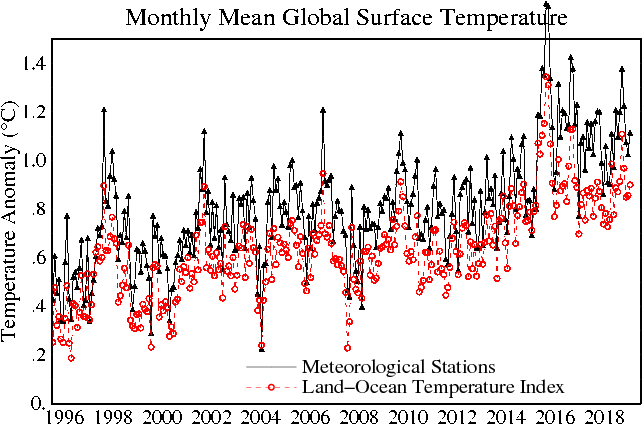
NASA’s Goddard Institute for Space Studies (GISS) Global Monthly Mean Surface Temperature Anomaly – 1996 to Present:
NOAA’s – National Climate Data Center – Annual Global Land and Ocean Temperature Anomalies:

UK Met Office’s – Hadley Center – Climate Research Unit (CRU) Annual Global Average Land and Ocean Temperature Anomaly;

the UK Met Office – Hadley Center – Climate Research Unit (CRU) Monthly Global Average Land Temperature;

and HadCRUT4 Global, Northern and Southern Hemispheric Temperature Anomalies:

The Pause appears to apparent in Earth’s Land and Surface Temperature record. It is important to note that the reason that the IPCC claims to be;
“95% certain that humans are the “dominant cause” of global warming since the 1950s” BBC
is because prior to 1950 Anthropogenic CO2 Emissions from Fossil-Fuels were insufficient to have a significant influence on “Earth’s Temperature”, i.e. Anthropogenic CO2 Emissions from Fossil-Fuels;

and Cumulative Anthropogenic CO2 Emissions from Fossil-Fuels:

In May 2013, the Economist noted that;
The world added roughly 100 billion tonnes of carbon to the atmosphere between 2000 and 2010. That is about a quarter of all the CO₂ put there by humanity since 1750. And yet, as James Hansen, the head of NASA’s Goddard Institute for Space Studies, observes, “the five-year mean global temperature has been flat for a decade.”
Additionally, surface temperature records are burdened with issues of questionable siting, changes in siting, changes in equipment, changes in the number of measurement locations, modeling to fill in gaps in measurement locations, corrections to account for missing, erroneous or biased measurements, land use changes, anthropogenic waste heat and the urban heat island effect. Thus to see the Big Picture of “Earth’s Temperature”, it also helps to look up.
Atmospheric Temperatures:
Since 1979 Earth’s “temperature” has also been measured via satellite. “The temperature measurements from space are verified by two direct and independent methods. The first involves actual in-situ measurements of the lower atmosphere made by balloon-borne observations around the world. The second uses intercalibration and comparison among identical experiments on different orbiting platforms. The result is that the satellite temperature measurements are accurate to within three one-hundredths of a degree Centigrade (0.03 C) when compared to ground-launched balloons taking measurements of the same region of the atmosphere at the same time.” NASA
Here is RSS Global Temperature Lower Troposphere (TLT) – Brightness Temperature Anomaly- 1979 to Present;


and this is the University of Alabama – Hunstville (UAH) Global Lower Atmosphere Temperature Anomalies – 1979 to Present:

Note: Per John Christy, RSS and UAH anomalies are not comparable because they use different base periods, i.e., “RSS only uses 1979-1998 (20 years) while UAH uses the WMO standard of 1981-2010.”
The March UAH Lower Atmosphere Temperature Anomaly was .29 degrees C above the 30 year average and RSS Global Global Lower Troposphere shows a .127 degrees C increase per decade.
When we look at Earth’s “canaries”, i.e. RSS Northern Polar Temperature Lower Troposphere (TLT) Brightness Temperature Anomaly;

appears to have Paused for the last 18 years and RSS Southern Polar Temperature Lower Troposphere (TLT) Brightness Temperature Anomaly;

looks like it has been on Pause for its entire record.
To this point we’ve only addressed the Lower Troposphere Temperatures, the following Temperature Anomaly plots from RSS will increase in altitude as is illustrated here:
Here is RSS Temperature Middle Troposphere (TMT)- Brightness Temperature Anomaly- 1979 to Present;

According to Remote Sensing Systems, “For Channel (TLT) (Lower Troposphere) and Channel (TMT) (Middle Troposphere), the anomaly time series is dominated by ENSO events and slow tropospheric warming. The three primary El Niños during the past 20 years are clearly evident as peaks in the time series occurring during 1982-83, 1987-88, and 1997-98, with the most recent one being the largest.” RSS
Middle Tropospheric temperatures appear to show slow warming overlaid with the El Niño/La Niña Southern Oscillation (ENSO) cycle, including several comparatively large El Niño events. Middle Tropospheric temperatures appear to entered The Pause with the large El Niño in 1998.
Moving higher in the atmosphere, RSS Temperature Troposphere / Stratosphere (TTS) – Brightness Temperature Anomaly- 1987 to Present;

has been in The Pause since records began in 1987, with a trend of just -.004 K/C per decade.
The 1997-98 and 2009 – 10 El Niño events are still readily apparent in the Troposphere / Stratosphere plot above, as is a spike from the 1991 eruption of Mt. Pinatubo. Note that the effect of Mt. Pinatubo is the opposite in the Lower and Middle Troposphere versus the Troposphere / Stratosphere (TTS), i.e. “Large volcanic eruptions inject sulfur gases into the stratosphere; the gases convert into submicron particles (aerosol) with an e-folding time scale of about 1 year. The climate response to large eruptions (in historical times) lasts for several (2-3) years. The aerosol cloud causes cooling at the Earth’s surface, warming in stratosphere.”
Ellen Thomas, PHD Wesleyan University
It is interesting that, incorporating the impact of three significant surface driven warming events, Troposphere / Stratosphere Temperatures (TTS) have been quite stable, however there is a bit of regional variation here, e.g.:
RSS Northern Hemisphere Temperature Troposphere / Stratosphere (TTS) – Brightness Temperature Anomaly- 1987 to Present;

has been increasing by .047 K/C per decade, whereas the RSS Southern Hemisphere Temperature Troposphere / Stratosphere (TTS) – Brightness Temperature Anomaly- 1987 to Present;

has been decreasing by -.039 K/C per decade.
Moving higher still in the atmosphere, the RSS Temperature Lower Stratosphere (TLS) – Brightness Temperature Anomaly – 1979 to Present;

“is dominated by stratospheric cooling, punctuated by dramatic warming events caused by the eruptions of El Chichon (1982) and Mt Pinatubo (1991).” RSS
The eruptions of El Chichon and Mt Pinatubo are readily apparent in the Apparent Atmospheric Transmission of Solar Radiation at Mauna Loa, Hawaii:

“The stratosphere” … “in contrast to the troposphere, is heated, as the result of near infrared absorption of solar energy at the top of the aerosol cloud, and increased infra-red absorption of long-wave radiation from the Earth’s surface.”
“The stratospheric warming in the region of the stratospheric cloud increases the latitudinal temperature gradient after an eruption at low latitudes, disturbing the stratospheric-troposphere circulation, increasing the difference in height of the troposphere between high and low latitudes, and increasing the strength of the jet stream (polar vortex, especially in the northern hemisphere). This leads to warming during the northern hemisphere winter following a tropical eruption, and this warming effect tends to be larger than the cooling effect described above.” Ellen Thomas, PHD Wesleyan University
The Lower Stratosphere experienced “dramatic warming events caused by the eruptions of El Chichon (1982) and Mt Pinatubo (1991).” RSS “The long-term, global-mean cooling of the lower stratosphere stems from two downward steps in temperature, both of which are coincident with the cessation of transient warming after the volcanic eruptions of El Chichon and Mt. Pinatubo.” … “Here we provide observational analyses that yield new insight into three key aspects of recent stratospheric climate change. First, we provide evidence that the unusual step-like behavior of global-mean stratospheric temperatures is dependent not only upon the trend but also on the temporal variability in global-mean ozone immediately following volcanic eruptions. Second, we argue that the warming/cooling pattern in global-mean temperatures following major volcanic eruptions is consistent with the competing radiative and chemical effects of volcanic eruptions on stratospheric temperature and ozone. Third, we reveal the contrasting latitudinal structures of recent stratospheric temperature and ozone trends are consistent with large-scale increases in the stratospheric overturning Brewer-Dobson circulation” David W. J. Thompson Colorado State University
Above the Stratosphere we have the Mesosphere and Thermosphere, neither of which have I identified current temperature time series for, but of note is that on “July 15, 2010” “A Puzzling Collapse of Earth’s Upper Atmosphere” occurred when “high above Earth’s surface where the atmosphere meets space, a rarefied layer of gas called “the thermosphere” recently collapsed and now is rebounding again.”

“This is the biggest contraction of the thermosphere in at least 43 years,” says John Emmert of the Naval Research Lab, lead author of a paper announcing the finding in the June 19th issue of the Geophysical Research Letters (GRL). “It’s a Space Age record.”
The collapse happened during the deep solar minimum of 2008-2009—a fact which comes as little surprise to researchers. The thermosphere always cools and contracts when solar activity is low. In this case, however, the magnitude of the collapse was two to three times greater than low solar activity could explain.
“Something is going on that we do not understand,” says Emmert.
The thermosphere ranges in altitude from 90 km to 600+ km. It is a realm of meteors, auroras and satellites, which skim through the thermosphere as they circle Earth. It is also where solar radiation makes first contact with our planet. The thermosphere intercepts extreme ultraviolet (EUV) photons from the sun before they can reach the ground. When solar activity is high, solar EUV warms the thermosphere, causing it to puff up like a marshmallow held over a camp fire. (This heating can raise temperatures as high as 1400 K—hence the name thermosphere.) When solar activity is low, the opposite happens.” NASA
In summary, “the Pause” is apparent in Earth’s atmospheric record, Lower and Middle Troposphere appear to have warmed slowly, overlaid with the El Niño/La Niña Southern Oscillation (ENSO) cycle, including four comparatively large El Niño events, and tempered by the cooling effects of the eruption of El Chichon (1982) and Mt Pinatubo (1991). Lower and Middle Tropospheric temperatures appear to have paused since the large El Niño in 1998. Tropospheric / Stratospheric temperatures appear to have been influenced by at least three significant surface driven warming events, the 1997-98 El Niño, and the eruptions of El Chichon in 1982 and Mt Pinatubo in 1991, but have maintained a stable overall trajectory. Stratospheric temperatures appear to have experienced two “dramatic warming events caused by the eruptions of El Chichon (1982) and Mt Pinatubo (1991).”, and “unusual step-like behavior of global-mean stratospheric temperatures” which has resulted in a significant stratospheric cooling during the last 30 years. Lastly, “during deep solar minimum of 2008-2009” “the biggest contraction of the thermosphere in at least 43 years” occurred and “The magnitude of the collapse was two to three times greater than low solar activity could explain.”
Ocean Temperatures:
“The oceans can hold much more heat than the atmosphere. Just the top 3.2 metres of ocean holds as much heat as all the world’s air.” Commonwealth of Australia – Bureau of Meteorology
From a surface perspective Hadley Center’s HadSST2 Global Sea Surface Temperature Anomaly;

NOAA’s – National Climate Data Center – Global Sea Surface Temperature Anomaly;

Reynolds OI.v2 Global Sea Surface Temperature Anomaly

all appear to be well into The Pause.
Obviously Sea Surface temperature only scratch the surface, thus changes in Ocean Heat Content are important in understanding “Earth’s Temperature”. Here is NOAA’s NODC Global Ocean Heat Content from 0-700 Meters – 1955 to Present;

and here is the same from Ole Humlum’s valuable climate data site Climate4you.com, NODC Global Ocean Heat Content – 0-700 Meters – 1979 to Present:

It seems apparent from the plots above that Global Ocean Heat has increased over the last several decades, and has not paused per se, however the rate of increase seems to have slowed significantly since 2004.
Sea Level:
“Global sea level is currently rising as a result of both ocean thermal expansion and glacier melt, with each accounting for about half of the observed sea level rise, and each caused by recent increases in global mean temperature. For the period 1961-2003, the observed sea level rise due to thermal expansion was 0.42 millimeters per year and 0.69 millimeters per year due to total glacier melt (small glaciers, ice caps, ice sheets) (IPCC 2007). Between 1993 and 2003, the contribution to sea level rise increased for both sources to 1.60 millimeters per year and 1.19 millimeters per year respectively (IPCC 2007).” Source NSIDC
Global Mean Sea Level Change – 1993 to Present:

Global Mean Sea Level Change Map with a “Correction” of 0.3 mm/year added May, 5th 2011, due to a “Glacial Isostatic Adjustment (GIA)” – 1993 to Present;

While it appears that Sea Level Rise has continued recently;
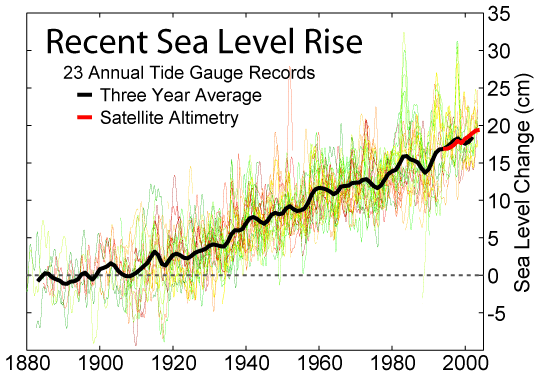
it is important to note that Sea Levels were increasing at a similar pace during the first half of the 20th century, before anthropogenic CO2 emissions were sufficient to have a significant influence on “Earth’s Temperature” and Sea Level:
Snow and Ice:
A proxy often cited when measuring “Earth’s Temperature” is amount of Snow and Ice on Earth. According to the United States Geological Survey (USGS), “The vast majority, almost 90 percent, of Earth’s ice mass is in Antarctica, while the Greenland ice cap contains 10 percent of the total global ice mass.” Source USGA
However, there is currently no generally accepted measure of ice volume, as Cryosat is still in validation and the accuracy of measurements from Grace are still being challenged. Sea Ice Area and Extent are cited as proxies for “Earth’s Temperature”, however there is significant evidence that the primary influences on Sea Ice Area and Extent are in fact wind and Atmospheric Oscillations.
With this said, Global Sea Ice Area;

had it’s largest maximum in 2013, since 1996 and has remained stubbornly average for the entirety of 2013. Antarctic Sea Ice Extent has remained above the 1981 – 2010 “normal” range for much of the last four months;

we had the third most expansive Southern Sea Ice Area measured to date;

and Southern Sea Ice Area has remained above average for almost all of the last two years:

At the other pole Arctic Sea Ice Extent has remained within the 1981 – 2010 “normal” range for the entirety of 2013;

and Northern Hemisphere Sea Ice Area had it’s smallest decline since 2006:

There appears to have been a negative trend in Northern Hemisphere Sea Ice Area and Extent, a positive trend in Southern Hemisphere Sea Ice Area and Extent, thus the resultant Global Sea Ice Area trend appears to be slightly negative. However, in the last 6 years there does appear to be a Pause in Global Sea Ice Area.
In terms of land based data, here is 20 Year Northern Hemisphere Snow Cover with 1995 – 2009 Climatology from NCEP/NCAR;

Northern Hemisphere Snow Cover Anomalies 1966 – Present from NCEP/NCAR;

Northern Hemisphere Winter Snow Extent – 1967 to Present from Rutgers University;

Northern Hemisphere Spring Snow Extent – 1967 to Present:

Northern Hemisphere Fall Snow Extent – 1967 to Present:

While none of the Snow plots offers a global perspective, when looking at the Northern Hemisphere, there appears to have been a slight increase in Winter Snowcover and Snow Extent, a decrease in Spring Snow Extent and no change in Fall Snow Extent over the historical record.
Based on the limited Global Ice and Snow measurements available, and noting the questionable value of Sea Ice Area and Extent as a proxy for temperature, not much inference can currently be drawn from Earth’s Ice and Snow measurements. However, there does appear to be a Pause in Global Sea Ice Area.
Conclusion:
The Pause in “Earth’s Temperature” appears in many of Earth’s observational records, it appears to extend for between 6 – 16 years depending on the data set and what it is being measured.
Additional information on “Earth’s Temperature” can be found in the WUWT Reference Pages, including the Global Temperature Page and Global Climatic History Page
Please note that WUWT cannot vouch for the accuracy of the data/graphics within this article, nor influence the format or form of any of the graphics, as they are all linked from third party sources and WUWT is simply an aggregator. You can view each graphic at its source by simply clicking on it.
The Mickey Mouse analysis by Santer will soon be replaced by another which will be 25 years plus!
What else would one expect from climate “scientists”!
Another way they move the goal posts is to allege that areas where temperature is not measured is where all the heat is going. First there was the deep oceans (it magically transported itself below the upper layers) and the latest is that the heat is where the thermometers are not.
Even if they started measuring today, nothing could be determined for 30 years. So their claims cannot be disproven. But neither can they be proven. They are basically unsupported conjecture.
Outstanding!!!
I was just looking this minute for some of these graphs to debunk the propaganda headlines that have been showing up in the MSM. These are so good, I think I will send them to some of my Liberal friends as well. Nothing like a few facts to get the Liberal heads spinning.
The analysis by Santer can’t be replaced by a longer time frame because the non-warming period then becomes longer than the warming period previously.
Actually the latest is that’s 15y since 2005. Whatever.
You’ve shown TTS (Trop/Strat) and TLS (Lower Strat) plots. The first show mixed results, the latter cooling. But a cooling stratosphere has always been part of AGW theory. In recent years, ozone depletion has caused more cooling than the GHE.
Says AR3:
“WMO (1999) concluded, on the basis of intercomparisons of the temperature records as measured by different instruments, that there has been a distinct cooling of the global mean temperature of the lower stratosphere over the past two decades, with a value of about 0.5°C/decade. Model simulations from GCMs using the observed O3 losses yield global mean temperature changes that are approximately consistent with the observations. Such a cooling is also much larger than that due to the well-mixed greenhouse gases taken together over the same time period.”
Best summary I’ve seen of where things factually stand as of today. Thanks for a job well done.
santer didnt move the goal posts.
jones was referring to SAT.
Santer is referring to TLT.
Both used different methods to determine an acceptable pause.
Neither method is correct.
I’ll deal with santer
1. he assumed that the noise structure of GCM is a suitable proxy for the real noise.
its not. especially when Santer included GCMs that dont simulate volcanos
2. he assumed a constant warming signal that has to emerge from the noise.
A) he selected a too warm signal
B) his noise was too benign.
3. he picked a confidence level (95%) that is too low for robust results.
50% of the global warming is hiding in the very deep ocean and other 50% is hiding the arctic where we can’t accurately measure temperature. A nuclear blast is going off every second in the deep ocean releasing global warming it’s just too deep for you to feel it. But you should be alarmed. It’s also just too cold in the arctic for the thermometers to work well so we have to estimate warming because it’s too cold up to live except for Santa Claus, his elves, polar bears and the “deniers’ that sabotage the thermometers. Finally, just because the ground temperature warming is not statistically significant doesn’t mean its not warming. They wouldn’t spend millions our dollars and many hours teaching our children about global warming if it wasn’t really happening. A proper STEM education is too important to our countries future to play politics.
Perhaps the 17 year gap in global warming is due to time dilation by relativity? One must be open minded and consider all the possibilities …
Great post!
The data you show for 60N to 82.5N for RSS Northern Polar Temperature Lower Troposphere (TLT) Brightness Temperature Anomaly gives a trend of 0.33 C/decade. UAH is probably about the same. This is five times too small to support the claims in the Cowtan and Way paper.
The Arctic covers 4% of the globe surface. To change the 15 year increase from 0.08 C (HadCRUT4) to 0.18 C in the hybrid dataset requires adding in a temperature change of (0.18-0.08)/0.04 = 2.5 C, or 1.67C/decade in the Arctic.
Something is wrong with that paper.
“The simulations rule out (at the 95% level) zero trends for intervals of 15 yr or more, …”
So, according to the official science on climate in the US, the global warming hypothesis is falsified by their metrics.
@Mosher — “I’ll deal with santer”
MoshLogic: “Santer wasn’t wrong, instead he was wrong.” The entire meaning behind ‘falsification’ is that there’s a line in the sand that, when crossed, establishes? That you were wrong.
So rather than salvaging Santer by circularly indicting him, how about you let us know which AGW theories are:
a) Falsifiable
b) Not-falsified yet.
The pause in temperature rise seems to be a well kept secret.
I watched “Question time” last night on TV where Lord Lawson was a panel guest, and the inevitable question was “does the hurricane in the Philippines show the reality of climate change?”
Lawson responded by explaining that there has been no warming in 15 years, and this was met by mocking laughter from other panellists. It is obvious that they thought this was the pronouncements of a deluded fool.
Such a level of ignorance must be difficult to acquire, and the knee jerk response from the shrieky woman who happens to be a member of parliament made me shudder to think that our futures are literally in the hands of people whose cognitive grasp of reality is barely more than that of an adolescent.
Are we still at war with Oceana?
Besides the May, 5th 2011, “Glacial Isostatic Adjustment (GIA)” of 0.3 mm/year there have been additional corrections totaling up to 0.6 mm/yr added to the chart put out by Colorado University’s Sea Level Research Group. Remove corrections and sea level for the last ten years has probably gone up at a rate of less than 2 mm/yr
=========================================================================
That graph seems to imply that the CO2 from the steak I grilled last year is still up there mixing with the CO2 from the steam engines from the railroads my great uncles worked for.
Do they tag each molecule?
Do they have some type of “carbon tracing”?
For those who deny the temperature standstill read the many temperature standstill quotes from the climate scientists. The first one is Dr. Phil Jones who reported slight cooling in 2005 and in 2009 said in the CRU emails:
What is significant about 15 years? Why would Phil Jones think 15 years is significant enough to warrant worry? The leaked/hacked CRU emails hold the key to the CAGW scare for they are revealing. I wish some journalist with balls would ask Phil why 15 years of no warming is significant?
JustTheFacts,
Wow! This is a really solid compendium of the temperature data for land, sea and air over the reliably measured time frame. Combined with the sea level data, polar ice data, and snow and ice extents, it paints an increasingly clear and detailed picture of a planet that is no longer warming, even as the inaccurately labeled ‘green house gasses’ have continued their steady rise.
Another WUWT article for reference and wide distribution! Thanks a bunch, JTF!
MtK
Mosher et. al. will be out next month.
Nick Stokes says: November 15, 2013 at 12:03 pm Remote Sensing Systems (RSS) – Microwave Sounding Units (MSU) – Click the pic to view at source[/caption]
 National Oceanic and Atmospheric Administration (NOAA) – Earth System Research Laboratory (ESRL) – Click the pic to view at source[/caption]
You’ve shown TTS (Trop/Strat) and TLS (Lower Strat) plots. The first show mixed results, the latter cooling. But a cooling stratosphere has always been part of AGW theory.
So was a tropical upper troposphere “hotspot”, but that doesn’t seem to be proving out:
http://wattsupwiththat.com/2013/07/16/about-that-missing-hot-spot/
In terms of stratospheric cooling;
[caption id="attachment_54062" align="alignnone" width="568"]
did not occur in correlation with increasing anthropogenic CO2 emissions;
[caption id="" align="alignnone" width="600"]<a href="http://www.esrl.noaa.gov/gmd/webdata/ccgg/trends/co2_data_mlo.png" alt="" src="http://wattsupwiththat.files.wordpress.com/2013/11/co2_data_mlo.gif) – Earth System Research Laboratory (ESRL) – Click the pic to view at source[/caption]
rather the cooling appears to have occurred two steps after the "dramatic warming events caused by the eruptions of El Chichon (1982) and Mt Pinatubo (1991)";
RSS. The impact of El Chichon and Mt Pinatubo can be seen in impact seen in Apparent Atmospheric Transmission of Solar Radiation at Mauna Loa, Hawaii:
[caption id="" align="alignnone" width="600"]
In recent years, ozone depletion has caused more cooling than the GHE.
Can you present evidence in support of this statement?
Wow, I think I just wore out the wheel on my mouse…
Warmists seem to be like our Mayor Ford here in Toronto: they can’t quit, but they have no moral standing either. Unfortunately, wonderful posts like this are no more than a punch to the nose of one of those stand-up clown punching bags…
justthefactswuwt: “Can you present evidence in support of this statement?”
Hrm.. Off to a bad start. “Do you have any evidence that the previously wrong predictions, that have been shown to be wrong, or not wrong because they quite wrongly looked at the wrong things.”
That’s a game you don’t win. Once Stokes has exhibited the ability to see on which side of a foot, the mark lies, and call it honestly what it is, then *and only then* let him launch into a tirade about how we should in the future change the length of a foot and pretend it always applied to past measurements.
==========================================================
I read that and couldn’t help but think of Al Gore. He “warned” us about the depleting ozone and the ozone “hole” and then he “warned” us about CO2 emissions and Global Warming.
Will he ever get it right?
Steven Mosher says:
November 15, 2013 at 12:11 pm
santer didnt move the goal posts.
jones was referring to SAT.
Santer is referring to TLT.
Both used different methods to determine an acceptable pause.
Neither method is correct.
I’ll deal with santer
1. he assumed that the noise structure of GCM is a suitable proxy for the real noise.
its not. especially when Santer included GCMs that dont simulate volcanos
2. he assumed a constant warming signal that has to emerge from the noise.
A) he selected a too warm signal
B) his noise was too benign.
3. he picked a confidence level (95%) that is too low for robust results.
________________________________________________________________________
I’m confused. Two world class expert climate scientists, using the methods that make them world class expert climate scientists come up with different time scales for pauses that are significant. The times for significance are passed and they are both wrong? Was this pointed out and hotly debated when they came up with the times? Did they retract and modify? It turns out that Santer’s methodology was suspect in developing his 17 years. If he got that wrong, what else has his methodology missed?
I’ve spent decades developing processes and models that are expected to be correct and work. When they don’t, it gets expensive and getting mulligans has been painful. It seems that the mulligans for AGW are heat hiding in the ocean or where Arctic temperature monitors aren’t. The AGW predictions have been extremely costly and when the leading lights of climate science get it wrong, the mulligans ought to be more than, oops, they were wrong.
Steven Mosher says:
November 15, 2013 at 12:11 pm
santer didnt move the goal posts.
jones was referring to SAT.
Santer is referring to TLT.
>>>>>>>>>>>>>>>>>>>>>>>
Yeah. Jones said it would take 10 years by metric X and Santer said no, no, it would take 17 years by metric Y. That’s not moving the goal posts? You really think we’re stupid, don’t you.