 (Perturbation Calculations of Ocean Surface Temperatures.)
Guest essay by Stan Robertson, Ph.D., P.E.
1. Introduction
It is generally conceded that the earth has warmed a bit over the last century, but it is not clear what has caused it, nor whether it will continue and become a problem for humanity. There is a possibility that some of the warming has been caused by anthropogenic greenhouse gases, but it is also likely that the sun has been partially responsible. The arguments that are advanced to say that humans caused it and that it will become a serious problem rely on models that have not been validated and positive feedback effects that have not been shown to exist, at least at the hypothesized levels of effectiveness. The apparent weakness in the argument that the sun has been a major contributor is that satellite measurements of Total Solar Irradiance (TSI) have not shown changes large enough to have directly produced the warming of the earth over the last half century. But what about indirect effects? Is it possible that the sun exerts control in some indirect way? In these notes I recapitulate the evidence that this is the case by showing that the variations of TSI cannot provide the energy that is necessary to account for the warming of the oceans during solar cycles.
TSI, as measured above the earth’s atmosphere varies by about 1.2 watt/m2 over a nominal eleven year solar cycle (h/t Leif Svaalgard) primarily at wavelengths shorter than 2 micron. The dominant harmonic variation of TSI would thus have an amplitude half this large, or about 0.6 watt/m2. About 70% of this enters the earth atmosphere. Averaged over latitudes and day/night cycles, about one fourth of this 70%, or ~0.11 watt/m2, on average, enters the upper atmosphere. Since only about 160 watt/m2 of 1365 watt/m2 of incoming solar radiation at wavelengths less than 2 micron reaches the earth surface, the amplitude of short wavelength TSI reaching the earth surface would be only (160/1365)x0.6 = 0.07 watt/m2. However, about half of the difference between 0.11 and 0.07 watt/m2 eventually reaches the earth surface as scattered thermal infrared radiation at wavelengths greater than 2 micron. Thus the average amplitude of TSI reaching the earth surface in all wavelengths would be about 0.09 watt/m2. So the question is, just how much sea surface temperature variation can this produce?
Several researchers, including Nir Shaviv (2008), Roy Spencer (see http://www.drroyspencer.com/2010/06/low-climate-sensitivity-estimated-from-the-11-year-cycle-in-total-solar-irradiance/) and Zhou & Tung (2010) have found that ocean surface temperatures oscillate with an amplitude of about 0.04 – 0.05 oC during a solar cycle. (In fact, all of the ideas that I am presenting here were covered in Shaviv’s work, but it has not gotten the attention that it deserves.) Using 150 years of sea surface temperature data, Zhou & Tung found 0.085 oC warming for each watt/m2 of increase of TSI over a solar cycle. Although not strictly sinusoidal, the temperature variations can be approximately described in terms of a dominant sinusoidal component of variation with an 11 year period. Thus the question to be answered at this point is, can 0.09 watt/m2 amplitude of variation of TSI entering the oceans produce temperature oscillations with an amplitude of 0.04 – 0.05 oC?
The answer to this question depends on the average thermal diffusivity of the upper oceans. That is an unknown, but not unknowable, quantity. Thermal diffusivity is the ratio of thermal conductivity to heat capacity. The upper 25 to 100 meters of oceans are well mixed by waves and shears. These are mixing zones with high thermal diffusivity and correspondingly small temperature gradients. Diffusivities are lower at greater depths. Bryan (1987) has found that thermal diffusivities ranging from 0.3 to 5 cm2/s are needed to account for the temperature profiles below the mixing zone. In my first trial calculations of the energy flux necessary to account for the temperature variations, I tried values of thermal diffusivity in the range 0.1 – 10 cm2/s and found that the TSI variations were generally inadequate to produce the sea temperature variations over a solar cycle. But there was wide variation of calculated energy flux. Larger values of thermal diffusivity required more heat because more was able to penetrate to the depths, but even for 0.1 cm2/s, the required input was double the TSI variations that reach the earth surface. Fortunately, there is a way to constrain both the value of the thermal diffusivity and the heat input. It consists of first matching the measured trends of surface temperatures and ocean heat content over time. Measurements of these were reported by Levitus et al. (2012) and are available from http://www.nodc.noaa.gov/OC5/3M_HEAT_CONTENT/ .
In the calculations described below, I have used the data from 1965 to 2012 for ocean depths to 700 meters. Sea surface temperatures and ocean heat content began to increase after 1965. Only about a third of the increase of heat content occurred at depths below 700 meter. Since little heat migrates below this depth over 11 year solar cycles, it is preferable to use the 0 – 700 m data for the purpose of calibrating the thermal diffusivity
2. Heat Transfer Perturbation Calculations
For the calculation of sea surface temperature and sea level changes, we can treat the variations of radiations entering and leaving atmosphere, lands and oceans as minor perturbations on an earth essentially in thermal equilibrium. Ocean mixing zones, thermoclines and other features of the temperature profiles remain largely as they were while small radiant disturbances produce minor variations of temperature starting from zero, and imposed at each depth. Thus the effects of these disturbances can be modeled as one-dimensional energy flows into a medium at uniform temperature. Such “perturbation calculations” are among the most powerful analysis techniques used by physicists and engineers and are widely used. The energy equation to be solved in this case is:
http://i1244.photobucket.com/albums/gg580/stanrobertson/equation_zpscea297ad.jpg

Where T is the temperature departure from equilibrium at depth , z, and time, t. q is a perturbing radiant flux entering the surface, u the absorption coefficient, c is absorber heat capacity and k its thermal conductivity. The rate of heat transfer by conduction processes is controlled by the thermal diffusivity, which is the ratio k/c.
As a one dimensional heat flow problem, it is straightforward undergraduate level physics or engineering to numerically solve the equation above for the expected changes of surface temperature as surface radiant flux varies. In my calculations, temperature changes were calculated for 1.0 meter increments of depth in the oceans. Two cases were considered. In one
case the surface radiation perturbation was assumed to increase linearly with time. This corresponds to the ocean conditions for the period 1965-2012. In the second case, it was assumed to vary as a cosine function of time with the 11 year period of the solar cycle. The cosine function provides both some positive and some negative variation in the first half cycle, which helps to minimize the transients of the first few years.
I treated q and thermal diffusivity, (k/c), as input parameters that were chosen to provide agreement with the observed sea surface temperature variations and ocean heat content measurements (https://www.ncdc.noaa.gov/ersst/ ). The absorption coefficient, u, was entered in piecewise fashion. Only the deep UV radiations penetrate to depths below 10 meter, but conduction takes energy to much greater depths. For the values of u chosen, only 44.5% of the surface energy flux goes deeper than 1 meter, 22.5% below 10 meter and 0.53% to 100 meter (h/t Leif Svalgaard). Thermal diffusivity of oceans was assumed to be 0.3 cm2/s below 300 m. This accords with Bryan’s estimates below the mixing zone, but little change of results occurred for values as low as 0.1 cm2/s. The required heat inputs are relativity insensitive to the thermal diffusivity below 300 meter. For the shallower depths, thermal diffusivity was varied until trends in accord with observed temperatures and heat content were produced.
It is necessary to maintain an energy balance at the sea surface in approximate equilibrium with the incoming solar radiation. As estimated by Trenberth, Fasullo and Kiehl (2009), about 160 watt/m2 enters the surface, on average. At a mean temperature of 288 oK, the sea surface will emit about 390 watt/m2 of surface thermal infrared radiation at wavelengths longer than about 2 micron, however, about 84% of that is returned as back scattered radiation. The rest of the energy balance is provided by evaporation and thermal convection, which remove about 59% of the heat from the surface. From the standpoint of merely wanting to know how much heat is required to change the ocean surface temperature, it is possible to maintain a proper energy balance without delving into the messy details of evaporation, convection and infrared absorption in the first few millimeters of water. The temperature variations at one meter depth will not be measurably different from those at the surface for the thermal diffusivities of interest here. If we merely want to know what net energy flux entering the surface is required to make the water temperature at one meter depth oscillate with an amplitude of 0.04 – 0.05 oC , then all we need to do is account for the outgoing surface infrared emission and let 41% (160 watt/m2 / 390 watt/m2 = 0.41) escape. At the present 288 oK, the earth radiates an additional 5.42 watt/m2 for each 1 oC increase of surface temperature. In the case of surface temperature being perturbed by 0.04 oC, an outgoing additional 0.22 watt/m2 would be generated and 0.09 watt/m2 was allowed to escape. This nicely balances the amplitude of TSI variations that reach the earth’s surface.
3. Linear heating:
In these calculations, the aim was to find the heat input and thermal diffusivities necessary to account for the observed surface temperature increase (http://www.nodc.noaa.gov/OC5/3M_HEAT_CONTENT/ )Extended Reconstructed Sea Surface Temperature) and the increased ocean heat content (OHC 700) that have been reported by NOAA. Since surface temperatures had not been increasing in the early 1960s, but began to increase in the last half of that decade, I chose to start calculations with linearly increasing heating in 1965. I found that the ocean heat content to a depth of 700 meters was quite sensitive to the thermal diffusivity used. The best results that I have been able to obtain were for a thermal diffusivity of 1 cm2/s to 300 meter depth and surface heat input increasing at a rate of 0.31 watt/m2 per decade. These are shown on the graph below with calculated trends shown by the green and black lines. On a time scale of 50 years, most of the heat accumulates at relatively shallow depths. To better reflect a realistic thermal diffusivity for greater depths, I used a lower value of 0.3 cm2/s below 300 meter. That has little practical effect on a 50 year times scale, but would be necessary if one wanted to extend the calculations for several centuries while surface heating perturbations had time to penetrate to much greater depths.
http://i1244.photobucket.com/albums/gg580/stanrobertson/OHC700_zpsb9e34e91.jpg

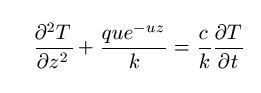
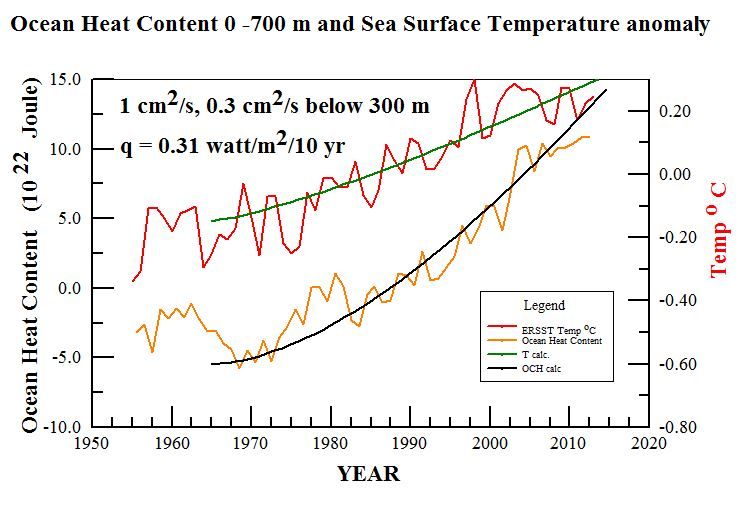
Figure 1. Ocean heat content 0 – 700 meter and surface temperature trends according to NOAA. Blue and green lines show trends calculated for the parameters shown.
These calculations establish some parameters that do a good job of representing the thermal behavior of the upper oceans, however, if one looks closely at the data trends in the graph, it is apparent that both surface temperature and ocean heat content have considerably slowed their rates of increase in the last decade. This makes it unlikely that greenhouse gases are the cause of the rate of heating needed to explain the previous trends because their effects should have become enhanced rather than diminished. It might also be noted that a similar warming trend occurred in the first half of the previous century before anthropogenic greenhouse gases could have contributed significantly. Thus it is more likely that both warming periods had natural origins.
Obtaining simultaneous fits to the ocean heat content and sea surface temperature trends with only two free parameters, thermal diffusivity and surface heating rate, is quite confining. Acceptable, but noticeably worse, fits than shown above, were obtained with thermal diffusivities ranging from 0.8 to 1.2 cm2/s and heat inputs ranging from 0.29 to 0.33 watt/m2. Based on previous calculations for sea level data, I was initially inclined to think that larger thermal diffusivities would be necessary, but larger values let more heat penetrate to greater depths than the amounts of heat reported by Levitus et al. In addition, I was chagrined to learn that most of the variation of sea level that accompanies solar cycles is caused by evaporation rather than thermal expansion.
Solar Cycles:
The process of choosing thermal diffusivity and surface heating rates to accord with observations provides a sound basis for calculating what to expect for the temperature variations during solar cycles. In this case we can use the thermal diffusivity of 1 cm2/s that is required of the ocean heat content results as an input parameter and choose the heat input that is required to produce temperature variations of 0.04 – 0.05 oC amplitude. Producing sea surface temperature variations with an amplitude of 0.04 oC requires a surface heat input of 0.33 watt/m2, as shown below:
http://i1244.photobucket.com/albums/gg580/stanrobertson/solarcycle10_zpsa3b8b0ee.jpg
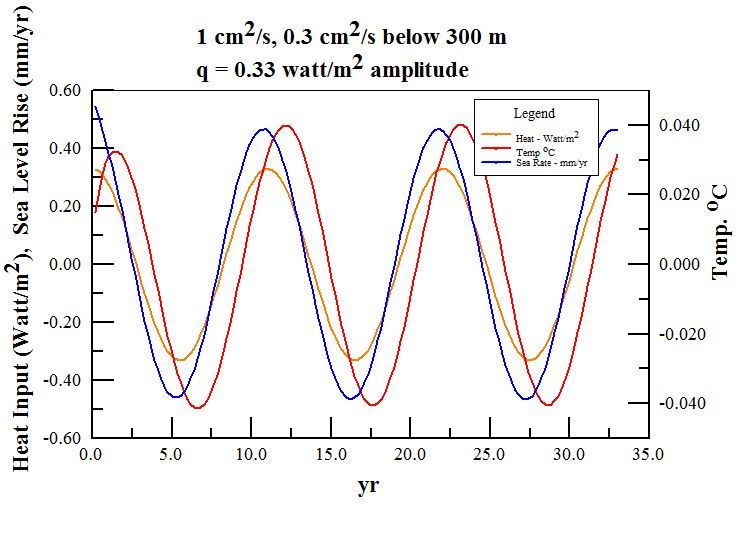

Figure 2. Radiant flux, ocean temperature oscillations, and sea level variations for three solar cycles of eleven years each. The entering flux shown here is the value of q = 0.33 watt/m2 needed to drive the variations of surface temperature of 0.04 oC with ocean thermal diffusivity of 1.0 cm2/s to depth of 300 m. The amplitude of thermosteric rate of change of sea level was 0.47 mm/yr. Temperature lags the driving energy flux by 15 months. The thermal expansion coefficient of sea water used here was 2.4×10⁻⁴/ oC.
I believe that this settles the issue of what is required to produce sea surface temperature oscillations with an amplitude of 0.04 oC. The solar TSI variations that reach the earth’s surface are smaller than the 0.33 watt/m2 needed to account for sea surface temperature variations by a factor of 3.6 for this smallest estimate of sea surface temperature variability.
Although the estimated 0.33 watt/m2 that is required to explain the surface temperature variations is large compared to the amplitude of TSI variations that reach the surface, it is still only about two parts per thousand of the 160 watt/m2 of solar UV/VIS/NIR that reaches the earth surface. There are many possible ways in which the sun might modulate the surface energy flux to this extent. These include modulation of cloud cover and small spectral shifts in the energetic UV that might modulate ozone absorption or produce shifts of the effective sea surface albedo. It would seem to be a fairly direct radiative effect, rather than feedback, since it must vary in phase with the solar cycle.
In summary, my calculations based on energy conservation considerations imply that the sun modulates the ocean temperatures to a much greater extent than can be provided solely by its TSI variations. The great question that desperately needs an answer is how does it do it? It should be easily understood that solar effects would not necessarily be confined to cycles. More likely, the sun has been the driver of the large changes of temperatures of the Roman and Medieval warm period, the Little Ice Age, and the recent recovery from it without requiring large changes of its own irradiance. When we understand how the sun does this, we will have begun to understand the earthly climate.
###
Biographical note:
Stan Robertson, Ph.D, P.E, retired in 2004 after teaching physics at Southwestern Oklahoma State University for 14 years. In addition to teaching at three other universities over the years, he has maintained a consulting engineering practice for 30 years.
References:
Bryan, F., 1987: Parameter Sensitivity of Primitive Equation Ocean General Circulation Models. Journal of Physical Oceanography, 17, 970-985. (PDF available here http://journals.ametsoc.org/doi/abs/10.1175/1520-0485%281987%29017%3C0970%3APSOPEO%3E2.0.CO%3B2
Levitus, S. et al., 2012 World ocean heat content and thermosteric sea level change (0–2000 m), 1955–2010, Geophysical Research Letters, 39, L10603, doi:10.1029/2012GL051106, 2012 http://onlinelibrary.wiley.com/doi/10.1029/2012GL051106/abstract
Shaviv, Nir 2008, Using the oceans as a calorimeter to quantify the solar radiative forcing, Journal of Geophysical Research, 113, A11101 http://www.sciencebits.com/files/articles/CalorimeterFinal.pdf
Trenberth, K., Fasullo, J., Kiehl, J. 2009: Earth’s Global Energy Budget. Bull. Amer. Meteor. Soc., 90, 311–323. doi: http://dx.doi.org/10.1175/2008BAMS2634.1 www.cgd.ucar.edu/staff/trenbert/trenberth.papers/TFK_bams09.pdf , Fig. 1
Zhou, J. and Tung, K. ,2010 Solar Cycles in 150 Years of Global Sea Surface Temperature Data, Journal of Climate 23, 3234-3248 http://journals.ametsoc.org/doi/abs/10.1175/2010JCLI3232.1
geran says:
October 10, 2013 at 4:53 pm
Rich, who made you the referee?
No referee is needed. Anybody with a shred of intelligence and critical sense can appreciate his points.
strange that anyone could possibly claim the sun really doesnt have much impact on our climate……
Chris @NJSnowFan says:
October 10, 2013 at 5:05 pm
…
So is mans daily heat release into the atmospher and waterways from all fuels really a factor on the atmosphere or just localized heat island effects.
>>>>>>
Chris, our waste heat is only a small fraction of the total energy produced from world-wide electricity.
All or mankind’s electrical power production is a thousand times less than the energy we receive from the Sun.
Oh, wait, it is TEN thousand times less than the Sun provides.
Okay, it is SIXTY thousand times less than the Sun provides.
(Wiki, a proven AGW site, actually still reports these figures.)
There could never be anything wrong with infrared thermometry being completely unable to register heat of enthalpy or anything. Therefore it must be human breath and cowfarts.
lsvalgaard says:
October 10, 2013 at 5:07 pm
Anybody with a shred of intelligence and critical sense can appreciate his points.
That’s why I had to include the disclaimer, for those WITHOUT a shred of intelligence or critical sense—(Just funning, love your intelligent comments, just don’t get to “high and mighty” for us low-lifes.)
What many sceptics here must realise is this simple truth:
We don’t have to give an explanation for the global surface warming since 1975, 1950 or 1850.
We only need to point out problems, errors and ask questions about AGW / CAGW. That’s it. That’s all sceptics have to do because that’s how science works.
Example: I submit a paper blaming the sun for global warming since 1975. A peer reviewer points out several flaws in my submitted paper and it’s subsequently rejected. I am upset and turn around on my way out and ask them can they think of a better reason? They don’t have to give me one damned reason, they have done their job. Let’s remember that.
Stan, I absolutely agree. What do you find out there to explain the major climate transitions – the entrys to and from interglacials?
Jimbo says:
October 10, 2013 at 5:31 pm
Jimbo, I cannot improve on what you said, so I leave you in charge as I turn into a pumpkin for the night.
You can DO it.
is the winter climate different from the summer climate in the northern hemisphere…..seems to me the ONLY difference between the 2 is the angle of the sun…maybe the sun DOES impact climate.
Radiative flux is expressed in Watts per square meter. A Watt per square meter is a joule per second per square meter. One needs a time term in any equation purporting to determine temperature change from change in radiative flux. I am not sure that the fundamental equation of climate sensitivity used by the models contains a time variable. Without one, the equation seems to my inexpert eye to be meaningless.
Four separate groups – two amateur, two professional – have been in touch in recent months to say that the time-integral of the solar forcing is capable of explaining all or nearly all temperature change on all timescales at or above the 11-year solar cycle. So I’m not sure we can dismiss “Busie olde foole, unrulie Sonne” as the primum mobile of globakl temperature change.
So funny that suddenly the IPCC invoked the low solar cycle as one of the reasons for the global temperature “hiatus”… I still await Leif Svalgaard ripping them since according to Leif, in normal science, the assumption of solar variations being the cause of climate change has been falsified.
lsvalgaard says:
October 10, 2013 at 3:03 pm
Did you even bother to read the article?
You are assuming that TSI is the only possible mechanism again.
One other quick comment, this one on man’s body heat release pee and shower water. There is about 7 billion people in the world. Humans pee about 140 gallons of 98.6° liquids per year. So that comes out to be about 1 trillion gallons of 98.6°pee water into water ways a year. Now if you add up all the hot water that is flushed into the ground and water ways from about 3.5 billion(half world has heated water source) people taking 10 minute shower daily. Water per person at 110° is 30 gallons per person a day. 3.5 billion people x30 gallons of water per day = Is about 100 billion gallons of heated water flushed daily. Do the math for the year and that is a lot of 100+° water flushed s year. My caculater does not go that high.
lsvalgaard says:
October 10, 2013 at 3:41 pm
Reflecting energy (IE, more clouds) doesn’t generate energy, but it will impact sea surface temperatures.
The difference is total solar energy reaching the sea surface. Some of the decrease comes from direct TSI, some of it comes from other mechanisms.
Chris @NJSnowFan says:
October 10, 2013 at 5:05 pm
UHIs definitely affect the measured T of the planet, especially since GISS’ formerly secret algorithms “correct” for urban heat islands by making the readings hotter! You just can’t make this stuff up.
But in terms of human activities actually having a measurable effect on the T of the atmosphere, not so much.
lsvalgaard says:
October 10, 2013 at 4:16 pm
Now you are the one making unwarranted assumptions.
Where is your proof that there changes in the amount “getting through” are insufficient to create the changes in sea surface temperature. As you yourself have acknowledged at other times, our knowledge of clouds and how they change is insufficient to make such a definitive claim.
lsvalgaard says:
October 10, 2013 at 4:35 pm
The key word here is AVERAGE.
Gernan, yes mans heat out put is very small compared to the sun but it is a NEWER source of heat to the earth and is a 24/7 365 days of a year one.
I do feel mans heat release is a very small puzzle piece of global temps. There are some many puzzle pieces.
lsvalgaard says:
October 10, 2013 at 3:23 pm
Hockey Schtick says:
October 10, 2013 at 3:16 pm
For a start, here’s 50 papers describing potential solar amplification mechanisms
None of those explain how 3.6 times more heat reach the surface than the variation of what the Sun puts out…Otherwise the climate system would be a nifty energy producer: you put 10 units in and you get 36 out. I want one of those 🙂
What if the answer is not found in how much energy reaches the surface, but how much actually exits the system. According to one paper I was just reading, OLW from the ocean can decrease by up to 80% based simply on clouds.
In my uninformed opinion … [but I”m catching up], the assumption that the ocean is in constant equilibrium with regards to heat is bogus. The ocean sucks up heat, .. some it immediately releases, but a good portion of it gets moved around, stored for awhile, then releases it.
Lindzen and others have shown that the Earths OLW is heavily correlated with the SST and the OLW radiation exiting the ocean. Thus, if the ocean is sucking up heat, .. and it’s SST increases, that is by default going to increase cloud cover over time, decreasing OLW from the ocean surface, but at the same time decreasing the SW charge to the ocean. It’s only a matter of time before the charge on the ocean begins to run low … and the result will be a decrease in SST … clouds will decrease .. and we will go into a long recharge period. What complicates matters, is that we have two “capacitors” .. the pacific and the atlantic, and they aren’t always in sinc. … AND … I don’t know what effect TSI is having, but I’ve read somewhere that TSI has actually increased by about .3-.4% since the LIA. Don’t know if there has been any decrease in TSI over this past cycle … or what it will do over the next 15 years or so. But depending on cloud cover … a 0.3% decrease or increase in the estimated 342 W/M2 that I read hits the surface would be about 1 W/M2, which is more than the 0.33 W/M2 that the OP evaluated. Even assuming that only 50% of that reaches the surface, you’d still be left with 0.5 W/M2 .. which is still higher than 0.33 W/M2.
lsvalgaard says:
October 10, 2013 at 3:03 pm
The solar TSI variations that reach the earth’s surface are smaller than the 0.33 watt/m2 needed to account for sea surface temperature variations by a factor of 3.6 for this smallest estimate of sea surface temperature variability.
So, in normal science, that falsifies the assumption that solar variations are the cause.
OK, so Dr Svalgaard has demonstrated that he doesn’t understand the effect of the thermal inertia of the oceans.
Next!
You might find an answer here, “Temporal changes in the power of the longwave radiation of the system Earth-atmosphere emitted to space always lag behind changes in the power of absorbed solar radiation due to slow change of its enthalpy. That is why the debit and credit parts of the average annual energy budget of the terrestrial globe with its air and water envelope are practically always in an unbalanced state. Average annual balance of the thermal budget of the system Earth-atmosphere during long time period will reliably determine the course and value of both an energy excess accumulated by the Earth or the energy deficit in the thermal budget which, with account for data of the TSI forecast, can define and predict well in advance the direction and amplitude of the forthcoming climate changes. From early 90s we observe bicentennial decrease in both the TSI and the portion of its energy absorbed by the Earth. The Earth as a planet will henceforward have negative balance in the energy budget which will result in the temperature drop in approximately 2014. Due to increase of albedo and decrease of the greenhouse gases atmospheric concentration the absorbed portion of solar energy and the influence of the greenhouse effect will additionally decline. The influence of the consecutive chain of feedback effects which can lead to additional drop of temperature will surpass the influence of the TSI decrease. The onset of the deep bicentennial minimum of TSI is expected in 2042±11, that of the 19th Little Ice Age in the past 7500 years – in 2055±11. reference link http://www.thegwpf.org/russian-astrophysicist-predicts-global-cooling/
“Radiative flux is expressed in Watts per square meter. A Watt per square meter is a joule per second per square meter. One needs a time term in any equation purporting to determine temperature change from change in radiative flux.”
Time I think is 24 hours a day, 365 days a year.
I don’t think averaged watts works. Nor do I think the average amount sunlight in a year works. it wouldn’t seem to work in regards Milankovitch cycles.
Leif writes “So, in normal science, that falsifies the assumption that solar variations are the cause.”
In climate science, however, there is a muttering of “natural variation” and continue on regardless.
Leif writes “None of those explain how 3.6 times more heat reach the surface than the variation of what the Sun puts out…”
CO2 doesn’t bring energy to the party either. The sun is “putting in” hundreds of Watts. You dont need an extra 1W of TSI to get 1W of warming at the surface, there are myriad atmospheric processes that can potentially warm, CO2 being just one of them.
lsvalgaard says:
October 10, 2013 at 3:03 pm
The solar TSI variations that reach the earth’s surface are smaller than the 0.33 watt/m2 needed to account for sea surface temperature variations by a factor of 3.6 for this smallest estimate of sea surface temperature variability.
So, in normal science, that falsifies the assumption that solar variations are the cause.
Too bad Dr. Robertson didn’t ask you before hand. Then he could of avoided wasting his time just like other doctors looking into how solar variations might affect climate. It is so wonderful having you present refutations to all of his considerations and others considerations and you do it with so few words.
It was interesting to see how Dr. Robertson talked about TSI seems to remind me of a pompous ass saying how everyone talks about TSI a certain way that just happens not to be this way. Hmmm. I’ll ignore any response by Isvalgaard, as I have learned how he works. Pronouncements from on high. We have it from the great L. S.. It can’t be the sun.