It has been quite entertaining to watch the various explanations coming out to rationalize “the pause” in surface temperatures for the last 16 years. For example, as Jerome Ravetz points out to me in email, The Times Hannah Devlin says the warming has just gone into hiding.

But there is a funny thing about that deep ocean warming.
As Bob Tisdale wrote:
Ever since the NODC released their ocean heat content data for the depths of 0-2000 meters and published Levitus et al (2012), it seems that each time a skeptic writes a blog post or answers a question in an interview, in which he or she states that global surface temperatures haven’t warmed in “X” years, a global warming enthusiast will counter with something to the effect of: global warming hasn’t slowed because ocean heat content continues to show warming at depths of 0-2000 meters. Recently, those same people are linking Balmaseda et al (2013) and claiming the warming of ocean heat content data continues.
It is true that the NODC’s ARGO-era ocean heat content (0-2000 meters) continues to warm globally, but always recall that the ARGO data had to be adjusted, modified, tweaked, corrected, whatever, in order to create that warming. That is, the “raw” ocean heat content data for 0-2000 meters shows the decreased rate of warming after the ARGO floats were deployed. (See the post here.) Also, while the much-revised NODC ocean heat content data for 0-2000 meters might show warming globally, it shows very little warming for the Northern Hemisphere oceans since 2005. See Figure 1.
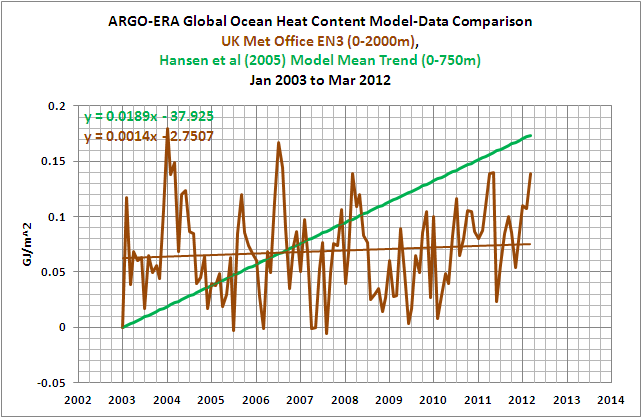

Figure 1
Can well-mixed human-created greenhouse gases pick and choose between the hemispheres, warming one but not the other? One might think that’s very unlikely.
Something else to consider: the Northern Hemisphere warming of ocean heat content for depths of 0-2000 meters occurs in only one ocean basin, and it’s not one of the big ones.
Right there is a premise falsifier. But I find this figure even more interesting:
There was a comparatively minor warming in the Northern Hemisphere at depths of 0-2000 meters from 2005 to 2012. But the upper 700 meters in the Northern Hemisphere cooled. The difference is provided to show the additional warming that occurred at depths of 700 to 2000 meters.

Figure 2
So the question here is simple. As Hannah Devlin writes in the Times:
The pause in global warming during the past decade is because more heat than expected is being absorbed by the deep oceans, according to scientists.
How does that heat get to the deep ocean hidey hole, down to 2000 meters, without first warming the upper 700 meters in transit? That’s some neat trick.
You can read more on how that deep ocean hidey hole doesn’t seem to hold up when the data is examined carefully here.
The claim has been made that its the sun doing it:
[Tisdale] SkepticalScience’s Rob Painting provides a reasonable explanation of the hypothetical cause of greenhouse gas-driven warming of the global oceans in the post Observed Warming in Ocean and Atmosphere is Incompatible with Natural Variation. Painting writes (my boldface):
Arguably the most significant climate-related impact of increased concentrations of greenhouse gases in the atmosphere, is that they trap more heat in the ocean. Over the last half-century around 93% of global warming has actually gone into heating the ocean. A little-known fact is that the oceans are almost exclusively heated by sunlight (shortwave radiation) entering the surface layers.
Back in 2009 it was claimed that solar radiation changes would do just that:

Well Duncan, we are still here, speaking clearly to the issue.
That article was a reaction to this Judith Lean Paper in GRL (bold mine):
=============================================================
How will Earth’s surface temperature change in future decades?
Judith L. Lean, David H. Rind Article first published online: 15 AUG 2009 DOI: 10.1029/2009GL038932
Reliable forecasts of climate change in the immediate future are difficult, especially on regional scales, where natural climate variations may amplify or mitigate anthropogenic warming in ways that numerical models capture poorly. By decomposing recent observed surface temperatures into components associated with ENSO, volcanic and solar activity, and anthropogenic influences, we anticipate global and regional changes in the next two decades. From 2009 to 2014, projected rises in anthropogenic influences and solar irradiance will increase global surface temperature 0.15 ± 0.03°C, at a rate 50% greater than predicted by IPCC. But as a result of declining solar activity in the subsequent five years, average temperature in 2019 is only 0.03 ± 0.01°C warmer than in 2014. This lack of overall warming is analogous to the period from 2002 to 2008 when decreasing solar irradiance also countered much of the anthropogenic warming. We further illustrate how a major volcanic eruption and a super ENSO would modify our global and regional temperature projections.
==================================================================
Since that obviously hasn’t happened, and “the pause” is an inconvenient truth, the cheerleaders are looking for alternate explanations. Voila! The deep ocean hidey hole.
The ocean provides the perfect cover for global warming because unlike the atmosphere, few people experience it directly. Few people go diving down to 2000 meters with thermometers and few people go swimming in the ocean with pH meters to check the claims of “ocean acidification”.
On the other hand, virtually the whole of humanity can and has experienced “the pause” in air temperatures.
When the deep ocean hidey hole doesn’t pan out in a few years, and that stored hidden warming doesn’t spring out of the deep ocean like a caged lion, where will they put the warming next? They are running out of places.
“… you allege fraud where there is none… ” [Scribbler 7/24/13 at 1:43PM]
Okay, Scribble, have it your way — Fantasy Club “scientists” are just REALLY, REALLY, STUPID.
@ur momisugly Mark Bofill
And aside from all that, once the heat gets down to the bottom of the Marianas Trench, it will wake up Godzilla as well.
I spent a number of years in the aerospace industry at a company that built satellites and instrumentation for manned space flight. Quality control was, to say the least, rigorous. Every part had a unique serial number with full version and document control. All instruments, including thermometers, were bench tested and then tested again in a chamber that operated at the partial pressures and temperatures found in orbit. I find it hard to believe that the Argos thermometers and any probes etc. that are part of the temperature sensing sub-system were not subjected to testing with the results recorded. It would be interesting to FOIA the test data for the thermometers to learn what kind of a testing protocol was used, what percentage was bench tested, if they were designed to withstand Trenberth’s hidden heat, if they were capable of even 0.1 degree accuracy in a test rig let alone 0.01 degree accuracy in the field, etc. I think that the concept is obvious.
I will wager a case of one of Chico’s finest, High Water Brewing Company’s stout, that the concepts that I have described are foreign to NOAA and the Argos program and that there is no test data available for the Argos thermometers because any testing was rudimentary at best and logs were not kept.
The laws of thermodynamics would demand that the upper 700m would have to double in temp to force the heat down and break the thermolines which keep differing ocean levels of water at differing temps. ( salinity among other things creates these barriers) Its like a layer cake… got to eat the first layer to get to the second.
I am at a loss of what mechanism is responsible for the heat magically by passing the laws of fluid and heat dynamics..
@ur momisugly Phil ?? Which Phil ??
“””””……Actually the deep ocean’s temperature is approximately 4°C. This is also the maximum density of water. Below 4°C, water starts to expand until it freezes, at which point it is less dense than the liquid phase. ……””””””
This is a common misconception. The 4 deg C maximum water density ONLY applies to FRESH WATER.
The salinity of ocean water is such that the density increases continuously all the way down to the freezing point.
It may very well be true, that the deep oceans are at about 4 deg C, but it is NOT because of any maximum density myth. Ocean water is way too salty to have a maximum density before it freezes.
So which Phil are you, because the real one fully understands that ??
I always understood deep ocean processes to be very slow. Indeed my understanding is that sea levels are gradually rising because the deep oceans haven’t finished warming up from the end of the last ice age. I cannot square this understanding of very slow changes in the deep ocean with the notion that the oceans have somehow reacted in the space of less than half a century to surface changes on the order of half a degree in order to hide away the extra heat.
The other problem I have with this is that detecting it requires measurements of the sea temperature below 700 metres accurate to within a thousandth of a degree. I disagree that a large number of measurements AT DIFFERENT LOCATIONS can be combined to produce a measurement with this accuracy. There seems to be statistical fallacy involved here in the error bound computation. These are not a large number of independent measurements of the same thing. It is wrong to treat them as if they were. Furthermore if the deep ocean had undergone sudden unusual recent warming, we’d expect to see an acceleration in the rate of sea level rise. We don’t see this, in fact if anything we see a deceleration. I am therefore not convinced that the purported warming even exists.
Even if we could measure deep sea temperatures this accurately and did reliably determine that they had risen in recent years, we only have a record of these temperatures going back at most a decade. We have no idea of the historical extent of the variation.
Finally, no mechanism has been proposed for getting the heat down there. So even accepting that deep ocean warming had been detected, all we have is a correlation without a physical mechanism. Essentially a coincidence! If you allow such correlations without known physical mechanism you will see there is much stronger evidence of this type that a quiet sun causes very cold weather than there is for the warmist conjecture that the deep oceans are hiding recent warming.
The deep oceans are mostly between 0.0C and 2.0C.
This graph shows the average temperature of the oceans at 4,000 metres according to the world ocean atlas. Around Antarctica, about 0.0C; Atlantic 2.0C, Pacific 1.0C.
http://data.nodc.noaa.gov/woa/WOA13Fv2/decav/temperature/1.00/t_0_0_87.jpg
At 5,000 metres, about the same.
http://data.nodc.noaa.gov/woa/WOA13Fv2/decav/temperature/1.00/t_0_0_97.jpg
Tax-and-spend liberals are always like this. I’m a fiscal conservative, and I tend to argue against publically-financed worlds fairs, olympics, arenas, stadiums, etc. When shown the numbers that their pet projects will lose a ton of money, tax-and-spend liberals invent something called “hidden economic benefits”, which they claim outweigh the proven losses. This discussion reminds me of those arguments, except that here it’s “hidden global warming” that outweighs the measured cooling.
Overheard at a tent in an “Occupy” rally amid pot/tobacco smoke, leather jackets, and a VERY notable lack of academic achievements: “It dun hid awf up in thuh OHshun, Ya’W!”
@ur momisugly Janice Moore
“fixes his eyes hard on Murphy’s”
Mmmmm….Murphy’s
http://www.murphys.com/index.php#
And why can’t anyone except me spell ‘losing” these days?
george e. smith said on July 24, 2013 at 9:22 pm:
Did you miss the /sarc tag? 😉
@ur momisuglyBill Illis July 24, 2013 at 9:39 pm
Thanks for the links. Yours were NOAA, mine was NASA??!
P.S. Please note the /sarc tag in my original comment.
Now, I have just completed my experiment and the data is actually correct. It is just the wrong way up. Because everything in the southern hemisphere is upside down, you have to turn that chart upside down and ‘presto’ Global warming is back in an instant. The pause has gone! Same goes for the sea ice in Antarctica … That has actually all disappeared!
/sarc
@Bill Illis 9:39 pm.
And what, pray tell, is the data sampling at 4000 and 5000 m ? I suspect a lot of data and contour smoothing. A map at 2000 m would be sourced from ARGO, Deeper than 2000 m is very sparcely sampled.
Page 2 of this PDF has a vertical profile, 0 to 5000 m depth, 75S to 65N latidude in the Western Atlantic. Again, what control below 2000 m is unspecified. But it is an interesting profile.
I don’t give a rip about heat in the oceans. I was told that the surface temperature would rise and by how much. I was told that the science was settled. I was told I’m stupid for thinking otherwise. I was shown graphs of rising temperatures of the surface. Why would I care about ocean heat. First temperature is not equal to heat, secondly there isn’t even a linear correlation. If these guys want to change the subject from temperature to heat, which most here seem fine with, then please explain how moving air current can change global heat. After all they have blamed cool years on el-Nino or el-Nina.
@RayG 8:36 pm RE: accuracy in the field.
Long-term Sensor Drift Found in Recovered Argo Profiling
Floats, Oka-2005, Journal of Oceanography, Vol. 61, pp. 775 to 781, 2005.
It describes the instrument drift of 3 Argo floats recovered in 2003 off the Japan coast. Temperature drift might be within 0.003 deg C over a span of 0 to 33 deg C. (Impressive!)
(From Decimals of Precision, WUWT Feb 2, 2012)
ironargonaut says:
July 25, 2013 at 12:28 am
…..
After all they have blamed cool years on el-Nino or el-Nina.
————–
Yes, and I always get the blame for the weather,.
cynical_scientist says:
July 24, 2013 at 9:29 pm
My thoughts are very similar. The time lag for ocean heat content to change significantly (globally) must be pretty darn huge. And no, I don’t think 50 years of less than half a degree of surface warming would cover it, either!
Whatever the OHC is supposed to be telling us (according to the warmista) it does not necessarily correlate to current or very recent surface temps. But then again, that’s what the models are for, to ‘prove’ whatever ‘they’ want?
Eric Simpson says:
July 24, 2013 at 11:38 am
“… is there any way you can disable the trackpad to defeat the really bothersome cursor float?”
Yes in Windows XP and above(can’t speak to *pple).
Control Panel —> Mouse(or touchpad) —>Then hunt around in “hardware” or the name of the touchpad(varies with hardware maker). Turn touchpad off or “disable when external USB pointer device attached”(varies with hardware maker).
Hope this helps.
Bob, please pardon but I have to ask. Don’t global ocean currents serve to alter temperatures below the surface? Is that a mechanism sufficient to permit episodes where surface measures fall a bit while the depths pick up a few joules?
While I suspect hedonics make up much or all of the problem here, is it right to suggest temperature measures in deep ocean cannot possibly rise unless the surface samples do? Would an equatorial increase for a year or ten – offset by cooler surface temps elsewhere – do that trick?
Thanks.
Reading everyone’s contributions, this has been one of the most entertaining threads for a while. I’ve laughed quite a few times.
Yet no one has really nailed the root cause of this new unprecedented ‘Anthropogenic Deep Oceanic Global Warming Replacing Climate Change’ doom quite yet . . . .
(Sarc on) It’s the fault of all those pesky whales. They come up from the deep, inhale vast quantities of really hotter than hotty air and drag it back down to the bottom. All deep diving sea mammals do it. And as for insects, water beetles do the same in our garden pond – and the surface bubbles too – so it must be boiling then.
These climate change nuts seriously need to stop drinking that anthroprogenic koolaid.
The heat is being hidden under a grassy knoll in Dallas.
CO2 has no means of making the atmosphere putting extra energy into the ocean. The only thing more CO2 in the atmosphere could possibly do to make the surface (and the ocean) warmer is restrict the total energy going out of the ocean, from the surface up. This could only possibly happen if the troposphere actually got warmer first or cooled more slowly than the surface, creating a less steep temperature gradient surface > atmosphere. Nothing of this is observed to happen since 2001. And still global OHC has increased:
http://i1172.photobucket.com/albums/r565/Keyell/CO2OHCnot_zpse70e5c79.png
Claiming CO2 warming continues unabatedly even when the surface and atmospheric warming isn’t simply won’t fly. In effect, they’re rejecting their originally hypothesized CO2 warming mechanism. Lifting the ERL should lift the tropospheric temperature profile, hence relatively warm each tropospheric layer down, ultimately leading to a warming surface. This is not observed. And still energy is accumulating in the ocean. What AGW mechanism does that?