It has been quite entertaining to watch the various explanations coming out to rationalize “the pause” in surface temperatures for the last 16 years. For example, as Jerome Ravetz points out to me in email, The Times Hannah Devlin says the warming has just gone into hiding.

But there is a funny thing about that deep ocean warming.
As Bob Tisdale wrote:
Ever since the NODC released their ocean heat content data for the depths of 0-2000 meters and published Levitus et al (2012), it seems that each time a skeptic writes a blog post or answers a question in an interview, in which he or she states that global surface temperatures haven’t warmed in “X” years, a global warming enthusiast will counter with something to the effect of: global warming hasn’t slowed because ocean heat content continues to show warming at depths of 0-2000 meters. Recently, those same people are linking Balmaseda et al (2013) and claiming the warming of ocean heat content data continues.
It is true that the NODC’s ARGO-era ocean heat content (0-2000 meters) continues to warm globally, but always recall that the ARGO data had to be adjusted, modified, tweaked, corrected, whatever, in order to create that warming. That is, the “raw” ocean heat content data for 0-2000 meters shows the decreased rate of warming after the ARGO floats were deployed. (See the post here.) Also, while the much-revised NODC ocean heat content data for 0-2000 meters might show warming globally, it shows very little warming for the Northern Hemisphere oceans since 2005. See Figure 1.
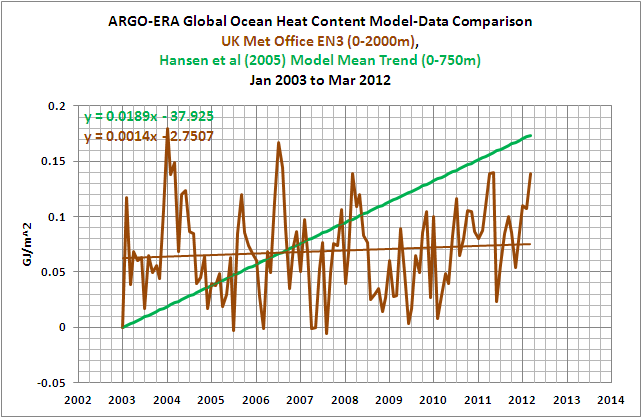

Figure 1
Can well-mixed human-created greenhouse gases pick and choose between the hemispheres, warming one but not the other? One might think that’s very unlikely.
Something else to consider: the Northern Hemisphere warming of ocean heat content for depths of 0-2000 meters occurs in only one ocean basin, and it’s not one of the big ones.
Right there is a premise falsifier. But I find this figure even more interesting:
There was a comparatively minor warming in the Northern Hemisphere at depths of 0-2000 meters from 2005 to 2012. But the upper 700 meters in the Northern Hemisphere cooled. The difference is provided to show the additional warming that occurred at depths of 700 to 2000 meters.

Figure 2
So the question here is simple. As Hannah Devlin writes in the Times:
The pause in global warming during the past decade is because more heat than expected is being absorbed by the deep oceans, according to scientists.
How does that heat get to the deep ocean hidey hole, down to 2000 meters, without first warming the upper 700 meters in transit? That’s some neat trick.
You can read more on how that deep ocean hidey hole doesn’t seem to hold up when the data is examined carefully here.
The claim has been made that its the sun doing it:
[Tisdale] SkepticalScience’s Rob Painting provides a reasonable explanation of the hypothetical cause of greenhouse gas-driven warming of the global oceans in the post Observed Warming in Ocean and Atmosphere is Incompatible with Natural Variation. Painting writes (my boldface):
Arguably the most significant climate-related impact of increased concentrations of greenhouse gases in the atmosphere, is that they trap more heat in the ocean. Over the last half-century around 93% of global warming has actually gone into heating the ocean. A little-known fact is that the oceans are almost exclusively heated by sunlight (shortwave radiation) entering the surface layers.
Back in 2009 it was claimed that solar radiation changes would do just that:

Well Duncan, we are still here, speaking clearly to the issue.
That article was a reaction to this Judith Lean Paper in GRL (bold mine):
=============================================================
How will Earth’s surface temperature change in future decades?
Judith L. Lean, David H. Rind Article first published online: 15 AUG 2009 DOI: 10.1029/2009GL038932
Reliable forecasts of climate change in the immediate future are difficult, especially on regional scales, where natural climate variations may amplify or mitigate anthropogenic warming in ways that numerical models capture poorly. By decomposing recent observed surface temperatures into components associated with ENSO, volcanic and solar activity, and anthropogenic influences, we anticipate global and regional changes in the next two decades. From 2009 to 2014, projected rises in anthropogenic influences and solar irradiance will increase global surface temperature 0.15 ± 0.03°C, at a rate 50% greater than predicted by IPCC. But as a result of declining solar activity in the subsequent five years, average temperature in 2019 is only 0.03 ± 0.01°C warmer than in 2014. This lack of overall warming is analogous to the period from 2002 to 2008 when decreasing solar irradiance also countered much of the anthropogenic warming. We further illustrate how a major volcanic eruption and a super ENSO would modify our global and regional temperature projections.
==================================================================
Since that obviously hasn’t happened, and “the pause” is an inconvenient truth, the cheerleaders are looking for alternate explanations. Voila! The deep ocean hidey hole.
The ocean provides the perfect cover for global warming because unlike the atmosphere, few people experience it directly. Few people go diving down to 2000 meters with thermometers and few people go swimming in the ocean with pH meters to check the claims of “ocean acidification”.
On the other hand, virtually the whole of humanity can and has experienced “the pause” in air temperatures.
When the deep ocean hidey hole doesn’t pan out in a few years, and that stored hidden warming doesn’t spring out of the deep ocean like a caged lion, where will they put the warming next? They are running out of places.
“When the deep ocean hidey hole doesn’t pan out in a few years, and that stored hidden warming doesn’t spring out of the deep ocean like a caged lion, where will they put the warming next? They are running out of places. ”
The core?
“Weird [you can say again!] … either we have aliens at work – or ….” [Mr. Murphy at 11:20]…………….. Leprechauns!
Mulligan: Aye, Murphy me lad, [gravely nodding], ’tis the wee folk [glances around, wouldn’t do to have one hear you — they are NOT nice] for sure.
Murphy: Mulligan, ye’re full o’ beans.
Mulligan: [fixes his eyes hard on Murphy’s] How d’ye explain THIS, then, eh? Every time there’s lots o’ fish in the stream, there’s been Leprechauns at work.
Murphy: See any?
Mulligan: Nope.
Murphy: How do you know there are any, then?
Mulligan: Because there’ve been a lot of fish. It’s Leprechauns that bring the fish, I TELL YE.
Murphy: Okay, Mulligan, then, if the Leprechauns fill the stream with fish, then why have there been no fish in the stream for the past 17 years or so?
Mulligan: They hid ’em in a big cave in Scotland.
******************************************
Climatologist Quote of the Week (emphasis mine):
“… decreasing solar irradiance also countered much of the anthropogenic warming… .” [Lean and Rind]
Aaaand the power steering going out on my car also countered much of my anthropogenic steering. Since when has a LACK OF BOOST been a countervailing force?!!
**********************************
Well written post, A-th-y — great use of quotes from the WUWT oceans expert, Bob Tisdale. Thanks!
@ALL YOU WONDERFUL WUWT SCIENTISTS AND RESEARCHERS ABOVE
WELL DONE! Thunderingly powerful refutation of the Fantasy Science Club!
You guys are so COOL!
I love this site.
So we are now on step 3?
1. The models say that Co2 is the biggest driver of Global warming, it will heat up the Earth and temperatures will be going up. The evidence will be the hotspot.
Temperatures are stalling and no (statistically significant) warming for 18-20 years (depending on which data set is used). The hotspot can’t be found.
2. Instead of heating the atmosphere, the increased warming (energy) is causing Extreme Weather, more and more severe hurricanes, cyclones, tornados and other storms, droughts and increased rainfall.
The data shows that extreme (whatever that means) weather is not increasing. Hurricanes and cyclone activity is decreasing and there is no significant change in global droughts and rainfall data.
3. Instead of heating the atmosphere and causing Extreme Weather, the heat is now moving into the deep oceans.
No sufficient data available for the deep oceans………
And they still maintain the models are correct.
Step 4…?
The inconvenient truth is, warming can not hide in the abyss for long, for average temperature of the deep ocean is a regulated quantity. At least as long as there is an interface between ice and seawater anywhere on the globe (and sea ice is not going to go away completely any time soon). The explanation is simple, I believe even climate scientists have the mental capacity to comprehend it.
As some heat gets into the abyss, conceivably by vertical turbulent mixing, that is, driven by pure mechanical energy input, it makes deep waters more buoyant. Now, seawater, unlike fresh water, has its highest density just above freezing, which temperature is assumed right at the seawater – ice interface, what is more, it is determined by the very physics of seawater, not “climate”. The next step is, this water mass starts to sink somewhere along the ice edge, replacing somewhat warmer and more buoyant water masses at depth, ones mentioned above, which got there driven by turbulent mixing, induced by internal waves breaking above rugged bottom features. And yes, those internal waves are excited by tidal flows and surface winds, that is, by mechanical, not thermal means.
The net result is, temperature of the deep ocean gets right back to the point it used to be. No long term warming is possible whatsoever, the regulator is set to the freezing point of seawater tightly.
Now, the only free parameter in the story above is the exact locations of downwelling and distribution of downwelling fluxes among said locations. Downwelling flux, integrated globally, is set by the rate of vertical mixing, that is, by global re-supply of buoyancy at depth, which in turn is determined by tidal forces (roughly periodic over the Metonic cycle, 19 years) and surface winds, over the Southern ocean, mostly (Roaring Forties, Furious Fifties, Screaming Sixties), whose intensity cannot increase indefinitely either. Therefore, it is really about the distribution of a pre-determined flux, which won’t vary much with “climate”.
Downwelling, obviously, occurs at locations where density of seawater is highest along the seawater – ice interface. This is where climate comes into play, because these locations are determined by (regional) climate, which in turn is influenced by ocean surface currents carrying water to those spots.
Density of seawater at a temperature next to freezing is determined by its salinity and pressure. The first one is easy to comprehend, the saltier the water, the higher its density is. As for the latter one, freezing point of seawater decreases with increasing pressure, therefore at locations with deep ice, temperature of liquid water next to it is lower than temperature at freezing on the surface, while its density is higher.
The former process occurs in the Noth Atlantic, mostly, its procuct is called North Atlantic Deep Water. The latter one forms around Antarctica, where roots of ice ridges & shelves often go down to several hundred meters or more. See Antarctic Bottom Water for details. In the North Pacific neither salinity, nor depth of ice is sufficient to induce downwelling under current climate.
The point is, locations of downwelling and local fluxes (unlike the overall flux) are not fixed, and downwelling at any specific spot is intermittent. It moves around in a haphazard manner, increasing in some regions while decreasing elsewhere. It’s like weather, at a slow pace.
De core is de heap big warmy place.
Is de billion quintrillion degree place…..centigrady or farenheity thingies…I forget…
Corrections to my 1:47 pm:
I took the liberty of using Figure 3 from Willis Eschenbach’s “The Layers of Meaning in Levitus”
Today ARGO delivers 100,000 profiles per year.
It’s always the last place you look
So in essence, ARGO buoys are the new trees. There will probably end up being one special Yamal Buoy that is the crux of another failed Warmist scare.
I see Rob Painting is busy trolling Roy Spencer’s site.
Next the heat will be hiding by ‘hiding’ by escaping into space. Hang on, but that invalidates greenhouse gas models……cant have that.
Don’t the ARGO buoys “go with the flow”, and wouldn’t the natural flow of deep waters be from cooler to warmer, otherwise you would never get upwellings of warmer water.
ie could the barely significant warming of the sub 700m area be just an artefact of how it is measured.
Maybe its the warming of the currents from processes WITHIN the Earth
I probably shouldn’t say this because it might give them ideas..
But I wonder how much energy has been sucked up by the growth in the biosphere.?
Obama will reveal the location of the missing the next time he “pivots” to the economy …
I’ll add a bit to the post from Berényi Péter. As other posters have pointed out the amountof energy involved will barely heat the deep ocean .01-,01degC. putting it at 3-4degC +- .01 or so. In order for that energy to heat anything it has to transfer energy to a lower temperature. Unlike radiation, kinetic heat energy can’t transfer energy to a warmer substrate. Just where in the world is there any place colder than the deep ocean to transfer heat to. At best, the “increase” in deep ocean temperature might very slightly slow other processes, such as the ice/water interface effect Berényi Péter posits. There is just no “there” there regarding deep ocean heating, if it truly is occurring, to any effects on the larger climate.
where will they put the warming next?
How about down the mouth of volcanoes.
That way the heat can be traveling into the belly of Mother Gaea and if we don’t stop CO2 then her belly will explode!
I hope all the correct protocols are in place when securing the screen door on the alarmists submarine.
Actually the earth has been getting a lot cooler since 1980. Except the coldness has been hiding in the extra deep ocean. Prove me wrong.
More seriously, if so much heat has been going into the ocean, should not sea level rise be increasing dramatically?
If the heat is cycling in and out of the oceans as they suggest, the warming we had in the 80’s and 90’s could just as well have been through heat coming out of the oceans and not CO2
jorgekafkazar says:
July 24, 2013 at 9:19 am
————————————————–
Why not just do the experiments yourself?
Experiment 1. Effect of incident LWIR on liquid water that is free to evaporatively cool.
Incident LWIR can slow the cooling rate of materials. Climate scientists claim that DWLWIR has the same effect over oceans as it does over land, and this is shown in many Trenberthian energy budget cartoons. Does the ocean respond to DWLWIR the same way as land?
– Build two water proof EPS foam cubes 150mm on a side and open at the top.
– Position a 100mm square aluminium water block as LWIR source 25mm above each cube.
– Position two small computer fans to blow a very light breeze between the foam cube and the water blocks.
– Insert a probe thermometer with 0.1C resolution through the side of each cube 25mm below the top.
– Continuously run 80C water through one water block and 1C water through the other.
– Fill both EPS foam cubes to the top with 40C water an allow to cool for 30 min while recording temperatures.
– Repeat the experiment with a thin LDPE film on the surface of the water in each cube to prevent evaporative cooling.
You will find that water that is free to evaporatively cool does not have its cooling rate significantly changed by incident LWIR. LWIR radiation from CO2 does not trap heat in the oceans.
Experiment 2. Effect of heated air on liquid water that is free to evaporatively cool.
Some claim that a hotter atmosphere can heat the oceans or slow their cooling rate. CO2 acts to cool the atmosphere at all concentrations above 0.0ppm, but you can check the effect on the oceans of heated air for amusement purposes.
– Fill a small plastic bucket with cold water.
– stir the water and measure the temperature.
– Direct the hot air from a hair drier at the surface of the water from distance that prevents splashing for about 5 minutes.
– Stir the water again and measure the temperature.
– Repeat the experiment but this time direct the hair drier at the side of the bucket.
You will find that trying to heat liquid water that is free to evaporatively cool with hot air in contact with the skin evaporation layer is ineffective.
The Global Warming Monster is not hiding in the deep oceans, intermittently leaping out to cause “Extreme Weather” then running away again. The Global Warming Monster does not exist.
When the deep ocean hidey hole doesn’t pan out in a few years, and that stored hidden warming doesn’t spring out of the deep ocean like a caged lion, where will they put the warming next?
Well, I was going to suggest they ‘put it where the sun don’t shine’…… but I realized that the deep ocean hidey hole IS where the sun don’t shine!
They really are running outta places, aren’t they??!!!
“…, the “raw” ocean heat content data for 0-2000 meters shows the decreased rate of warming after the ARGO floats were deployed.”
And they wonder why we don’t trust climate science.
As to where the missing heat went, I’m going with Libby and Pandolfi who in 1979 came out with a paper that said their proxy data showed a repeating pattern and this pattern shows warming until 2000 and then cooling, for perhaps 50 years.
I.E: A natural cycle is hiding the warming.
I did some investigating on the picture of the boat in the Times of London article. I searched Getty Images and could not locate it. I did a View Image Info on the photo and I found the description:
“Low water levels in a lake in China”
Further searches found another article, same boat, published May 2012:
http://www.nydailynews.com/news/world/earths-needed-sustain-human-activity-2030-report-finds-article-1.1078933
But now I have a name, Chaohu lake, and a date, May 2011.
Further searches came up with the same boat, different angle, also dated May 2011:
http://english.cri.cn/6909/2011/05/30/189s640237.htm
The closest I came in Getty Images was this:
http://www.gettyimages.com/detail/news-photo/fishing-boats-run-aground-at-chaohu-lake-on-may-28-2011-in-news-photo/114933826
Again, dated May 2011
If ones does a BING image search for chaohu lake, 99% of the images are of a very wet lake. In fact, they have an Algae problem right now from raw sewage and industrial pollution. No mention of any drought. In fact, I saw one article on flooding in the same region in July 2011, so the drought must have been short lived.
Now given the propensity of the Chinese government to do master planning, damming rivers and moving whole villages, I don’t think anyone can say that this drought was absolutely caused by AGW. But that won’t stop the AGW proponents from recycling old pictures with their stories… Given the modern convenience of the Web, it astounds me that they are too lazy to find fresh pictures to an old story..
SSTs are warmer than surface air temps, we have different seasons at the same time in different parts of the globe, and the seas lag temp changes on land for those. Immediate thermal equilibrium doesn’t happen in the earth’s system.
It’s a very nice boat, isn’t it?. I thought it was a punt on some English tidal creek. The flat bottom is perfect for navigating shallow, swampy backwaters, and lying at rest on the mud when the tide goes out or the seasonal lake margins start to dry up. It was made for that lake.