Initial Notes: This post contains graphs of running trends in global surface temperature anomalies for periods of 12+ and 16 years using HADCRUT4 data. They indicate that we have not seen a warming hiatus this long since about 1980.
Much of the following text is boilerplate. It is intended for those new to the presentation of global surface temperature anomaly data.
GISS LAND OCEAN TEMPERATURE INDEX (LOTI)
Introduction: The GISS Land Ocean Temperature Index (LOTI) data is a product of the Goddard Institute for Space Studies. Starting with their January 2013 update, it uses NCDC ERSST.v3b sea surface temperature data. The impact of the recent change in sea surface temperature datasets is discussed here. GISS adjusts GHCN and other land surface temperature data via a number of methods and infills missing data using 1200km smoothing. Refer to the GISS description here. Unlike the UK Met Office and NCDC products, GISS masks sea surface temperature data at the poles where seasonal sea ice exists, and they extend land surface temperature data out over the oceans in those locations. Refer to the discussions here and here. GISS uses the base years of 1951-1980 as the reference period for anomalies. The data source is here.
Update: The June 2013 GISS global temperature anomaly is +0.67 deg C. It warmed about +0.12 deg C since May 2013.

GISS LOTI
NCDC GLOBAL SURFACE TEMPERATURE ANOMALIES
Introduction: The NOAA Global (Land and Ocean) Surface Temperature Anomaly dataset is a product of the National Climatic Data Center (NCDC). NCDC merges their Extended Reconstructed Sea Surface Temperature version 3b (ERSST.v3b) with the Global Historical Climatology Network-Monthly (GHCN-M) version 3.2.0 for land surface air temperatures. NOAA infills missing data for both land and sea surface temperature datasets using methods presented in Smith et al (2008). Keep in mind, when reading Smith et al (2008), that the NCDC removed the satellite-based sea surface temperature data because it changed the annual global temperature rankings. Since most of Smith et al (2008) was about the satellite-based data and the benefits of incorporating it into the reconstruction, one might consider that the NCDC temperature product is no longer supported by a peer-reviewed paper.
The NCDC data source is here. NCDC uses 1901 to 2000 for the base years for anomalies.
Update: The June 2013 NCDC global land plus sea surface temperature anomaly is +0.64 deg C. It decreased -0.02 deg C since May 2013.

NCDC Global (Land and Ocean) Surface Temperature Anomalies
UK MET OFFICE HADCRUT4 (LAGS ONE MONTH)
Introduction: The UK Met Office HADCRUT4 dataset merges CRUTEM4 land-surface air temperature dataset and the HadSST3 sea-surface temperature (SST) dataset. CRUTEM4 is the product of the combined efforts of the Met Office Hadley Centre and the Climatic Research Unit at the University of East Anglia. And HadSST3 is a product of the Hadley Centre. Unlike the GISS and NCDC products, missing data is not infilled in the HADCRUT4 product. That is, if a 5-deg latitude by 5-deg longitude grid does not have a temperature anomaly value in a given month, it is not included in the global average value of HADCRUT4. The HADCRUT4 dataset is described in the Morice et al (2012) paper here. The CRUTEM4 data is described in Jones et al (2012) here. And the HadSST3 data is presented in the 2-part Kennedy et al (2012) paper here and here. The UKMO uses the base years of 1961-1990 for anomalies. The data source is here.
Update (Lags One Month): The May 2013 HADCRUT4 global temperature anomaly is +0.50 deg C. It increased about +0.07 deg C since April 2013.

HADCRUT4
149-MONTH RUNNING TRENDS
As noted in my post Open Letter to the Royal Meteorological Society Regarding Dr. Trenberth’s Article “Has Global Warming Stalled?”, Kevin Trenberth of NCAR presented 10-year period-averaged temperatures in his article for the Royal Meteorological Society. He was attempting to show that the recent hiatus in global warming since 2001 was not unusual. Kevin Trenberth conveniently overlooked the fact that, based on his selected start year of 2001, the hiatus has lasted 12+ years, not 10.
The period from January 2001 to May 2013 is now 149-months long. Refer to the following graph of running 149-month trends from January 1880 to May 2013, using the HADCRUT4 global temperature anomaly product. The last data point in the graph is the linear trend (in deg C per decade) from January 2001 to the current month. It is slightly negative. That, of course, indicates global surface temperatures have not warmed during the most recent 149-month period. Working back in time, the data point immediately before the last one represents the linear trend for the 149-month period of December 2000 to April 2013, and the data point before it shows the trend in deg C per decade for November 2000 to March 2013, and so on.

149-Month Linear Trends
The highest recent rate of warming based on its linear trend occurred during the 149-month period that ended in late 2003, but warming trends have dropped drastically since then. Also note that about 1980 was the last time there had been a 149-month period without global warming—before recently.
192-MONTH RUNNING TRENDS
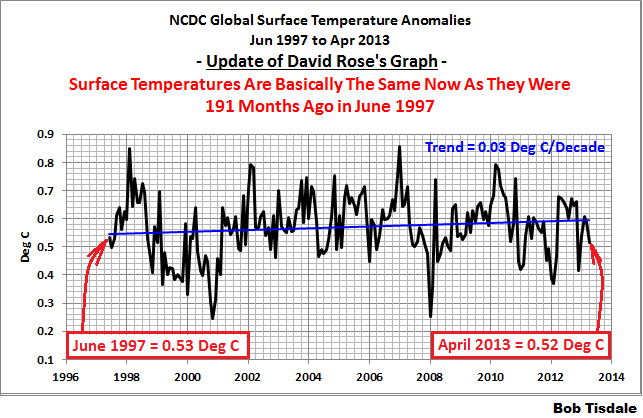
In his RMS article, Kevin Trenberth also conveniently overlooked the fact that the discussions about the warming hiatus are now for a time period of about 16 years, not 10 years—ever since David Rose’s DailyMail article titled “Global warming stopped 16 years ago, reveals Met Office report quietly released… and here is the chart to prove it”. In my response to Trenberth’s article, I updated David Rose’s graph, noting that surface temperatures in April 2013 were basically the same as they were in June 1997. We’ll use June 1997 as the start month for the running 16-year trends. The period is now 192-months long. The following graph is similar to the one above, except that it’s presenting running trends for 192-month periods.

192-Month Linear Trends
The last time global surface temperatures warmed at the minimal rate of 0.03 deg C per decade for a 192-month period was the late 1970s.
The most widely used metric of global warming—global surface temperatures—indicates that the rate of global warming has slowed drastically and that the duration of the hiatus in global warming is unusual during a period when global surface temperatures are allegedly being warmed from the hypothetical impacts of manmade greenhouse gases.
A NOTE ABOUT THE RUNNING-TREND GRAPHS
There is very little difference in the end point trends of 149-month and 192-month running trends if GISS or NCDC products are used in place of HADCRUT4 data. The major difference in the graphs is with the HADCRUT4 data and it can be seen in a graph of the 149-month trends. I suspect this is caused by the updates to the HADSST3 data that have not been applied to the ERSST.v3b sea surface temperature data used by GISS and NCDC.
COMPARISON
The GISS, HADCRUT4 and NCDC global surface temperature anomalies are compared in the next two time-series graphs. The first graph compares the three global surface temperature anomaly products starting in 1979. Again, due to the timing of this post, the HADCRUT4 data lags the GISS and NCDC products by a month. The graph also includes the linear trends. Because the three datasets share common source data, (GISS and NCDC also use the same sea surface temperature data) it should come as no surprise that they are so similar. For those wanting a closer look at the more recent wiggles, the second graph starts with Kevin Trenberth’s chosen year of 2001. Both of the comparisons present the anomalies using the base years of 1981 to 2010. Referring to their discussion under FAQ 9 here, according to NOAA:
This period is used in order to comply with a recommended World Meteorological Organization (WMO) Policy, which suggests using the latest decade for the 30-year average.

Comparison Starting in 1979
###########

Comparison Starting in 2001
AVERAGE
The last graph presents the average of the GISS, HADCRUT and NCDC land plus sea surface temperature anomaly products. Again because the HADCRUT4 data lags one month in this update, the most current average only includes the GISS and NCDC products. The flatness of the data since 2001 is very obvious, as is the fact that surface temperatures have rarely risen above those created by the 1997/98 El Niño.

Average of Global Land+Sea Surface Temperature Anomaly Products
TODAY IS BUY A CUP OF COFFEE FOR A SKEPTICAL BLOGGER DAY
As you’re likely aware, global warming skeptics do not receive gazillion dollar government research grants, and most of us do not have research, educational or other positions related to climate change. While we do have tip/donation links on our websites, we often forget to remind visitors that they’re there. This is a gentle reminder. Hint –> My Tip Jar.
If you’re reading this at WattsUpWithThat, Anthony Watts has put in countless hours establishing that website as the place to go for information and discussions about global warming and climate change, so please give Anthony’s Surface Stations Project Donation Link a click.
And I stopped counting years ago how many hours per week I put into preparing graphs, writing blog posts and replying to questions and comments, so please remember My Tip Jar, too.
Every tip is very much appreciated. Please buy an unfunded skeptic a cup of coffee.
Thanks, Bob
I am charted out I think I will put on my overcoat because It is freezing here in Australia
Is it ok if I buy you a beer?
It seems odd to see the phrase “It decreased -0.02 deg C since May 2013.”, and my automatic feeling is that this is a double negative, and it is only after looking at the phrase “The June 2013 GISS global temperature anomaly is +0.67 deg C.” that I realise what is really meant.
Reblogged this on gottadobetterthanthis and commented:
The data clearly shows no warming for a little while. It seems to have reached maximum and started to cool, but it is a bit early to say so. However, the globe has warmed, and global warming is a hoax in spite of that fact because the proposed cure is far more deadly and harmful to the planet than the status quo and the presumed continuation of any warming trend. Cooling is eventually inevitable. It will be deadly, and population on our planet will decrease. It will be bad. Hopefully that is still several decades away and slow in coming, allowing us to adapt and innovate and minimize the suffering and hunger. Regardless, cold kills. Warmer is better.
@Bloke – I’m guessing that’s what the tip jar link is for. Actually he mentions his tip jar twice which might be accidental or an extra extra hint.
Sorry Bob, only real skeptics get coffee.
Pseudo skeptics are advised to apply to the Heritage Foundation as per usual.
Global “Nothing”. No warming, no cooling. Now, NO Climate “Change”.
Hint taken Bob (sorry it’s not more) we can’t have you running low on caffeine can we?
If you got to woodfortrees.com and plot HADCRUT3 from say 1995 to 2014 and then do the same for HADCRUT4 for the same time period you will what they are doing. The big El Nino of 1997/98 is being pounded down while the more recent temperatures are being pushed up. They are using “creating accounting” to diminish, step by step, the pause in global warming. Soon the 15 year pause will be diminished to 10 years and so on. In the real world this would be criminal but in the world of “climate science” it is SOP.
Isn’t Anthony funded by the Heartland Institute?
Many thanks – this sort of presentation is of great help to us amateurs
Its going to be pretty hard for 2.5C of warming to show up in the next 87 years when the rate of increase right now is basically nothing.
Its going to be pretty hard for 2.5C of warming to show up in the next 87 years when the rate of increase right now is basically nothing.
In 2007 the 15-yr trend was about 0.30 C/decade. Where was everyone then?
These short-term trends flucatuate.
I dunno 🙁
Our Champion Sir Christopher of Belchley keeps banging on about “As the long period without statistically-significant warming (at least 17 years on all datasets; 23 years on the RSS data) continues” ( http://wattsupwiththat.com/2013/05/05/benchmarking-ipccs-warming-predictions/ ). But eyeballing the graphs above I can only see a plateau in global temp. rise since around 2005-2006.
I must be doing something wrong; looking at the graphs from the wrong angle, not tilting my head right, something like that
Update: The June 2013 GISS global temperature anomaly is +0.67 deg C. It warmed about +0.12 deg C since May 2013.
Update: The June 2013 NCDC global land plus sea surface temperature anomaly is +0.64 deg C. It decreased -0.02 deg C since May 2013.
So the net difference between GISS and NCDC is 0.14. That is huge! To put that number into perspective, that is the difference between 3rd place and 13th place on HadCRUT4 where the anomalies are 0.531 and 0.392 respectively. Are we supposed to trust their numbers?
Sedron L says:
July 19, 2013 at 7:00 am
Isn’t Anthony funded by the Heartland Institute?
>>>>>>>>>>>>>>>>
[You] forgot the /sarc
Anthony had (1) one research project funded by a donor found by Heartland and that is it.
It is the Weather Stations Project which will be free to the public.
Village Idiot says:
July 19, 2013 at 9:26 am
It depends on the data set. And there is a difference between no warming and no statistically significant warming at the 2 sigma level. Different data sets are different. Take a look at the graph below:
http://www.woodfortrees.org/plot/rss/from:1990/plot/rss/from:1990/trend/plot/rss/from:1996.9/plot/rss/from:1990/plot/rss/from:1990/trend/plot/rss/from:1990/detrend:0.3128/trend/plot/rss/from:1990/detrend:-0.3128/trend/plot/rss/from:1996.9/trend
The very latest for RSS is that there is no warming for 16 years and 7 months and no statistically significant warming for 24 years, going back to July 1989.
The situation with GISS, which used to have no statistically significant warming for 17 years, has now been changed with new data. GISS now has over 18 years of no statistically significant warming. As a result, we can now say the following: On six different data sets, there has been no statistically significant warming for between 18 and 24 years.
Sedron L says:
July 19, 2013 at 7:24 am
In 2007 the 15-yr trend was about 0.30 C/decade. Where was everyone then?
These short-term trends flucatuate.
——————————————————————————————————————-
The long-term CET linear trend from 1659 to present is 0.25 deg C per CENTURY !!
Sedron L says:
July 19, 2013 at 7:24 am”……………………………………………”
_____________________________________________________________________________
We’ll see, but how long a trend do you need before you say it is long term?
Werner, do your statistics include autocorrelation? They should. Include autocorrelation when calculating uncertainties, and then tell us what percentage of the time a 15- or 20-year trend has been statistically significant. I think you will find that they rarely are.
PS: GISS and NCDC monthly error bars are 0.05 C and 0.08 C respectively. Hence a monthly difference can have quite a large error bar, so a monthly difference of 0.14 isn’t inconsistent.
The long-term CET linear trend from 1659 to present is 0.25 deg C per CENTURY !!
The long-term global trend from 5 Mya to present is -0.0001 C/century:
http://en.wikipedia.org/wiki/File:Five_Myr_Climate_Change.svg
Village Idiot says:
July 19, 2013 at 9:26 am
I must be doing something wrong; looking at the graphs from the wrong angle, not tilting my head right, something like that
_______________________________________
Definitely wrong angle. Eyeballing provides different results based on what part of the graph you cover up.
Here, it is clearly rising (with some noise) all the time to 2004:
http://www.woodfortrees.org/plot/wti/from:1992/to:2004
Here, it is clearly constant (with some noise) all the time since 1998:
http://www.woodfortrees.org/plot/wti/from:1998/to:2013
Both are right and wrong at the same time. It all depends on what your eyeball removes as noise and what remains after that.
My personal favorite tipping point is 2002.
http://www.woodfortrees.org/plot/wti/from:1992/to:2002
http://www.woodfortrees.org/plot/wti/from:2002/to:2013
Sedron L says:
July 19, 2013 at 10:02 am
Werner, do your statistics include autocorrelation? They should.
I am just using the tools at my disposal from:
http://www.skepticalscience.com/trend.php
Feel free to give your corresponding numbers using autocorrelation. By the way, did Phil Jones use autocorrelation when he said the 15 year trend at that time from 1995 to 2010 was NOT significant but later said the 16 year trend from 1995 to 2011 WAS significant?
Here is what the HadCRUT4 numbers are for certain years:
After latest update for Hadcrut4:
Start of 1995 to end 2009: 0.135 +/- 0.147. Warming for 15 years is not significant.
Start of 1995 to end 2010: 0.138 +/- 0.132. Warming for 16 years is significant.
Start of 1995 to end 2011: 0.111 +/- 0.121. Warming for 17 years is not significant.
Start of 1995 to end 2012: 0.098 +/- 0.112. Warming for 18 years is not significant.
Werner, do you even know if you’re accounting for autocorrelation? And what autocorrelation is?
If you’re not accounting for it, your numbers are scientifically meaningless. They might be fun nonetheless, but not meaningful.
Here is what the HadCRUT4 numbers are for certain years:
This is just silly. Of what possible significance could it be that the 16-yr trend is not significant, the 17-yr trend is, and the 18-yr trend is not? What does that tell you about climate? Essentially nothing but that a nonscientific choice of the interval gives useless results. Should one not worry if the statistical significance is 93% but do worry if it is 95.0001%? That’s silly.
You are getting all caught up in numerical minutae and failing to think about the big picture. Where were you 6 years ago when the 15-year trend was 0.30 C/decade? It was just as meaningless (though high) then as it is now (though low). It fluctuates greatly.
Most of us want to understand climate, not every little blip in the numbers.