Initial Notes: This post contains graphs of running trends in global surface temperature anomalies for periods of 12+ and 16 years using HADCRUT4 data. They indicate that we have not seen a warming hiatus this long since about 1980.
Much of the following text is boilerplate. It is intended for those new to the presentation of global surface temperature anomaly data.
GISS LAND OCEAN TEMPERATURE INDEX (LOTI)
Introduction: The GISS Land Ocean Temperature Index (LOTI) data is a product of the Goddard Institute for Space Studies. Starting with their January 2013 update, it uses NCDC ERSST.v3b sea surface temperature data. The impact of the recent change in sea surface temperature datasets is discussed here. GISS adjusts GHCN and other land surface temperature data via a number of methods and infills missing data using 1200km smoothing. Refer to the GISS description here. Unlike the UK Met Office and NCDC products, GISS masks sea surface temperature data at the poles where seasonal sea ice exists, and they extend land surface temperature data out over the oceans in those locations. Refer to the discussions here and here. GISS uses the base years of 1951-1980 as the reference period for anomalies. The data source is here.
Update: The June 2013 GISS global temperature anomaly is +0.67 deg C. It warmed about +0.12 deg C since May 2013.

GISS LOTI
NCDC GLOBAL SURFACE TEMPERATURE ANOMALIES
Introduction: The NOAA Global (Land and Ocean) Surface Temperature Anomaly dataset is a product of the National Climatic Data Center (NCDC). NCDC merges their Extended Reconstructed Sea Surface Temperature version 3b (ERSST.v3b) with the Global Historical Climatology Network-Monthly (GHCN-M) version 3.2.0 for land surface air temperatures. NOAA infills missing data for both land and sea surface temperature datasets using methods presented in Smith et al (2008). Keep in mind, when reading Smith et al (2008), that the NCDC removed the satellite-based sea surface temperature data because it changed the annual global temperature rankings. Since most of Smith et al (2008) was about the satellite-based data and the benefits of incorporating it into the reconstruction, one might consider that the NCDC temperature product is no longer supported by a peer-reviewed paper.
The NCDC data source is here. NCDC uses 1901 to 2000 for the base years for anomalies.
Update: The June 2013 NCDC global land plus sea surface temperature anomaly is +0.64 deg C. It decreased -0.02 deg C since May 2013.

NCDC Global (Land and Ocean) Surface Temperature Anomalies
UK MET OFFICE HADCRUT4 (LAGS ONE MONTH)
Introduction: The UK Met Office HADCRUT4 dataset merges CRUTEM4 land-surface air temperature dataset and the HadSST3 sea-surface temperature (SST) dataset. CRUTEM4 is the product of the combined efforts of the Met Office Hadley Centre and the Climatic Research Unit at the University of East Anglia. And HadSST3 is a product of the Hadley Centre. Unlike the GISS and NCDC products, missing data is not infilled in the HADCRUT4 product. That is, if a 5-deg latitude by 5-deg longitude grid does not have a temperature anomaly value in a given month, it is not included in the global average value of HADCRUT4. The HADCRUT4 dataset is described in the Morice et al (2012) paper here. The CRUTEM4 data is described in Jones et al (2012) here. And the HadSST3 data is presented in the 2-part Kennedy et al (2012) paper here and here. The UKMO uses the base years of 1961-1990 for anomalies. The data source is here.
Update (Lags One Month): The May 2013 HADCRUT4 global temperature anomaly is +0.50 deg C. It increased about +0.07 deg C since April 2013.

HADCRUT4
149-MONTH RUNNING TRENDS
As noted in my post Open Letter to the Royal Meteorological Society Regarding Dr. Trenberth’s Article “Has Global Warming Stalled?”, Kevin Trenberth of NCAR presented 10-year period-averaged temperatures in his article for the Royal Meteorological Society. He was attempting to show that the recent hiatus in global warming since 2001 was not unusual. Kevin Trenberth conveniently overlooked the fact that, based on his selected start year of 2001, the hiatus has lasted 12+ years, not 10.
The period from January 2001 to May 2013 is now 149-months long. Refer to the following graph of running 149-month trends from January 1880 to May 2013, using the HADCRUT4 global temperature anomaly product. The last data point in the graph is the linear trend (in deg C per decade) from January 2001 to the current month. It is slightly negative. That, of course, indicates global surface temperatures have not warmed during the most recent 149-month period. Working back in time, the data point immediately before the last one represents the linear trend for the 149-month period of December 2000 to April 2013, and the data point before it shows the trend in deg C per decade for November 2000 to March 2013, and so on.

149-Month Linear Trends
The highest recent rate of warming based on its linear trend occurred during the 149-month period that ended in late 2003, but warming trends have dropped drastically since then. Also note that about 1980 was the last time there had been a 149-month period without global warming—before recently.
192-MONTH RUNNING TRENDS
In his RMS article, Kevin Trenberth also conveniently overlooked the fact that the discussions about the warming hiatus are now for a time period of about 16 years, not 10 years—ever since David Rose’s DailyMail article titled “Global warming stopped 16 years ago, reveals Met Office report quietly released… and here is the chart to prove it”. In my response to Trenberth’s article, I updated David Rose’s graph, noting that surface temperatures in April 2013 were basically the same as they were in June 1997. We’ll use June 1997 as the start month for the running 16-year trends. The period is now 192-months long. The following graph is similar to the one above, except that it’s presenting running trends for 192-month periods.
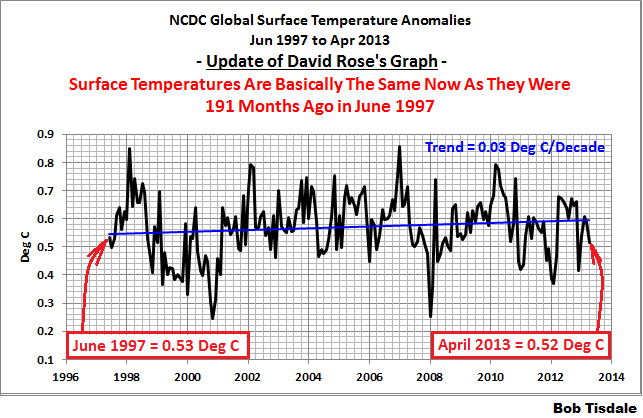

192-Month Linear Trends
The last time global surface temperatures warmed at the minimal rate of 0.03 deg C per decade for a 192-month period was the late 1970s.
The most widely used metric of global warming—global surface temperatures—indicates that the rate of global warming has slowed drastically and that the duration of the hiatus in global warming is unusual during a period when global surface temperatures are allegedly being warmed from the hypothetical impacts of manmade greenhouse gases.
A NOTE ABOUT THE RUNNING-TREND GRAPHS
There is very little difference in the end point trends of 149-month and 192-month running trends if GISS or NCDC products are used in place of HADCRUT4 data. The major difference in the graphs is with the HADCRUT4 data and it can be seen in a graph of the 149-month trends. I suspect this is caused by the updates to the HADSST3 data that have not been applied to the ERSST.v3b sea surface temperature data used by GISS and NCDC.
COMPARISON
The GISS, HADCRUT4 and NCDC global surface temperature anomalies are compared in the next two time-series graphs. The first graph compares the three global surface temperature anomaly products starting in 1979. Again, due to the timing of this post, the HADCRUT4 data lags the GISS and NCDC products by a month. The graph also includes the linear trends. Because the three datasets share common source data, (GISS and NCDC also use the same sea surface temperature data) it should come as no surprise that they are so similar. For those wanting a closer look at the more recent wiggles, the second graph starts with Kevin Trenberth’s chosen year of 2001. Both of the comparisons present the anomalies using the base years of 1981 to 2010. Referring to their discussion under FAQ 9 here, according to NOAA:
This period is used in order to comply with a recommended World Meteorological Organization (WMO) Policy, which suggests using the latest decade for the 30-year average.

Comparison Starting in 1979
###########

Comparison Starting in 2001
AVERAGE
The last graph presents the average of the GISS, HADCRUT and NCDC land plus sea surface temperature anomaly products. Again because the HADCRUT4 data lags one month in this update, the most current average only includes the GISS and NCDC products. The flatness of the data since 2001 is very obvious, as is the fact that surface temperatures have rarely risen above those created by the 1997/98 El Niño.

Average of Global Land+Sea Surface Temperature Anomaly Products
TODAY IS BUY A CUP OF COFFEE FOR A SKEPTICAL BLOGGER DAY
As you’re likely aware, global warming skeptics do not receive gazillion dollar government research grants, and most of us do not have research, educational or other positions related to climate change. While we do have tip/donation links on our websites, we often forget to remind visitors that they’re there. This is a gentle reminder. Hint –> My Tip Jar.
If you’re reading this at WattsUpWithThat, Anthony Watts has put in countless hours establishing that website as the place to go for information and discussions about global warming and climate change, so please give Anthony’s Surface Stations Project Donation Link a click.
And I stopped counting years ago how many hours per week I put into preparing graphs, writing blog posts and replying to questions and comments, so please remember My Tip Jar, too.
Every tip is very much appreciated. Please buy an unfunded skeptic a cup of coffee.
Thanks, Bob
Sedron L says:
July 20, 2013 at 1:42 pm
Please do not be a fool, and learn the difference between past and present tenses.
Sedron L says:
July 20, 2013 at 1:43 pm
“There is — downward currents, as happen in the north Atlantic.”
This is a flail. There is no narrow pipeline which can carry heated waters to the depths without diffusion to the surrounding waters.
Bart: You noticeably ignored the question of 0-700 m warming.
What is your number?
(Your claim is false.)
There is no narrow pipeline which can carry heated waters to the depths without diffusion to the surrounding waters.\
There sure is — it’s called the ocean conveyer.
But no need, since the 0-700 m layer is warming strongly too.
I would like to see you apply Q = mct to prove it.
Werner, this is how they do it. Have you read the papers by Levitus? They go into the discussion of errors at great length.
however the laws of thermodynamics say the heat is too diffuse to do anything
This is a joke, right? The laws of thermodynamics say absolutely nothing of the sort.
Heat is heat.
Sedron L says:
July 20, 2013 at 8:08 pm
Werner, this is how they do it.
And what temperature change do they get for
“0-2000 m (last 8.3 yrs): (0.80 +/- 0.09) e22 J/yr”?
Sedron L says:
July 20, 2013 at 8:10 pm
however the laws of thermodynamics say the heat is too diffuse to do anything
This is a joke, right? The laws of thermodynamics say absolutely nothing of the sort.
Heat is heat.
From:
http://en.wikipedia.org/wiki/Laws_of_thermodynamics
“The prime example of irreversibility is in the transfer of heat by conduction or radiation. It was known long before the discovery of the notion of entropy that when two bodies initially of different temperatures come into thermal connection, then heat always flows from the hotter body to the colder one.”
“There is no narrow pipeline which can carry heated waters to the depths without diffusion to the surrounding waters.\
There sure is — it’s called the ocean conveyer.”
Are you suggesting that if you had a volume of warm water and it was conveyed to the bottom of the ocean that there would be any heat left in it a year later? Heat always flows from hot to cold and even if some hot water made it to a depth of 2000 m, being warmer than the surrounding water, would it not rise up and would not its heat diffuse into the colder water that it passes through?
You say heat is heat. You can heat a city by 2 C but you cannot use that heat to do useful work, but you can burn gasoline in a car and have the same amount of heat in a small confined area. That heat can do useful work. That is why heat lost to friction is considered to be wasted heat since it is too diffuse to be of any use.
Werner Brozek says:
July 20, 2013 at 8:44 pm
And what temperature change do they get for
“0-2000 m (last 8.3 yrs): (0.80 +/- 0.09) e22 J/yr”?
Let me answer my own question.
From an earlier article by Bob Tisdale:
“That obviously means that about 48% of the ocean volume is above 2000 meters.”
The volume of water from 0 to 2000 m is about 48% of 1.37 x 10^9 km^3 or 6.58 x 10^8 km^3. With 1000 m in a km, this would be 10^9 m3 in a km3, for a total volume of 6.58 x 10^17 m^3.
So let us assume that the last 8.3 years got 0.80 x 10^22 J x 8.3 = 6.64 x 10^22 J.
The specific heat capacity of sea water is 3850 J/kgC.
The density of sea water is about 1020 kg/m3, so a volume of 6.58 x 10^17 m3 has a mass of 6.7 x 10^20 kg.
Plugging in these numbers into Q = mct gives:
6.64 x 10^22 J = 6.7 x 10^20 kg x 3850 J/kgC x dt
This gives a change in temperature of 0.0257 C if I did not make a mistake.
Sedron L says:
July 20, 2013 at 8:06 pm
“There sure is — it’s called the ocean conveyer.”
The THC is not a narrow pipeline, and this is a massive flail of desperation.
Sedron L says:
July 20, 2013 at 1:37 pm
“The 65-yr trend of HadCRUT4 is +0.10 C/decade.”
Yes, about the same as it has been for the last century+. Which tells us what?
Werner, what is your point — that the ocean is huge?
I think we can all agree to that. The question of interest is how, as a heat bath, does it affect the atmosphere and climate? Because it contains a huge amount of heat, and because this is increasing quickly on a per unit area basis, the potential is large.
Yes, about the same as it has been for the last century+M/i>
Sorry, no. In fact, the trend for the first 65 yrs of the HadCRUT4 data (which begins in 1850) is -0.02 C/decade.
The THC is not a narrow pipeline, and this is a massive flail of desperation.
How do you think water gets down there? Little diffuses from above, instead, it is taken down by ocean currents, as happens to the AMOC in the North Atlantic. Once there is stays for hundreds of years…. The Gulf Stream’s transport peaks at about 150 Sv….
Sedron L says:
July 22, 2013 at 7:31 am
Anything before 1900 is essentially speculative.
Sedron L says:
July 22, 2013 at 7:37 am
“Once there is stays for hundreds of years…”
Precisely. So, how is it all of a sudden showing up at 2000 meters all across the oceans a scant 15 years after all the global warming supposedly started going there?
Massive flail.
Sedron L says:
July 22, 2013 at 7:28 am
Werner, what is your point — that the ocean is huge?
My point is that the ocean is a virtually infinite heat sink that we humans will never heat to a degree that it will affect surface temperatures.
Werner, your last comment makes no physical sense at all. Whether two objects exchange heat does not depend on their size, only on their heat content. It’s *because* the ocean’s heat content can get so large that it *can* influence surface temperatures.
Think about it: you are claiming that no matter how much heat the ocean contains, however high, it cannot influence surface temperatures. Does that make intuitive sense to you?
It also contradicts the well-known influence of El Ninos and La Ninas on surface temperatures.
Anything before 1900 is essentially speculative.
Talk about making up the rules as you go along!
Care to explain what happened in 1900 to magically make the data more than “speculative?”
Precisely. So, how is it all of a sudden showing up at 2000 meters all across the oceans a scant 15 years after all the global warming supposedly started going there?
You’re not big into data, are you?
In fact, the 0-700 m region of the ocean has been gaining heat since at least 1970:
http://www.nodc.noaa.gov/OC5/3M_HEAT_CONTENT/
In that time a huge amount of water have been transported along the AMOC and taken downward. If the flow is 100 Sv, that works out to 11% of the ocean volume in 45 years. Heat gets lost all along the way, of course, but not all of it, so it’d be expected for a fair bit of heat to be transported down there.
Sedron L says:
July 23, 2013 at 7:24 am
Whether two objects exchange heat does not depend on their size, only on their heat content.
I do not agree. Suppose that I have a hot iron marble at say 80 C and I put it into a sink of water that I heated from 0 C to 15 C. The temperatures will reach a level according mct = mct for each substance.
Suppose I also heat a bath tub from 0 C to 90 C and put the same hot marble in there instead. What happens this time? While the bathtub has a much higher heat content, it will cool the 80 C marble such that mct = mct still applies.
What happens does NOT depend on heat content but only on temperature differences.
Think about it: you are claiming that no matter how much heat the ocean contains, however high, it cannot influence surface temperatures. Does that make intuitive sense to you?
I did not say that. What I said was: “My point is that the ocean is a virtually infinite heat sink that we humans will never heat to a degree that it will affect surface temperatures.” So I would agree that a huge asteroid could hit the middle of the Pacific and it would indeed have a huge impact. However our puny CO2 additions will never make the oceans boil. If the temperature of the top 2000 m did indeed go up by 0.0257 C in 8.3 years due to our emissions, how long will it take to reach an increase of 2 C? And even if this happens would it affect the air if the deep ocean heated from 3 C to 5 C?
Sedron L says:
July 23, 2013 at 7:26 am
‘Care to explain what happened in 1900 to magically make the data more than “speculative?”’
Coverage gets more and more spotty the farther back you go. Read up on the history of the measurements. Prior to roughly 1900, it is especially poor.
Sedron L says:
July 23, 2013 at 7:35 am
“You’re not big into data, are you?”
You’re not big into logic, are you? The data pre-ARGO are very questionable, and post-ARGO, they’ve been statistically at a standstill.
“Heat gets lost all along the way, of course, but not all of it, so it’d be expected for a fair bit of heat to be transported down there.”
Not detected. The upper layers have not been warming significantly for at least a decade. So, we have no pathway diffusing heat downward.
As for the THC, you said it yourself: the THC takes hundreds of years. Obviously, that isn’t how recent surface heat is getting to the 2000-700m range.
So, to recap, we have no pathway diffusing down, and we have no pathway from the THC. Ergo, any heating of the 2000-700m range is not due to a CO2 induced increase of surface temperatures. Cause and effect, or rather, lack thereof. See how this works?
Looking at this post, I think the average dataset indicates a clear upwards trend up until, and including, 2007. I think the plateau might be more evident (and may even show a slight cooling), if you trim the data to show from only 2008 to 2013. We don’t want people getting the wrong idea, if you know what I mean. Might want to do this soon too, as El Nino is forecast to return in 2014, which might throw off the plateau trend back into an upwards one, which would be catastrophic for the cause.
Good post!