PRESS RELEASE
New Paper Proposes Cost-Effective Climate Policy That Gets Around Key Scientific Uncertainties
London: A new paper, published today by the Global Warming Policy Foundation, proposes a radical new climate policy approach that offers to be the most cost-effective means of curbing CO2 emissions, while automatically adjusting the stringency of the policy to the severity of the problem.
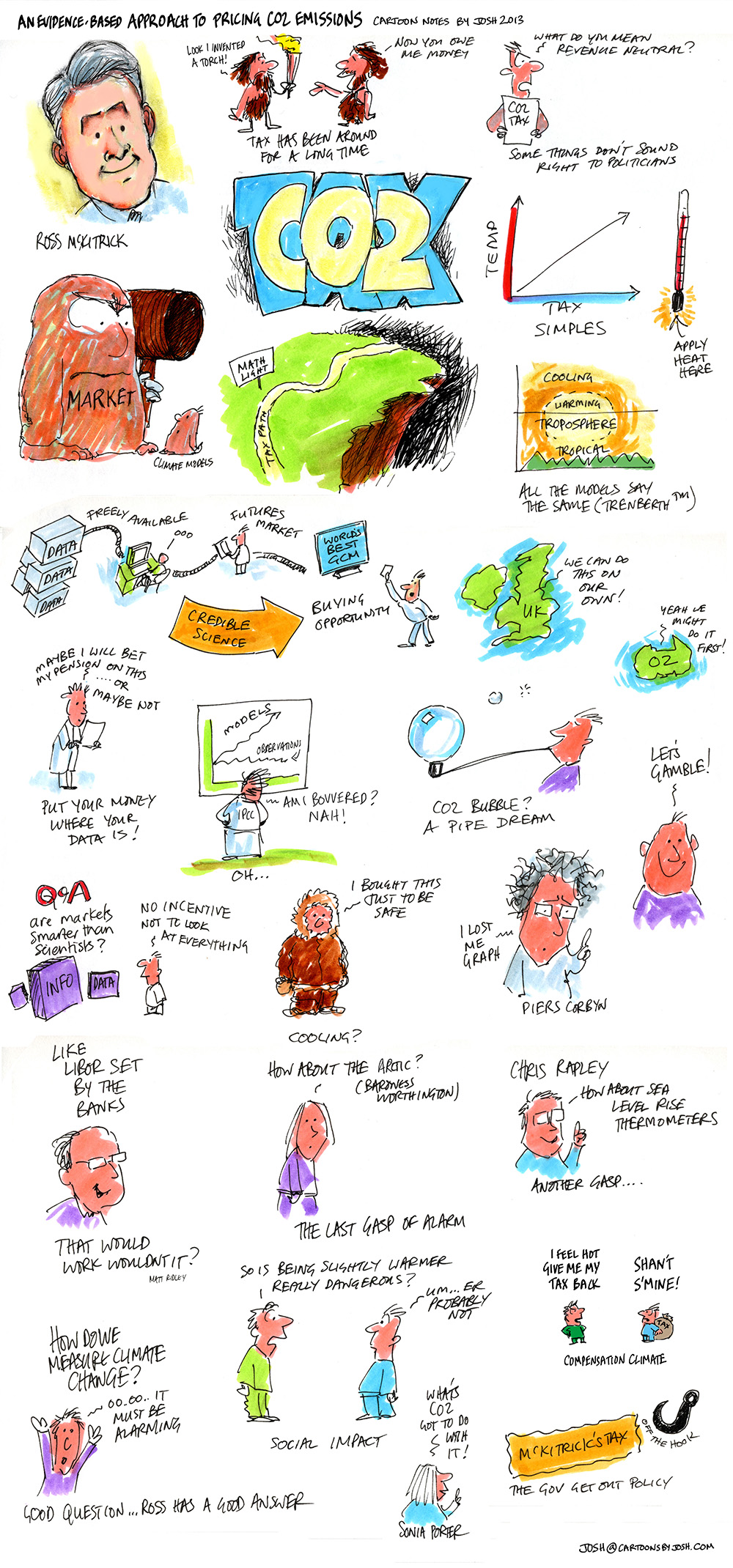
The paper‘An Evidence-Based Approach To Pricing CO2 Emissions’ written by Professor Ross McKitrick (University of Guelph, Canada) proposes to link the level of a tax on CO2 emissions to temperatures in the tropical troposphere, and to create a 30-year futures market for tax-exemption certificates. Investors would then have long term certainty about the carbon price, and the future tax rates would incorporate all known evidence of the likely path of global warming.
If started at a low level and used to pay for income tax reductions, McKitrick’s carbon tax will be economically beneficial even if enacted unilaterally.
“If the climate models are correct, the carbon tax will rise significantly as CO2 levels rise; but if the temperatures remain stagnant or low, then the tax and its economic cost will remain low too,” said Professor McKitrick. “Either way we get the right outcome, and the market will reward industries and investors who make the most objective use of available science in forming long term plans.”
“The temperature-based procedure that McKitrick outlines in his paper would provide a strong incentive for more thorough and objective analysis of possible future developments in the climate system. It thus offers a blueprint for an evidence-based low-cost emissions policy that would also promote the cause of better understanding,” Professor David Henderson writes in the foreword to the GWPF paper.
Full paper is available here
UPDATE: Ross McKitrick writes in via email.
There was an article in the UK Register and a blog post by Marcel Crok. The comment threads at Bishop Hill and Watts Up revealed a lot of confusion about what I was talking about, so I have prepared a detailed response.
Also, a cartoonist in the audience (Josh) made a fun set of visual notes of my talk.
Spot on, Willis. That’s absolutely on the nail. A carbon tax or an energy tax based upon some hypothetical rise or fall in temperature is pure unadulterated tosh. And it is incredibly naive to think that Governments will roll back on any taxes or make a carbon tax ” in lieu of “. Anybody who thinks that is not living in a real world. Any new tax will always be ” in addition to ” and will never come down in cost for the general public. Only the top corporations will get away with more benefits which they can wheedle out by doing backroom deals. This energy tax will be of a reverse Robin Hood nature, robbing the poor to make the rich more richer.
Willis, I agree with your assessment of the politics. New tax is simply manna from heaven to politicians and bureaucrats and any carbon tax will much more likely be abused than applied honestly.
Ross – It may sound like a good idea but what is your expected outcome?
My guess is the new lawwill get the temperature calculationsfrom the IPCC or a US scientific body like NOAA.
CO2 goes up, temperature goes up and they raise the tax.
Next year, CO2 goes up, temperature goes up and they raise the tax.
At what point is this cycle changed?
How does anything get fixed? Whatever that means. If we give the government a few trillion dollars (which will be added to the general revenue) they’ll stop all of the F3, F4 and F5 tornadoes? What’s your expected outcome? I would never trust the numbers.
Full disclosure, I consider myself libertarian and I don’t like the idea of giving government another revenue stream….They got plenty.
Maybe I’ll approve – as long as I provide whatever temperature readings I want and I decide how to spend the money. Oh wait, that’s what they want to do…Such a deal!
If Obama wants a little extra spending money let him write another questionable Executive Order that can easily be cancelled by a future president. If congress makes it a law it’ll never go away. It’ll just be written so they can tweak it each year to improve revenue. That’s what taxes do and that would be okay with everybody in positions of power.
I agree with Willis, “this is industrial strength stupidity.”
cn
it’s befitting on independence day
to remember how we got that way
by throwing the damn tea in the bay!
and those who were lesser men
became canadienne.