By Dr. Vincent Gray
1. Roy Spencer and Murry Salby
The greatest difficulty facing the promoters of the theory that human emissions of carbon dioxide cause dangerous global warming is the inconvenient truth that it is impossible to measure the average temperature of the earth’s surface by any known technology. Without this information it is not possible to claim global warming.
In order to make this claim the “Mean Global Surface Temperature Anomaly Record” (MGSTAR) was fabricated from temperature measurements made at meteorological weather stations.
It did not matter that
· There is no standardized method for making these observations,
· They are unrepresentative of the earth’s surface, and worse the further back you go.
· Their locations are mainly close to cities,
· Only maximum and minimum temperatures are measured,,
· The number and location of stations changes daily
Despite these disabilities, which would have killed the idea in the days when genuine scientists controlled the scientific journals, the public have been persuaded that this dubious procedure is a genuine guide to global temperature change. They even seem to accept that a change in it over a century of a few decimals of a degree is cause for alarm
John Christy and Roy Spencer in 1979 at the University of Huntsville, Alabama established an alternative procedure for plotting global temperature anomalies in the lower troposphere by using the changes in the microwave spectrum of oxygen recorded by satellites on Microwave Sounder Units (MSUs). This overcame several of the disadvantages of the MGSTAR method.
It is almost truly global , not confined to cities. Although it misses the Arctic, this is also true of the MGSTAR. There have been some problems of calibration and reliability but they are far less than the problems of the MSGTAR record. They are therefore more reliable.
From the beginning the two records have disagreed with one another. This created such panic that the supporters of the IPCC set up an alternative facility to monitor the results at Remote Sensing Systems under the aegis of NASA and in the capable hands of Frank Wentz, an IPCC supporter. It was confidently believed that the “errors” of Christy and Spencer would soon be removed. To their profound disappointment this has not happened, The RSS version of the Lower Troposphere global temperature anomaly record is essentially the same as that still provided by the University of Huntsville. It is also almost the same as the measurements made by radiosonde balloons over the same period
The MSU record has now been going for 34 years. Spencer has recently published a comparison between temperature predictions made by a large number of IPCC climate models and their projected future and the temperature record as shown by the MSUs and the balloons.
at http://www.drroyspencer.com/wp-content/uploads/CMIP5-73-models-vs-obs-20N-20S-MT-5-yr-means1.png
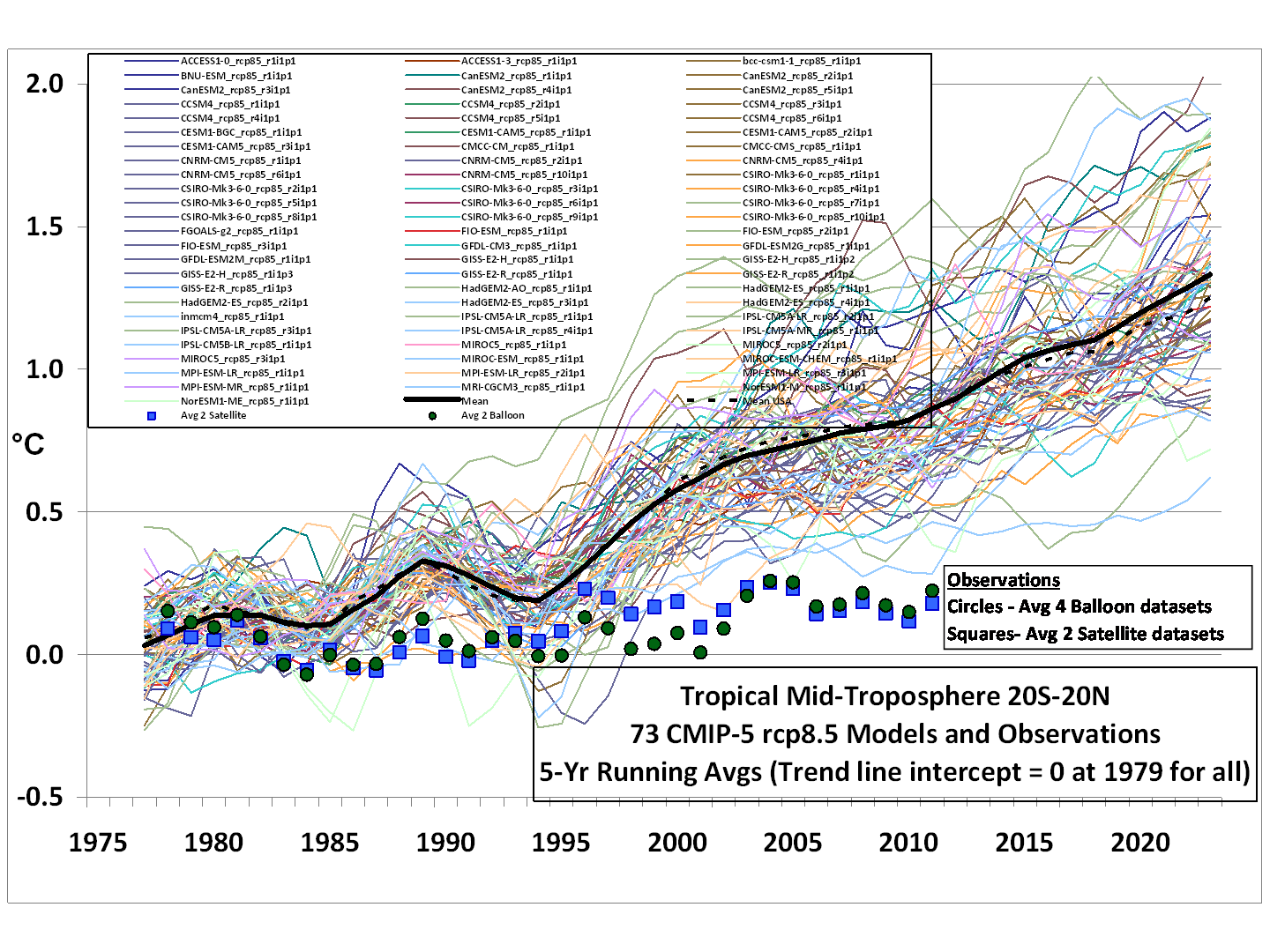
It is surely obvious that all the models are wrong and that their projections are nonsensical.
I might also add that the central line is also meaningless.
2. MURRY SALBY
Murry Salby is Professor of Climate Science at McQuarrie Univerity where he has an impressive research programme to be seen at
http://envsci.mq.edu.au/staff/ms/research.html
He has published a book “Physics of the Atmosphere and Climate”.
He has recently expounded his views on the climate in two Youtube presentations. I have found that it was necessary to see both of them several times before I got a clear idea of what he is claiming. The first one, at
was a presentation at the Sydney Institute on 2nd August 2011.
He begins by showing the paleo record based on ice cores and shows that there is a close correlation between carbon dioxide and temperature, with temperature coming first. The same applies to methane.
He then attaches it to the more recent CO2 record and plots the Carbon13 figures, which declined over the whole period. Since plant material prefers C12 this means that the additional CO2 comes from plant material. The IPCC claims that the additional plant material must come from combustion of fossil fuels, so this is their “Smoking Gun” that the increase in CO2 is caused by human-derived emissions.
But the extra plant-derived CO2 could be natural. Salby sets out to show that this is true. He shows a satellite map of natural sources of CO2 which come more from the tropics than from temperate regions (but only 6% more)
He then provides data and graphs which show that the additional CO2 results from what happens during a temperature fluctuation, using the satellite (MSU) temperature record since 1978. He shows that the CO2 which is released by a temperature increase is always greater than the CO2 absorbed when the temperature falls, providing a net increase in the atmosphere
The CO2 increase is from natural sources. It is not related to temperature, but to the behaviour of temperature fluctuations.
The second Youtube presentation at
took place at Hamburg 18th April 2013.
It starts with an attempt to clear up the discrepancy of the first presentation, where , carbon dioxide was related to temperature for the ice core proxies and where carbon dioxide was related to a difference between emissions and absorption during a temperature fluctuation for the recent measurements.
He does this by questioning the reliability of the ice core measurements, something that my late friend Zbigniew Jaborowski questioned in 1997.
He points out that the snow that traps air from the atmosphere and then solidifies irons out the fluctuations in temperature which are the real source of CO2 increase, and that some diffusion of the gases must happen when they are buried. By a rather elaborate set of mathematical calculations he restores the fluctuation effect from the ice cores and shows that it is compatible with his other calculations from recent measurements
He then extends his calculations of CO2 from temperature fluctuations by using the instrumental record. When he allows for its low reliability as you go back in the record (only 8% of the earth in 1860) he derives an impressive agreement between carbon dioxide increases and the calculated natural additions derived from temperature fluctuations over his entire range.
He shows that for the MSU record, carbon dioxide is completely unrelated to temperature,
We already know from the first part of this newsletter that climate models based on the assumption that carbon dioxide increases influence global temperature are fundamentally wrong so it does not matter much whether it comes from human-related emissions or from natural sources.
I vociferously object to science by Youtube. In the old days any new theory from a recognised academic would be welcomed by the journals, but nowadays any disagreement with the IPCC orthodoxy would have difficulty finding a place in a scientific journal.
All the same, this material from Salby needs to be properly documented before it could be considered seriously
Cheers
Vincent Gray
Wellington, New Zealand
Bart says:
June 26, 2013 at 8:32 am
I understand that it is difficult for a lay person to understand why it the necessary conclusion.
While most of my theoritical knowledge is too far in the past, I had a lot of practical experience in processes to know what is possible or probable and what not.
The mass balance argument still holds but that seems to be an endless discussion.
Regardless of the mass balance argument, the isotopes argument I explained recently is as good, it shows that there is no substantial increase of CO2 from deep ocean upwelling. And the oxygen balance shows that vegetation is a net sink for CO2 (and thus a net sink for preferably 12CO2).
Further, as discussed before, atmospheric inputs and outputs from/to the oceans are fully pressure difference dependent. It simply is impossible that a constant difference in temperature will give an increasing accumulation without a negative feedback from increased CO2 levels in the atmosphere.
Ferdinand Engelbeen says:
June 26, 2013 at 11:38 am
“The mass balance argument still holds but that seems to be an endless discussion.”
It trivially does not. You should be embarrassed to even claim it. Someday, you will realize it.