By Dr. Vincent Gray
1. Roy Spencer and Murry Salby
The greatest difficulty facing the promoters of the theory that human emissions of carbon dioxide cause dangerous global warming is the inconvenient truth that it is impossible to measure the average temperature of the earth’s surface by any known technology. Without this information it is not possible to claim global warming.
In order to make this claim the “Mean Global Surface Temperature Anomaly Record” (MGSTAR) was fabricated from temperature measurements made at meteorological weather stations.
It did not matter that
· There is no standardized method for making these observations,
· They are unrepresentative of the earth’s surface, and worse the further back you go.
· Their locations are mainly close to cities,
· Only maximum and minimum temperatures are measured,,
· The number and location of stations changes daily
Despite these disabilities, which would have killed the idea in the days when genuine scientists controlled the scientific journals, the public have been persuaded that this dubious procedure is a genuine guide to global temperature change. They even seem to accept that a change in it over a century of a few decimals of a degree is cause for alarm
John Christy and Roy Spencer in 1979 at the University of Huntsville, Alabama established an alternative procedure for plotting global temperature anomalies in the lower troposphere by using the changes in the microwave spectrum of oxygen recorded by satellites on Microwave Sounder Units (MSUs). This overcame several of the disadvantages of the MGSTAR method.
It is almost truly global , not confined to cities. Although it misses the Arctic, this is also true of the MGSTAR. There have been some problems of calibration and reliability but they are far less than the problems of the MSGTAR record. They are therefore more reliable.
From the beginning the two records have disagreed with one another. This created such panic that the supporters of the IPCC set up an alternative facility to monitor the results at Remote Sensing Systems under the aegis of NASA and in the capable hands of Frank Wentz, an IPCC supporter. It was confidently believed that the “errors” of Christy and Spencer would soon be removed. To their profound disappointment this has not happened, The RSS version of the Lower Troposphere global temperature anomaly record is essentially the same as that still provided by the University of Huntsville. It is also almost the same as the measurements made by radiosonde balloons over the same period
The MSU record has now been going for 34 years. Spencer has recently published a comparison between temperature predictions made by a large number of IPCC climate models and their projected future and the temperature record as shown by the MSUs and the balloons.
at http://www.drroyspencer.com/wp-content/uploads/CMIP5-73-models-vs-obs-20N-20S-MT-5-yr-means1.png
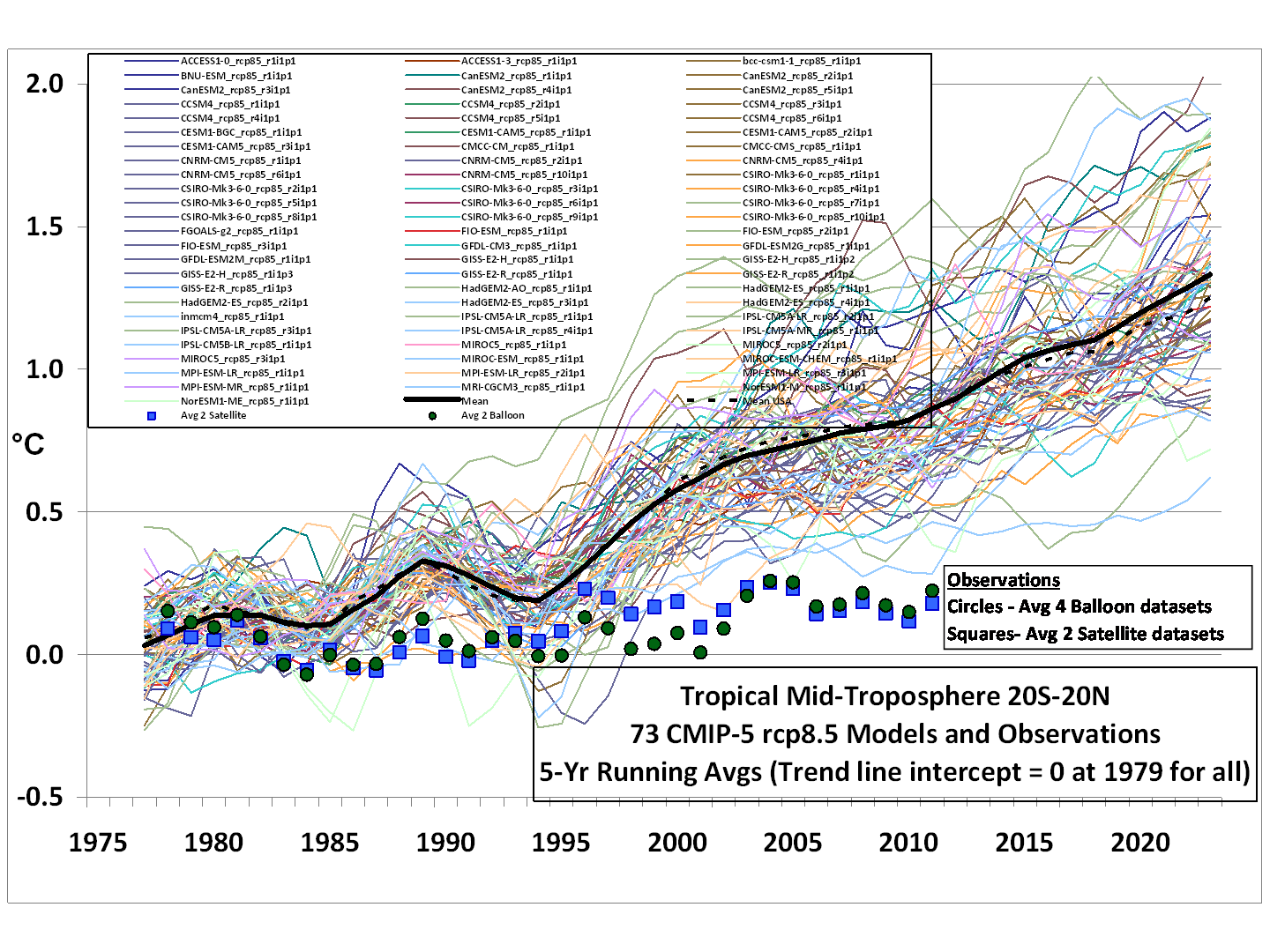
It is surely obvious that all the models are wrong and that their projections are nonsensical.
I might also add that the central line is also meaningless.
2. MURRY SALBY
Murry Salby is Professor of Climate Science at McQuarrie Univerity where he has an impressive research programme to be seen at
http://envsci.mq.edu.au/staff/ms/research.html
He has published a book “Physics of the Atmosphere and Climate”.
He has recently expounded his views on the climate in two Youtube presentations. I have found that it was necessary to see both of them several times before I got a clear idea of what he is claiming. The first one, at
was a presentation at the Sydney Institute on 2nd August 2011.
He begins by showing the paleo record based on ice cores and shows that there is a close correlation between carbon dioxide and temperature, with temperature coming first. The same applies to methane.
He then attaches it to the more recent CO2 record and plots the Carbon13 figures, which declined over the whole period. Since plant material prefers C12 this means that the additional CO2 comes from plant material. The IPCC claims that the additional plant material must come from combustion of fossil fuels, so this is their “Smoking Gun” that the increase in CO2 is caused by human-derived emissions.
But the extra plant-derived CO2 could be natural. Salby sets out to show that this is true. He shows a satellite map of natural sources of CO2 which come more from the tropics than from temperate regions (but only 6% more)
He then provides data and graphs which show that the additional CO2 results from what happens during a temperature fluctuation, using the satellite (MSU) temperature record since 1978. He shows that the CO2 which is released by a temperature increase is always greater than the CO2 absorbed when the temperature falls, providing a net increase in the atmosphere
The CO2 increase is from natural sources. It is not related to temperature, but to the behaviour of temperature fluctuations.
The second Youtube presentation at
took place at Hamburg 18th April 2013.
It starts with an attempt to clear up the discrepancy of the first presentation, where , carbon dioxide was related to temperature for the ice core proxies and where carbon dioxide was related to a difference between emissions and absorption during a temperature fluctuation for the recent measurements.
He does this by questioning the reliability of the ice core measurements, something that my late friend Zbigniew Jaborowski questioned in 1997.
He points out that the snow that traps air from the atmosphere and then solidifies irons out the fluctuations in temperature which are the real source of CO2 increase, and that some diffusion of the gases must happen when they are buried. By a rather elaborate set of mathematical calculations he restores the fluctuation effect from the ice cores and shows that it is compatible with his other calculations from recent measurements
He then extends his calculations of CO2 from temperature fluctuations by using the instrumental record. When he allows for its low reliability as you go back in the record (only 8% of the earth in 1860) he derives an impressive agreement between carbon dioxide increases and the calculated natural additions derived from temperature fluctuations over his entire range.
He shows that for the MSU record, carbon dioxide is completely unrelated to temperature,
We already know from the first part of this newsletter that climate models based on the assumption that carbon dioxide increases influence global temperature are fundamentally wrong so it does not matter much whether it comes from human-related emissions or from natural sources.
I vociferously object to science by Youtube. In the old days any new theory from a recognised academic would be welcomed by the journals, but nowadays any disagreement with the IPCC orthodoxy would have difficulty finding a place in a scientific journal.
All the same, this material from Salby needs to be properly documented before it could be considered seriously
Cheers
Vincent Gray
Wellington, New Zealand
This isn’t the first place I’ve said this, but temperature is a piss poor proxy for energy balance. What we need to know is that for every joule that arrives on Earth at least one joule leaves. That is balance. It won’t show up in the temperature record – quit looking.
Like Sandy on the east coast of the US, I wonder if the recent, record breaking, storm that struck Wellington the other day has been attributed to AGW?
dp says:
June 21, 2013 at 11:19 pm
….a flawed record at that, too short in duration to be meaningful as well. We are talking about “THE climate”, there is only one. Earth’s. And it is as old as the earth. So what the hell are we doing pretending we can conclude anything from 0.00000003333333 of all time? The debate is basically a niggling over the hubris of a few druid-like “scientists” who presume to represent climate behaviour with guesses.
Great post, thank you.
Well when I was back at the U of A doing some experiments, my supervisor had this idea, that if I was going to figure out what was going on in a circuit, using know physics to calculate currents flowing between nodes, it was highly desirable to measure the Voltage at EVERY node all at the same time. No good measuring some today, and some others tomorrow, and expecting the intermodal Voltage differences to remain where they were.
So why do climatists think it doesn’t matter when you measure each of your weather station Temperatures. If by chance, all of them were exactly the same Temperature, you might assume there was no heat energy flowing in any direction anywhere Well unless those Temperatures are all taken at the same instant, you can’t be sure of where heat energy is flowing. And as for averaging; on average, a hurricane doesn’t do much damage. Only if you cherry pick the data, and only look at structures, during the minutes or hours, when the storm center is passing over them, then you might mistakenly assume that the storm is wreaking havoc everywhere. Coming across from Africa it was a mere pussycat.
Nobody, ever observed the average value of something real, anywhere at any time. It’s a fictitious made up number.
It has already been established many times on this website that temperatures are measured in the most inappropriate places such as near the Tarmac at airports where there is a strong heat island effect and on the roofs of public buildings, where as well as a heat island effect, central heating in the building will produce warming. This is of course what the majority of climatologists want!
Meteorological weather stations based at airports are designed to give advice on the conditions AT THE AIRPORT and in the immediate area for air movements. In turn airports can be very untypical of the wider area , with there wide amounts of open flat tarmac areas .
There misuse to cover wider areas is because there available , not that the information then give is typical of that wider area .
The great heresy of alarmists is that there are natural climate cycles operating today. Hence, the frantic efforts of Mann et alia to refute the existence of the MWP and other warm periods during the Holocene Era of the past ~10,000 years.
So by denying/ignoring natural climate cycles, this allows alarmists to argue the modest warming we have experienced over the past 150 years is all man made.
Climate models – always beautiful to the eye of the modeller – are meaningless if we have no clue what the temperature record would have been like if man had not been here.
Add to that, the knowledge: i) weather is essentially ‘chaotic’, and ii) it is clear the amount we know about what factors control weather is dwarfed by what we do not know about them.
On top of that, you then have to consider the principal motivations of the modeller. In climate science, there are severe employment/grant considerations if you do not come up with the Establishment approved result. Also, the modeller knows his results will be subject to severe censorship by the Establishment controlled media, including scientific journals, if his/her results are anything other than “Thermageddon is coming”.
Historical data banks of the Earth’s surface temperature are under the control of the alarmists. Hence, the regular corrections to always make the recent past cooler. If anything proves that Establishment climate science is rotten to the core, it is this.
For what it’s worth;it’s Macquarie University.
Your first point about temperatures makes no mention of the problems with the satellite datasets, which Christy and Spencer have recorded and attempted to correct, but satellite decay and failure of instruments have continued up to the most recent months.
 "
"
Also, the apparent difference between the satellite datasets and the ground-based thermometers is partially due to the different base periods adopted by all of them. When put on the same 30-year period of 1981-2010 as recommended by the WMO, the main datasets appear to agree fairly well. One thing that is immediately apparent is the wider swings in more recent years shown by the two satellite datasets (RSS and UAH).
<img src="
Thank you Vincent Gray, again, having followed you for years at the NZCPR. Your first paragraph says it all, they can’t even measure it! I sleep better knowing you are out there speaking common sense and more.
Sorry for the failed attempt to insert an image directly, but the first link seems to work OK. I need to learn html.
From the written historical record, going back two thousand years and more, it easy to see that significant changes in climate, as warm as, or warmer than recent times and several periods colder, without carbon dioxide levels being a possible cause have occurred. In theory the recent rise in CO2 levels should contribute to a small rise in temperatures, but less than the natural cyclical changes, which are probably due to solar-planetary interactions.
Until the climate models can map the past, one cannot believe any of the multiple projections about which the alarmists are so worried.
I love this site. 🙂
All the climate scare BS is calmly, politely & surgically exposed & removed. 🙂
I’m going to do my best to ensure it gets well known in our local schools. 🙂
Keep up the good work chaps.
JD.
🙂
“I might also add that the central line is also meaningless.”
Sorry, but I beg to differ. The central line has significant meaning, because it show just how BADLY the models, in general, perform compared to reality.
Excellent post. Vincent Gray is undervalued by NZ.
The Murray Salby presentations should be simplified for general popular consumption. Outstanding.
“Patrick says:
June 21, 2013 at 11:35 pm
Like Sandy on the east coast of the US, I wonder if the recent, record breaking, storm that struck Wellington the other day has been attributed to AGW?”
Our own near equivelent of the UK Met Office, NIWA. Might have to revise part of this June-August 2013 Climate Outlook. Since Winter isn’t over yet and we’ve all ready have had the most flooding in 20yrs in parts of the South Island and near record snowfalls. 🙂
Overall, temperatures for winter 2013 (June – August) are very likely to be above average across the entire country. However, occurrences of cold snaps, frost and snow conditions should, of course, still be expected in many areas from time to time, as is typical of winter. Sea surface temperatures around New Zealand’s coasts are also forecast to be above the climatological average for the coming three months.
Winter rainfall is likely to be in the normal or above normal ranges in the north and east of the North Island, and in the near normal range for the remainder of the country. Soil moisture levels and river flows are likely to be above normal in the north of the North Island, normal or above normal in the east of the South Island, normal or below normal in the west and south of the South Island, and near normal in other regions.
Overall picture
Rainfall, soil moisture and river flows
Rainfall for the June–August period as a whole is likely to be in the normal or above normal ranges in the north and east of the North Island, and near normal for the southwest of the North Island and for all the South Island. Soil moisture levels and river flows are likely to be above normal in the north of the North Island, and normal or above normal in the east of the South Island. Elsewhere, soil moisture levels and river flows are likely to be near normal, except in the west and south of the South Island where normal or below normal conditions are likely.
Temperature
June to August temperatures are very likely to be above average across the entire country. Sea surface temperatures around New Zealand are also forecast to remain above normal over the coming three months.
http://www.niwa.co.nz/climate/sco/seasonal-climate-outlook-june-august-2013
“Marian says:
June 22, 2013 at 1:44 am”
I really need to use the /sarc tags more. I lived in Wellington for 9 years, so very familiar with the winter southerlies that blow through, along with the bitter cold. Only a mad Englishman would drive an open top Land Rover in Wellington in winter. In fact before I arrived in NZ in 1995, the south was experiencing a severe winter. Also did some contract work for NIWA later on too. I was unimpressed with NIWA’s science with regards to weather and climate then, my opinion has not changed since. I used to work with the son of Augie Auer, a popular weatherman and a non-supporter of the AGW hypothesis, too.
Patrick says:
June 21, 2013 at 11:35 pm
Like Sandy on the east coast of the US, I wonder if the recent, record breaking, storm that struck Wellington the other day has been attributed to AGW?
==================================================
Record breaking? Que?
What was record breaking about it?
According to NIWA (NZ Herald June 22nd, 2013) this storm was
NOT as strong as the storm in 1968 which sank the inter-island
ferry TEV Wahine.
Having directly experienced both, it also did not feel (subjectively,
to me) to be as bad or as destructive as Cyclone Bola in 1988.
Cyclone Bola hammered the whole of the North Island for several
days. This storm did its damage over the night of the 20th mostly
around the Wellington and Nelson areas. (The lightning and hail in
Auckland was spectacular!)
The violence in this storm was caused by the extreme cold air sucked
up from the edge of the Antarctic ice pack. (Src: NIWA)
According to American statistics, the only record Sandy broke was
the area it covered. It’s impact was significantly less than other extreme
weather events to hit New York in previous decades as you will see if you
search this blog for discussion and articles on Sandy.
(Wahine. pronounced Waa-HEEN-ee)
Patrick says:
I really need to use the /sarc tags more.
======================================
🙂 no further comment 🙂
Most of the heat in the biosphere is trapped, and moves about, in the 1,300,000,000 cu km of ocean water. The tiny amount in the atmosphere is never going to properly reflect what is happening in the oceans.
I cannot imagine how mankind could ever really influence the heat in the oceans, we are too tiny compared to this vol of water
Augie Auer, a voice of sanity, may he rest in peace.
Is biosphere the correct term? I am not a scientist.
@Patrick, a friend today did try to attribute the latest winter storm in NZ to “global warming” I was able to direct him to WUWT and
http://www.drroyspencer.com/2013/06/still-epic-fail-73-climate-models-vs-measurements-running-5-year-means/
If the Great storm of 1936 were to happen today the damage would be massive.
http://www.civildefence.govt.nz/memwebsite.NSF/Files/Tephra2003-Storms-from-tropic/$file/Tephra2003-Storms-from-tropic.pdf
I have very sound memories of the 1966 Wahine storm.
I have seen the second Salby video. He starts well but his final claim goes back to the same old flat earth AR4 model that spawned the GHE theory in the first place, ie., ignoring the reality of a rotating spherical earth with day and night. So 4/10.