Despite recent claims by Justin Gillis in this NYT piece that the plateau in surface temperatures is misunderstood by scientists…
…given how much is riding on the scientific forecast, the practitioners of climate science would like to understand exactly what is going on. They admit that they do not, even though some potential mechanisms of the slowdown have been suggested. The situation highlights important gaps in our knowledge of the climate system, some of which cannot be closed until we get better measurements from high in space and from deep in the ocean.
…and that it is just some start point issue…
As you might imagine, those dismissive of climate-change concerns have made much of this warming plateau. They typically argue that “global warming stopped 15 years ago” or some similar statement, and then assert that this disproves the whole notion that greenhouse gases are causing warming.
The starting point is almost always 1998…
It can be shown that the plateau may extend further back than that, and that nature still rules the climate system, more so than man. I’m not sure why Gillis thinks 15 years is the number people use starting at 1998, I don’t know of anyone making that claim recently. Even CRU’s Phil Jones admitted in a BBC interview that there had been no “statistically significant” warming since 1995, a point also brought up in 2008 by Dr. Richard Lindzen at WUWT when he said: “Why bother with the arguments about an El Nino anomaly in 1998?”
More importantly, the kickoff point for this most recent discussion by The Mail’s David Rose started 16 years ago, in 1997. The 15 year/1998 choice seems like a purposeful misdirection by Gillis. Using 1997 as preferred by Rose, we are fast approaching Dr. Ben Santer’s 17 year test, and if we use Jones and Lindzen’s 1995 start point, we’ve passed it. What will Gillis say then? – Anthony
More here in this essay By Dr. David Whitehouse via The GWPF
The absence of any significant change in the global annual average temperature over the past 16 years has become one of the most discussed topics in climate science. It has certainly focused the debate about the relative importance of greenhouse gas forcing of the climate versus natural variability.
In all this discussion what happened to global temperature immediately before the standstill is often neglected. Many assume that since the recent warming period commenced – about 1980 – global temperature rose until 1998 and then the surface temperature at least got stuck. Things are however not that simple, and far more interesting.
As Steve Goddard has interestingly pointed out recently using RSS data going back to 1990 the Mt Pinatubo eruption in 1991 had a very important effect on global temperatures.
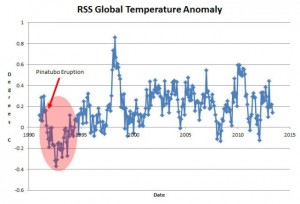
The Pinatubo eruption threw more sunlight-reflecting aerosols into the stratosphere since the Krakatoa outburst in 1883. Its millions of tonnes of sulphur dioxide reduced incident sunlight and had a maximum of 0.4 deg C cooling effect on global temperatures and an influence that lasted for several years.
The result of this temperature decrease is to increase the difference between the global temperatures of the 1990s and the 2000s. Removing this volcanic dip reduces quite significantly the temperature increase seen over the 1990 – 2013 period. When the errors are taken into account it is not impressive.
There was another very important volcanic eruption in the 1980s – El Chichon in 1982 – whose aerosols actually reduced solar irradiance by an even greater extent than Pinatubo.
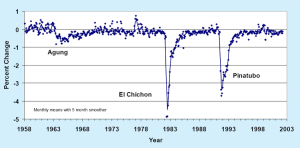
Removing this volcanic signal also reduces the statistical significance of the rise in temperature seen since 1980. (In fact, statistically speaking, one is hard-pressed to find any statistically significant warming between 1980 – 1995.)
The El Chichon eruption is interesting because one of the strongest El Nino events, some say the strongest ever, occurred just after it. These two events had an interesting interplay for it seems that the global temperature rise induced by the warm water of the El Nino was offset by the cooling effect of the stratospheric aerosols from El Chichon. It is interesting to speculate what might had happened if El Chichon had not gone off. Would the 1982 El Nino have been as dramatic as the 1998 one? And would it have left in its wake elevated global temperatures, as 1998 seems to have done? What would have been the impact on environmental thinking, and on James Hansen’s global warming warning in 1988?
In the post-1980 global temperature data the effects of the El Ninos and La Ninas are obvious both as discrete events and as a source of ‘noise’ in the temperature of the past 16 years. The statistically significant increase in global temperature since 1980 occurred in the years after the Pinatubo eruption’s dip had ended, and before the onset of the strong 1998 El Nino. If strong El Ninos are a mechanism for changing global temperatures in a stepwise fashion we may have to wait for another strong one before the current temperature standstill ends. Perhaps we should also be looking at the link between the lifting of the post-volcanic aerosol burden and its possible effect on the initiation of El Ninos.
The Unthinkable
One of the interesting aspects of the current temperature standstill is that it persists despite several El Ninos and La Ninas.Since 2006 the influence of these events has been more pronounced in satellite data; El Ninos in 2007 and 2009-10, La Ninas in 2008, 2010–2012. These events have increased the ‘noise’ of the global temperature data in recent years.
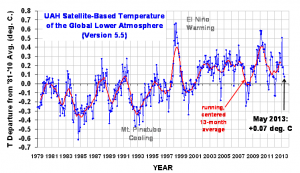
(Courtesy Dr Roy Spencer – www.drroyspencer.com)
Removing this noise is tricky, but without it there is a hint, just a hint, that sans El Nino/La Nina effects and volcanic dips, the global temperature might be reducing. As usual, five more years of data will be fascinating to analyse.
 wpDiscuz