We discussed Dr. Roy Spencer’s post More on Trenberth’s Missing Heat in my recent post and in the cross post at WattsUpWithThat.
One of the points Roy made: a change in ocean heat content is presented in terms that look impressive: Joules times 10^22 or Joules with oodles of trailing zeroes. However, in terms that most people are familiar with, temperature, the warming of the global oceans since 1955 was a minute change. Roy wrote:
Because of the immense heat capacity of the deep ocean, the magnitude of deep warming in Scenario 3 might only be thousandths of a degree. Whether we can measure such tiny levels of warming on the time scales of decades or longer is very questionable, and the new study co-authored by Trenberth is not entirely based upon observations, anyway.
The NODC presents their ocean heat content data through their webpage here. There, they also include a link to the 2012 paper by Levitus et al that introduced their dataset for depths of 0 to 2000 meters World Ocean Heat Content and Thermosteric Sea Level change (0-2000 m),1955-2010. In the abstract, Levitus et al identify the change in temperature of the volume of water that makes up the global oceans to depths of 2000 meters, or about 6560 feet (my boldface):
We provide updated estimates of the change of ocean heat content and the thermosteric component of sea level change of the 0–700 and 0–2000 m layers of the World Ocean for 1955–2010. Our estimates are based on historical data not previously available, additional modern data, and bathythermograph data corrected for instrumental biases. We have also used Argo data corrected by the Argo DAC if available and used uncorrected Argo data if no corrections were available at the time we downloaded the Argo data. The heat content of the World Ocean for the 0–2000 m layer increased by 24.0 ± 1.9 × 10²² J (±2S.E.) corresponding to a rate of 0.39 W m−2 (per unit area of the World Ocean) and a volume mean warming of 0.09°C.
That’s right. According to Levitus et al 2012, the average temperature of the global oceans to depths of 2000 meters warmed a miniscule 0.09 deg C (or 0.16 deg F) from 1955 to 2010. Granted, the heat capacity of the ocean is much greater than the atmosphere, but that warming of 0.09 deg C strains believability. Are we able to sense such a small change?
Some might think Top Gear’s Jeremy Clarkson is correct with what he wrote in a June 2012 The Sunday Times article titled Kaboom! It’s my turn to play fantasy climate change:
Science fiction is thriving; only today it’s all being written by global warming enthusiasts.
(Just in case there’s a problem with the link above, Benny Peiser’s GlobalWarmingPolicyFoundtion has a copy of Jeremy Clarkson’s article here.)
Figure 1 is the same graph I presented in the introduction of More on Trenberth’s Missing Heat. Except in this graph I’ve scaled the data in deg C so that it creates the 0.09 deg C warming of the global oceans to depths of 2000 meters from 1955 to 2010 in the NODC data. As a reminder, the “unadjusted” ocean heat content data is represented by the UKMO EN3 data, and the corrected—tweaked, adjusted, modified, whatever—ocean heat content data is represented by the NODC data. Regardless of whether you find the unadjusted or adjusted data to be the more reasonable dataset, we’re still talking of a warming of about 0.09 deg C over a 55-year period.

Figure 1
Keep in mind, the global oceans cover a surface area of about 361 million square kilometers and the data is supposed to represent the average temperature of the oceans to depths up to 2 kilometers.
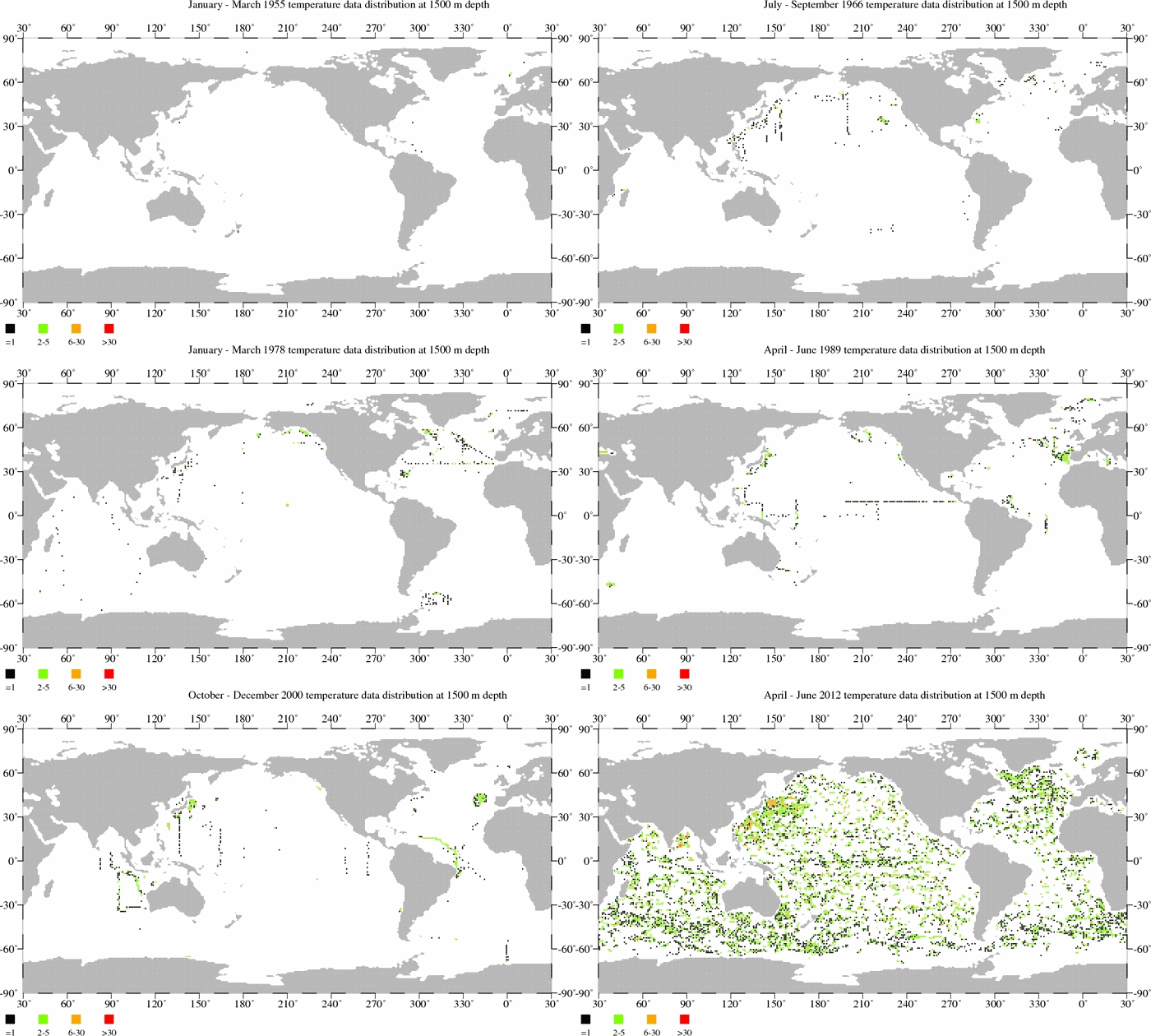
Now consider how few temperature samples there are at depths of 1500 meters before 2003/04 (Refer to gif animation of temperature sample maps here). 2003/04 is when the ARGO floats began to have reasonably complete coverage of the global oceans. It’s very difficult to find the dataset credible. A warming of 0.09 deg C in 55 years equals a linear trend of approximately 0.016 deg C per decade. That’s sixteen one thousandths of a deg C per decade.
Even during the ARGO era, the data has to be modified in order for it to come close to matching the warming trends simulated by climate models. I’ve shortened the term of the data in Figure 2 to the ARGO era (the period of 2003 through 2011) to give you an idea of just how small those corrections are in deg C. I’ve also included the linear trend lines for the sake of discussion. Also note that the larger annual changes in the two datasets are on the order of 0.005 to 0.006 deg C.

Figure 2
ONE MORE THING TO CONSIDER
Most of the warming occurred in the top 700 meters. But the warming at those depths has flattened in recent years.
Levitus et al 2012 also identifies the warming of the depths of 0 to 700 meters. They write in the abstract:
The heat content of the World Ocean for the 0–700 m layer increased by 16.7 ± 1.6 × 10²² J corresponding to a rate of 0.27 W m−2(per unit area of the World Ocean) and a volume mean warming of 0.18°C.
The depths of 0-2000 meters warmed 0.09 deg C from 1955 to 2010, but the warming of the top 700 meters was twice that amount. That means the warming of the depths of 700 to 2000 meters, where the warming is said to continue, was miniscule in terms of deg C.
ALARMIST REPORTS ABOUT THE CONTINUED WARMING OF THE OCEANS
In their attempts to overcome the flattening of surface temperatures trends, the alarmist community—SkepticalScience and Climate Progress in particular—have been very active recently with their reports about the continued warming of the global oceans. The most recent is Joe Romm’s April 16th post Reuters Ignores Its Own Accurate Reporting On Rapid Warming Of Oceans. If the alarmist community and the mainstream media presented the ocean warming to depths of 2000 meters in terms people understood (deg C) instead of the units meant to alarm (10^22 Joules), would the believers in manmade global warming find the ocean heat content data credible? Some would. Others wouldn’t. It really strains believability.
CLOSING
ARGO floats were introduced to allow researchers to sample the temperature and salinity of the global oceans to depth. According to the testimony of Raymond Schmitt when the ARGO program was looking for US funding, ARGO floats would permit scientists to “begin to understand this largest component of the global water cycle.” (Refer to the Woods Hole Oceanographic Institution webpage.) But can they realistically be used to find missing heat that’s supposed to be associated with human-induced global warming? Or are certain members of the climate science community still grasping at straws in efforts to keep their taxpayer-funded research afloat?
Discover more from Watts Up With That?
Subscribe to get the latest posts sent to your email.
You should redo figure 1 so that the vertical scale of the graph covers a full degree C.
TimTheToolMan (And Bob Tisdale),
While I do not have strong opinions in either direction WRT the “missing heat”, I am not sure we have to infer a “uniform” diffusion of heat. Ï would think the meriodinal overturning could be a plausible mechanism for a substantial fraction.
While we are talking of this: I suspect the abyssal water volumes and the upwelling areas also are un- or poorly described “jokers” in the GCM.
As the turnover times are from 100’s to 1000’s of years, I would think climate “signals” (in this context, stored heat (to stick to the vernacular)) from earlier warm periods (e.g. MWP) in fact could resurface and contribute to the current atmospheric conditioins.
I can see no problem in havning downwelling of warmer water than e.g. today, the only requirement is that the surrounding water is relatively (even) warmer and less dense.
Cassanders
In Cod we trust
izen says: “As usual it is the consistancy between different methods of detecting change that give certainty and robustness to the overall conclusion. Quibbling about details of one method that indicates a certain conclusion is pointless if it is validated by other methods of measurement.”
If memory serves, it was recently estimated that groundwater pumping contributed 40% to the rise in sea level and that experts in sea level were surprised it was so great. The additional contribution of groundwater would tend to undermine your thoughts that sea level is a reasonable proxy for heat content.
Is the gravitational energy associated with tidal influence reflected in the temperature measurements?
One of the components of climate is range. NE Oregon and the two other states that meet in the corner may soon have to expand climate zone parameters. We have several zone numbers here. But right now, the range is dipping. Dipping. DIPPING. Pretty soon, if this keeps up, we will have to change our plant zone number in Burpees catalog. However, no one here is running through the streets screaming “ICE AGE! ICE AGE!” The robust nature of our populace simply tells us to put a coat on.
More reasoned minds will also look at oceanic temperature range, daily fluctuations, trends, and oscillations as natural variations. Only AGW scientists panic.
Thanks, Bob. I keep on learning about the oceans and their enormous size and heat capacity that puts them in charge of a planet that should have been named “Aqua”.
TimTheToolMan says: “The point is that if we can measure as accurately as they say, then they should be able to produce a graph showing how the energy is actually moving downwards into the ocean by showing trends at particular depths and showing the net movement downwards.”
Part of what you’re requesting was presented in earlier papers. Refer to Figure 2 in Levitus et al 2005:
ftp://ftp.nodc.noaa.gov/pub/data.nodc/woa/PUBLICATIONS/grlheat05.pdf
Regards
Is that as meaningless a metric as “global mean temperature”?
David says: “30 plus years and the clock is ticking, still waiting for climate scientist to put error bars on their graphs, still waiting for greenhouse.”
Error bars can be found for some of the NODC OHC data. Go to the NODC website:
http://www.nodc.noaa.gov/OC5/3M_HEAT_CONTENT/
Beneath the graph is a grey box and at the top of it is the “figures with error bars “ option. Give it a click. Then click on the graph 2, which gives you the ocean heat content for 0-2000meters. Curiously, data and error bars are only presented during the ARGO era. They do, however, present error bars in the Levitus et al (2012) paper for the full term (that appear different during the ARGO era than what they present online. The paper presents the pentadal data while the website presents the quarterly data). See Figure 1:
http://data.nodc.noaa.gov/woa/PUBLICATIONS/grlheat12.pdf
Bob writes “Correct. But they show the warming wasn’t uniform. That was my point.”
How does figure 3 show that the warming is non-uniform? I mean I fully expect the warming to be non-uniform, dont get me wrong… but a figure showing the cumulative heat content for the entire depth being considered varying over time says nothing about how the heat is distributed.
I guess my point is regarding insufficient spacial and temporal resolution to actually map the energy within the ocean and see how it changes over time, ie where the energy moves to and comes from. If they can do that, then they can say the energy has moved down into the ocean depths.
Great article, Bob! 100% agreement here.
Did the deep sea currents stay exactly the same? Did the the ARGO sensors stay in exactly the same place?
(There are 3566 floats)
An accurate measurement of the heat content at depth and the ability to see 0.1C change??? No Way in Heck!
I do not care how good the senors are you are not going to get that type of accuracy for measuring the WHOLE ocean’s heat content. On top of that when ARGO was complete (2007) is when the data flattened. Only the 2007 to present data is worth anything.
It’s looking to me that the “cold water” of the ocean depths is acting as a heat-diffuser/sink. That the much greater mass of cold water acts as a “brake” to further warming. Take a 1C rise in the first 100m and, by mixing, it gets the temp reduced and distributed thruout a far more massive cold-water volume, where it becomes insignificant. The deep, cold water acts as a “memory” of relatively recent glacial melting. ‘Course this depends on how much and how deep the mixing is.
I am puzzled that the surface, mid depth and deep currents seem to be ignored here. Surely a current of just one knot at the bottom of the ocean will have a mixing effect just the same as a similar surface current, and there are recent papers about new information on deep currents in particular. Sorry I don’t have links but I think I read about them here not that long ago. Also I know one retired submariner who talks of hiding under or over thermoclines defining the upper / lower limits of currents going in different directions and/or at different speeds.
0.09C with that volume of water is in no way a “minuscule” amount of heat. Take that amount of heat and put it into the atmosphere. That’ll give you some perspective.
Bob writes “Part of what you’re requesting was presented in earlier papers. Refer to Figure 2 in Levitus et al 2005:”
Thats more useful. Two things about it, though. Firstly its pre-Argo so of limited use. But secondly doesn’t appear to support the idea heat is travelling into the depths to any great extent anyway! No wonder they didn’t publish anything like that in their later papers…
izen says:
April 17, 2013 at 5:46 am
The increase in thermal energy reaching the deep oceans may be hard to measure and at the limits of detectability with current methods. However it is supported by the independent methodology of measurement of the thermal expansion of the oceans raising sea level.
As usual it is the consistancy between different methods of detecting change that give certainty and robustness to the overall conclusion. Quibbling about details of one method that indicates a certain conclusion is pointless if it is validated by other methods of measurement.
So since the volumetric thermal expansion coefficient for for water is 207*10^-6/degree c, for a .19 degree change in temperature, we are seeing a less than one thousandth of a percent in volume change? And we are accurately measureing this. Somehow, my willing suspension of disbelief for this tall tale snapped.
izen,
On must consider how atmospheric enthalpy can get to the deep ocean. Deep water is formed in the North Atlantic and around the Antarctic vortex. The North Atlantic and Arctic surface water temperatures have definitely been rising, so let’s concede that North Atlantic deep water formed in the last 55 years is a couple thousandths warmer and a slug of this water has begun its thousand year journey.
Southern Ocean surface water surface temperature, however, has definitely been cooling, and simply by area this seems the larger source of deep water.
Our slug of toasty North Atlantic water will not begin to encounter the Antarctic Vortex, the pump, for another 500 years.
@- Bob Tisdale
“If memory serves, it was recently estimated that groundwater pumping contributed 40% to the rise in sea level and that experts in sea level were surprised it was so great. ”
Actually 42% or 0.7mm per year which neatly explained the ‘unknown’ source of around 0.7mm of rise per year above and beyond the known influences of land based ice loss and thermal expansion.
@- “The additional contribution of groundwater would tend to undermine your thoughts that sea level is a reasonable proxy for heat content.”
Wrong.
Confirming the source of ALL the factors causing sea level rise so that they can be correctly partitioned between ice melt, thermal expansion and aquifier pumping helps make the measurement of thermal energy entering the oceans MORE accurate.
Complete BS. Can we really measure the temp of the oceans globally at 2000 meters and measure it to this degree of accuracy?
In a word — NO!
Thanks for an excellent post. Regarding to:
….Granted, the heat capacity of the ocean is much greater than the atmosphere, but that warming of 0.09 deg C strains believability. Are we able to sense such a small change?..
..it is also a matter of measuring, as Eschenbach writes clearly here:
http://wattsupwiththat.com/2013/04/17/a-different-perspective-on-trenberths-missing-heat-the-warming-of-the-global-oceans-0-to-2000-meters-in-deg-c/#more-84385
It is a bit peculiar how warming of the oceans suddenly becomes an issue after atmosphere warming has stalled.
And the heat capacity of oceans is not large only because of the huge volumes, but also because of the substance of water in itself. Water has a relatively high heat capacity compared to other substances; relatively much energy has to be transferred to raise the temperature of water. Trying to compute the very large amounts of energy transfer to the water through measuring very small differences in temperature is a bit like using a handspike, a lever, the other way around to rock a stone, holding the hands on the short distance from the fulcrum trying to find the right force to push downwards.
izen says:
April 17, 2013 at 5:46 am
However it is supported by the independent methodology of measurement of the thermal expansion of the oceans raising sea level.
==========
No. What is being measured is ASSUMED to be due to thermal expansion. Ground water extraction has since been shown to account for 1/2 the increase. This significantly increases the odds that the other 1/2 will also be found to be due to some other factors.
What we are seeing the the observer-expectation effect. Researchers expected to find the oceans rising due to thermal expansion, so when they found them rising they assumed they knew the cause. Faulty logic => faulty science.
There is plenty of evidence that the rising oceans are largely regional. That the oceans themselves are not constrained by the ocean basins, but extend far into the earth’s crust, and would fully sink into the earth except for the heat of the earth’s interior turning them to extremely high pressure steam at the boundary layer which prevents them from sinking further. It is quite possible that this boundary layer is what separates the earth’s crust from the mantle and makes life on earth possible.
People tend to think of the oceans as giant swimming pools or bath-tubs, with an impervious layer containing the water. However, that is simply an illusion. The dirt and rock that contains the oceans is not a barrier to water. The smallest crack and water will try and flow out of the oceans towards the earth’s core. Except for the heat of the core we would have no visible oceans. They would have long since drained away into the interior.
Ryan says: “0.09C with that volume of water is in no way a “minuscule” amount of heat. Take that amount of heat and put it into the atmosphere. That’ll give you some perspective.”
If you had read the post, you would have noted that that was not disputed. The reason for this post was to illustrate the absurdity of thoughts that we can determine the temperature of the global oceans to depths of 2000 meters with the accuracy required to claim global warming continues at depths of the global oceans.
It’s no accident that the “missing heat” showed up somewhere no independent researcher can check. I notice izen ignores some of the issues, here, but continues to comment. I’d guess the Warmists are shaking in their boots over this one, given that their favorite bugbear, CO2, is failing.
As with atmospheric global warming, it’s insufficient to measure a few temperatures hither and thither. To determine whether oceans are warming or not, we’d need to measure the temperatures of all the currents and measure all the heat fluxes.
Remember those little oven thermometers that have a bimetallic coil in them? They are inaccurate when new and gradually get further and further off. Well, ocean volume is not as good a thermometer as those. Another factor swept under the rug:
http://www.iceagenow.com/Three_Million_Underwater_Volcanoes.htm
And then there is friction-generated heat from tidal forces and slippage of tectonic plates…
Enjoyable and interesting article, Bob T.
Although I’m not sure that the heat capacity of the deep ocean is all that much different Volume:Volume than the heat capacity of shallower water, if you are going to resolve 0.001636°C/year it should be considered. Given the immense measurement difficulty, currents, thermoclines and other effects, an actual measurement of this would be impossible. Sounds like a number best left to calculation and modeling.