In the post Trenberth Still Searching for Missing Heat, we discussed the recent Balmaseda et al (2013) paper “Distinctive climate signals in reanalysis of global ocean heat content”, of which Kevin Trenberth was a coauthor.
Dr. Roy Spencer also has a recent post on that paper. I’ve cross posted Roy’s post following this introduction. Roy Spencer argues that it is possible for the oceans to warm to depth, while the surface temperatures remain flat, but… (No spoiler from me. You’ll have to read Roy’s post.)
Roy does note that arguments about continued ocean warming to depth “…depend upon global deep ocean temperature changes being measured to an accuracy of hundredths or even thousandths of a degree…”. That’s why all of the adjustments to the ocean heat content data are so critical to this discussion.

Figure 1
If we were to consider the “unadjusted” ocean heat content data (represented by the UKMO EN3 data in Figure 1) to be correct, then the ocean heat content for depths of 0-2000 meters flattened as soon as the ARGO floats had reasonably compete coverage of the global oceans in 2003-04. It’s only when the ocean heat content data is corrected, tweaked, adjusted, modified, whatever (represented by the NODC data in Figure 1), that the global ocean heat content continues to warm in relative agreement with climate models.
START OF ROY SPENCER’S POST
More on Trenberth’s Missing Heat
April 8th, 2013 by Roy W. Spencer, Ph. D.
While I don’t necessarily buy Trenberth’s latest evidence for a lack of recent surface warming, I feel I need to first explain why Trenberth is correct that it is possible for the deep ocean to warm while surface warming is seemingly by-passed in the process.
Then I will follow up with observations which run counter to his (and his co-authors’) claim that an increase in ocean surface wind-driven mixing has caused the recent lack of global warming.
Can Deep Ocean Warming Bypass the Surface?
It depends on what one means by “warming”. A temperature change is the net result of multiple processes adding and subtracting heat. Warming of the deep ocean originally caused by radiative forcing of the climate system cannot literally bypass the surface without some effect on temperature. But that effect might be to keep some cooling process from causing an even steeper dive in temperature.
It’s like adding a pint of warm water, and a gallon of cold water, to a sink full of room temperature water. Did adding the pint of warm water cause the temperature in the sink to rise?
To appreciate this, we first need to understand the basic processes which maintain the vertical temperature distribution in the global oceans. The following cartoon shows a North-South cross section of measured ocean temperatures in the Atlantic.

The average temperature distribution represents a balance between 3 major processes:
(1) surface heating by the sun (mitigated by surface evaporation and infrared radiative loss) which warms the relatively shallow ocean mixed layer;
(2) cold deepwater formation at high latitudes, which slowly sinks and fills up the oceans on time scales of centuries to millennia, and
(3) vertical mixing from wind-driven waves, the thermohaline circulation, and turbulence generated by flow over ocean bottom topography (the latter being partly driven by tidal forces).
The key thing to understand is that while processes (1) and (2) continuously act to INCREASE the temperature difference between the warm mixed layer and the cold deep ocean, the vertical mixing processes in (3) continuously act to DECREASE the temperature difference, that is, make the ocean more vertically uniform in temperature.
The average temperature distribution we see is the net result of these different, competing processes. And so, a change in ANY of these processes can cause surface warming or cooling, without any radiative forcing of the climate system whatsoever.
So, let’s look at a few ocean mixing scenarios in response to radiative forcing of the climate system (e.g. from increasing CO2, increasing sunlight, etc.), all theoretical:
Scenario 1) Warming with NO change in ocean mixing: It this case, surface warming is gradually mixed downward in the ocean, leading to warming trends that are a maximum at the ocean surface, but which decrease exponentially with depth.
Scenario 2) Warming with a SMALL increase in ocean mixing. This case will result in weaker surface warming, and slightly stronger warming of the deep ocean, both compared to Scenario 1. The warming still might decrease exponentially with depth.
Scenario 3) Warming with a LARGER increase in ocean mixing. This case could lead to an actual surface temperature decrease, but warming of the deep ocean, similar to what I believe Trenberth is claiming.
Yes, the surface waters “warmed” before the deep ocean in Scenario 3, but it was in the form of a weaker temperature drop than would have otherwise occurred.
Because of the immense heat capacity of the deep ocean, the magnitude of deep warming in Scenario 3 might only be thousandths of a degree. Whether we can measure such tiny levels of warming on the time scales of decades or longer is very questionable, and the new study co-authored by Trenberth is not entirely based upon observations, anyway.
I only bring this issue up because I think there are enough legitimate problems with global warming theory to not get distracted by arguing over issues which are reasonably well understood. It takes the removal of only one card to cause a house of cards to fall.
But it also points out how global warming or cooling can occur naturally, at least theoretically, from natural chaotic variations in the ocean circulation on long time scales. Maybe Trenberth believes the speedup in the ocean circulation is due to our driving SUVs and flipping on light switches. He has already stated that more frequent El Ninos are caused by anthropogenic global warming. (Except now they are less frequent — go figure).
In some sense, natural global warming and cooling events are made possible by the fact that we live within an exceedingly thin warm surface “skin” of a climate system in which most of the mass (the deep ocean) is exceedingly cold. Any variations in the heat exchange between those two temperature worlds (such as during El Nino with decreased mixing, or La Nina with increased mixing) can cause large changes in our thin-skinned world. It that sense, Trenberth is helping to point out a reason why climate can change naturally.
Have Ocean Winds Increased Recently?
Trenberth and co-authors claim that their modeling study suggests an increase in ocean surface winds since 2004 has led to greater mixing of heat down into the ocean, limiting surface warming.
Fortunately, we can examine this claim with satellite observations. We have daily global measurements of ocean surface roughness and foam generation, calibrated in terms of an equivalent 10 meter height wind speed, from AMSR-E:

I don’t know about you, but I don’t see an increase in surface winds since 2004 in the above plot. This plot, which is based upon wind retrievals that have been compared to (as I recall) close to 1 million buoy observations, really needs to be extended back in time with SSM/I and SSMIS data, which would take it back to mid-1987. That’s on my to-do list.
So far, I would say that the so-called missing heat problem is not yet solved. I have argued before that I don’t think it actually exists, since the “missing heat” argument assumes that feedbacks in the climate system are positive and that radiative energy is accumulating in the system faster than surface warming would seem to support.
For the reasons outlined above, Trenberth’s view of deep ocean storage of the missing heat is still theoretically possible since increased vertical ocean mixing doesn’t have to be wind-driven. But I remain unconvinced by arguments that depend upon global deep ocean temperature changes being measured to an accuracy of hundredths or even thousandths of a degree.
Finally, as I have mentioned before, even if increased rate of mixing of heat downward is to blame for a recent lack of surface warming, the total energy involved in the warming of the deep oceans is smaller than that expected for a “sensitive” climate system. Plots of changes in ocean heat content since the 1950′s might look dramatic with an accumulation of gazillions of Joules, but the energy involved is only 1 part in 1,000 of the average energy flows in and out of the climate system. To believe this tiny energy imbalance is entirely manmade, and has never happened before, requires too much faith for even me to muster.

END OF DR. SPENCER’S POST
Back to Roy’s statement, “But I remain unconvinced by arguments that depend upon global deep ocean temperature changes being measured to an accuracy of hundredths or even thousandths of a degree”:
First consider that the ARGO floats have had “complete” coverage of the global oceans since 2007. The Earth’s oceans and seas cover about 361 million square kilometers or 139 million square miles. There were 3566 ARGO floats in operation in March 2013. If the floats were spaced evenly, then each ARGO float is sampling the temperature at depth for a surface area of approximately 101,000 square kilometers or 39,000 square miles—or an area about the size of Iceland or the State of Kentucky.
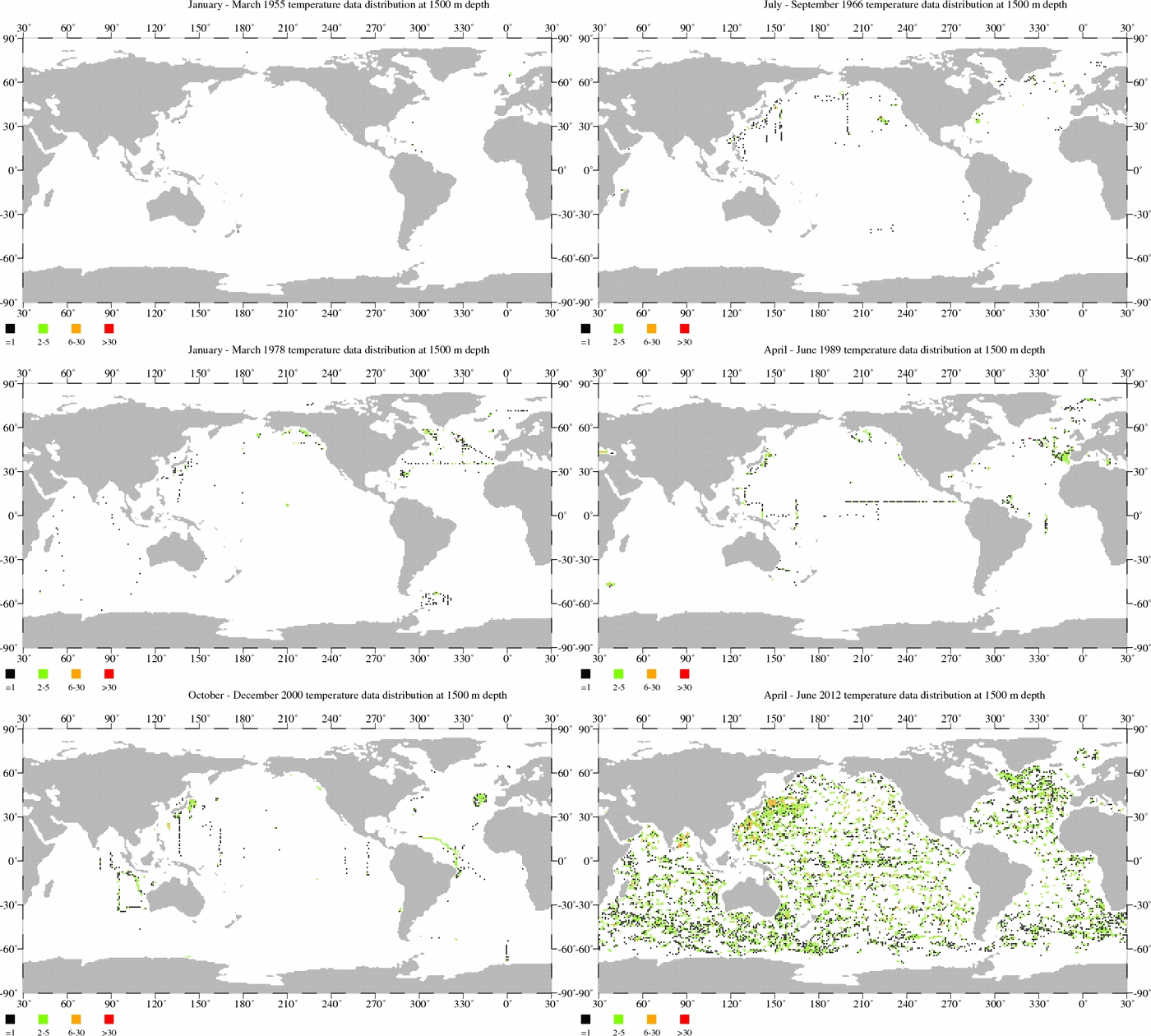
Second, consider that the ARGO era is when the sampling is at its best, but before ARGO temperature sampling at depth was very poor. Refer to the following animation. Temperature sample maps at 1500 meters (6MB). There is little observational data at depths of 1500 meters prior to ARGO. In other words, we have little idea about the temperatures of the global oceans to depths of 2000 meters and their variability before ARGO.
Third, on top of that, consider that ARGO floats have been found to be unreliable, hence the need to constantly readjust their observations.
Do we have any idea about the variability of the temperatures and ocean heat content of the global oceans to depth? Simple answer: No.
For more information on the problems with Ocean Heat Content data, refer to the post Is Ocean Heat Content Data All It’s Stacked Up to Be? and NODC’s Pentadal Ocean Heat Content (0 to 2000m) Creates Warming That Doesn’t Exist in the Annual Data – A Lot of Warming.
Discover more from Watts Up With That?
Subscribe to get the latest posts sent to your email.
That’s 0.015C / 15C. kg), and the heat capacity of water is AROUND four joules per kilogram degree kelvin. To put it another way, if one changed the temperature of the ocean by 0.1 C, one would change its heat content by
  Joules, or a thousand petajoules.
Sadly, no. Centigrade has a meaningless, arbitrary zero. The only meaningful zero is to be found in the absolute scale, where zero temperature corresponds to zero entropy and zero enthalpy. 0.1% is around 0.3C. However, the oceanic heat capacity is so enormous that for one to look for missing heat on the scale in question one has to be able to measure effects on the order of 0.001 K, more than two orders of magnitude more accurately even than this. That’s because there are a lot of kilograms of water in the ocean (
All of this sounds more impressive than it actually is. It’s around five or ten seconds worth of total insolation, if the Earth weren’t in almost perfect radiative balance pretty much all of the time.
That’s assuming I didn’t screw up my arithmetic above. Been known to happen…;-)
rgb
Now here is a fun question –
We have been told that we are all soon going to drown from the incessantly rising seas, said sea level rise being the result of our sinful, SUV driving lifestyle. We have also been told that this is proved, because the measured rise in sea level very closely matches the predictions for sea level rise produced by the “global warming” models.
But now we are being told that about 15 years worth of “global warming” has been swept so far under the rug, that it has ended up in the Deep. This raises a question.
How can “global warming” be both:
1. Warming the upper ocean with its full effect, so as to cause the “as predicted” sea level rise, while at the same time
2. Warming the deep ocean with its full effect (where warming would result in sea level decrease).
Evidently, “global warming” heat can be stored in one part of the ocean (too deep to be seen), and yet cause thermosteric expansion of another part of the ocean.
Hmmmmmm……
philincalifornia says:
April 15, 2013 at 3:41 am
Dr. Kildare has been replaced: http://refash.files.wordpress.com/2011/01/dexter-syringe.jpg?w=570
Recall that process (2) ‘cold deepwater formation at high latitudes’ is more complicated in the full calculation as it also generates a non-insignificant amount of warming due to the water sinking kilometers in the gravitational potential.
Graham Green says:
April 15, 2013 at 6:10 am
This is obviously an excellent post and some thoughtful comment. I am intrigued by the statement that “ARGO floats have been found to be unreliable”. If anyone can offer any info on this unreliability I would be most obliged.
It maybe that you have to say that they are unreliable to justify ‘adjusting’ their data.
This needs translation into normal non-climatology English.
“ARGO floats have been found to be unreliable” neans
“ARGO floats have been reporting data that does not match our computer models”
If there is one thing that the World Meteorological Office should do is impose Quality Management System. The QMS would ensure that those people collecting or observing data should store the data as is and not be involved in research into weather or climate.
Climate science at the moment is like accountants being their own auditors. There is no way that researchers should be trusted to ‘check’, ‘homogenize’, adjust or conceal the input data to their research especially when these are metrics important to the entire world. There is a distinct impression that data from some quite expensive measurement systems is being deliberately obfuscated if not concealed altogether. For example observations from the ISO standard new climate network in the US which embarrassingly is reporting lower temperatures than the non-ISO standard system.
Below is the comment I left at Dr. Spencer’s site a week ago. I still see no way in which downward heat flux from anthropogenic warming could affect readings at down to 2000m in the timeframe allowed without also affecting heat content in higher layers. These waters are not turbo-pumped in an insulated column to the depths, and they do not rise back to the 2000m level overnight.
The whole notion strikes me as silly, and grasping for straws. If there is heating of the mid-layers independent of heating of the upper layers, it is most likely a lagged response of waters which sank centuries ago, well before the industrial age.
M Courtney says:
April 15, 2013 at 7:24 am
Fair enough.
Heat from the earth is irrelevant at the bottom of the ocean.
/////////////////////////////////////////////////
Oceanic volcanoes are spectacular, but rather like pimples on the seabed. Considering the heat inputted into the oceans merely by considering volcanoes is not, in my opinion, viewing the complete picture.
What one needs to consider is how hot would the seabed be, if the oceans were totally drained of water?. How much heat is conducted/radiated from the seabed floor? Would the seabed, if drained of water, be warm to the touch, or at any rate warmer than just a few degrees C. If it would be warmer than a few degrees C, it is inputting heat at the bottom of the ocean and helping to keep the deep ocean warm.
The ocean seabed is akin to a hot plate on the hob of an oven. The ocean is the pan of water sitting on top of the hotplate (the ocean seabed floor).
I am not sure that we really know how much geological heat there is being inputted at the very bottom of the ocean since as far as I am aware, we have never drilled a bore hole in the very deep abyss at the very deepest part of the ocean. Heck, we have hardly ever visited the sea floor in this region, let alone drilled the seabed. Accordingly, I do not think we know how hot the seabed would be if it were to be drained of water.
As you no doubt know, as you drill a bore hole and get nearer the mantle, temperature increases with depth. The geothermal temperature varies from location to location much to do with the rock type but around 4 degC per 100m is fairly typical.
The average depth of the ocean is a little over 4,000m and the deepest ocean is just over 11,000m, Further, the oceanic crust is far thinner (about 7 to 10km in thickness) compared to the continental crust (about 25 to 70km) so the geothermal gradient will be different. All of this would suggest that if there were no oceans, the dry seabed floor would be significantly warmer than geological depressions on continental land (such as death valley). However, oceanic crust is of different rock composition which is generally more dense compared to continental crust.
I have no answers. No doubt there is some borehole data from off-shore drilling in the oil industry. However, this would not encompass the very deepest parts of the ocean.
Its seems to me that the argument is based largely if not solely on circular reasoning. Our models show that the ocean depths have warmed because of an increase in ocean surface winds. Our models show that the ocean surface winds have increased because the ocean depths have warmed.
“It turns out there is a spectacular change in the surface winds which then get reflected in changing ocean currents that help to carry some of the warmer water down to this greater depth,” Trenberth said. “This is especially true in the tropical Pacific Ocean and subtropics.” …
“So, some of this heat may come back in the next El Niño event … but some of it is probably contributing to the warming of the overall planet, the warming of the oceans. … It means that the planet is really warming up faster than we might have otherwise expected,” he said.
How did Trenberth determine that there was a “spectacular change in the surface winds”? Bob’s chart shows very little change, certainly not “spectacular change,” in surface winds. It’s quite funny how Trenberth goes from “may” and “probably” to a definite conclusion that the planet is really warming up faster than he expected.”
The article goes on to say that sea level rise on the U.S. West Coast has been suppressed for the past two decades, but it will accelerate when heat accumulating in the deep oceans comes back to warm the surface. Can anyone explain this? If the oceans really are warming, why haven’t they already expanded and caused a greater rise in sea level on the West Coast? And why would sea levels begin to rise faster after some of the heat leaves the oceans to warm the surface? If heat leaves the oceans, wouldn’t the waters cool and contract somewhat?
I love the various discussions and papers coming out to address the ‘missing heat problem’. The assumption that the earth system as a whole is still gaining in heat due to AGW is such a faith based ‘fact’ these scientific papers will continue to come out even after Canada is under glaciers again.
Then to see the various ‘reasons’ to explain the model / reality difference are then ‘proven’ using yet more tweaks to models.
This is so like the Earth being the center of the universe syndrome. It’s really similar – only man could be causing the climate to change!
Amazing!
This whole article is baloney, start to finish. Long wave radiation comes from the sun, not some mischievous molecules of greenhouse gas. A total of 39 molecules of CO2 out of every 100,000 molecules of air, could not influence anything, even if they tried to. On top of that, I have seen no “proof” that there is such a thing as greenhouse gas.
Water segregates itself into layers due to the change in density, dependent on changes in its temperature and salinity. That is why ice floats and the bottom of the ocean is not coated with ice. For anybody who does not understand the temperature/density principle of water, I suggest a vacation to the beach at St. Margaret’s, Nova Scotia. Wade out until you can swim and do so. When you are a short distance from shore, start treading water. As your feet sink into the cold layer, a couple of feet down, you will understand the layering effect. You will also understand the shallow mixing effect of wind and waves.
Molecules of water are going to obey the laws of thermodynamics. When a warm molecule bumps into a cooler molecule, there will be an exchange of heat energy. When this happens a few trillion times, you have a layer of a uniform temperature.
I would also like to see some proof that anybody has developed a temperature sensing system that can measure temperatures to an accuracy of 0.001 degrees. I am also suspicious of any statement of how many cubic miles of water are in the oceans. Sounds like a guesstimate to me.
I am beginning to repent of raising the effect of heat from the Earth on the bottom of the Ocean but I think I should clarify two things:
1 I really had no idea about the magnitude of heat from the sources below and I am quite willing to accept that they are of an order of magnitude too small to be significant. Volcanoes are hot but the Ocean is big… it was a red herring. Whoops. But now I know and am happy to learn.
2 This statement in the article seems reasonable “The average temperature distribution we see is the net result of these different, competing processes. And so, a change in ANY of these processes can cause surface warming or cooling, without any radiative forcing of the climate system whatsoever.” So my original question of the significance of heating from below was raised, in part, by the potential for amplification of the effect by a change in one or more of those processes. Is that ridiculous?
Again, it may well be daft but it doesn’t seem obviously laughable to me. I am just curious.
What we call the earth’s surface is to the earth as a whole, as the skin of an apple is to the whole apple. …. approximately. It seems what happens is that the void of space cools the earth’s surface, but the sun adds some energy that creates a little heat and weather.
I’m puzzled by some things I read in this post. Specifically this example:
This does not address the sign of the transfer of energy to and from the Earth. Things on Earth warm and cool as a function of dilution, for example. Conduction is another kind of dilution. Certainly that is the case for fluids which can carry warmth far from the source and spread it very thin. Humor me this sidebar: You buy a gallon of paint. The base is white. To that is added 2 ounces of die. Properly mixed that 2 ounces of die can be spread across hundreds of square feet of surface using a paint roller. So it is with energy that has arrived on Earth. There are many places for it to go including back where it came from. The problem is it is spread so thin we can’t find it below a certain energy density, or differentiate it from already existing energy. And it is a travesty we can’t. The consequence is we turn to models that we can’t trust and which have no skill. Same can be said for many of the modelers, I suppose. And we then fool ourselves into treating the results as data.
We are using heat as a test for the presence of energy and we try to establish the amount of energy based on the temperature, but is this the right way to follow energy movement? We are, after all, most interested in the coming and going of energy over time. We want exactly as much energy to leave the Earth system as arrives else our planet will heat up. Given the ability of the ocean to dilute the energy density below our means to detect it from noise I think not.
Except there’s this. Quite a bit of energy that arrives from various sources is sequestered biologically and chemically and for all practical purposes becomes inert or at least out of the energy flow for perhaps gazzillions of years. Clathrates come to mind. Maybe Trenberth’s missing energy is precipitating out into the oceanic biome as living organisms and sequestered on the sea floor as biological waste and clathrate mats and other benign forms of non-viable energy. I’ve never seen a chart that describes the rate at which energy is converted to life and subsequently preserved sequestered in the waste byproducts of having been alive.
And yes, I know the bogieman stories of clathrate hydrate eruptions that can happen “real soon now” and cause the next great mass wasting, but that is not the point.
Does Trenberth realise that he is asserting that global warming is not a problem?
If the burning of fossil fuels was going to cause global surface temperatures to warm by 4C or more over a century then we should be concerned. But Trenberth tells us that his ocean transport mechanism will lead to the deep ocean will warm by a few hundredths of a degree instead. Cancel the concern because that is a change so small we can scarcely measure it.
The conclusion is that obviously the burning of fossil fuels is perfectly OK because the Earth has a mechanism for putting that excess heat away in a place where it won’t cause a problem.
To my mind, the oceans of the world are the sleeping giant of global warming and this giant has awaked to stop global warming in its tracks by absorbing the trapped heat. A popular guess as to the world’s energy imbalance is 0.5 w/m2 or for the whole planet, 8 zeta joules per year. There are about 1400 zeta grams of water in the oceans at a specific heat of 4 joules per gram per degree C so to warm the oceans up 1 degree would take 1400 x 4/8 = 700 years. Based on BP’s statistic review of world energy, we have about 80 years of fossil fuel left. I think this must be the end of the global warming story. The oceans are quite well mixed by thermohaline circulation which is probably increasing because of the increase in world rainfall not by wind. This enhanced circulation is quite sufficient to pump 8 zeta joules per year down into the depths although we cannot measure the temperature change at present.
Me thinks your cartoon is too cartoonish…the temp of the deep ocean water is between 3 and 4 degrees C due to the insane pressure at 4 km below the surface. The temp must be around the maximum density of salt water and not near 0 degrees centigrade.
http://www.windows2universe.org/earth/Water/deep_ocean.html
There is no missing heat. It is energy and expressing ‘itself’ in other forms.
I want to make it absolutely clear that I haven’t got the missing heat. You can search me if you like. So stop looking at me like that.
World’s Most Bogus! The 1955 to ARGO “Ocean Heat Content” is the most BOGUS piece of crap in the world.
NO WAY TO JUSTIFY ANY VALIDITY OR ACCURACY.
Repeat a lie..often…etc.
I wish Willis would take this on by the THROAT and destroy this evil monster once and for all.
Max
I’m with M Courtney on the volcanic heat, it is boldly stated that the oceans are huge and total geothermal heat released into the oceans is very small in comparison.
This makes sense to me.
But what do we really know about the actual number and intensity of volcanic activity under the seas?Volcanic smoker vents? Who knew before their discovery?
The volcanic activity found under the north pole a few years ago being a beautiful demonstration of our ignorance.
Of course the certainty of our measurements once again appears to exceed the accuracy of our instruments.
Thats climatology.
@rgb
Specific heat of water is 4.186J/gram so 1.4×10^21 * 4×10^3 = 5.6×10^24J
IF Trenbreth et al were correct that the current radiative imbalance were about 1.0 x10^22 J per year AND then deep ocean was getting mixed right along then it would take about 500 years to heat the whole ocean 1.0K (if I too have not messed up the arithmetic 🙂
So it seems odd that they are trying to argue for deep ocean sequestration as that also kills the whole CAGW argument…..
Btw I very much appreciate reading your comments here. Thanks for sharing your knowledge !
If Trenberth wants his theory about the warming hiding in the deep ocean to be believable he needs to elaborate a mechanism for this and also to elaborate why it did not occur during the obvious decades of surface warming.
The deep ocean and deep lakes are cold due to endothermic chemical reactions and especially hydration of calcium carbonate. The chemistry of these reactions is well know; however, the heat transfers have been ignored.
The deep oceans cannot ‘heat’ up per se; the deep water will move.
Bob Tisdale,
I know you’ve been busy doing the two recent posts and you may have had to move on from your previous post. You were kind enough to address a question I posed there. However, I may not have understood part of your answer. I’ll repost it here. Thanks in advance.
Bob Tisdale, Thanks for taking the time to address a few questions. Above, I asked:
“Does ENSO add or subtract energy from Earth’s climate system, or does it just move energy around within that system?”
You replied: “ENSO adds heat to the oceans at depth.”
Can I conclude from that answer that ENSO does NOT add energy to Earth’s climate system, but rather just moves energy around within that system?
Thanks Again for your interesting post(s).
JP