In the post Trenberth Still Searching for Missing Heat, we discussed the recent Balmaseda et al (2013) paper “Distinctive climate signals in reanalysis of global ocean heat content”, of which Kevin Trenberth was a coauthor.
Dr. Roy Spencer also has a recent post on that paper. I’ve cross posted Roy’s post following this introduction. Roy Spencer argues that it is possible for the oceans to warm to depth, while the surface temperatures remain flat, but… (No spoiler from me. You’ll have to read Roy’s post.)
Roy does note that arguments about continued ocean warming to depth “…depend upon global deep ocean temperature changes being measured to an accuracy of hundredths or even thousandths of a degree…”. That’s why all of the adjustments to the ocean heat content data are so critical to this discussion.

Figure 1
If we were to consider the “unadjusted” ocean heat content data (represented by the UKMO EN3 data in Figure 1) to be correct, then the ocean heat content for depths of 0-2000 meters flattened as soon as the ARGO floats had reasonably compete coverage of the global oceans in 2003-04. It’s only when the ocean heat content data is corrected, tweaked, adjusted, modified, whatever (represented by the NODC data in Figure 1), that the global ocean heat content continues to warm in relative agreement with climate models.
START OF ROY SPENCER’S POST
More on Trenberth’s Missing Heat
April 8th, 2013 by Roy W. Spencer, Ph. D.
While I don’t necessarily buy Trenberth’s latest evidence for a lack of recent surface warming, I feel I need to first explain why Trenberth is correct that it is possible for the deep ocean to warm while surface warming is seemingly by-passed in the process.
Then I will follow up with observations which run counter to his (and his co-authors’) claim that an increase in ocean surface wind-driven mixing has caused the recent lack of global warming.
Can Deep Ocean Warming Bypass the Surface?
It depends on what one means by “warming”. A temperature change is the net result of multiple processes adding and subtracting heat. Warming of the deep ocean originally caused by radiative forcing of the climate system cannot literally bypass the surface without some effect on temperature. But that effect might be to keep some cooling process from causing an even steeper dive in temperature.
It’s like adding a pint of warm water, and a gallon of cold water, to a sink full of room temperature water. Did adding the pint of warm water cause the temperature in the sink to rise?
To appreciate this, we first need to understand the basic processes which maintain the vertical temperature distribution in the global oceans. The following cartoon shows a North-South cross section of measured ocean temperatures in the Atlantic.

The average temperature distribution represents a balance between 3 major processes:
(1) surface heating by the sun (mitigated by surface evaporation and infrared radiative loss) which warms the relatively shallow ocean mixed layer;
(2) cold deepwater formation at high latitudes, which slowly sinks and fills up the oceans on time scales of centuries to millennia, and
(3) vertical mixing from wind-driven waves, the thermohaline circulation, and turbulence generated by flow over ocean bottom topography (the latter being partly driven by tidal forces).
The key thing to understand is that while processes (1) and (2) continuously act to INCREASE the temperature difference between the warm mixed layer and the cold deep ocean, the vertical mixing processes in (3) continuously act to DECREASE the temperature difference, that is, make the ocean more vertically uniform in temperature.
The average temperature distribution we see is the net result of these different, competing processes. And so, a change in ANY of these processes can cause surface warming or cooling, without any radiative forcing of the climate system whatsoever.
So, let’s look at a few ocean mixing scenarios in response to radiative forcing of the climate system (e.g. from increasing CO2, increasing sunlight, etc.), all theoretical:
Scenario 1) Warming with NO change in ocean mixing: It this case, surface warming is gradually mixed downward in the ocean, leading to warming trends that are a maximum at the ocean surface, but which decrease exponentially with depth.
Scenario 2) Warming with a SMALL increase in ocean mixing. This case will result in weaker surface warming, and slightly stronger warming of the deep ocean, both compared to Scenario 1. The warming still might decrease exponentially with depth.
Scenario 3) Warming with a LARGER increase in ocean mixing. This case could lead to an actual surface temperature decrease, but warming of the deep ocean, similar to what I believe Trenberth is claiming.
Yes, the surface waters “warmed” before the deep ocean in Scenario 3, but it was in the form of a weaker temperature drop than would have otherwise occurred.
Because of the immense heat capacity of the deep ocean, the magnitude of deep warming in Scenario 3 might only be thousandths of a degree. Whether we can measure such tiny levels of warming on the time scales of decades or longer is very questionable, and the new study co-authored by Trenberth is not entirely based upon observations, anyway.
I only bring this issue up because I think there are enough legitimate problems with global warming theory to not get distracted by arguing over issues which are reasonably well understood. It takes the removal of only one card to cause a house of cards to fall.
But it also points out how global warming or cooling can occur naturally, at least theoretically, from natural chaotic variations in the ocean circulation on long time scales. Maybe Trenberth believes the speedup in the ocean circulation is due to our driving SUVs and flipping on light switches. He has already stated that more frequent El Ninos are caused by anthropogenic global warming. (Except now they are less frequent — go figure).
In some sense, natural global warming and cooling events are made possible by the fact that we live within an exceedingly thin warm surface “skin” of a climate system in which most of the mass (the deep ocean) is exceedingly cold. Any variations in the heat exchange between those two temperature worlds (such as during El Nino with decreased mixing, or La Nina with increased mixing) can cause large changes in our thin-skinned world. It that sense, Trenberth is helping to point out a reason why climate can change naturally.
Have Ocean Winds Increased Recently?
Trenberth and co-authors claim that their modeling study suggests an increase in ocean surface winds since 2004 has led to greater mixing of heat down into the ocean, limiting surface warming.
Fortunately, we can examine this claim with satellite observations. We have daily global measurements of ocean surface roughness and foam generation, calibrated in terms of an equivalent 10 meter height wind speed, from AMSR-E:

I don’t know about you, but I don’t see an increase in surface winds since 2004 in the above plot. This plot, which is based upon wind retrievals that have been compared to (as I recall) close to 1 million buoy observations, really needs to be extended back in time with SSM/I and SSMIS data, which would take it back to mid-1987. That’s on my to-do list.
So far, I would say that the so-called missing heat problem is not yet solved. I have argued before that I don’t think it actually exists, since the “missing heat” argument assumes that feedbacks in the climate system are positive and that radiative energy is accumulating in the system faster than surface warming would seem to support.
For the reasons outlined above, Trenberth’s view of deep ocean storage of the missing heat is still theoretically possible since increased vertical ocean mixing doesn’t have to be wind-driven. But I remain unconvinced by arguments that depend upon global deep ocean temperature changes being measured to an accuracy of hundredths or even thousandths of a degree.
Finally, as I have mentioned before, even if increased rate of mixing of heat downward is to blame for a recent lack of surface warming, the total energy involved in the warming of the deep oceans is smaller than that expected for a “sensitive” climate system. Plots of changes in ocean heat content since the 1950′s might look dramatic with an accumulation of gazillions of Joules, but the energy involved is only 1 part in 1,000 of the average energy flows in and out of the climate system. To believe this tiny energy imbalance is entirely manmade, and has never happened before, requires too much faith for even me to muster.

END OF DR. SPENCER’S POST
Back to Roy’s statement, “But I remain unconvinced by arguments that depend upon global deep ocean temperature changes being measured to an accuracy of hundredths or even thousandths of a degree”:
First consider that the ARGO floats have had “complete” coverage of the global oceans since 2007. The Earth’s oceans and seas cover about 361 million square kilometers or 139 million square miles. There were 3566 ARGO floats in operation in March 2013. If the floats were spaced evenly, then each ARGO float is sampling the temperature at depth for a surface area of approximately 101,000 square kilometers or 39,000 square miles—or an area about the size of Iceland or the State of Kentucky.
Second, consider that the ARGO era is when the sampling is at its best, but before ARGO temperature sampling at depth was very poor. Refer to the following animation. Temperature sample maps at 1500 meters (6MB). There is little observational data at depths of 1500 meters prior to ARGO. In other words, we have little idea about the temperatures of the global oceans to depths of 2000 meters and their variability before ARGO.
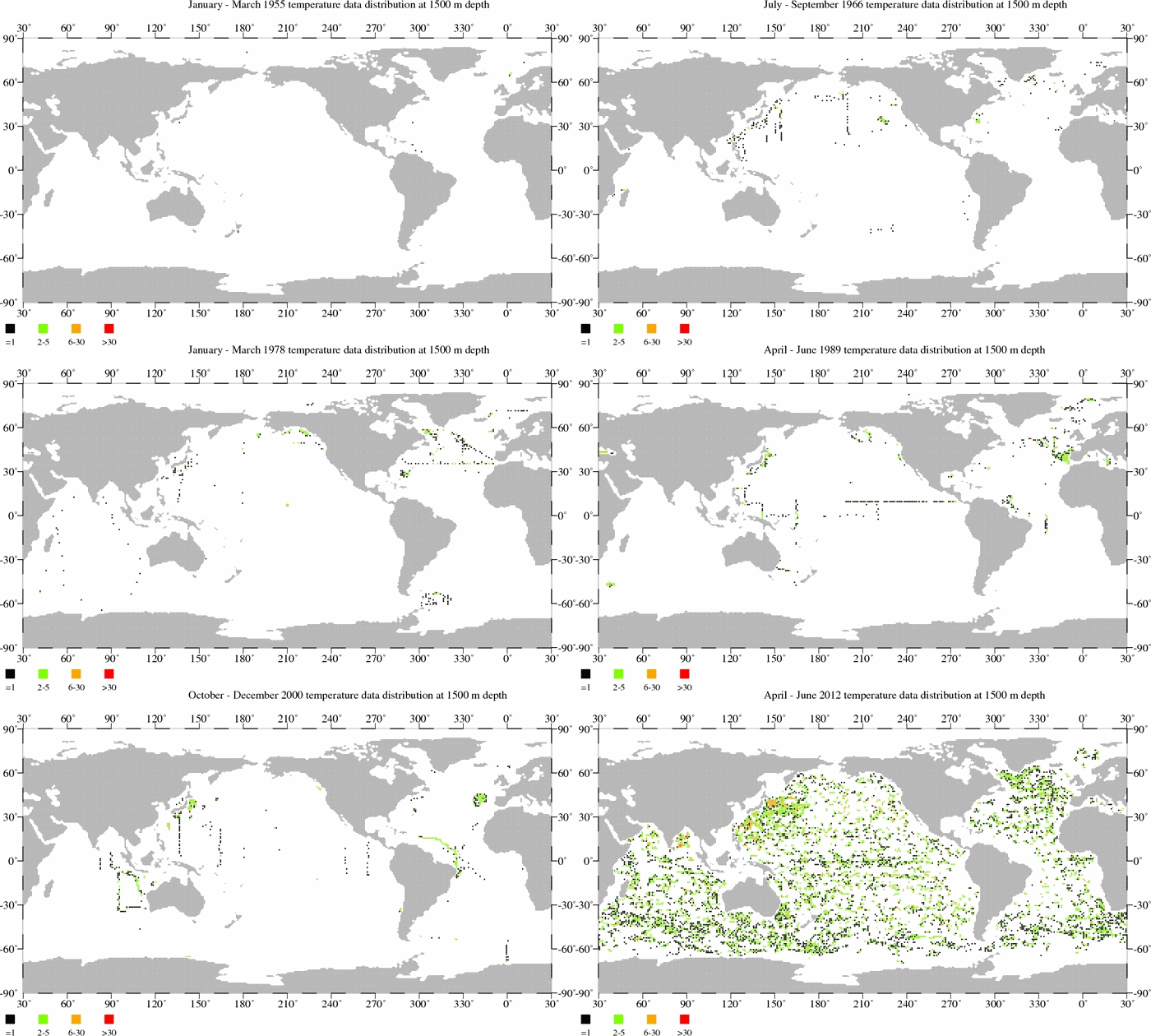
Third, on top of that, consider that ARGO floats have been found to be unreliable, hence the need to constantly readjust their observations.
Do we have any idea about the variability of the temperatures and ocean heat content of the global oceans to depth? Simple answer: No.
For more information on the problems with Ocean Heat Content data, refer to the post Is Ocean Heat Content Data All It’s Stacked Up to Be? and NODC’s Pentadal Ocean Heat Content (0 to 2000m) Creates Warming That Doesn’t Exist in the Annual Data – A Lot of Warming.
Opps….the winner of the Houston Film Festival was “American Empire”….which covers the same concepts as “Lesterland”. That movie trailer is at http://www.AmericanEmpiretheDocumentary.com
Regardless, all of the faux science is publicly funded, monopolist directed, outcome based for the benefit of the 0.05% of the Lesters. That is the root of the “climate change” problem.
M Courtney says:
April 15, 2013 at 4:21 am
… may I ask about heating from the bottom of the Ocean?
I’m not an expert but I’ve wondered about this myself. I think that the heat from the earth’s interior is considered to be negligible. This makes sense when you reflect that the temperature of water at the depth of the ocean is only 4 or 5 degrees C while average air temperatures are more like 15 C. I trust that hard rock geologists have studied the geothermal gradient very well and can calculate how much heat emanates from the depths. (I seem to remember from my college days that the earth gets about 1 degree F hotter every 70 feet you go down.) I have also read that the midatlantic ridge is higher than the rest of the ocean floor due to heat causing the material near the ridge to expand. This, of course, is because hot rock expands.
Let us hope that Mr. Trenberth does not switch fields and become a paleontologist.
“After a thorough search has ruled out the possibility of their location being in civilized and well traveled parts of the globe, we have determined that living dinosaurs must therefore be currently inhabiting some of the poorly mapped areas of the Antarctic high plateau. Our re-analysis of seismic readings from the area have clearly demonstrated the ‘thunk-thunk-thunk’ of their massive footfalls.”
tallbloke says: “The deep water measurements use salinity as a proxy for temperature don’t they?”
ARGO floats sample salinity, but before that I believe you’re correct.
Can someone explain to me why the Argo network hasn’t detected this heat on its way to the deep ocean? Thanks.
Which scenario results in more equatorial ocean evaporation thus water vapor in the lower atmosphere: La Nina or El Nino? The Trenberth heat depends entirely on more water vapor in the air. And the runaway condition depends entirely on increasing water vapor. Unfortunately for them, the vagaries of ENSO delivers a blow against constant fudge factors in their “code”.
Trenberth has finally located Maxwell’s Demon. He’s in the middle of the ocean.
M Courtney and tarpon, regarding undersea volcanos: This is a topic that’s often raised on ocean heat content threads. Over the past 4-6 years I’ve seen the topic discussed in a couple of papers and blog posts. If memory serves, those who attempted to calculate their contributions to ocean warming found volcanos have an impact so small it’s irrelevant. That’s my recall of the topic. Unfortunately, I didn’t save copies of the papers or links to the blog posts.
M Courtney says: April 15, 2013 at 4:21 am
WRT volcanic-seabed heating. From the numbers given in my CRC Handbook, the heat from the earth averages .0082 watts/sq meter. Not much.
Fair enough.
Heat from the earth is irrelevant at the bottom of the ocean.
And heat from volcanoes is also negligably small so variations with time are insignficant.
I may feel apologetic for wasting your time yet, as a total ignoramus of the subject, I will swallow my feelings and refuse to apologise for asking a stupid question.
We novices must ask to learn.
Pamela Gray says: “Which scenario results in more equatorial ocean evaporation thus water vapor in the lower atmosphere: La Nina or El Nino?”
El Niños cause more precipitation over the tropical Pacific, La Niñas cause less, but the variations are not proportional to the strength of ENSO events as measured by sea surface temperature-based indices.
http://i48.tinypic.com/6jgdvq.jpg
Methinks you’ve got the wrong word there, partner.
Wouldn’t it be ironic if Earth’s surface temperature was driven by the Earth’s molten core circulating in nonlinear ways similar to the sun’s internal circulation. Does the Earth’s core then have the equivalent of Earth spots but at depths where they cannot be seen as we see sun spots? What is to stop the earth’s molten core from being influenced by gravitational and angular momentum such that heat is conducted irregularly into the oceans over lengthy periods of time. Such heat then slowly dissipates into the atmosphere. The lag time would be very long indeed. We could be experiencing global warming due to the way the core was hundreds if not thousands of years ago. http://www.nasa.gov/topics/earth/features/earth20110309.html
What is there about Laws of Thermodynamics that warmists do get. Heat rises simple as that.
And when volcanoes heat the bottom, the heat rises.
It’s easier to fake things that aren’t easily measured, or manipulated. Corrected data is manipulated dat.
It is comparatively simple to measure the rate of heat flow out of the Earth’s surface, and this is a complete non-player in the global climate. It could be ten times greater than it is currently measured to be and still be negligible. And it’s not ten times greater than it is currently measured to be, even if those measurements aren’t particularly accurate.
It’s really easy to make bald assertions without even citing a single reference such as:
en.wikipedia.org/wiki/Earth’s_energy_budget
It’s doubly especially easy when one doesn’t understand the things that make water special, and the impossibility of water “heated” at 4 C rising to the surface to magically become water at 25 C because “heat rises”.
A better article to read than the one above is:
http://en.wikipedia.org/wiki/Geothermal_gradient
because measuring the geothermal gradient and the thermal conductivity of rock make it bone simple to compute the rate of heat flow associated with the gradient:
http://en.wikipedia.org/wiki/Heat_conduction#Fourier.27s_law
You clearly have been contaminated with Dragonslayer antiscience. Sadly, spouting nonsense of this sort simply reduces the credibility of actual skeptics such as Tisdale and Spencer even as they remain accountable to all of the precepts of well-done science, such as backing wild-ass statements up with data and arguments instead of just saying “the earth is being heated/cooled by invisible fairies flapping their little wings to cool or dancing a little fairy dance to heat” without any actual evidence of the fairies beyond the fact that the Earth DOES sometimes heat and sometimes cool.
And BTW, in case you’ve read some of crap on Slayer websites and taken it too seriously, no, fusion is not a meaningful energy source inside of the Earth, and even though the energy released by fission sounds impressive, it really isn’t, not when one compares it to the 99.96 to 99.97% of the total energy budget that comes from Mr. Sun. The geothermal contribution to total surface temperature is a tiny fraction of a degree.
One other aspect of geothermal power makes it unsuitable as a candidate for observed “global warming” quite independent of its measured magnitude. On average the rate of energy production inside of the Earth is almost certainly a very nearly constant (if anything, slowly decreasing) function. Yes, idiotic Slayer lore tries to avoid this problem by asserting that there are sudden changes as subterranean Uranium deposits are moved around to create natural reactors, but somehow they fail to do the arithmetic associated with thermal diffusion in three dimensions and spatiotemporal averaging over the entire interior volume. Even if there were (or are!) dramatic variations in heat output in highly localized environments where volcanoes pierce the crust and provide a conduit for heat loss that short circuits the substantial resistance of that crust, those variations are indeed highly localized and temporally distributed. There is no evidence at all, compelling or weak, to suggest that variation of a completely negligible measured number is responsible for the macroscopic global changes in temperature observed even in the completely reliable 33 year UAH LTT (for example).
So let’s keep it real, folks. Doubt CAGW/CACC all you like — I do too — but TRY HARD not to make egregious claims like “there is no such thing as the greenhouse effect” or “underwater volcanic heat is responsible for global warming” without some very hard numbers and good physics to back them up.
rgb
Regarding undersea volcanoes, it isn’t the occasional volcano that is the main contribution to ocean heating–it’s the midoceanic spreading centers and their hydrothermal circulation. I’ve read where a volume equal the entire ocean goes through that system (which is a continuous mountain range about 40,000 miles long) every 8 million years, and consequently contributes a significant amount of heat (along with soluble elements) to the ocean’s mass. The mid-oceanic ridge is believed to be caused by up-welling of hot material in the mantle, likely heated by the outer core of the Earth, hence the source of the heat.
http://en.wikipedia.org/wiki/Mid-ocean_ridge
If the knowledge is important, you need to learn it one way or the other. It isn’t about punishment, it’s about getting the job done. The chief’s choices were: 1 – You re-take the course with a different instructor. 2 – He persuades someone that the knowledge wasn’t important and you shouldn’t be responsible for it. 3 – You get ‘punished’ for failing to learn the material first time around.
Depending on the circumstances any of those three actions would be reasonable. Having said that; if your chief had been a better communicator, we wouldn’t be having this conversation. 😉
I am still troubled by the claimed accuracy of the ARGO floats. It is profoundly difficult to measure temperature to an accuracy of 0.001 degree C in a calibration laboratory. Simply dunking an expensive RTD (Resistance Temperature Detector) in a tub of water won’t achieve that.
Even assuming you have managed to achieve a calibrated accuracy of 0.001 degree C for your field measurement RTD (or other temperature measuring device), the next issues to deal with are instrument drift over time, calibration shift with pressure (!), aging from temperature cycling, and variations in measurement current. No instrument lab would claim a device would maintain that accuracy for an indefinite period time or under all possible environmental conditions.
Then, of course, we have to realize that what an instrument measures is the temperature of its sensor, not the process it is supposed to be measuring. Temperature measuring sensors must be protected from the environment of the process being measured. The ARGO deep ocean environment requires a substantial level of protection for the sensor. In the real world of instrumentation, you must take into account the isolation of that sensor from whatever it is measuring. At the very least, a typical temperature measuring well adds a time lag that could effect readings while the ARGO float is changing depth.
So 0.001 degree C long term accuracy? That is stretching credibility.
OK I have my widget makers prejudices twitching away here.
“It’s only when the ocean heat content data is corrected, tweaked, adjusted, modified, whatever”
If we have to change the data, doesn’t that mean either that the data is cobblers to start with. or that it doesn’t support the process we are subjecting it to?
“and the new study co-authored by Trenberth is not entirely based upon observations, anyway”
Doesn’t this absolve us of any need to read it?
“then the ocean heat content for depths of 0-2000 meters flattened as soon as the ARGO floats had reasonably compete coverage of the global oceans in 2003-04.”
So the process behaviour changes when an improved and supposedly better measurement method is introduced. Basically says that all the prior history can be round filed as garbage (not my first choice of adjective)
“ARGO floats have been found to be unreliable”
So why is everybody gathered around having a circle jerk over them? Stop wasting your time, get a better gauge set, or limit analysis to areas where the metrology system errors are small compared to the effect being measured.
Thank god its the whole world economy at stake and not something vital like the durability of your brake pads.
Peter Miller says:
April 15, 2013 at 4:02 am
Good post. Now that Trenberth has discovered “deep ocean warming,” (DOW?), things are worse than we thought. But, as you point out, he states only half a hypothesis. Maybe the DOW can explain the lack of warming in the last seventeen years. That is the first half of the hypothesis. For the second half of the hypothesis, Trenberth offers only “things are worse than we thought.” Why would he not consider that he might have discovered the first glimmers of huge and powerful regulators of CO2 and temperature in the deep oceans? Because he is searching for support for his top down theory. Trenberth should be saying that there is a great need for empirical research into this matter and that several decades of research could reveal some important answers. But such a scientific attitude would sidetrack global warming hysteria. Trenberth cannot let that happen.
TRENBERTH LOSES HIS STRAWBERRIES
(see the courtroom scene in The Caine Mutiny)
As greenhouse gases still accrete
This captain of the climate wars
Is searching for the missing heat
That he believes the ocean stores
He’ll prove to all humanity
That danger in the deep resides!
The Kraken that he knows must be
That Davy Jones’ locker hides!
(The soul’s more heavy than we think
A truth that everyone must face
And to what depths a soul may sink!
O! To what dark and dismal place!)
Does Captain Trenberth understand
The data leaves him no appeal?
He tumbles in his restless hand
Three clacking balls of stainless steel
MY GEOMETRIC LOGIC PROVES
HEAT TELEPORTS FROM PLACE TO PLACE!
FROM SKIES INTO THE DEPTHS IT MOVES
AND IN BETWEEN IT LEAVES NO TRACE!
(When silent faces stare at you
It’s always best to shut your jaw
But Trenberth is without a clue
As he believes they stare in awe!)
Eugene WR Gallun
It boggles the mind of the average Joe (me) …. 0.1%
I’m no math guy but it gets hard to buy all this.
That’s 0.015C / 15C.
Stop the world because we have absolutely got the data that
proves indicates showsimplies we’re all gonna die, sometime.We have
measured observed calculated made upmodeled a 0.1% change in temperature of the entire earth…and now we know …for sure…this time.In the words Bob Dylan, “I can only think in terms of me and now I understand”.
So, if my normal body temperature is 37C and for some inexplicable reason it shoots up 0.1% it goes to 37.037.
If my weight is 180 lbs and for some explicable it shoots up 0.1% it goes to 180.18 lbs.
imho
Anyone, and I do mean anyone, attempting to explain to the average citizen (me) how or even why they have managed to measure these obscene numbers would be laughed out of the local bar.
This is why I and most of the world remain skeptical and for the most part Rationally Ignorant
cn
We presumably know from replicate measurements in various locations by ARGO buoys and earlier instruments how accurate ocean temps can be. Why don’t you or Roy tell us what the lit says about this? (Performance can deteriorate over time and needs to be re-assessed.)
Joseph A Olson says:
April 15, 2013 at 6:07 am
Earth’s oceans contain 310 million cubic miles of water at an average…
Nooo, noooo, the dragonslayers have come, the dragonslayers have come!
Now it’s not helium fusion in the crust powering global warming, it is latent heat at undersea vents. I suppose that’s an improvement.
As for the tail wagging the dog, yes and no. “Yes”, the heat capacity of the ocean dwarfs that of the atmosphere, especially the relatively thin slice of the atmosphere near sea level where we actually live and where air temperature is considered “surface temperature”. That is the bit about Roy asserting that to make claims regarding missing heat one has to resolve temperatures and temperature changes to within order of a thousandth of a degree, reliably, at depth, to facilitate global enthalpy computations, because things that would make comparatively large changes in surface temperatures would hardly change the temperature at depth. The ocean is, indeed, an enormous heat buffer, and one with a non-Markovian memory and multiple time scales wherein energy associated with previous climate state is absorbed or released. Some part of the ocean’s contribution to the climate was established back in the LIA, or the beginning of the twentieth century, not just over the last year or five years or even ten years.
The larger problem is (as always) the statistical one. A few thousand buoys, even if they were all remarkably accurate as far as temperature measurements are concerned, would have a very hard time supporting an INTEGRAL of enthalpy over the volume of a highly structured ocean, especially when a nontrivial (and probably ignored!) component of the enthalpy is raw/bulk kinetic energy associated with bulk fluid transport. A simple rule I like to apply is that no matter how precise the thermometer I have outside, it is a remarkably poor measure of the “average temperature on my property” even for as small and localized a chunk of land as that property, and it is a REALLY poor measure of mean Durham temperature, and an even worse measure of mean temperature in Durham county.
The laws of large numbers and the CLT can only help with this to some extent. Using a single thermometer per county might help you find a mean temperature for North Carolina that was normally distributed and had a meaningful standard deviation (one that is almost certainly going to be much larger than 0.001 C, of course), but the probable deviation of that mean temperature from the mean temperature at my house is likely to be systematic and large, and applying that mean temperature in some sort of volume-averaged enthalpy computation likely to be even more systematically erroneous and larger. The density of ARGO buoys is MUCH WORSE than trying to measure the mean temperature of Durham on the basis of a single thermometer in my back yard, and I’m enormously skeptical that the system has the resolution to make any meaningful statement whatsoever about the so called missing heat. Maybe it’s there, maybe not. Either way, the ocean could buffer that missing heat for a century without significantly changing its bulk temperature profile, so if the missing heat IS going into the ocean and keeping the surface comparatively cool(er than it would otherwise be), that’s simply spiffy, an instant end to the theory of catastrophic warming.
“No”, in that the surface temperature of the Earth is not set by heat flow from the interior. If you took the Earth away from the Sun, it would be cold as all hell. It IS cold as all hell down there on the 70% of the Earth’s surface covered by ocean. The surface temperature is almost entirely set by insolation as energy in, radiation as energy out. You could turn off 100% of geothermal energy and never miss it. You could double it and never notice any effect (lost in the noise).
You might take a bit of time and try to learn Fourier’s Law for heat flow. It would help to keep you from making egregiously incorrect remarks concerning geothermal contributions to the overall energy budget.
But no, honestly, can anything manage that? Probably not.
rgb
Sea level was higher during most of the Cretaceous Period than at any other time in the Phanerozoic Eon, & possibly ever, especially in its Late Epoch, but before regression in the Maastrichtian Age just before the K-Pg mass extinction event. These high levels did not result mainly from lack of ice, but used to be attributed to thermal expansion. Now they are thought primarily to have occurred from displacement of seawater by the enlarged mid-oceanic ridges powering rapid continental drift during that period.
So 0.001 degree C long term accuracy? That is stretching credibility. times 0.1 or 0.001 C.
 .
.
And I obviously agree, but I’m sure that they cite the central limit theorem as the basis of their claim. Let’s assert that the expensive thermometers in the buoys are accurate to 0.1 degree. Let’s assume that there are 10,000 of them. Then one might expect the standard deviation of the mean temperature produced by 10,000 iid samples from the same distribution to be order of
Of course there are fewer than 10,000 buoys IIRC, their accuracy is probably no better than 0.1 C, the samples are in no conceivable sense iid samples drawn from the same distribution, the ocean has nontrivial structure, currents, thermoclines, inversions, variations in density, salinity, and thermal heat capacity with depth, the ocean is moving with a nontrivial kinetic energy component and satisfies some sort of Navier-Stokes equation from hell inside an irregularly shaped, gravity contrained, wind-driven, solar heated, spinning accelerating volume, and there aren’t enough buoys for them on a GOOD day to resolve the KNOWN fine-grained structure of oceanic currents (where surface currents alone make up around 10% of all water in the ocean and have an almost fractal structure, constantly changing, turbulent rolling structure).
The Central Limit Theorem is good, but it ain’t that good, not at the surface, not at depth. I’d argue that they aren’t within orders of magnitude of the resolution needed to claim knowledge within 0.001C at depth suitable even for a crude oversimplified multiply-T-by-some-assumed-C estimate of
rgb