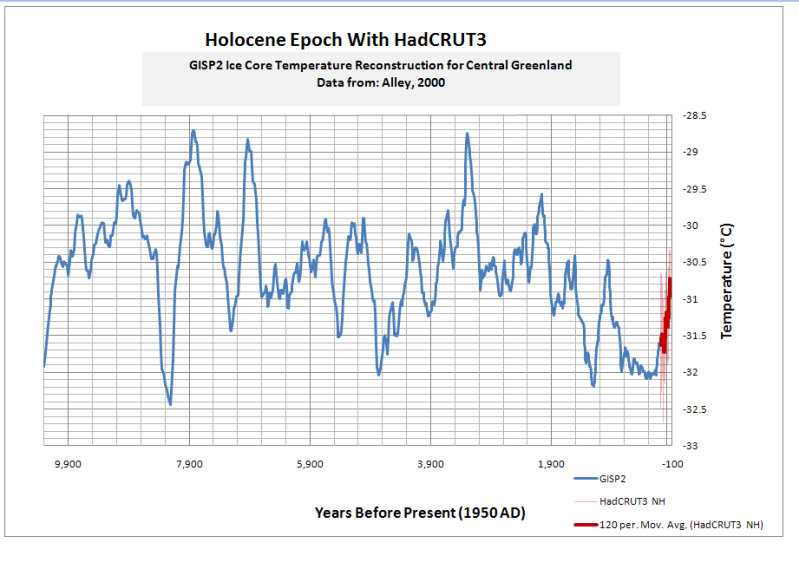
Image Credit: Photobucket.com – GISP2 – Alley, 2000
By WUWT regular “Just The Facts”
In building WUWT Paleoclimate Reference Page during these crowdsourcing threads (1, 2) there have been a number disputes raised about various graphs. During this thread I am hoping that we can determine logical classifications for graphs based upon Alley, 2000. In future crowdsourcing threads we will have to address an array of other disputed reconstructions including Briffa et al., 1998, Jones et al., 1998, Mann et al., 1998, Pollack et al., 1998, Jones et al., 1998, Mann et al., 1999, Mann et al., 2000, Briffa et al., 2001, Esper et al., 2002 and Jones and Mann 2004, AR4 section 6.6.1.1 2007 and Marcott et al. 2013.
Thus far three methods have been used for classifying disputed graphs on the WUWT Paleoclimate Reference Page. The first is to add a “Graph Background” link to offer additional pertinent details. The second is to add a Disputed Graph label to the graph, along with a brief description of the nature of the dispute. The third is to place the graph in the section at the bottom of the Paleoclimate page titled Incorrect/Falsified Graphs along with a longer description of the reason the graph is incorrect or has been falsified. Your suggested improvements to our graph classification methodology are most welcome.
I this thread I’d like to solidify the classifications for the graphs based upon Alley, 2000. The dispute around Alley, 2000 has focused on the axis labels, as WUWT commenter Phil states here
Any graph that claims to use Alley’s GISP2 data must either finish at 95 years Before Present (BP=1950) or AD1855 because that is the final date in his database which is on-line and freely available to us all. Lappi’s graph mistakes Present for 2000 as does Easterbrook, they should have a note added pointing out their error or be excluded.
Based on Alley’s own Figure 1 from his 2000 paper;

the x axis label is Age (thousand years before 1950) or Years Before Present (1950AD) and the Alley, 2000 data clearly ends 0.0951409 thousand years Before Present. Taking that into account, the following are the graphs from the WUWT Paleoclimate Reference Page know to be based upon Alley, 2000 and their proposed Classifications:
2,500 Years – GISP2 – Alley, 2000 Classification: Correct – No Change
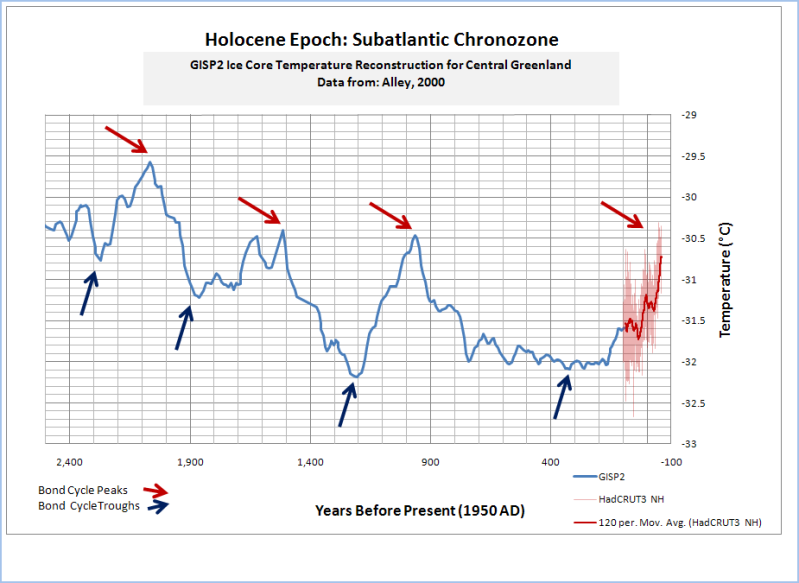
10,000 Years – GISP2 – Alley, 2000 Classification: Correct – No Change
10,000 Years – GISP2 – Alley, 2000 Classification: Correct – No Change

10,000 Years – GISP2 – Alley, 2000, Ljungqvist et al and HadCRUT3 Classification: Correct – No Change
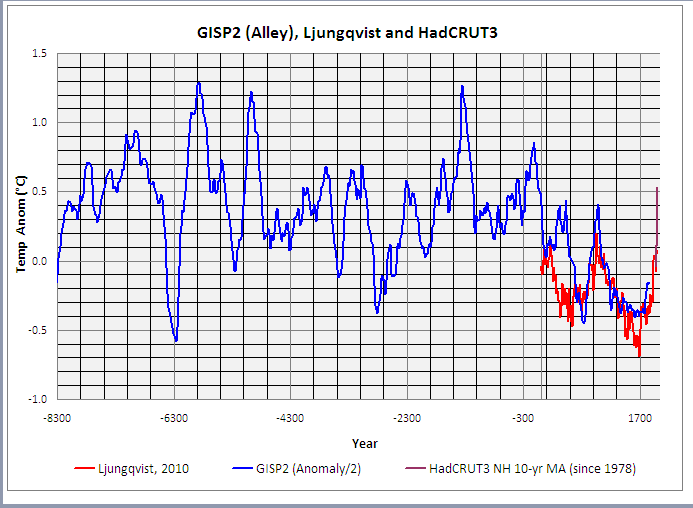
10,000 Years – GISP2 – Alley, 2000 Classification: Confusing – Add Label: Disputed Graph – The x axis label should read Years Before Present (1950 AD)

10,000 Years – GISP – Alley, 2000 – Vostok – Petit et al. 1999 – Click for Animation – Classification: Confusing – Add Label: Disputed Graph – The x axis labels should read Years Before Present (1950 AD)

10,000 Years – GISP2 – Alley, 2000 Classification: Incorrect – Move to Incorrect/Falsified Graphs section – Label Incorrect Graph – The x axis label, “Years Before Present (2000 AD)”, should read Years Before Present (1950 AD)
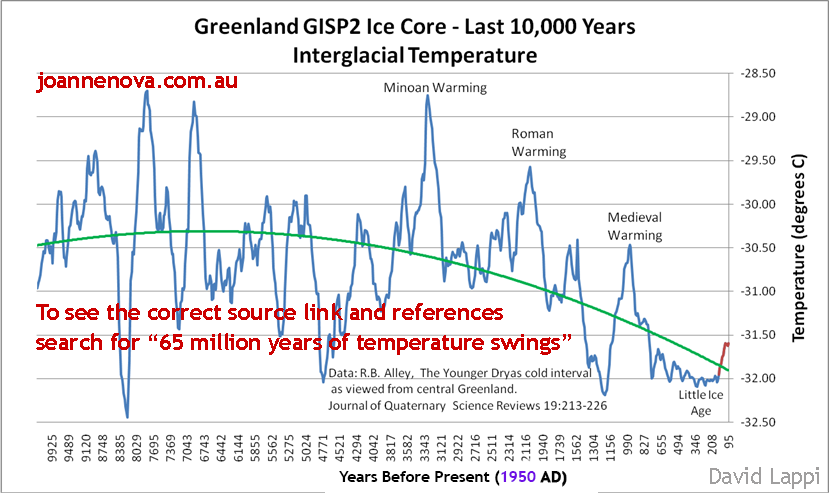
10,000 Years – GISP2 – Alley, 2000 Classification: Incorrect – Move to Incorrect/Falsified Graphs section – Label Incorrect Graph – The x axis label, “Years Before Present (2000 AD)”, should read Years Before Present (1950 AD)

Please provide your thoughts and recommendations on these proposed graph classifications and labels for the Alley graphs, as well as any other improvements, corrections or other additions to the WUWT Paleoclimate Reference Page in comments below.
Purely as an aside – “Years Before Present” is surely one of the stupidest modern inventions, because “present” is not a constant and it runs backwards. As a committed atheist, I see no problem whatsoever with simply using the date used by all of the connected world, regardless of its origin. However, if something else has to be used, and if “years before present” doesn’t mean years before present but means “years before 1950″ then call it YABY (Years After Base Year”, where Base Year is whatever anyone wants to call it that makes it equal to what most people call “1950”.
Haven’t seen much reference to Senna and others 2009.
http://www.clim-past.net/5/523/2009/
Their conclusions are not dissimilar to Marcott’s [that’s Marcott’s thesis not Marcott et al, “Science”]
The polar amplification factor in Alley 2000 versus Global temperatures (and all the borehole calibrated Greenland ice cores) is 5 to 1
So the temps in Alley 2000 change by 5 times as much as the global temperature.
A very similar ice core (NGRIP) versus a global temperature estimate over the last ice age.
http://s18.postimg.org/6rih4vhrd/Greenland_vs_Global_Temperatures_135_Kya.png
On Bond ‘cycles’: http://www.leif.org/EOS/Obrochta2012.pdf
“Our new results suggest that the “1500-year cycle” may be a transient phenomenon whose origin could be due, for example, to ice sheet boundary conditions for the interval in which it is observed. We therefore question whether it is necessary to invoke such exotic explanations as heterodyne frequencies or combination tones to explain a phenomenon of such fleeting occurrence that is potentially an artifact of arithmetic averaging”
justthefactswuwt says:
April 13, 2013 at 1:24 pm
Gerg Goodman says: April 13, 2013 at 12:25 pm
The idea of vetting and classifying seems to be good one. However, assimilating a graph covering 10k years with a careless error of 50 years “before present” issues with something that is falsified seems unreasonable and improper.
The axis labelling issue is worth flagging but this does not fall into the same category as falsification.
Things like Jones and Mann cropping , padding , grafting etc is clearly falsification.
It would be to dilute their sins to confound that will a rather insignificant technical error of not correctly noting what “before present” is defined as.
———————————–
But the graphs are incorrect, regardless of the the method and motivations. And 50 years is quite important when the warming of the second half of the 20th century forms the entire basis of the Catastrophic Anthropogenic Global Warming narrative.
Once we start to deal with Jones, Mann, Marcott, etc. we can consider whether it makes sense to break out the Incorrect/Falsified Graphs section into multiple sections, but for now I am inclined to leave it as is. What does everyone else think?
I think that you could be falling into the ‘Marcott’ trap. 50 years is totally unimportant in a 10,000 year plot and most of the proxies in that 10,000 years are unable to discriminate a 50 year value. As long as the proxies are reliably shown in the graph it would be better just to truncate the time axis. We are dealing with climate not weather so 50 years is unimportant.
This again? GISP2 is an O16/O18 proxy ratio measurement..it is NOT a measurement of local Greenland climate..it is a better proxy for Hadley Cell strength and tropical/subtropical SSTs.
In reply to
crosspatch says:
April 13, 2013 at 12:22 pm
The problem I have is using Greenland cores or Greenland temperature as a representation of global climate. Greenland is subject to extremely local weather events, some of which can be persistent on a decadal scale.
philr1992 says:
April 13, 2013 at 6:24 pm
This again? GISP2 is an O16/O18 proxy ratio measurement..it is NOT a measurement of local Greenland climate..it is a better proxy for Hadley Cell strength and tropical/subtropical SSTs.
William,
Crosspatch statement is not correct, regions of the planet do not warm or cool for hundreds of years do to local weather conditions. Philr1992 you are using terms in a sentence with the hope that they will support your position which it appears is that the Greenland Ice Sheet temperature data should be suppressed.
The Greenland Ice sheet is representative of the temperature in the Northern Hemisphere, with some qualifications. The Dansgaard-Oeschger (D-O) cycles, the obvious dominate warming and cooling cycle, periodicity 1450 years plus or minus 500 years, in the GISP2 Greenland Ice core analysis is also observed in ocean sediment analysis. The D-O cycles and the glacial/interglacial cycles is relevant to the climate change discussion.
The problem is not the data, but the fact that data does not support the ‘message’. A component of the ‘message’ is that the 20th century temperature rise is unprecedented which it is not.
http://www.climate4you.com/images/GISP2%20TemperatureSince10700%20BP%20with%20CO2%20from%20EPICA%20DomeC.gif
http://www.climate4you.com/
P.S. Thank-you every one that is bringing the paleo data to Watts up. The attempts to make the D-O cycle go away as it off ‘message’ are ridiculous, pathetic, and sad.
The people how are pushing the ‘message’ have attempted to suppress the paleo climate data, as it does not support their ‘message’. A very small percentage of the general population are aware of the D-O cycles. A very small percentage of the population are aware that interglacial periods are short, roughly 12,000 years, that we are at the end of this interglacial period and that the past interglacial periods ended abruptly.
https://ams.confex.com/ams/pdfpapers/74103.pdf
The Sun-Climate Connection by John A. Eddy, National Solar Observatory
Solar Influence on North Atlantic Climate during the Holocene
A more recent oceanographic study, based on reconstructions of the North Atlantic climate during the Holocene epoch, has found what may be the most compelling link between climate and the changing Sun: in this case an apparent regional climatic response to a series of prolonged episodes of suppressed solar activity, like the Maunder Minimum, each lasting from 50 to 150 years8.
The paleoclimatic data, covering the full span of the present interglacial epoch, are a record of the concentration of identifiable mineral tracers in layered sediments on the sea floor of the northern North Atlantic Ocean. The tracers originate on the land and are carried out to sea in drift ice. Their presence in seafloor samples at different locations in the surrounding ocean reflects the southward expansion of cooler, ice-bearing water: thus serving as indicators of changing climatic conditions at high Northern latitudes. The study demonstrates that the sub-polar North Atlantic Ocean has experienced nine distinctive expansions of cooler water (William: And nine expansions of warmer water which unfortunately is politically incorrect to acknowledge) in the past 11,000 years, occurring roughly every 1000 to 2000 years, with a mean spacing of about 1350 years.
Each of these cooling events coincides in time with strong, distinctive minima in solar activity, based on contemporaneous records of the production of 14C from tree-ring records and 10Be from deep-sea cores. For reasons cited above, these features, found in both 14C and 10Be records, are of likely solar origin, since the two records are subject to quite different non-solar internal sources of variability. The North Atlantic finding suggests that solar variability exerts a strong effect on climate on centennial to millennial time scales, perhaps through changes in ocean thermohaline circulation that in turn amplify the direct effects of smaller variations in solar irradiance.
Just the Facts:
This may be picky; but the graphs have titles! Use them when referencing!
e.g. Some graphs (most if not all) have a lead in description “10,000 Years – GISP2 – Alley, 2000 Classification: Correct – No Change”
Whereas the graph states (if I have the right graph); “Holocene Epoch with HADCRUT3”
I agree with some of the other commenters; “Years before present” is a useless boat anchor identifier. Yeah the graph is third party; so add a note stating clearly when the present time is assumed to be.
I second the notion that all spliced charts should be identified! If possible add smaller graphs depicting the splices.
Love the animated graph; it’s a little fuzzy though. Would it be possible t make it stop action till clicked?
Definitively identify any graph that is ‘soiled, contested, disputed, in question, not replicated or replicable, data/code is lost or worse, refused
To fail to identify graphs that fail honest science questions will open WUWT to being cited as a proponent of the graphs by their inclusion (as research cites).
And; thank you for doing this JTF!!
If the graph simply needs a change of labelling or description then calling it “falsified” seems much too strong. Even calling it “disputed” seems an overreaction to this type of error. I would prefer a label along the lines of “acceptable with correction or clarification”.
If we’re relabelling the x-axes, the AD comes before the year.
Sorry, I still like this graph from GISS data:
http://suyts.files.wordpress.com/2013/02/image_thumb265.png?w=636&h=294
I think it tells the whole story.
By using a normal Y-axis, it is clear that global warming has stalled…
Anyone want to dispute this graphic???
JTF “Every graph is linked, just click on the pic and it will take you to where it was found/hosted.”
Yes , I did realise that and was surprised that I just got some ‘pastbin/dropbucket’ not the true origin. I did not realise that a lot of these graphs are of unknown origin.
Another label “origin unknown” would seem to be in order where that is the case.
“If we’re relabelling the x-axes, the AD comes before the year.”
I don’t think anything should be changed on any graph. Otherwise you go and get the data and plot the graph yourself in the way you think it should be done.
Notes should be used to explain any issues with dates.
If the labelling issues have a significant impact on how the graph is read, label it as misleading/falsified , whatever, or just don’t use it all.
Is there a need to deal with every anonymous unattributable graph in a pastebin on the internet?
JoNova/Lappi and WUWT/Easterbrook graphs :
Both these graphs have insufficient labelling of content to stand alone. They need a link to the article which presumably explains more. (Lappi green line is what? Why is it valid? Valid what?)
Ian W says: April 13, 2013 at 6:15 pm
I think that you could be falling into the ‘Marcott’ trap. 50 years is totally unimportant in a 10,000 year plot and most of the proxies in that 10,000 years are unable to discriminate a 50 year value. As long as the proxies are reliably shown in the graph it would be better just to truncate the time axis. We are dealing with climate not weather so 50 years is unimportant.
50 years is important when it could be misleading for some and provide grounds for others to challenge the validity of the graphs, e.g.:
http://www.skepticalscience.com/print.php?r=337
The goal here is to build an accurate set of graphs, and we have extra 10,000 year graphs based upon Alley, 2000, thus a 50 year axis label mistake is sufficient grounds for exclusion.
William Astley says:
April 13, 2013 at 7:24 pm
The Sun-Climate Connection by John A. Eddy
Eddy said: “Based on the assumption of an increase in the amplitude of irradiance variations that accompany slower changes in solar activity, about half of the documented rise in global surface temperature in the period from about 1900 to 1940 can be ascribed to solar changes. In the remaining years of the century the fraction falls to about one fourth of the total rise in temperature, with the remainder attributed to ever increasing greenhouse warming. But it must be emphasized, once again, that the larger-amplitude, slower changes in solar irradiance on which these deductions are founded have yet to be observed.”
And that is precisely the point. In the ten years since Eddy’s paper, the assumption has crumpled and there is no good evidence of these longer periods in TSI. There are even some hints of TSI being higher during grand minima [since there are no dark spots to decrease TSI].
On Bond ‘cycles’: http://www.leif.org/EOS/Obrochta2012.pdf
“Our new results suggest that the “1500-year cycle” may be a transient phenomenon whose origin could be due, for example, to ice sheet boundary conditions for the interval in which it is observed. We therefore question whether it is necessary to invoke such exotic explanations as heterodyne frequencies or combination tones to explain a phenomenon of such fleeting occurrence that is potentially an artifact of arithmetic averaging”
Gerg Goodman says: April 13, 2013 at 8:55 pm
Yes , I did realise that and was surprised that I just got some ‘pastbin/dropbucket’ not the true origin. I did not realise that a lot of these graphs are of unknown origin.
Many of these graphs were submitted in comments on the other crowdsourcing threads. It will take a while to validate, title and label all of them all accurately.
Another label “origin unknown” would seem to be in order where that is the case.
That’s a good idea, I’ll add a label when I get a chance.
JTF – I’ve researched this pretty deeply, as its been an ongoing question. There is more to it than simply stating 1950 = “present” is correct. First there must be definitive proof what the correct date for “present” really is for Alley 2000. There is circumstantial proof, and even pretty good anecdotal evidence, that 1950 is correct, but as you note it is very important to know with certainty what the actual date is.
Don Easterbrook claims present = 2000, and there are a number of versions of the Alley 2000 graphs that say that. I believed, from my original review, that 1950 was correct. But based on the lack of Alley being able to offer any definitive answer I dug in to it again. I still believe it may have been the intent and/or belief that 1950 was correct, but as I work my way back upstream from Alley I no longer believe that is a definitive answer.
I have reached out to Don, to try to get to the bottom of it, and hopefully will get a reply soon.
A. Scott says: April 13, 2013 at 9:30 pm
JTF – I’ve researched this pretty deeply, as its been an ongoing question. There is more to it than simply stating 1950 = “present” is correct. First there must be definitive proof what the correct date for “present” really is for Alley 2000. There is circumstantial proof, and even pretty good anecdotal evidence, that 1950 is correct, but as you note it is very important to know with certainty what the actual date is.
Don Easterbrook claims present = 2000, and there are a number of versions of the Alley 2000 graphs that say that. I believed, from my original review, that 1950 was correct. But based on the lack of Alley being able to offer any definitive answer I dug in to it again. I still believe it may have been the intent and/or belief that 1950 was correct, but as I work my way back upstream from Alley I no longer believe that is a definitive answer.
I have reached out to Don, to try to get to the bottom of it, and hopefully will get a reply soon.
Not that I make it a habit of of trusting SkepticalScience.com, but this statement seems pretty credible:
Ian H says: April 13, 2013 at 8:13 pm
If the graph simply needs a change of labelling or description then calling it “falsified” seems much too strong.
atheok says: April 13, 2013 at 8:03 pm
Definitively identify any graph that is ‘soiled, contested, disputed, in question, not replicated or replicable, data/code is lost or worse, refused
I agree that falsified is strong for some, perhaps we can just call the section at bottom “Incorrect Graphs”, and then we can add additional flavor to the graph titles based on the issues associated with each graph.
lsvalgaard says: April 13, 2013 at 9:28 pm
On Bond ‘cycles’: http://www.leif.org/EOS/Obrochta2012.pdf
Further to the point:
OK , some digging. The 10k Alley graph seems to be _derived_ from the one produced in SS.org rebuttal of the Easterbrook graph. Easterbrook clearly did not understand what he was doing with the dates and did not bother researching even when questioned. Their arguments against his graph seem sound. “Invalid” seems correct label.
However, the Alley 10k graph has been crudely modifies by someone. I could not understand the blue “GISP dite temps” label stuck up in the air. The reason is because they’ve moved the data !!
So “falsified” would be best there.
The following would seem to the original, with the article to explain it’s derivation:
http://hot-topic.co.nz/wp-content/uploads/2011/01/GISP210klarge.png
The 1.4 deg C shift is derived from the previous graph showing “reconstructed Greenland temperatures for the period 1840-2007 ”
http://hot-topic.co.nz/wp-content/uploads/2011/01/GRIPtempBox480.png
There is a link to the paper and it turns out that it’s a mix of recent weather station data and _climate model_ reconstructions.
http://journals.ametsoc.org/doi/abs/10.1175/2009JCLI2816.1
The text comments: ” It’s clear there is a calibration issue between the long term proxy (based on ∂18O measurement) and recent direct measurement of temperatures on the Greenland ice sheet. How that might be resolved is an interesting question”
So we move from _climate model_ reconstructions to “recent direct measurement” . The noted calibration issue is not resolved but the 1.4 deg C rise in the MODEL reconstruction is used anyway.
So I would suggest moving the current Alley 10k graph to “falsified” (which I would still like to see separate from simple errors of labelling) and replacing with SkS and a link to the originating article.
The graph also gets “disputed/misleading” for mixing incompatible data. “Assuming” GISP and GRIP sites vary by 0.9 deg C , shifting the 1.4 rise from an air temp climate model on to GISP2 data is simply unjustified. Especially when the text notes an unresolved calibration problem that it does not even attempt to resolve. What they are effectively doing is “resolving” it by assuming there is a fixed difference between the two stations and that there is NO calibration or compatibility issues between the modelled air temp and GISP2 core “temps”.
Totally unfounded.
The GISP2 + 1.4 deg C line is clearly labelled so I’d say this is misleading rather than falsification. However, presenting model output as “GISP site temp” and referring to “recent direct measurement” is borderline falsification.
“I agree that falsified is strong for some”
Indeed but not unjustified in some cases. For example Mann’s padding the filter window with later instrumental temps when actual data were available from Briffa for those years. This “trick” was to ensure that the smoothed line totally masked the graphing of instrumental data on to the cropped off Briffa proxy data.
That was artful and deliberate falsification.
Whoever, took what was labelled as GRIP site temp and shifted it down 0.9 deg C leaving the label also falsified the graph.
I think it should be used sparingly since it implies intent. There are cases however, where that is justified.
I think it is important to separate that sort of thing from Easterbrook’s apparent bodge due to not understanding the subject.
graphing of instrumental data on to the cropped off Briffa
oops, I meant _grafting_ . The result of the contamination is bend up the end of cropped Briffa data, that is still coloured as Briffa line. It was a fraud.
http://joannenova.com.au/2010/02/the-big-picture-65-million-years-of-temperature-swings/
Found source of Lappi graph. No explanation of his quadratic (?) fitted model , what it means or why it’s there or how we might interpret it. Nada.
It does not add anything to the std Vostok record other than this unexplained line.
I’d like suggest labelling it “disputed” but since he does not say what he’s done it’s hard to dispute. That essentially makes it invalid/irrelevant.