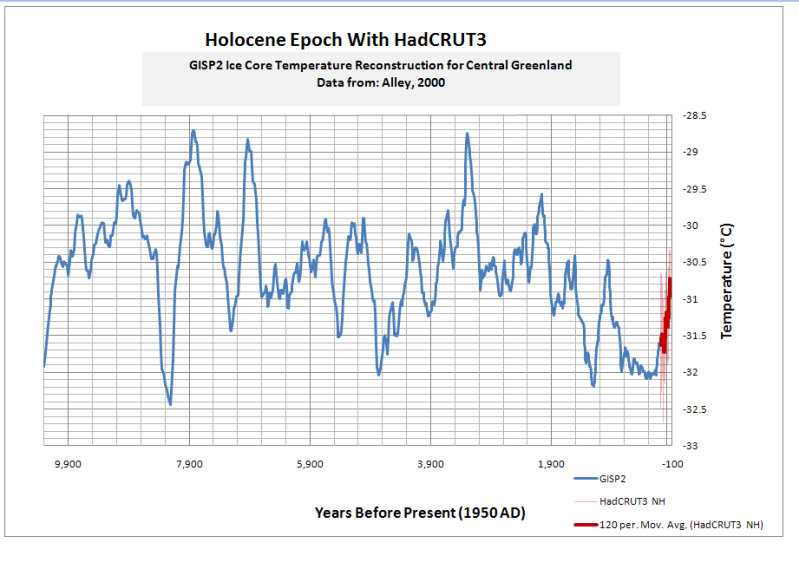
Image Credit: Photobucket.com – GISP2 – Alley, 2000
By WUWT regular “Just The Facts”
In building WUWT Paleoclimate Reference Page during these crowdsourcing threads (1, 2) there have been a number disputes raised about various graphs. During this thread I am hoping that we can determine logical classifications for graphs based upon Alley, 2000. In future crowdsourcing threads we will have to address an array of other disputed reconstructions including Briffa et al., 1998, Jones et al., 1998, Mann et al., 1998, Pollack et al., 1998, Jones et al., 1998, Mann et al., 1999, Mann et al., 2000, Briffa et al., 2001, Esper et al., 2002 and Jones and Mann 2004, AR4 section 6.6.1.1 2007 and Marcott et al. 2013.
Thus far three methods have been used for classifying disputed graphs on the WUWT Paleoclimate Reference Page. The first is to add a “Graph Background” link to offer additional pertinent details. The second is to add a Disputed Graph label to the graph, along with a brief description of the nature of the dispute. The third is to place the graph in the section at the bottom of the Paleoclimate page titled Incorrect/Falsified Graphs along with a longer description of the reason the graph is incorrect or has been falsified. Your suggested improvements to our graph classification methodology are most welcome.
I this thread I’d like to solidify the classifications for the graphs based upon Alley, 2000. The dispute around Alley, 2000 has focused on the axis labels, as WUWT commenter Phil states here
Any graph that claims to use Alley’s GISP2 data must either finish at 95 years Before Present (BP=1950) or AD1855 because that is the final date in his database which is on-line and freely available to us all. Lappi’s graph mistakes Present for 2000 as does Easterbrook, they should have a note added pointing out their error or be excluded.
Based on Alley’s own Figure 1 from his 2000 paper;

the x axis label is Age (thousand years before 1950) or Years Before Present (1950AD) and the Alley, 2000 data clearly ends 0.0951409 thousand years Before Present. Taking that into account, the following are the graphs from the WUWT Paleoclimate Reference Page know to be based upon Alley, 2000 and their proposed Classifications:
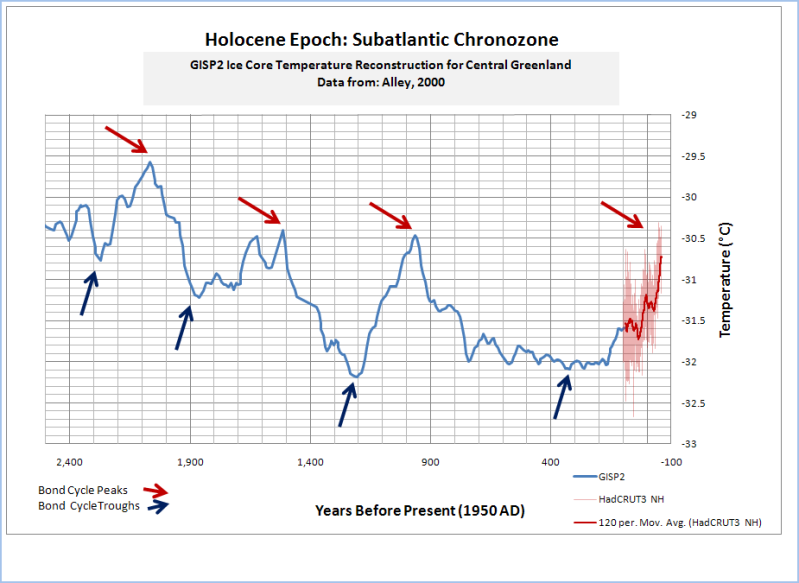
2,500 Years – GISP2 – Alley, 2000 Classification: Correct – No Change
10,000 Years – GISP2 – Alley, 2000 Classification: Correct – No Change
10,000 Years – GISP2 – Alley, 2000 Classification: Correct – No Change

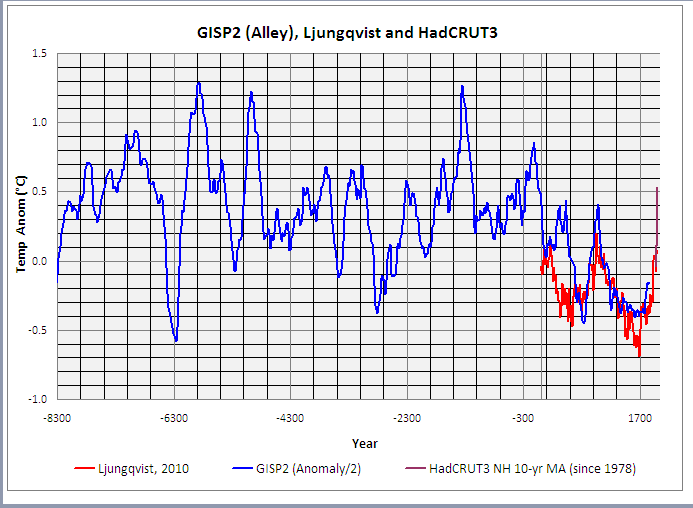
10,000 Years – GISP2 – Alley, 2000, Ljungqvist et al and HadCRUT3 Classification: Correct – No Change
10,000 Years – GISP2 – Alley, 2000 Classification: Confusing – Add Label: Disputed Graph – The x axis label should read Years Before Present (1950 AD)

10,000 Years – GISP – Alley, 2000 – Vostok – Petit et al. 1999 – Click for Animation – Classification: Confusing – Add Label: Disputed Graph – The x axis labels should read Years Before Present (1950 AD)

10,000 Years – GISP2 – Alley, 2000 Classification: Incorrect – Move to Incorrect/Falsified Graphs section – Label Incorrect Graph – The x axis label, “Years Before Present (2000 AD)”, should read Years Before Present (1950 AD)
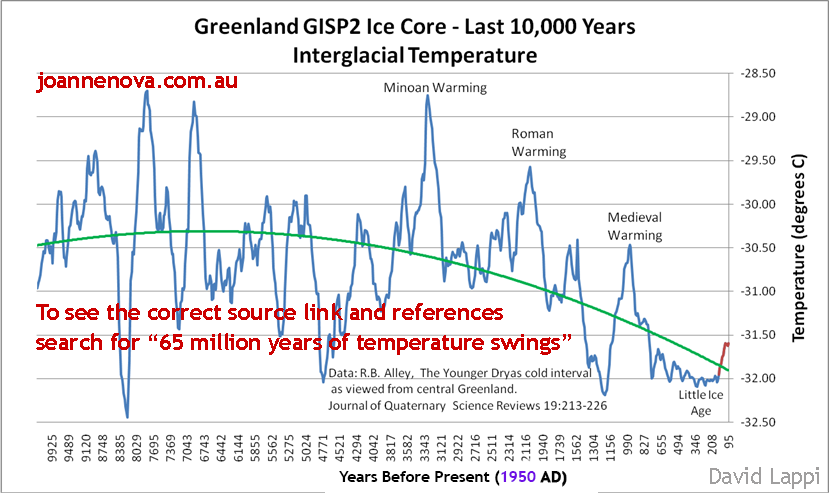
10,000 Years – GISP2 – Alley, 2000 Classification: Incorrect – Move to Incorrect/Falsified Graphs section – Label Incorrect Graph – The x axis label, “Years Before Present (2000 AD)”, should read Years Before Present (1950 AD)

Please provide your thoughts and recommendations on these proposed graph classifications and labels for the Alley graphs, as well as any other improvements, corrections or other additions to the WUWT Paleoclimate Reference Page in comments below.
Smoothed paleoclimatic and instrumental records simply do not belong on the same graph IMO.
A simple red dot indicating the current decade average (say) would be less misleading.
What the fairly low resolution GISP2 and Vostok records (which are the best paleoclimatic records available … Alley) show is that there have been large temperature fluctuations over the past 10,000 years and that, in comparison, the temperature rise since the LIA is insignificant.
JTF – always trust your first instinct when it comes to Nutelli and SKS. First, that is simple hearsay, not definitive in any way. That said I too was prepared to accept it, as it compliments the anecdotal information.
But it turns out that is not what Alley actually said, or at least believed. It turns out in the course of one of their arrogant and disrespectful attacks on Easterbrook here – attacks that had continued for several years – a number of quotes from Alley re: this subject were posted. And all were conditional – ‘I think’ rather than ‘I know’ type comments. Richard did not in any way answer definitively that “yes, we used 1950 for present.”
Those comments from Alley – not just one but a handful – each similarly conditional – are what restarted my digging.and backtracking.
I would not have responded to them were I Don either. They were rude and in-civil – literally chasing him across the internet badgering, attacking and denigrating.
For the present I think you are fine using 1950. That is the most supported, although not IMO definitive, answer. Using 1950 as “present” should have been what was used, for a number of reasons. That said, using 1950, or 2000, both have problems when backtracking and trying to match everything up.
In reply to:
“lsvalgaard says:
April 13, 2013 at 9:28 pm
William Astley says:
April 13, 2013 at 7:24 pm
The Sun-Climate Connection by John A. Eddy”
“We therefore question whether it is necessary to invoke such exotic explanations as heterodyne frequencies or combination tones to explain a phenomenon of such fleeting occurrence that is potentially an artifact of arithmetic averaging”
The Dansgaard-Oeschger cycle is caused by solar magnetic cycle changes, not by an artifact arithmetic averaging. Their are cosmogenic isotope changes at each and every D-O cycle, cosmogenic isotope changes are caused by solar magnetic cycle changes: The sun is the driver, the question is how does the sun cause what is observed?
You for some unexplained reason cut out the quote from John Eddey’s review paper that notes there are solar modulated cosmogenic isotope changes in the ocean sediment data that correlate with the each of the nine Dansgaard-Oeschger (D-O) cycles that are observed in the current interglacial and that the D-O cycles occur with a periodicity of 1450 years plus or minus 300 years. A D-O cycle is the Northern Hemisphere warms when the solar magnetic cycle is very active and then abruptly cools when the sun abruptly moves into a special Maunder minimum. The 20th century warming is following the pattern of past D-O cycles exactly. If it looks like a duck, walks like a duck, perhaps it is a duck (i.e. The 20th century warming has the first part of a D-O cycle.)
We both know that the explanation for the D-O cyclic warming and cooling is not changes to the total solar irradiation (TSI, the sun does not get warmer or colder). The driver for the D-O cycles is solar magnetic cycles changes, which result in changes to solar heliosphere, solar wind and solar wind bursts changes and the mysterious third mechanism.
It appears we are about to experience the cooling portion of a Dansgaard-Oeschger cycle.
http://nsidc.org/data/seaice_index/images/daily_images/S_timeseries.png
Greenland ice temperature, last 11,000 years determined from ice core analysis, Richard Alley’s paper.
http://www.climate4you.com/images/GISP2%20TemperatureSince10700%20BP%20with%20CO2%20from%20EPICA%20DomeC.gif
http://www.climate4you.com/
At the above site, the following graph, a comparison of the past solar cycles 21, 22, and 23 to the new cycle 24 is provided. That graph is update every six months or so.
http://www.solen.info/solar/images/comparison_recent_cycles.png
This is a graph, that is also located at the above site, that compares solar cycle 24 to the weakest solar magnetic cycles in the last 150 years.
http://www.solen.info/solar/images/comparison_similar_cycles.png
https://ams.confex.com/ams/pdfpapers/74103.pdf
The Sun-Climate Connection by John A. Eddy, National Solar Observatory
Solar Influence on North Atlantic Climate during the Holocene
A more recent oceanographic study, based on reconstructions of the North Atlantic climate during the Holocene epoch, has found what may be the most compelling link between climate and the changing Sun: in this case an apparent regional climatic response to a series of prolonged episodes of suppressed solar activity, like the Maunder Minimum, each lasting from 50 to 150 years8.
The paleoclimatic data, covering the full span of the present interglacial epoch, are a record of the concentration of identifiable mineral tracers in layered sediments on the sea floor of the northern North Atlantic Ocean. The tracers originate on the land and are carried out to sea in drift ice. Their presence in seafloor samples at different locations in the surrounding ocean reflects the
southward expansion of cooler, ice-bearing water: thus serving as indicators of changing climatic conditions at high Northern latitudes. The study demonstrates that the sub-polar North Atlantic Ocean has experienced nine distinctive expansions of cooler water in the past 11,000 years, occurring roughly every 1000 to 2000 years, with a mean spacing of about 1350 years.
Each of these cooling events coincides in time with strong, distinctive minima in solar activity, based on contemporaneous records of the production of 14C from tree-ring records and 10Be from deep-sea cores. For reasons cited above, these features, found in both 14C and 10Be records, are of likely solar origin, since the two records are subject to quite different non-solar internal sources of variability. The North Atlantic finding suggests that solar variability exerts a strong effect on climate on centennial to millennial time scales, perhaps through changes in ocean thermohaline circulation that in turn amplify the direct effects of smaller variations in solar irradiance. (William: The warming and cooling is caused by solar magnetic cycle changes that change the amount of planetary clouds. Less clouds, less solar radiation reflected off into space and the planet warms. More clouds, more solar radiation reflected off into space and the planet cools.)
William Astley says:
April 14, 2013 at 3:54 am
The Dansgaard-Oeschger cycle is caused by solar magnetic cycle changes, not by an artifact arithmetic averaging. There are cosmogenic isotope changes at each and every D-O cycle, cosmogenic isotope changes are caused by solar magnetic cycle changes: The sun is the driver, the question is how does the sun cause what is observed?
Much of the cosmogenic isotope variation is caused by climate not by the Sun. E.g. http://arxiv.org/ftp/arxiv/papers/1004/1004.2675.pdf
“We have made other tests of the correspondence between the 10 Be predictions and the ice core measurements which lead to the same conclusion, namely that other influences on the ice core measurements, as large as or larger than the production changes themselves, are occurring. These influences could be climatic or instrumentally based.” and “Indeed this implies that more than 50% the 10Be flux increase around, e.g., 1700 A.D., 1810 A.D. and 1895 A.D. is due to non-production related increases!”
periodicity of 1450 years plus or minus 300 years … The 20th century warming is following the pattern of past D-O cycles exactly.
How can it follow exactly when you claim a 300-yr uncertainty in the period? This is just wishful thinking.
The driver for the D-O cycles is solar magnetic cycles changes, which result in changes to solar heliosphere, solar wind and solar wind bursts changes and the mysterious third mechanism.
This is vague and insufficient. The solar wind etc is not changing much and its effect is minimal, e.g. http://www.leif.org/research/GC31B-0351-F2007.pdf
Sun-Climate Connection by John A. Eddy, National Solar Observatory
Endlessly repeating the same mantra does not make it true or importent, but let me do the same, quoting Eddy:
“Based on the assumption of an increase in the amplitude of irradiance variations that accompany slower changes in solar activity, about half of the documented rise in global surface temperature in the period from about 1900 to 1940 can be ascribed to solar changes. In the remaining years of the century the fraction falls to about one fourth of the total rise in temperature, with the remainder attributed to ever increasing greenhouse warming. But it must be emphasized, once again, that the larger-amplitude, slower changes in solar irradiance on which these deductions are founded have yet to be observed.”
And that is precisely the point. In the ten years since Eddy’s paper, the assumption has crumpled and there is no good evidence of these longer periods in TSI. There are even some hints of TSI being higher during grand minima [since there are no dark spots to decrease TSI].
William Astley says:
April 14, 2013 at 3:54 am
The driver for the D-O cycles is solar magnetic cycles changes, which result in changes to solar heliosphere, solar wind and solar wind bursts changes and the mysterious third mechanism.
I predicted in 2004 that cycle 24 would be the smallest in a 100 years, yet TSI and the solar bursts are not following the cycle down: http://www.leif.org/research/TSI-not-following-SSN-F107.png
‘TSI’ is just a handy index for solar output in general. Variations in TSI is caused by variations in solar magnetism and other things that depend of solar magnetism [such as UV and CMEs = your ‘solar bursts’] just vary the same way. We know that during the Maunder Minimum the cosmic ray modulation by the heliosphere was even more vigorous than today.
Let’s phrase it somewhat differently. There are terms that are decisively negative against the science of the graph. before a negative judgment is applied, it is expected that there is proof for the finding. Incorrect. falsified, wrong, etcetera, etcetera; are types of terms that require proof.
So if we have science to back up a negative judgment, by all means use it. Until then keep the labeling to what will not require getting a pal-reviewed paper through the hate teams. Each of these terms “…soiled, contested, disputed, in question, not replicated or replicable, data/code is lost or worse, refused…” along with many others are just as damning as ‘incorrect’ without anyone having to quibble about details. We all know how effective the CAGW team is at misdirection using circular reasoning and spurious phrasings. One of the team’s tactical actions is to rush a pal review paper through that ‘rebuts’ anti-CAGW science. It doesn’t matter how poor their science is, they know that they have a chokehold on the review process.
Keep to terms that are provable at our web level. Refuses to release code/data/math/inputs/weights/whatever is enough for us to call foul and to label a graph. Call it incorrect and we’ll all be arguing the devil in CAGW spin details without headway.
It would be difficult to find any 100 year segment of these graphs that would not cause panic among our current politicians, scientists, and social engineers.
lsvalgaard says:
April 14, 2013 at 5:39 am
William Astley says:
April 14, 2013 at 3:54 am
The Dansgaard-Oeschger cycle is caused by solar magnetic cycle changes, not by an artifact arithmetic averaging. There are cosmogenic isotope changes at each and every D-O cycle, cosmogenic isotope changes are caused by solar magnetic cycle changes: The sun is the driver, the question is how does the sun cause what is observed?
lsvalgaard says:
Much of the cosmogenic isotope variation is caused by climate not by the Sun. E.g. http://arxiv.org/ftp/arxiv/papers/1004/1004.2675.pdf
“We have made other tests of the correspondence between the 10 Be predictions and the ice core measurements which lead to the same conclusion, namely that other influences on the ice core measurements, as large as or larger than the production changes themselves, are occurring. These influences could be climatic or instrumentally based.” and “Indeed this implies that more than 50% the 10Be flux increase around, e.g., 1700 A.D., 1810 A.D. and 1895 A.D. is due to non-production related increases!”
William: The paper I quoted is Gerald Bond’s that determined cosmogenic isotope changes by analyzing ocean floor sediments not ice sheets. Gerald Bond’s analysis confirmed that solar magnetic cycle changes correlate with the Dansgaard-Oeschger warming and cooling cycle.
It has been known for some time there are proxy analysis issue with ice sheets cosmogenic isotopes. I am also quoting papers that use C14 analysis in tree rings and BE10 analysis from multiple sources. What is your point? That the solar magnetic cycle does not change? How do you explain the current solar magnetic cycle change?
You keep bringing up the fact that TSI changes cannot explain the D-O climate cycle. TSI variation is not the hypothesized mechanism. The mechanism by which the sun causes the D-O cyclic warming and cooling is modulation of planetary clouds.
As shown in this graph planetary cloud cover was reduced in the 20th century. A reduction in planetary cloud cover will cause the planet to warm. An increase in planetary clouds will cause the planet to cool.
http://wattsupwiththat.com/2013/04/12/the-sun-was-in-my-eyes-was-it-more-likely-over-the-past-3-plus-decades/
http://bobtisdale.files.wordpress.com/2013/04/figure-1-pinker2006-fig-1.png
lsvalgaard says:
periodicity of 1450 years plus or minus 300 years … The 20th century warming is following the pattern of past D-O cycles exactly.
How can it follow exactly when you claim a 300-yr uncertainty in the period? This is just wishful thinking.
William:
The period is 1450 years plus or minus roughly 500 years. What is your point that D-O cycles of warming followed by cooling did not occur? How similar is the 20th century warming to past D-O cycles?
Look at the Greenland Ice sheet pattern of warming and cooling. The regions of the planet that warmed for the nine (9) Dansgaard-Oeschger cycles in the past 11,000 years are the same regions (Warming in the Northern Hemisphere and on the Greenland Ice sheet and significant warming in the high Arctic, warming in the Southern Hemisphere, and slight cooling on the Antarctic ice sheet) that warmed in the 20th century.
Think of pattern recognition as a tool to determine what actually caused the past and what is causing the current planetary temperature changes.
The pattern where the Arctic region and the Greenland Icesheet significantly warms and the Antarctic Ice sheet slightly cools and the reverse pattern is called the polar see-saw. The polar see-saw matches the Dansgaard-Oeschger cycles (i.e. The polar see-saw is caused by the same forcing mechanism that is causing the D-O cycle. Direct measurement of ice sheet temperature shows the polar see-saw cycle out until roughly 3000 BP which is the limit of that measurement technique.
Modulation of planetary cloud cover by the sun explains the polar see-saw. Temperature at both poles is changing simultaneous. A forcing mechanism to explain the polar see-saw must be able to affect the entire planet simultaneously and must be able to cause the Arctic and Greenland Ice sheet to warm and cause slight cooling of the Arctic Ice sheet. Changes of planetary cloud cover by the sun is capable of causing that pattern.
http://arxiv.org/abs/physics/0612145v1
“The Antarctic climate anomaly and galactic cosmic rays by Henrik Svensmark
It has been proposed that galactic cosmic rays may influence the Earth’s climate by affecting cloud formation. If changes in cloudiness play a part in climate change, their effect changes sign in Antarctica. Satellite data from the Earth Radiation Budget Experiment (ERBE) are here used to calculate the changes in surface temperatures at all latitudes, due to small percentage changes in cloudiness. The results match the observed contrasts in temperature changes, globally and in Antarctica. Evidently clouds do not just respond passively to climate changes but take an active part in the forcing, in accordance with changes in the solar magnetic field that vary the cosmic-ray flux.”
The CO2 AGW theory predicted that the majority of the warming from atmospheric CO2 rise would be in the tropics not in the high Arctic. The current pattern of warming does not support the assertion that increases in atmospheric CO2 caused the current warming. Atmospheric CO2 rose for roughly 11,0000 years as the planet cooled. There are period of millions of years where the planet is warm and atmospheric CO2 is low and visa versa. There is obviously something fundamental incorrect with the extreme AGW theory.
The D-O cycle has two components, planet warms when the solar magnetic cycle increases and then cools when the period of high solar activity is followed by the special Maunder minimum. Livingston and Penn’s observation that the magnetic field strength of newly formed sunspots is decaying linearly is what would be expected for the start of a special Maunder minimum.
The attached paper determined past solar activity using C14 and B10 analysis from multi sources. There is correlation of C14 and B10 changes if the data is taken from multiple sources and smoothed.
The fact that the 20th century warming follows the warming of past Dansgaard-Oeschger cycles rather than warming pattern predicted by the AGW theory provides support for the assertion that the majority of the 20th century warming was caused by changes to solar magnetic cycle.
Unusual activity of the Sun during recent decades compared to the previous 11,000 years by Solank et al.
http://cc.oulu.fi/~usoskin/personal/nature02995.pdf
Greenland ice temperature, last 11,000 years determined from ice core analysis, Richard Alley’s paper.
http://www.climate4you.com/images/GISP2%20TemperatureSince10700%20BP%20with%20CO2%20from%20EPICA%20DomeC.gif
http://www.climate4you.com/
lsvalgaard says:
The driver for the D-O cycles is solar magnetic cycles changes, which result in changes to solar heliosphere, solar wind and solar wind bursts changes and the mysterious third mechanism.
This is vague and insufficient. The solar wind etc is not changing much and its effect is minimal, e.g. http://www.leif.org/research/GC31B-0351-F2007.pdf
William:
The driver for the Dansgaard-Oschger cycles is not TSI. The sun does not get warmer or colder, it changes to the sun that modulate ion production on the earth, which is solar heliosphere changes, changes to the number and magnitude of solar wind burst, and the mysterious third mechanism.
Really interesting, thanks!
Given your interest, I think that you (and the other readers here) would be really interested in some recent research that I have come across that theorizes about crowds and such similar phenomena.
It’s called “The Theory of Crowd Capital” and you can download it here if you’re interested: http://papers.ssrn.com/sol3/papers.cfm?abstract_id=2193115
In my view it provides a powerful, yet simple model, getting to the heart of the matter. Enjoy!
JTF – I would note as well that the “2,500 Years – GISP2 – Alley, 2000” and “10,000 Years – GISP2 – Alley, 2000” along with Lappi and Easterbrook ones, include observed data appended to the reconstruction record.
I would submit, that in light of the skeptic side being critical of appending instrumental record onto reconstructions, that we should hold to a similar standard for all work. Here, these graphs should add a clear legend that the red section is instrumental record added to the graph.
In this case I think adding the instrumental record is helpful, as long as it is clearly identified. It would also IMO be helpful to insure a “0” years before present is clearly noted.
William Astley says:
April 14, 2013 at 10:44 am
William: The paper I quoted is Gerald Bond’s that determined cosmogenic isotope changes by analyzing ocean floor sediments not ice sheets. Gerald Bond’s analysis confirmed that solar magnetic cycle changes correlate with the Dansgaard-Oeschger warming and cooling cycle.
It actually does not. He only suggests that it may be so, but does not show that it is.
What is your point? That the solar magnetic cycle does not change? How do you explain the current solar magnetic cycle change?
The point is that you have not specified what you mean by ‘solar magnetic cycle’. What exactly changes? and how much. The current solar activity is no different from what it was 100 years ago.
The mechanism by which the sun causes the D-O cyclic warming and cooling is modulation of planetary clouds.
And how does it do that? cosmic rays? and how do we know what the cosmic rays were when much of the cosmic ray record just reflect variations of climate and not the sun?
The period is 1450 years plus or minus roughly 500 years. What is your point that D-O cycles of warming followed by cooling did not occur?
My point is that with an uncertainty of 500 years in the cycle length it is impossible to claim [as you did] that the pattern matches exactly and that you therefore were overstating your case.
How similar is the 20th century warming to past D-O cycles?
Not similar at all. Interplanetary magnetic field during the past 9300 years inferred from cosmogenic radionuclides by Steinhilber et al.,Journal of Geophysical Research: Space Physics, Volume 115, Issue A1, CiteID A01104 (2010)
“We have reconstructed the interplanetary magnetic field (IMF), its radial component, and the open solar magnetic flux using the solar modulation potential derived from cosmogenic 10Be radionuclide data for a period covering the past 9300 years. Reconstructions using the assumption of both constant and variable solar wind speeds yielded closely similar results. During the Maunder Minimum, the strength of the IMF was approximately 2 nT compared to a mean value of 6.6 nT for the past 40 years, corresponding to an increase of the open solar magnetic flux of about 350%. We examine four cycles of the Hallstatt periodicity in the IMF with a mean period of ˜2250 years and an amplitude of ˜0.75 nT. Grand solar minima have largely occurred in clusters during the Hallstatt cycle minima around the years -5300, -3400, -1100, and +1500 A.D. The last cluster includes the Dalton, Maunder, and Spörer minima. We predict that the next such cluster will occur in about 1500 years. The long-term IMF has varied between ˜2 nT and ˜8 nT and does not confirm a proposed floor (lower limit). There is a slowly changing long-term trend of amplitude 1.5 nT, with a minimum around the year -4600 and a maximum around 0 A.D. that may be of solar origin but which also may be due to unknown long-term changes in the atmospheric effects or geomagnetic field intensity.”
No D-O cycles in the cosmic ray record.
Unusual activity of the Sun during recent decades compared to the previous 11,000 years by Solanki et al.
Did not happen. http://www.leif.org/research/The%20long-term%20variation%20of%20solar%20activity.pdf e.g. slide 6.
The driver for the Dansgaard-Oschger cycles is not TSI.
TSI is just a shorthand for all the other things that basically follow TSI because they all derive from the same source: the sun’s magnetic field. You invoke cosmic rays [and a mysterious mechanism, but the cosmic rays have not varied the way it should to explain the non-existent D-O cycle. Bottom line: you do not have a case. Just endlessly repeating obsolete papers doesn’t cut it. Now you may fervently believe in your fantasy and that makes you happy and content, so in that sense it is good. The most ardent proponents of the solar influence are the CAWG crowd: the need the sun to explain climate change before SUV’s. As Eddy pointed out that explains most of the variation before ca. 1980 but only 1/4 after that showing [as he says] that AGW since then accounts for the other 3/4 of the rise.
William Astley says:
April 14, 2013 at 10:44 am
The paper I quoted is Gerald Bond’s that determined cosmogenic isotope changes by analyzing ocean floor sediments not ice sheets. Gerald Bond’s analysis confirmed that solar magnetic cycle changes correlate with the Dansgaard-Oeschger warming and cooling cycle.
It actually does not. He only suggests that it may be so, but does not show that it is so.
What is your point? That the solar magnetic cycle does not change? How do you explain the current solar magnetic cycle change?
The point is that you have not specified what you mean by ‘solar magnetic cycle’. What exactly changes? and how much. The current solar activity is no different from what it was 100 years ago.
The mechanism by which the sun causes the D-O cyclic warming and cooling is modulation of planetary clouds.
And how does it do that? cosmic rays? and how do we know what the cosmic rays were when much of the cosmic ray record just reflect variations of climate and not the sun?
The period is 1450 years plus or minus roughly 500 years. What is your point that D-O cycles of warming followed by cooling did not occur?
My point is that with an uncertainty of 500 years in the cycle length it is impossible to claim [as you did] that the patterns match <b<exactly and that you therefore were overstating your case.
How similar is the 20th century warming to past D-O cycles?
Not similar at all. Interplanetary magnetic field during the past 9300 years inferred from cosmogenic radionuclides by Steinhilber et al.,Journal of Geophysical Research: Space Physics, Volume 115, Issue A1, CiteID A01104 (2010)
“We have reconstructed the interplanetary magnetic field (IMF), its radial component, and the open solar magnetic flux using the solar modulation potential derived from cosmogenic 10Be radionuclide data for a period covering the past 9300 years. Reconstructions using the assumption of both constant and variable solar wind speeds yielded closely similar results. During the Maunder Minimum, the strength of the IMF was approximately 2 nT compared to a mean value of 6.6 nT for the past 40 years, corresponding to an increase of the open solar magnetic flux of about 350%. We examine four cycles of the Hallstatt periodicity in the IMF with a mean period of ˜2250 years and an amplitude of ˜0.75 nT. Grand solar minima have largely occurred in clusters during the Hallstatt cycle minima around the years -5300, -3400, -1100, and +1500 A.D. The last cluster includes the Dalton, Maunder, and Spörer minima. We predict that the next such cluster will occur in about 1500 years. The long-term IMF has varied between ˜2 nT and ˜8 nT and does not confirm a proposed floor (lower limit). There is a slowly changing long-term trend of amplitude 1.5 nT, with a minimum around the year -4600 and a maximum around 0 A.D. that may be of solar origin but which also may be due to unknown long-term changes in the atmospheric effects or geomagnetic field intensity.”
No D-O cycles in the cosmic ray record.
Unusual activity of the Sun during recent decades compared to the previous 11,000 years by Solanki et al.
Did not happen. http://www.leif.org/research/The%20long-term%20variation%20of%20solar%20activity.pdf e.g. slide 6.
The driver for the Dansgaard-Oschger cycles is not TSI.
TSI is just a shorthand for all the other things that basically follow TSI because they all derive from the same source: the sun’s magnetic field. You invoke cosmic rays [and a mysterious mechanism, but the cosmic rays have not varied the way it should to explain the non-existent D-O cycle. Bottom line: you do not have a case. Just endlessly repeating obsolete papers doesn’t cut it. Now you may fervently believe in your fantasy and that makes you happy and content, so in that sense it is good. The most ardent proponents of the solar influence are the CAWG crowd: they need the sun to explain climate change before SUV’s. As Eddy pointed out that may explain most of the variation before ca. 1980 [if you believe it does] but only 1/4 after that showing [as he says] that AGW since then accounts for the other 3/4 of the rise. Do you agree with Eddy?
Gerg Goodman says: April 13, 2013 at 11:02 pm Tinypic – Click the pic to view at source[/caption]
 SkepticalScience.com – Click the pic to view at source[/caption]
OK , some digging. The 10k Alley graph seems to be _derived_ from the one produced in SS.org rebuttal of the Easterbrook graph. Easterbrook clearly did not understand what he was doing with the dates and did not bother researching even when questioned. Their arguments against his graph seem sound. “Invalid” seems correct label.
However, the Alley 10k graph has been crudely modifies by someone. I could not understand the blue “GISP dite temps” label stuck up in the air. The reason is because they’ve moved the data !!
So “falsified” would be best there.
The following would seem to the original, with the article to explain it’s derivation:
http://hot-topic.co.nz/wp-content/uploads/2011/01/GISP210klarge.png
The 1.4 deg C shift is derived from the previous graph showing “reconstructed Greenland temperatures for the period 1840-2007 ”
http://hot-topic.co.nz/wp-content/uploads/2011/01/GRIPtempBox480.png
There is a link to the paper and it turns out that it’s a mix of recent weather station data and _climate model_ reconstructions.
http://journals.ametsoc.org/doi/abs/10.1175/2009JCLI2816.1
The text comments: ” It’s clear there is a calibration issue between the long term proxy (based on ∂18O measurement) and recent direct measurement of temperatures on the Greenland ice sheet. How that might be resolved is an interesting question”
So we move from _climate model_ reconstructions to “recent direct measurement” . The noted calibration issue is not resolved but the 1.4 deg C rise in the MODEL reconstruction is used anyway.
So I would suggest moving the current Alley 10k graph to “falsified” (which I would still like to see separate from simple errors of labelling) and replacing with SkS and a link to the originating article.
The graph also gets “disputed/misleading” for mixing incompatible data. “Assuming” GISP and GRIP sites vary by 0.9 deg C , shifting the 1.4 rise from an air temp climate model on to GISP2 data is simply unjustified. Especially when the text notes an unresolved calibration problem that it does not even attempt to resolve. What they are effectively doing is “resolving” it by assuming there is a fixed difference between the two stations and that there is NO calibration or compatibility issues between the modelled air temp and GISP2 core “temps”.
Totally unfounded.
The GISP2 + 1.4 deg C line is clearly labelled so I’d say this is misleading rather than falsification. However, presenting model output as “GISP site temp” and referring to “recent direct measurement” is borderline falsification.
Great input. I’ve split the Incorrect/Falsified Graphs section into two, added this graph to the new Falsified Graph section and linked to your comment as Graph Background:
Falsified Graphs
10,000 Years – Falsified Graph GISP2 – Alley, 2000 The graph presents model output as “GISP site temp”, erroneously refers to “recent direct measurement” and mixes incompatible data sets,.Graph Background
[caption id="" align="alignnone" width="542"]
Please let me know if there are any additional changes you’d make to this entry. Also, I added the orginal graph to the Paleoclimate page, i.e.:
[caption id="" align="alignnone" width="542"]
Thank you
Gerg Goodman says: April 13, 2013 at 11:30 pm David Lappi – JoNova.com – Click the pic to view at source[/caption]
http://joannenova.com.au/2010/02/the-big-picture-65-million-years-of-temperature-swings/
Found source of Lappi graph. No explanation of his quadratic (?) fitted model , what it means or why it’s there or how we might interpret it. Nada.
It does not add anything to the std Vostok record other than this unexplained line.
I’d like suggest labelling it “disputed” but since he does not say what he’s done it’s hard to dispute. That essentially makes it invalid/irrelevant.
I’ve labeled this graph as Disputed, added a brief explanation, along with a link to your comment and moved this graph to the newly renamed Disputed/Incorrect Graphs at the bottom:
12,000 Years – Vostok – Disputed Graph: Graph is based upon this article, however per this comment, the article provides no explanation or quantitative support for the line fitted to the graph.
[caption id="" align="alignnone" width="578"]
Please let me know if you have any proposed changes to the explanation or otherwise.
A.scott says: “I would submit, that in light of the skeptic side being critical of appending instrumental record onto reconstructions, that we should hold to a similar standard for all work. Here, these graphs should add a clear legend that the red section is instrumental record added to the graph.
In this case I think adding the instrumental record is helpful, as long as it is clearly identified. ”
Of course consistent standards must be applied. That is why, unless someone has take the trouble to establish that physical ‘averaging’ that goes into making a physical proxy is comparalbe with whatever it is being comprared to, there is noway it should appear on the same graph.
Clearly any ice core record will be fundamentally different in resolution of both sampling interval and the process that underlies the proxy quanitity, from either land thermometer readings or SST.
Thus plotting the two on the same graph is not at all “helpful” . If you think it is helpful, you have probably fallen into the trap of misinterpretation that this practice seeks to induce.
“Please let me know if you have any proposed changes to the explanation or otherwise.”
The article makes a good point about perspective but these graphs on their own provide nothing but a plot of Vostok, which I imagine is well covered already, and an unexplained line that tries to suggest something to the reader without ever say what it is.
I think if he did up and say what it was ( i’m guessing a quadratic) it would readily disputed. Without explanation it can only be seen as misleading.