Guest post by Paul Homewood

http://www.guardian.co.uk/environment/2013/mar/27/climate-change-model-global-warming
The Mail on Sunday ran an article by David Rose a couple of weeks ago, pointing out just how woeful most climate models had been in predicting global temperatures in the last decade or so. Added to other media reports in recent months, the public at large, at least in the UK. are now gradually becoming aware that temperatures have flatlined for several years.
Desperate to counter this, the Guardian have reported on some work by Myles Allen, Professor of Geosystem Science at Oxford University. They report:-
Forecasts of global temperature rises over the past 15 years have proved remarkably accurate, new analysis of scientists’ modelling of climate change shows.
The debate around the accuracy of climate modelling and forecasting has been especially intense recently, due to suggestions that forecasts have exaggerated the warming observed so far – and therefore also the level warming that can be expected in the future. But the new research casts serious doubts on these claims, and should give a boost to confidence in scientific predictions of climate change.
The paper, published on Wednesday in the journal Nature Geoscience, explores the performance of a climate forecast based on data up to 1996 by comparing it with the actual temperatures observed since. The results show that scientists accurately predicted the warming experienced in the past decade, relative to the decade to 1996, to within a few hundredths of a degree.
The forecast, published in 1999 by Myles Allen and colleagues at Oxford University, was one of the first to combine complex computer simulations of the climate system with adjustments based on historical observations to produce both a most likely global mean warming and a range of uncertainty. It predicted that the decade ending in December 2012 would be a quarter of degree warmer than the decade ending in August 1996 – and this proved almost precisely correct.
The new research also found that, compared to the forecast, the early years of the new millennium were somewhat warmer than expected. More recently the temperature has matched the level forecasted very closely, but the relative slow-down in warming since the early years of the early 2000s has caused many commentators to assume that warming is now less severe than predicted. The paper shows this is not true.
These claims raise a number of issues, but let’s start by looking at the actual numbers. Plotted below are the annual HADCRUT4 anomalies, (based on y/e August, in line with Allen’s workings).

The decade averages, as indicated by the red lines, have increased from 0.196C to 0.467C, so on the face of it, Allen’s prediction was spot on. But we need to delve a little deeper.
1) Let’s start by making a general observation. The Guardian suggest that the results of this one model somehow vindicate climate modelling in general. This is clearly a nonsense, as we will see later, as is their claim that it “should give a boost to confidence in scientific predictions of climate change”
2) The article also talks about “the relative slow-down in warming since the early years of the early 2000s”. This is more nonsense – warming has not “slowed down”, it has stopped.
3) The first thing to notice about Allen’s prediction is just how low it was, compared with most other models. His forecast of 0.25C warming in 16 years equates to about 1.5C/century, well below other predictions. We’ll compare a couple later.
4) His starting point, the 10 years ending 1996 were, of course, affected by Pinatubo. The years 1992-94 were about 0.15C lower than the years before and after, so it is reasonable to assume the decadal average was about 0.04C lower as a result. In other words, about a sixth of Allen’s prediction of a 0.25C increase is no more than a rebound from Pinatubo.
5) As there was warming between 1986 and 1996, the temperatures at the end of that decade were already higher than the decadal mean. The average of 1995/96 was 0.07C higher than the decadal mean. In other words, part of Allen’s predicted increase between 1996 and 2012 had already occurred before 1996.
6) By the time the paper was written in 1999, Allen, of course, already knew that temperatures had climbed significantly since 1996, with the average of 1997 and 98 being 0.46C. Remember that his model predicted a figure of 0.45C for the decade to 2012, (0.196C + 0.250C).
I wonder why we were not told then that there would be no net warming for the next 13 years?
7) Although the model has, fortuitously, accurately predicted the temperature to 2012, this does not mean that it has been validated. The lack of warming for at least 10 years is a significant feature, and any model that fails to predict this cannot be said to be validated. It is ludicrous to posit that it “should give a boost to confidence in scientific predictions of climate change”.
8) As I mentioned, many other models forecast much more rapid rates of warming. The Met Office’s decadal forecast in 2007, for instance, which predicted global temperatures in 2012 would be 0.60C higher than 1996.

http://notalotofpeopleknowthat.wordpress.com/2013/02/06/met-office-decadal-forecast2007-version/
9) Or Hansen’s famous 1988 model, that predicted more than a degree of warming, even under Scenario B.

http://i90.photobucket.com/albums/k247/dhm1353/Climate%20Change/HansenvUAH.png
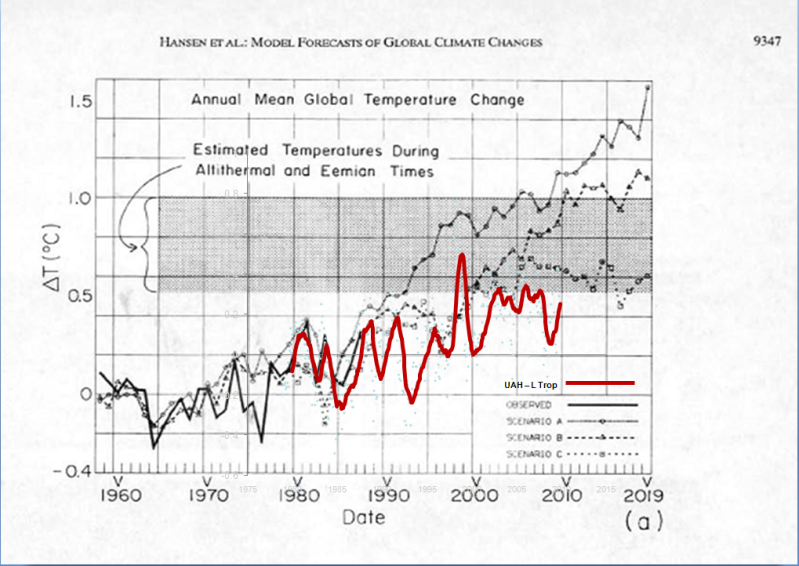
Conclusion
Contrary to the Guardian’s claims, Myles Allen’s work does not indicate vindicate climate modelling in general, nor does it inspire confidence in current predictions.
Furthermore, Allen’s work fails to explain why temperatures have flatlined in the last ten years, and why his original model did not predict it. More importantly, it has nothing to say about what this pause means for temperatures during the next decade.
But you would not expect to hear any of this from the Guardian.
Kindlekinser says:
“The null hypothesis is not a theory.” No, it is a hypothesis, just like it says. Like any hypothesis or theory, the Null Hypothesis can be falsified. But so far, it has withstood all attempts to falsify it.
You add: “…the theory is that rising CO2 et al is causing warming.” You are confusing laboratory results with the planet — which is affected differently by convection.
You say:
“The data are showing global temperatures are holding relatively steady at an elevated rate even as CO2 continues to increase. The theory therefore suggests…” &etc.
Global temperatures are not “holding relatively steady at an elevated rate”. See here. Temperatures have been much higher in the past, during times when CO2 was very low. Current temperatures are neither unusual nor unprecedented.
There is no “theory” that says CO2=AGW. That is merely a conjecture, with no measurable evidence to support it. The only empirical evidence we have shows that changes in CO2 are the result of changes in temperature — not the cause.
In science, measurements are everything. If something is not measurable, it is nothing more than a conjecture; an opinion. A guess.
This is an excellent article. If anyone needed proof that the Guardian publishes propaganda rather than science then that proof is found in this article. There can be no excuse for the outrageously false claims made about these modelers and their model. Savaged by science and the facts, Alarmists are fleeing to obfuscation and lies.
Kindlekinser…
“Wamron: I’m not sure what distinction you are making by using the term “contention”. Of course one can’t claim something is true because no one has demonstrated it to be untrue. I must be misunderstanding your comment.”
You understood my comment. Can you not understand that saying something is true because it has not been proven untrue is exactly what YOU said in a previous comment? Maybe not what you thought you were saying but it is what you said.
“The null hypothesis is not a theory. CO2 warming has been a theory for over 100 years. ”
Do you know what is even meant by “theory” and “null hypothesis”?
Kindlekinser says:
March 31, 2013 at 10:27 am
….. I doubt many people, even here, would suggest that CO2 does not cause warming–it is a physical property of the gas that can be empirically demonstrated in the lab…..
>>>>>>>>>>>>>>>>>>>>>>>>>>>
We are a wee bit more sophisticated than you seem to think:
WUWT: The Logarithmic Effect of Carbon Dioxide
The only way the fraudsters can get a large climate sensitivity out of CO2 is by having it cause a positive feedback with H2O. That however is not happening so you are stuck with CO2 having an ever decreasing effect.
It is Water with the help of the Sun that run the climate CO2 is a minor bit player.
” It predicted that the decade ending in December 2012 would be a quarter of degree warmer than the decade ending in August 1996 – and this proved almost precisely correct”
and
“the early years of the new millennium were somewhat warmer than expected”
Doesn’t that mean if they predicted the average correctly, but the early years were warmer, that the later years were cooler than predicted? However, they go onto say “More recently the temperature has matched the level forecasted very closely”.
Can all three of those statements be true?
I thought this was pretty cool from comments in the Guardian, similar to the Dr David Viner piece.
2004 BBC, and if recent trends continue a white Christmas in Wales could certainly be a thing of the past.”
http://news.bbc.co.uk/1/hi/wales/north_west/4112137.stm
BBC 28th Marck 2013, Alan Kendall, general manager of Snowdon Mountain Railway, said: “It’s the worst I’ve experienced in the 11 years I’ve been here. He said temperatures were dropping to -20C in places.
http://www.bbc.co.uk/news/uk-wales-north-west-wales-21969488
Ian W…I dont see how your reply relates to my comment.
yes some models got it right.
others predicted cooling.
the majority predicted more warming than occured.
this paper is an example of the sharp shooter fallacy.
Wamron says:
March 31, 2013 at 11:39 am
Ian W…I dont see how your reply relates to my comment.
Possibly because my reply was not to your comment?
Ian W says:
March 31, 2013 at 11:03 am
Kindlekinser says:
March 31, 2013 at 10:27 am
G. Karst:
Ian W responding to Kindlekinser’s response to G. Karst.
Ian W: I think we are in agreement here. Lab results demonstrate that CO2 has the potential to cause warming in the atmosphere, so the theory is that it does. My point is that data haven’t invalidated the theory because there is no better supported theory to replace it that matches the evidence that warming has occurred, including evidence that it has been warmer in past eras. Your point about demonstrating actual atmospheric effects of CO2 I think is a staple of understanding why the Earth is as warm as it is. Absent CO2 we would be much colder.
Gail Combs: I don’t smoke cigars or anything else, and I’m not trying to spin. Are you suggesting that “oceans as calorimeter” represents a better supported theory? The role of the oceans in atmospheric warming has been an ongoing part of the debate, so perhaps it will emerge as having more explanatory value. I don’t think it has that status yet, though, based on the cited paper from 2008.
D.B. Stealey: The null hypothesis will remain the same no matter what theory one is testing. And it is simply untrue that that the theory has resisted all attempt to falsify it. Any significant result reported in the literature would have by definition falsified the null. But a significant finding in one study doesn’t mean the null hypothesis goes away for the next study. As for their being no theory that CO2=warming, I am at a loss how to respond. Perhaps that is not the technical configuration for the theory, but that’s what everyone is talking about here
Wamron: I don’t say that the theory is true. I just say that it remains viable until a better theory replaces it. And, yes, I know the difference between a null hypothesis and a theory. I was responding to a comment that asked when the null hypothesis of natural variation was replaced by CO2 warming theory. That makes no sense to me as written. The null hypothesis doesn’t get replaced; various theories compete with each other against the null hypothesis. Theories with explanatory value continue, theories that no longer provide explanatory value are discarded.
Kindlekinser:
Your post at March 31, 2013 at 7:24 am says in total
Oh dear! That is so wrong it would require a book to detail all its errors.
Scientific theories are never “validated” but may be falsified.
This is because
(a) science seeks the closest possible approximation to truth by attempting to find information which is not consistent with existing understanding(s) and amending or rejecting understanding(s) in the light of the obtained information
but
(b) pseudoscience decides an understanding is true and seeks information which supports the understanding while ignoring or rejecting information which is not consistent with the understanding.
In other words “theory validation” is the practice of pseudoscience and not science. In science a theory cannot be validated because it is accepted as being the best available explanation which it is hoped can be falsified to provide a better explanation.
In science a theory is determined to be wrong when it is falsified; i.e. when empirical data does not agree with the theory. The theory is then amended or rejected. And observation that a theory makes incorrect predictions is empirical evidence that the theory is wrong; i.e. it falsifies the theory.
However, there may be some debate as to whether or not the prediction was inaccurate and not completely wrong. For example, if a theory says the globe will warm by x over a stated period but the globe only warms by 50% of x then the theory may not be completely wrong, although the theory has been falsified such that it needs amendment. But if the globe does not warm or cools over the stated period then the theory is completely falsified and needs to be rejected.
Whether or not “another theory” exists is irrelevant to the scientific rejection of a theory. If the theory is falsified by empirical data then in the absence of another theory all that can be said is “We don’t know” (which is probably the most profound of scientific statements).
Using a theory which is known to be wrong is NOT an appropriate guide to “future predictions”. If the theory is wrong then its predictions would most probably be wrong. Tossing a coin would be a better guide to “future predictions” because only 50% of its predictions would be wrong.
Richard
LOL. I presume he was indoors with the furnace on when this propaganda was penned.
==============================================================
Of course I can.
But, unlike the Hansenites and Goregaphiles, I haven’t figured out how to profit from it.
Kindlekinser:
I rebutted the nonsense you posted at March 31, 2013 at 7:24 am. Subsequent to that twaddle, at March 31, 2013 at 10:27 am you have presented a post which is also complete nonsense and begins saying
The Null Hypothesis is a basic scientific principle which a conjecture must overcome before it can be elevated to become a hypothesis.
Anthropogenic global warming (AGW) has not overcome the Null Hypothesis and, therefore, it is merely a conjecture. It is not yet a hypothesis and is nowhere near becoming a theory.
Many conjectures have existed for over 100 years and have recently been emulated using computer models (e.g. alien spaceships) but that does not elevate them to being theories.
I point out that WUWT is a science blog and suggest your posts would be more appropriate at pseudoscience blogs such as SkS and RC. They waste space on WUWT.
Richard
‘“Global warming predictions prove accurate”– Guardian’
http://2.bp.blogspot.com/-r1cWwg5Dl0w/TY_SL3p5crI/AAAAAAAARb8/N2_Kdu7K0e4/s640/blog+212.jpg
What has the BBC and the Independent got in common?
Fast forward.
re: Kindlekinser… It seems to me what’s being likely demonstrated is that feedback effects are either much less positive or non-existent or negative. I think the core of what’s happened is that once warming was observed and popularly (among scientists) thought to be significantly due to CO2, feedback became inevitably overcharged because of a linear trend bias and especially because the logarithmic curve of CO2 band saturation is something not many people can comfortably model in their own thinking – so the automatic tendency is to turn it into something linear or even exponential by picking up a lot of positive feedback effects to bend the curve. Even Einstein pulled an arbitrary number to prevent a finite big bang universe if I remember that right, which goes to show how easily it can happen in an incomparably less definite field. The same thing happened going down in the 70’s cooling scare – the human mind has a pretty strong tendency to look for trends leading to problems and assuming they are self caused and avoidable. We’re looking at climate trends and trying not to walk off a cliff, naturally assuming that there is a cliff and that we are doing the walking. (If that doesn’t give too much credence to the theory that abstract thinking is dominated by our “engine” for dealing with physical reality)
I think it is worth saying that there could still be a CO2 warming effect, since the temperatures are at a ‘plateau’ even though as far as I’ve understood solar activity has been low since the last warming trend stopped. If the solar effect is strong it could/should imply a strong CO2 effect which seems to be overlooked. Caveats are needed. “Warming(/cooling)” seems to inherently imply a feedback direction rather than “this much warmer than what the trend would have been”. Natural variability is a baby thrown out without any bathwater as the garden of Eden assumption that there was some kind of natural temperature before the industrial revolution seems to be goram systemic (where does our ‘plateau’ of “warm temperatures” fit in the overall interglacial line rather than what the pre-industrial temperature was, which is what the Guardian’s model uses as a baseline). Finally seeing how similar theories of AGC were (“growing consensus among scientists” I think is a direct quote from Time about it in the 70’s) it shows that CO2 as the theory about temperature seems too easily to become pollution particulates as the theory about temperature – it becomes too easily isolated due to biases to comfortably describe it as a default which has to be replaced I think. However I may be misreading anyways that you’re saying it is the theory rather than warming is the theory for CO2.
“But the new research casts serious doubts on these claims, and should give a boost to confidence in scientific predictions of climate change.”
—
Again, they try to redefine the term climate change as if it is a pro-AGW stance. It is not. Climate change is a skeptical position that counters the notion of unprecedented global warming. Of course, they never mention that they might mean “man-made” climate change. Even so, climate change means that there is nothing unprecedented going on.
Kindlekinser:
“I don’t say that the theory is true. I just say that it remains viable until a better theory replaces it.”
No mate, what you said is up there for the world to see, to whit:
“So, to invalidate a theory requires more than just inaccurate prediction. It also involves finding another theory that better explains the observed results.”
What you said THERE is that a theory is not invalidated if no other theory has been validated in its stead. So, as I said previously, you are maintaining that a contention is valid unless proven invalid by demonstration of the validity of an alternative contention. In other words, anything is true until disproven. By that yardstick a guy who says his wearing a kilt keeps tigers at bay has a valid explanation as to why there are no tigers in the park.The mere fact that there never were any tigers in the park provides no explanation as to why there were no tigers in the park. So his is the only “explanation”.
An explanation is meaningless if it is neither sufficient nor necessary. AGW is not necessary because there are other explanations and it is not sufficient because it cannot explain events happening now.
The problem with your use of the word “theory” is that you dont seem to acknowledge that a set of contentions only become a theory when the hypotheses they generate have been validated by the correctness of their predictions. OK I see you were referring to a specific use of “null hypothesis” (or misuse). But you still fall over on that business of the difference between a contention, opinion, or conjecture and a genuine theory. AGW is not a theory until it generates testable hypotheses. Its only incidentally voiced hypotheses (temperature predictions) have failed. It is not a theory, it is conjecture, opinion, contention.
Your particular stumbling point is failure to disentangle validity from custom. You refer to the customary retention of non-validated theory but this OCCURRENCE does not constitute any kind of ersatz validation. A thing is not valid upon the contingency of its currency but upon demonstration that it corresponds with actuality. That can only be accomplished by measure of the accuracy of its predictions.
So, you remain wrong about that. The accuracy of the predictions IS everything. When you refer to attempts to retroactively explain failed predictions in order to defend a theory you describe precisely what Popper called “immunisation” of a pseudo-theory against disproof. When you suggest additional “explanations” need to be added, then you engage in EXACTLY what Imre Lakatosh called the construction of a “protective belt” of sub-tending theories. On both counts you explicitly state the thought processes that are characteristic of pseudo-science.
Kindlekinser says:
March 31, 2013 at 12:25 pm
Ian W: I think we are in agreement here. Lab results demonstrate that CO2 has the potential to cause warming in the atmosphere, so the theory is that it does. My point is that data haven’t invalidated the theory because there is no better supported theory to replace it that matches the evidence that warming has occurred, including evidence that it has been warmer in past eras. Your point about demonstrating actual atmospheric effects of CO2 I think is a staple of understanding why the Earth is as warm as it is. Absent CO2 we would be much colder.
Unfortunately, I do not think we are in agreement.
All that laboratory experiments showed was that in an enclosed cylinder with CO2 mixed with non-radiating gases illuminated with infrared, the temperature in the cylinder rose.
It is pure conjecture to assume that the same effect shown inside a closed cylinder will raise the temperature of the Earth’s atmosphere. CO2 molecules will still be absorbing and re-emitting infrared in just the same way, but there are multiple dynamic effects such as water vapor changing state and atmospheric enthalpy, and convective processes and the multiple secondary effects of those. Your laboratory experiment removed many of the real world variables so it cannot be simply assumed that in the presence of those variables the results will be the same.
richardscourtney: [first response] You didn’t need a book; your post was sufficient to emphatically correct my use of validation in this context. I disagree, though, that the theories generally are rejected only when they are falsified completely. Often they are discarded because another theory does a better job of explaining the phenomenon. Yes, if you don’t have another theory and the existing one has been completely falsified, then “I Don’t Know” is the best response. But that is clearly not the situation we are in now.
richardscourtney: [second response] Twaddle seems unnecessarily harsh, though it is a great word I’ll keep in mind if ever I have the opportunity to use it. Your strong reaction notwithstanding, I am not the first person on this web site, or even in this thread, to use the more general usage of “theory” to describe CO2 as a greenhouse gas. However, the “scientific theory” that CO2 has warming properties for the atmosphere in general is not in dispute, and serves as a partial explanation for why the Earth is warm and Venus is boiling. The more specific idea (hypothesis, conjecture) debated here and elsewhere that human increase of CO2 has the potential to warm the Earth even more was first proposed over a century ago, and is based on this scientific theory. Since the scientific method can be applied to this question, unlike your comparison to alien spaceships, I can’t see how this discussion counts as pseudoscience.
Kindlekinser’s remarks are another example of how — in the absence of direct empirical observation of the postulated CO2 / water vapor amplification process which confirms its presence in the earth’s climate system — the debate over human-induced climate change continues to pass through the GHG Narrative Diode.
The GHG Narrative Diode works this way …. any trend plateau which is anything less than a statistically significant declining trend in Global Mean Temperature occurring continuously over some long period of time — three to five decades — will continue to be interpreted as representing insufficient evidence that a human caused GHG-driven global warming trend isn’t still operative as the primary driver for climate change.
Said another way, a statistically significant trend in falling global mean temperature must occur continuously over some very lengthy period of time — thirty years at the minimum, but more likely fifty years — before the climate science community ever begins to question the narrative of human-caused GHG-driven global warming.
There is something now evidently something unusual flourishing in the Longdendale Chain system which supplies water to Manchester’s half million inhabitants. A special concentrated version of this water is supplied to the water coolers in the offices of the Grauniad. This is the only viable explanation of the weird articles that emanate from this once great newspaper these days.
The Grauniadistas are a bunch of navel-preening, self-servinbg liars who are lying in their self-serving naval-preening. And they want everyone else to pay for their luxury vacations around the world, preaching poverty to us ignorant masses. Grrr#
Very difficult to observe the charts correctly ,when observing them thru Pound Notes, mistakes will be made and there is much more work to be done as long as them Pound Notes keep coming.