Guest Post by Willis Eschenbach
I was reading an interview with Adrian Bejan (worth taking a look at), and I got to musing about his comments regarding the relationship between energy use and per capita income. So I pulled up GapMinder, the world’s best online visualization software. Here’s a first cut at the relationship between energy and income.
 Figure 1. Energy use per person (tons of oil equivalent, TOE) versus average income, by country. Colors show geographical regions. Size of the circle indicates population. The US is the large yellow circle at the top right. Canada is the overlapping yellow circle. China is the large red circle, India the large light blue circle. Here’s a link to the live Gapminder graph so you can experiment with it yourself.
Clearly, other than a few outliers, the relationship between energy use and income is quite straightforward. You can’t have one without the other. Well, that’s not quite true, you can have energy without income. You can have (relatively) high energy use without having the corresponding income, plenty of Africa is in that boat. But the reverse is not true—you can’t have high income without high energy use. You need the energy to make the income.
Now, James Hansen is the NASA guy who is leading the charge to stop all forms of cheap energy. Coal is bad, terrible stuff in his world. He calls trains of coal “death trains”. He wants to deny cheap energy to all of those folks in the bottom half of the graph above. Well, actually, he wants to deny access to cheap energy to everyone, but where it hurts is the bottom half of the graph. For example, the World Bank and other international funding agencies, at the urging of folks like Hansen, have been turning down loans for coal plants in developing countries.
But as you can see, if you deny energy to those folks, that is the same as denying them development. Because when there’s less energy, there’s less income. The two go hand in hand. So what James Hansen is advising is that we should take money from the poor … actually he wants to deny them cheap energy, but that means denying them income and the development that accompanies it.
A look at the history of some of the countries is instructive in that regard, to see how the income and the energy use have changed over time. Figure 2 shows the history of some selected countries.
 Figure 2. A history of selected countries. Colors now show crude birth rate (births per thousand)
Now, this is showing something very interesting. It may reveal why Hansen thinks he’s doing good. Notice that for countries where people make below say $20,000 of annual income, the only way up is up and to the right … which means that the only way to increase income is to increase energy use. Look at India and China and Brazil and Spain and the Netherlands as examples. (Note also that crude birth rate is tied to increasing income, and that the crude birth rate in the US has dropped by about half since 1960.)
Above that annual income level of ~ $20,000, however something different happens. The countries start to substitute increased energy efficiency for increased energy use. This is reflected in the vertical movement of say the US, where the 2011 per capita energy use is exactly the same as the 1968 per capita energy use. And Canada is using the same energy per person as in 1977 … so let’s take a closer look at the upper right section of the chart. Figure 3 shows an enlargement of just the top right of the chart, displaying more countries.
 Figure 3. A closeup of Figure 2, showing more countries. Start date is 1968 for clarity.
Now, this is interesting. Many, perhaps most of these countries show vertical or near vertical movement during the last twenty years or so. And the recent economic crash has caused people to be more conservative about energy use, squeezing more dollars out per ton of oil equivalent.
But that only happens up at the high end of the income spectrum, where people are making above about twenty or even twenty-five thousand dollars per year. You need to have really good technology to make that one work, to produce more income without using more energy. You need to be in what is called a “developed” nation.
When people think “development”, they often think “bulldozers”. But they should think “energy efficiency”, because that is the hallmark of each technological advance—it squeezes more stuff out of less energy. But you have to be in an industrialized, modern society to take advantage of that opportunity.
So this may be the reason for Hansen’s attitude toward energy use. He may not know that most of the world is not in the situation of the US. This may be the reason the he claims that we should curtail energy use by all means possible. He may not see that while the US and industrialized countries can get away with that, in part because we waste a lot of energy and have a lot of both money and technology, the poor and even the less well off of the world have little energy or money to waste.
For those poorer countries and individuals, which make up the overwhelming bulk of the world’s population, a reduction in energy use means a reduction in the standard of living. And the part Hansen and his adherents don’t seem to get is that for most of the world, the standard of living is “barely” … as in barely making ends meet.
As is usual in this world, the situation of the rich and the poor is different, and in this case the break line is high. Twenty grand of income per year is the line dividing those who can take advantage of technology to get more income with the same energy, and the rest, which is most of the world. Most of the world are still among those who must use more energy to increase their income. They don’t have the option the US and the developed nations have. They must increase energy use to increase income.
And when you start jacking up energy prices and discouraging the use of cheap energy sources around the planet, as Hansen and his adherents are doing, the poorest of the poor get shafted. James Hansen is making lots and lots of money. He’s comfortably in the top 1% of the world’s population by income, and he obviously doesn’t give much thought to the rest. We know this because if he thought about the poor he’d realize that while he is mouthing platitudes about how he’s doing his agitation and advocacy for his grandchildren’s world in fifty years, what he’s doing is shafting the poor today in the name of his grandchildren. Of course Hansen is not the first rich white guy to do that, so I suppose I really shouldn’t be surprised, but still …
Increased energy prices, often in the form of taxes and “cap-and-trade” and “renewable standards”, are THE WORLDS MOST REGRESSIVE TAX. Hansen proposes taxing the living daylights out of the poor, but he won’t feel the pain. He can stand a doubling of the gas prices, no problem. But when electricity and gas prices double around the planet, POOR PEOPLE DIE … and Hansen just keeps rolling, he has quarter-million-dollar awards from his friends and a fat government salary and a princely retirement pension you and I paid for, he could care less about increased energy prices. He’s one of the 1%, why should he pay attention to the poor?
Forgive the shouting, but the damn hypocrisy is infuriating, and I’m sick of being nice about it. James Hansen and Michael Mann and Gavin Schmidt and Phil Jones and Peter Gleick and the rest of the un-indicted co-conspirators are a bunch of rich arrogant 1%er jerkwagons who don’t care in the slightest about the poor. Not only that, but they’ve given the finger to the rest of the climate scientists and to the scientific establishment, most of whom have said nothing in protest, and far too many of whom have approved of their malfeasance.
Their patented combination of insolent arrogance and shabby science would be bad enough if that was all they were doing … but they are hurting poor people right now. Their policies are causing harder times for the poor today, as we speak … and they mouth platitudes about how they are saving the poor from some danger they won’t see for fifty years?
If you ask the poor whether they’d rather get shafted for sure today, or possibly get shafted in fifty years, I know what they’d tell you. To me, hurting the poor today under the rubric of saving them in half a century from an unsubstantiated and fanciful danger is moral dishonesty of the first order.
So let me say to all of you folks who claim the world is using too much energy, you have the stick by the wrong end. The world needs to use MORE energy, not less, because there is no other way to get the poor out of poverty. It can’t be done without cheap energy. We need to use more energy to lift people out of bone-crushing poverty, not use less and condemn them to brutal lives. And to do that, energy needs to be cheaper, not more expensive.
Let me be crystal clear, and speak directly to Hansen and other global warming alarmists. Any one of you who pushes for more expensive energy is hurting and impoverishing and killing the poor today. Whether through taxes or cap-and-trade or renewable subsidies or blocking drilling or any other way, increasing energy costs represent a highly regressive tax of the worst kind. And there is no escape at the bottom end, quite the opposite. The poorer you are, the harder it bites.
So please, don’t give us the holier-than-thou high moral ground stance. Spare us the “we’re noble because we are saving the world” BS. When a poor single mother of three living outside Las Vegas has her gas costs double, she has little choice other than to cut out some other essential item, food or doctor visits or whatever … because her budget doesn’t have any of the non-essential items that James Hansen’s budget contains, and she needs the gas to get to work, that’s not optional.
For her, all her money goes to essentials— so if gas costs go up, her kids get less of what they need. You’re not saving the world, far from it. You’re taking food out of kids’ mouths.
You are causing pain and suffering to the poor and acting like your excrement has no odor … but at least there is some good news. People are no longer buying your story. People are realizing that if someone argues for expensive energy, they are anti-human, anti-development, and most of all, without compassion for the poor. They are willing to put the most damaging, regressive, destructive tax imaginable on the poorest people of the planet.
Now those of you advocating for higher energy prices, after reading this, you might still fool the media about what you are doing to the poor. And it’s possible for you to not mention to your co-workers about the real results of your actions. And you could still deceive your friends about the question of the poor, or even your wife or husband.
But by god, you can no longer fool yourself about it. As of now, you know that agitating for more expensive energy for any reason hurts the poor. What you do with that information is up to you … but you can’t ignore it, it will haunt you at 3 AM, and hopefully, it will make you think about the less fortunate folk of our planet and seriously reconsider your actions. Because here’s the deal. Even if CO2 will damage the poor in 50 years, hurting the poor now only makes it worse. If you think there is a problem, then look for a no-regrets solution.
Because if you truly care about the poor, and you are afraid CO2 will increase the bad weather and harm the poor fifty years from now, you owe it to them to find a different response to your fears of CO2, a response that doesn’t hurt the poor today.
w.
@Wamron 8:39
Don’t go that route.
Life has too many surprises.
What seems eternal, later becomes a useful lesson.
And may I suggest that by availing yourself of government aid, now, you are helping us all by speeding the future shrinkage of government.
We can’t afford to let the collapse come fully, the war phase is no longer useful with the toys we now have.
Thanks for another fine posting Willis, as Rockie Road has been saying for a while now, these do-gooders are really Genocidal Warmista’s.
This absurd double speak language our would-be saviours use is clear evidence they lie.
Speaking of the Dead Kennedy’s,try Frank Zappa, ‘I am the Slime”.Thats our media.
By my calculations, we should be around 1000 comments from the infamous 1 million.
Absolutely brilliant article Willis. I have been harping on about this for ever it seems. That “Green” policies are diverting us from the real issues. For example the global threat to humans from extensively drug resistant tuberculosis.
Do I think XDR-TB needs more dollars – damned right, do I think cancer needs more dollars – you bet, do I think feeding and immunising children in poor countries needs more dollars- yup.
Do I think we shoud burn surplus corn in our cars – hell no, do I think we should spend 100 bn dollars mitigating temperature change by 0.00024 degrees in 2100… um, doesn’t even rate!
This isn’t a scientific battle, it’s a political one grounded in morallity. We need to make much more of the moral vacuum that green politics lives in. The way to make Obama listen in the US is to show his immorality in supporting misanthropic policy in a largely moral USA. Unfortunely we in Australia have already decsended into the moral pits, throwing money at green schemes while at the same time withdrawing 500million that used to be spent on pallitive care for advanced cancer patients.
The wonderful nation of Australia supposedly “Leading the way” in fighting the scurge of climate change is only one of a few countries that DOESN’T have an ion beam (proton) cancer treatment facility – jeeze, I think we’re lucky to have MRI here. The money wasted on climate change here is 100 times what it would take to build these things… But then resources like those only stop people dying… they don’t “save the planet”
Thank you Anthony, now i’ve had a rant about this at your place I feel much better.
[quote]Above that annual income level of ~ $20,000, however something different happens. The countries start to substitute increased energy efficiency for increased energy use. This is reflected in the vertical movement of say the US, where the 2011 per capita energy use is exactly the same as the 1968 per capita energy use. And Canada is using the same energy per person as in 1977 … so let’s take a closer look at the upper right section of the chart. Figure 3 shows an enlargement of just the top right of the chart, displaying more countries.
Figure 3. A closeup of Figure 2, showing more countries. Start date is 1968 for clarity.[/quote]
Although the bulk of this article is very good, that part is not actually so to remotely the degree implied or depicted.
There is no postindustrial economy to the degree commonly hyped by environmentalists, but, rather, as always, most really critical living expenses are material goods, from residences to cars. Such as the ratio of U.S. income to the cost of living expenses (residence + food + car + gasoline + etc.) has not doubled since 1968 as the false picture presented by GDP “income” in figure 2 would imply. Actual doubling in income and prosperity would be such as if one could work 20 hours a week and afford a residence plus all else as much as someone could in 1968 in the U.S. on 40 hours a week, but that is not so at all.
While I’m not an expert on Canada, more familiar with the U.S., I bet the primary reason that Canada is using the same energy per person now as in 1977 is that if one were to look at not superficial GDP but real prosperity, like how many hours of work it takes on average to pay for the primary living expense (a residence) plus food and a car and gasoline and other basic living expenses, they’ve probably (like the U.S.) had very little rise in true prosperity ever since around the 1973 oil crisis and the policy-influencing rise of anti-industry enviropolitical ideologies.
Physical production (if expressed in terms like houses built per capita per year, tons of steel made per person per year domestically as opposed to importing, etc.) has been mostly flat in the U.S. per capita since the 1970s when not outright declining. Overall, it has not doubled like GDP BS would superficially suggest. Agriculture is one of the few endeavors that has had major growth in domestic physical production but more an exception than the rule. Most economists are employed by governments and government-supported colleges, with corresponding biases, not quite as bad as climatology but influencing even how the standard definition of GDP borders on double-counting government spending by design.
Sometimes there is pure gain from efficiency improvements, such as if an air conditioner is improved to be more efficient even while having less capital cost too, but those little changes are less a major influence than the overall picture discussed before and subsequently.
GDP is inflated by counting as if gain rather than harm all sorts of BS, especially parasitic overpricing of service sector and support segments of the economy; for instance, due to essentially no real meaningful competition to limit overcharging and inefficiency (as people don’t really shop around and compare prices when it isn’t practical), “the cost of the average American hospital stay nearly doubled from 2000 to 2010 while average stay length declined” and rose a number of times more relative to several decades ago even if adjusting for inflation ( http://www.google.com/search?q=cost+of+a+hospital+stay ). Likewise, educational costs have skyrocketed as colleges overprice more; the government responds by more generous student loans; colleges respond by in turn jacking up prices still higher since the new loans allow them to get as many customers (students) as before without having to moderate price growth like ordinary businesses; and the cycle repeats. Like other service sector segments not cost-moderated sufficiently by competition, government itself has gone up far more in cost (spending) than what it actually non-wastefully provides in return, already at $6.3 trillion annual government spending in the U.S. and continuing to rise rapidly ( http://www.usgovernmentspending.com/ ) if looked at without the typical misleading measure of failing to count all levels from local to federal.
(Also, a large portion of the superficial U.S. GDP growth per capita since the 1960s comes from factors like, for instance, if a mother stayed at home raising a kid in the 1960s, that wasn’t counted as income and part of GDP, but, if her modern-day counterpart works at a daycare raising kids, that gets counted as raising GDP; such is not to say that women shouldn’t be able to work but just to point out how GDP as constructed is misleading at best).
Official inflation adjustments are false as discussed, for instance, at shadowstats.com
The route into an alien unseen reality of real prosperity beyond modern-day first-world levels would include growth in physical production and energy generation on almost everything from innovation in mass-producing residences for fewer instead of more manhours of labor each to industrial-scale space launch, eventually all of the way up to a Kardashev type 2 civilization.
Willis, brilliant essay, as powerful and as full of truth and hope as every good sermon should be.
@Bill McKibben
I don’t very often get angry, but your wilful stupidity makes me angry. You obviously don’t understand the thrust of Willis’ excellent article; cheap and available energy enables the poor to claw their way up and out of poverty. Your juvenile Tinkertoy approach to providing the worlds poor with cheap energy is about as useful as attempting to cook breakfast by lighting your farts.
bill mckibben says:
March 15, 2013 at 11:33 am
Thanks, Bill. There have been “interesting studies” on the same question since the 1970s. None of them have ever amounted to a fart in a whirlwind. The headline on the Mirror account says
Solves? SOLVES? It’s a study about the FUTURE, full of rainbows and unicorns and optimism. Solves? Hardly.
This one claims that;
Bill, none of those are new technologies. Solar, wind, geothermal, all are pretty mature technologies, with years of development and millions of dollars in subsidies pushed their way. And at present, all of those put together aren’t doing anything. Here’s the bad news:
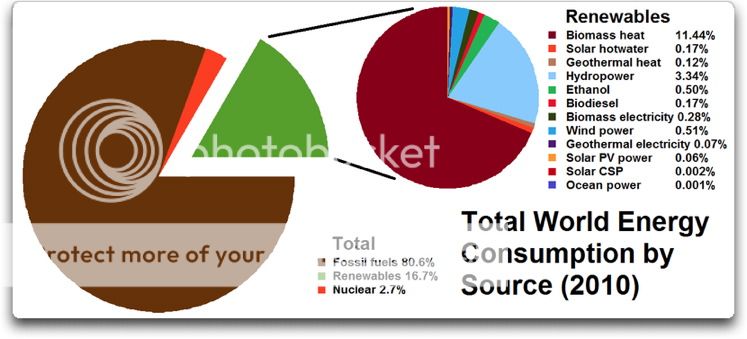
Wind power … half a percent.
Solar PV … less than a tenth of a percent
Geothermal electricity … less than a tenth of a percent.
After years and years and years of people like you claiming that solar and wind and the like are the fuel of the future … together we’ve got about six-tenths of a percent of global power.
And you seriously claim that this will solve the worlds’ energy problems?
Bill, here’s the thing. Pushing renewables pushes up the cost of energy. I don’t care if they run on unicorn farts and only produce distilled water as a waste product—they push up the cost of energy and that harms and impoverishes and kills the poor.
That’s what you are doing with your BS about “350” ppmv for CO2. You are taking food out of kids mouths, based on your inchoate fears of carbon …
So I do hope that this disturbs your sleep, Bill. I hope that this makes you reconsider. I hope that you do care about the poor, and you’ve just been blind to the damages that you’ve been doing. And I hope you give up your quixotic quest for a meaningless goal.
w.
If any poster here hasn’t seen the CornwallAlliance item, elink to which David Hagen has posted here, by all means read it. I am not a religious person, but the moral arguments made here apply to any (humane) belief system, and the evidence they cite is truly impressive.
Jimbo – right you are, these peoiple actually do consciously mean to murder millions. That is their real agenda – and worst of all, they expect to get richer doing it.
Right now I’m far more interested in “Wamron” than anything about CAGW. If anyone can contact her / him, do so. I earlier asked the moderator or someone at WUWT to since WUWT has the email, and I hope they did. I’ve been in his / her shoes, and it ain’t good. Without outside help it is almost impossible. To hell with whether the help is government or private. Help is help and should be given. In my arrogant opinion human life has intrinsic value beyond any monetary valuation.
Thingodonta –
Here is a real-life example of the “breaking eggs to make an omelet” thinking from my own experience: In one of my past lives as a university history professor, I had a colleague (also a PhD in history, as I am) who was forever talking about how much more humane and efficient the Soviet system was than ours in the US. Once, when I reminded him of the 80 million people murdered by Lenin and Stalin, his response was, “Well, that was a necessary step in reforming society.”
Obviously the greens think the same way as this blatherskite.
Funny how the color of the flag of mass murder has changed: for Hitler, Stalin and Mao it was red, but now it’s green.
Don’t know why anyone would push old out-dated dirty technology these days when there are cheaper, cleaner energy sources being developed. Shades of the luddites. Eg solar pv is replacing diesel generators as well as bringing electricity for the first time to millions of people in the developing world.
I agree that the climate change “solutions” are a tax on the poor and even the middle class. That’s the reason the powers that be are pushing the climate change agenda. The resources of the planet are limited and the powers that be want to perserve their unfair share of the energy pie. Climate change is smoke screen to disguise the evil motives behind the “solutions”. No energy is being saved. There have been no reductions in carbon dioxide emissions. The US has avoided increasing energy per capita by deindustrializing. Offshoring production to China does not decrease world energy use or carbon emissions, but does lower the energy used in the homeland.
Good post, Willis. Summed it up for me.
After four years in West Africa the realities of life became pretty clear – Life quality =Energy consumption and the poorer you are the less likely you are to be using clean or efficient energy. If there is no electricity or gas you see a lot of deforestation.
But Mega-bucks Hansen just cannot see what the fuss is about when he wallows in self righteousness having paid a few more bucks to fill his car…
None of this matters in the long run, or even in the short term. It will take only the right crisis to push us into totalitarianism.
But great article anyway. Hansen is merely one of the enabling puppets.
Sic transit gloria America.
Willis; Says what so many people feel.
Michael C. Roberts says:
March 15, 2013 at 9:41 am
“Slow, under-the-radar changes until your goose is thoroughly cooked and society as you remember it no longer exists. It is happening before our eyes.”
Michael you are right, this insidious push for World Government has been going on for many years:
Check out “United Socialist Nations”
http://scienceandpublicpolicy.org/originals/un_progress_governance_via_climate_change.html
I agree Willis, well said.
Green policies hold back development. Development is vital for the third world, a non PC name but true, and development needs energy to the same level as we are used to. Development will reduce child mortality rate leading to a reduced birth rate. Energy means time to improve health care, increase child education, clean potable water for all, better housing, more food, in fact it cannot be overemphasized that cheap available energy is good for the planet.
Martin,
you parrot somebody who talks nonsense. If you already left school with a moderate knowledge of math say, dividing two numbers with their units, you should be able to recognize that you are being lied to. You cannot replace diesel generators with pv solar. It doesn’t matter if one is “dirty” and the other is “clean” or if one is “old out-dated” (which it isn’t) and the other “being developed”. The “clean” one cannot work even if its development had been done with a perfect result in e.g. 97% efficiency. Look out the window and do the math.
Carbon taxes and so-called “green” energy have a double and even triple-whammy effect. The first, and most direct effects have already been covered. They have a depressing effect on the economies of developed countries like the U.S., slowing business activity and/or forcing it overseas, and raising unemployment levels. Standards of living are reduced, squeezing the already-suffering middle-class, and shifting many downwards into poverty levels. The supreme irony is that, the poorer an economy is, the less able they are to deal with real environmental issues. Greenie dreams and schemes thus cause death as well as environmental destruction.
Re Robert A Taylor…..and others…..you remind me of why I hesitated over making my declaration earlier. Your reactions make me feel self-indulgent. But the problem is that: people who know how much worse off others are will hide their Green-imposed misery and the B^%$#*&^ responsible get off without their effects being made apparent. Lets face it, those who are worse off on the global scale, a billion as someone says, maybe more, have no voice. Nobody hears anything out of them. It is only those in our own societies who are relatively better off than the global poor but nonetheless in poverty by our standards who are in a position to flag-up the oppressive effects of Green policies.
Even here, we see one of our posters earlier (whose words meant a lot and I hope finds better luck than of late) reporting that he may even lose access to the internet, in which case, he and anyone in our society in such a situation are also denied a voice. I would rather that everyone who is hurting come out with it now, loudly and often. The longer they hold back, the worse the reaction will be when it comes. When we start having power ottages in the UK next winter, thousands will join the ranks of, as Homer put it (and Eighties campaigners misquoted) “the silent majority”. Dead men tell no tales. Well Im talking now. Rather than shame others into staying silent by reacting with misplaced solicitude you should be encouraging everyone of this endangered species to cry out loud.
As for “help”…well what does that mean? Its part of the illusion in which we in developed societies have dwelled so long that there is necessarily, ever, such a thing as”help”. If you lose every source of income what possible “help” can there be? And the bottom line is, self immolation by Buddhist monks worked. The death of one Tunisian cigarrette seller has changedthe face of the Middle East and North Africa, even if not for the better.
Rabe – parrot here, from Bloomberg a few months back:
http://www.bloomberg.com/news/2012-01-25/solar-cheaper-than-diesel-making-india-s-mittal-believer-energy.html
An excellent piece by Willis.
It’s true that the poorest will be hardest hit by this green nonsense, but it still has catastrophic effects in the developed world.
In the UK energy prices have been driven up by nonsensical green policies. Our government is squandering billions of pounds on windmills that don’t work most of the time.
Many people, including myself, can afford these price increases, though knowing that it’s all based on a mad delusion does hurt.
But it’s the old and less well off who can’t afford sky-high energy bills and as a result they’re going cold. And dying as a direct result. Quite possibly hundreds or thousands of old people are dying every winter as a fairly direct result of high energy prices. And now we’re having very hard winters with plenty of snow. The English climate has been rapidly getting colder since 2000, as shown by CET.
I would have been a life-long Conservative voter, but no longer. Now I’m a UKIP voter. I refuse to vote for a party whose policy is to push up the price of energy. In my humble opinion, people who push this green fantasy based on bad and fraudulent science are guilty of mass murder. And that includes our prime monister.
Chris
Just had my energy bills through. They tell me my electricity direct debit needs to rise from £58pm to £74pm, and gas from £78pm to £90pm. These are huge increases – even by the standard of recent years. I told my wife that by 2020 we won’t be able to afford to live in the UK any more. Maybe emigrate to India. I’m not joking!
Once again, Willis, you present obscure and occluded facts and data in an eye-bulgingly simple manner. Thanks you! Large hat-tip to you!
Quite so Willis. Hansen et al are clearly contemptuous of the majority of mankind and indifferent to their fate. It is hard to understand how they can be like this given their undoubted intellectual capacities, but then again throughout human history the hierarchies have always demonstrated a remarkable ability to deny others what they themselves feel entitled. Although I freely admit to not being the brightest of individuals I would be ashamed to sacrifice concern for others less fortunate than myself by adopting or supporting policies that clearly create wholesale suffering while living a life insulated from the consequences of my actions. These people are beyond condemnation in this world.
First, deep inside the Left hate people. There are too many humans on Earth. Some must die, and who better than those fecund poor people? Of course, they’ll never admit it. Eugenics again (e.g. Planned Parenthood). Here we see overeducated stupid people rising to high places of authority. We need to remove their authority. They should not have the power to make decisions affecting so many people. That’s why we must shrink government, cut regulations, and never ever join a one world government.
Second, were you using constant dollars? If not, we might be seeing inflation in the vertical rise, not rising income. And that could be another interesting point to extract from the chart. When are economies actually healthy? I’m seeing a fish hook in Fig 2. Looks like developed are economies slowly sinking where inflation can’t hide it. With constant dollars, the energy-income curve might be sharper.
More than that. Efficiency is progress. Subsistence living is poverty, when all of your work only just keeps you alive. I don’t romanticize that. The technological advances in energy sources: women, slaves, animals, water and wind powered mills, steam, electricity, fossil fuels, nuclear power. The technology is available. It’s the “modern society” part that is the problem (sorry that’s ambiguous, not everyone believes progress/modernity is good).