Guest post by David Archibald
Climate has real world consequences, and those operating in fields that will be affected by changing climate bring a different perspective to the problem of predicting what will happen. Bill Fordham, advising the grain industry in the Midwest, kindly sent me a copy of the advice he provides to his clients. Following are two of his charts:

In Bill’s words,” Here is a chart of the 11-Year Sunspot Cycle you have probably never seen before! It is an 11-Year Average of the Monthly Sunspot Data. Why do I think it is important to look at an 11-Year Average? Because I am interested in how the ongoing 11-Year Average acts as we go forth in time with the droughts in the 1930’s and 1906.
I am also greatly interested in how the ongoing 11-Year Average acts as we go forth in time with the “Little Ice Age” that bottomed in 1816, the “Year Without A Summer”! The 1816 Eleven-Year Average Bottom was 327 months from the 1788 Eleven-Year Average Peak. If Sunspot history repeats similar to the 1788-1816 cycle, 327 m onths from the April 1990 Eleven-Year Average Peak will be in July 2017. For what it’s worth, the rate of decline since the 60 level was broken in April 1990 projects an 1816 level of 14.2 in just 44 more months from now, or by October 2016. If the current rate-of-decline in the 11-Year Average stays on track for another 44 months, we may need a few more blankets!”

This graph of Bill’s plots Solar Cycles 22 to 24 over Solar Cycles 3 to 6. What is interesting about this graph is that it suggests that the Sun has a limited playbook. Solar Cycles 22 and 23 are very similar in size and shape to Solar Cycles 3 and 4. But we are now coming up to big departure from how Solar Cycle 5 played out. To put that into context, let’s revisit the last prognostications of the Solar Cycle 24 Prediction Panel of 8th May, 2009. Four years ago, they said that,”solar maximum is now expected to occur in May, 2013.” They got it right, possibly to the month, or at least very close. As solar cycle length is more important in controlling climate than solar cycle amplitude, it doesn’t matter so much that they got the amplitude wrong.

The above figure of the heliospheric current sheet from the Wilcox Observatory tells us that we are at the peak of the solar cycle, even though peak sunspot number was some time ago.
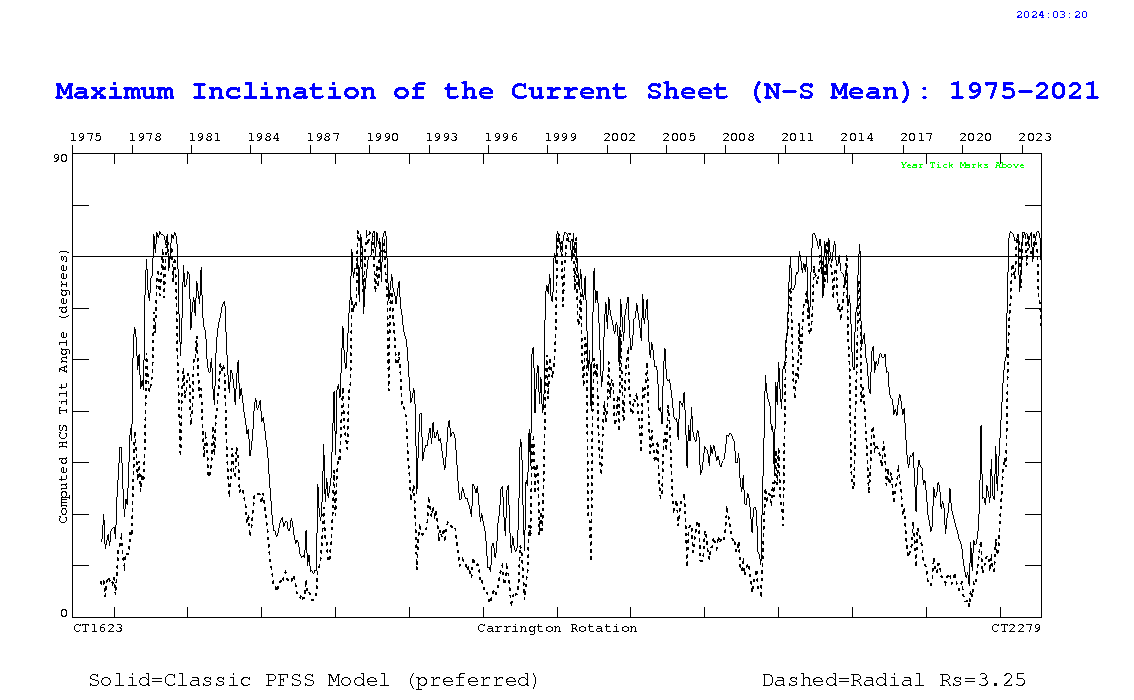
Now that we are at solar cycle maximum, there is only one prediction of future solar activity extant from the solar physics community. That is Livingstone and Penn’s estimate of Solar Cylce 25 maximum amplitude of 7. But the important number from here, the parameter that tells us what climate is going to do, is the time to the flattening of the heliospheric current sheet at the 24/25 minimum. So far the monthly sunspot number of Solar Cycle 24 has tracked Solar Cycle 5 very closely. Solar Cycle 5 was 12 years long. If Solar Cycle 25 is also to be 12 years long, the year of 24/25 minimum would be 2020. The climate implication of that is no net cooling over Solar Cycle 25 relative to Solar Cycle 24.
But there is a parameter which tells us exactly how long Solar Cycle 24 will be. That is the green corona emissions diagram produced by Richard Altrock, manager of the USAF coronal research program at Sacramento Peak, New Mexico. This is that diagram from June 2011:

I have annotated it to show the solar cycles over the same period. In his public statement, Altrock noted that Solar Cycle 24 was 40% slower than the average of the previous two cycles. That means that it is going to be 40% longer and that is borne out by the diagram. Solar minimum for the last four minima has occurred when emissions are exhausted at 10°. The latitude of 10° is shown as the red line on the diagram. Further to that, the last two solar cycles show that the month of minimum can be predicted by drawing a line between solar maximum (the point at which the rush to the poles intersects 76°) and the point of exhaustion at 10°. The bulk of activity is bounded by this line. On this line of evidence, Solar Cycle 24 will be 17 years long and the longest solar cycle for 300 years. We have a long wait ahead of us – half a generation.
While we are waiting for minimum, someone could do the world a very good service and take Bill Fordham’s interest in the droughts of the 1930’s and 1906 a bit further and calculate, on a year by year basis, what the Corn Belt would produce if the climate of the period 1800 to 1850 was repeated. Then we would know with enough certainty what we are in for – both the quantum and the volatility.
David Archibald says:
March 6, 2013 at 9:18 pm
John Finn says:
March 6, 2013 at 4:06 pm
You are mixing me up with the Butler and Johnson graphic which used two points for each cycle.
You used the B&J graphic then used the B&J technique to produce correlations with data from other regions.
My mind could not handle that level of complexity. So not correct.
Ah I see. You now ‘prefer’ Friis-Christensen and Lassen – despite, apparently, not understanding how the correlations were achieved. In your post (March 5, 2013 at 11:06 pm) you state that F-C&L “found cooling over the following cycle” implying that they used the length of the ‘ current’ solar cycle to determine the temperature change over the following cycle. If you check the Solheim et al paper (your own link) you’ll find that the F-C&L used a 1-2-2-2-1 filter over 5 cycles.
Now correct me if I’m wrong – but the filter weighting suggests that F-C&L are using data from not only the current and previous 2 cycles but also from next 2 future cycles. Since you are predicting a long SC24 – which also follows a ‘long’ SC23 – the claimed temperature correlation is going to be fail significantly for the 1996-2008 period and by an even greater margin for the 2008-? period.
Predictions are going very well and thank you for asking. How are your team’s predictions going? Having a bit of trouble? For the last 10 years or so?
I don’t have a ‘team’, David. I happen to think that increasing CO2 is likely to result in some modest warming so current trends match up pretty well with ‘my’ predictions. I fully expect natural factors to offset the CO2 signal from time to time so I’m not surprised that the strong late 20th century warming appears to have slowed (though not significantly).
More worryingly your reference to ‘my team’ suggests you believe that you are,in some way, leading the debate on the ‘sceptical’ side. In 2004 I challenged Michael Mann (on Realclimate)
about the ‘grafting’ of actual temperature readings onto the proxy record – i.e. the factor at the heart of the ‘hide the decline’ issue. This was 5 years before climategate. I’ve constantly argued AGW issues with pro-warmers. The likes of Richard Lindzen, Roy Spencer and Jack Barrett (since ~1992 in the UK) raise credible sceptical arguments.
A true sceptic questions anything that he/she considers is junk – whatever it’s source.
Years ago I was stationed in Hawaii and my son was about 5 years old. He understood the correlation between putting up a Christmas tree and then having presents appear under it on the morning of Dec 25. His understanding was that Santa Claus came in the night and placed the presents there (theory). Then one Christmas morning he noticed the doors and windows were locked from the inside (real world data). He wanted to know how Santa could get in under those conditions. I realized it was time to explain the truth to him.
Moral of story: anything seems possible when you do not understand the science behind a theory.
Just wondering if David and Vuk know that the windows and doors are locked.
David Archibald:
Solar Cycle 5 was so long because of the exceeding early maximum of SC4, as well as it being a weak cycle. SC4 maximum was about 5yrs earlier than the nominal position, while SC23 maximum in comparison on the first peak was only about 2yrs early, so it would be sensible to subtract at least 3yrs off your projection for the next minimum. 2025 to early 2026 is the most likely placement for SC25 maximum, and with a 4 to 4.5 year rise, that would put the next minimum at from 2021 to early 2022. Though given a very slack SC24, these dates may be ~1yr later.
David said:
“The 1816 Eleven-Year Average Bottom was 327 months from the 1788 Eleven-Year Average Peak. If Sunspot history repeats similar to the 1788-1816 cycle, 327 months from the April 1990 Eleven-Year Average Peak will be in July 2017.”
There is a very severe cold episode coming through Spring and early Summer of 2016, followed by the 179yr return of Murphy’s winter from Jan 2017, with again another very cool early Summer.
@Tom in Florida says:
March 7, 2013 at 5:33 am
++++
But your son did not need to understand the science behind the presents appearing, to be correct that they would appear each succeeding year. My prediction is that this December 24th, many children will have a hard time sleeping, waiting for presents to appear under Christmas trees –regardless of lack of open doors and I’ll add, regardless of the lack of chimneys too.
Thanks to David for another provocative article. I see Mr. Alvestad has Feb. 2012 as a possible 24 max:
http://www.solen.info/solar/images/cycle24.png
If that were to be borne out then 24 might resemble cycle 4 as much as 5. But 24 now seems a little ambivalent, tending upward in sum. Too bad we do not yet have a science of the Sun, so we could turn our attention to more practical matters, like deficits or drones.
Mario Lento says:
March 7, 2013 at 3:48 pm
@Tom in Florida says:
March 7, 2013 at 5:33 am
++++
But your son did not need to understand the science behind the presents appearing, to be correct that they would appear each succeeding year. My prediction is that this December 24th, many children will have a hard time sleeping, waiting for presents to appear under Christmas trees –regardless of lack of open doors and I’ll add, regardless of the lack of chimneys too.
========================================================================
But you either missed or left out the part where I said “His understanding was that Santa Claus came in the night and placed the presents there (theory).” So he based his hopes of getting presents were based on the myth of Santa Claus bringing presents. Should there come a time when I could not afford those presents, there would be no presents and he would no longer be correct because he did not understand the science behind why there were presents in the first place, to wit: I had enough money to buy them. So the point is: anyone can make predictions without understanding why those predictions should happen, and some times those predictions turn out to be true, but it is not science.