Guest post by David Archibald
Climate has real world consequences, and those operating in fields that will be affected by changing climate bring a different perspective to the problem of predicting what will happen. Bill Fordham, advising the grain industry in the Midwest, kindly sent me a copy of the advice he provides to his clients. Following are two of his charts:

In Bill’s words,” Here is a chart of the 11-Year Sunspot Cycle you have probably never seen before! It is an 11-Year Average of the Monthly Sunspot Data. Why do I think it is important to look at an 11-Year Average? Because I am interested in how the ongoing 11-Year Average acts as we go forth in time with the droughts in the 1930’s and 1906.
I am also greatly interested in how the ongoing 11-Year Average acts as we go forth in time with the “Little Ice Age” that bottomed in 1816, the “Year Without A Summer”! The 1816 Eleven-Year Average Bottom was 327 months from the 1788 Eleven-Year Average Peak. If Sunspot history repeats similar to the 1788-1816 cycle, 327 m onths from the April 1990 Eleven-Year Average Peak will be in July 2017. For what it’s worth, the rate of decline since the 60 level was broken in April 1990 projects an 1816 level of 14.2 in just 44 more months from now, or by October 2016. If the current rate-of-decline in the 11-Year Average stays on track for another 44 months, we may need a few more blankets!”

This graph of Bill’s plots Solar Cycles 22 to 24 over Solar Cycles 3 to 6. What is interesting about this graph is that it suggests that the Sun has a limited playbook. Solar Cycles 22 and 23 are very similar in size and shape to Solar Cycles 3 and 4. But we are now coming up to big departure from how Solar Cycle 5 played out. To put that into context, let’s revisit the last prognostications of the Solar Cycle 24 Prediction Panel of 8th May, 2009. Four years ago, they said that,”solar maximum is now expected to occur in May, 2013.” They got it right, possibly to the month, or at least very close. As solar cycle length is more important in controlling climate than solar cycle amplitude, it doesn’t matter so much that they got the amplitude wrong.

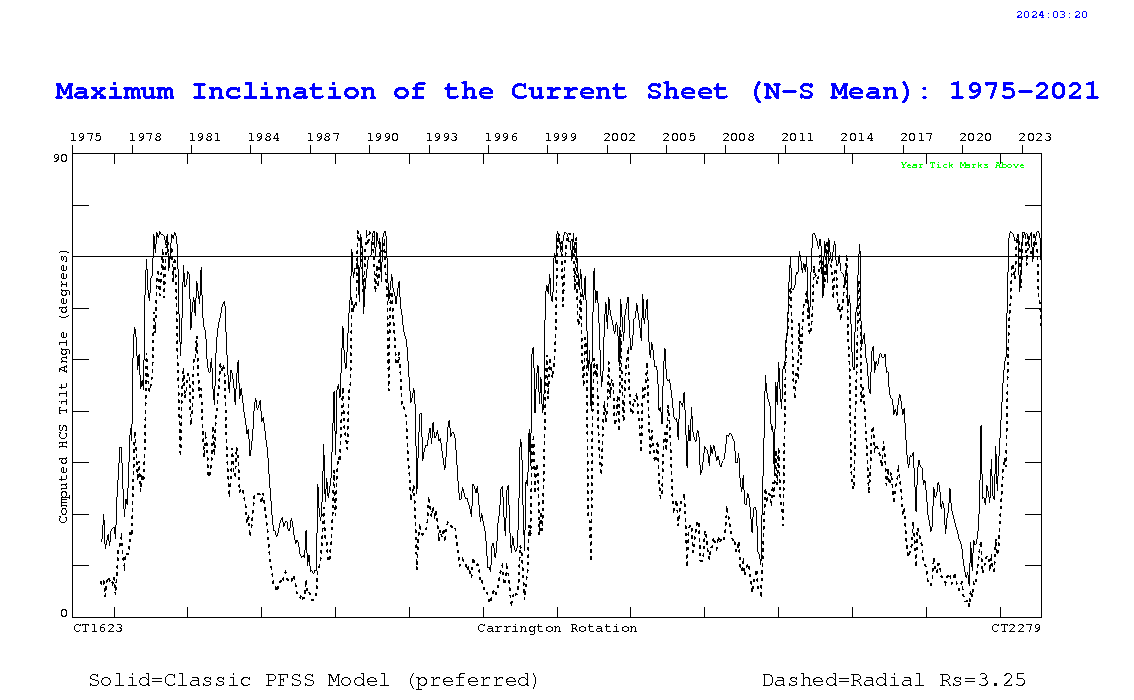
The above figure of the heliospheric current sheet from the Wilcox Observatory tells us that we are at the peak of the solar cycle, even though peak sunspot number was some time ago.
Now that we are at solar cycle maximum, there is only one prediction of future solar activity extant from the solar physics community. That is Livingstone and Penn’s estimate of Solar Cylce 25 maximum amplitude of 7. But the important number from here, the parameter that tells us what climate is going to do, is the time to the flattening of the heliospheric current sheet at the 24/25 minimum. So far the monthly sunspot number of Solar Cycle 24 has tracked Solar Cycle 5 very closely. Solar Cycle 5 was 12 years long. If Solar Cycle 25 is also to be 12 years long, the year of 24/25 minimum would be 2020. The climate implication of that is no net cooling over Solar Cycle 25 relative to Solar Cycle 24.
But there is a parameter which tells us exactly how long Solar Cycle 24 will be. That is the green corona emissions diagram produced by Richard Altrock, manager of the USAF coronal research program at Sacramento Peak, New Mexico. This is that diagram from June 2011:

I have annotated it to show the solar cycles over the same period. In his public statement, Altrock noted that Solar Cycle 24 was 40% slower than the average of the previous two cycles. That means that it is going to be 40% longer and that is borne out by the diagram. Solar minimum for the last four minima has occurred when emissions are exhausted at 10°. The latitude of 10° is shown as the red line on the diagram. Further to that, the last two solar cycles show that the month of minimum can be predicted by drawing a line between solar maximum (the point at which the rush to the poles intersects 76°) and the point of exhaustion at 10°. The bulk of activity is bounded by this line. On this line of evidence, Solar Cycle 24 will be 17 years long and the longest solar cycle for 300 years. We have a long wait ahead of us – half a generation.
While we are waiting for minimum, someone could do the world a very good service and take Bill Fordham’s interest in the droughts of the 1930’s and 1906 a bit further and calculate, on a year by year basis, what the Corn Belt would produce if the climate of the period 1800 to 1850 was repeated. Then we would know with enough certainty what we are in for – both the quantum and the volatility.
Arthur C Clarke’s three laws were:
1. When a distinguished but elderly scientist states that something is possible, he is almost certainly right. When he states that something is impossible, he is very probably wrong.
2. The only way of discovering the limits of the possible is to venture a little way past them into the impossible.
3. Any sufficiently advanced technology is indistinguishable from magic.
There is a large group of scientists who will not accept any correlation as causal unless specific testable mechanisms for the causal link are defined. They will attack the initial attempts to identify the mechanism and if they can find fault with these initial descriptions of the mechanism, they will claim that the correlation does not exist as the mechanism proposed is not workable. Not only that they then often attempt to belittle the proponents of these initial mechanism descriptions as gullible and people who would believe in the supernatural.
So we see Archibald and others on the effect of Solar cycles on climate we see Vukevic identifying correlations between planetary activity and solar activity as did Theodore Landscheidt, with similar approaches to describing the behavior of the Sun, and their critics disagree with them by finding faults with the proposed mechanism – therefore discounting observed correlations as impossible usually following that with belittling ad hominem such as ‘they are astrologers’ …. Or perhaps as Clarke would have put it – they believe in magic.
This response sequence appears to be a common one and would appear to be examples of Clarke’s first and third laws.
There would appear to be a need for clarity. First the correlation needs to be defined in detail not the mechanism. This correlation can then be agreed without even attempting a mechanism. Sailers did not need to know the laws of gravitation to identify the correlation between the moon and the tides. It would seem foolish to tell sailers that as they can’t describe the gravitational effects of the moon on the oceans, tides are not influenced by the moon; yet it is a logical argument that is commonly used and indeed is being used in this thread. Once a correlation has been agreed the mechanism can be researched.
http://arxiv.org/pdf/1202.1954v1.pdf
Dicke (1978) showed that an internal chronometer has to exist inside the Sun, which after a number of short cycles, reset the cycle length so the average length of 11.2 years is kept.
========
Why does the chronometer need to be internal? The sun may only be a part of the clockworks that regulates the cycle length.
Odd that in 1934 the sunspots/solar cycle were at a low point, yet it was so warm. Obviously not a 1:1 correlation. If there was, would not have needed to come up with current climate models based on CO2 dominating.
wayne Job says:
March 6, 2013 at 4:00 am
why the pause in warming now and a recent temperature drop in the oceans is not caused by the suns sabbatical.
Actually, although the sunspot number has dropped, the Total Solar Irradiance [energy output] has not. The sun is putting out more now than it did ten years ago.
anna v says:
March 6, 2013 at 4:25 am
Sometimes one can use data to predict future data, beginning with the tides which even primitive people could observe and predict their timing, though the theory evaded them.
But such prediction is still not science. As long as you have a theory you may claim that you are doing science even if the theory is wrong.
ferd berple says:
March 6, 2013 at 6:11 am
Dicke (1978) showed that an internal chronometer has to exist inside the Sun
He claimed that it had to exist [not the same thing].
Now, the Sun rotates. That makes for a pretty good clock. We use rotation as a clock on Earth.
Ian W says:
March 6, 2013 at 5:02 am
There would appear to be a need for clarity. First the correlation needs to be defined in detail not the mechanism
But that is precisely the problem. The correlations are not well-defined, the data is often obsolete, cherry-picked or even made up. The precisely provenance of the data is lacking.
lsvalgaard says:
March 6, 2013 at 6:43 am
wayne Job says:
March 6, 2013 at 4:00 am
why the pause in warming now and a recent temperature drop in the oceans is not caused by the suns sabbatical.
Actually, although the sunspot number has dropped, the Total Solar Irradiance [energy output] has not. The sun is putting out more now than it did ten years ago.
Leif people are saying that the frequency bands within TSI have altered and that the eUV in particular has dropped even though the overall TSI may be constant or higher. Is this the case?
Ian W says:
March 6, 2013 at 7:00 am
Leif people are saying that the frequency bands within TSI have altered and that the eUV in particular has dropped even though the overall TSI may be constant or higher. Is this the case?
There is considerable debate on this. The prevailing thought is that the calibration of the data is not precise enough to draw any firm conclusion on any change in the spectral composition. And, in any case the energy in the EUV is too minute to make any difference. But people will, of course, grasp at any straws they can find.
lsvalgaard says:
March 6, 2013 at 6:43 am
Actually, although the sunspot number has dropped, the Total Solar Irradiance [energy output] has not. The sun is putting out more now than it did ten years ago.
Here is a plot comparing TSI with the sunspot number and F10.7 http://www.leif.org/research/TSI-not-following-SSN-F107.png TSI has been scaled to match SSN and F10.7 during solar cycle 23 and you can see that in SC24, too few spots and too little F10.7 are observed. My interpretation of this is that the magnetism is there, but not concentrated enough to produce visible spots with attendant F10.7 emission. This is the Livingston&Penn effect in action.
Yes, I have seen a very similar diagram. In JGR April 2012.
lsvalgaard
March 6,2013 at 6:43 am
ferd berple says:
March 6, 2013 at 6:11 am
Dicke (1978) showed that an internal chronometer has to exist inside the Sun
He claimed that it had to exist [not the same thing].
Now, the Sun rotates. That makes for a pretty good clock. We use rotation as a clock on Earth.
Dicke didn’t know about nonlinear dynamical systems. It’s quite common for such a system to oscillate, though with very poor periodicity, even with a steady energy source. The Lorentz equations, a toy model of the atmosphere, are the original example of such a system. A model like that might explain the periodicity of the sunspot cycle.
It’s quite a stretch to connect the 24.5 day solar rotation period with the eleven year sunspot cycle. Mind explaining how that comes about?
paullinsay says:
March 6, 2013 at 7:56 am
It’s quite a stretch to connect the 24.5 day solar rotation period with the eleven year sunspot cycle. Mind explaining how that comes about?
‘The solar cycle is driven by [differential] solar rotation winding up magnetic field lines.
A recurring problem with relying on correlation with past events is that you have no model to follow when you observe a circumstance which you have never seen before.
For example; suppose the types of solar cycles *Do* recur, but there are actually about 100 different types, and we have only measured 25 of them? When events occur on such a long (relative to our lives) time scale it is very difficult to know when you’ve got enough data to rely on past correlation.
Specifically, it occurs to me, just from the way the current graphs are looking, that this may be a low amplitude and short cycle, going back to minimum by 2018. Now we don’t have an example of that in the record, which has led people to believe that all low amplitude cycles must cover an above average amount of time. But there’s no reason that is necessarily so, especially when there is so much about the dynamics of the sun that we are still trying to work out.
it’s big ,bright, quite near and it varies over timescales of hundreds of years. the sun must have a big effect on the earth’s climate! i remember reading on a NASA site a few years ago at solar minimum prior to sc24,that the lack of solar activity caused the earth’s atmosphere to shrink .
lsvalgaard says:
March 6, 2013 at 6:43 am
“Actually, although the sunspot number has dropped, the Total Solar Irradiance [energy output] has not. The sun is putting out more now than it did ten years ago.”
Could you expand, please, on the idea that sunspots are visible because they are cooler and thus darker (umbra) with the edge (penumbra) also cooler (but not to the same extent). Then, should we not expect large sunspot area to correlate with lower TSI? This is what I’ve quoted you as saying but you have restricted it in a manner (10 years?). Can we interpret this as a general statement? If so, it seems many folks have missed this relationship. Thanks, John.
Interesting arguments. I recall early on that David was more correct in his forecast of SC24 than Leif. So, I continue to be diligent and listen to David’s comments who coincidentally mentions Solheimp et al.
“Relations between the length of a sunspot cycle and the average temperature
in the same and the next cycle are calculated for a number of meteorological
stations in Norway and in the North Atlantic region. No significant trend
is found between the length of a cycle and the average temperature in the
same cycle, but a significant negative trend is found between the length of a
cycle and the temperature in the next cycle. This provides a tool to predict
an average temperature decrease of at least 1.0 ◦C from solar cycle 23 to 24
for the stations and areas analyzed. We find for the Norwegian local stations
investigated that 25–56% of the temperature increase the last 150 years may
be attributed to the Sun. For 3 North Atlantic stations we get 63–72%
solar contribution. This points to the Atlantic currents as reinforcing a solar
signal.” http://climaterealists.com/attachments/ftp/Solheimp.pdf
It seems there are plenty of predictors pointing to a cooling of climate amongst the noisy warmist defenders. I see no reason to die on principle or stubbornness in this topic of climate forecasting. Getting colder is lethal. Getting warmer is not. Life is pretty good in the tropics. 🙂
John F. Hultquist says:
March 6, 2013 at 10:12 am
Then, should we not expect large sunspot area to correlate with lower TSI? This is what I’ve quoted you as saying but you have restricted it in a manner (10 years?). Can we interpret this as a general statement? If so, it seems many folks have missed this relationship.
This is what one would assume and what has been the case in the past back to 1978 [when measurements of TSI began]. It is generally understood that TSI varies because the magnetic field varies. Also that sunspots form from magnetic fields emerging on the surface of the Sun. Suppose that the process that concentrates the field into spots recently is operating less efficiently, then we might understand why fewer spots are formed and why there is a growing discrepancy between TSI and the sunspot number. Stated differently: perhaps the sunspot number is no longer a good measure for solar magnetic activity.
Yes, I tend to agree with David on this….it’s going to get much colder, the warm period is wanning.
Another problem with this post is the base assumption that corn yields and genetics are similar to any time in the past, they are not. We have excellent yield and excellent genetics that allow corn to be rather quickly adapted to changing environment. We plant corn from Canada to the equator now.
http://www.bing.com/images/search?q=average+corn+yield&id=02F16A6545E03ACF36E38E05D75BDB5A1671FEE4&FORM=IQFRBA#view=detail&id=BF6677FBED3D748824618ACC8FF4837828A50ECD&selectedIndex=15
David Archibald says:
March 5, 2013 at 11:06 pm
donald penman says:
March 5, 2013 at 8:37 pm
Way back in 1991, Friis-Christensen and Lassen found that the cooling was over the following solar cycle. For the US Canadian border region, the heating/cooling relationship is 0.7 degrees C per year of solar cycle length. So if 24 is 4 years longer than cycle 23, then climate over solar cycle 25 will be 2.8 degrees C cooler than what it was over solar cycle 24, irrespective of the length or amplitude of solar cycle 25 itself.
Right – so SC22 was 9.7 years long and SC23 was 12.6 years. That’s roughly 3 years longer so cooling at the US Canadian border should be about 2.1 deg (i.e. 3 x 0.7) over SC24.
I think I’ve got that right. Can you update us on the cooling to date, David. Does the colder climate only affect the US Canadian border or does it affect other regions. In previous posts/papers you’ve made reference to Armagh. Things seem to have gone a bit quiet on Butler & Johnson and the Armagh correlations over the last few years.
The mention of B&J reminds me that it was they, rather than F-C&L, who specifically linked temperature to the length of the current (but also following) solar cycle. In fact you included the B&J scatter plot of Armagh Temps v Current SCL in several of your earlier papers. In a response to my query on Warwick hughes blog (circa 2006) you actually confirmed it was the Current SCL/Temp link you were using. However, once it became obvious that Armagh had experienced it’s 4 warmest years on record during SC23 you then began claiming that the link referred to the following cycle (SC24).
Now I note that your 2 deg SC24 cooling prediction is slowly being glossed over and you appear to now to be focusing on SC25.
Mario ask why there would be no net cooling. He gets an answer that cooling or heating is related to cycle length. Lief rightly says [well sort of], it has nothing to do with length ..
Mario … here’s the problem. … it depends on your perspective. If you are inclined to be a “scientists” .. and I am one so I can talk smack about my own …. then you are also more inclined to get caught up into what the prevailing scientific consensus on a subject is. Just look at the idiots who think Climate is a direct correlation with AGHGs. Likewise, you have a guy in the OP who thinks that length of cycle should directly correlate with whether or not we are cooling or warming.
BUT …. as a “Cook” .. I would suggests you look at the behavior of water, especially given the fact that 70% of the earths surface is water. I don’t have to keep on increasing the heat under the pot for it to boil. And .. when I turn it off, it doesn’t instantly go back to room temperature. More like the Water Sun relationship .. I can turn the heat down … and the water keeps on boiling. … maybe not quite as vigorously, but it continues to boil none the less. It is for this reason, water, that Sun Spots don’t exactly correlate with Temp … nor do cycle lengths.
Don’t remember who posted it, but some dude on here posted the “Hot Water Bottle Theory” of earth’s climate, and he undoubtedly is the smartest guy in the room. Until all these goof balls with lots of letters after their names wise up and figure out they are not the smartests guys in the room, we will be stuck with science that is trying to tease out a tree from the forests. Well ..it aint’ gonna happen.
John Finn says:
March 6, 2013 at 2:09 pm
I’ve got a fan! Someone who is following my work over the years in minute detail. How very flattering! You say you want some more, well, I’m not surprised. I refer you to Solheim et al’s paper: http://arxiv.org/pdf/1202.1954v1.pdf
Note that they credit me with the discovery of the use of solar cycle length as a predictive tool. Report back when you think you have understood it.
David Archibald says:
March 6, 2013 at 3:28 pm
John Finn says:
March 6, 2013 at 2:09 pm
I’ve got a fan! Someone who is following my work over the years in minute detail. How very flattering! You say you want some more, well, I’m not surprised. I refer you to Solheim et al’s paper: http://arxiv.org/pdf/1202.1954v1.pdf
Note that they credit me with the discovery of the use of solar cycle length as a predictive tool. Report back when you think you have understood it.
So you’re not going to address any of my points. Perhaps I’ll make the questions clearer to help with your understanding.
1. I claimed that you initially used a SCL/Temperature correlation where the solar cycle length (SCL) referred to the CURRENTcycle. To be more specific 2 temperature points for each SC were plotted on a scatter graph which were determined by calculating the mean temperatures for an 11 year period centred on both the solar maximum and solar minimum.
Is this not correct?
2. You then moved the goalposts from the CURRENT cycle to the FOLLOWING cycle and have since predicted a 2 deg decline in temperatures at a number of locations based on the length of SC23. You claim the temperature decline will take effect over SC24 (i.e. the cycle that followed SC23).
Can you update us on the success – thus far – of these predictions?
Dr. Deanster says:
March 6, 2013 at 2:40 pm:
++++++
I tend to agree that the sun and water can explain most of what climate that’s been observed. And no one better than Bob Tisdale, in my opinion, explains that. I’d like to see more on how the sun affects the chaos that affects ENSO processes. Looking too closely just at the sun doesn’t offer explanations of the other relationships that happen here on earth.
I am fascinated by David Archibald’s work as well others who post here. Leif offers very strong mediation on matters related to the sun. I think he offers no predictive predictions on climate change. I’d say he suggests anyone who claims they’ve found what will affect future climate is basing it on wrong headed theories. I think the observations can be predictive, even where correlation strays from those theories, there are good explanations of other processes which affect climate. When these processes align, they can amplify, dampen or reverse the expected affect.
The IPCC could be the organization that has done the most damage to how science is perceived. Their singular charter is to prove that AGW is real, and collect funding for their summary to policymakers. They seem dishonest in their claims that more drought, more rain, more snow, less snow, more heat, less heat… are all as a result (with 95% certainty) that CO2 caused it.
I hope I have not misrepresented or oversimplified anyone’s cases here, but that’s what I read.
John Finn says:
March 6, 2013 at 4:06 pm
Do you think I am like Obama, whose position on gay marriage is evolving? I am not like Obama. I am as constant as the pole star. You are mixing me up with the Butler and Johnson graphic which used two points for each cycle. My mind could not handle that level of complexity. So not correct.
Predictions are going very well and thank you for asking. How are your team’s predictions going? Having a bit of trouble? For the last 10 years or so? Very disappointing for you. What happens when money for researching sustainability dries up? And it will dry up. The warmer lies can’t be sustained forever, and then certain economies will be effected. At some point, the exit door will be jammed with sustainability lecturers and sustainability researchers all trying to get through it at once. You want to be out that door before the rush.
David Archibald says:
March 6, 2013 at 9:18 pm
I am as constant as the pole star.
And quite ignorant too 🙂 The pole star is a variable star [actually a five-star system, with the main star a classical cepheid].