Guest post by David Archibald
Climate has real world consequences, and those operating in fields that will be affected by changing climate bring a different perspective to the problem of predicting what will happen. Bill Fordham, advising the grain industry in the Midwest, kindly sent me a copy of the advice he provides to his clients. Following are two of his charts:

In Bill’s words,” Here is a chart of the 11-Year Sunspot Cycle you have probably never seen before! It is an 11-Year Average of the Monthly Sunspot Data. Why do I think it is important to look at an 11-Year Average? Because I am interested in how the ongoing 11-Year Average acts as we go forth in time with the droughts in the 1930’s and 1906.
I am also greatly interested in how the ongoing 11-Year Average acts as we go forth in time with the “Little Ice Age” that bottomed in 1816, the “Year Without A Summer”! The 1816 Eleven-Year Average Bottom was 327 months from the 1788 Eleven-Year Average Peak. If Sunspot history repeats similar to the 1788-1816 cycle, 327 m onths from the April 1990 Eleven-Year Average Peak will be in July 2017. For what it’s worth, the rate of decline since the 60 level was broken in April 1990 projects an 1816 level of 14.2 in just 44 more months from now, or by October 2016. If the current rate-of-decline in the 11-Year Average stays on track for another 44 months, we may need a few more blankets!”

This graph of Bill’s plots Solar Cycles 22 to 24 over Solar Cycles 3 to 6. What is interesting about this graph is that it suggests that the Sun has a limited playbook. Solar Cycles 22 and 23 are very similar in size and shape to Solar Cycles 3 and 4. But we are now coming up to big departure from how Solar Cycle 5 played out. To put that into context, let’s revisit the last prognostications of the Solar Cycle 24 Prediction Panel of 8th May, 2009. Four years ago, they said that,”solar maximum is now expected to occur in May, 2013.” They got it right, possibly to the month, or at least very close. As solar cycle length is more important in controlling climate than solar cycle amplitude, it doesn’t matter so much that they got the amplitude wrong.

The above figure of the heliospheric current sheet from the Wilcox Observatory tells us that we are at the peak of the solar cycle, even though peak sunspot number was some time ago.
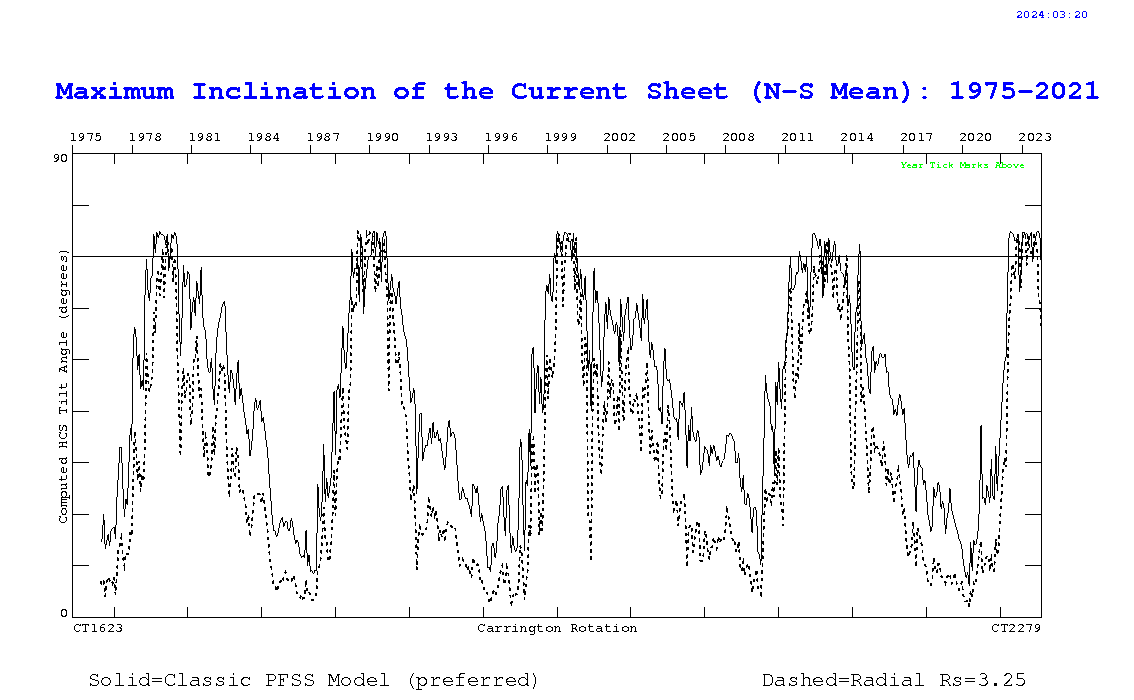
Now that we are at solar cycle maximum, there is only one prediction of future solar activity extant from the solar physics community. That is Livingstone and Penn’s estimate of Solar Cylce 25 maximum amplitude of 7. But the important number from here, the parameter that tells us what climate is going to do, is the time to the flattening of the heliospheric current sheet at the 24/25 minimum. So far the monthly sunspot number of Solar Cycle 24 has tracked Solar Cycle 5 very closely. Solar Cycle 5 was 12 years long. If Solar Cycle 25 is also to be 12 years long, the year of 24/25 minimum would be 2020. The climate implication of that is no net cooling over Solar Cycle 25 relative to Solar Cycle 24.
But there is a parameter which tells us exactly how long Solar Cycle 24 will be. That is the green corona emissions diagram produced by Richard Altrock, manager of the USAF coronal research program at Sacramento Peak, New Mexico. This is that diagram from June 2011:

I have annotated it to show the solar cycles over the same period. In his public statement, Altrock noted that Solar Cycle 24 was 40% slower than the average of the previous two cycles. That means that it is going to be 40% longer and that is borne out by the diagram. Solar minimum for the last four minima has occurred when emissions are exhausted at 10°. The latitude of 10° is shown as the red line on the diagram. Further to that, the last two solar cycles show that the month of minimum can be predicted by drawing a line between solar maximum (the point at which the rush to the poles intersects 76°) and the point of exhaustion at 10°. The bulk of activity is bounded by this line. On this line of evidence, Solar Cycle 24 will be 17 years long and the longest solar cycle for 300 years. We have a long wait ahead of us – half a generation.
While we are waiting for minimum, someone could do the world a very good service and take Bill Fordham’s interest in the droughts of the 1930’s and 1906 a bit further and calculate, on a year by year basis, what the Corn Belt would produce if the climate of the period 1800 to 1850 was repeated. Then we would know with enough certainty what we are in for – both the quantum and the volatility.
I am sure that some Stanford solar Physicist will say the charts are all bunk with slighted adjustment to make them align with history but to my naked eye I would not argue with the correlation.
Well, that might be hard. We have a good idea of yield potential, and even recent good years show what is possible under current moderate and even challenging climate. But calculating impact of “colder” climate on harvest ignores key variables, such as last/first frost, moisture, timing, type, ect. not to mention our ability to forecast changes and anticipate planting shorter season grain varieties, etc.
The 1800-1850s were a time of significant change in agriculture and so comparing relevant harvest sizes don’t necessarily show impact of climate.
Perhaps the easiest and “best” estimate might come from examining grain yields vs. latitude curve and overlaying that drop in yield in lieu of equivalent climate cooling. You don’t want to imagine greater precision than is really possible in such a forecast. There’s lots of different types of “colder” climate.
There are several things wrong with this post. The worst one is the assumption that the Sun is going to repeat itself with a delay of 19 cycles. There is no justification for that.
So far the monthly sunspot number of Solar Cycle 24 has tracked Solar Cycle 5 very closely
This cannot be stated in those words, because we simply do not know what the sunspot number was during solar cycle 5 with enough accuracy to say that something follows it ‘very closely’.
The extrapolation of Altrock’s plot of the green corona is also shaky [even on its face], but even more so when we look at an updated plot, e.g. Figure 5 of http://www.leif.org/research/ApJ88587.pdf
That the solar cycle length controls the climate has been debunked enough that we need not keep beating that dead horse.
I think that Leif has a point about the inexact nature or historical sunspot counts, but I would certainly be interested in seeing what he has to say about a projected 17 year length of cycle 24. That doesn’t look very plausible from the sunspot count trend to date.
Just get rid of ethanol subsidies. Instant doubling of corn production for food. Lets not forget Brazil.
But there is a parameter which tells us exactly how long Solar Cycle 24 will be. That is the green corona emissions diagram produced by Richard Altrock,
When updating the Figure with later data it is evident that there is no change in slope of the butterfly-wings of the green corona, so there is no justification for extrapolating to a very long cycle 24: http://www.leif.org/research/Green-Corona-Altrock-Waldmeier.png
Regarding this sentence: The climate implication of that is no net cooling over Solar Cycle 25 relative to Solar Cycle 24.
Could someone explain why there would be no net cooling over the next solar cycle 25?
Mario Lento says:
March 5, 2013 at 7:19 pm
Could someone explain why there would be no net cooling over the next solar cycle 25?
What does that matter? as the whole thing is unfounded in the first place.
I thought 1816 had something to do with Tambora.
Investors and new residents are buying Florida real estate betting the grand solar minimum of solar cycle 24 will boost property values, due to reduced risks of hurricanes and see great year round weather in future forecasts. There’s a large amount of cheep real estate in Florida due the housing bubble bust, and is a great time to invest for good projected returns in response to solar in-activity for as far as the eye can see.
Leif: you wrote: “What does that matter? as the whole thing is unfounded in the first place.”
+++++++++++
Thank you for the response.
I still want to know what the explanation was behind the statement… whether or not it’s unfounded. I am open to hearing that explanation. I was expecting to “read” that if cycle 24’s waning was going to cause cooling, then cycle 25’s predicted further waning would continue that cooling trend. So I’m confused here.
What’s interesting to me is that solar forecasting is what I would call an “interpretative science” – much like my own fields of expertise in geophysics & geology. We have physical principles we base our interpretations on but we do not have a controlled laboratory environment so there are lots of uncertainties in future projections. In this case, we have David & Leif taking largely similar data sets & coming up with substantially different conclusions.
This is much like drilling an oil or gas prospect where geoscientists look at similar data sets but come up with substantially different conclusions on whether there is a drillable prospect or not.
As regulars to WUWT know, any time David makes a post , Leif is there to provide a counter-point. Very predictable. Now, to carry my analog further, if this were an oil & gas deal & I were an investor who was going to make a decision to pursue this deal based on the arguments of David & Leif, I would be unconvinced by either. Why? Because to someone with limited knowledge of the subject matter, neither of them presents an argument that is a knock-out punch.
I am sure this commentary is aggravating to both David & Leif but that is how I see it & I wouldn’t be surprised if many other readers feel similarly, given the diversity of opinions we always see on these solar posts.
Fundamentally, David’s posts generally argue that we are headed into a period of low solar activity & that low solar activity leads to a colder climate. Leif generally argues that David’s analysis is flawed, that he doesn’t understand solar physics & that there isn’t any reason to believe solar activity is tied to changes in climate. Personally, I think David commonly does a good job finding data to support his case & I think Leif does a good job defending his position from his years of experience & research.
I propose that Anthony should set up a post & a point / counter point to debate this once and for all. A list of subjects to debate should be defined (ie Solar activity is tied changes in climate, solar cycle 24 will be x years long, etc). For each subject, David & Leif will present their best data-based arguments to support their positions, keeping in mind that the vast majority of their audience are complete amateurs in the subject matter. To keep in exciting & interesting, there should be a poll for each subject, where readers vote on who has made a more convincing case. This would be followed by a comment section on opinions on why readers thought David or Leif made a better case / why they were convinced by their arguments
Obviously, the pole would be scientifically meaningless as there would likely be an outcome bias coming into the post already by many readers. That being said, I think the whole thing could be very educational for all readers & that we would all walk away from the debate with a deeper knowledge of the sun & possibilities (or lack of possibilities ) for solar influence of climate. Knowledge is power & I think this would make all readers more knowledgable.
Jeff L says:
March 5, 2013 at 8:06 pm
In this case, we have David & Leif taking largely similar data sets & coming up with substantially different conclusions.
Unfortunately, data-based arguments are not science [it is like stamp collecting]. It becomes science when interpreted in terms of a theory or model or understanding which can then connect the data to everything else we have learned and understood. Data can be supportive or dismissive of a theory or even suggest a new theory which must then be formulated and fitted into the web of other theories. I use the word ‘theory’ here in its scientific sense meaning a shorthand [often expressed in mathematical language, but not necessarily] for a vast amount of observational data allowing predictions to be made of the outcome of future observations. Without a theory there is nothing to discuss [assuming that the data are agreed to] and nothing to learn. This is the problem with Archibald’s missives.
Back in 2007, a short time after an Inconvenient Truth, which actually switched me to a skeptic almost immediately, I started hearing predictions of a mini ice age. Since then, for a number of reasons, I was pretty much leaning towards believing that the period of warming was nearing its end and that global temps would flatline and start cooling after 2012-2014. That seems to be happening.
If we continue to not warm and/or cool, that gives some credence to those who have predict as much. It does not mean that they knew precisely why. Most of the explanations have to do with the sun.., and that it’s small changes cause other things to happen (let’s call them feedbacks) that we either can or cannot prove.
With regard to warming or cooling, Leif mostly focuses on TSI, and dismisses the idea of other feedbacks caused by a reduction in the sun’s output. As an academic, and purist, I respect that opinion. I cannot stand on any ground and debate Leif, as he’s extremely studied and consistent in his knowledge.
Bob Tisdale offers explanations based on observations that show where the heat came from and how it was stored in the oceans and released. Of course the heat came from the sun, and though no one can prove why the weather systems does what it does, I tend to thing the sun is driving it. And of course there is so much chaos that further complicates what we observe. At least Bob’s science is hard to debunk, because it’s not theory, it painstakingly follows the heat! I see nothing at all inconsistent with Bob’s logic.
The GCR theory could shed light on the solar feedback mechanism.
To me it does not matter whether I understand why it tends to get cooler at night than during the day, it just does —usually. Sometimes a cold front moves in during the day and a warm front moves in at night.
To me, all signs point to the sun as having an affect on our climate that goes beyond TSI. Chaos and bad or inconsistent data can certainly show otherwise, but to me, if I had to bet, I’d say it’s the sun.
Mario lento
“Could someone explain why there would be no net cooling over the next solar cycle 25?”
there would be no net cooling if solar cycle 25 was 12 years long because that is the same length as solar cycle 24 if solar cycle 25 was 17 years long then there would be net cooling .The theory is that the longer a solar cycle is the more cooling happens.
donald penman: Thank you… I misread that. I still have it in my mind that cycle 25 is generally predicted to be smaller than 24… so I missed that.
I don’t know Leif or David, but I have watched their exchanges over time. The argument is predictable. As I say that I know that Leif is waiting for the turning point data, but so are we all.
I suport the post/counter point debate as suggested above.
I would love to present this information to my teenage son, but I hold off because the information is so vague.
The forum suggested above would be great relief to me.
I say yes!!
I have to agree with Michael Cohen above; while the graph at the top matches a sunspot cycle minimum for 1815, the “year without a summer” was a result of the explosion and eruption of Mount Tambora. https://en.wikipedia.org/wiki/Mount_Tambora Perhaps the double-whammy of solar climate and volcanic dust simply made the cold weather even worse.
It seems the future is still unknown. David A’s interest in “what the Corn Belt would produce” fails to spark much interest for me because we do know the past and the present. A few years ago corn for freezing was much in evidence in our area. Then the local processor notified all the contracted growers that it would not be buying corn the following year. Presto, no corn was planted. If some aspect of climate causes a slow fall off in profits from growing corn, expect a likewise move to other crops. If a climate “shift” happens, expect a rapid shift to better adapted crops. Boundaries can shift rapidly with modern techniques, business models, and communications. If you are not familiar with how corn was grown 100+ years ago, read this:
http://homesteadcongress.blogspot.com/2008_04_27_archive.html
“Solar Cycle 24 will be 17 years long and the longest solar cycle for 300 years”
What are the dates for this? If you are counting from 2008-2009 the next solar minimum will be in 2025-2026, This doesn’t make sense to me. The next solar minimum will be approximately 2019 and the solar maximum of SC25 will be approximately 2025-2026.
The sunspots may weaken but the Cycle will still remain.
lsvalgaard says:
March 5, 2013 at 8:31 pm
Not to disrespect Dr Svalgaard, but at some point someone has to stick their neck out and try to reasonably quantify the influence of our solar system’s heater(Sun) on the the climate of our third planet.
I like the track record of this person;
Piers Corbyn – Solar Cycle Caused 2010 Snow
Solar Maximum and Solar Minimum Approximation 1875 – 2040
http://thetempestspark.files.wordpress.com/2013/03/sunspot_area-1875-2040-4.jpg
Leif
Just curious, do you think a sunspot count will evolve to include all sunspots earth side and farside now that we have STEREO? I know what is on earth side is important to us on earth, but seems we are missing half the picture.
Alex Avery says:
March 5, 2013 at 6:54 pm
We have daily records of climate for the first half of the 19th century. There are now yield forecasting programs that will tell you very closely how much grain you will produce given parameters of temperature and rainfall on a daily basis. And will take into account that you will replant after losing the first crop to frost for example. All this using today’s seed types and fertiliser.
Mario Lento says:
March 5, 2013 at 7:19 pm
Friis-Christensen and Lassen theory: http://arxiv.org/pdf/1202.1954v1.pdf