
ENSO forecast based on tidal forcing with an Artificial Neural Network
Investigation submitted by Per Strandberg
Here on this page, you are going to find evidence that tidal forcing is one of the most important, if not the most important driver for ENSO variations. That tidal forcing could be the main explanation for ENSO variations was something I stumbled upon when I examined possible ENSO drivers.
After the previous results which I got when I was using an Artificial Neural Network ANN and where I did an analysis of the correlations between the global mean temperature and possible forcing drivers, which can be viewed here, I turned my attention to the ENSO index by looking into the Multivariate ENSO Index (MEI).
One thing I found when I analyzed the result from correlations to ENSO was that there is a strong correlation between variations in Earth’s rotations both to the global mean temperature and to the ENSO index. What we are talking about here are small variations in Earth’s rotations, which are in the order of milliseconds.
One other factor with correlation to the ENSO is of course SOI, but I also found correlations to SST, PDO, and the Kp and Ap indexes.
From this, I concluded that either it is ENSO which is driving changes in Earth’s rotation or it changes in Earth’s rotation, which is causing variations in ENSO or more likely it is some combination of both.
Proof that ENSO and variations of Earth’s rotation are proportionally correlated to each other has been known for some time. This can be seen here.
The mechanisms which tie ENSO and variations in Earth’s rotation together are caused by sea current changes, changes in trade winds or by displacements of water between the equator and slightly higher latitudes. This all makes sense.
The water currents in the northern hemisphere follow a clockwise pattern, and in the Southern hemisphere they follow a counterclockwise pattern because of the Coriolis effect. The trade wind and the currents near the equator are moving to the west. However the Current closest to the equator called the equatorial counter current move to the east. Still deeper at depth down to 200 meters at the equator an ever stronger current is moving to the east.
The behavior of this current of the Equatorial Pacific is shown on this page by Bob Tisdale.
The only mechanism by which ENSO can be driven by changes in Earth’s rotation is by variations in the tidal force.
My next step was to try to include tidal forcing in my ANN.
I then got three problems, which I had to overcome.
Firstly: I had to find data over the position and distance to the Moon and to the Sun. Eventually, I found software from which I could get this data, although it gave limited information and I was only able to print out time and position when the Sun and the Moon were closest and farthest from the Earth and with the Moon I could also calculate the time and position of the new moon, the full moon and the moon nodes. The Moon nodes are the location where the Moon cross over the ecliptic plane.
Secondly: I had to find the formula for the tidal force vector and implement this into my software.
Thirdly: I had to figure out what features in the tidal forcing which could affect ENSO. I had to experiment with different configurations based in my limited and rather crude data. To do this, I had to make complicated trigonometrically calculations in order to get the right value of the tidal force. Eventually, I got good correlations between ENSO and the tidal forcing. By this time, I had figured out which features in the tidal forcing that were causing this correlation. However it was not a direct correlation with ENSO, rather it was a correlation with the derivate signal of ENSO, i.e. it was affecting the rate of change of ENSO. The correlation to the change of rate in Earth’s rotation, on the other hand, is direct. This means that tidal forcing is causing the rate of Earth’s rotation to either speed up or speed down. The rate of rotation is then responsible for changes of the ENSO index. One reason was that it was difficult to identify, which features, which cause correlations. This was because each tidal forcing point I use the sum of monthly calculations. The size of the tidal forcing changes each and every day and how to summarize this data the right way into useful functions, which can be used to construct values that could create good correlations were difficult.
Of course, the tidal force is not the only factor which drives ENSO, but it is the most influential factor.
To test if that would be the case I ran my network with the right tidal forcing data. I also included feedback loops back in the network from the output ENSO values to some of the input nodes. After some testing and individual adjustments of the internal components in the artificial network, I got good results. Following on my earlier experiment of the ANN on the mean global temperature I trained the ANN from late 1978 up to the end of 2004. I used the time from 2005 up to the late 2011 for test the calculations, in order to find the minimal error function.
 |
This is the result I got. The exciting thing with this result is that it is possible to make forecasts for much longer times into the future. Today’s predictions use computer models and are only able to make credible predictions 4 to 5 months into the future. While in my case, using my ANN calculations based on tidal forcing can be made for forecasts for an almost unlimited time because the Moon and Sun’s positions into the future are known in advance. Although, I have to stress that with the predication so far it is not possible to get the last figure right. Currently, it is only possible to make an estimate with a relative high likelihood at any date if ENSO are going to be positive, negative or neutral. However, as can be seen here the predictions are not always correct. The main large El Niño events of 1982 and 1998 can clearly be seen, but the large magnitude of these events can not be predicted.
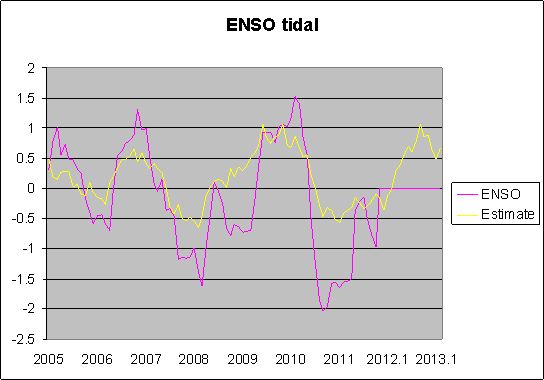 |
I later made a ENSO forecast from late 2011 up to 2020. I cannot show the result here because of proprietary reasons. This picture shows the test period and some of the forecast which ends in early 2013.
Note, however that the calculations from this graph, the ENSO index uses ENSO feedback values which all are from estimated ones. Those are not the real ENSO values.
Now Look at: the previous graph with the whole time span from 1979 up to 2011! On this graph, look at the beginning at the 3 first years from the start of 1979. These 3 first years have all exceptional good correlation to the real ENSO values. The difference with the start values in this case is that I use real ENSO values for the feedback values in the network calculations which are going into the calculations with values before the graph begins. This is because in my ANN, I use for every calculation point values which goes 3 years back in time and I must use real input values for values before my first calculated value.
If I would make a forecast for the next years using current real ENSO values from 3 years back and up to the current date, my forecast would be greatly improved and would be much better than forecast made with current computer models. There were 2 important events that happened the years just after 1979. The first was the eruption of El Chichon in 1982 in Mexico. The second was the unusually strong el Niño event between 1982-1983.
My calculated values after 1982 of ENSO tend to come out of phase after and around 1982, and the ANN seems not to be able to handle strong El Niño’s very well. After some years, the estimated ENSO value deteriorate somewhat mainly because of errors in the feedback caused by the inertia in Earth’s rotation. In contrast to computer model forecasts, I don’t use data from the Tropical Atmosphere Ocean TAO network which is a NOAA measurement network of buoys in the tropical Pacific that deliver real time data which feeds these ENSO models with real time data.
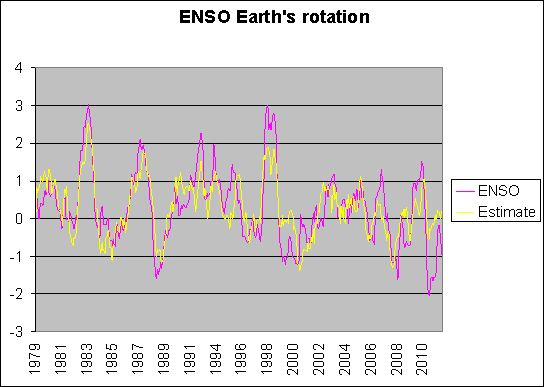 |
Here is a result from the same program, but as input it uses variations in the Earth’s rotation instead of tidal forcing. As you can see, the correlation to the Earth’s rotation makes the result much better. However in contrast to tidal forcing, future changes in Earth’s rotation is unknown.
 |
Here is another graph from the same program with feedback but this time the input signal is only from SOI Southern Oscillation Index. As expected SOI is closely related to ENSO.
 |
Here is a repeat with the same program, but this time with a combination of tidal forcing, changes in Earth’s rotation, SOI, Kp and the Ap indexes. As you can see, this result is similar to that of the previous with only SOI.
The next step I plan to take is to use the ANN with real time data and make more accurate ENSO predictions for the next 3 to 4 years in to the future. I also want to test with real ENSO input data for several time periods in order to evaluate statistically how the good predictions can be based on real time ENSO feedback input data for the beginning.
After that, I want to improve on my result by using more precise and accurate tidal calculations. I have found a program from which I can make precise calculations of the Moon and the Sun on a daily basis. Other factors I plan to look into are the mechanism of the Kelvin wave, Walker circulation and MJO which all should influence ENSO to some degree.
So far I have only looked at ENSO. I can easily switch to SOI, NOI and changes in Earth’s rotation and use that as an output for predicting ENSO with the ANN.
Conclusion from my result is that tidal forcing is as a major factor in ENSO forcing. I now have gotten new questions. Compared with other causes how important is the effect from tidal forcing? Is it possible to find an increasing effect from tidal forcing by improving the tidal data I use? Is it, for example, possible to identify tidal forcing as the cause for the strong El Niño of 1982 and 1998?
It may be possible to get better ENSO results by using predictions based on SOI, NOI, Earth’s rotations or by starting from tidal forcing only. I’ll test and see. Also, ENSO and SOI are parameters for which there exists long historical data records. By, using a longer time span for training and testing, the accuracy of predictions based on ANN should be improved.
I acknowledge that it is not easy to find correlations between tidal forcing without testing out the right feature and by using am ANN. However I do find it very strange that no scientist to my knowledge has been looking into a possible connection between tidal forcing and ENSO in any depth.
As can be seen from what the IPCC writes about ENSO predictions, they do not have a clue. The current data models that are in use can only predict with any accuracy 4 to 5 months into the future. When it comes to the ENSO drivers, these researchers think chaos theory and random noise are the mechanisms which explains the causes of ENSO changes.
However Cerveny, R. S. and J. A. Shaffer (2001) et al. in the report, The Moon and El Niño, Geophys. Res., writes about the Moon cycles and ENSO, where they find correlations between the solar cycles and ENSO.
To me at least, it seems that the solution to long range ENSO prediction has for a long time been right in front of the eyes of these researchers, but nobody has taken up the challenge to figure it out.
I see the same reason why the climate community at large has not studied tidal forcing as an explanation for ENSO variations and why none TSI solar forcing as an additional cause for climate forcing ignored. The primary reason is that they have had their education in meteorology, atmospheric physics, thermodynamics or in computer science. Most of them are specialists in a few narrow disciplines, and as such they prefer only to apply knowledge from the fields they know. They are not generalists and display strong resistance for applying knowledge from other area from which they lack knowledge. Then add to that group thinking, peer pressure and lack of funding for research in alternative causes of climate change and this explains the current one-sided situation. This is one of reason that predictions made with computer simulations are failing.
ANN are seldom used in climate science. There are some exceptions. One is research done by Dr William Hsieh from the University of British Columbia who uses this technique for ENSO predictions, but to my knowledge without using any tidal forcing. To learn more about how ANN works and how I have implemented this technique in climate investigation, Click here
Per
I later made a ENSO forecast from late 2011 up to 2020. I cannot show the result here because of proprietary reasons
How about Nino around 2013, 16, 19, 23-24 and 27?
agfosterjr says:
January 21, 2013 at 7:17 am
“First, is it possible for reversible tidal effects to influence ocean currents?”
It depends on geometry. Take a shallow rectangular pan, fill with about an inch of water, float an object on it. Keeping the bottom of the pan on the table, move it gently in a circle. The object will begin following the wall of the pan. Bottom and edge effects are important. Try this with a bottle of water so no surface wave can form and a suspended object remains immobile.
Per Strandberg (@LittleIceAge) says:
January 21, 2013 at 5:20 am
“Then if, the result improves I keep the new weight or if it doesn’t I keep the old weight.”
A (possibly ignorant) question-
Wouldn’t this be cherry-picking?
LOL
Want to borrow my shovel?
All that furious digging, yours is bound to be nearly worn out.
Yes, you.
“y’re ‘n ‘ld c’nt”– (scribbled note from Keith Richards to Mick Jagger)
There are times I wax eloquent. And then there are times I am just a cheeky little Irish elf. To this post: “nuts”.
Duke C.:
re your question at January 21, 2013 at 10:41 am
No, it is training the neural net. But your question is important because it goes to the nub of the underlying problem with the study which I stated in my post at January 20, 2013 at 4:31 pm.
Richard
Per Strandberg (@LittleIceAge) says:
January 21, 2013 at 5:20 am
You also don’t use the scientific method, so whether you use backpropagation is meaningless. If you did use the scientific method, you’d answer the questions that I asked, and provide links to your data, and expose your methods, and publish your predictions, instead of trying once again to sneak your unsupported, uncited opinions in under the radar.
Oh, wait, I forgot … you don’t want to reveal your special Kentucky Fried Science secret recipe with 11 special herbs and spices, for business reasons … fine, no problem, see you in the Yellow Pages, but if you are a businessman, what the heck are you doing posting here?
The issue here is not the method that you used to get your wrong answers, Per—it is that your answers are wrong. Even that would be bearable if you provided data and methods. But so far, all you’ve done is turn up with your theory in one hand and your johnson in the other. You’ve got no data, no supporting information, no computer programs, no citations, no logical conclusions, no agreement from other researchers, nothing scientific at all, and I hate to tell you but your johnson isn’t all that convincing in the science arena either.
You still seem like you don’t get it. This is a science site. We don’t care about your strong belief that you are right. We don’t care about your assurances that you are a black belt in neural networks. None of that gets a look-in here, we’re interested in science.
Please go away until you have some actual science to share with us. You know, data, methods, transparency, results, that kind of thing.
w.
Bart says:
January 21, 2013 at 10:04 am
agfosterjr says:
January 21, 2013 at 7:17 am
“Keep in mind that the measurable effects on LOD, those of fortnightly frequency, are about 99.99% reversible–that is, terrestrial angular momentum is retained, angular velocity is recovered. Which is no say no energy has been transferred to or from the hydrosphere.”
It does not follow. Angular momentum and energy are entirely different things. Many spin stabilized spacecraft, for instance, are controlled by dissipating energy to damp nutation, while angular momentum stays constant.
========================================================================
No gyroscope ever broke Newton’s laws of motion, namely, for every action there is an equal and opposite reaction. If something starts spinning you’ll have to burn some fuel on the retrorockets. You are denying the most elementary physics. I’ll grant that I could have said, whatever energy was transferred from the lithosphere to the hydrosphere is returned to the lithosphere, but all these transfers of potential energy (angular momentum) involve energy.
To repeat, how can energy have been lost to ENSO if earth rotation remains constant–over the long term? Does that make sense to you? If you want to claim that tides affect ENSO without involving LOD then be my guest, but good luck quantifying anything! –AGF
pochas says:
January 21, 2013 at 10:37 am
agfosterjr says:
January 21, 2013 at 7:17 am
“First, is it possible for reversible tidal effects to influence ocean currents?”
It depends on geometry. Take a shallow rectangular pan, fill with about an inch of water, float an object on it. Keeping the bottom of the pan on the table, move it gently in a circle. The object will begin following the wall of the pan. Bottom and edge effects are important. Try this with a bottle of water so no surface wave can form and a suspended object remains immobile.
==========================================================================
I don’t know what your experiment has to do with the problem–you don’t seem to understand the terms “reversible tidal effects.” See my response to Bart, 1057. –AGF
richardscourtney says:
January 20, 2013 at 4:31 pm
Richard, while I agreed with almost all of your interesting post, I must take exception to this one admittedly minor point. Training a neural net is indeed a procedure that can be exactly specified. It is nothing more than a series of steps, why would they be unable to be specified? You specify the details of the net, you specify the training data, what is unspecifiable? What am I missing?
In any case, I gave up in frustration, not because of the neural net issue, but because Per refused to answer questions about his data, methods, predictions and conclusions. I don’t have time for that kind of coy nonsense, that’s not science in any sense.
w.
Willis! Coffee! Spit! Computer screen! Paper towel!
Willis:
Your post at January 21, 2013 at 11:03 am says to me
You are right. You missed nothing. I stand corrected. Sincere thanks.
Prompted by your post I have given more thought to the matter and add the following.
At very least Per Strandberg could have specified if he had trained his network by use of supervised learning, unsupervised learning and reinforcement learning. From his description I inferred that he used reinforcement learning but on consideration that inference is an assumption on my part.
My assumption is supported by (at January 21, 2013 at 5:20 am) his saying of his training method
This addition in a post also shows that your correction of me is correct: the addition would not have been needed if it were in the paper.
In my opinion the list of “random weights” does not seem to be a serious omission but failure to state the determined optimum ‘weight’ most definitely is a serious omission of the paper.
So, you are right and I thank you for correcting me. Hopefully, this reply will correct any misleading impression I may have provided.
Please note that my post did agree with your objections that the paper ‘is not science’ for the reasons you had stated.
Richard
richardscourtney says:
January 21, 2013 at 10:46 am
Richard, thanks for clarifying.
You know, I don’t agree with Willis’ tone, and it’s a bit uncomfortable watching him dress down a guest author answering questions. But if there wasn’t any board policing we would have folks like Andrea Rossi showing up, touting the Ecat. The Reggie Hammond method (48 hours, “There’s a new sheriff in town…”) can be offensive, but it’s effective
agfosterjr says:
January 21, 2013 at 11:02 am
“–you don’t seem to understand the terms “reversible tidal effects.”
Tidal effects are dissipative. That’s why the moon is slowly receding.
agfosterjr says:
January 21, 2013 at 10:57 am
“To repeat, how can energy have been lost to ENSO if earth rotation remains constant–over the long term?”
Here’s a hint: the set of all energy states subject to the constraint that the magnitude of angular momentum is constant is non-empty.
You are arguing against well-established physics. This stuff is used every day in practical applications. I gave you a hint about satellites and nutation dampers. Do a little googling on those terms, and you will find information. Here’s a good place to start: the classic case of the Explorer 1 satellite falling into a flat spin.
Should have said: “Here’s a hint: the set of all energy states subject to the constraint that the magnitude of angular momentum is constant is non-trivial. It is not a singleton point.
Duke C. says:
January 21, 2013 at 11:55 am
I don’t know how many times I have to say this, but I’m a patient man. I’m not dressing down a “guest author answering questions”. I am registering my objections to a guest author NOT ANSWERING QUESTIONS AND NOT FOLLOWING THE SCIENTIFIC METHOD. Sorry for the shouting, but I hope it gets through to everyone the nature of my objections
Other than in vague generalities, he has not given us his methods, his data, or his forecasts. He claims to have discovered some arcane aspect of the lunar cycle that forces the ENSO oscillation … but what aspect? All he says is:
He has no physical theory connecting whatever it is in the tidal forcing to the ENSO phenomenon. We have not seen what he calls his “complicated trigonometrically calculations”, and to tell the truth, I’m not sure I want to …
Concerned about this, I raised eight specific scientific issues. His answer?
Sorry, but I’m not interested in “general points”. I’m interested in people who are willing to answer questions, to explain and defend their theory. And no, Duke, he’s not doing that.
w.
pochas says:
January 21, 2013 at 12:43 pm
agfosterjr says:
January 21, 2013 at 11:02 am
“–you don’t seem to understand the terms “reversible tidal effects.”
Tidal effects are dissipative. That’s why the moon is slowly receding.
======================================================================
Those are the “irreversible” tidal effects. These involve permanent LOD increase and involve no change in earth rotational inertia. These are not measured by the IERS, but are calculated from lunar laser ranging. These are four orders of magnitude weaker than “reversible” tidal effects. It is the analysis of “reversible” effects as reported since the invention of crystal clocks which are analyzed by way of LOD. These are by definition impossibly related to ENSO: energy must be conserved, and they involve no irreversible energy loss. Four centuries of telescopy have also shown reversible effects, but combined with irreversible, long term tidal dissipation.
We’re talking pretty basic here. –AGF
Bart says:
January 21, 2013 at 12:50 pm
agfosterjr says:
January 21, 2013 at 10:57 am
================================================================
Bart, you are talking absolute gibberish. You don’t have a high school comprehension of the physics. The angular momentum of the earth/moon system is constant–almost–except for what is lost to solar tides. Read my response to pochas at 117 for a basic introduction to the terms. You can’t deliver tidal energy to ENSO without permanent negative earth acceleration. Period. –AGF
agfosterjr says:
January 21, 2013 at 1:26 pm
It’s not often you come up against such a stark display of Dunning-Kruger. I’ve given you some links, and some keywords to search for, kid. Don’t bother me anymore until you have learned something.
Bart, way back I asked whether fortnightly LOD frequency was caused by spring/neap tides or by the inclination of the earth axis to the moon. Nobody replied. Can you? Can you give the slightest hint of why your neoEulerian effects should apply to the earth/moon system? Do you think planet earth is subject to axis alteration like your asteroids and rockets? Can you give us some indication that you understand the difference between reversible and irreversible tidal effects? Can you explain to us how ENSO can undo basic thermodynamics and transfer energy back to earth rotation? Can you give us the slightest indication that yours is not the display of Dunning-Kruger? You have explained nothing, understood nothing; you have only resorted to distraction that has nothing to do with the subject at hand. You are well advised to run and hide from the discussion. –AGF
agfosterjr says:
January 21, 2013 at 2:29 pm
I was responding to your claim
Whatever the merits, or lack thereof, in tying LOD to energy in the hydrosphere, this statement is false on a very elementary level. Angular momentum is not energy. To measure the change in energy, you would need to measure the change in nutation, not spin. And, because the Earth is so massive, it doesn’t take much to result in massive energy transfer. I’m not saying there is such transfer going on, mind you. That is TBD. But, you aren’t even asking the right question, so your answer, as Pauli would say, isn’t even wrong.
Bart, once again you show your hopeless lack of background in physics. Whoever said angular momentum is energy? Not I. But a change in AM certainly does entail energy expenditure. And no change in AM certainly does entail no energy transfer. It’s that simple. And you don’t understand the simplest physical concepts.
And what the hell is this nutation nonsense? Tides have nothing to do with nutation, everything to do with LOD (= “spin”). Why do you insist on advertising your incompetence? –AGF
Stephen Rasey says:
January 20, 2013 at 9:54 am
You seem to have assumed that changes in the rate of Earth rotation
(Chart: Deviation of length of day, 1965-2010), changes that ammount to no more that 2 milliseconds per day per month, is the driver of ENSO.
;——————————————————————
The LOD is measure of the change in the Earth’s spin.
The Earth’s rotational or orbital motion is actually complicated.
It’s the center of mass of the Earth and the Moon which follows an ellipse around the Sun (or in the ecliptic plane.)
Although it might appear to a naive observer on Earth that the Moon is simply rotating about the Earth, it’s also co-rotating with the Earth around the Sun – which causes the orbit of the Moon around the Earth to precess with a period of approximately 18 years.
Or stated slightly differently, the trajectory of the Moon in the sky is not constant – and on clear days not all high or low ocean tides are equal.
agfosterjr says:
January 21, 2013 at 8:11 pm
“And no change in AM certainly does entail no energy transfer.”
I’m not going to argue this with you. It is well understood by knowledgeable people. There are resources on the web. I have already given you one link which explains the effect on Explorer 1:
“Tides have nothing to do with nutation, everything to do with LOD (= “spin”). “
Ordinary East-West tides give us ordinary, and well cataloged and understood, short term effects. The question we are looking at here is what linkage there may be with ocean dynamics and long term climate. Nutation of the Earth’s axis has a very distinct likelihood of playing a significant part in that.
The oceans damp the nutation, and in doing so, they dissipate energy in the form of heat. The effect is only second order observable in spin, so a small signal in LOD is hardly unexpected.
This is all standard theory. Rail against it and stomp your feet however you like, people are still going to use it, as they have been doing for decades before Mr. A. G. Foster, Jr. came along. Because it works.