
(Image Credit: WoodForTrees.com)
By Werner Brozek, edited and with introduction by WUWT regular “Just The Facts”
Your help is needed in building a regular temperature trend analysis for WUWT. With much attention being focused on how much warming, or lack thereof, has occurred in Earth’s recent past (1, 2, 3, 4) it seems worthwhile to establish a regular update that provided a consummate summary of the key temperature records and their associated trends. Fortunately, WUWT regular Werner Brozek has been compiling just such an update and posting it in comments on WUWT and Roy Spencer’s website. As such, we would like to present an expanded version of Werner’s analysis for your input and scrutiny, before finalizing the content and form of these regular updates. As such, please review the following and lets us know, if it appears to be factually accurate, what you think of the layout, what you think of the content, if you think certain links should be images or images should instead be links, any additional improvements that can be made. There are few additional specific questions included in Werner’s analysis below. Thank you for your input. JTF
—
Temperature Trend Analysis
By Werner Brozek
This analysis has three section covering 6 data sets, including GISS, Hadcrut3, Hadsst2, Hadcrut4, RSS and UAH:
Section 1, provides the furthest date in the past where the slope is a least slightly negative.
Section 2, provides the longest time for which the warming is NOT significant at the 95% level.
Section 3, provides rankings of various data sets assuming the present ranking stays that way for the rest of the year.
Section 1
This analysis uses the latest date that data is available on WoodForTrees.com (WFT) to the furthest date in the past where the slope is a least slightly negative. So if the slope from September is 4 x 10^-4 but it is – 4 x 10^-4 from October, I give the time from October so no one can accuse me of being less than honest if I say the slope is flat from a certain month.
On all data sets, the different times for a slope that is at least very slightly negative ranges from 8 years and 3 months to an even 16 years.
1. UAH Troposphere Temperature: since October 2004 or 8 years, 3 months (goes to December)
2. NASA GISS Surface Temperature: since May 2001 or 11 years, 7 months (goes to November)
3. Wood For Trees Temperature Index: since December 2000 or 11 years, 9 months (goes to August)
4. Hadley Center (HadCrut3) Surface Temperature: since May 1997 or 15 years, 7 months (goes to November)
5. Hadley Center (HADSST2) Sea Surface Temperatures: since March 1997 or 15 years, 8 months (goes to October)
6. RSS Troposphere Temperature: since January 1997 or 16 years (goes to December) RSS is 192/204 or 94% of the way to Ben Santer’s 17 years.
7. Hadley Center (Hadcrut4) Surface Temperature: since December 2000 or an even 12 years (goes to November.)
Here they are illustrated graphically;

you can recreate the graph directly here.
Here is an alternate graphical illustration;
you can recreate the graph directly here.
(Which of these illustrations do you prefer? Are they too cluttered to include in one graph? If so, how can we make this more user friendly?)
Section 2
For this analysis, data was retrieved from SkepticalScience.com. This analysis indicates for how long there has not been significant warming at the 95% level on various data sets.
For RSS the warming is NOT significant for 23 years.
For RSS: +0.130 +/-0.136 C/decade at the two sigma level from 1990
For UAH, the warming is NOT significant for 19 years.
For UAH: 0.143 +/- 0.173 C/decade at the two sigma level from 1994
For Hacrut3, the warming is NOT significant for 19 years.
For Hadcrut3: 0.098 +/- 0.113 C/decade at the two sigma level from 1994
For Hacrut4, the warming is NOT significant for 18 years.
For Hadcrut4: 0.098 +/- 0.111 C/decade at the two sigma level from 1995
For GISS, the warming is NOT significant for 17 years.
For GISS: 0.113 +/- 0.122 C/decade at the two sigma level from 1996
(Note that we have concerns with using data from SkepticalScience.com, however we have not identified another source for this data. Does anyone know of a reliable alternative source where these data points can be readily accessed?)
Section 3
This section provides the latest monthly anomalies in order from January on. The bolded one is the highest for the year so far. I am treating all months equally and adding all anomalies and then dividing by the total number of months. This should not make a difference to the relative ranking at the end of the year unless there is a virtual tie between two years. After I give the average anomaly so far, I say where the year would rank if the anomaly were to stay that way for the rest of the year. I also show the warmest year on each data set along with the warmest month ever recorded on each data set. Then I show the previous year’s anomaly and rank.
The 2011 rankings for GISS, Hadcrut3, Hadsst2, and Hadcrut4 can be deduced through each linked source.
The latest rankings for UAH can be found here.
The rankings for RSS to the end of 2011 can be found here. (Others may also be found here)
With the UAH anomaly for December at 0.202, the average for the twelve months of the year is (-0.134 -0.135 + 0.051 + 0.232 + 0.179 + 0.235 + 0.130 + 0.208 + 0.339 + 0.333 + 0.282 + 0.202)/12 = 0.16. This would rank 9th. 1998 was the warmest at 0.419. The highest ever monthly anomaly was in April of 1998 when it reached 0.66. The anomaly in 2011 was 0.130 and it will come in 10th.
With the GISS anomaly for November at 0.68, the average for the first eleven months of the year is (0.32 + 0.37 + 0.45 + 0.54 + 0.67 + 0.56 + 0.46 + 0.58 + 0.62 + 0.68 + 0.68)/11 = 0.54. This would rank 9th if it stayed this way. 2010 was the warmest at 0.63. The highest ever monthly anomalies were in March of 2002 and January of 2007 when it reached 0.89. The anomaly in 2011 was 0.514 and it will come in 10th assuming 2012 comes in 9th or warmer.
With the Hadcrut3 anomaly for November at 0.480, the average for the first eleven months of the year is (0.217 + 0.194 + 0.305 + 0.481 + 0.473 + 0.477 + 0.445 + 0.512+ 0.514 + 0.491 + 0.480)/11 = 0.417. This would rank 9th if it stayed this way. 1998 was the warmest at 0.548. The highest ever monthly anomaly was in February of 1998 when it reached 0.756. One has to back to the 1940s to find the previous time that a Hadcrut3 record was not beaten in 10 years or less. The anomaly in 2011 was 0.340 and it will come in 13th.
With the Hadsst2 anomaly for October at 0.428, the average for the first ten months of the year is (0.203 + 0.230 + 0.241 + 0.292 + 0.339 + 0.351 + 0.385 + 0.440 + 0.449 + 0.428)/10 = 0.336. This would rank 9th if it stayed this way. 1998 was the warmest at 0.451. The highest ever monthly anomaly was in August of 1998 when it reached 0.555. The anomaly in 2011 was 0.273 and it will come in 13th.
With the RSS anomaly for November at 0.195, the average for the first eleven months of the year is (-0.060 -0.123 + 0.071 + 0.330 + 0.231 + 0.337 + 0.290 + 0.255 + 0.383 + 0.294 + 0.195)/11 = 0.200. This would rank 11th if it stayed this way. 1998 was the warmest at 0.55. The highest ever monthly anomaly was in April of 1998 when it reached 0.857. The anomaly in 2011 was 0.147 and it will come in 13th.
With the Hadcrut4 anomaly for November at 0.512, the average for the first eleven months of the year is (0.288 + 0.208 + 0.339 + 0.525 + 0.531 + 0.506 + 0.470 + 0.532 + 0.515 + 0.524 + 0.512)/11 = 0.45. This would rank 9th if it stayed this way. 2010 was the warmest at 0.54. The highest ever monthly anomaly was in January of 2007 when it reached 0.818. The anomaly in 2011 was 0.399 and it will come in 13th.
Here are the above month to month changes illustrated graphically;

you can recreate the graph directly here.
Appendix
In addition to the layout above, we also considered providing a summary for each temperature record, as is illustrated below for RSS. Please let us know if you find this format to be adventurous/preferred as compared to the category breakout above, and also please let us know if there are any additional analyses that might be valuable to incorporate.
RSS
1. With the RSS anomaly for November at 0.195, the average for the first eleven months of the year is (-0.060 -0.123 + 0.071 + 0.330 + 0.231 + 0.337 + 0.290 + 0.255 + 0.383 + 0.294 + 0.195)/11 = 0.200. This would rank 11th if it stayed this way. 1998 was the warmest at 0.55. The highest ever monthly anomaly was in April of 1998 when it reached 0.857. The anomaly in 2011 was 0.147 and it will come in 13th.
The rankings for RSS to the end of 2011 can be found here.
2. RSS has a flat slope since January 1997 or 16 years (goes to December). See:

Recreate graph here.
3. For RSS the warming is NOT significant for 23 years.
For RSS: +0.130 +/-0.136 C/decade at the two sigma level from 1990
See here.
Put in 1990 for the start date; put in 2013 for the end date; click the RSS button; then calculate.
About the Author: Werner Brozek was working on his metallurgical engineering degree using a slide rule when the first men landed on the moon. Now he enjoys playing with new toys such as the WFT graphs. Werner retired in 2011 after teaching high school physics and chemistry for 39 years.
—
Please let us know your thoughts and recommendations in comments below. Thanks Werner & Just The Facts
Discover more from Watts Up With That?
Subscribe to get the latest posts sent to your email.
Lance Wallace said (January 6, 2013 at 5:20 pm)
“…The CRN is excellent for providing data from well-administered sites meeting all NOAA/WMO criteria. It will be useful in coming decades for establishing trends. However, at present the full network of 114 or so stations has only been operating for four years, so will not be useful in my opinion for trend analysis until a number more years have gone by…”
The length of time for trend analysis may not be there, but it might be useful as a “control” – that is, which of the seven listed sources is the closest match to sites that are “well-administered sites meeting all NOAA/WMO criteria”.
woodfortrees (Paul Clark) says: January 7, 2013 at 8:42 am
OK, I consider myself chivvied 🙂
We prefer pursued with diligence and rigor… 🙂 BTW, brilliant website. Thank you for your contributions to the advancement of human knowledge.
First up, WTI has now been updated to use UAH 5.5 (that’s why it was stuck in August, because 5.4 stops then).
Most appreciated.
For adding CRN / NOAA and anything else, I need:
– URL to data source file in moderately sane text format (I’m used to reading most format horrors now, but basically it needs monthly anomaly data)
– Credit information as in the current credits page
If people can find these details and either post here or mail me it makes it much easier to add rather than a vague wishlist.
Is what Walter Dnes provided for NOAA:
ftp://ftp.ncdc.noaa.gov/pub/data/anomalies/monthly.land_ocean.90S.90N.df_1901-2000mean.dat
along with this credit page;
http://www.ncdc.noaa.gov/cmb-faq/anomalies.php
sufficient for your purposes? The Monthly Global (land and ocean combined into an anomaly) Index can be found towards the bottom of the above page, more easily linked to from here:
http://www.ncdc.noaa.gov/cmb-faq/anomalies.php#anomalies
Also here’s GHCN-M version 3.2.0 Technical Report on their newest version:
http://www1.ncdc.noaa.gov/pub/data/ghcn/v3/techreports/Technical%20Report%20NCDC%20No12-02-3.2.0-29Aug12.pdf
We’ll keep working on CRN to see if we can find it or put it in a “moderately sane text format”. If there’s anything we can help you with, now or in the future, please let us know, and we’ll be happy to help.
Walter Dnes says: January 7, 2013 at 5:16 pm Click the pic to view at source[/caption]
 Click the pic to view at source[/caption]
Make that 18,000 years. Another graphic we need is the retreat of ice since the peak of the last ice age.
The best I’ve got is 140,000 Years Antarctic/Vostok;
[caption id="" align="alignnone" width="578"]
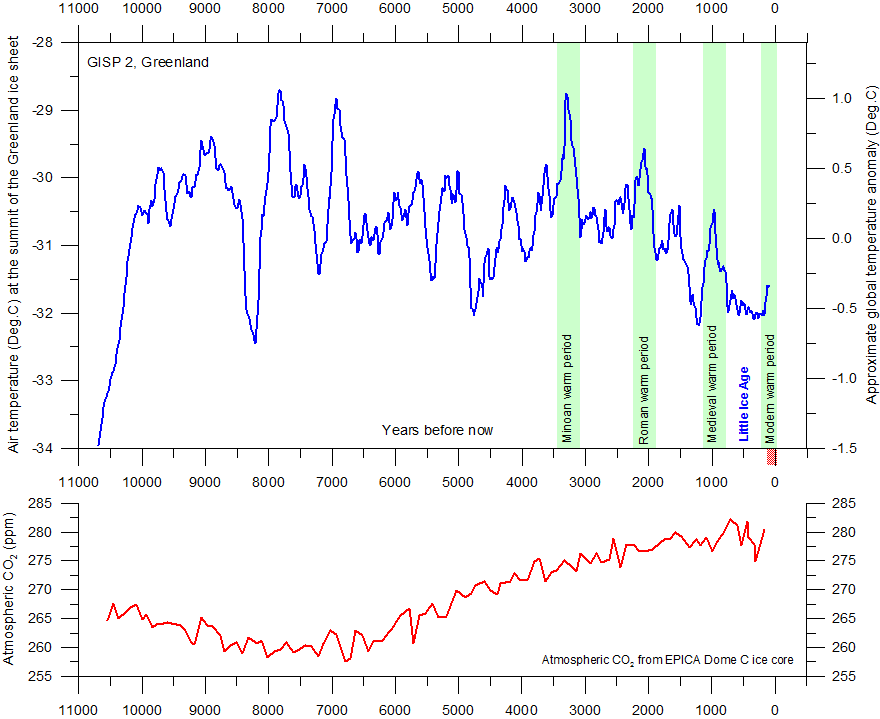
carried into 11,000 years GISP2 Temperature Since 10700 BP with CO2 from EPICA DomeC:
[caption id="" align="alignnone" width="578"]
both of which will be included in the forthcoming WUWT Paleoclimate Reference Page.
Monckton of Brenchley says:
January 7, 2013 at 9:00 am
It is particularly important to provide a single, bold, accurate, visually-clear image that will reproduce well on TV and in the news media.
justthefactswuwt says:
January 7, 2013 at 5:43 pm
I like the inclusion of CO2 in at least one of the header graphics.
Can we build on what I have reproduced below?
I do not know if UAH and RSS can be easily combined, however if they can, then the period from December, 1997 to the present would be extremely close to no change. The positive slope for UAH is 0.00495983 per year but the negative slope for RSS is -0.00464267 per year. The difference is about 0.0003 per year. This would be flat for all intents and purposes. If this straight line is then superimposed on the CO2 change as shown, it would look dramatic. We could then show the graph with a bold headline:
SATELLITE DATA SHOWS NO CHANGE FOR 15 YEARS AS CO2 CLIMBS
This would be followed by the following, perhaps:
http://www.woodfortrees.org/plot/rss/from:1997.9/plot/rss/from:1997.9/trend/plot/uah/from:1997.9/plot/uah/from:1997.9/trend/plot/esrl-co2/from:1997.9/normalise/offset:0.25/plot/esrl-co2/from:1997.9/normalise/offset:0.25/trend
Henry@werner
current data on UAH simply still is wrong as it (completely) differs from all other datasets (going in the opposite direction) and might give the wrong impression that there is a possibility of warming. However, there is no warming. I checked this with my own sample of 47 stations.
Why not work out the average deltaT anomalies coming from all data sets, satellite or not,
and same presentation as at the end of your last post?
I think that would be neat.
Walter / JTF: Thanks for the NOAA/NCDC links, that’s exactly what I need and should be easy to add.
Larry: Noted your concerns about colour blindness, and interesting that line width would help – I’ll add a line width selector to the wishlist.
To answer Werner’s / Monckton’s question about averaging UAH & RSS it isn’t possible yet on WFT itself, although I did have in mind adding some tricks allowing combination of series with a simple stack-based system (think RPN, Forth, Postscript or JVM according to age, applied to entire series).
In the meantime, however, would it not be better to use WTI, which includes HADCRUT3 (currently, I’m wondering if I should shift to 4) and GISTEMP as well as RSS + UAH – so two land and two satellite datasets…
OK, that all said, maybe it’s time to cash in some reputation points here: I’m a little worried about where this analysis is leading and the conclusions that may be drawn from it by others… OK, maybe we can demonstrate a lack of statistically significant warming in global surface/LT temperatures for N years, and maybe N is getting surprisingly large. It would be quite another thing to derive from this that “global warming has stopped” (there may be other heat reservoirs, and there certainly are longer term cyclical processes at work *), let alone any stronger political statements about the value of energy efficiency measures etc. I know people haven’t been doing this in this thread, but just tread carefully, please.
(*: actually the many layers of cycles is where my real interest lies, and the reason I built WoodForTrees in the first place)
Here is a style of plot that I think may be more suited to your needs. It is a color map of all possible trends you could create over a period of time, and uses fading out to show the limits of significance. The axes are start point (y) and end point(x). To look at all trends ending at the present, you just follow down the right axis. But it puts it in the context of other periods too.
You can choose different datasets and time periods – I’ve shown Hadcrut 1989-2010 here. You can also show the plots without shading, and plots of the CI’s.
Paul Clark (wood for trees) says
….where this analysis is leading…
*: actually the many layers of cycles is where my real interest lies, and the reason I built WoodForTrees in the first place)
Henry says
The measurements with the correct science will show the truth?
I agree with you that there could be a number of cycles playing, but I found that one of the main cycles is that of the 88 year Gleisberg cycle which duly causes the ca. 90-100 year weather cycle as identified even in ancient history.
I don’t know if you figured out our current position within that cycle?
http://blogs.24.com/henryp/2012/10/02/best-sine-wave-fit-for-the-drop-in-global-maximum-temperatures/
Note that the energy-in over the whole of that cycle is basically zero but we have now entered the cooling part which I expect to be rather spectacular, i.e. showing global cooling rather than global warming, (although some places on earth run opposite the wave due to increased clouds and precipitation.)
Perhaps you should extend the time line back so that the data covered would be statistically significant.
Lower up:
At January 8, 2013 at 3:55 am you say
I say, perhaps you, Lower up, should learn from the well-deserved trouncing you received on the thread at
http://wattsupwiththat.com/2013/01/04/the-dr-david-viner-moment-weve-all-been-waiting-for-a-new-snow-record/
and learn to think before making a post.
Richard
woodfortrees (Paul Clark) says: January 8, 2013 at 1:53 am
OK, that all said, maybe it’s time to cash in some reputation points here: I’m a little worried about where this analysis is leading and the conclusions that may be drawn from it by others… OK, maybe we can demonstrate a lack of statistically significant warming in global surface/LT temperatures for N years, and maybe N is getting surprisingly large. It would be quite another thing to derive from this that “global warming has stopped” (there may be other heat reservoirs, and there certainly are longer term cyclical processes at work *), let alone any stronger political statements about the value of energy efficiency measures etc. I know people haven’t been doing this in this thread, but just tread carefully, please.
No worries, the output from this exercise will be judiciously factual, and we’ll keep our eyes on the big picture. If fact, part of the reason for this exercise is to develop additional content for the next update of our Big Picture Look At “Earth’s Temperature”:
http://wattsupwiththat.com/2012/11/10/a-big-picture-look-at-earths-temperature-extreme-weather-update/
(*: actually the many layers of cycles is where my real interest lies, and the reason I built WoodForTrees in the first place)
There are so many layers of cycles. We’ve tried to capture as many as we could in the WUWT Potential Climatic Variables Reference Page;
http://wattsupwiththat.com/reference-pages/research-pages/potential-climatic-variables/
but there are decades, if not centuries, of research ahead of us before our understanding of Earth’s climate system moves beyond rudimentary.
woodfortrees (Paul Clark) says:
January 8, 2013 at 1:53 am
In the meantime, however, would it not be better to use WTI, which includes HADCRUT3 (currently, I’m wondering if I should shift to 4) and GISTEMP as well as RSS + UAH – so two land and two satellite datasets…
Thank you for your reply. When I use WTI, the slope for the last 15 years is 0.0018. (As per NOAA’s criteria). However the slope is flat for 12 years.
http://www.woodfortrees.org/plot/wti/from:1997.9/plot/wti/from:1997.9/trend/plot/wti/from:2000.9/trend
This slope of 0.0018 is an order of magnitude greater than the 0.0003 that I calculated for just the two satellite data, even though we are awaiting a more accurate version6 from UAH. It may be tempting to accuse us of using the data sets that suit our biases. However, despite issues with the latest UAH version, the land data sets have UHI issues, thermometer placement issues, time of day issues and perhaps questionable adjustment issues, etc.
If we were to have a temperature slope line going up at 20 degrees, and a CO2 line going up at 40 degrees, it may look like the CO2 is going up twice as fast and we may be accused of misrepresenting things due to the scale we use. That is one reason why I like a slope of 0.
Another reason I like a slope of 0 is that we do not have to explain something to the general public that may confuse the issue even more. When Phil Jones had his interview in February, 2010, he said the 0.12 C/decade warming was not significant at the 95% level over 15 years, and many papers made no attempt to explain the 95% significance and simply said “No warming for 15 years”. I talked to a person who believed in CAGW and he was very upset over the dishonesty of the reporters for this sort of headline. Ideally, I would like a headline that is short and true and to the point with no explanation required where “No warming for 15 years” means exactly that.
Very, very tempting. In fact I’m afraid you may have just handed people who want to shoot this down a missile launcher and a couple of cases of heat seekers. 🙂
henry says
http://www.woodfortrees.org/plot/wti/from:2002/plot/wti/from:2002/trend
increasing the “no warming” trend as global cooling sets in, clearly, in the end, will eventually lead to a misrepresentation of science; people will stop worrying about global warming forgetting that global cooling also needs attention,
i.e.
As the farmers in Anchorage have noted,
http://www.adn.com/2012/07/13/2541345/its-the-coldest-july-on-record.html
the cooling is so bad there that they do not get much of any harvests.
And it seems NOBODY is telling them there that it is not going to get any better. The cooling will last until 2030-2040. See here:
http://wattsupwiththat.com/2012/11/19/cooling-in-the-near-future/
The sad story is, that as we enter 2013, and where the world should prepare itself for climate change due to (natural) global cooling,
for example, by initiating more agricultural schemes at lower latitudes (FOOD!),
and providing more protection against more precipitation at certain places (FLOODS!),
the media and the powers-that-be are twiddling with their thumbs, not listening to the real scientists,
e.g. those not making any money and nice journeys out of the gravy train that “global warming” has become.
Therefore: be careful of being apologetic: in the end the truth will suffer
always depict the results as they are.
If you use the 11 or 12 year trend, explaining it shows all positive and negative coming from the sun, in one solar cycle, it would show the real trend, as I see it coming;
for 2013 I predict that as you throw off one month each time at the beginning, and add the new month at the end, the (visible) negative trend during one solar cycle time period will increase.
You want to bet?
It helps in two ways. In some cases if the color sample is large enough I can figure out the color by eye with careful examination (red green color blind are not truly “color blind” we just see some colors with much lower intensity than those with normal color vision. That means colors who differ by slight differences are very difficult assign a color name too). In other cases I use a colorblind assist tool like “whatcolor4” which uses a color picker to select a sample of something and then I can compare that reading with a color sample from the key and work out which color is which. Color dithering makes this more difficult on thin lines, and thicker lines it is much easier to get a 3×3 pixel or 5×5 pixel sample which will give a true color sample.
http://www.visibone.com/colorblind/
http://safecolours.rigdenage.com/
Larry
woodfortrees (Paul Clark) says:
January 8, 2013 at 9:54 am
Very, very tempting. In fact I’m afraid you may have just handed people who want to shoot this down a missile launcher and a couple of cases of heat seekers. 🙂
Sometimes you just cannot win! A few months ago I was challenged to prove the slope was 0 for 15 years. I did so. But I was accused of cherry picking since the 15 years was before the big El Nino. Another person used less than 15 years and was accused of using less than 15 years!
By the way, RSS for December just came out and it dropped even more than UAH from November. It went to 0.101 from 0.195, or a drop of 0.094 versus a drop of 0.080 for UAH.
With the RSS anomaly for December at 0.101, the average for the twelve months of the year is (-0.060 -0.123 + 0.071 + 0.330 + 0.231 + 0.337 + 0.290 + 0.254 + 0.383 + 0.294 + 0.195 + 0.101)/12 = 0.192. This would rank 11th. 1998 was the warmest at 0.55. The highest ever monthly anomaly was in April of 1998 when it reached 0.857. The anomaly in 2011 was 0.147 and it will come in 13th.
Earlier I had said RSS had a slope of 0 for 16 years. In about 7 hours I will know whether I have to add 1 or 2 months to this. I really appreciate that I can rely on the WFT update right on time. In contrast, the Hadsst2 for November is still not out!
Richards didn’t get a trouncing several posters agreed that the mechanism off AGW has feasible based on the fact the CO2 was a greenhouse gas, CO2 concentration is increasing in the atmospher, and the greenhouse effect increases as the concentration increases. Finally no one could dispute that humans were contributing to the CO2 in the atmosphere due to (among other thing) the combustion of fossil fuels.
NO ONE could show those facts were incorrect, even after lengthy discussion.
Lower up says:
“…and the greenhouse effect increases as the concentration increases.”
Wrong. Wrong! As I and others have repeatedly explained to you. That is simply an incorrect “fact”, which would falsify your conclusion if it wasn’t already deconstructed.
In reality, the ‘greenhouse effect’ decreases as the concentration of CO2 increases. Currently, a large rise in CO2 makes no measurable difference in global warming — which has stalled for the past decade and a half, while CO2 continues to rise. The link above shows exactly why this is.
DBoehm, with all due respect, you provided a graph that showed the greenhouse effect increased as the concentration of CO2 increased. As you pointed out the effect deminished at higher concentrations of CO2, but it still increased.
The reason I suggested extending the time line so that the data is statistically significant because it can be legitimately said that there has been no statistical cooling over that period. In fact it makes no sense to display incomplete day where you cannot draw a conclusion. If you do as I suggest, you could not be accused of misleading the readers.
DBoehm, I see how you have miss read your own graph, you are looking at the ppm on the x axis and the read the increase in temperature from the y axis. This is wrong wrong wrong as you say. You don’t honestly believe that the increase in temperature at 580 ppm raise the temperature by 0.02 degrees, whereas a concentration of 20ppm will give a increase of 1.7 degrees.
Each increase along the x axis is CUMULATIVE. The effect of each concentration should be added together. This is a simple process using calculus to calculate the area under the line (so showing it as a bar graph is misleading and probably caused your problem).
To Lord Monckton and others interested in combining RSS and UAH:
In an earlier post I said:
“I do not know if UAH and RSS can be easily combined, however if they can, then the period from December, 1997 to the present would be extremely close to no change. The positive slope for UAH is 0.00495983 per year but the negative slope for RSS is -0.00464267 per year. The difference is about 0.0003 per year. This would be flat for all intents and purposes.”
However RSS for December just came out and to update this:
The negative slope for RSS is -0.0049078 per year. The difference now is 5.2 x 10^-5. For all intents and purposes, this is 0. By the way, the December UAH is not yet in the form to be used by WFT. However that will have no effect since the December point is right on the slope line. 0.0049078 x 15 is 0.0735, so if I plot RSS from December, 1997; get the trend line; and then detrend it by -0.0735, I get a straight line.
It is not as good as automatically combining UAH and RSS since each has to be plotted separately, but the straight line with 0 slope can clearly be shown. See below for what this looks like.
http://www.woodfortrees.org/plot/rss/from:1997.9/plot/uah/from:1997.9/to:2013/plot/rss/from:1997.9/to:2013/detrend:-0.0735/trend
Would this be acceptable to you? Is there anything else you would like me to try out?
Lower up:
In this thread at January 8, 2013 at 4:05 am I advised you to learn from “the well-deserved trouncing you received” on another thread.
Your subsequent posts in this thread demonstrate that you are unwilling (unable?) to accept that advice. So, it seems you are another ‘Greg House’.
I strongly commend everybody to ignore your posts unless – as in the previous thread – they are so fallacious that they warrant rebuttal to avoid your errors misleading onlookers.
Richard
RichardCourtney, your explanation of the decrease in the greenhouse effect using light and increasing numbers of glass panes was very good, but it completely escaped DBoehm comprehension. He appears to think the greenhouse effect DECREASES as the concentration of carbon dioxide increases. Oh dear, when discussing the mechanism behind AGW, I assumed a little bit of understanding. I would have expected the more learned posters such as yourself and Davidmhoffer to have picked it up and corrected DBoehm’s fundamental error.
Richard, you are both mistaken in your critercism and advice. I have pointed out how DBoehm has misread his graph and come to the incorrect conclusion. You did not pick this up or if you did decided to remain mute in the matter. I understand why you have advised people to ignore me, it is embarrassing to you.
My point that the mechanism for AGW has merit. Namely:
Carbon dioxide is a greenhouse gas
Carbon dioxide concentration is increasing in the atmosphere
The increase in Carbon Dioxide concentration is increasing the greenhouse effect
Humans are increasing the amount of Carbon dioxide in the atmosphere
Repeatedly I have asked anyone to point out which of those four facts are incorrect and NO ONE has. This means the mechanism for AGW is valid.
Trying to hide this from the other poster is unfair to them. You should be advising them to read my posts so they can make up their own informed opinion of whether AGW is actually happening.