Guest post by Dr. Leif Svalgaard
The official sunspot number is issued by SIDC in Brussels http://sidc.be/sunspot-data/ . The [relative] sunspot number was introduced by Rudolf Wolf http://en.wikipedia.org/wiki/Rudolf_Wolf in the middle of the 19th century. He called it the ‘relative’ number because it is rather like an index instead of the actual number of spots on the Sun. Spots occur in groups [which we today call ‘active regions’] and Wolf realized that the birth of a new group was a much more significant event than the emergence of just a single new spot within a group, so he designed his index, R, [for any given day] to be a weighted sum of the number of spots, S, and the number of groups, G, giving the groups a weight of 10: R = S + 10*G. The number of 10 was chosen because on average a group contains about 10 spots, and also because it is a convenient number to multiply by.

Later, Wolf introduced the so-called ‘k-factor’ to compensate for differences in the size of telescope, precise counting method, observer acuity, etc, in order to bring the relative sunspot number determined by another observer on to the same scale as Wolf’s: R = k (10*G + S), where k is 1 for Wolf himself using his ‘standard telescope’ [Figure 1a,b] and his rules [not counting the smallest spots] for counting spots. From the 1860s Wolf had to travel extensively and he used exclusively [for the rest of his life] a much smaller telescope [Figure 1c]. With a smaller telescope Wolf, obviously’ saw fewer spots [and groups!], so he used k = 1.5 to convert his counts to the scale of the standard telescope.
Wolf’s successor, Alfred Wolfer, thought [rightfully] that the rule of ‘not counting the smallest spots’ was too vague and advocated to count all spots and groups that could be seen. This, of course, made his count larger than Wolf’s, so based on overlapping counts during 1876-1893, determined that to place his [Wolfer’s] relative number on to the Wolf scale he should multiply by 0.6 [one could say that his k-factor was 0.6]. This conversion factor of 0.6 has been adopted by all [Zurich] observers ever since. Adopted, not measured, as Wolf is not around any more. SIDC adopts that same factor, thus striving to stay on the Zurich scale.
So far, so good. But at some point in the 1940s, the Zurich observers began to ‘weight’ sunspots according to size and complexity, such that large spots would not be counted just once [as Wolf and Wolfer did], but up to five times, i.e. given a weight of five. There is nothing wrong with that, if one then also adjusts the k-factor to reflect this new way of counting. The director of the Zurich observatory from 1945-1979, Max Waldmeier, may have thought [?] that the weighting was introduced a long time ago [he mentions ‘about 1882’] so that no change of k-factor would be needed. Waldmeier set up a station in Locarno in southern Switzerland [as the weather on the other side of the Alps is often complimentary to that in Zurich] to provide observations when it was cloudy in Zurich. The observers in Locarno [Sergio Cortesi began in 1957 and is still at it] were instructed to use the same weighting scale as Waldmeier in Zurich. Because SIDC to this day normalize all observations they collect from a network of 60-70 observers to the count from Locarno, the weighting scheme carries over unchanged to the modern sunspot number.
We know that Wolfer did not weight the spots [contrary to Waldmeier’s assertion], because Wolfer himself explicitly [in 1907] stated that each ‘spot is counted only once, regardless of size’, and also because Wolfer’s counts as late as in 1924 when compared to other observers’ simply show that single spots are counted only once no matter how large.
To get a feeling for how the weighting works, try to count the spots on the Locarno drawing for today http://www.specola.ch/drawings/2013/loc-d20130104.JPG and compare your counts with the values given for each numbered group in the little table at the upper right.
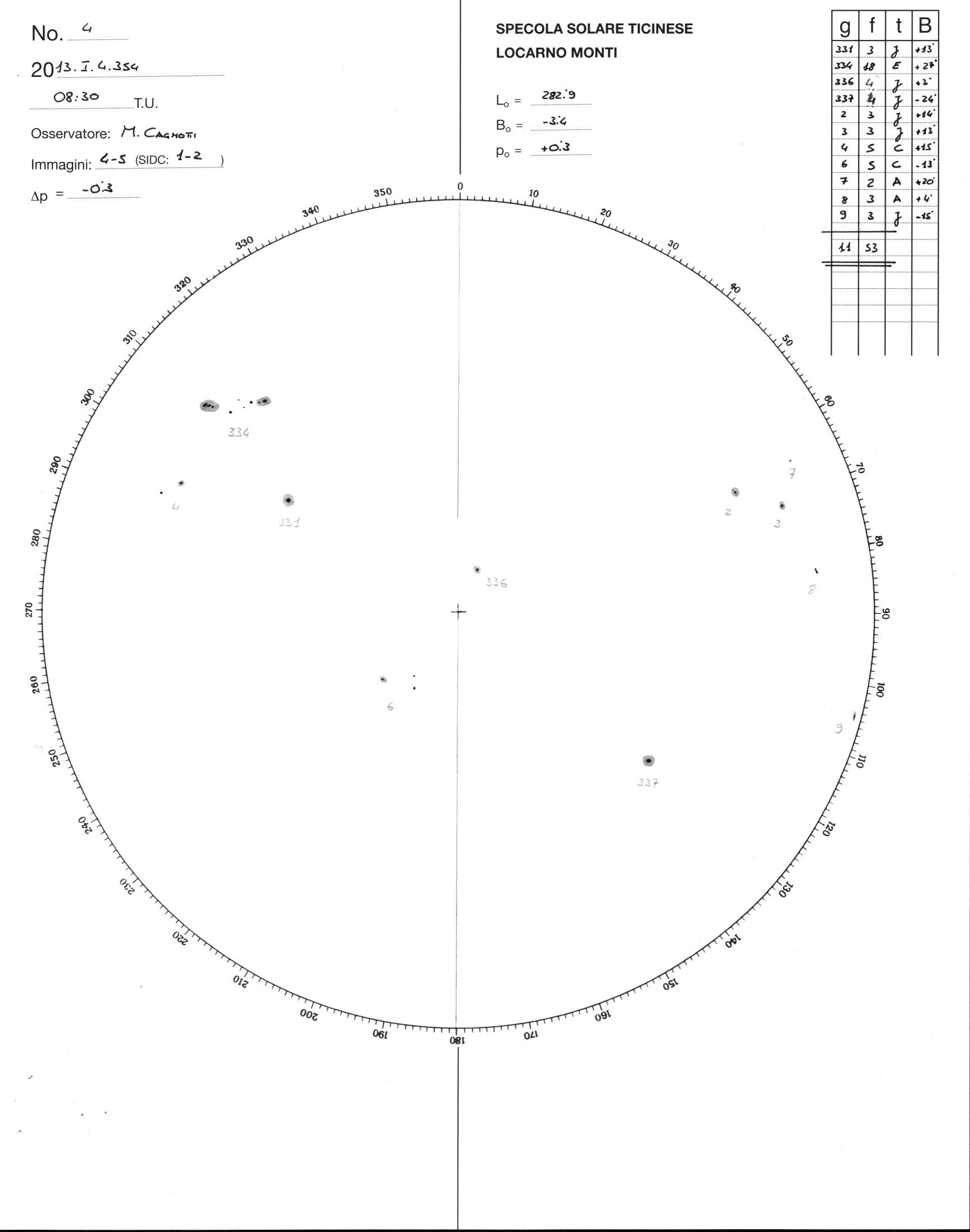
![loc-d20130104[1]](http://wattsupwiththat.files.wordpress.com/2013/01/loc-d201301041.jpg?quality=83)
(Note: I did this exercise, and found that my layman’s count was much lower than the “official” count, lending credence to Leif’s premise. Try it! – Anthony)
Marco Cagnotti’s [from Locarno] count is 11 groups and 53 ‘weighted’ spots. My count of the actual number of spots is 23. Try it for yourself. Your count may differ by about one from mine, but that does not change the fact that the weighted relative number 10*11+53=163 is about 23% larger than the ‘raw’, simple count of 10*11+23=133 that Wolfer and Wolf would have reported. For the whole of 2012 the ‘over count’ was 18%. So, it seems that the relative sunspot number suffered a 20% inflation because Waldmeier did not change his k-factor to compensate for the weighting.
Can we verify any of this? Well, one verification you can do yourself: just count the spots. But a better test is to ask the Locarno observers to report two numbers: the weighted count as usual and the unweighted count, where each spot is counted just once. Such a test has been [as is being] done. Figure 2 shows the effect of the weighting. Blue symbols show the official weighted count, and red symbols show Marco and my raw counts. The conclusion should be obvious.

The top panel of Figure 3 shows how well the sunspot number calculated from this formula matches that reporter by the Zurich observers.

Applying the same formula to data after 1945 gives us the lower panel. Under the assumption that the Sun did not know about Waldmeier we would expect the same relationship to hold, but in fact there is an abrupt change of the observed vs. the expected sunspot numbers between 1946 and 1947 of [you guessed it] 20%. Several other solar indicators give the same result. So there are several smoking guns.
What to do about this? One obvious thing would be to simply to remove the inflation [dividing the modern sunspot number by 1.20] and to stop weighting the spots. This turns out to be a bad idea, at least users of the sunspot numbers complain that they do not want to change the modern numbers as they are used in operational programs. The next-best thing is to adjust the old numbers before 1947 by multiplying them by 1.20. This is what we have decided to do [at least for now]. Who are ‘we’? You can see that here http://ssnworkshop.wikia.com/wiki/Home
There is a precedent for this [with the same ‘solution’]. In 1861 Wolf had published his first list of relative sunspot numbers, which he then updated every year after that. But about 1875 he realized that he had underestimated Schwabe’s counts [which formed the backbone of the list before Wolf’s own observations began in 1849]. Consequently, Wolf increased wholesale all the published sunspot numbers before 1849 by 25%. So we are in good company.
A somewhat disturbing [to many people] consequence of the correction of the official sunspot number is that there is now no evidence for a Modern Grand Maximum [‘the largest in 8000 years’ or some such].
NOTE: Figure 4 added 1/5/13 at Leif’s request

“On the contrary, I reconstruct solar wind and UV back centuries and find that they also do not vary much. Sunspot Number, TSI, and all other ‘potential variables’ vary together.”
I thought that it was recently noted that solar wind changed by 50% more than expected, and also that it was discovered that the UV varied by 10x from expectations (10% rather than 1%)?
“lsvalgaard says:
January 6, 2013 at 6:40 am
TimTheToolMan says:
January 6, 2013 at 1:57 am
I think a 10% increase over that period is enough to be interested in.
Yes, that would give us a warming of 0.003 degrees.”
I am assuming you are discussing UV…Do you have data to back up that calculation of 0.003 degrees (didn’t know the science had been worked out on that)? What is the time period of discussion for the 10% variation?
Hy again,
Thank you very much for your kind reply. 🙂
But what about this graph:
http://www.mpg.de/495993/pressRelease20041028
Has this been proven to be wrong? Isn’t there a consensus that on longer timescales solar “cycles” influence climate. There is an explanation for the Dansgaard-Oeschger-events based on several solar cycles. What about these cycles? Is there a scientific consensus that these cycles exist?
And if you were right, wouldn’t that mean that no such cycles ever existed. Or do you just say, that there was nearly no difference between 1700 and 2010, but on longer timescales there was a stronger effect on climate by TSI.
What I try to find out is if the sun cannot be responsible for anything, what has caused the differences in 14C and 10Be over longer timescales.
Do I understand your linked paper right, that these questions are still disputed and under investigation. Or is this blogpost the new consensus among solar scientists that there is no Great Maximum and nothing less important than todays Minimum?
Best regards
Ed(Europe)
DayHay says:
January 6, 2013 at 9:54 am
Perhaps if you study temperature data the late 20th century warming will go away as well…..
I think you are nurturing a false hope…
ed says:
January 6, 2013 at 10:07 am
Is there data at present that shows that TSI is higher when there are faculae present with smaller dark spots? Seems like we should be detecting this since the L&P graph seems to be holding, or generate a scatter plot to see if there is correlation, and I would think there is enough variability between cycles to quantify this. Or is it just that our current PMOD/ACRIM composites are not of sufficient quality to quantify for the last three cycles?
PMODACRIM are not good enough for this, long-term, but there are some indications that TSI from the much more accurate SORCE mission does not follow the sunspot number in recent years. E.g. http://www.leif.org/research/TSI-Recent-SSN.png
ed says:
January 6, 2013 at 10:10 am
I thought that it was recently noted that solar wind changed by 50% more than expected, and also that it was discovered that the UV varied by 10x from expectations (10% rather than 1%)?
You have been [partly] had by NASA press releases. The solar wind now is where it was a century ago. The UV variation has to do with how UV varies with wavelength, not with the total amount of UV we get.
ed says:
January 6, 2013 at 10:14 am
I am assuming you are discussing UV…Do you have data to back up that calculation of 0.003 degrees (didn’t know the science had been worked out on that)? What is the time period of discussion for the 10% variation?
During the 1st half of the time since 1700 the average sunspot number was 53, during the 2nd half it was 60. From modern measurements we know that 1 sunspot increases TSI by 0.007 W/m2 on average, so 7 extra spots increase TSI by 0.049 W/m2 or a fraction of 0.049/1361 = 0.00036 of TSI. That changes the temperature by a quarter of that [as per Stefan-Boltzman law], or 0.00009, which of the current 288K comes to 0.00259K
Eddy says:
January 6, 2013 at 10:20 am
But what about this graph:
http://www.mpg.de/495993/pressRelease20041028
Has this been proven to be wrong?
Essentially: yes. The red data points are the Group Sunspot number sliced on to the blue curve. And the GSN is not correct.
Isn’t there a consensus that on longer timescales solar “cycles” influence climate. There is an explanation for the Dansgaard-Oeschger-events based on several solar cycles. What about these cycles? Is there a scientific consensus that these cycles exist?
The D-O ‘cycles’ are likely an artifact from averaging 1000 and 2000 year variations [there is no ‘sharp’ 1500 or 1470-yr cycle]. There are very likely such long ‘cycles’ in climate. There is no good evidence that they are solar related.
What I try to find out is if the sun cannot be responsible for anything, what has caused the differences in 14C and 10Be over longer timescales.
We know that climate produces a part of the cosmic ray proxy variations as large or larger than those directly caused by the sun. Only more ice cores can resolve the question.
that these questions are still disputed and under investigation.
All of these questions are under heavy and vigorous debate. Old ‘myths’ die slowly. The end result of the current research is not in sight. What my post here is about, is to at least get one of the input parameters correct.
ed says:
January 6, 2013 at 10:14 am
Do you have data to back up that calculation of 0.003 degrees (didn’t know the science had been worked out on that)? What is the time period of discussion for the 10% variation?
It is difficult to type in so many zeroes. Here are the correct numbers:
During the 1st half of the time since 1700 the average sunspot number was 53, during the 2nd half it was 60. From modern measurements we know that 1 sunspot increases TSI by 0.007 W/m2 on average, so 7 extra spots increase TSI by 0.049 W/m2 or a fraction of 0.049/1361 = 0.000036 of TSI. That changes the temperature by a quarter of that [as per Stefan-Boltzman law], or 0.000009, which of the current 288K comes to 0.00259K
The last number 0.00259 was correct. For all whiners: the albedo, emissivity, greenhouse effects, and the spherical Earth are automatically taken into account by using the actual temperature 288K.
Thanks, for the very informative blog/post. As to the comment, “A somewhat disturbing [to many people] consequence of the correction of the official sunspot number is that there is now no evidence for a Modern Grand Maximum [‘the largest in 8000 years’ or some such].”
Many thinking that the prior sunspot data was correct formed hypothesis about the climate based on those ideas. And once someone has a favorite hypothesis, it is difficult to let it go.
On the other hand, if the most significant driver of warm and cold periods was the sun, the lack of a Modern Grand Maximum seems to fit with the changes in climate that have been seen. The Little Ice Age was a very cold period and during that period, I think the evidence supports that there was some kind of grand minimum of sun spots given that many observers indicate no sunspots were even seen for an extended period. Perhaps since the “grand minimum” if that is what it was, the sun returned to normal and since then, temperatures have been gradually recovering back to what it was during the Medieval period. Since there are cycles of solar activity the warming has not been even but somewhat cyclical due to the influence of solar changes, random climatic events, volcanoes, changes in climate cycles and even changes in CO2.
Leif replies “I think a 10% increase over that period is enough to be interested in.
Yes, that would give us a warming of 0.003 degrees.”
I dont suppose you have that figure in W/m2 do you?
BobG says:
January 6, 2013 at 1:24 pm
Perhaps since the “grand minimum” if that is what it was, the sun returned to normal and since then, temperatures have been gradually recovering back to what it was during the Medieval period.
since we don’t really know what causes those long-period climate changes, your view can, of course, not be easily dismissed. But, if you are correct, we would expect that the climate would change very slowly [on a human scale] so talking about impending ice ages because the Earth may not have warmed the last 16 or so years does not make much sense. Also, one would expect the long-term solar and climate records to be in sync for thousands of years [‘forever’, essentially]. This does not seem to be the case, but one could always say that the data is not good enough to determine the case either way. In any case, the purpose of my research and my post here is not to entertain such speculations, but simply to make sure at least one of the solar inputs to the problem is as correct as we can make it. Personally, I’m a fence-sitter on the sun-weather-climate issue and I do not believe one should let politics or emotions and such run the science. People often get the impression that I’m ‘dead-set’ against any S-W-C connection. This is incorrect. The truth is simply that none of the arguments [some good, most bad] brought forward on this have compelled me to come off the fence.
TimTheToolMan says:
January 6, 2013 at 1:34 pm
Leif replies “I think a 10% increase over that period is enough to be interested in.
Yes, that would give us a warming of 0.003 degrees.”
I dont suppose you have that figure in W/m2 do you?
Read my comments, please. How does 0.049 W/m2 grab you? I could live with a doubling of that, for a temperature change of 0.005 degrees.
TimTheToolMan says:
January 6, 2013 at 1:34 pm
I dont suppose you have that figure in W/m2 do you?
The tone of your comment leaves a bit to be desired. You could have said something like this:
“I am too lazy [or don’t have time, can’t read, whatever] to check if you gave a figure in W/m2. If I missed it, could you please tell me again? Thank you”.
Leif writes “From modern measurements we know that 1 sunspot increases TSI by 0.007 W/m2 on average, so 7 extra spots increase TSI by 0.049 W/m2 or a fraction of 0.049/1361 = 0.000036 of TSI.”
No I had simply missed that you’d given the answer in response to someone else. For that, I apologise. In that answer you’ve not mentioned whether that is using the previous understanding on Sunspot vs TSI leading to Visible energy or after the Harder adjustment?
It seems to me that if a multiplier of say 4 was used for the Harder adjustment then the difference is out around 0.2 W/m2 and that is something worth considering.
TimTheToolMan says:
January 6, 2013 at 6:23 pm
No I had simply missed that you’d given the answer in response to someone else. For that, I apologise.
OK.
In that answer you’ve not mentioned whether that is using the previous understanding on Sunspot vs TSI leading to Visible energy or after the Harder adjustment?
TSI includes all the solar output at all wave lengths. The Harder suggestion does not change TSI measurably.
Here is what I have SIDC with pre1947 SSN 1.2x. Looks like it doesn’t make a lot of difference to the trend, or the significance of the activity over the last 60yrs. It is exceptional in our era…what the final multipliers will be, who knows…
http://s852.beta.photobucket.com/user/etregembo/media/SIDCSSNADD20PERCWNTPRE1947_zps6f5c6b8b.png.html
ed says:
January 6, 2013 at 6:32 pm
It is exceptional in our era…
‘Exceptional’ is too strong. Compared with the often touted Modern Grand Maximum, out era is not special.
what the final multipliers will be, who knows…
As far as the influence of the weighting, there is not much more to expect. The cause has been found, the effect measured, and that is it. Further data or analysis will not change the result significantly. An issue is whether Wolf’s assessment was correct to begin with. That may be a topic of a future post.
“A comparison with sunspot and neutron records confirms that ice core 10Be reflects solar Schwabe cycle variations, and continued 10Be variability suggests cyclic solar activity throughout the Maunder and Spoerer grand solar activity minima. Recent 10Be values are low; however, they do not indicate unusually high recent solar activity compared to the last 600 years.”
http://www.leif.org/EOS/2009GL038004-Berggren.pdf
Leif Svalgaard says:
January 6, 2013 at 9:26 am
…I could have shown the Group Sunspot Number instead, which would have been a more direct comparison. I chose to show a different graph to underscore the real problem [and to provoke comments and discussion like yours]….
>>>>>>>>>>>>>>>>>>>>
Thanks for the explanation. I have no use for that sort of game playing. It does not advance scientific knowledge.
As you know, I think the sun has some effect on the climate but that type of crap is doing no one any favors. I am also willing to entertain other variables as having an effect, water being the biggest as far as I can see so far. However I don’t think any one has the list nailed down yet much less all the mechanisms. – a very intriguing scientific problem.
Gail Combs says:
January 6, 2013 at 7:09 pm
Thanks for the explanation. I have no use for that sort of game playing. It does not advance scientific knowledge.
You are right. That was poor judgement on my part. I was trying to do too much in one go. What I should have shown is the use people put the SSN to, like this Figure
http://www.leif.org/research/TSI-GSN-SSN-Background.png
The very intriguing problem of sun-climate is plagued by input with known problems. We are trying to remedy some of those.
Leif writes “TSI includes all the solar output at all wave lengths. The Harder suggestion does not change TSI measurably.”
You have mentioned this several times but TSI is not the whole story.
The Harder adjustment means more Visible and less UV (or vice versa) and that means more surface warming and related stratosphere cooling (or vice versa) and we dont know whether there has been a trend on those. The Harder adjustment means there is more scope for change and potential trends.
The December 2012 Smoothed Sunspots Number and their effect on the Smoothed Monthly Values curve have been posted. http://www.swpc.noaa.gov/SolarCycle/sunspot.gif
The SMV curve has inflected and the negative slope now parallels the Predicted Values Curve of 2008, but ~30 SSN lower and 9½ months early.
TimTheToolMan says:
January 7, 2013 at 12:05 am
The Harder adjustment means more Visible and less UV (or vice versa) and that means more surface warming and related stratosphere cooling (or vice versa) and we dont know whether there has been a trend on those. The Harder adjustment means there is more scope for change and potential trends.
There are several possibilities:
1) The Harder finding is not real [due to calibration problems]
2) Even if real, the effect on global temperature is very small [less 0.1 degrees] as per the calculations of Calahan that I showed
3) We have a good proxy for UV going back to 1722 [the diurnal variation of the geomagnetic field] which shows that total UV closely follows ordinary solar activity
4) If the Harder effect is real and UV behaves like that in every cycle it does not influence the trend
5) If the Harder effect is new [i.e. never happened before] then the effect cannot have been the reason for climate change over time.
6) More scope for change hardly matters if the changes are very small [c.f. point2]
TimTheToolMan says:
January 7, 2013 at 12:05 am
The Harder adjustment means more Visible and less UV (or vice versa)
In regard to my point 1):
Lean, Judith L., Matthew T. DeLand, 2012: How Does the Sun’s Spectrum Vary?. J. Climate, 25, 2555–2560. doi: http://dx.doi.org/10.1175/JCLI-D-11-00571.1
How Does the Sun’s Spectrum Vary?
“Recent observations made by the Spectral Irradiance Monitor (SIM) on the Solar Radiation and Climate Experiment (SORCE) spacecraft suggest that the Sun’s visible and infrared spectral irradiance increased from 2004 to 2008, even as the total solar irradiance measured simultaneously by SORCE’s Total Irradiance Monitor (TIM) decreased. At the same time, solar ultraviolet (UV) irradiance decreased 3–10 times more than expected from prior observations and model calculations of the known effects of sunspot and facular solar features. Analysis of the SIM spectral irradiance observations during the solar minimum epoch of 2008, when solar activity was essentially invariant, exposes trends in the SIM observations relative to both total solar irradiance and solar activity that are unlikely to be solar in origin. The authors suggest that the SIM’s radically different solar variability characterization is a consequence of undetected instrument sensitivity drifts, not true solar spectrum changes. It is thus doubtful that simulations of climate and atmospheric change using SIM measurements are indicative of real terrestrial behavior.”
TimTheToolMan says:
January 7, 2013 at 12:05 am
The Harder adjustment means more Visible and less UV (or vice versa)
http://ntrs.nasa.gov/archive/nasa/casi.ntrs.nasa.gov/20110023422_2011024608.pdf
“Thus, we conclude that the solar UV variations presented in Harder et al. (2009) and Haigh et al.
(2010) are incorrect, and that the long-term calibrations of the SORCE SIM and SORCE
SOLSTICE instruments need to be revised.”
lsvalgaard says:
January 5, 2013 at 11:04 am
Jim G says:
January 5, 2013 at 10:15 am
“The sunspot cycle controls only a very small part of our climate, so the precise method is not so important.”
“Perhaps a “lead us to believe” type comment would be less dogmatic and more appropriate.
It should be obvious that everything I say is just my humble opinion. ”
Your “humble” opinion is, as always, valued highly by me. I was only asking that it be stated as something less than hard fact given the variety of opinions on the subject. But then, perhaps, for a moment I forgot to whom I was speaking and sincerely would not want too much change as I do very much enjoy your “humble” responses.
Regards
Leif writes “2) Even if real, the effect on global temperature is very small [less 0.1 degrees] as per the calculations of Calahan that I showed”
As I’ve repeatedly said, I’m NOT interested in what models suggest the related temperature changes will be and am only interested in the differrence in the forcing because that can directly be related to the OHC changes which IMO is the only useful measure of GW.
And I’ve also said all along that the SIM data is new, short and could be problematic. I’ve never said the Harder adjustments are real but they’re all we have to go on for the moment. However if the more general result is true that UV and Visible components of TSI vary more than previously thought then that very much adds the possibility of trends leading to long term effects at the surface.
Anyway we’re going round in circles. You have your strong beliefs on this but I’m not convinced yet and would prefer to let the data speak for itself until it has been shown to be wrong and no I dont think the reanalysis has shown that yet. In time we’ll get a definitive answer although it may take years and more obsevations to do so.
lsvalgaard says:
January 5, 2013 at 2:31 pm
The paper report is [freely] available, not yet in digital form. Unfortunately the record does not overlap with RGO so the calibration is ‘free-floating’ and we can only calibrate by comparing to other records, e.g. the sunspot number 🙂
Nope, I am not interested in reports, paper or otherwise. I am interested in a database of more than 150 years of solar disk images (from 1858 to 2012). That’s what it takes to settle the question.