Guest post by Dr. Leif Svalgaard
The official sunspot number is issued by SIDC in Brussels http://sidc.be/sunspot-data/ . The [relative] sunspot number was introduced by Rudolf Wolf http://en.wikipedia.org/wiki/Rudolf_Wolf in the middle of the 19th century. He called it the ‘relative’ number because it is rather like an index instead of the actual number of spots on the Sun. Spots occur in groups [which we today call ‘active regions’] and Wolf realized that the birth of a new group was a much more significant event than the emergence of just a single new spot within a group, so he designed his index, R, [for any given day] to be a weighted sum of the number of spots, S, and the number of groups, G, giving the groups a weight of 10: R = S + 10*G. The number of 10 was chosen because on average a group contains about 10 spots, and also because it is a convenient number to multiply by.

Later, Wolf introduced the so-called ‘k-factor’ to compensate for differences in the size of telescope, precise counting method, observer acuity, etc, in order to bring the relative sunspot number determined by another observer on to the same scale as Wolf’s: R = k (10*G + S), where k is 1 for Wolf himself using his ‘standard telescope’ [Figure 1a,b] and his rules [not counting the smallest spots] for counting spots. From the 1860s Wolf had to travel extensively and he used exclusively [for the rest of his life] a much smaller telescope [Figure 1c]. With a smaller telescope Wolf, obviously’ saw fewer spots [and groups!], so he used k = 1.5 to convert his counts to the scale of the standard telescope.
Wolf’s successor, Alfred Wolfer, thought [rightfully] that the rule of ‘not counting the smallest spots’ was too vague and advocated to count all spots and groups that could be seen. This, of course, made his count larger than Wolf’s, so based on overlapping counts during 1876-1893, determined that to place his [Wolfer’s] relative number on to the Wolf scale he should multiply by 0.6 [one could say that his k-factor was 0.6]. This conversion factor of 0.6 has been adopted by all [Zurich] observers ever since. Adopted, not measured, as Wolf is not around any more. SIDC adopts that same factor, thus striving to stay on the Zurich scale.
So far, so good. But at some point in the 1940s, the Zurich observers began to ‘weight’ sunspots according to size and complexity, such that large spots would not be counted just once [as Wolf and Wolfer did], but up to five times, i.e. given a weight of five. There is nothing wrong with that, if one then also adjusts the k-factor to reflect this new way of counting. The director of the Zurich observatory from 1945-1979, Max Waldmeier, may have thought [?] that the weighting was introduced a long time ago [he mentions ‘about 1882’] so that no change of k-factor would be needed. Waldmeier set up a station in Locarno in southern Switzerland [as the weather on the other side of the Alps is often complimentary to that in Zurich] to provide observations when it was cloudy in Zurich. The observers in Locarno [Sergio Cortesi began in 1957 and is still at it] were instructed to use the same weighting scale as Waldmeier in Zurich. Because SIDC to this day normalize all observations they collect from a network of 60-70 observers to the count from Locarno, the weighting scheme carries over unchanged to the modern sunspot number.
We know that Wolfer did not weight the spots [contrary to Waldmeier’s assertion], because Wolfer himself explicitly [in 1907] stated that each ‘spot is counted only once, regardless of size’, and also because Wolfer’s counts as late as in 1924 when compared to other observers’ simply show that single spots are counted only once no matter how large.
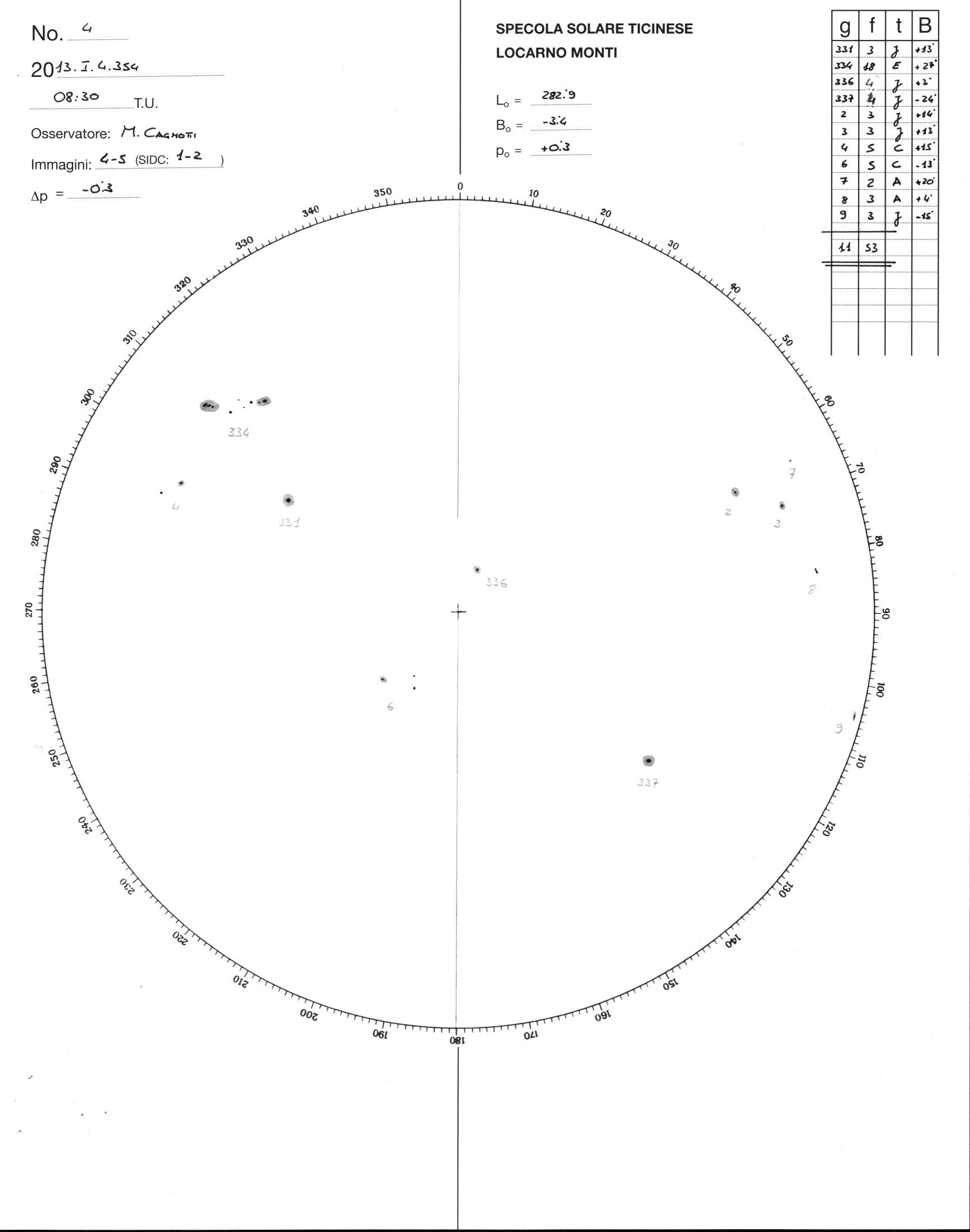
To get a feeling for how the weighting works, try to count the spots on the Locarno drawing for today http://www.specola.ch/drawings/2013/loc-d20130104.JPG and compare your counts with the values given for each numbered group in the little table at the upper right.
![loc-d20130104[1]](http://wattsupwiththat.files.wordpress.com/2013/01/loc-d201301041.jpg?quality=83)
(Note: I did this exercise, and found that my layman’s count was much lower than the “official” count, lending credence to Leif’s premise. Try it! – Anthony)
Marco Cagnotti’s [from Locarno] count is 11 groups and 53 ‘weighted’ spots. My count of the actual number of spots is 23. Try it for yourself. Your count may differ by about one from mine, but that does not change the fact that the weighted relative number 10*11+53=163 is about 23% larger than the ‘raw’, simple count of 10*11+23=133 that Wolfer and Wolf would have reported. For the whole of 2012 the ‘over count’ was 18%. So, it seems that the relative sunspot number suffered a 20% inflation because Waldmeier did not change his k-factor to compensate for the weighting.
Can we verify any of this? Well, one verification you can do yourself: just count the spots. But a better test is to ask the Locarno observers to report two numbers: the weighted count as usual and the unweighted count, where each spot is counted just once. Such a test has been [as is being] done. Figure 2 shows the effect of the weighting. Blue symbols show the official weighted count, and red symbols show Marco and my raw counts. The conclusion should be obvious.

The top panel of Figure 3 shows how well the sunspot number calculated from this formula matches that reporter by the Zurich observers.

Applying the same formula to data after 1945 gives us the lower panel. Under the assumption that the Sun did not know about Waldmeier we would expect the same relationship to hold, but in fact there is an abrupt change of the observed vs. the expected sunspot numbers between 1946 and 1947 of [you guessed it] 20%. Several other solar indicators give the same result. So there are several smoking guns.
What to do about this? One obvious thing would be to simply to remove the inflation [dividing the modern sunspot number by 1.20] and to stop weighting the spots. This turns out to be a bad idea, at least users of the sunspot numbers complain that they do not want to change the modern numbers as they are used in operational programs. The next-best thing is to adjust the old numbers before 1947 by multiplying them by 1.20. This is what we have decided to do [at least for now]. Who are ‘we’? You can see that here http://ssnworkshop.wikia.com/wiki/Home
There is a precedent for this [with the same ‘solution’]. In 1861 Wolf had published his first list of relative sunspot numbers, which he then updated every year after that. But about 1875 he realized that he had underestimated Schwabe’s counts [which formed the backbone of the list before Wolf’s own observations began in 1849]. Consequently, Wolf increased wholesale all the published sunspot numbers before 1849 by 25%. So we are in good company.
A somewhat disturbing [to many people] consequence of the correction of the official sunspot number is that there is now no evidence for a Modern Grand Maximum [‘the largest in 8000 years’ or some such].
NOTE: Figure 4 added 1/5/13 at Leif’s request

Thank you for the detailed answers.
davidmhoffer says:
January 4, 2013 at 7:01 pm
Nah, I do some really dumb things sometimes…OK, really often. I’m a continuous stream of mishaps.
Isopropyl alcohol cleans permanent marker up lickety split I’ve discovered.
hear hear! I absolutely swear by IPA for all manner of uses. I keep a couple of gallons of it in my garage and have a number of spray bottles containing varying solutions under my kitchen sink which I will typically use for cleaning heat-sink compound from CPUs and ICs, cleaning motorcycle engine parts after refurbishment or repair, cleaning all manner of computer externals including keyboards and screens , cleaning the uPVC window frames on the conservatory and even to sanitise the various cuts i inevitably end up with by messing with such things.
I have similar fetish for orange oil, but for different uses.
From the 1860s Wolf had to travel extensively and he used exclusively [for the rest of his life] a much smaller telescope [Figure 1c]. With a smaller telescope Wolf, obviously’ saw fewer spots [and groups!], so he used k = 1.5 to convert his counts to the scale of the standard telescope.
Is there a record of how he derived this figure? It doesn’t seem directly related to the resolving power of the apertures involved, so I’m guessing there’s a compensation added for different image scales due to different magnifications. Just an academic enquiry, not a challenge to his or other results.
On figure 1, the telescope in section a is labelled “Wolfer”, yet the description states the telescope was Wolf’s. Did Wolfer inherit Wolf’s ‘scope along with his mantle? If a next generation leader of solar science is called Dr Svalgrad, outsiders may be yet more easily confused.
Wolf’s different apertures and his travel prompted a thought regarding atmospheric “seeing”. I’m an amateur (casual) astronomer, and I’ve noted big effects on visible solar detail due to varying atmospheric instability. At different times of the same day, and from one day to the next, the amount of discernable detail differs. This difference can be accentuated in larger apertures. In a steady atmosphere, my six inch ‘scope shows lots more detail than my three inch. But in an unsteady atmosphere the detail levels can be quite similarly low in both instruments. There will be seasonal variations (hot days vs cold days; sun high up vs low down), geographical variations, and weather / climate variations (a jet stream overhead can ruin observing for many months).
I understand the causes of these, but I’m curious as to whether Wolf and his peers had any systematic way of allowing for the effects on observation. His career predates the likes of the Pickering scale:
http://www.damianpeach.com/pickering.htm
(nice visual representation here – for the night sky)
or the Mt. Wilson Solar Seeing Scale:
http://obs.astro.ucla.edu/150_draw.html
The sun alters atmospheric steadiness short and long term, and the altered atmosphere impacts measurements of the sun. Maybe complicates things?
– I feel strangely compelled here to make a general safety comment about observing the sun. Do not observe the sun with any optical instrument, even low power binoculars, unless the proper protection has been applied – permanent, painful blindness may result.
lsvalgaard;
so he designed his index, R, [for any given day] to be a weighted sum of the number of spots, S, and the number of groups, G, giving the groups a weight of 10: R = S + 10*G. The number of 10 was chosen because on average a group contains about 10 spots, and also because it is a convenient number to multiply by.
>>>>>>>>>>>>>>>>
Uhm, hold on, I be a bit confused. Am I to understand that the entire system is predicated on an artificial math construct that started out as a judgment call?
davidmhoffer says:
January 4, 2013 at 6:32 pm
AAAAAAAAAAAAAAAARGH!
I figured I’d put a red dot with a felt marker on the screen over every sun spot so I don’t count any twice. I checked twice, I was SURE is was dry erase….
++++++++++++++++++++++++++++++++++++++++++++++++++++++++++++++++++++++++++
One tip I have seen for removing permanent marker from dry erase boards is to trace over it with a dry erase marker. The dry erase ink will dissolve the permanent ink. I have tried this and it does work. I would be willing to bet it would work as a method for removing permanent marker marks from any non-permeable surface.
after looking at the pdf with the earlier helsinki data, it does look fairly close to world temps eg-
http://wattsupwiththat.files.wordpress.com/2011/11/tbrown_figure6.png
1810 to 1870 was a fairly warm period.
Not sure what constitutes a grand maximum, but even with your reconstruction TSI and SSN have been on an uptrend. I added a trend line and some “average” lines, this recent burst of activity almost didn’t even go below the long term average. Each successive cluster of roughly 60yrs stays higher for longer. Even the lows of the 60yr clusters are successively higher. This will likely crash after the peak of this cycle (and the next), but it’s been an interesting non-maximum.
http://s852.beta.photobucket.com/user/etregembo/media/Leifs_TSI_SSN_zpsd657ab1f.png.html
DirkH says: (and others)
January 4, 2013 at 8:23 pm (replying to)
davidmhoffer says:
January 4, 2013 at 6:32 pm
Well, at least he didn’t use whiteout on his PC screen …. 8<)
Reblogged this on sainsfilteknologi and commented:
Sun Spot
DR says:
January 4, 2013 at 7:55 pm
Hear hear!
unfortunately, that will not bring back the missing archives.
Andrejs Vanags says:
January 4, 2013 at 8:29 pm
Have Schwabe’s original counts been preserved, or are we in a position of just correcting Wolf’s corrections? In other words, can we always access the original uncorrected data?
Schwabe’s original drawings still exist. They are being digitized as we speak, as part of the SSN workshop effort:
http://www.leif.org/research/SSN/Arlt.pdf
http://www.leif.org/research/SSN/Arlt2.pdf
http://www.leif.org/research/SSN/Arlt3.pdf
PJF says:
January 4, 2013 at 9:04 pm
“From the 1860s Wolf had to travel extensively and he used exclusively [for the rest of his life] a much smaller telescope [Figure 1c]. With a smaller telescope Wolf, obviously’ saw fewer spots [and groups!], so he used k = 1.5 to convert his counts to the scale of the standard telescope.”
Is there a record of how he derived this figure?
Yes, and the telescope still exists and we can verify that number [it is about right].
On figure 1, the telescope in section a is labelled “Wolfer”, yet the description states the telescope was Wolf’s. Did Wolfer inherit Wolf’s ‘scope along with his mantle?
Wolfer was Wolf’s assistant and took over the telescope in 1876. Today it is operated by Thomas Friedli [the other person in the photos]. http://www.rwg.ch/joomla/
I understand the causes of these, but I’m curious as to whether Wolf and his peers had any systematic way of allowing for the effects on observation.
Wolf was fully aware of all this. Actually seeing is less important in a small telescope.
I feel strangely compelled here to make a general safety comment about observing the sun. Do not observe the sun with any optical instrument, even low power binoculars, unless the proper protection has been applied – permanent, painful blindness may result.
Galileo went blind from looking at sunspots [at sunset where the intensity is down, but still…]
davidmhoffer says:
January 4, 2013 at 9:08 pm
Uhm, hold on, I be a bit confused. Am I to understand that the entire system is predicated on an artificial math construct that started out as a judgment call?
Yes, but also backed up by extensive observations, and time has proven that Wolf made the right choices. Lucky, perhaps. But it is always better to be lucky than merely to be right.
“Ian H says:
January 4, 2013 at 5:24 pm
Leif is a true scientist. He doesn’t make extravagant claims about things he doesn’t know. He makes conservative statements about things he is sure about. He openly states the limits of his knowledge, and if challenged can explain absolutely everything he does in as much detail as his audience can comprehend. He never appeals to authority or talks down to people. He doesn’t need to do that. He just knows more about sunspots than just about anyone else in the world. That what a scientist should be like and indeed what most scientists are like. ”
Try talking to Leif about the Electric Universe…….
davidmhoffer says:
January 4, 2013 at 9:08 pm
Uhm, hold on, I be a bit confused. Am I to understand that the entire system is predicated on an artificial math construct that started out as a judgment call?
Yes, but also backed up by extensive observations, and time has proven that Wolf made the right choices. Lucky, perhaps. But it is always better to be lucky than merely to be right.
>>>>>>>>>>>>>>>>>>>>
Uhm….what makes it right? You’re constantly explaining that various proxies don’t match the sunspot record. But if there was never a physical basis for defining the system in the first place, why would you expect them to match?
Steve B says:
January 4, 2013 at 9:44 pm
Try talking to Leif about the Electric Universe…….
That gets short shrift like all pseudo-science deserves. Sadly, some pseudo-science makes its way into WUWT, promoted or invented by misled or scientific illiterate people. Try this link for more on the E-U:
http://dealingwithcreationisminastronomy.blogspot.com/p/challenges-for-electric-universe.html
Thomas Friedli gave an illuminating presentation at the 2nd SSN workshop in Brussels in May, 2012: http://www.leif.org/research/SSN/Friedli.pdf well worth a read.
“A somewhat disturbing [to many people] consequence of the correction of the official sunspot number is that there is now no evidence for a Modern Grand Maximum [‘the largest in 8000 years’ or some such].”
============
Projection, upon the audience.
Nice.
I am surprised Greenwich had weather clear enough for someone to see the sun and take a picture ‘every day’. Few times a month perhaps in winter.
What does it mean, to you, that there was no Grand Maximum? What does this tell us, in the context of Climate on earth? AGW? TSI? Thx Leif… Does this mean you are conceding the electric universe idea then ….hahahahah!!!!
ps. When is your friend going to publish his findings on decay anomaly/Sun rotation theory?
Clearly, if there is no great trend in sunspot numbers over the past 300 years, then the correlations between global temperature and solar activity are not directly linked to sunspot number. It’s just a coincidence that they were low during the Maunder and Dalton minima. Equally, if the second half of the 20th century did NOT have 5 cycles of unusually high sunspot numbers, then you can’t correlate the warming of the past 30 years with them.
Rather than shilly shally about this, perhaps the debate could move on to the parameters which DO affect things, in particular which parameters caused the times of the Maunder and Dalton minima to be cooler and which parameters caused the abrupt warming in the last 19th- and 20th centuries (the former clearly wasn’t to do with carbon dioxide, was it?!)
Is it the solar wind modulations affecting entry of cosmic rays into the earth’s atmosphere? Is it the non-random mixing of oceans leading to altered sea surface temperatures?
It has been claimed that large planet-solar interactions can provide a possible explanation for centennial- and Gleissberg cycles. Has the physics of that been worked out yet or has it been comprehensively debunked as a theory??
Getting the sunspot number right is a matter of physics and exactitude.
But if sunspot numbers do NOT modulate climate in any meaningful way, then surely continued discussion of this part of solar physics is secondary to more pertinant discussions at this site??
Previous post:
please replace last with late in para 2….
After the correction of the historical SSN-Record with the factors from Leif http://www.leif.org/research/IAUS286-Mendoza-Svalgaard.pdf ( b4 1945 1.2; b4 1870 1,4) one can make a diagram with the accumulated sunspot anomaly since the start of every sunspot cycle and so you’ll get a nice comparison of every cycle in one view. The anomaly of one month is the difference between the actual SSN- value and the average of the monthly values cycle 1…23 after cyclestart: http://www.dh7fb.de/ssnano/image003.gif . We see: the cycle 24 is the weakest since SC7 , the last one of the Dalton-Minimum so far. I’ll update this figure every month.
lsvalgaard says:
The RGO data is a 100 years and Wolf’s series is 160 years plus the data back to 1610, 400 years.
By how many different combinations of instrumentations and index methodologies? And what were they?
Wolf invented his relative sunspot number around 1850, but dug up observations back to 1610 and constructed sunspot numbers back to about 1700.
Clearly, Wolf himself was not comfortable applying his invented index methodology to the information from prior to “about 1700”, so claiming 400 years is not legitimate.
WRT Wolf’s methodology and its derivatives, what is the criterion for the demarcation of a group?
But at some point in the 1940s, the Zurich observers began to ‘weight’ sunspots according to size and complexity, such that large spots would not be counted just once [as Wolf and Wolfer did], but up to five times, i.e. given a weight of five. There is nothing wrong with that, if one then also adjusts the k-factor to reflect this new way of counting.
I disagree. Not with the notion that it is OK to adopt a different index methodology – they are all equally arbitrary in the absence of an external objective for the proxy. Rather with the notion that a single k-factor is necessarily sufficent to translate from one such index to another. It is not.
You can’t back out multiple factors (different resolutions of raw count, discounting of some spots below X size, differential weighting of some other spots above X size or Y complexity, differential counting of spots that occur within a “group” as opposed to not) using a single multiplier. Unless you assume that the proportion of all sunspots in each of the various size, complexity, and proximity categories remains constant over time. An assumption like that explicitly denies the utility of those very factors – you’re back to just counting spots.
At any rate, rejiggering the data to conform to a particular invented index methodology (even if done with the mathematical rigor not contained in a single k-factor) cannot say anything whatsoever about the existance of a “Grand Solar Maximum”. At best, it just says that particular index methodology does not capture it, if it does exist.
All such indexes are invented and arbitrary. Choose another index methodology, and you can find that GSM, whether it exists or not. No problem doing that. The problem only arises when whatever index is chosen is taken to have some external meaning. At which point it becomes a model of a specifc physical process. No problem with that, so long as it is acknowledged as such, and treated appropriately. The rest is just counting dots on the head of a pin.
Out of curiousity, when you guys do sunspot area, what method do you use to account for spherical geometry?
Sorry, who cares about the “sunspot number”?
The number is anyway a poor proxy of the sun activity. Not only the “number” of spots counts, but also the area of each spot, and this can change the results drastically!
We have to measure the cosmic ray intensity that is a much directer proxy.
Okay. I’m lost. So which method of counting sunspots REALLY controls our climate?
In re screen cleaning; I thought IPA was dilute aqueous ethanol solution ~6% ABV – India Pale Ale.
Line-outs are the Rickover Navy way. Another valuable micro-managing tool are O and X; O in the procedure margin when the ‘O’rder is given, X’ed on completion, all logged.
Re Pseudo-science, it’s always worth having at the back of your mind things like this:
In his 1950 BBC radio series, The Nature of the Universe, Hoyle mockingly called this idea the ‘big bang,’ considering it preposterous.
“this idea” being Georges LeMaitre’s expanding universe. That’s not to say that a lot of stuff isn’t pseud-science. Shakespeare got it right with:-
“And therefore as a stranger give it welcome.
There are more things in heaven and earth, Horatio,
Than are dreamt of in your philosophy.”
Only history will show what was pseudo-science and what was true-science, perhaps that history won’t be written for a very,very long time. As it happens I’ve no wish to be contentious here.
An interesting and informative post – thank you, Leif, and a Happy New Year to you.
Whilst I wholly approve in principle of counting all spots above zero size, I wonder whether this won’t introduce its own problems as the Livingston and Penn effect progressively ‘fades’ the smallest spots into the background. What do you do then? Use other information (magnetic?) to identify the smallest and most ‘uncontrasty’ spots? Require a certain contrast ratio between putative spots and their surroundings? (Pray that the L&P effect is cyclical and moves back upwards before too long …?) Whatever you decide, one thing is certain – somebody will decide it’s “the wrong method”!
Amazing how many matters of detail there can be, even in something as superficially straightforward as counting sunspots.