Global Cooling – Climate and Weather Forecasting.
Guest post by Dr. Norman Page
Introduction.
Over the last 10 years or so as new data have accumulated the general trend and likely future course of climate change has become reasonably clear. The earth is entering a cooling phase which is likely to last about 30 years and possibly longer. The major natural factors controlling climate change have also become obvious.Unfortunately the general public has been bombarded by the scientific and media and political establishments with anthropogenic global warming – anti CO2 propaganda based on the misuse and misrepresentation of already shoddy IPCC “science” for political ,commercial and personal ends.
The IPCC climate science community largely abandoned empirical Baconian inductive scientific principles and built worthless climate models based on unfounded assumptions designed to show that anthropogenic CO2 was the driving force behind changing climate. Most of the IPCC output is useless as a tool for predicting future climate trends and their impacts and in particular the IPCC Summaries for Policymakers can be safely ignored for practical purposes. The divergence between the IPCC Hansen projections and the observed trends is shown below.
Fig 1 ( From Prof. Jan-Erik Solheim (Oslo) )

Fortunately, however , the basic data is now easily available so that any reasonably intelligent person can check on line daily or monthly to see what the incoming empirical data actually is and draw ones own conclusions.
Here’s how to do it in a few simple steps. I have put in CAPITALS the main empirical observations on which one can draw conclusions re climate change ,its causes and future trends and also get a good idea of weather patterns and trends for the next year or so.
1. Check the Temperature Trends and Data.
Because of the Urban Heat Island effect ,the built in local variability of the NH land data and the thermal inertia of the oceans, Sea Surface Temperatures are the best measure of global temperature trends. These show that the global warming trend ended in about 2003. THERE HAS NOW BEEN NO NET WARMING SINCE 1997 -15 YEARS WITH CO2 RISING 8.5% WITH NO GLOBAL TEMPERATURE INCREASE. SINCE 2003 THE TREND IS NEGATIVE.
To check the past years go to
ftp://ftp.ncdc.noaa.gov/pub/data/anomalies/annual.ocean.90S.90N.df_1901-2000mean.dat
and for monthly updates go to.
ftp://ftp.ncdc.noaa.gov/pub/data/anomalies/monthly.ocean.90S.90N.df_1901-2000mean.dat
The 2012 average NCDC SST anomaly thru Sept was .4438 versus the 1997 annual anomaly of .4575.
The peak anomaly was .5207 in 2003.
An excellent site for reviewing all the basic temperature data is http://www.climate4you.com/
2. Check the current phase of the Pacific Decadal Oscillation.
Here is a plot and suggested projection based on the Hadley SST3 from Tallbloke.

(See: http://tallbloke.wordpress.com/2012/10/23/the-carbon-flame-war-final-comment/) He says “I have put together a simple model which replicates sea surface temperature (which drives global lower troposphere temperature and surface temperatures a few months later). The correlation between my model and the SST is R^2=0.874 from 1876 FOR MONTHLY DATA.” The model is shown with predictions to 2050 (blue) along with the HADsst3 (red).
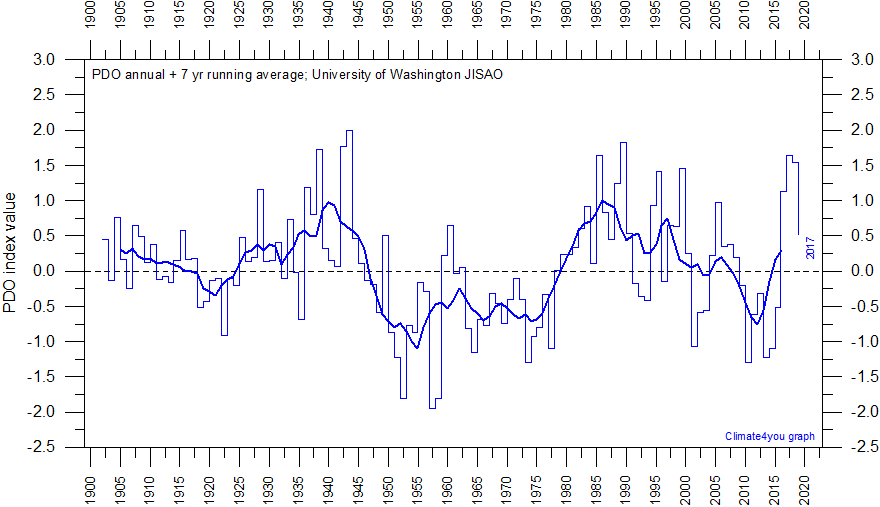
I included Fig 2 because an approximate 60 year cycle is obvious by inspection and this coincides well with the 30 year +/- positive (warm) and 30year +/ negative (cold) phases of the Pacific Decadal Oscillation. Figure 2 shows warming from about 1910 – 1940-45 , cooling from then to about 1975 -.warming to about 2003-5 and cooling since then. Total warming during the 20th century was about 0.8 degrees C. For a complete discussion and review of the data relating the PDO to the other oceanic cycles and temperatures see
For latest PDO data see http://jisao.washington.edu/pdo/PDO.latest
IT IS CLEAR THAT WE ARE IN THE EARLY STAGES OF A THIRTY YEAR NEGATIVE (COOLING ) PDO CYCLE.

3. Check Solar Activity – where are we at?
The major ice age climate cycles are controlled by the sun – earth orbital eccentricity,and the earth’s obliquity and precession. These cycles are approximately 100,000, 41,000 and 21000 years in length respectively and are well documented in the ice core and geological record. It is useful to keep in mind that the warmest temperatures in the current interglacial occurred about 7500+/- years ago and the GENERAL TREND IS NOW A COOLING TOWARDS THE NEXT ICE AGE.
Fig 4 http://colli239.fts.educ.msu.edu/1999/07/11/vostok-1999/

These long term cycles are modulated by quasi cyclic trends in solar activity which may be decadal ,centennial or millennial in length.Of particular interest in deciding where we are with regard to the solar cycles is the approximately 1000 +/- year cycle which produced succesively the Roman Warm Period, the Dark Ages,the Medieval Warm Period, the Little Ice Age and the recent 20th century warming.
Fig 5 (From http://www.theregister.co.uk/2012/07/10/global_warming_undermined_by_study_of_climate_change/ )

The red line shows the continuing cooling trend from the Holocene optimum and the 1000yr +/- solar cycle is clearly seen.
NOTE – A REASONABLE CASE CAN BE MADE THAT THE WARMING PEAKS OF A 60 YEAR PDO CYCLE AND THE 1000 YEAR SOLAR CYCLE COINCIDED AT 2000 +/- AND WE ARE LIKELY ON THE COOLING SLOPE OF BOTH.
The clearest empirical measure of solar activity is the solar magnetic field strength. On an empirical basis Livingston and Penn have shown that the decline in solar magnetic field strength suggests that sunspots could disappear by about 2015 signalling THE START OF A NEW MAUNDER MINIMUM WITH SIGNIFICANT COOLING.
For a semi-empirical estimate of the possible cooling if a Maunder Minimum does develop see http://pubs.giss.nasa.gov/docs/2001/2001_Shindell_etal_1.pdf
Note the abstract of the Shindell paper (Mann is one of the et als) says “THIS LEADS TO COLDER TEMPERATURES OVER THE NORTHERN HEMISPHERE CONTINENTS ESPECIALLY IN WINTER (1 to 2 C), IN AGREEMENT WITH HISTORICAL RECORDS AND PROXY DATA FOR SURFACE TEMPEERATURES
“For a good review of the latest sunspot and magnetic data see
http://wattsupwiththat.com/2012/09/03/the-sun-still-slumping/ and to keep with the decline in solar magnetic field strength and the liklihood of a Maunder Minimum check monthly the Livingston and Penn thread at
http://solarcycle24com.proboards.com/index.cgi?board=general&action=display&thread=855
Perhaps the best indicator of the effect of the declining solar magnetic field can be seen in the Galactic Cosmic Ray flux.
This can be checked on a daily basis at http://cosmicrays.oulu.fi/#database
Fig 6 Neutron count since 1964 from the Oulu data base.

The Dec 2009 neutron maximum ( solar cycle 23 -24 minimum) is greater than anything seen previously and the neutron count is now (Nov 2012) higher than at any comparable time in previous cycles since we are only 12 -18 months away from the cycle 24 solar maximum.There was a secular change in solar magnetism in 2005 – check the WUWT link posted earlier. The neutron count ties to earths climate via cloud cover and albedo. Simply put – the lower the neutron count the lower the cloud cover and the warmer the temperature. Because of the enthalpy and thermal inertia of the oceans there is a 10 – 12 year lag between the neutron troughs and global SSTs. The short term temperature record is variable over shorter times than 12 years because of El Ninos and La Ninas and volcanic and lunar effects but the increasingly lower counts on the three troughs from 1970 – 1991 are well matched by the temperature rise from 1981 – 2003. THE RELATIVELY HIGH NEUTRON COUNT IN 2012 COMPARED WITH 1970 SUGGESTS THAT BY 2024 GLOBAL TEMPERATURES WILL BE BELOW THOSE OF 1970 WHICH WERE ALREADY BELOW 2012 BY ABOUT 0.36 C.
4. Check the Southern Oscillation Index.
Fig 7 http://www.bom.gov.au/climate/enso/

In Fig 7 values above +8 indicate La Ninas, values below -8 are El Ninos and values in betwen are neutral or La Nadas.
Figure 7 also has some predictive value relative to global temperatures. ( Mclean et al JGR 2009) Global temperatures appear to lag the SOI by about 7 months.
5. Climate , Weather and Extreme Events.
Sections 1 – 4 above show that the earth has entered a cooling trend which will continue for at least 30 years and perhaps longer. To get some idea of possible extreme weather events we might look at extremes found between the MWP and the Little Ice Age. It is unlikely however that any future extremes will be “unprecedented”.There is a large literature on this topic which interested parties can consult.Some general empirical observations can be made.
On a cooling earth there is a steeper temperature gradient from the Tropics to the Poles. This produces instabilities with the jet stream swinging meridionally further south and north. Thus blocking high pressure systems develop with extremes of cold and heat and sharp temperature gradients between air masses with for example Sandy type blizzards or tornado swarms. A cooler world will be a generally drier world with increasing droughts globally and in e.g the USA corn belt and in the USA in general When combined with shorter growing seasons and possible early and late frosts this is likely to threaten world food production as population increases.
The PDO and SOI indices are the main ocean climate and weather indicators.Obviously ,for regional analyses at particular times, the phases of other ocean systems relative to the first two – for the U.S for example the AMO and NAO need to be considered. These are easily checked by looking from time to time at the work of the best climate and weather interpreters Joe D’Aleo and Joe Bastardi on http://www.icecap.us/
6.Summary of some Future Trends and Policy Suggestions.
The empirical observations highlighted in CAPITALS above indicate that the global warming temperature trend has peaked .The peak is broad with only a little cooling to date but this will likely accelerate from 2015 or 2016 on reflecting the beginning of the increase in the cosmic ray count already seen from 2004 – 2009 in Fig 6. The cooling will last until 2030- 2040. Often the signal for a climate direction change is a see saw effect between Arctic and Antarctic sea ice. The Arctic is still reflecting the peak in the warming trend with low summer ice values.
The first indication of a cooling event is however the increase in Antarctic sea ice which has already occurred.
This alters the oceanic deep water circulation patterns and spreads the cooling world wide. The Arctic ice will begin to catch up in a five years or so.
With a cooling world sea levels will stop rising and begin to fall as glaciers and ice caps begin to increase and the oceans compress with cooling.Eventually the rate of CO2 increase will slow and may even reverse even if human emissions continue to rise .
Because the error bars in our rough estimates of natural temperature variations are larger than any possible
I plotted the whole series. This series is already using the modified numbers with the “cooled past” right? So, even with the cooled, past, the last dozen to 16 or so years seem to have deviate from the “follows CO2” mantra. Can anyone tell me if this is the new and improved NOAA data??? Are they going to cool, 1998 through 2005 to show we are still warming?
Massimo PORZIO says:
November 19, 2012 at 4:19 pm
Personally, I have a hard time believing the summers will be quite that cold.
I have a simple question.
What is the level of accuracy (confidence level as a %) for the global temperature used for 1860 in the various data sets?
Just curious………
Well, we will be cold. Our machines and systems will need to be modified to function properly in the cold temperatures. We will need to adjust our agricultural and live stock practices. However, barring a “green” revolution, we should have the energy and resources required to survive and even prosper during a general cooling.
The best part is that we will not be subject to mindless extortion for purposes of redistributive change and to artificially advance politicians, scientists, and activists political, economic, and social standing.
No. Wait. They already changed the marketing platform to focus on climate “change”. It seems they have configured the system so that we lose whether the winds blow cool or warm.
@ur momisugly OssQss: you wrote: “What is the level of accuracy (confidence level as a %) for the global temperature used for 1860 in the various data sets?”
The level of accuracy must have been very high indeed. They had super duper mercury thermometers calibrated at two points using boiling water and ice bath’s at sea level. According to the numbers they use, the must have been good to within 0.0001 degree… so that would be +/- 100 millionths. Sorry I know that’s not what you were asking, but I could not resist.
And, to top it all off, the rate of change of CO2 is almost perfectly correlated affinely with temperature, which means that human inputs are rapidly sequestered and have virtually no impact on atmospheric concentration. Not only is the global temperature metric careening toward the cliff, but we aren’t even sitting near the front of the bus, much less at the wheel.
At least, in the future, we will be able to restrain the hubris of politicized science simply by making reference to the Great Climate Change Fiasco of the early 21st century.
Bart says:
November 19, 2012 at 5:53 pm
The missing link.
OssQss says:
November 19, 2012 at 5:29 pm
“What is the level of accuracy (confidence level as a %) for the global temperature used for 1860 in the various data sets?”
Probably not very, but please don’t adjust it! Oh, wait…
Mario Lento,
Thermometer accuracy is not important in determining a trend. The same mercury thermometers used for the past several centuries in compiling the Central England Temperature record show a steady warming trend, which has not accelerated in modern times. If the thermometer’s accuracy is off by a degree or two, it will still show the long term temperature trend.
Despite a rise in CO2 from about 280 ppmv to today’s 394 ppmv, the long term global warming trend has not accelerated. Conclusion: CO2 has no measurable effect on the global temperature.
mitigatedsceptic says:
November 19, 2012 at 5:24 pm
Has there been any explanation/excuse for IPCC not being invited to Doha?
>>>>>>>>>>>>>>>>>>>>
They are a lightning rod for the science discussion, and they don’t want to discuss the science. Without them in the room, any tough questions about the science don’t result in scientists stuttering and fumbling for answers. The science is settled will be the answer, now let;s move on to strangling freedoms and economies.
But there’s another game afoot, and that is to move many of the important agenda items to another forum, mainly the MEF (Major Economics Forum). Watch for the alarmist proposals to be slid in through the back door at the MEF just like carbon taxes in the US were slid in the back door using the EPA.
The MEF doesn’t get near the coverage in the first place, economics is just not that exciting a thing to report on. This appears to be the brainchild of the Obama administration. Get the discussion out of the public eye, away from the NGO’s, and slide an agreement in pieces through the MEF with the world the none the wiser.
The good news is that China will tell them to p*ss off, as will Russia, India and Brazil. Canada and Japan will both use that as an excuse not to do anything either. But don’t cheer the impending death of the Doha round because what we have to fight now is worse: a deal being done that the public doesn’t know about and isn’t immediately obvious as a “climate deal” but just as damaging in the long run. Backroom politics at the global level is not a good thing.
logiclogiclogic says:
November 19, 2012 at 4:54 pm
Me? I don’t know. Add that as theory four..
DaveE.
The changes to the jet stream that am seeing are pointing towards climate cooling.
Because the jet stream is making bigger movements towards the north and the south, means it will end up flowing over a larger area of the earth’s suface. Which is very likely to lead to a increase in cloud cover.
Also with this greater movement it will allow the increased risk of letting winter bed in early over the NH landmasses.
Stephen Wilde says:
November 19, 2012 at 4:20 pm
“I notice though that the writer supports the cosmic ray link to cloudiness whilst acknowledging greater jetstream movement…”
On the jet stream business, wouldn’t a quiet sun mean less UV heating of the stratosphere and therefore less poleward movement in the stratosphere? This would mean less Coriolis force and less swirl in the polar vortex, so that the cold air masses would simply flow down the continental interiors instead of mixing randomly in systems that progress west to east? This fits with recent work that indicates that continental interiors are especially cold during intervals of quiet sun.
There seems to be a growing understanding in the wider climate science community that temperature increases have been driven mainly by CO2 and natural cycles with volcanoes and sun spots playing a lesser role. Examples are:
– The posting by Tallbloke mentioned above,
http://tallbloke.wordpress.com/2012/10/23/the-carbon-flame-war-final-comment/
– The modelling work on my own site:
http://www.climatedata.info/Discussions/Discussions/opinions.php
– The paper by Zhou, J., and K. Tung, 2012 (mentioned here recently).
The thrust of all these papers/postings is that CO2 and natural cycles influence climate (expressed as global mean temperature) by a similar order of magnitude. Tallbloke favours 30% CO2 but up to 50%, I go for 50% +/- 10%, Zhou and Tung go for 50%. If this is the case, the implications are huge.
1. Half of the rapid warming at the end of the last century was natural. The IPCC models assume it all was. They are therefore out by a factor of two. However many nations and international organisations have made countering the impact of the high predictions part of their energy strategy. (Only yesterday I sent a link to a new World Bank paper looking at a 4 °C temperature rise). It will be difficult to reverse this momentum.
2. I don’t imagine many of those behind realclimate.org and kindred sites will find it easy to admit that only half the warming was anthropogenic. On the other hand, many contributors to this site would find it equally hard to admit that only half the warming was natural. In short, few of those who have taken polarised positions would be comfortable with a CO2/natural balance. The fact that the narrow IPCC related climate science community is pushing extreme events suggests that they may be aware of this and are developing an exit/transition strategy which will enable them to keep the grants rolling in.
The next few years are going to be interesting.
We’re all going to freeze!
We’re doomed!
Dr. Page’s analysis and conclusions are consistent with mine, as from my speech in April 2012 to chemical engineers in Lis Angeles.
Transcript and slides are at:
http://sowellslawblog.blogspot.com/2012/05/warmists-are-wrong-cooling-is-coming.html?m=0
We are extremely ill-prepared for the coming cooling. Part III of the speech, “Implications”, describes some of what we can expect. We must have policy changes very soon to meet the challenges ahead.
Some of us have been saying this kind of thing for a long time now. We must remain true to our principles and one of them essentially says correlation is not causation. Admittedly just as tempting for skeptics like me as it is for the AGW believers. Just a little philosophical reminder.
The experts of climatology have been insisting that cycle do not occur naturally.Hence the linear response of their models.The cycles apparent in the data are just noise, after all, are we to believe the govt provided experts or our lying eyes? If I thought CO2 was a potent warming gas I would be planning some major burns real soon..
logiclogiclogic says:
November 19, 2012 at 4:54 pm
The agw enthusiasts are admitting that 20 years would be only A 2%
chance event and likely prove the agw theory to be essentially dead as
is. So a couple years should pretty much decide this. I will
disregard that they’ve said forever that an 8 or 10 year pause was
fine but 15 would be the death but now we’ve got 16 or 17 flat and
they believe 15 is not that remarkable so they want another 5 years.
==============
In a couple more years they will say 20 years is not significant, another 5 is needed. No amount of time will ever be accepted as having falsified AGW. The 20 years of rising temps before the current leveling were taken as certain proof that AGW was correct, thus any evidence showing it is not correct must be false..
Only a month and change until the big whammy! 🙂
Dr. Norman Page writes: “I included Fig 2 because an approximate 60 year cycle is obvious by inspection and this coincides well with the 30 year +/- positive (warm) and 30year +/ negative (cold) phases of the Pacific Decadal Oscillation.”
The PDO is inversely related to the sea surface temperature anomalies of the North Pacific over decadal timescales so there cannot be cause and effect based on the PDO.
ogiclogiclogic says:
November 19, 2012 at 4:54 pm
For many reasons it seems likely there are 3 possibilities of merit
that can happen from here regarding climate theory….
These 3 theories are all at a critical juncture….
The time for endless debate is over. Now the dice are cast and I
think nature will tell us the answer over the next year or two.
________________________________
Actually if the natural cycles theory is correct you will see changes.
1. From a El Niño dominated ENSO to a La Niña dominated ENSO.
2. The jet stream going from zonal to meridional
We are already seeing the results of the jets going meridional, blocking highs, Sandy and the cold waves I listed in an earlier comment today link.
Looks like the Northern Hemisphere snow cover is off to a good start according to NOAA. State of the Climate Global Snow & Ice October 2012
mitigatedsceptic says:
November 19, 2012 at 5:24 pm
….They will still be trying to stop carbon emissions when they are skating on the Thames and the Rhine.It is reported that the consequences of winter of 1708-9 included 600,000 deaths in France alone from starvation by 1710.
What is to be done?
______________________________________
The deaths have already started.
Hypothermia deaths double over five years
More than 2,500 people in England and Wales are likely to perish from cold in the week leading up to Christmas, experts said today… estimated 40,000 more people die between December and March
In 2008 there were food riots in over thirty countries.
If as some think we are headed into another ‘little Ice Age’ I would not want to be a professor sitting in a college in a big city when (Not if) the food riots start.
US Foodstamp Usage Rises To New Record High
According to Shadow Statistics the real unemployment rate rose from ~21% to 23% since Obama took office. But that is alright Obama is going to give us Obamacare, remove all those pesky Coal plants and tax us some more.
Even worse Something unimaginable has taken place in the US where a handful of soldiers tried to stage a coup in the US.
I am not sure the Ivory Tower types realize they are playing with fire when they move people out of their comfort zone into third world conditions for a trumped up reason.
If you want to stay true to español, try Las Niñas, Los Niños, and Las Nadas.
The other side already pulled a CYA by saying there could be a cooling period after which the climate would rapidly shift back to the predicted behavior according to models. Thus, they gave themselves another decade or two of wiggle room. Except, the public will not buy it.
Indeed, energy is the central factor driving our opportunities for the future. It is incorrect to say we are running out of energy. We have many centuries of fuel in hand now.
The very important point made about birth rates should not be overlooked. LIfe on the planet will be better with a high per capita energy consumption economy. Think Star Trek. That’s sooo much better than the Tijuana life world-wide. The other side tries to sell a Little-House-on-the-Prairie mythical future of low per capita energy consumption. Well, here’s that little house:
http://www.kansastravel.org/littlehouseontheprairie.htm
Now tell me that’s where you really want to live.
OssQss says:
November 19, 2012 at 5:29 pm
I have a simple question.
What is the level of accuracy (confidence level as a %) for the global temperature used for 1860 in the various data sets?
________________________
A.J. Strata has done that analysis. link