Guest post by David Archibald
Robert Hargraves lives in Hanover, New Hampshire. Mr Hargraves believes that “Global warming is harming us all.” Using the temperature – solar cycle length relationship from Friis-Christensen and Lassen theory, for cycles 24 and 25, this is what Nature has in store for Hanover, New Hampshire:

So the coming years will be a severe test of his faith in the State-sponsored belief system.
In the meantime, he has done the World a good service by writing a book which describes why Liquid Flouride Thorium Reactors (LFTRs) are the solution to maintaining a high standard of living when the fossil fuels run out.
He starts the book by describing the basic physics of energy and then goes on to rehash IPCC material on global warming. Sometimes authors let slip, by their pronouncements, that they don’t have a good grip on the physical world. One of the better examples of that in Mr Hargraves’ case is this passage, ”Changes to life in the ocean will also be dire. Ocean life thrives in cold water; Caribbean water is blue and clear because it has less life than temperate and polar oceans.” Brian Fagin is another warmer author who betrays a lack of understanding of the physical world; in a number of his books he has describes arrow heads as weighing 1 kg. At any rate, on reading this sort of thing, the reader is alerted to not take any statement as being necessarily true.
The useful part of the book begins on page 115 with a discussion of the costs of existing energy sources – coal-fired power at 5.6 cents/kWh using coal at $45 per tonne and natural gas-based power at 4.8 cents/kWh using natural gas at $5/MBTU. Wind is far more expensive at 18.4 cents/kWh. Using pumped hydro storage to pacify it for the grid would add at least another 6 cents/kWh. Solar power is much the same cost at 23.5 cents/kWh.
Discussion of nuclear power begins in Chapter 5 on page 176. LFTRs will operate by having neutrons from the reactor core irradiate thorium in a blanket, converting it to fissile U233. That U233 is periodically rinsed from the blanket salt and fed to the core. Power from LFTRs is expected to cost of the order of 3 cents per kWh all up. The LFTRs will need a starter fuel at the rate of 1 kg per MW. The best source of that is the more than 72,000 tonnes of spent fuel rods that has accumulated in the US. That contains at least 648 tonnes of plutonium which is enough to start more than 3,000 200 MW reactors. Those spent fuel rods that have accumulated over the decades are a precious resource.
There is an interesting section on China’s LFTR project starting on page 260. China’s interest was triggered by an article in July 2010 in American Scientist. A delegation visited Oak Ridge National Laboratories where molten salt reactor work was done in the mid-1960s. The Chinese LFTR project was announced at a meeting of the Chinese Academy of Sciences in January 2011. Oak Ridge had 1,894 Chinese visitors in 2011! The project currently employs 432 people, expected to rise to 750 in 2015. A working 2 MW (t) reactor is expected by 2017 and a 10 MW (e) by 2020. The Chinese reaction to that July 2010 article reminds me of John Boyd’s OODA loop. There was a mere six months between reading an article and committing to a major new thrust in nuclear research. The contrast between that and the billions spent in the West on recreating medieval fear and superstition, and calling it climate science, could not be more stark.
This book is also comprehensive. A section on synthetic liquid fuels and how they might be made using nuclear power starts on page 355. It is realised that sources of carbon might become so scarce that the cheapest source might be carbon dioxide extracted from the atmosphere. A scheme to do that is illustrated on page 361. This is ironic in a book that asserts that carbon dioxide is the scourge of Mankind.
King Hubbert, of peak oil fame, realised that Mankind’s fossil fuel use would only be a blip in time and that the future, of necessity, will be nuclear-powered. This is Figure 30 from his 1956 paper “Nuclear Energy and the Fossil Fuels”:

Mr Hargraves’ book has updated that insight and added flesh to the bones of the idea. His book is a useful addition to the comity. He is also to be lauded for self-publishing it. My edition is simply marked “Made in the USA; Lexington, KY; 09 September 2012”. The book’s website is: www.thoriumenergycheaperthancoal.com It can be purchased from Amazon.

===============================================================
Below is a video describing the concept. Long, but informative – Anthony
Just for the people spreading some FUD about David Archibald’s rethoric, here’s your opportunity to hear him talk. Couldn’t find the particular interview mentioned. At an anti carbon tax rally in 2011.
Candu expands cooperation with China
“Candu nuclear technology has the potential to make a major contribution to reducing China’s dependence on imported nuclear fuel resources by utilizing abundant domestic thorium resources,” according to Jerry Hopwood, AECL’s vice president of product development. He added, “This signing marks the initiation of an important step to demonstrate the use of thorium fuel in commercial Candu reactors.”
http://www.world-nuclear-news.org/ENF-Thorium_use_in_Candu_units_to_be_assessed-1507095.html
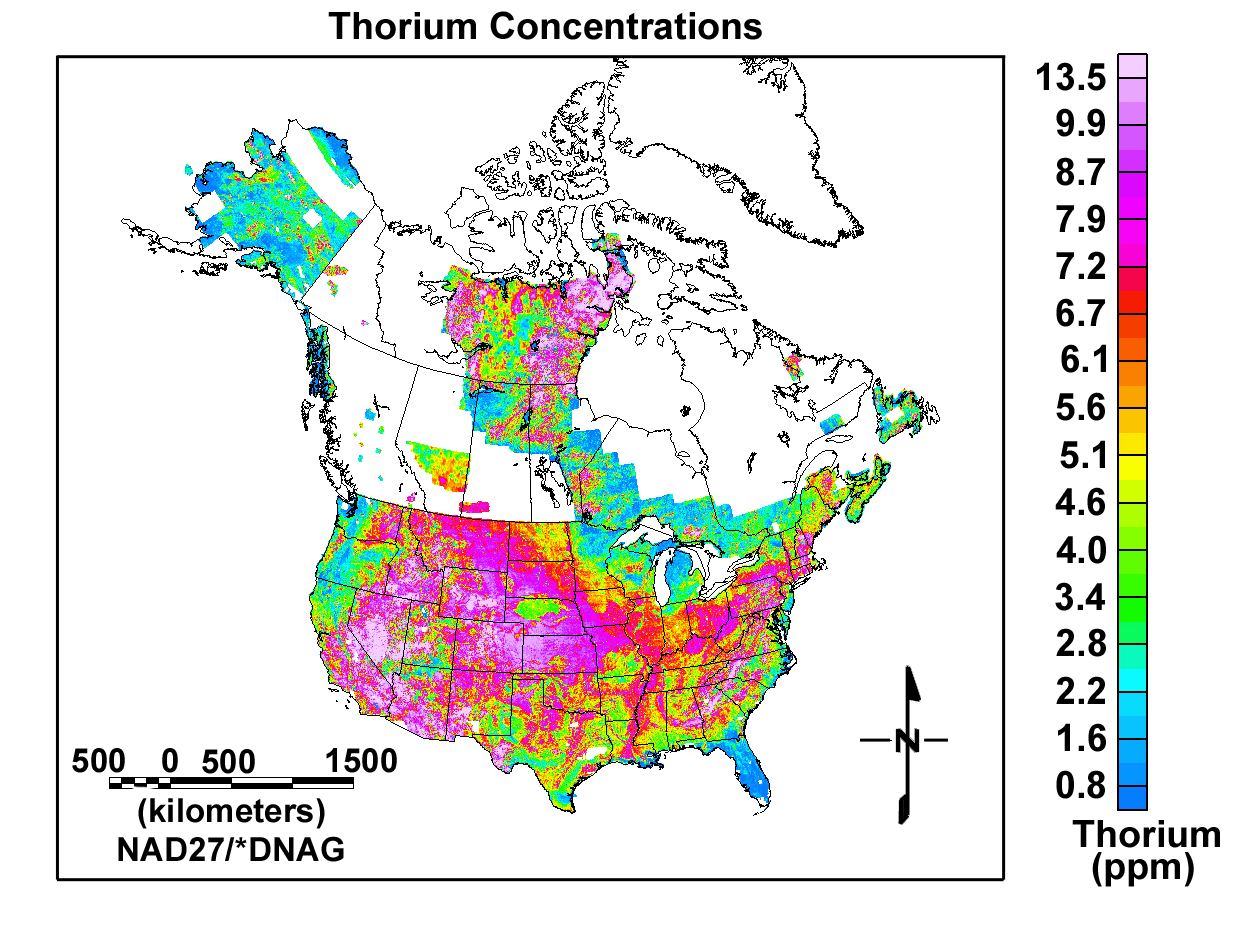
The map of Thorium abundance is misleading. All elemets would display the same pattern, more or less..
“That sounds like biblical language to me. I can’t imagine anyone discussing science with that kind of language.”
Well, obviously you just did. So what is the problem with that kind of terminology ?
David Archibald says:
October 3, 2012 at 12:12 am
Don K says:
October 2, 2012 at 7:13 pm
While theoretically possible to build a bomb using U233, the U232 in it makes it very difficult in practice. Nobody would bother when it is much easier to make ones from plutonium.
——————————-
I agree that it’s unlikely that any country that had the technology to isolate U235 would build a bomb with U233, I suspect that if Niceragua or Albania or any of 120 or so other smaller countries really wanted to build a nuclear weapon and had Thorium reactors, they might decide that the engineering problems of a U233 weapon were less of a challenge than that of separating U235 from U238. It’s shouldn’t be high on anyone’s list of concerns I think, but I submit that the common assumption that Thorium technology CAN’T lead to weapons is probably wrong.
Folks are using “Thorium Reactor” as a synonym for “molten salt” reactor. It isn’t. You can make traditional reactor designs using Thorium just fine. The company named Lightbridge makes fuel bundles with thorium that can be used in traditional reactors (in licensing tests for Russian reactors last I looked).
http://ltbridge.com/technologyservices/fueltechnology/thoriumbasedseedandblanketfuel
India has used thorium in various reactor types as proof of concept. As it needs a high neutron source to get it started breeding, and them being short of Uranium, they started with building Uranium reactors to breed enough Pu to form the seed of Th breeders. It’s more a ‘time to make the starter fuel’ issue than a “can’t do thorium easy” issue.
The USA made a thorium reactor as one of our very first. Pebble bed with U driving Th breeding to U233.
BOTH the USA and India have made nuclear bombs from U233 and /or ‘non weapons grade Pu’ (ours was part of the “Teapot” tests IIRC. MEC?) There is NOTHING to prevent using Th to breed U233 to make bombs and at minimum the US has done it. (Who knows how many more). U233 is about the same as Pu in terms of being really good “boom stuff”. (Yes, you need to avoid leaving it too long in the cooker and getting too many hot isotopes…)
IMHO, it was the realization of just how easy it is to go from Th to U233 to a bomb that caused the USA to spend so much time stressing how Th ought not be a fuel…. At the same time they heavily dissed the CANDU (which does great on Th) so I suspect that a heavy water reactor does that conversion ‘nicely’ (but that is speculation on my part).
http://nuclearweaponarchive.org/Usa/Tests/Teapot.html
This was a 22 kt yield core, less than the 31 kt from the Pu core planned, but still plenty…
Indian tests:
https://en.wikipedia.org/wiki/Uranium-233
” In 1998, as part of its Pokhran-II tests, India detonated an experimental U-233 device of low-yield (0.2 kt) called Shakti V.”
http://nuclearweaponarchive.org/India/IndiaShakti.html
https://en.wikipedia.org/wiki/Thorium
It’s just not hard at all to use Thorium in all sorts of reactor designs. The Molten Salt option is just one of many. It may be great, or it may take 100 years to develop and license, but Thorium can be used in our other reactors anyway, if desired.
Bruce of Newcastle says
Second, the problem with LTFR’s is the engineering. As a guy who has direct experience with molten salt systems and many other halide systems they are a source of much engineering angst and failed processes.
————
Thanks for that practical experience. I have made the same point previously just based on theory.
feet2thefire says:
October 2, 2012 at 9:36 pm
“The money needs to be allotted to make this happen. Here in the USA. The Chinese are willing to take the ball and run with it. THAT ALONE should be a huge clue that we’d better get off our butts and get going. Yes, we could jump in later, because it would still behoove us to do so, even then, because of all our stored Thorium – but if all the patents go to the Chinese, we would be sucking hind teat for a VERY long time. But we would get cheap energy, either way. It’s just that we would be at the mercy of the Chinese if we don’t get in the ballgame NOW. All it takes is money and will. And stop being stupid and stop listening to people yammering and just take a flyer on getting it to work. It IS only an engineering problem.”
Steve Garcia
========================================
Patents are valid for 17 years. The U.S. has proven energy reserves for 100s of years. Your urgency is political, not “an engineering problem.”
“The Chinese are willing to take the ball and run with it. THAT ALONE should be a huge clue that we’d better get off our butts and get going.”
Mr. Obama used this to justify spending on Solyndra, et al.
@Bruce of Newcastle:
CANDU can easily use Th. In fact, there are many potential fuel mixes and cycles:
http://www.ccnr.org/advanced_fuel_cycles.html
So everything from burning up HE bomb materials to ‘self sufficient’ once started up. And lots of points in between. As the CANDU has online refueling, you can gradually introduce Thorium into some channels and as the U233 builds up, move on to the next channels.
More technical coverage here: http://www.nuclearfaq.ca/brat_fuel.htm
In 2009 they planned to do it in CANDU in China:
http://www.world-nuclear-news.org/ENF-Thorium_use_in_Candu_units_to_be_assessed-1507095.html
Nice picture of CANDU omnivorous fuel cycles with Th in the lower left quadrant:
So basically anywhere there is an existing CANDU reactor, you can start burning some Thorium now, and a whole lot more over time if desired. (pending all the mandated approvals and committees and …)
Similarly, the Lightbridge style fuel bundles can go into our existing light water reactors (Russian was being certified first due to them being faster than US in approvals process; but US reactors or European just as easy).
Not quite “drop in replacement” as the core needs more care in where neutrons are produced, absorbed, and U233 breeding happens, but not exotic either. Somewhat more fiddling with the fuel bundles in terms of which go where when, but not too bad.
There’s somewhere around 3 x to 5 x more Th than U and it’s easily found concentrated in Monzanite sands and as a ‘contaminant’ in Rare Earth minerals. There’s a large beach of the sand on the Florida Georgia border and mountains of it in India. Australia has a fair pile too.
http://www.ga.gov.au/energy/uranium-thorium/thorium-resources.html
Note that those are in thousands of TONS of Thorium. It is likely more than that as folks are not exactly looking for the stuff. Mostly thinking it a contaminant in other ores…
A couple of million tons of Thorium is a lot of fuel…
https://en.wikipedia.org/wiki/Thorium
has a couple of interesting points. I thought I remembered Shippingport, but it looks like it was only one of the cores:
Also that couple of million tons is based on a low price. At higher prices, more is available:
So basically we run out of Thorium when we run out of granite… or sea water… but we’ve got a few thousands of years worth of really cheap and easy stuff to use up first…
White it is fine to lust after the MSFBR nothing stands in the way of just fueling up the existing reactor fleet with Thorium (other than dirt cheap Uranium…and licensing approval)
MattN says:
October 2, 2012 at 6:25 pm
I do not understand why the US is not ALL OVER thorium reactors by now
Fuel cycle infrastructure will have to be built as well. It’s not just the cost of the actual reactor…it’s the cost of everything that goes with it. If you build 100 of them then those costs are reasonable,
The first LFTR was built and run at Oak Ridge. It ran without any problems for, I think, 10 years but may be 6 years but it did run for a good time. The concept was cancelled due to the refusal of GE to use the technology because there was no money in it. Current PWR’s need to be refueled at regular intervals. GE et al provide the reactors at cost but charge an extreme price for the refuels. Keeps the bottom line healthy.
There is more thorium around than any other nuclear fuel. Uranium is a scarce commodity with rising prices. No such problem with thorium. LFTR’s are also much safer than PWR’s since they run at atmospheric pressure. PWR’s run at very high pressures to keep the water liquid at the temperatures they run at. Hence that big containment vessel needed in case there is a failure within the system.
There is a lot of info on the web, just search LFTR.
AS an aside- the rare earth problem in the US, ie buying these metals from China, is because the rare earths minerals contain thorium which is mildly radioactive. The EPA prohibit their extraction because of the thorium. If there was a use for thorium in the US then the rare earths would also be available. The US currently has more rare earths than China so the use of LFTRs would cut imports from China of rare earth minerals.
I ran across this link about a year ago. I don’t know when it was updated last. But I like seeing a side by side comparison, it makes organizing the info a bit better…
http://debatepedia.idebate.org/en/index.php/Debate:_Thorium_based_nuclear_energy
Using the above link initially brings up a window at the web site asking if you want to use the new debatepedia, select No. I didn’t find the Thorium link on the ‘new and improved’ site.
I’m happy enough with the idea of liquid thorium reactors (and have been for some time, although I’m not certain that the technical obstacles have all been surmounted to the point where the system is ready for prime time). Their primary advantage is that they are almost impossible to melt down — if a runaway reaction starts the system simply melts a plug, draining away the liquid salts, and everything slows/stops (if I recall correctly). Also, they are more difficult to use as the basis of nuclear proliferation — U-235 and plutonium are bomb material, the former absurdly so (you can make yourself a dirty and somewhat inefficient but still creditable “nuclear bomb” with two subcritical pieces of U-235 if you simply hammer them together as hard as you can with your arms).
I disagree with other things in the top article, however. The very first figure — what is the left hand scale, degrees Farenheit? On what basis should we believe the projections on the left? Bear in mind that a common skeptic complaint, well founded, is that theoretical models used to project global temperatures suck. The F-C model is not only a theoretical model, it is a one-dimensional model (devoid of any known/computable physical basis, basically curve fitting and extrapolation). In a nutshell it says “we’re about to start a Maunder Minimum, therefore global temperatures will return to LIA temperatures last seen in the LIA”. It assumes direct coupling between solar state only and global climate.
Sure, maybe. But the rational basis for the argument is weak, to say the least. The initial state of the planet is hardly the same as it was in the late 16th century. Global climate is a highly non-Markovian process and generally evolves slowly under the influence of drivers we do not fully understand, playing “catch up” to some elusive dynamical equilibrium state on top of a chaotic turbulent tighly coupled set of enthalpy reservoirs with different time constants. The problem is hard, yet you present a simple graph and blithely assert it to be true. As a true skeptic, I doubt it. It would be interesting if it turns out to be true, but at the moment it is at best a hypothetical model prediction, and one with somewhat flimsy physical basis, no better than that of the IPCC and in certain ways, probably worse.
I’d go on — solar power installed on individual dwellings currently pays of its own cost in roughly 13 to 15 years, falling, in most of the US, less than that in certain parts with high insolation and local power costs (costs that are often driven by the costs of delivery, not production). What does it cost for solar power connected to an individual dwelling that kicks surplus back into the grid, paid off in 13 years but in production for 20+? Would that be “it makes a profit”? It would. Presuming that the cost of solar cells continues to drop to less than $1/watt installed full retail (as it is projected to do) by the early/middle of the next decade, amortization times will drop to 7-8 years for individuals, 4-5 years for corporate power producers, and there will be a massive rush to build solar plants while solar power will become standard roofing for all new construction — wrapped right into your original mortgage, your house will be cost neutral for electricity over decadal time scales (at which point it will be even cheaper and more efficient to upgrade and repair or store the surplus for your own use instead of relying on the grid). Engineering in 20 years will obviously be a lot better than it is today, especially with money to be made driving it.
Thorium for better or worse is same old same old. Huge generating plants, expensive distribution grid, relatively scarce and mined and toxic/radioactive fuel. And in the meantime, one of these decades they will very likely succeed in making fusion work and it will be the end of the game, as nothing will compete with fusion and we have millions of years worth of deuterium to burn in the oceans, let alone minable deuterium in abundance in the solar system if it comes to that.
These latter points are the ones that ultimately make even the worst case CAGW scenarios moot. We are in the last two decades of human existence where burning mined organic material will make the slightest bit of economic sense (although I expect we’ll continue to burn natural gas to cook, heat homes and water, and will continue to burn gasoline and diesel to run cars at least until we come up with batteries that can store the equivalent of 35kWh per “gallon” of storage volume. Anthropogenic CO_2 production will peak in the next decade or thereabouts, and thereafter decline. Liquid thorium plants will certainly contribute to this (as will more Uranium plants, if we ever get off of the stick and start building them) but they are at most a stopgap measure that is IMO destined to be obsoleted almost before they really get going.
rgb
I’m a huge fan of Thorium – particularly LFTR, which offers the option of using effective gas turbines. Start building reactors today, I say!
One thing: Compared to all other costs, the costs of Thorium and fuel processing are (for the amounts needed) essentially zero. Unlike conventional nuclear power, which needs highly processed fuel, you need to invest once in the LFTR reactor, and then it only needs some maintenance over the reactor’s lifetime (whatever that will turn out to be). So the marginal cost per kWh effectively becomes zero (or very close to zero).
Hurray!
Now, we already had some industries were marginal costs dropped to zero: Music, Movies and Print.
Oh.
Combine that we the perspective that until Thorium is rolled out on a wide scale, energy prices will continue go up, for various reasons, but mainly because the world’s energy demand is rising fast, and more costly energy sources have to be tapped to satisfy the increased demand.
What could happen is rising energy prices, and then start to plummet once Thorium gains traction.
Now, I don’t know how it will play out, but I would not be the slightest bit surprised if we end up living in “interesting times” as the Chinese say.
But rgb, will solar panels ever produce enough energy in their lifetime to both manufacture themselves, all inclusive, *and* supply years of energy to consumers? Will they ever become energy neutral? Maybe so if they become both printable and durable.
Also, I don’t put much hope in fusion. Instead of making plants smaller and smaller, those installations would be huge best I can tell.
See where I am coming from? Liquid salt reactors produce enough temperature to manufacture enough energy to clone themselves, start to finish, fuse carbon into hydrocarbons, produce fertilizer, various chemicals, desalination using the waste heat, etc, etc let alone electrical generation. Don’t think even fusion holds all of those characteristics at a small enough scale to be feasible and inexpensive and distributed.
Of course, I am taking a thousand year view.
Thorium IS the energy of the future: It’s safe, abundant, reliable, zero CO2 emissions (nice selling point for political, not scientific reasons), it’s cheap, E=MC2 beats F=MV2 by a factor of many millions, 99% of fissionable material turned to pure energy and remaining Uranium 238 is in great demand, it’s been proven to work, takes up very little land area, doesn’t lead to nuclear proliferation, would reduce dependence on Middle East oil (which is about to implode), many by-products of reactor are in high demand for medical and commercial purposes, construction costs are relatively low and soon recouped from energy and by-product production, doesn’t need a containment system because it runs unpressurized, safety mechanism is passive and fail-safe, the processing of some Thorium ore yields much needed Rare Earth Metals, Thorium is as abundant as Pb, a golf-ball sized chunk of Thorium is sufficient to provide ALL your energy for your entire life, it can actually use existing nuclear waste as a neutron source and convert it to pure energy thereby resolving our existing nuclear waste problem, etc., etc., You get the picture…
A number of concerns listed in comments here are simply urban myths. The salts in LFTRs are very corrosive and existing high quality Nickel steel is sufficient to contain 800C liquid Fluoride/Thorium salts.
LFTR technology WILL be the world’s next energy source. All it takes is the will of a few politicians to establish an approval process for development/deployment/standards and the first reactor could be up and running in 10 years; perhaps sooner WITH PRIVATE CAPITAL, not public funds.
There are many corporations and individuals willing to invest a few billion dollars to create a multi-trillion dollar industry.
The only thing preventing this from happening is the political will to ALLOW this technology to be developed.
And so it goes….until it doesn’t…..
Whatmenaresayingaboutwomen Jay says:
October 3, 2012 at 4:32 am
“That sounds like biblical language to me. I can’t imagine anyone discussing science with that kind of language.”
Well, obviously you just did. So what is the problem with that kind of terminology ?
==========================================================================
“Coal trains of Death” is much more sciency sounding.
From what I’ve read, the principal advantages are less waste, improved safety, 300-400 year half-life of the generated waste, ability to switch them On and Off at will, and availability of the fuel.
Do LFTRs extend the reactor’s commissioned life span? The problem with reactors, we would need to build them forever because they are decommissioned ever 40-50 years and we’re about to decommission a substantial number of our reactors by 2025.
The Life Span of U.S. Reactors
http://www.businessweek.com/magazine/nuclear-power/
Related to new “Generation IV” reactor designs:
Perhaps the farthest-out design comes from a spinoff of Intellectual Ventures, a company headed by former Microsoft (MSFT) chief scientist Nathan Myhrvold and funded in part by Microsoft co-founder Bill Gates. TerraPower, as the spinoff is known, used massive computing power to design a reactor that could run for decades on an isotope of uranium that is today considered waste. The concept, first proposed in the 1950s, is to set up a slow-moving wave in which neutrons transmute inert, nonfissile fuel such as uranium-238 into fissile isotopes such as plutonium-239 that can split and throw off energy. TerraPower says its spent fuel would not be useful for making weapons. The company, chaired by Gates, has been seeking a production partner and a host country. So far, no takers.
http://www.businessweek.com/magazine/content/11_14/b4222070137297.htm#p3
unrelated but very cleaver:
Nasdaq recently posted an interesting Navy approach for supplying jet fuel to ships at sea.
US Navy Develops a Technique to Produce Jet Fuel from Sea Water
Read more: http://community.nasdaq.com/News/2012-09/us-navy-develops-a-technique-to-produce-jet-fuel-from-sea-water.aspx?storyid=177559#ixzz27mOqXYay
Estimated Tons of Thorium Recoverable at up to $80/Kg
http://blogs-images.forbes.com/williampentland/files/2011/09/thorium.jpg
From this story
http://www.forbes.com/sites/williampentland/2011/09/11/is-thorium-the-biggest-energy-breakthrough-since-fire-possibly/
David,
The temp history of Hanover is a proxy of the global temperatures, I agree, but the quantum is quite different. Cut and pasting Hanover onto the State of Hampshire is reasonable, and the Canadian-American wheatland border area, which is what you have addressed in the past, is also reasonable, but more subdued. The Contiguous US vs Hanover, and then the Northern Hemisphere vs Hanover and then the Global All Measurements vs Hanover shows that when when Hanover goes down 2.0C, the globe goes down much less.
I did the analysis crudely, and got something like 2C at Hanover means 0.4C in the world (I forget, and my analysis is at home, where I am not). So significant, yes, and a disaster for the IPCC narrative, yes, but not a return to an ice-age that some might interpret a 2C drop to create (as it would if this were global).
Perhaps you could post a series of Hanover vs Everywhere else. The Skeptics and Warmists alike are concerned about CAGW in the world, not particularly in Hanover, though I gather it is a nice, stable place with an excellent history of keeping meteorological records.
As for the warmists, skeptical authority leads to credibility leads to trust: if you can make the local vs global connection, it will become a speaking point for the doubters.
Some useful points for reference:
(1) The CANDU reactor was designed in order to use natural uranium. Canada could not afford the expensive enrichment technology developed by the United States. Graphite reactors can also use natural uranium. (And if you think uranium is rare, consult the nearest granite countertop. See the black specs? Pitchblende.)
(2) The fissile transmute of thorium is U-233, which does not undergo spontaneous fission and therefore does not produce neutrons for a startup process. Th-232 has a very low spontaneous fission rate. This is why thorium reactors need a bootstrap process to start up.
(3) Containment has nothing to do with pressurized coolant. The Chernobyl reactor used graphite moderator and had no containment. How well did that work out? There was a similar accident at a CO2-cooled graphite reactor in Windscale, UK, many years ago. Containment is an entirely prudent safety precaution against uncontrolled release of radioisotopes.
(4) Only a fraction of a percent of the fissionable mass is converted to energy. Be thankful for that.
(5) Don’t hold your breath awaiting fusion power. The fusion reaction produces 14 MeV neutrons, which cannot be harnessed for power and transmute the structural materials of the reactor. Although no waste products are produced from the actual reaction, massive quantities of structural waste will have to be removed from such reactors on a regular basis. (This “first wall” problem was well understood in the 1970s, when I learned it from my graduate lab director.) Moreover, we seem to be no closer to meeting the containment conditions for self-sustaining reactions. The reality is that “fusion power” is the rubric under which the government conducts research into the physics of thermonuclear reactions. That knowledge is used elsewhere.
Thorium is a perfectly acceptable nuclear fuel, and my attitude about nuclear fuel is “burn, baby, burn.” But it is a transuranic element and produces the same fission products as uranium and plutonium, which are the direct consequence of the fission reactions. Creation of transuranic isotopes is a by-process, and most of the transuranics are fissionable. The “problems” of conventional uranium reactors can be dealt with by sensible policies (like fuel reprocessing) and existing alternative reactor designs, instead of whole new technologies. The point is: whatever arguments have been used to stymie current nuclear power can and will be employed against thorium molten-salt reactors. Do not imagine that the enviro-nazis will accept any technology that promises the production of copious, inexpensive power.
Global Warming is not harming us all. The UNIPCC AR5 will confirm this. For instance, wheat yields will increase in Northern Europe, and large areas of the Arctic Tundra will become forest.
http://manicbeancounter.com/2011/10/03/climate-change-impacts-in-ar5-%E2%80%93-it-is-better-than-we-thought/
On his slide titled “Power Generation Resource Inputs” (t=12:41) he says
Wind
460 MT steel per MW (average)
I’m not a wind powe advocate, but that has to be wrong, surely?
rgbatduke says:
October 3, 2012 at 7:02 am
I agree in entirety with your first few paragraphs, thereafter we disagree. I think we can agree that Thorium is now a problem of technology, much of which is already solved. it’s now down to best available technology and that is an engineering problem.
One of the arguments against LFTR that I’ve seen is that although it has been demonstrated at a small scale, can it be scaled up? I’m all for relatively small scale distribution grids with some interconnection but safeguards in place to trip the interconnect on fault conditions.
Relatively scarce? Who’s kidding who here?
I am minded of when I.C.I., (Imperial Chemical Industries,) used to just burn off the waste, ie what we see as fuel, petrol, (gasoline,) and diesel.
Is Thorium mined, toxic and radioactive? yes. It’s also currently waste product to be disposed of.
,
Still twenty five years in the future, same as in the 50’s. Not saying it won’t happen, it’s just always been the future. Perhaps some conspiracy theorist can come up with a reason for that; maybe Paul Ehrlich is behind it. 😉
You didn’t mention all the Uranium & Thorium in the sea I note.
DaveE.